SAD

Sometimes you can sense some sort of lethargy this time of year revealing itself in blatant ways, like not wanting to go to work, not filling out some forms or editing some article, not bothering to return important calls completely out of a sense of avoidance, as if you might be able to wait long enough and all of this will pass—this stuff that brings you down, and to be honest, you’re not really sure what that stuff is. The idleness of society maybe, the constant sense of impending doom reported in all forms of media about democracy, about pandemics, about weather, about climate, about the economy, about depression and isolation. You have no reason to take any of it personally, but some people can’t let it go, and it weighs heavy, so you aim for avoidance, which unfortunately ends up a heavier burden.  

Sometimes the withdrawal is subtle. You can sense yourself not trying as hard or caring as much, like eating whatever is around instead of thinking it through, not going for a walk because you don’t want to be bothered putting on a coat or dealing with any sensory change. You’re sitting; you’re comfortable, and you’re numb. It works. 

Numb is good.

In both situations you are absolutely aware of it. Going for a walk helps. Filing out the forms, returning calls, all help by providing a sense of accomplishment and forward motion, like checking things off the to-do list, it leaves you with the hint that if you keep going there’s something worthwhile on the other side.

There’s the rub. It seems you keep reaching the other side and there’s still nothing there to lift the spirits, not this season anyway—more hostility in the east, more pessimism in our government, more variants on deck ready to step to the plate after Omicron smacks a triple into right field, and fires in LA so out of control it’s hard to watch or imagine. So you try a little less at one task, and it spirals from there. You realize your handwashing time has dropped to about 12 seconds. It’s not depression; it’s, well, yeah, it’s depression, but not in the deeply caving sense; in the “whatever” sense.

The problem with this type of malaise is it can be debilitating to you without being scary to others if you are not suicidal. The truth is, the vast majority of people who deal with depression are not contemplating suicide and will never kill themselves, which is what most friends fear most, and when those friends learn that is not part of the equation, they feel better. But that can often make it worse since the objective is for you to feel better, not them. But that’s fair since you know what they don’t: that a different suicide exists, a slow erosion of sorts, which anonymously eats away at ambition and accomplishment, takes the edge off of energy and momentum. It’s the guy sitting at a bar nursing a beer, nowhere to go despite having a million things to do. It’s the one on the park bench watching people walk by but not noticing a single one of them; it’s the inability to concentrate, the disinterest in listening, the short responses to questions, the inability to make it through the most basic of activities. It’s writing endless emails about nothing to others in some attempt to reach out; but that just backfires. Rational thought has nothing to do with it. “Knowing” what to do is not relevant. Your mind is suspended, your thought process withdraws into some elementary state.  

On the one hand it’s situational—financial problems, relationship problems, blizzards. But it can also be chemical if you don’t have medical help. It’s addiction without restraint. It’s a combination of these, and it is unpredictable because the same thing that leaves you in bed staring at the ceiling feeling hopeless can drive you to your feet to tackle whatever it is that left you prostrate to begin with. It is a conundrum that plays handball in your brain.

The guy at the bar with the beer, the woman in the park, the man at the river watching the tide roll out, all know exactly what the problem is. But their brains are aflush with fog, their anxiety has disabled their decision-making capabilities, and their strongest assets and most celebrated talents that normally keep them going the rest of the year, are no longer applicable since they carry a sense that those traits are probably what brought them to this place to begin with. They sit and wonder what if. They sit.

“Maybe if I had just…”

“Perhaps I should have…”

“Fuck it.”

At some point it seems you stop fighting altogether and are either not afraid to hit bottom, or you hope to use that bottom to bounce back, not afraid to fail since it can’t be worse than this. It is extreme but that is part of the diagnosis—extremes, polar reactions—sometimes both in one day. Sometimes within one hour.

More often than not, the guy on the corner holding the cardboard sign didn’t “decide” to quit, didn’t give up, but “felt” a pressure that he no longer could handle or define, caught in some stream of disconnect and hopeless confusion. Sometimes the one who does, in fact, tragically go that last fatal step didn’t “decide” to do anything at all, and that is the point. Suicide is not a decision. It is one step beyond decision making. The vast majority of people who deal with depression have that in check, less so in the dead of winter, of course.

But that’s not you. Truly. And that is the problem; you really aren’t suicidal at all. And when suicide is not part of the equation, others feel that you must be “okay,” or “going through something right now.”

Yeah, winter, you’re going through a snow bank. This is the worst time of year for many people with depressive issues. Seasonal Affective Disorder is real and feels like all of the above. Nothing helps but time, but time to some people sounds like the slow drip of icicle melt. Others say you’ll get over it, it will pass, hang in there, talk to someone. Yes, all of the above, but right now–right this minute–you need help and you don’t know it.

Other people try to help so they talk about the weather or sports or anything at all with enthusiasm and a sense of caring, but it often makes it worse, only emphasizes that others get excited about the minutia while you can no longer find value in a sunrise.

And the disguises are nothing short of cunning. I’ve known people fighting depression who on the outside resonate as the very poster image of Carpe Diem. I’ve been friends with people who contemplated overdosing on Monday while making plans for Tuesday, who loved others more than the average soul but only wanted their puppy nearby at checkout time, and people who fought depressive ways by pushing adventure to the limit, and beyond. “What a lust for life!” people exclaimed. They had no idea.

It isn’t exactly depression, by the way, though it is easier to simply call it that because it certainly wears the same eyeshadow as depression. It is indifference; it is a vague inability to muster the energy to lift your spirits enough to give a damn about anything. It’s not like you woke up depressed so you decided to stay on the couch all day; you simply don’t care that you’re on the couch to begin with. Complete apathy. You’re not down about anything; you answer “fine” because you really are fine; fine’s a fine word; vague and indifferent. It has the definitive weight of a horse shoe and the value of fog. “I’m fine, really,” should never be left alone with a person who fights depression.

Ironically, for most of these afflicted people, life is amazing, every half-beat is a moment of “miracles and wonder” which is why you cannot comprehend the misuse of time. The abuse of time in so short a life, you think, is as suicidal as the abuse of substances, and that can be depressing as well.

It is the time of year when you wake at three am knowing nothing is going to work, and you’re going to lose your house and your sense of security and no answer makes sense, no way forward seems rational. Equally, the dawn can come with new ideas and hope, and if you push those moments far enough into the morning, you just might be able to make a day of it. But January has 285 days. And February is several months long. March? Well you well know that March is merely a tease. April comes and breathing is easier. May, and nothing stands in your way. But in January it is safe to say yet difficult for others to understand that May hasn’t even been invented yet. It doesn’t exist and neither will you by then.

On the outside you seem to be fine. On the inside you’re grasping the thin rope of enthusiasm with clenched fists, pretending all will be well, but your insides—much against your will—are shredding at the thought of what to do next.

You “hang in there.” You “get through it.” You suffer the trite suggestions of others who simply can’t understand what the big deal is. That’s okay though, you think. Really. There are no solutions, per se. Just more questions. And “hang in there” is at the very least an acknowledgement you really aren’t trying to dismiss your very existence; it just happens sometimes. Depressed people do not feign depression; they feign contentment.

This afternoon I went to the river where a bitter breeze is pushing down from the west. There’ll be ice tonight somewhere, and snow, but I sat reminding myself I have been there, touched that ring of undefinable despair, and I’ve moved through it, sometimes with difficulty, often with ease, always with the knowledge that I’ve had one freaking incredible life so far, and time enough left, I hope, to continue my pilgrimage well into the next mood swing. But there are moments, collisions with frustration at the gap between the way things are and the way things should be, that catch some people off guard. “You’ve been like this before,” a dear friend told me not long ago when things were less than fine. “And you’ll be like this again.” And all you can think is, “Yes I will, like right now.” But what she meant was this is you, this is part of your DNA, this is as much you as your skin. What she meant was there is no “fighting” the tigers that come at night. Better to sit and dine with them, and wait. Just wait.

And Eventually you remember that the seasons, like everything else, change. And love is holding the other end of that thin line you’re grasping.

I’ve been released
And I’ve been regained
And I’ve been this way before
And I’m sure to be this way again
Once more time again

–N. Diamond
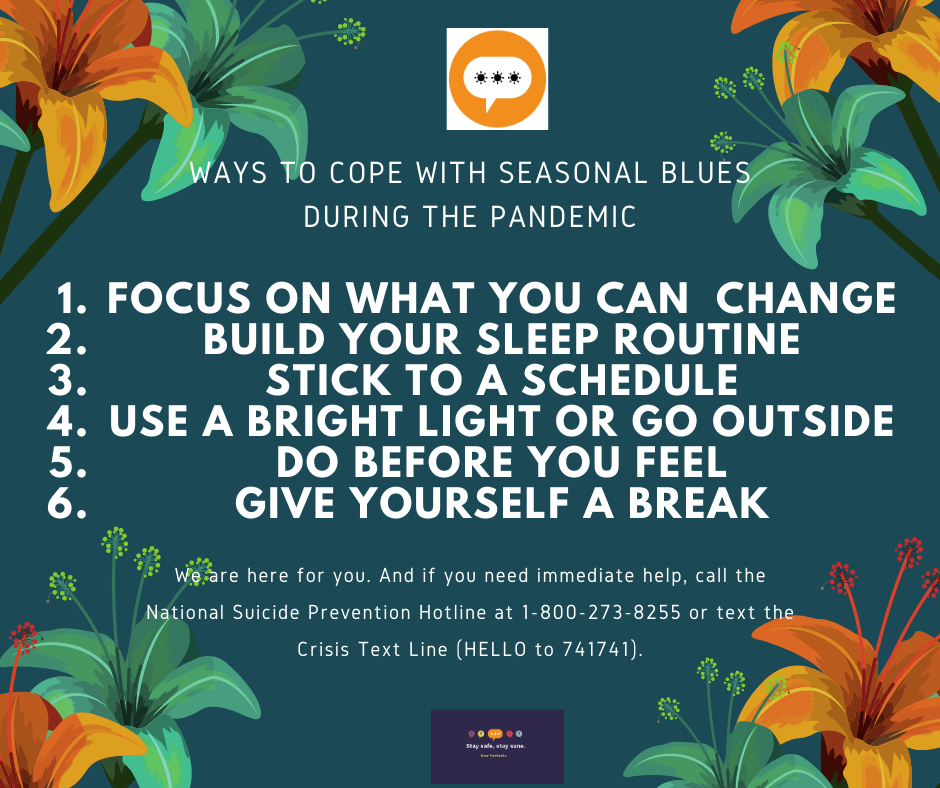
First the COVID-19 pandemic, now winter….is seasonal depression coming my  way? — Dear Pandemic

For Those Who Stay Behind

Note: This is a very serious one. Read. Share. Forgive. It’s all we’ve got.

This is for Dave W, Bobbie B, Bud D, Tricia K, and the one’s who live with those unseen wounds which simply won’t heal.

***

A broken limb is obvious. A cast, a sling, a set of crutches or even a knee cart, and people can see the problem, understand the delays and compromises. We move aside or assist in any way we can.

What happens when someone injures their mind, breaks their thought process, when a person cracks their perception of reality and ration? The world is quick to judge the results of some unseen wound festering in their frontal lobe. “They’re lazy,” we say; “They’ve given up,” we say; “They keep asking for help and I’ve had enough,” we say. No one replies to the unfortunate soul with some walker, “No, sorry. I’m not helping you anymore.”

Well, in both cases the likelihood of one asking for help is pretty slim anyway.    

Monsters such as depression, anxiety, and nervous breakdowns can destroy a person’s ability to function. People can’t think as clearly so they lose jobs, they make bad financial decisions and lose money and property. “They could have done something else; they could have sought help from a professional if that was true,” we say.

And when nothing makes sense anymore and the world is too much with them and there is absolutely no meaning in anything—when numbness overtakes the idle sadness, they find a way out.  

The truth is suicide is not always the result of depression; it is not always a person simply giving up. In fact, it is often seen by the psychologically afflicted as the perfect solution. It is not doing harm; it is solving problems. The mind no longer functions the same as others’ minds. If they even want to ask for help, they don’t even know what it looks like to ask for anything in particular, so they seek solutions on their own, like sleep, like cutting off contact, like shutting the brain down for good. It is not life they fear or wish to escape; it is their mind. It is a difficult task to escape one’s own thoughts.

“There is medicine for that,” we say.

Not really. Sure, there is medicine to help someone cover up the wound, like a Band Aid, but the sore doesn’t heal as much as it is buried. The infection will return as soon as

well 

as soon as it rains, or when the next call comes from a creditor because they can’t work enough to keep up, or, worse, when a call doesn’t come any longer from friends and they suddenly remember they were better once, and they won’t be like that again. But even that’s not accurate since they simply are like this now, and apparently always were, and the moment it happened is an allusive memory.

Because while in the movies when someone has a nervous breakdown, they flail their hands and scream, cry, and someone might slap them, tell them to snap out of it, in reality that’s not what happens. The truth doesn’t play well on film. In reality they say nothing. They might drink, of course, or become addicted to some pain reliever, some vice that keeps their brain in the moment like alcohol or other self-defeating measures that keep their mind from dwelling on some past or future attack, but they might just as easily sleep all day, or more likely not sleep at night. They try and work but the ability to focus is gone; not ignored or delayed—the actual part of the brain that helps them do work or see a reason to exist at all has a hole in the middle of it, the circuits are infected and surrounded by puss, but no one can see that, so it can’t possibly be anything other than “a phase,” “laziness.”

Later, afterwards, people say they didn’t know, “They always seemed fine.” “I thought they were going through something.” “They said it was no big deal.”

They say, “I wish they had asked for help.” They say, “I did all I could.”

They say, “What a shame.”

Indeed.

Did Hemingway have another novel, Van Gogh another masterpiece, Robin Williams another routine for the thousands of kids he used to visit in hospitals?

Depression and mental illness often caused by a mental breakdown can cause lives to rip apart, and the only explanation they have when they ask for help again and again is “I’m trying.” And eventually that simply isn’t good enough no matter how much they are loved. They live out on the fringe, they hold signs, they sleep on grates. Likewise, they live in country houses and city apartments. They seem to try, they try to seem to fit in.

Maybe if they wore a cast, had sutures across their forehead. We like to see problems before we help solve them. We don’t offer help to people when we don’t know they’re suffering; how could we? Unless we know them well.

And that’s the problem. No one knows them at all. They’re funny and outgoing. They make light of serious situations. They can work a room. So they either never ask at all or, when they do so too often say “I need help,” it is difficult to see how. “Again?” we reply. “Why now?” we ask. The thing is in a few days they will not even remember they ever asked for help to begin with. This is true; the compromised brain actually blocks that out completely. To us they can either be absolutely silent or seem constantly desperate; but to them it just happened.

Here’s the problem:

How can we find that line between someone who really needs help and someone who just needs a bit more tough love? What do we do if there is no visible “mistake” that needs correcting? What do we say when they say nothing at all, or if we do ask if they need help, they say, “No thank you, it’ll be fine,” more out of a notion of being too embarrassed to say yes. Too ashamed. They’d rather…what?

They’d rather die. To be sure. I remember a phone call early one morning when I just didn’t want to hear it again. I remember a visit from someone who needed more than I could give. I recall calling once and the phone kept ringing. I’ll never forget that one.

Where is the line between knowing whether we helped enough and we could have done more?

Honestly, it runs right down the middle of the rest of our lives, and we walk it aimlessly, hoping we made the right call, that there was nothing we could do. Even if we’d rather be on the side of foolishness, helping people way more than they probably deserve, we can’t ever know.

So we call and talk, stop by, we get them to laugh because apparently we think laughter is the best medicine.

That’s not how a nervous breakdown plays out. Trust me on this one. But there is no Habitat for Humanity that helps people rebuild their minds. So they lose everything: their homes, their families, their purpose. And there’s not a damn thing we can do about it. Well, sure there is, but the place between knowing and not knowing is dark and difficult to navigate.

So. What do we do?

We forgive them for finding a solution the rest of us thinks is foolish. We forgive them for believing that the pleasure found by watching their kids and grandkids grow, watching another sunset with someone, laughing at lunch with friends, still isn’t worth the pain—the constant and debilitating pain—that comes constantly to infect their mind; constantly, day and night. Even their dreams are saturated with pain.

Forgiveness for something we do not understand is a monumental task. But then for some, so is life.

If you need help, Call 988 immediately.

If you know someone who needs help, Call them. You don’t have to know what to say. Say anything.

If you are living with the memory of someone you feel like you could have helped more, it isn’t your fault. It isn’t their fault. Forgive them. Forgive yourself.

Remember what we learned as toddlers: How would we want them to react if it was us? What would we want them to remember if it was us?

Not everyone is fine. It’s that simple.

Bob Kunzinger writes the weekly blog, A View from this Wilderness, which premiered in January 2016, and is the author of eleven books, including the forthcoming Office Hours, as well as hundreds of articles in national and international publications. He lives in Virginia.

I Never Needed Anybody’s Help in Any Way

I heard an interesting comment on NPR last week. When talking about someone who died by suicide, the victim’s brother said he didn’t think his sibling didn’t like life anymore as their mother had suggested, but just didn’t like one particular part of life, and somewhere over the course of time—maybe weeks, maybe months or longer—the poor man hyper focused on that one aspect until it became a monster, blocking his view of any other aspect of existence remotely salvageable; even the finest reasons to continue were saturated with the pain of one part, perhaps even a small part, of life.

On the one had it made their mother feel a bit stronger—that her late son did not despise life, and in particular perhaps not the life she and her husband had built for them, but one thing happened, who knows what, and that overtook him despite the beauty around him. He couldn’t see past that monster any longer, and in his then-compromised view, nothing else existed any longer. Life became about the pain-inflicting monster, so killing oneself seemed the only clear way to end the pain.

On the other hand, for those who still know someone with some form of depression, particularly situational depression and not chronic or manic depression, being able to unearth and understand that aspect of life which has the potential to take over a person’s mind can help isolate it and, over time maybe, destroy it. At the very least the knowledge of the issue might help others keep it in perspective, perhaps even eliminate it.

The surviving brother then, almost off-handedly, said, “I wish we had gone hiking more.” No one picked up on it; at least not on air. But I did. It slid right in my thought process and simmered all day. His brother must have been considering how things might be different if he had helped replace the monster with something more powerful, more soul-owning. For them, apparently, hiking. Had they gone enough times, or consistently enough anyway, for the deceased to have discovered that hiking was his life and he now could own that choice, his routine and whatever negative issues came up—a problem with a partner, finances, even simple malaise that chronically depressed people will never be able to explain—would be minimized by the power found in something positive.

It doesn’t have to be hiking. Could be music, sports, food. But something active, something visceral and kinetic.

I asked my students the other day how much time each day do they spend watching other people live their lives or pretend to live life. That is, how much time are they stagnant viewing other people’s happenings on tv, movies, TikTok, etc. I’m not talking about going to events like sports or lectures or the like. No, those are very participatory. I mean the dead-brained observation we do that when we’re done—or better stated, when we take a break–we are exhausted, and we never did a damn thing.

The suicide rate among college-aged students is about 2 percent, about 1100 per year, and about 25% know of someone who killed themselves, and just over that percentage thought about it themselves, all of them offering as their primary motivators pressure, helplessness, relationships, loneliness, and money.

It takes just one issue to debilitate a person, make them feel hopeless, and all the time in the world trying to balance it with positive acts cannot extract that monster from the mind, and eventually ration slides away so that suicide is not a conscious decision but in itself a rational act to eliminate the pain, which by that point is all there is.

And later people say they wish they knew, they say they would have helped. The man on the radio said, “He asked for help; we told him we had helped him all we could and he had to do this alone.” He was riddled with guilt, but then realized that the way he could have helped may not have been clear to either his brother or him at the time. One just assumes the help one asks for when in a bad place is the only way to help them out of that place, but that’s not always accurate; in fact, it is often hardly ever accurate. “I just should have been there more, called and asked how he was doing more, had lunch,” the brother added. Exactly.

Yes. He should have, but not because of his tragic loss, but because we are humans, responsible for each other, and I am so guilty of not being there for others it is disturbing. I can change that, but there are some things I cannot change. We can at least change the things we can. I’ll leave the wisdom part for someone else.

I guy I knew a long time ago told me a story about a friend who couldn’t see past a bad relationship, a mentally abusive relationship, and saw no way out of it, particularly since they just had a baby girl. In all other aspects of his life he was okay, very giving, impossibly kind to others, but he felt he had nowhere to turn. His mother ignored him, his father tried to help but without emotion, making it difficult. And he thought his friends had moved on. One morning the troubled one called a friend, but the friend didn’t answer the phone. The friend was pretty sure he knew who was calling and that he was probably depressed, but he didn’t want to deal with it at that moment. Three hours later the guy I knew called to tell him that the troubled one killed himself. He told the friend that the widow told him his last outgoing call was to the friend. He thought it would make him feel good to know the dead guy was thinking of him, probably missed him. He had no way of knowing that the man had ignored that very call. I knew these people; and it is easy to say there was nothing anyone could have done, but that simply isn’t true. We just tell ourselves that. Certainly we may not be able to save someone’s life, but we can save some time for them. It’s a tough call but an easy decision; make the call, stop by, go for a walk. Grab some tea.

Give them a reason.

We are here for each other. It’s all we have. We are only here for each other. We can’t save others if they don’t want to be saved, but by trying to help others we just might end up saving ourselves.

Breakdown Dead Ahead

This morning I woke up about four from a dream so real I looked around the room expecting to see people from a place I used to work; people who just a few deep minutes earlier were sitting next to me in intense discussion. I sat in bed aflush with images of standing in hallways, sitting in my office, standing before classes, walking from building to building; or the early days out in portable buildings, walking to the market with my officemate for lunch.

My heart raced and my breathing became labored and shallow. My BP spiked and my mouth went completely dry. I got up and headed out to the river where the water found my resting pulse. Some seabirds dove for breakfast, and I watched an osprey carry a fish to a nest. Dolphins swam by. The dolphins don’t know about my dream. The osprey might.

With a nod to Jason Isbell: Maybe it’s time to let the old ways die.

I rode that train for almost thirty years, one-way, full speed. When I disembarked, it took me some time to get my bearings; I still can’t always find my balance. Usually I can forget that period of my life, but when I remember incidents, or, like last night, when I wake up awash in the past, I shake.

It is difficult to explain.

There’s nothing from that time I need any longer, and nothing to gain from remembering. It has taken me five years to figure this out, always assuming that since I spent so much time—literally half my life—wading through those murky waters, it must be essential to carry at least some of it forward. But no—and this is where one can get their money’s worth out of therapy: Simply, no. Nothing. Oh, of course at the time the paycheck and benefits, the ability to travel the world on someone else’s dime, all worked for me. But that inner-core sensation that I’m “contributing” my “verse” to the bigger “play,” well, that never materialized for me, so thirty years of pouring oneself into the same bucket with a hole in the bottom is quite discouraging. Don’t misunderstand me; it had serious advantages over nearly every other profession. This isn’t about that. In fact, I still do it somewhere else, and I love it. It was there. It was then. Some people who try and remind me I did some good, had a positive effect on some people, and should be proud of that period, are missing the point. I know what happened; I was mostly there at the time. It is irrelevant. Like watching your favorite baseball team score six runs in a game but lose ten to six. Yes, remind them of how great they did scoring the six runs; then step back.

This is about the self-preservation necessary by living a life which outpaces the past. Sometimes—granted, not always; in fact recently I wrote fondly of my time at a health club in New England where I know I had a positive effect as well, and about where I wish I would have a vivid dream, of course—but sometimes there are no glory days and there is no sense of melancholy. Sometimes those tethers simply tug at the scars, open old wounds. You have to let it go. It’s not always an amicable separation; sometimes it’s a reminder of wasted time, and the best psychological recourse is akin to a bad divorce. Or, better, like you never met the person to begin with. Yes, that would be better—some dreams can kill.

The idea of “moving forward” is so simple and common that the axioms to do so are abundant, and they all are a variation of the need to “face forward” and “take small steps.”

Let’s go deeper:

A nervous breakdown in movies is nearly always represented as a person freaking out, flailing their arms, and screaming or crying or otherwise needing to be slapped upside their head. This makes sense since some visuals are needed. But the reality is a nervous breakdown can be as subtle as the rain. Certainly there can be “emotional outbursts and uncontrollable anger,” but more often it is what cannot be shown appropriately on a screen that dominates the symptoms: withdrawal, a sense of being overwhelmed, not wanting to interact with others, feeling burnt out, moody, low. Your self-esteem evaporates, you feel worthless and unqualified for anything, you make illogical requests, you assume nothing is going to work. You stop showing up. You make horrible, self-destructive decisions to the point that those who had faith in you lose their desire to help.

At first, after a major change, after that significant about face, what you do not yet realize is a nervous breakdown can come disguised as a welcome surprise. It is, in fact, similar to mania in that the person might feel overly optimistic.

Here’s how the experts break it down:

  • The honeymoon phase – The first stage of a nervous breakdown is referred to as the “honeymoon” stage and is particularly noticeable when undertaking new work responsibilities or initiatives. There are no warning signs of a nervous breakdown at this time. You are, on the contrary, enthusiastic and committed to your work. You are also highly productive and eager to demonstrate your potential in any way possible. If you do not avoid overworking or implementing effective strategies to deal with stressful situations and get enough rest, you will gradually progress to the next stage.
  • The onset phase – This stage is reached when you recognize that certain days are more stressful than others. You have insufficient time for personal needs, family, and friends. As you struggle to keep up with your stressful schedule and workload, your productivity levels begin to diminish. And you may begin to experience some mental and physical symptoms of stress, such as headaches, anxiety, changes in appetite, high blood pressure, and an inability to concentrate or focus. 
  • The chronic stress phase – Chronic stress sets in when you do nothing to manage the mounting stress of work or other commitments. As a result, your productivity levels decline, and you may start to feel overwhelmed. You begin to withdraw from social situations and exhibit symptoms of mood disorder. In extreme circumstances, some individuals may start to self-medicate with alcohol or drugs to escape their overwhelming negative emotions. 
  • The burnout phase – Burnout occurs when an individual has reached their limit and can no longer function normally. During this stage, you will neglect your personal needs and self-care and continue to isolate yourself socially. Along with other physical symptoms, headaches and fatigue may intensify. 
  • The habitual burnout phase – Those unable to recover from burnout and whose symptoms have become a part of their daily lives attain this level. This phase can have a detrimental effect on your career, relationships, and health and cause burnout syndrome or other long-term complications. Therefore, getting assistance as soon as possible is imperative if you are experiencing this phase of a nervous breakdown.

Usually comfort is found in extreme retrospect; that is, you look to times before the place of the fall, when that proverbial garden was still green and the metaphoric apple was still on the tree. You reach back for help from those you knew before all of that time, those without association.

And sometimes you get it, though usually not because there is an overwhelming urge in society to tell people it is a “phase” and they’ll “move past it.”

Ask them to do that to a soldier just back from war; tell them their issues are just a phase and they should move past it. How about this instead: listen. Tell them you’re there if they need you. Call them more than once to see how they’re doing, to talk about something completely present and benign.

Semantically, the words “nervous” and “breakdown” are deceiving because it isn’t the same “nervous” one feels when the roller coaster is clicking to the apex of the ride; it is an internal, simmering, indefinable nervousness more akin to complete and absolute helplessness so that even talking seems irrelevant. And it isn’t a “breakdown” in the category of the car no longer running because the starter is broken. It is more like a stall; all the parts are working, but you have a complete sense of an inability to move. You’re a deer in the headlights.

And often, quite dangerously, there is the overwhelming need to just end the thought process that fuels all of this.

Ask that soldier just back from war what their instincts are when they’re feeling this way. It isn’t to “talk about it” or be told anything at all. And the mere fact one might have to take drugs to get them through is a daily reminder swallowed with water that something is not right and any sense of hope is clearly synthetic.

So what is to be done?

Ironically, you accept that it was a phase you went through, and it is time to move on. You just do not, do not, absolutely do not want to be told that.

Because the dreams will come and you’ll see faces of people you used to eat lunch with, used to share an office with, and your depression with force you to wonder why you wasted so much time with people who couldn’t give a rat’s ass you ever existed at all. And that just fuels your sense of worthlessness. And the cycle begins.

Every single person has to decide for themselves how to deal with this. And no one can tell them how; even a therapist, though any therapist worth their weight already knows this and simply helps someone discover these things on their own.

It is as individual as your dreams.

If it were me? I mean, just speaking hypothetically here, but if it were me what would I do to somehow shed those deeply rooted and tightly clasped feelings of worthlessness?

My instinct of course would be to leave like I did throughout my twenties. Maybe I’d go back to Spain, or perhaps sail south on a forty-one foot Morgan Out Island named Pura Vida. Maybe I’d move to some mountains somewhere and go hiking. Yes, that would be nice too. That therapist worth their weight would somehow suggest that having plans like these, escape plans, is essential even though you know you’ll never follow through on any of it. That isn’t the point; the point is about possibility, about choice, about regaining that often taken for granted ability to make our own decisions, something that seems completely gone to a person with this level of depression and hopelessness. They need to feel possible.

It’s kind of like hope but not really. Hope implies some form of stagnancy, of waiting. It needs to be more kinetic than that, like saying, “Hey, let’s get an Airbnb in the Netherlands,” or “You know I think I’ll walk the same route this time instead of doing the Portuguese Route.”

Imagine a brain whose sense of “possibilities” has been extracted. Just for a moment, imagine a person who has not even a remote sense that anything good can possibly ever happen again.

That’s what we’re talking about.

And if you walk into any store today, anywhere, one out of every twelve people are feeling helpless. One out of every twenty completely abandoned.

+++

On the wall of an office I was in a few weeks ago is a poster of an open sky across some western vista. The quote from Richard Bach is one I remember from when I was young.

“Here’s a test to see if your mission on this earth is complete: If you’re alive, it isn’t.”

Too simple? Too elementary? Too, excuse me, pedestrian?”

Maybe.

But I saw the poster and thought of Spain, so there’s that.