This is Part One of a Five Part Series here at A View.
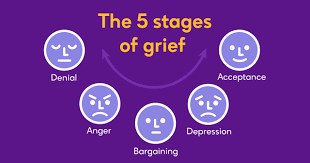
Psychologists teach us there are five stages of grief. Personally, I believe there are a few dozen, but I’m counting overeating, drinking, the gummy-chewing stage, the Marvel Universe binge-watching stage, and several others, but for the sake of brevity, let’s go with Elizabeth Kubler-Ross’ count-em-on-one-hand list of stages, from her book On Death and Dying (so right away we’re not in a good place).
The Fantastic Five: Denial, Anger, Bargaining, Depression, and Acceptance, or DABDA, as I just decided to use for sake of association.
First, here’s an AI generated overview before I slaughter them:
DABDA:
- Denial: A natural reaction to loss, denial can help people slow down the grieving process and avoid feeling overwhelmed. It can also be a way to try to understand what’s happening.
- Anger: A common reaction to the frustration of no longer being able to live in denial, anger can feel like an emotional outlet as people adjust to a new reality. It can also provide temporary structure and a connection to the person who died.
- Bargaining: People may try to change the circumstances that are causing their grief, such as hoping that things will improve if they take certain actions.
- Depression: A stage of grief
- Acceptance: A stage of grief where people find control and figure out how to proceed
PART ONE:
Denial:
I’m good at this—really in all aspects of life—but given the chance to forget that someone I love is dead, I’m all over it. This is most easily accomplished if you live a great distance from the deceased, or if you have had little contact over the years. Denial is convenient when you have a lot to do and thoughts of someone you love who recently passed or even not so recently slow you down. Kubler-Ross doesn’t disparage denial, but she does suggest it is best to move through it honestly. And I will, eventually. I understand it is simply self-preservation that I assume my father is at home watching golf (this one is hard to do since my mother no longer lives in the same place they did, so I am too aware of his goneness), Letty is visiting family in Italy, Eddie is playing blues in the city, Dave is misunderstanding lyrics at some coffee shop in Tampa, and Fr Dan, well, Fr Dan was already half in heaven to begin with. He’s not gone as much as he now plays the role of advocate. Richard made denial easy by his convenient disappearance from society and media several years ago. In my mind he’s home watching old Jane Fonda exercise videos.
It’s not easy to remain in this stage sometimes; there’s got to be a gummy that aides in denial.
But I see no reason we all can’t just assume those we love are off doing other things and they’ll be back in touch at some point. “It’s not healthy” Liz Kubler-Ross writes. Why? Why is it better to “accept” they are gone and won’t be coming back than it is to “accept” that they’re in Thailand playing Mahjong? It works for me, and I’m able to function properly without facing the reality that for the rest of forever, eternally foreverness, throughout the future of infinite time, I will never see these people again. They were here briefly; now they are gone.
“They’ve gone ahead,” people say.
“They’re in a better place,” people say.
“You’ll see each other again someday,” people say.
My mind holds onto that last one, yes, but not the way they mean it in some ethereal ghosty way. No. We’ll see each other again when they get back from Machu Pichu. I can’t wait to see their pictures.
Listen, I’m not dumb; I know they’re dead. Dave was in denial of death and told no one. Letty wasn’t crazy about it but moved toward it with class. Fr. Dan had no idea; neither did Eddie. Richard fell, so it’s doubtful he knew. Result: they’re not coming back, ever, and as Mr. Croce aptly pointed out: “Photographs and Memories, Christmas cards you sent to me. All that I have are these, to remember you.”
Yes, I know.
But grant that my considerably better mood and more focused work ethic come from an absence of acceptance of such significant losses.
I recently attended a writing seminar about grief, and the moderator—poet Anne Marie Wells from Northern Virginia—asked us to think about synonyms for grief for five minutes and write them down. To do so I had to briefly abandon my denial stage, but it seemed Kubler-Rossy, so I agreed. Anne Marie distributed a poem wherein the poet (not her) had synonyms for “grief” which were more personal than any formal understanding of the emotion.
I took the blank sheet of paper and wrote “SYNONYMS FOR GRIEF” at the top, slowly and neatly, OCDish, taking it slowly in an effort to eat up some of the allotted time. I started with the obvious: sorrow, misery, sadness, anguish, distress, agony, torment.
But I didn’t believe it. I couldn’t feel it in my stomach where true grief exists. I jotted down a few more: sadness, depression, helplessness. They felt empty. Dictionary words. Pointless.
I put down the pen and reread the poem. I looked at the clock and still had three minutes in the exercise. I stared across the library where the seminar was held, and I saw a guy at the computer with headphones on. He looked like my childhood friend, Eddie, who was killed by a car while walking out of work one night. I thought of Harry Chapin—a connection Eddie and I had.
I flipped the page over and tried again:
“Synonyms for Grief.”
Cats in the Cradle. Golf on television on a Sunday afternoon. Brussels in September.
La Vie En Rose (That one rips me apart. Grief incarnate).
Paul Simon songs. Seared tuna. Hard cider.
Wham’s “Wake me up before you Go Go.”
Black and white photographs. Change jingling in a pocket. Coors Light.
French accents.
Okay, so I wrote “French accents” fifteen minutes ago and went for a walk. My chest hurts.
Grief.
Grief sucks. It can be damn near suicidal. I get it Lizzy, I really do. It can also be cleansing; it can make us stronger, and yes, of course I grieve; I just did.
But denial is where it’s at. I’m running up to the post office and see if Letty sent a postcard. I might stop by the club to watch some golf, alone since my son’s traveling and Dad lives too far away. Then I’m going to finish the manuscript that was due last month about a friend of mine who is now living in a village in South America.
I just might be able to denial my way through the rest of my life. But that would piss Elizabeth off, and Anger is Stage Two. Some other time. For now, I prefer having nothing to be angry about.