The Rain that Day

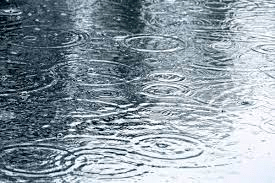
There’s a scene in one of the Hunger Games films where Jennifer Lawrence and Josh Hutcherson are sitting in the doorway to their house. The shot is from deep inside the room and we can see them almost silhouetted on the floor leaning against the door frame looking outside where a heavy, steady rain is falling. It’s summer or fall. The door is open yet and they seem comfortable, and it is raining. 

That image stayed with me. I want to call the director and say, “Well done,” you nailed one of the most comforting images I can recall–inside warm and dry away from the storm but close enough to appreciate it. 

I loved sitting on the patio when I was a child, under the canvas awning when it rained, and I just assumed it was raining everywhere, which at eight years old was probably a three block radius. What did I know of everywhere? But that closeness of rain never left me. In Spain on more than one occasion we donned our raingear and walked out onto the Camino to keep going, a heavy fog sometimes filled the air, and on one day near the village of Cee on the way back from Fisterra to Santiago, we couldn’t even see ten feet forward. But here I am eleven years off the Way and I remember that day as if I just walked in the door from the path and set my walking stick against the fireplace stones. 

What is it about the rain? 

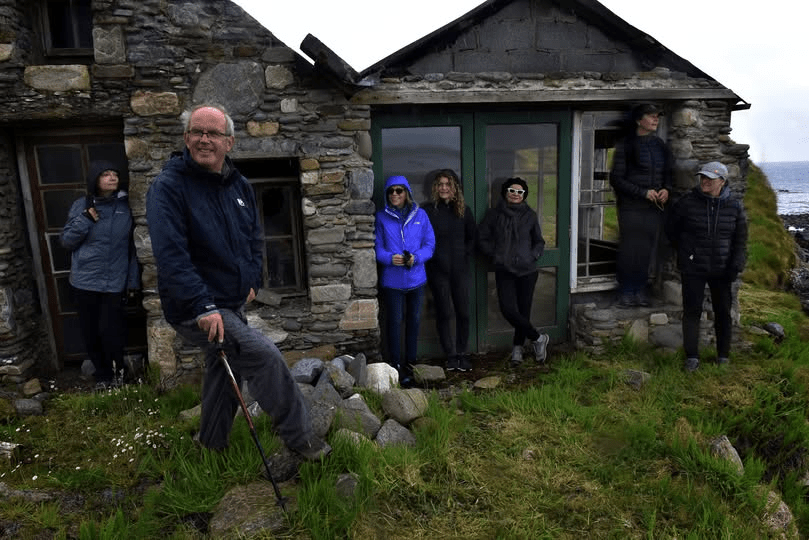
On a trip to Ireland, the only day out of ten it rained was the very day archeologist Michael Gibbons planned to give us a walking tour of the Renvyle Peninsula in Connemara just along the Wild Atlantic Way. We went anyway, along roads and across bogs for a half dozen miles, and sometimes it was only cloudy, but more often a steady Irish rain fell as more of a pleasing accompaniment than any nuisance of weather. In fact, when we walked near an abandoned home we stood under the eaves to wait out a downpour and during the short break we laughed and joked with each other about nonsensical things, but it is the time from the walk we remember most, the moment we all took pictures and realized how stunning the Irish Pete could smell in a rain, and how we didn’t mind, not in the least.

I took a moment just now to look up the history of rain, already knowing the first evidence dates back 4 billion years, and the first mention of it in literature dates back to both Gilgamesh and The Iliad. What I didn’t know until just now is that raindrops are not shaped like teardrops but more like hamburger buns, that one inch of rain over one acre of land weights over 110 tons, that Mawsynram, India, is the wettest place on Earth with more than 450 inches of rain annually, and that rain really does have its own odor, called petrichor, caused by the wetness releasing the oils from plants and soil which then fill the air. 

“The beauty of the rain is how it falls”

–Dar Williams

I love the smell of rain, the feel of it on my back and neck, but my reason has little to do with any enjoyment of being wet, soggy, drenched; it is because I can, because I am here in nature still, well after so many I love have closed the door behind them, all of whom if they could would love to be drenched in the rain with me, and we would laugh at being here, alive, and I’d say how moist I am and we’d laugh even harder. 

I love feeling alive and rain does that, even if I’m just on the patio at an old picnic table sixty years ago and the sound on the canvas above me and the steam off of the sidewalk nearby all kept me present, absorbing the moment before the next one came. How often in life can we be so acutely aware of a moment so that we can hear the nudge of the one that follows? Time is too swift for rain; life is too short for the subtle rise of mist from the pavement. 

“Let the rain kiss you, Let the rain beat upon your head with silver liquid drops, Let the rain sing you a lullaby.” –Langston Hughes

It’s the same with the sun, the feeling-alive thing. The heat and scorch on my neck and back energizes me like nothing else can, and everything around me is hyper-present, like I can feel the molecules, the very atoms of the light, and too of the rain, like the coursing of blood. 

It’s raining now, and I’m going to pour a cup of tea, put on a sweatshirt and go sit on the porch and listen to the rain in the woods and on the porch roof here at Aerie. I’ll let my mind wander and try and remember the last time I heard my father laugh and remember the last time my mother and I talked about nothing at all. I’ll think about Eddie and that time we walked all day in the rain through Heckscher State Park on the Great South Bay, just two fourteen-year-olds who suddenly owned the planet, and we spent all day out there and sang “The Long and Winding Road,” and now when I hear that song I think of rain, and Eddie, and how it always takes me a moment and a shake of my head to understand that day was fifty years ago, forty-five years before he closed the door behind him, and how that rain that day was like a third friend laughing along with us, singing along with us. When it rains now I can have that day again, and I like that. So I walked up here to my desk and settled into this chair and I’ll listen to the rain on the skylight before I turn out the lights. 

“Some people feel the rain. Others just get wet”

–Bob Marley
Curious Men: Lost in the Congo

The Allegheny River, Allegany, New York

Memory is as fluid as anything in our lives. What happened and what “seemed to happen,” as writer Tim O’Brien points out, can often be confused. When looking back we might have a habit to recall what seemed to happen, reality having been washed and hung out to dry over the course of decades. Sometimes though we can recall nearly ever nuance of a time in our lives for its significance, its uniqueness, or its romance. I have a pretty sharp memory when it comes to many events. A friend of mine and I were talking not long ago about how we can both remember nearly every detail, everything, about a period in our lives so long ago you’d think it was from another life. Many of us have times like those which, for whatever psychological reason, we can summon up to the point of remembering the clothes we wore on a particular day.

My basic memory for most things is pretty solid. I remember all my phone numbers and license plates, and, worse, the phone numbers and license plates of friends of mine. The old joke about song lyrics holds true with me, but so do the times spent with extended family. One of my only memories of my paternal grandfather was him weeding a lot he owned next door to his house on Long Island. He died when I was five, so I was no older than that, probably still four. But I picture that day, those moments, perfectly.

Some years ago when Meanwhile in Leningrad came out, someone asked how I can remember the conversations I had with survivors of the Siege of Leningrad, who at the time I knew them were in their eighties, and I wrote the book several years after our conversations. I said, well, first of all, they’re never going to find or read the book, so there’s that. But more accurately, when a woman sitting on a bench holding my hand tells me about dragging her dead husband and son across the city to leave in a mass grave, and she sat with me clinging to their photograph sixty years later, I will not forget any of it. Much of the writing in that book falls in that category. Did the conversation happen verbatim? Doubtful, but the gist of it is pretty damn accurate. There’s an old journalism method that when you write the piece and include quotes from someone, call them up and read what you wrote to them and ask, “That’s pretty much what happened, right?” Nearly all the time they’ll say yes. Can you remember the words, exactly the words, you spoke an hour ago? Exactly. If that’s not possible as in this case, I rely on memory and notes.

Memory is reliable or not depending upon just how present we are during the event. That time so long ago when we said we could remember everything: We were both very much present at the time, we lived the example of what would later be called “mindfulness.” Of course we remember. Likewise there are times I so shut out of my memory it’s like they never happened at all.

Still, some events are so close to my soul I would need the team from Matrix to come extract them.

Like what happened in 1980 and 81, when I was a freshman and sophomore in college, the subject of my forthcoming book, Curious Men, from Madville Press. Of that time then, I remember everything. I watched, studied, and listened so intently that this memoir could be considered a documentary for how clear the details remain to me four and a half decades later.

I like that “memoir” includes the Spanish word “oir,” to hear, because much of memory stems from what we hear, and as a nonfiction writer I am bound by listening to the world around me, sometimes to the one sitting in front of me, and those sounds of vowels and consonants and the musicality of language I know will never escape my recollection.

My friend, colleague, and former officemate, Tom Williams, once introduced me at a reading as a non-fiction writer by saying, “Here’s some shit that happened to Bob and the best he can remember of it.” That’s pretty spot on. Despite a degree in journalism, I never had what it took to do the job in the traditional sense like so many I graduated with, some of whom have won prestigious awards for their work. I was definitively not up to that task. But I could handle the feature work, the “Let me tell you what just happened to me” work, just fine. In college, my friend Deb used to help me with news stories and I’d help her with features. We knew our strengths. I had a column in the college paper for which I ventured out into the community and did something, and then I wrote about it. I went horseback riding in Machias, New York, flew planes in Wellsville, kayaked the lake in Allegheny State Park, and sat on the ground behind campus at Merton’s Heart. Those events I could remember. I knew how to be present. Most of those activities were out of my wheelhouse at the time, so recalling what happened was easier. I was paying closer attention, sometimes just so I wouldn’t die.

Memoir is like that. If we can’t remember it we’re certainly not going to write about it.

But not this time, not this book. Summation: As a college freshman uninterested in the normal activities of my floormates–that is, drinking and drinking–I felt lost and disconnected from everyone. Then a family friend returned from the Peace Corps and asked me to help him plan a trip, solo, on the Congo River. So I did.

Long story short, it didn’t work out and his trip became mine. The first half of the book takes place in western New York. The second half in the Congo.

Still, that’s not what the books about.

Most of it takes place now, in every classroom across America where nineteen-year-olds sit and try and find something worth doing, something that reaches deep inside them and wakes them up. I’ve been staring at nineteen-year-olds for thirty-six years and one thing hasn’t changed: they’re scared out of their minds. They’re alone in a new place far from home living in a room this size of their car with a total stranger, and every adult within earshot constantly wants to know their plans for their major, their careers, their lives. It is often unbearable.

I was exactly like that back then. Until a friend walked into my life and said, “I have an idea. I need your help.”

We were so young.

So that’s what this memoir is about: About that time back then. What we did and how and why we did it, yes, but mostly about being nineteen and far from home looking for a reason to exist at all.

This is how I remember it.

Coming this winter:

I’ve Got Your Number

I recently had to get a new phone. It didn’t work out, but that’s a different issue. You see, I have had an iPhone since my Blackberry died years ago. But I ordered an Android by accident. It came and I gave it one day and could not deal with it. Quick sidebar: I’m not remotely interested in pursuing a discussion of the differences, advantages, and quirks of phones in this space, or the comments, or casually—like, ever. I mention it only to illustrate that transitioning from the I to the A simply didn’t work out.

Ironically, the transition itself was ridiculously easy. I simply took the SIM card out of one and put it in the other. Done. Everything transferred. Very cool. But that wasn’t always the case. Some years ago I gave up my Blackberry for my first iPhone and in doing so I lost everyone’s phone numbers. Gone.

I wrote about it back then. What happened was I had to send an email to everyone I knew. It went something like this:

“Can you please text me, ‘Hi, this is _____’ so I can put your phone number back in my contact list?”

It was, I thought, a simple request.

First, my friends Robert and Molly in Ohio carried this out perfectly. From both I received a text with their names in the text. Understand, when you send a text to me, I can only see a phone number; it does not come through with your name on it unless you are already in my address book, which obviously no one was. So for the twelve people who wrote, “Here you go” or “It’s me” or “Sorry about your phone, here’s my number” or “Here ya go, let’s get beers,” some deciphering was necessary.

“Let’s get beers” was easy—Jose. It is his standard comment to me, so perhaps he wrote that on purpose knowing I’d know he’d know I knew. Someone else wrote, “So if I don’t say who I am, will you be able to figure it out?” which I figured out immediately because I could hear her “tone” in the response. For a few of the texts I had to look up the area code to figure out who it might be. One of them was on Long Island, so I knew it was a cousin, but that really doesn’t narrow it down much in my family. Then the message said, “Funny I just saw someone who looks just like you and I was smiling, thinking, ‘Hey there’s my cousin’ when he clearly thought I was smiling at him and it kind of got me in trouble,” so I knew it was Lisa. My cousins, all of them, have distinct personalities. Lisa has several.

My late friend Dave emailed his name, address, current location, plans for the weekend, apologies for my troubles, offers of assistance, and his next week’s schedule. But no phone number. No kidding. And since it was an email and not a text, I still couldn’t call him. Eventually I received a random song lyric from a Florida number and added “Dave” to my contacts. He’s one of a dozen or so contacts no longer with us. I am not sure how long I should wait until I delete them. I don’t think I ever will.

My brother, my friend Jack, and several others just replied to my email with their phone numbers, which was actually much easier and made more sense, but they also took that opportunity to welcome me to the 21st century and the world of Smart Phones (though my Blackberry was pretty smart). And that really is the point here.

There was a time back in the last millennium when I knew everyone’s number by heart. That was when I had no “contact list” in my phone; back when “my” phone was a fat machine on the counter used by the entire family, long before the invention of voice mail, call waiting, or answering machines. When we looked up someone’s number in a small address book enough times and then dialed it (rotary) enough times that the digits tended to stick in our minds. I can recall most of my own numbers well back into my childhood, most of my friends’ from then and through my twenties, as well as work numbers and relatives’ numbers, including my grandmother’s from her apartment in Queens in the eighties. It is not age that stole my retention; it is convenience. We now live in a world where, “If we don’t have to, we don’t.” In fact I know it isn’t age because I once went into one of my classes and asked fifteen twenty-year-olds if they could tell me the phone number of their best friend, and only one of them could. These are the same people who don’t take notes or rewrite notes from a peer after they’ve missed class, but instead simply take a picture of the pages and then can’t understand why they don’t understand.

I had a friend at Penn State who asked me for the date and time of something I was involved in. When I told her and asked if she wanted a pen to write it down, she said, “No, if I write it down I’ll forget it.” Exactly. Certainly, my memory is not what it used to be. Students’ names for me are nearly impossible, though to be fair that has less to do with memory than it does interest. One young lady said I don’t remember their names because I’m not trying hard enough to do so, and I said she was wrong, that I wasn’t trying at all. Ironically, I can tell you the name of every single person in my first class I taught thirty-five years ago. Much like the phone numbers, however, I had more reason to retain them years ago than I do now.

Numbers, though, have always come easy for me. I never had trouble committing to memory zip codes, addresses, bank account numbers, as well as phone numbers, and I still can. I even still remember one particular airman’s social security number, because in the ‘80s when you addressed letters to people in the Air Force, you followed their name on the envelope with their complete social security number. It was a different world. Today’s world has made it easy to forget what is essential—the phone numbers of my loved ones. Shouldn’t those numbers be second nature?

Apparently not, so I emailed everyone. Some people didn’t respond at all, which made me realize, yeah, maybe I don’t need them in my life. What a great opportunity to weed out the ones I wonder why I knew to begin with. Worse, there were numbers for people for whom I don’t have emails and can’t contact them at all. I know if there is a reason to contact me they will, but something more revealing crossed my apparently feeble mind: I don’t need nearly so many people in my life. My average contact-scroll used to take a while. This turned out to be a great way to clean house. I thought it would happen again moving from iPhone to Android, but no.

I most likely will not return to memorizing numbers, though I will attempt to retain a dozen or so of those people I can’t imagine not being able to call in an instant. What if I had to borrow someone’s phone? I’d like to remember those numbers or recall someone’s birthday without a Facebook prompt. One response via text was, “Hey, it’s me! Shouldn’t you know my number by heart?!”

My immediate thought was, “Yes, of course.” But then I thought, “No, I shouldn’t.” What I should be doing is seeing loved ones often enough that we have no reason to call. We should be laughing together at pubs, at picnic tables, across the fence in the yard, across the room, across time. Numbers should be pointless. Memory should be irrelevant for our consistent commitment to spending time together now. Too many numbers have no recipient anymore. People get deleted too quickly, and before you know it we’re wishing we could just meet them somewhere—no phones, no devices. Just the human touch.

One text came through as “Poetry is Bread Brother!!! Eat it up!!” so I entered, “Tim.” My favorite response to my email was the last text I received. It said simply, “Just put me in your contact list as ‘Tumbleweed’.” I knew exactly who it was even though that handle had been unknown to me before that text.  

I had no reason to contact everyone this time, which was a bit sad, actually. But in the end I gave up on the Android—it has no Facetime. So I simply moved the SIM card back to my iPhone and said, “Hey Siri. Text everyone,” to which she (mine’s a she from Ireland) replied, “What would you like to say?” I thought about it while the little squiggly thing moved back and forth, then replied, “Call me. Let’s talk.”

“Send it?”

“Yes.”

“Done.”  

Listen to this…

I don’t usually hear or see geese on the bay this late in spring, but last night they were there. Canada geese fly over my house every night in winter. From late afternoon until after midnight flocks of geese pass or land or take off from the wealth of local waterways. Some settle in small ponds, but most gather in the harvested fields. Usually they commute in groups of fifteen or twenty, but I’ve heard their honking and stepped onto the porch to see upwards of two hundred fly by. One time they were so loud in the field I went out to find thousands of geese settling in before continuing to who-knows-where. Their stay is swift, albeit perennial.

And last night they uncharacteristically crossed the twilight sky. It is that sound, though, the whoosh of wings in a methodical push along with their familiar call, which remains as true and consistent in my life as the sounds of birds in the morning. Here along the Chesapeake some geese nest all year, but it is in winter when migration routes from the St. Lawrence Seaway to all points south steer them into the area after dusk. I have laid in bed well into the evening and listened to them move past in the cold, clear sky. Sometimes I sit on the porch expecting, hoping, knowing they’ll be back.

The migration of geese in and of itself is not what keeps my attention in this narrative, even now in May when they’re more abundant in January. It is their sound and the way it always calls to me, like so many sounds in my life. There is music, yes, of course, but there is more. Some sounds get in my bloodstream, remind me of who I am at the core, which I can use in a world where it is so easy to get lost.

When I was young the foghorns in the early hours called out from the boats on the Great South Bay. I remember waking to their long, singular tone, warning other fishing vessels headed out or coming in across the reach. Foghorns will always remind me of my adolescence and riding bikes out on early spring weekend mornings with my friends, a band of twelve-year-old’s biking it to the bay through the fog and up to the docks. On clear days we could see Fire Island, but some mornings we couldn’t even see each other, and being that close to the water so early meant feeling the booming vibrations from foghorns. I can still smell the marsh on the nearby river and feel the cool wetness of the salty air on my skin.

And I know as long as I find my way to the water in winter I can count on the geese overhead, calling across the river. If I was to head back to the Island and one morning went to the docks at Timber Point, I am certain I’d not recognize the area for how much has changed. There might be more traffic nearby, and the number of leisure boats has most likely increased. But all these decades later I am equally certain the sound of foghorns would drift toward shore in the morning as certain as a flock of geese migrate through these local fields, even now on the front edge of summer.

More than twenty-five years ago I built this house frequented by hawks, the occasional eagle, countless osprey, and on winter evenings, geese. In recent years the number of bald eagles has increased. I have never been complacent watching such majestic birds of prey in flight. One move of her wings and an eagle can glide on a draft clear across the river before turning east across the bay. Still, they make no sounds. Oh, sometimes hawks call out to each other in a very distinct high pitch caw. But mostly they perch in silence. Their lack of sound creates a distance between us like strangers in a waiting room. Once I walked back from the river and saw an adult bald eagle atop the house. But because of the raptor’s silence and blank stare, we lacked connection, some sort of shared space.

Despite my own random migrations, I find comfort in the sound of the familiar. The voices of those I have loved and lost talk to me sometimes when I sit at night on the porch and recall long-ago conversations. There are too many to name, but sometimes I am taken aback by a sound coming off the trees like an old friend calling down the driveway, laughing. It can be very real. Yesterday I listened to a cd my sister made of an interview she did with our parents many years ago. It was the first time I heard my father’s voice in years; it was a profound moment, to find the past brushing against my skin like that, whispering I’m still here if you need me. Some sounds simply defy time itself.

We can be haunted by sound. 

In a world where we often seek silence to escape the noise, it is the sounds which ground us; the laughter of friends and companions that call to us through the fog of daily life and steer us home. Pavlov wasn’t far off, but the bells which I respond to are the sounds of my family gathering and telling stories, a football game on television on Thanksgiving Day with the smell of turkey filling the house, an old western on a rainy summer Saturday afternoon.

I love the daily calls of life, the drifting sounds on a summer evening, the persistence of the ocean waves, the relentless ranting of house wrens in the morning.

Wine glasses. Dice on a game board in the other room. The quiet wisp of golf on television. Steaks on a hot grill. An acoustic guitar. The heavy press of a hiking boot on a snowy trail.

Bacon in a pan in the morning. The bouncing of chains on a swing set.

Children laughing.

Rain.