The Shed

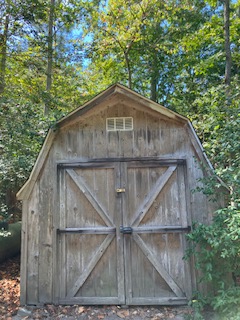
The Shed was twenty-feet deep by eight feet wide, with two windows, two lofts, double doors, and sturdy enough to withstand everything except Hurricane Isabel.

Of course, I bought the shed to hold supplies when I was building the house. Before I started, when I had first cleared the small portion of the property for the home, I had this shed delivered figuring I might need to sleep in during bad weather while up here for three of four days in a row seventy-five miles from the place in Virginia Beach. Michael and I went together to the shed place in Virginia Beach. Some guy paid for it but never picked it up so I bought it brand new for a song and the father and son team I bought it from delivered it seventy-five miles, across the Hampton Roads Bridge Tunnel, across the still-narrow Coleman Bridge, the Piankatank bridge, and down my winding driveway through the woods—for twenty-five dollars. I also bought them lunch.

It didn’t take long, as it tends not to take, to have stories to tell from the shed.

Back in ’99 we had fifteen inches of rain in two days and the water ran from the river side of the property down to the woods beyond the shed. I had the shed leveled off the ground by about eight inches on blocks, so the water rushed toward the door but instead dug crevices under the shed. The shed, miraculously was dry, but impossible to get to.

Isabel didn’t do a thing to the shed, but she knocked down thirty oak trees here at Aerie, and one of them lingered for weeks right above the shed. I knew it had to come down but this was a job I couldn’t pull off myself. Scavengers wanted more than fifteen thousand dollars to clear the fallen trees, so I said I’d do them myself, which I did, but I was afraid to cut the half-fallen tree in fear it would crush the shed. Instead, another storm just a few months later cracked the trunk and it crushed the back half of the shed for me. I remembering thinking, “Hell, I could have done that.”

So in the lemonade tradition, I made the back half into a greenhouse with plastic sheets for the roof, but it didn’t really work, and over time the mold and mildew and various snakes and wood rot got the best of The Shed. It took about twenty-seven years.

One time early when Michael was about five, we played hide and seek as we often did, and I ran in the shed while he was still too far away to follow me right in, but he could see me. I then climbed out the back window and settled behind the back wall. I heard him come in the shed and was quiet for a minute then said, to no one in particular, “Holy Cow, How did he do that? Daddy?”

I remember how we laughed.

We built things with wood and made signs and birdhouses. None of them were well done but they were all perfect. Occasionally we’d take a break and play “Voices.” That is, we’d recreate “Wind in the Willows,” and I was the voice of most of the characters—Badger, Toad, Moley, even the stoats.

And we kept the sporting equipment in there and played frisbee, football, golf, and ring toss, which we still do nearly thirty years later when outside barbequing.

The bikes he kept in the shed got bigger, and the toys were relegated to the loft while more accessible spaces were reserved for tools, chemistry sets, then inflatable kayaks and eventually equipment to hold his art supplies and frames.

When he was little, he would tie me up in a chair with a lasso his uncle sent him from Texas, and he kept lizards and frogs in tanks until he couldn’t feed them anymore and would let them go behind the shed, in the woods.

He kept buckets of fake snakes and lizards in there when he was young, and when the roof collapsed and water raged in, it carried the rubber reptiles out the door and under the shed. The next day I spent an hour reaching under the shed and pulling out the toys, until one reach pulled out amongst the fake snakes a real one with red and yellow and black, and I forgot the rhyme about poisonous snakes so I just threw everything as far as I could.

There were other days like that.

But there’s a hole out there tonight. And Michael is in Ireland, far from the fallen shed. It had to come down. I had to do it now or we’d be still out in the still standing shed telling stories.

I destroyed the last of it a few hours ago, and I rested on the nearby patio remembering the times we shared for his entire life, and the talks we had—so many talks we had safe in the shed, just the two of us, about growing up and traveling and things that frustrated us, and things we were scared of. Out in the country like this along the bay when a father and son go into the shed, usually it is for some form of punishment, “a whooping” as they say. Well I never had a reason to punish Michael; but we did have plans to make, so out to the shed we’d go, and he’d make notes on wood with a nail, and we’d plan adventures like training across Siberia or walking across Spain.

We kept tools in that shed, and mowers, bikes, grills, and more. And memories filled the spaces between everything else. We let a lot of memories occupy that space.

Funny though. I sat out there today when I had finished knocking it down and thought about the next week or so during which I will haul away the remnants, clean up the ground, lay down some field stones and mulch in front of a much smaller, new shed, put a few chairs and a small table there, and I tried to imagine the new way it will be, and it made me a bit sad, of course, but excited for a new place to talk. But lingering a bit in the hot afternoon air was the sound of ten-year-old Michael playing his harmonica and the distant hint of his unchanged voice asking if I want to play hide and seek.

There are some things that shed kept safe for us I’ll never be able to destroy.    

Now:

Next:

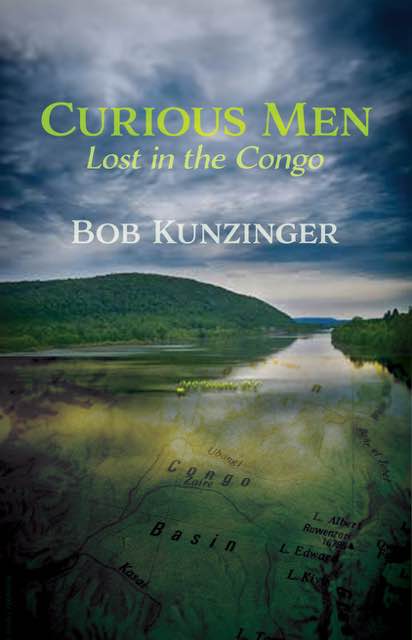
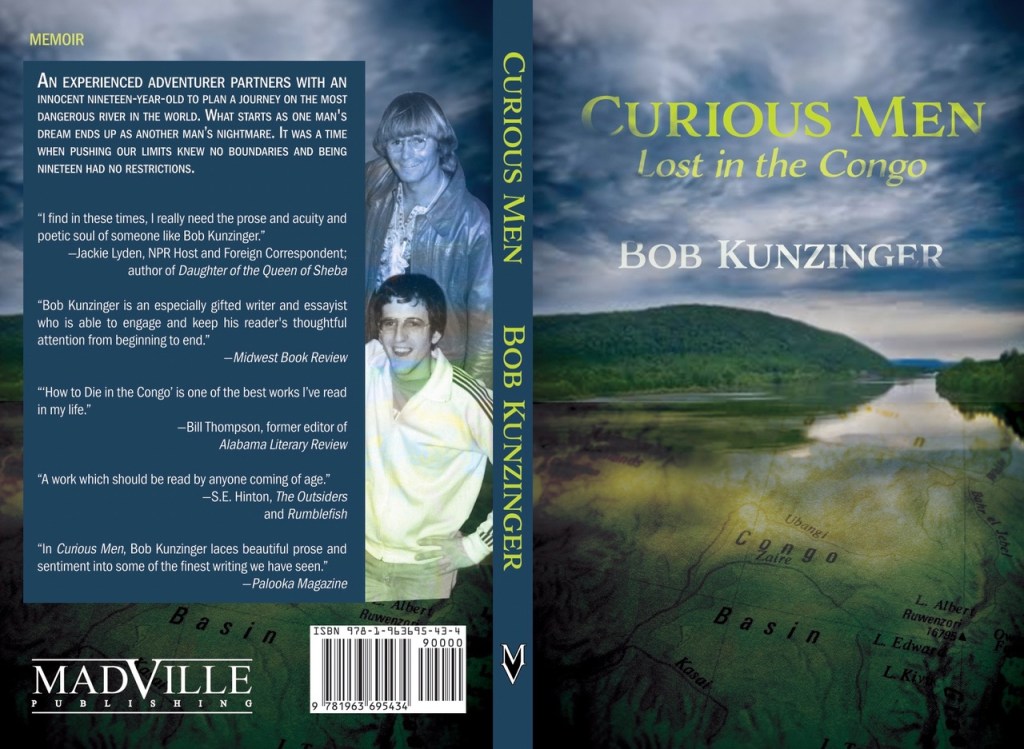
Curious Men: Lost in the Congo

The Allegheny River, Allegany, New York

Memory is as fluid as anything in our lives. What happened and what “seemed to happen,” as writer Tim O’Brien points out, can often be confused. When looking back we might have a habit to recall what seemed to happen, reality having been washed and hung out to dry over the course of decades. Sometimes though we can recall nearly ever nuance of a time in our lives for its significance, its uniqueness, or its romance. I have a pretty sharp memory when it comes to many events. A friend of mine and I were talking not long ago about how we can both remember nearly every detail, everything, about a period in our lives so long ago you’d think it was from another life. Many of us have times like those which, for whatever psychological reason, we can summon up to the point of remembering the clothes we wore on a particular day.

My basic memory for most things is pretty solid. I remember all my phone numbers and license plates, and, worse, the phone numbers and license plates of friends of mine. The old joke about song lyrics holds true with me, but so do the times spent with extended family. One of my only memories of my paternal grandfather was him weeding a lot he owned next door to his house on Long Island. He died when I was five, so I was no older than that, probably still four. But I picture that day, those moments, perfectly.

Some years ago when Meanwhile in Leningrad came out, someone asked how I can remember the conversations I had with survivors of the Siege of Leningrad, who at the time I knew them were in their eighties, and I wrote the book several years after our conversations. I said, well, first of all, they’re never going to find or read the book, so there’s that. But more accurately, when a woman sitting on a bench holding my hand tells me about dragging her dead husband and son across the city to leave in a mass grave, and she sat with me clinging to their photograph sixty years later, I will not forget any of it. Much of the writing in that book falls in that category. Did the conversation happen verbatim? Doubtful, but the gist of it is pretty damn accurate. There’s an old journalism method that when you write the piece and include quotes from someone, call them up and read what you wrote to them and ask, “That’s pretty much what happened, right?” Nearly all the time they’ll say yes. Can you remember the words, exactly the words, you spoke an hour ago? Exactly. If that’s not possible as in this case, I rely on memory and notes.

Memory is reliable or not depending upon just how present we are during the event. That time so long ago when we said we could remember everything: We were both very much present at the time, we lived the example of what would later be called “mindfulness.” Of course we remember. Likewise there are times I so shut out of my memory it’s like they never happened at all.
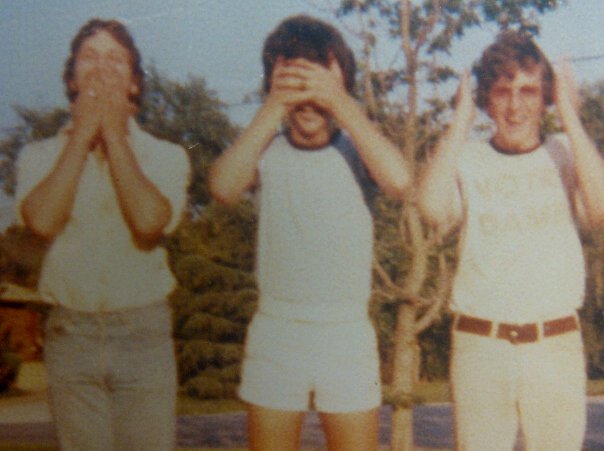
Still, some events are so close to my soul I would need the team from Matrix to come extract them.

Like what happened in 1980 and 81, when I was a freshman and sophomore in college, the subject of my forthcoming book, Curious Men, from Madville Press. Of that time then, I remember everything. I watched, studied, and listened so intently that this memoir could be considered a documentary for how clear the details remain to me four and a half decades later.

I like that “memoir” includes the Spanish word “oir,” to hear, because much of memory stems from what we hear, and as a nonfiction writer I am bound by listening to the world around me, sometimes to the one sitting in front of me, and those sounds of vowels and consonants and the musicality of language I know will never escape my recollection.

My friend, colleague, and former officemate, Tom Williams, once introduced me at a reading as a non-fiction writer by saying, “Here’s some shit that happened to Bob and the best he can remember of it.” That’s pretty spot on. Despite a degree in journalism, I never had what it took to do the job in the traditional sense like so many I graduated with, some of whom have won prestigious awards for their work. I was definitively not up to that task. But I could handle the feature work, the “Let me tell you what just happened to me” work, just fine. In college, my friend Deb used to help me with news stories and I’d help her with features. We knew our strengths. I had a column in the college paper for which I ventured out into the community and did something, and then I wrote about it. I went horseback riding in Machias, New York, flew planes in Wellsville, kayaked the lake in Allegheny State Park, and sat on the ground behind campus at Merton’s Heart. Those events I could remember. I knew how to be present. Most of those activities were out of my wheelhouse at the time, so recalling what happened was easier. I was paying closer attention, sometimes just so I wouldn’t die.

Memoir is like that. If we can’t remember it we’re certainly not going to write about it.

But not this time, not this book. Summation: As a college freshman uninterested in the normal activities of my floormates–that is, drinking and drinking–I felt lost and disconnected from everyone. Then a family friend returned from the Peace Corps and asked me to help him plan a trip, solo, on the Congo River. So I did.

Long story short, it didn’t work out and his trip became mine. The first half of the book takes place in western New York. The second half in the Congo.

Still, that’s not what the books about.

Most of it takes place now, in every classroom across America where nineteen-year-olds sit and try and find something worth doing, something that reaches deep inside them and wakes them up. I’ve been staring at nineteen-year-olds for thirty-six years and one thing hasn’t changed: they’re scared out of their minds. They’re alone in a new place far from home living in a room this size of their car with a total stranger, and every adult within earshot constantly wants to know their plans for their major, their careers, their lives. It is often unbearable.

I was exactly like that back then. Until a friend walked into my life and said, “I have an idea. I need your help.”

We were so young.

So that’s what this memoir is about: About that time back then. What we did and how and why we did it, yes, but mostly about being nineteen and far from home looking for a reason to exist at all.

This is how I remember it.

Coming this winter:

After Jackson Browne

It’s been a year since Dave died. A year next week on my birthday since Letty died, a year two weeks later since Richard died and then Fr Dan, then Billy…

There was more to say. But then, of course, there is always more to say, isn’t there?

That’s the lesson, I suppose, if one were to look for a lesson: Say it now.

“These days I seem to think a lot about the things that I forgot to do for you,

and all the times I had the chance to.”

Fr. Dan Riley, ofm
Bobbie Roehren Buckman
Fr. Brennen Fitzgerald, ofm
Mom
Dad
Dave Szymanski
Eddie Radtke
Letty Stone
Fr. Dan Riley, ofm
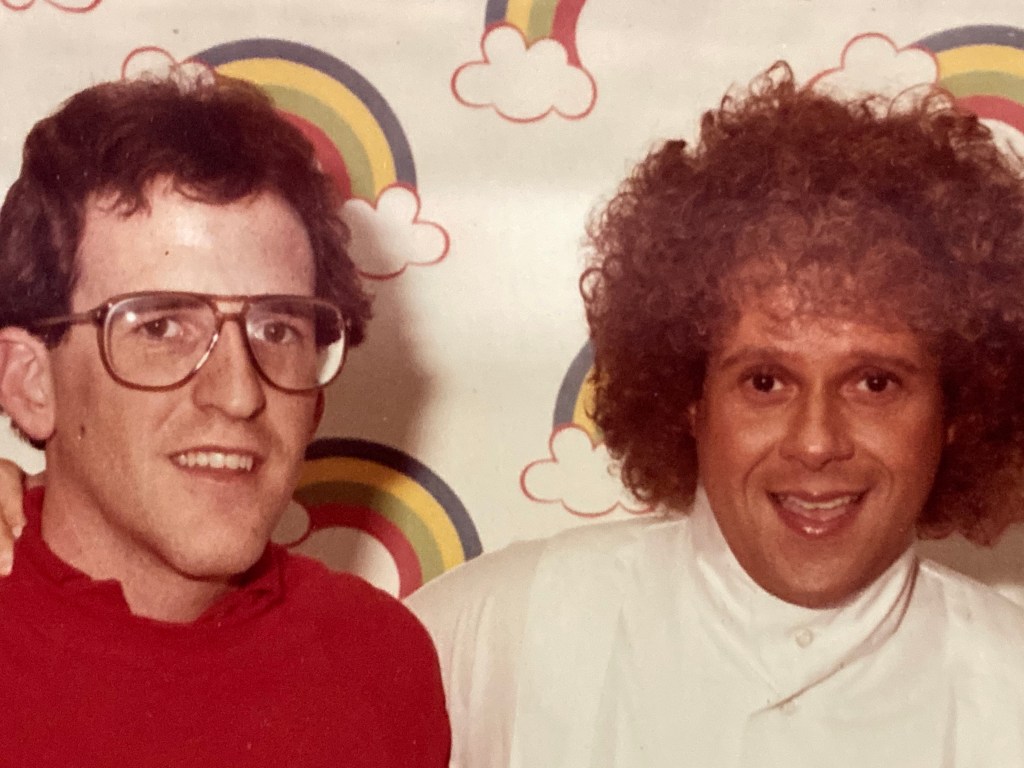
Richard Simmons
Dad and Mom
Pete Barrecchia
Fr. Dan
Cole Young
Dad and his siblings, Howard, Ed, Audrey, Phyllis, and Joan
Doug Dunn
Rachel Scher
Letty
My cousin Bill (with my cousin JoAnn)
Dave Weir (on left, with Mike Russell)

You’re the color of the sky
Reflected in each store-front window pane
You’re the whispering and the sighing of my tires in the rain

You’re the hidden cost and the thing that’s lost
In everything I do
and I’ll never stop looking for you
In the sunlight and the shadows

And the faces on the avenue
That’s the way love is

I don’t remember losing track of you
You were always dancing in and out of view
I must’ve thought you’d always be around

now you’re nowhere to be found

Talk about Opening Doors

My Yellow House in New England

I found an old silver key while cleaning my closet floor.  For years it might have been there shoved in the corner under the lip of a log, fallen perhaps from pants pockets or my winter coat.  I don’t recall losing a key or changing a doorknob.  Perhaps it opens some old lock on the old all-glass door on the side porch. At the start back then strangers would meander down the winding driveway through the woods to the house and cup their hands against the reflections on the door windows to look around. I replaced that door with a solid one and put a no-trespassing sign up front.  

Older, I think; the place in Wellsville, Pennsylvania, where I came home one July morning to find plants and flowers in the entrance and at the top of the stairs for my birthday. It was the first place I lived where I gave someone else a key. Or it might be from my first house in New England, where the door stuck in winter when the frame froze.  I’d spend hours shoveling my steps and those of the old woman across the street who delivered mail.  She’d bring apple pie for my efforts or leave one for me with Sam at the Deacon’s Bench antique store.

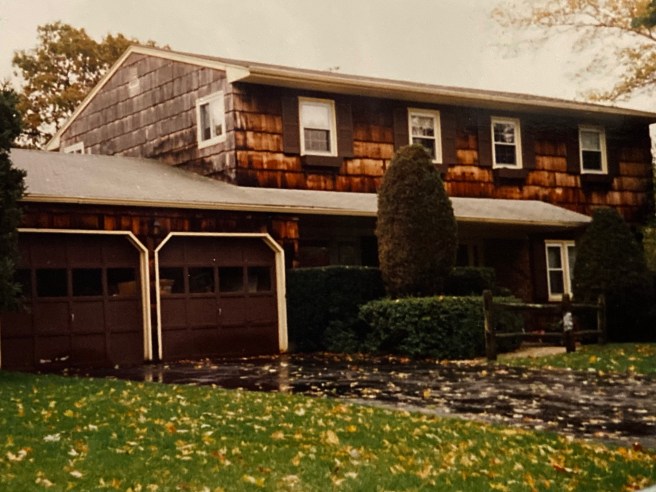
But that key was gold.  Now I think this one some souvenir from my childhood home on Church Road, the two-story colonial where I owned my own first house key though I never needed it since after playing ball or riding bikes all day along the Great South Bay, I’d run in the back door full stride and laugh the way childhood makes you laugh for no reason at all.

I can’t recall now what this silver key might be for, though I’ll keep it, resist the urge to throw it away as evidence shows I clearly resisted before.  After all, it still opens doors to places I never thought I’d return.

My childhood home on the Island
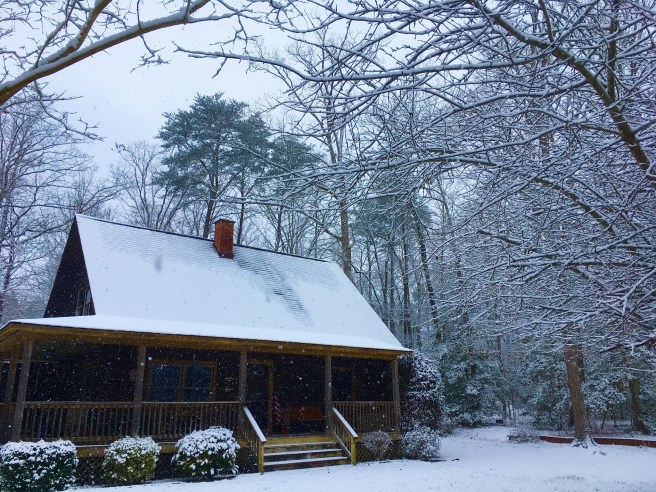
Aerie
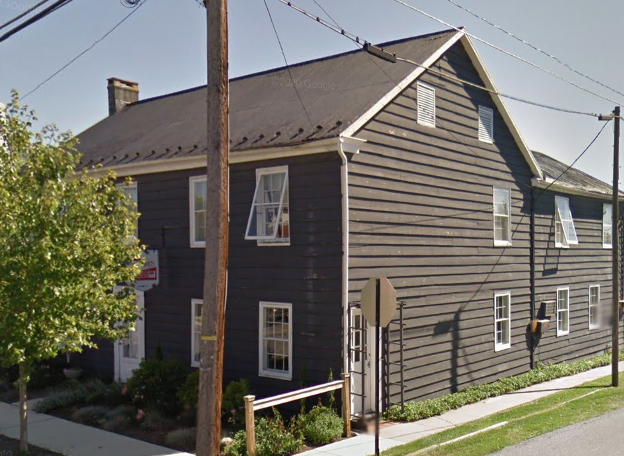
The Wellsville House

Dave

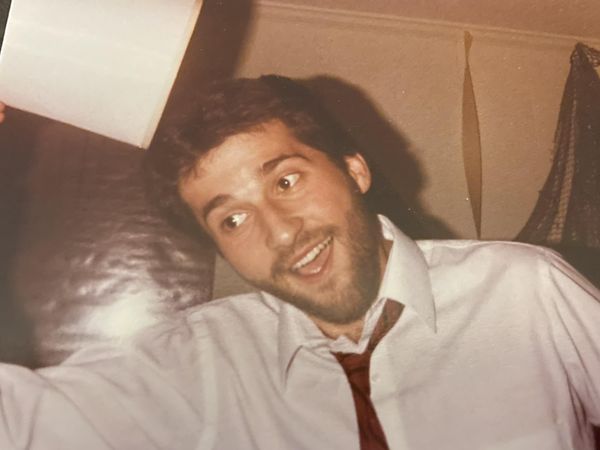
That’s my friend Dave Szymanski. He died Tuesday, May 14th. RIP my brother. We laughed so much that now just laughing at all often makes me think of him. We were going to get together when we both turned seventy and sing “Bookends” on some park bench. No kidding; it was part of the plan. We wanted to belt out to whatever audience was out walking their dog, “How terribly strange to be seventy!” Well, that won’t happen. Still, I am absolutely certain if I make it that far I’ll most definitely do just that, but alone, crying, laughing. I have so many stories about Dave you’d think we were twins. But those are mine now–Dave and I agreed to have joint custody of the stories of those times, but since he is gone now, I’m assuming full ownership. Unfortunately, they fall squarely under the category of “You had to be there,” so there’s no point in sharing them.

This is not likely to go where you believe it might go.

I’ve been thinking about what I can best call the start of some independent consciousness–that is, the time when I was first aware I was a growing, independent thinker/dreamer, mentally unattached to others, my thinking not entirely tethered to parents or siblings or teachers. I guess I was in what we then called Junior High, now Middle School, and at thirteen or fourteen years old life was still idyllic. That’s the point I think I started to think of myself as an individual. I have no idea if that is late, early, or disturbed. We lived near the Great South Bay next to a State Park and an arboretum, a golf club, and I was surrounded by friends in the village of Great River. I have memories before that, and possibly even dreams, which at that time were to either be an astronaut (Apollo 11) or play baseball during the summer (Miracle Mets) and be an ice cream man in Florida during the winter. But those were the “in the immediate” aspects of life; that is, things you thought about and said to friends but then forgot nearly instantly. But realism crept into my view somewhere around seventh grade when more realistic plans surfaced, like sailing around the world or riding my bike across the country, or being a musician or a writer or a tennis pro. All seemingly real plans at the time; those things which you no longer imagine and pretend but which you pursue, even if fruitlessly and without much talent.

No one save his family knew Dave was sick, so most of us didn’t have the chance to take the time to reminisce. It’s important; we always say, “Tell people how much you care about them because you never know if they’ll be around next week,” but we rarely follow through. We know it is true, and we know it is real, but we just don’t. But if we really did know it was the last time we might talk, the last chance to say something, like how much you appreciate the long conversations in the radio station at five in the morning, you picking out albums, him tearing UPI articles for the news; or how the three am pancake house runs were more important than final exams; or how the weekly texts through the next forty years kept you going, you’d tell him. Listen: Please, make sure if something happens and you know you’re going to be checking out, do not keep it a secret; some of us have a few things to say.

Anyway.

A few days ago someone asked me for my favorite picture of Dave. I went searching deep both on and offline, but I do not have many at all since back when we spent a lot of time together we rarely walked around with a camera and film. But I looked, all the while sifting through tons of other photos of the scattered years throughout my life, and at some point I stopped and simply sat remembering, and I realized something close to lifesaving during an otherwise heartbreaking week: What an amazing ride this has been so far.

I’ve mostly taken the paths of least resistance, I must admit, but apparently someone was up ahead clearing it for me, because it’s been outrageously fortunate. And I finally figured out what the pictures are for. Not only to reminisce, but to remind myself when I get lethargic or depressed, lonely, or tired, that I’m still walking this brilliant Camino, and to remind me of the words of Virgil when he wrote that Death twitched his ear and whispered, “Live….I’m coming.”

Not knowing when someone is going to die, or even that they are sick, is a cold reminder that we don’t know when we’re going to die, or when we might fall ill, and the truth is we just might have a few things to say to those we will leave behind. Speak now or forever…

I normally try to not write too directly only about myself, choosing instead for a digression into some common ground. But not this time. Honestly, this one is for me. Just a few findings from the journey so far:

Sandy. My best friend forty-five years ago.
My yellow house in Oakdale, MA. I lived for a few years on the first floor/basement behind the hill. The water is the Wachusett Reservoir, and up the road to the right was an apple mill, then up the mountain to the ski slopes, Princeton, Massachusetts. I loved it there and never should have left. 100 years earlier the house was a fish market.
My siblings and me (in the middle) in Massapequa Park on Long Island, where we lived from just after I was born until I was nine. It was a great place to be; Dad worked his tail off so we had great childhoods. My siblings are two of my five heroes.
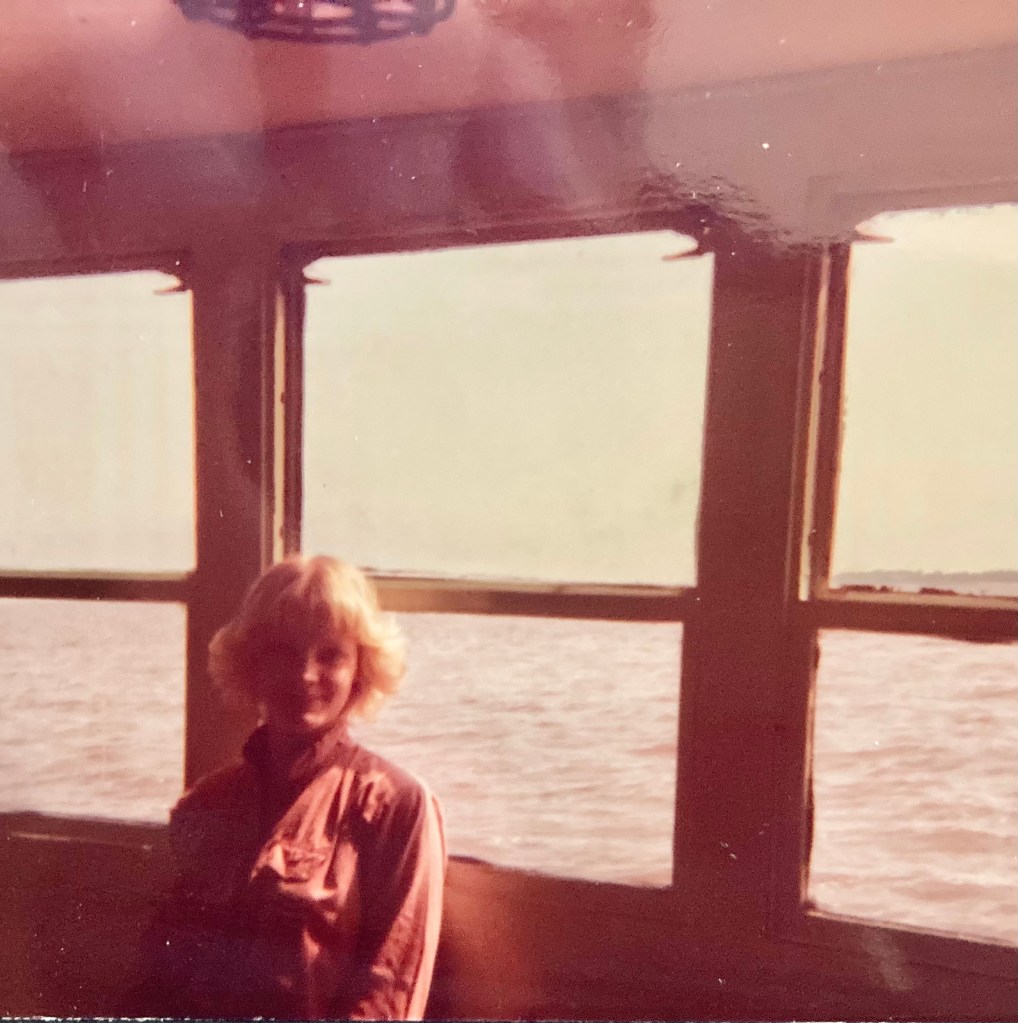
My friend Michele during high school. One day I borrowed Dad’s car to go to Michele’s for “about an hour.” Instead, we drove to the end of Knott’s Island on the Carolina border, drove onto the ferry, and headed down the coast of the Outer Banks. Neither one of us wanted to turn around. If we hadn’t we might well still be driving.
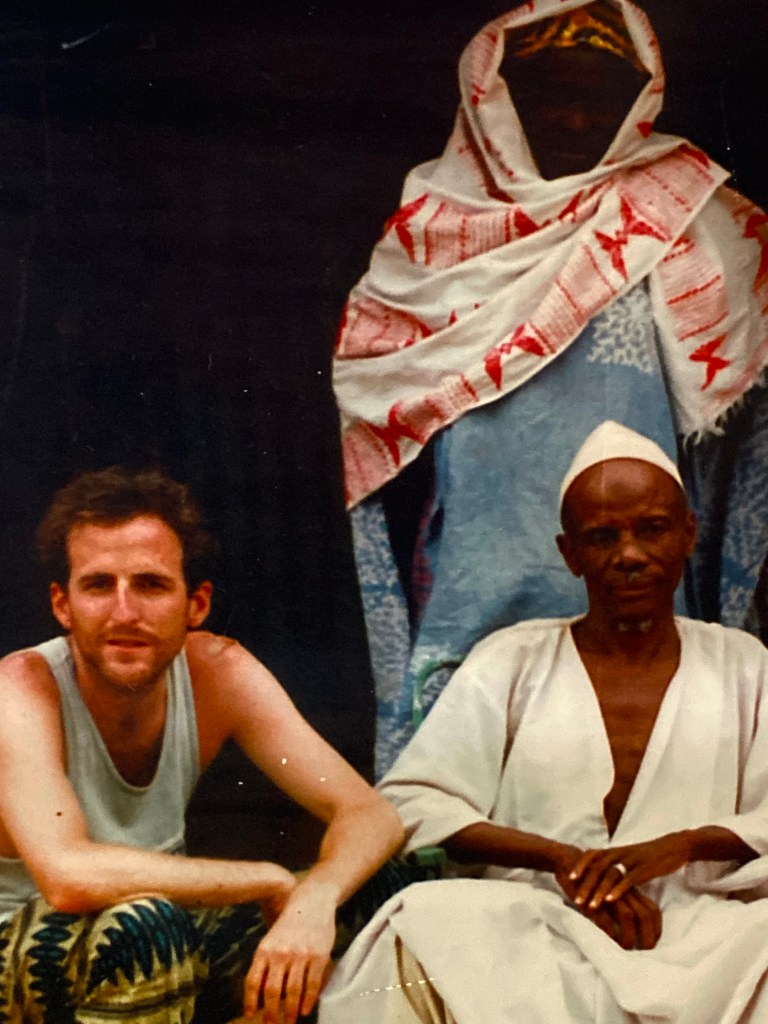
In Senegal where I spent some time before headed somewhere else in Africa. A few months earlier my life had completely changed, so I decided to change it further and ended up there. My college friend Claire and me with a village jeweler on the left. We had no clue who the dude on the right was. He just jumped in the picture.
I lived in this cabin in northern Norway for March of 1995 with my colleague Joe and American teacher/writer John Slade while we taught at the Bodo Graduate School of Business. We filleted cod caught by our seventy-five year old neighbor, Magnus. A Russian guitarist, Max, and I spent evenings in the cabin dueling folk tunes from the US and Russia. One night I fell through the ice on a lake but only to my ankles. Another we felt we had to duck from the swirling bands of the Northern Lights. Another we chased moose up a hill. Other stories for another time.
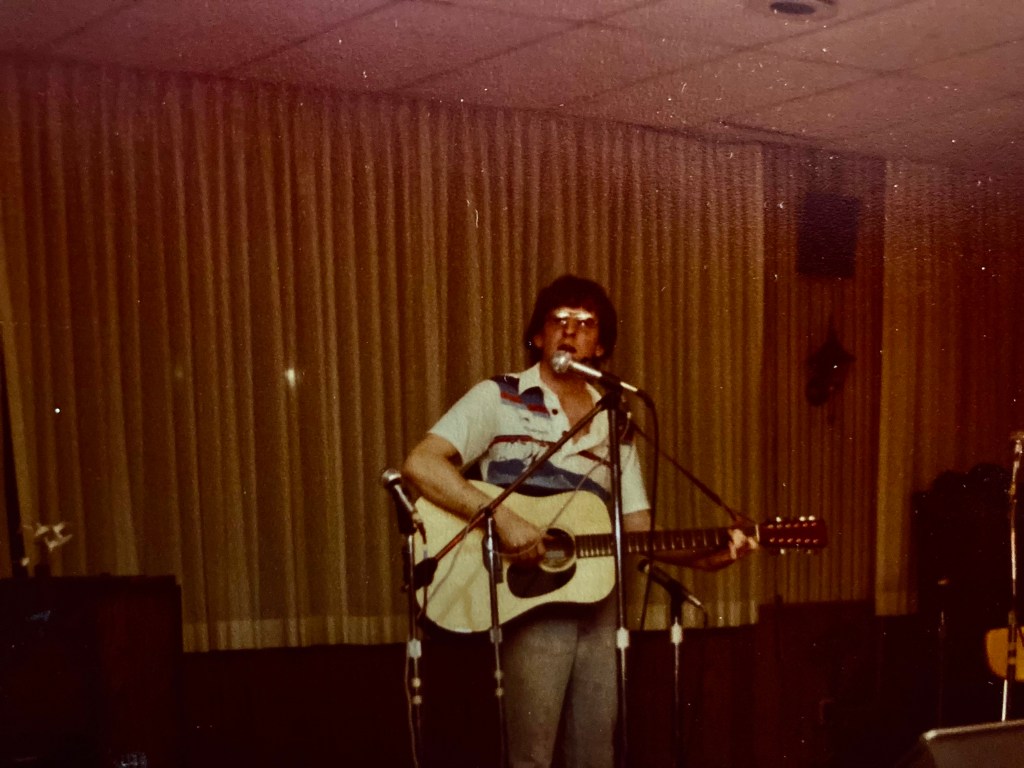
This old guitar saved my life. Coffeehouses kept me from falling through some proverbial ice during those years. And what stories from those gigs, like the time when 150 people sat to watch us play and at one point we opened the curtains behind me (there’s an Olympic size swimming pool on the other side of the windows) at the exact time a swimmer climbed out of the pool and his suit had slipped to his knees. We all waved. He dove back in the pool.
The Great River house my father had built and where we lived until moving to Virginia in ’75. When people ask where I’m from it is a difficult question to answer, but as I get older I say “Great River” and it is listed that way on my FB page. I live in Virginia. But I’m from Great River. Hard to explain.
My advisor and mentor, Pete Barrecchia. He was one of the true journalists of this country and the source of my first and greatest writing lesson. When someone in editorial writing class complained about not knowing how to start and where to put in the research and on and on and on, he put down his cigarette, grimaced, and said, “Oh just write the fucking thing.” It worked.
One of my escapes during college; Letchworth State Park. My escapes were either music or nature. Sometimes just the smoke-filled art studio beneath a dorm on the other side of campus. But escape was always important for me. Hard to explain.
My boss in the mid-eighties. One of the finest humans I’ve ever known. Yes, that’s him.
Village chief. And his wife.
My Great Uncle Charlie Kunzinger and Aunt Jane. Time note: He fought in WW1 in France, and when I was a freshman in college at St Bonaventure, he was still writing me letters and sending poetry.
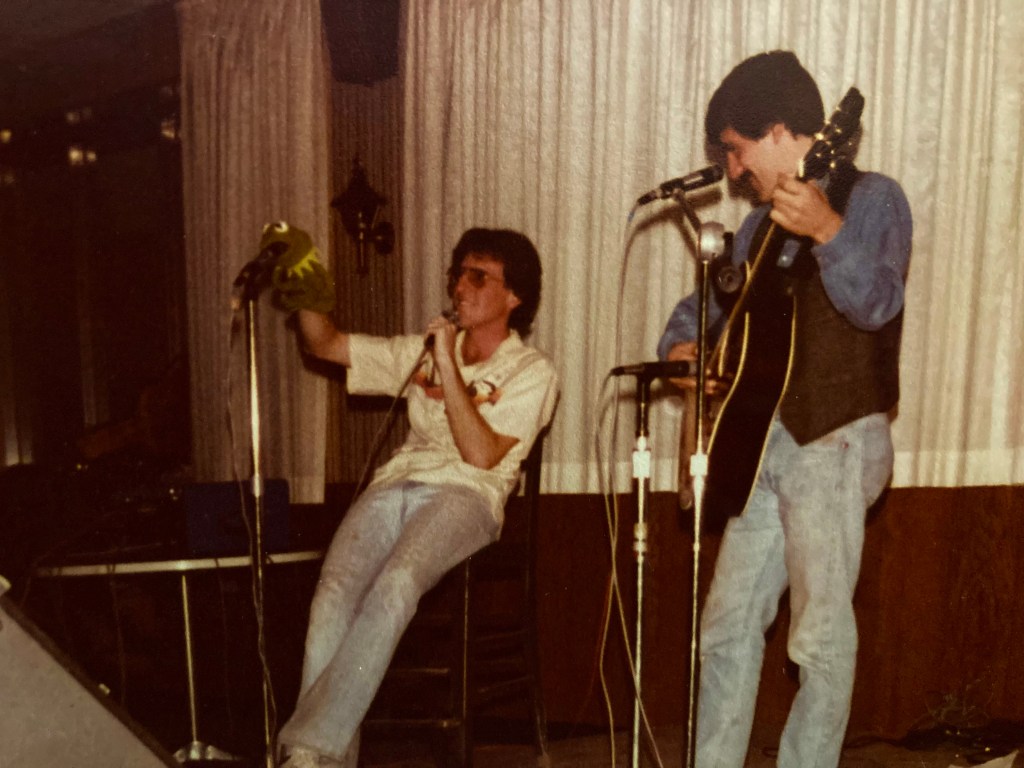
Mike Bonnano and Kermit when idealism was still okay to sing about, and where no one cared how bad you were.
My friend Tim O’Brien who most know for his prose writing but few know is an extremely accomplished magician. True story.
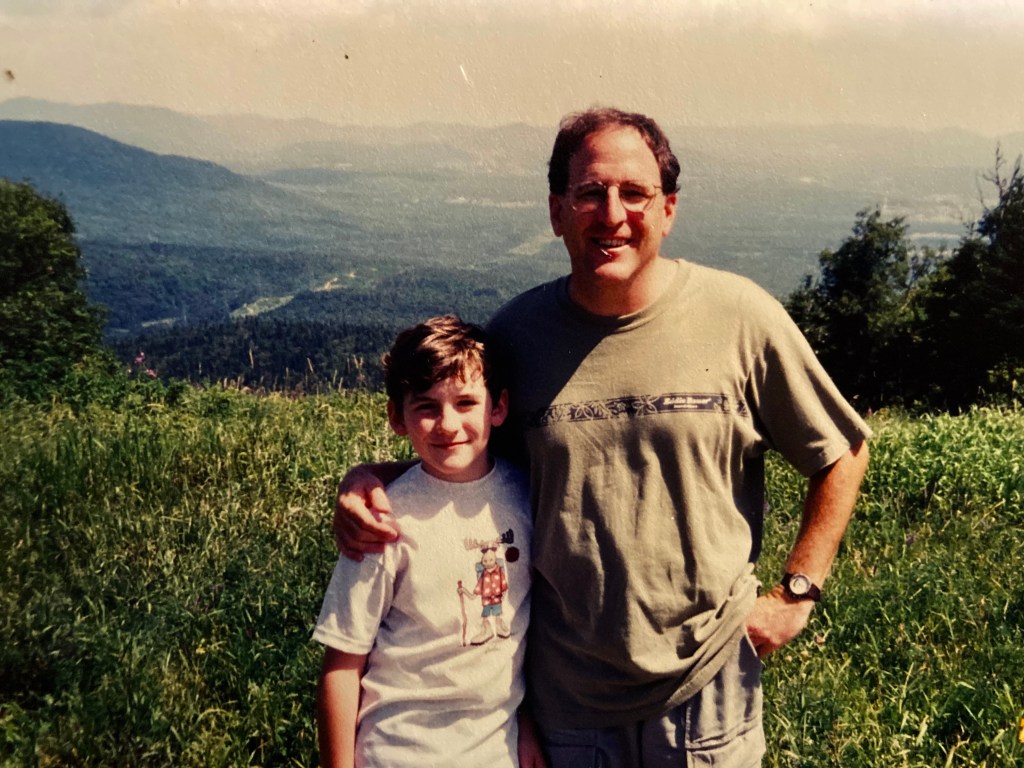
Michael and me in mountains of eastern Quebec many years ago. We’ve been literally around the world since then, and we’re still going. With apologies to Maya Angelou, “I wouldn’t take nothing for my journey now.”

Call someone. Tell them something. Anything. Forgive them. Ask them to forgive you. Tell them you’re sorry you didn’t answer the phone that last time they called and said they felt like talking. You planned to call them back but just didn’t “feel” like it yet. Now you can’t. Go ahead, call someone and say you wish you were as good a friend to them as they have been to you. Don’t be embarrassed. It’s only life, you know. That’s all.

It’s only life.

That Which We Are, We Are

The Chesapeake Bay Bridge Tunnel

I immersed myself in outdoorsy stuff in my early teens; even beyond that. I wonder if something innate in my DNA attracted me like chemistry to the outdoors and references to it, or my environment and influences doused me with enough references to nature that my path was clear.

I listened to all of John Denver; knew every word to every song. Played his music on the record player and my guitar. At the same time, my friend Eddie and I spent every single day in the woods and along the Great South Bay at Heckscher State Park, nearly literally our backyard back then on Long Island’s South Shore. I watched movies like Jeremiah Johnson and television shows like Grizzly Adams. I wanted to disappear from civilization like they did; I wanted cabins like they had up in the Rockies, with a warm fire going.

The beach took hold of my Buddhist-bending mentality, combined with Dan Fogelberg and Jimmy Buffett, books by Joshua Slocum and Robin Lee Graham. Patrick O’Brien and the first paragraph of Melville’s Moby Dick, which reads:

Some years ago—never mind how long precisely—having little or no money in my purse, and nothing particular to interest me on shore, I thought I would sail about a little and see the watery part of the world.

Damn I wish I wrote that, wrote “Son of a Son of a Sailor,” “Rocky Mountain High” and “Sweet Surrender,” wrote home from some mountain in Utah not far from Redford’s “Sundance” ranch, long before the film festival was born. Instead, I played their music, watched the shows, and spent as much time as I could in whatever nature I could.

I think it was the beginning of me always feeling slightly outside of everything, just a little beyond understanding people. For some time I thought it was insecurity, but now I believe I just preferred the natural state of things, how perfect it is out there. I had the theme of Grizzly Adams down pat:

Deep inside the forest
Is a door into another land
Here is our life and home
We are staying, here forever
In the beauty of this place all alone
We keep on hoping.

Maybe
There’s a world where we don’t have to run
And maybe
There’s a time we’ll call our own
Living free in harmony and majesty
Take me home
Take me home.

Even that line repetition is a nod to Frost’s line “Miles to go before I sleep.” Exactly.

Is it true that everything we are we remain? Our hopes remain. Our dreams remain. And if we hadn’t lived them out yet, perhaps we still will in some other season? Maybe.

A part of my mind never truly grew up, I know that. A part of my psyche still holds tight to how I used to think when I was young, sometimes to the point I can be out for a walk and not even remotely feel my age, forget that my ability to do most of the things I could then is, shall we say, compromised. But we trick ourselves. I can still ride a bike; can still hike in high altitudes. In my fifties I walked across Spain. So who knows.

What happens is we forget. We let go of so much of who we were to make room for who we become. It is natural and beautiful and necessary, and we would not come close to being who we are today without who we were then, watching Dan Haggerty and his bear walk down the mountain, or listening to John Denver’s opening guitar riff on “Rocky Mountain High.” It’s in our blood. It has to be.

Unless, again, something in our blood attracted us to those things. Who the hell knows, right?

Ever come across a trigger that brings you back to those moments you had then? Maybe it’s a picture in some old album your parents kept; or a book you read. I have books like that, from then, I have a baseball my friends all signed when I left Long Island and it transports my mind to that small village, almost as if had I driven there today I’d see fourteen-year-old Eddie coming out of his house ready to hike through the park. We have so much more ability to manipulate time than we realize.

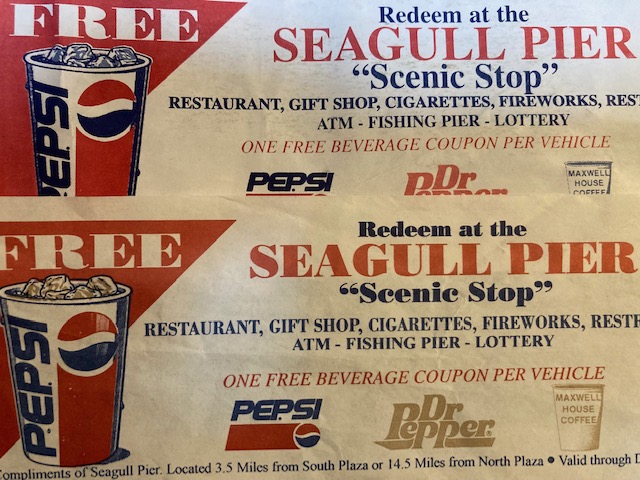
So, I had this job. One of my first, and the last one as a high school student. I worked on Seagull Pier on the South Island of the Chesapeake Bay Bridge Tunnel which connects Virginia Beach, Virginia, with the Eastern Shore of Virginia, known as the Delmarva Peninsula. I was thrilled to get hired out there for one reason: I’d be working “nearly” on the water, watching the sunset and rise, feeling the salt water on my face all the time, like Melville but without whales. I worked 10 pm to 6 am every night, usually alone, frying shrimp and fries, serving sodas to travelers with coupons they received when they paid their toll to make the crossing of one of the longest bridge-tunnels on the planet. Yes, they got a free Pepsi at the pier. It was pretty barren then—a diner-style interior with a few tables, a gift shop, and a pier filled with fishermen. In later years the restaurant took over part of the pier and became quite nice with a full menu. But back then it was just a quick stop for a basket of fried food, coffee or Pepsi, a few souvenirs and back on the road.

They tore it down a few years ago to expand the bridge tunnel.

I would drive my dad’s ‘72 Nova out there just before dark, park and stand on the rocks looking west up the Chesapeake, west, toward the setting sun. Then I’d head inside and cook, serve, clean, make coffee, talk to fishermen on rainy nights when they crowded the counter, talked to the rare customer who stopped for their free Pepsi or a burger at three AM. Then when my shift ended, or sometimes even before then if no one was there, I’d walk out on the parking deck on the east side of the building and watch the sunrise over the Atlantic at the mouth of the bay.

Just remembering that brings me such absolute peace I can, just for a moment, forget some of the minutia that I find myself up to my neck in. I remember, and I am there, can smell the salt, can feel the breeze coming off the water.

I love to remember.

One morning at about four, the door opened as I was just about to clean the grill. I glanced back to see who was coming in and it was a man by himself in a sweater. He had long hair, a thick beard, was tall, big, like a linebacker, and stood for a moment looking around.  I called to him to sit anywhere and he came right up behind me and sat at a stool, and he said, “Can you make me a burger on that grill before you clean it, my friend?”

Instant voice recognition. It was Dan Haggerty. Grizzly Adams himself. I asked and he said yes. We talked and he insisted I make a burger for myself as well, and fries, and we sat together and talked for an hour in the empty Seagull Pier restaurant. He was on his way to Florida and preferred to drive very late and very early.

Young people: This is before there was any form of a device with which I could capture the moment unless I happened to have my camera—a big device with film in it—which I didn’t. So we have those triggers. A baseball, an old guitar. Stories.
Today I received mail from my sister. My brother-in-law bought a new car, and in the old car, buried somewhere in the console or glove compartment or somewhere, they found three Free Drink coupons for Seagull Pier from one of their many trips south to see our parents in Virginia Beach.

She was discarding outdated coupons some toll clerk shoved at her with her change. I received a wormhole to a version of me that had my entire existence in front of me from a place I loved to show up and leave out in the middle of nature, where the sun set and rose again with my arrival and departure. What had for nearly fifty years become illusionary, almost some fiction from forever ago, suddenly seemed to happen this morning, and I felt younger, more alive.

I still head to the bay—same bay, ironically—to watch the sunrise; and to this river every evening to watch the sun disappear west into the Utah mountains. I still dream of riding horses across the Rockies. I still listen to Denver and Fogelberg.

If not, I know for certain I’d be a poorer man.

Everything we are, we remain. Our hopes remain. Our dreams remain. And while not all of them will find fruition, some might. Some just might. If not in this, then perhaps in some other season.

Perhaps.

Thanks Cathy and Greg, for not stopping for a free beverage

A Joyeux Noel

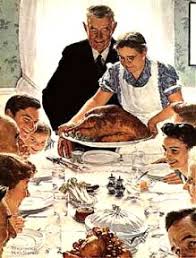
rockwell

Well before dawn this morning, I could see some stars and what must have been a planet in the west. Something about a clear sky at Christmastime has always mystified me, captivated my attention and imagination, from the simple, fun thoughts of reindeer and sleighs to the philosophical digressive pondering of First Cause and the imaginative world of proof. I love Christmas morning with its tidings and anticipatory pay-off. But even more I love the days earlier, of anticipation, alone, when the sky is a narrative, and the Author was sharp enough to leave enough room to us to fit in our own passages as we need to.  

In the east a sliver of light.

I remember now:

On Christmas morning before our parents were awake (or so we supposed), my siblings and I would gather, usually in my sister’s room, to exchange gifts we had bought for each other, before we headed down for the beginning of Christmas Day. It would inevitably still be dark out, and I know we’d lay awake waiting to hear each other also awake in the other room. A tap on the door. A “come in.” And we’d sit on the floor and open our presents.

At some point (like clockwork, as much an annual tradition as the Turkey or the pies), our mother would wake our father and he would exclaim, “I thought I said no one up before nine am!” and he couldn’t hide his smile to our laughter at the ludicrous suggestion we’d be up any later than five. It was always cold out during those Long Island years, and often snowy, but we weren’t going outside so it just added to the magic. Dad would be in his robe and slippers and he’d head to the living room as we gathered on the stairs and waited for him to plug in the multi-colored lights on the tree, and those on the rail, bringing to life the otherwise dark room. Mom had, of course, already organized whatever presents we would get into separate piles, and Dad would stand back and she directed us to the right area under the branches, though sometimes it was obvious if an unwrapped toy appeared, clearly already wished for by one of us. Dad would sit on the couch and watch in joy, even through the stream of “Wow, thank you Mom!” wishes continued.

It wouldn’t be long before the aromas of breakfast mixed with the onions and Bell Seasoning already underway for the stuffing, and eventually we’d need to get dressed, if not for church since we might have attended midnight mass, certainly for the droves of family who would soon fill the rooms. It was a beautiful way to grow up. I do not know the possible stresses, fears, and sacrifices that went on behind the scenes—that’s how good they were at it. Then, much later in the day after everyone else had left and we had all settled into the routine of looking at our gifts again, Dad would emerge from some closet with his gifts for each of us—books he had personally picked out, bought, and wrapped. It remains one of my favorite memories of all of my memories of my dear father.

It’s in the forties here today along the Chesapeake, and sunny. This is one of those days each year where I’ve been up so long and have done so much that it feels like it should be six hours later than it is. My sister and brother and nieces and nephew are all off in various parts of the country with their families anticipating their own Christmases, all of us with some common traditions, all of us with our individual touches to the holiday. Certainly all of us fortunate enough to be celebrating Christmas, laughing and telling stories, enjoying the food, the drinks, the sounds of football or Christmas music, and especially the welcome sounds of children, with another on the way. We are, to be sure, at peace this year. Anyone with family is engulfed in traditions which help balance our lives; they bring peace to our soul while providing some shared space not only with each other but with the idea of our ancestry, the hope of our posterity.

My father used to sit to the side for most of the holiday and enjoy being surrounded by his family. He’d carve the turkey, and of course disappear toward evening to get the books to give to us, but I picture him most in his chair, watching a game, laughing with us, waiting for Mom to call him to duty in the kitchen. He has moved on, and whatever there might be to know after this life of ours, well, he now knows, and that too brings me great peace.

Two deer stand nearby in the woods, cautious but not fleeing. It’s so quiet out. Absolute peace stretched out like canvas in all directions. On the water some ducks ease by.

I miss the days before society took “nearby” and “not far away” and tossed them to the strong breezes of technology and One World. The people I love are hundreds and even thousands of miles away, and we are used to that now. But this time of year I’m keenly aware of the distance. But in that small house around that small table when I was a child were so many relatives it is crazy to conceive how we pulled it off. But no one cared—we were together. Everyone was close enough to “drive over,” and by the time the turkey came out of the oven, a small crowd was sitting and standing and outside and in, laughing and sharing serious moments, because it was Christmas.

The sun is present now, but it is chilly, so I’m going inside again. I bought Michael a book at a local nautical shop and I need to wrap it to “surprise” him with Christmas evening when the rush of the day has settled down. He will be gracious enough to act surprised, just as we did with our father when he would predictably surprise us with books fifty and more years ago.

Well, except for one time. We had all settled down and we were sitting quietly, even the television off, the games had ended and dinner was done. My sister looked at our father and said, with a smile, “Okay, so where are our books?”

Thank God for memories. They bring us closer, help us to find the simplicity.

Chronology, One

Massapequa Park

We had a cat. Coco. Briefly.

And a dog, Randy. But he chewed furniture.

Dad made us all try liver and onions once and if we didn’t like it we didn’t have to eat it again. None of us ate it again.

Every Fourth of July the front lawn was packed with neighbors as my uncle shot off fireworks he picked up in the city. I remember still the way the air smelled of smoke and something like eggs.

The way every Christmas Dad would plug in the Christmas tree lights before we were allowed to go downstairs. Our “piles” of gifts, separated, wrapped. That afternoon the small dining room table was crowded with relatives. And how we sprayed fake snow through stencils on the mirror above the couch and on the squares of the bay window. Outside there was snow. Deep. And later I’d go out wrapped in wool and use a bucket to build a snow castle. And inside the Three Wise Men walked from the left side of the mirror to the right.

How Little League dominated my summer. I played for the Wildcats and wore a purple t-shirt and jeans and Keds. The way I couldn’t hit to save my life, so Dad promised me ice cream every day for a week if I got a home run. The way I got a home run.

And when six, I sweat under the hot lights of the television studio of Beachcomber Bills Television Show on WPIX in the city, and I sang “Zip a Dee Doo Dah.” I left with a Knock Hockey game and my brother and I would strap the plastic hockey sticks to our heads and hit the plastic puck around the basement. The “Superman” television show album they gave me. The joke I told on television for all of Metropolitan New York:

Me: “Why are there fences around graveyards?”

Beachcomber Bill: “Why?”

Me: Because people are DYING to get in.

The way I hit “Dying” because I thought no one would get the joke. The way no one ever again let me forget that joke.

The small turtles in the pan in the den downstairs on the shelf below the window.

Men lined up on bicycles for the block party parade. The drinks in their hands. Someone playing 78s. Andy Williams.  

The way our neighbor Joe, a boxer, bent his head when he talked. The way he could dive into the four-foot pool without using the ladder.

The way my friend Charlie and I would run from his house to mine. The deep snow of then. The long days of summer of then. Chalk on the sidewalk. Puddles at the curb. The cool grass on my back one winter afternoon when I looked into the sky and to this day I swear I saw my grandfather’s face come through the clouds.

The next day my grandmother on the couch crying. My mom telling her how my grandfather was such a good man.

The way I remember my dad was upstairs a long time.

Mom and I on a bus in town and at one of the stops was a circle of hippies with long hair and beads protesting the war. The way they looked so cool in tye-dyed shirts. The old ladies on the bus shaking their heads.

How I can still remember the names of every family in nearly every house on the block. The way when the occasional blackout hit in summer, people would stand outside at dusk and talk at the corner next to our house. “They have lights on Euclid.” “None on Massachusetts.” “It seems like all of East Lake and Philadelphia are out.”

The way I knew either Mom or Dad fell asleep watching television because I could hear the sound of static from the set when all the channels went off the air. And in the morning Dad took the train to work. And I would walk to the school next door. My brother with the white guard straps across his chest standing in the crosswalk. The way he made me stand on the side when I crossed the line walking home from first grade.

The way rain sounded on the awning on the side patio. The hedges. How even today the sound of rain on canvas makes me feel like I did when I was eight years old; somehow safe despite the occasional storms.

Then on weekends we started driving further out on the Island and would walk through empty houses, and I’d collect papers with the house layout on them. How in school that year, my third-grade teacher, who didn’t like boys, would yell at me for showing the house papers to my friends.

How I really liked a red-haired girl who was in my class since kindergarten, and I didn’t want to move. How the papers with the house layout smelled like the new houses, and I liked imagining which bedroom was mine. And how when holding the paper of the house we ended up buying, I knew even then at eight years old I’d never see the red-haired girl again so I made her a card and wrote “I love you” in it but I was afraid to give it to her so I threw it at her in the hallway that last day.

The way I knew I probably didn’t handle that very well.

How I couldn’t wait to watch that first moon-landing. And to watch the Mets on the television in our new home. The State Park, the arboretum, the Great South Bay. And I would make friends like you do when you’re nine. How Charlie and I wrote letters for a few months and then we drifted apart and where he is now I have no idea.

The way it was only twenty-two miles to our new home but it might as well have been a thousand miles. The way that even though we went back to East Lake Avenue to visit a few times, we never really went back like I thought we would.

The way that’s the way I learned we never go back. We just don’t.

This Night, This Day

In the east this morning a sliver of light. I stood at the bay and remembered:

More than five decades ago on Christmas morning before our parents were awake (or so we supposed), my siblings and I would gather before we headed down for the beginning of Christmas Day, usually in my sister’s room, to exchange gifts we had bought for each other. It would inevitably still be dark out, and I know the three of us would lay awake waiting to hear each other also awake in the other room. A tap on the door. A “come in.” And we’d sit on the floor and open our presents.

At some point (like clockwork, as much an annual tradition as the turkey or the pies), our mother would wake our father and he would exclaim, “I thought I said no one up before nine am!” and he couldn’t hide his smile to our laughter at the ludicrous suggestion we’d be up any later than five. It was always cold out during those Long Island years, and often snowy, but we weren’t going outside so it just added to the magic. Dad would be in his robe and slippers, and he’d head to the living room as we gathered on the stairs and waited for him to plug in the multi-colored lights on the tree, and those on the rail, bringing to life the otherwise dark room. Mom had, of course, already organized whatever presents we would get into separate piles, and Dad would stand back as she directed us to the right area under the branches, though sometimes it was obvious if an unwrapped toy appeared, clearly already wished for by one of us. Dad would sit on the couch and watch in joy right through the stream of “Wow, thank you Mom!” wishes.

It wouldn’t be long before the aromas of breakfast mixed with the onions and bell seasoning already underway for the stuffing, and eventually we’d need to get dressed, if not for church since we might have attended midnight mass, certainly for the droves of family who would soon fill the rooms. It was a beautiful way to grow up. I do not know the possible stresses, fears, and sacrifices that went on behind the scenes—that’s how good they were at it. Then, much later in the day, after everyone else had left and we had all settled into the routine of looking at our gifts again, Dad would emerge from some closet with his gifts for each of us—books he had personally picked out, bought, and wrapped. It remains one of my favorite memories of all of my memories of my father.

***

It was in the sixties here today along the Chesapeake, and sunny, and to be honest I’m just tired. This is one of those days each year where I’ve been up so long and have done so much that it feels like it should be six hours later than it is. My mother and sister and brother and nieces and nephew and their spouses and offspring are all off in various parts of the country preparing to celebrate their Christmases, all of us with some common traditions, each of us with our individual more recent touches to the holiday. Certainly, in times of such tumultuous anxiety throughout the world, all of us remain fortunate enough to be celebrating Christmas at all, laughing and telling stories, enjoying the food, the drinks, the sounds of football or Christmas music. We are, to be sure, at peace. Anyone with family is engulfed in traditions which help balance our lives; they bring peace to our soul while providing some shared space not only with each other but with memory, the idea of ancestry, the hope for posterity.

My father used to sit to the side for most of the holiday and enjoy being surrounded by his family. He’d carve the turkey, and of course disappear toward evening to get the books to give to us, but these days I picture him most in his chair, watching a game, sipping scotch or wine or a beer, laughing with us, waiting for Mom to call him to duty in the kitchen. He has moved on, and whatever there might be to know after this life of ours, well, he now knows, and that too brings me great peace.

It’s so quiet out tonight. Absolute peace stretched out like canvas in all directions. On the water some buffleheads ease by. Still, there are moments I wish I was somewhere else; or maybe simply some “when” else. I miss the days before society took “nearby” and “not far away” and tossed them to the strong breezes of technology and zoom. In that small house around that small table when I was a child were so many relatives it is crazy to conceive how we pulled it off. But no one cared—we were together. Everyone lived close enough to “drive over,” and by the time the turkey came out of the oven, a small crowd was sitting and standing and outside and in, laughing as well as sharing serious moments, because it was Christmas and we were together, and it was going to be like that forever.

For the day anyway.

The sun is getting low and it’s getting chilly. I’m going inside again. I bought Michael a book at a local nautical shop and I need to wrap it and “surprise” him with it later in the day tomorrow after the lift of Christmas has settled down. And he will be gracious enough to act surprised, just as I did with my father when he would predictably surprise the three of us with books half a century ago.

Geez, fifty years. More.

Hold tight to those around the table tomorrow. And when you have to let go, make sure they know you didn’t want to.

Merry Christmas my friends.