Five Stages of Grief

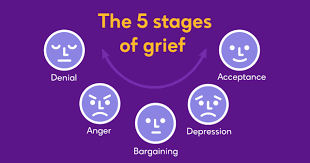
Psychologists teach us there are five stages of grief. Personally, I believe there are a few dozen, but I’m counting overeating, drinking, the gummy-chewing stage, the Marvel Universe binge-watching stage, and several others, but for the sake of brevity, let’s go with Elizabeth Kubler-Ross’ count-em-on-one-hand list of stages, from her book On Death and Dying (so right away we’re not in a good place).

The Fantastic Five: Denial, Anger, Bargaining, Depression, and Acceptance, or DABDA, as I just decided to use for sake of association.

First, here’s an AI generated overview before I slaughter them:

DABDA:

  • Denial: A natural reaction to loss, denial can help people slow down the grieving process and avoid feeling overwhelmed. It can also be a way to try to understand what’s happening.
  • Anger: A common reaction to the frustration of no longer being able to live in denial, anger can feel like an emotional outlet as people adjust to a new reality. It can also provide temporary structure and a connection to the person who died.
  • Bargaining: People may try to change the circumstances that are causing their grief, such as hoping that things will improve if they take certain actions.
  • Depression: A stage of grief
  • Acceptance: A stage of grief where people find control and figure out how to proceed

Denial: Stage One

I’m good at this—really in all aspects of life—but given the chance to forget that someone I love is dead, I’m all over it. This is most easily accomplished if you live a great distance from the deceased, or if you have had little contact over the years. Denial is convenient when you have a lot to do and thoughts of someone you love who recently passed or even not so recently slow you down. Kubler-Ross doesn’t disparage denial, but she does suggest it is best to move through it honestly. And I will, eventually. I understand it is simply self-preservation that I assume my father is at home watching golf (this one is hard to do since my mother no longer lives in the same place they did, so I am too aware of his goneness), Letty is visiting family in Italy, Eddie is playing blues in the city, Dave is misunderstanding lyrics at some coffee shop in Tampa, and Fr Dan, well, Fr Dan was already half in heaven to begin with. He’s not gone as much as he now plays the role of advocate. Richard made denial easy by his convenient disappearance from society and media several years ago. In my mind he’s home watching old Jane Fonda exercise videos.

It’s not easy to remain in this stage sometimes; there’s got to be a gummy that aides in denial.

But I see no reason we all can’t just assume those we love are off doing other things and they’ll be back in touch at some point. “It’s not healthy” Liz Kubler-Ross writes. Why? Why is it better to “accept” they are gone and won’t be coming back than it is to “accept” that they’re in Thailand playing Mahjong? It works for me, and I’m able to function properly without facing the reality that for the rest of forever, eternally foreverness, throughout the future of infinite time, I will never see these people again. They were here briefly; now they are gone.

“They’ve gone ahead,” people say.

“They’re in a better place,” people say.

“You’ll see each other again someday,” people say.

My mind holds onto that last one, yes, but not the way they mean it in some ethereal ghosty way. No. We’ll see each other again when they get back from Machu Pichu. I can’t wait to see their pictures.

Listen, I’m not dumb; I know they’re dead. Dave was in denial of death and told no one. Letty wasn’t crazy about it but moved toward it with class. Fr. Dan had no idea; neither did Eddie. Richard fell, so it’s doubtful he knew. Result: they’re not coming back, ever, and as Mr. Croce aptly pointed out:

“Photographs and Memories, Christmas cards you sent to me. All that I have are these, to remember you.”

Yes, I know.

But grant that my considerably better mood and more focused work ethic come from an absence of acceptance of such significant losses.

I recently attended a writing seminar about grief, and the moderator—poet Anne Marie Wells from Northern Virginia—asked us to think about synonyms for grief for five minutes and write them down. To do so I had to briefly abandon my denial stage, but it seemed Kubler-Rossy, so I agreed. Anne Marie distributed a poem wherein the poet (not her) had synonyms for “grief” which were more personal than any formal understanding of the emotion.

I took the blank sheet of paper and wrote “SYNONYMS FOR GRIEF” at the top, slowly and neatly, OCDish, taking it slowly in an effort to eat up some of the allotted time. I started with the obvious: sorrow, misery, sadness, anguish, distress, agony, torment.

But I didn’t believe it. I couldn’t feel it in my stomach where true grief exists. I jotted down a few more: sadness, depression, helplessness. They felt empty. Dictionary words. Pointless.

I put down the pen and reread the poem. I looked at the clock and still had three minutes in the exercise. I stared across the library where the seminar was held, and I saw a guy at the computer with headphones on. He looked like my childhood friend, Eddie, who was killed by a car while walking out of work one night. I thought of Harry Chapin—a connection Eddie and I had.

I flipped the page over and tried again:

“Synonyms for Grief.”

Cats in the Cradle. Golf on television on a Sunday afternoon. Brussels in September.

La Vie En Rose (That one rips me apart. Grief incarnate).

Paul Simon songs. Seared tuna. Hard cider.

Wham’s “Wake me up before you Go Go.”

Black and white photographs. Change jingling in a pocket. Coors Light.

French accents.

Okay, so I wrote “French accents” fifteen minutes ago and went for a walk.

My chest hurts.

Grief.

Grief sucks. It can be damn near suicidal. I get it Lizzy, I really do. It can also be cleansing; it can make us stronger, and yes, of course I grieve; I just did.

But denial is where it’s at. I’m running up to the post office and see if Letty sent a postcard. I might stop by the club to watch some golf, alone since my son’s traveling and Dad lives too far away. Then I’m going to finish the manuscript that was due last month about a friend of mine who is now living in a village in South America.

I just might be able to denial my way through the rest of my life.

Anger: Part Two  

(a bit more serious this time)

This is a tricky one since there are several levels involved. On the one hand we might lash out at others in some mind-bending way to “control” something, anything, as an emotional response to a death we had no control over which left us feeling helpless and abandoned. We might get angry at our children for the simplest of things to evade the reality of our own parents’ passing. Or we might be angry at the departed for departing, particularly when their exit is far too soon, burdening us with some sense of guilt for still being here, for slowly forgetting, for moving on. It’s a bit more rational to be angry when the death was self-inflicted. I’ve known several people who ignored that canon fixed against self-slaughter and ended their sea of troubles. Most notably a high school buddy who, after several attempts, succeeded when we were in our thirties. But I’ve learned much about mental health since then and it is hard to be angry at someone whose actions were quite decisively beyond their mental capabilities to control, despite what we wish.

In fact, anger either at the departed or at others because of the departed seems irrational at best. But it happens. For instance, my college friend Dave pissed me off. In the case of his death I blew right though denial and landed quite solidly in the deep end of anger. I’m not sure this is the type of emotion Betsy K-Ross was talking about, but give this a thought:

Some background. I knew Dave since the fall of 1979 and have written about him before on these pages. We ran a radio show together, worked at the campus newspaper together and the college radio station together, just him and me at 5 am for four years, Dave on news me spinning music, and we bonded during those pre-dawn hours in the chill of western New York. I stayed at his house in Buffalo on many occasions and became the “fourth son” of the family. We went on retreats together and relied upon each other for comic relief during pressing times throughout the next forty-five years.

Dave was talented but when he was faced with self-doubt, especially when he battled depression, he would call, and we’d talk until two or three in the morning. I once walked out of a reading in Virginia just after ten pm and he had called six or seven times. I returned the call and sat in the parking lot until dawn talking about all the reasons we keep breathing. He had no way of knowing I faced my own demons, and that he kept me going as well. I told him, but often Dave was not listening. That’s hard to explain. But we finished that conversation that morning laughing, laughing hard and even singing, “Old Friends.” And we talked about traveling to Australia together and writing a book. We both knew that would never happen; but talking about it pushed the other stuff out of view, and that’s why we stayed on the phone so long. We had to wait until our verbal tide came in and washed the rest away.

In the years since the introduction of the cell phone, we texted each other no less than three times a week. Sometimes it would be just some song lyrics that made us think of each other, sometimes a photo of the day. To be honest, I didn’t always answer when he called because he tended to ramble right past my “I have to go now, Dave” interjections, so I preferred the texts.

In late April, I texted him a simple hello and asked how he was doing. A random thing without lyrics or puns. He responded that he was fine, just a little tired, and he looked forward to talking soon. In mid-May the phone beeped, and it was a text from Dave. I opened it to find an obituary about Dave sent by his widow. My hands were shaking. I immediately called and we talked for a long time. Dave had been diagnosed with kidney cancer the previous September, but by the time they found it the disease had already metastasized rendering him a death sentence. “He fought hard the whole way,” she told me. He didn’t want anyone to know but his immediate family.

Pardon me on this one but Fuck You Dave (yeah, that’s anger right there). Seriously? First, the rationale for such silence is he thought he could beat it and didn’t want anyone to know, or he didn’t want people pouring sympathy all over him which he would hate, or he wanted to just focus on family, his beautiful three adult children and their own kids. Yes, I really do get that.

But those who exit without allowing others the chance to say goodbye or tell them how much they meant or at the very least acknowledge that you might not be alive if it wasn’t for him, just seems a tad selfish. This all came parallel to a deeply open knowledge of Letty’s impending death with the chance to tell it all to each other. Of the two, openness wins hands down.

Are you kidding me? It’s hard not to tell someone what you wanted to say when they just go away for a while, never mind forever. When I told Letty of Dave’s passing, just two months before hers, she was even more sure of her decision to expose her impending death to those she knew. No questions at all.

After I hung up with Dave’s widow I called Fr. Dan, who himself had but two more months to live and didn’t know it, and I told him the news. He was dumbfounded. He had spoken to Dave just two weeks earlier and all Dave told him was “I haven’t been feeling well; please keep me in your prayers.”

This forced me to wonder what I would do. Of course, my life has been an open book for quite some time, but it is more than that. Eddie got hit by a car, Fr Dan died in mid-sentence about his plans for the weekend, someone we love right now may not know what is next. Why aren’t we leaving it all on the table? Why do we keep our feelings, those deep, often embarrassing to admit out loud ones, inside? I can testify that of all the emotions I have about Letty’s passing, none of them is anger.

Dave on the other hand; I’m just pissed for him not giving me the chance—and he could have; I mean he knew what was about to happen—to tell him what I wanted to, and perhaps he had a few things he would have liked to say.

Well, lesson learned though. I just might dump pleasantries on you at any given chance just in case one of us exits the stage in the middle of the third act.

Still, Kubler-Ross addresses another anger in addition to the one focused at the bastards who died. This is the one where we feel helpless and lost, and someone once a part of our daily routine is now absent in all ways, and there’s no way to control that absence, so we channel that thorny emotion into one we can control which might relieve some of our anxiety at floundering without someone: Anger at ourselves.

Well, yeah. I’m angry at myself every time someone I love dies. Angry for not being there more often, angry at not having said what I so easily could have but simply didn’t bother to say. Angry at myself for getting angry at them in the past for the stupidest reasons. Angry at my aloofness and at my over-dependence, at my distance and my closeness and my silence and for saying too much.

Angry at myself for sitting quietly at the bay and watching the sun slip up above the distance and giving me another chance. EKR is clear about this one: the anger of guilt.

I’m aware of the psychoanalytical responses to this; please don’t load up the discussion page with comments about carrying on and blah blah blah. I know, really, I know. I get it. BTDT.

But understand: I welcome the anger at myself when someone dies. I think we all should get angry at ourselves when we didn’t tell someone how much they meant to us, how much we cared, how much we still do. It forces us to not make that mistake again. It impels us to be open with those we can, now, while time has allowed us to remain part of this ongoing brilliance of exquisite life.

Don’t keep your death to yourself while you are still alive.

Finally, Liz Ross writes that often anger is directed at some Deity for allowing the death to happen, particularly a premature death which for my part is the case for, well, all of them. This is the most ridiculous anger of all and I’m bored with hearing it. Listen, if your faith suggests death is all part of some greater plan, than your anger is contradictory and quite dumb as you’re now getting angry at a God who has enough control to decide death and when it happens to each of us. If you don’t believe that’s how it happens then move on, it’s no one’s fault.

I miss Dave. I miss his texts and more than a few times I have reached for the phone to write, “How terribly strange to be seventy,” in reference to our plans to sit on a park bench when we reach that age and sing Paul Simon’s song. But then I remember he fell shy by seven years. When I’m thinking clearly, I’m not angry at Dave; that’s foolishness. I’m not angry at some God or even myself. No, when I’m thinking clearly, anger is not part of any equation; only love, and the times we could have loved more.

Thanks Dave. Good on ya.

Bargaining: Part Three

At the end of The End, an obscure Burt Reynolds movie with Sally Field and Dom Delouise, after spending the entire film trying to die due to his terminal illness, Reynolds finds himself drowning in the ocean and decides he wants to live after all, bargaining with God. “Please God, if you save me, I’ll donate all of what I have to the church!” he screams as he tries to swim to shore. The closer he gets, however, the smaller the percentage. “Really God, save me, and thirty percent of everything…twenty….yes, fifteen percent of everything!”

We’ve all done this. “I’d give anything if…”  That’s bargaining. We’d trade our right arm for one more day. Even Willie Nelson would trade all his tomorrows. “Let her live at least until July and I’ll never again…” fill in the blank.

Bargaining is as much a part of living as death. It serves a purpose; that a loved one’s death was not in vain, and how we live our lives can change as the result of that death.  

The following diction is all negotiation:

Honestly, I’d give anything to be back in Hechscher State Park on the Great South Bay walking through the trails with Eddie, climbing the now-gone ruins of the old beach cabana along the water. How I’d kill to be back in some small café with Dave at two am having eggs and toast and laughing. One night Dave grew depressed because “even musician George Benson had become violent” he exclaimed as Benson’s song “Give me the knife” blasted from the speakers above us. Dave was so serious and maudlin about it I couldn’t stop laughing. Finally, I explained he was singing, “Give me the night,” to which Dave burst out laughing at himself. Geez. Yeah, give me that night, one more time. Give me one more morning at the radio station, Dave ripping headlines off of the UPI machine to read on air, all the while talking to me about his family in Buffalo. One more time, God, Buddha, whoever. Just once more.

And need I suggest that if I had riches, I’d trade them right now to spend another day walking with Letty to the farmer’s market? One more—damnit—just one more evening watching a Mets game with my dad. I’d head down to the crossroads and negotiate my soul for that one.

But bargaining is more than some ridiculous quid pro quo we try and slip in without anyone noticing, as if it can bring someone back to life, or sometimes bring ourselves back to life. It is how we keep our lives moving forward after someone dies. “From now on I’ll be kinder to people,” we say. “From here on out I’m going to let people know I love them,” we promise ourselves. But do we? So many negotiations are empty.

I don’t think I consciously slipped into the role of negotiator. But I know—I mean I happen to know for a fact—that the morning a high school friend of mine took his own life, he tried calling me in my office, but I didn’t bother answering as I was tired. Give me that moment back, of course. But why? Would that stop his determined mind? Who do I think I am that I entertain the idea that picking up that phone would have kept him out of the garage? But that’s not the point of Stage Three. We say and think those things as a method of imposing control over something we have no control over. It helps us say, quite astutely actually, I can’t save my friend’s life, but I can save mine.

We do that because it allows us to believe in things we would never accept under normal circumstances. If Eddie had left work even twelve seconds later, we would have had lunch that Christmas and reminisced about all those years hiking the trails of Heckscher. And I won’t say it, but until I am seventy I’ll think how I would have done anything to know Dave was dying so I could have taken my guitar to Tampa and sat at his bedside, and we would have sung that damn song about being seventy, just seven years early. It would have been a dream fulfilled that I could have carried with me for both of us. What would I have to do to make that happen? I would do it.

That’s Stage Three. It somehow reminds my subconscious that even though Eddie is gone and Dave is gone, our plans are still here, and their deaths do not necessarily mean my death. Stage three is the bridge from loss to that adjustment we must make to move on without those we love.

The day before Fr. Dan unexpectedly died, my mother had been in the hospital, and it didn’t look good for her. I texted him her condition, and he texted back. A few minutes later he called. He told me he had an appointment the next day but to call that following night and we could talk when he had more time.

When I retrieved my phone after work that next night to do just that, messages came through informing me of Fr. Dan’s death. That brings us to the “if only” part of life, that is bargaining with ourselves. Never again will I put off my friends, never again will I not help a friend who needs my help, never again.

But we do, don’t we? We put them off and we stop helping or even stop calling. As a society we promise we will do better after every damn school shooting, after every war, every natural disaster, we will do better to protect our children and our allies and our neighbors. It makes us feel better about ourselves and what we can do while we are still alive, and it helps us negotiate their deaths as something other than pointless.

I should point out that grief and grieving does not have to be about death, but when it is, it is called bereavement.

Well I’m focusing on bereavement grief, because I’m holding to the notion that if the ones who cause your grief are still alive you are still able to love, to forgive, to move on or even sometimes go back. So, sure we can call that grief the same way my mother used to take a deep sigh and say, “Why do you kids give me so much grief?!” But grief from death is directly related to the finality of the incident. She’s gone. He’s gone. They’re all just gone, dust, ashes floating in the Med, a corpse in some Florida graveyard.

Kris Kristoferson wrote, “I’d trade all my tomorrows for one single yesterday, holding Bobbie’s body next to mine.” Yeah, negotiation, Monday morning quarterbacking.

Regret.

The thing is, there might be no better time for regret than those days surrounding the death of a loved one. Yet people say, falsely I believe, “I have no regrets.” Well, hell, I do. Tons. They keep me sharp, make me evaluate my actions so I can avoid those same mistakes, they remind me to call people who are still alive knowing I regret not calling those who are gone, I’m talking forever gone, stardust, ashes in some Russian picture frame, ashes in some Southern Tier Franciscan Friar cemetery. Gone.

Yes, I cherish my regrets as emotional sticky notes reminding me to keep in touch, sometimes even to wear my heart on my sleeve.

E Ross suggests most of the bargaining taking place is with death itself, negotiating a longer stay in exchange for some vague and inconclusive adjustment to one’s lifestyle. “Just let me live long enough to see my kids be able to take care of themselves” is a good one for several reasons. It is fair to want that, but it leaves off the trade. It is a bargaining with ourselves to explore what is important in life. I don’t care if I die before the next James Bond film comes out, but let me live long enough at least for “this” to occur.

But I need to let Ms. Kubler-Ross speak for herself on this one:

Before a loss, it seems like you will do anything if only your loved one would be spared. “Please God,” you bargain, “I will never be angry at my wife again if you’ll just let her live.” After a loss, bargaining may take the form of a temporary truce. “What if I devote the rest of my life to helping others. Then can I wake up and realize this has all been a bad dream?” We become lost in a maze of “If only…” or “What if…” statements. We want life returned to what it was; we want our loved one restored. We want to go back in time: find the tumor sooner, recognize the illness more quickly, stop the accident from happening…if only, if only, if only. Guilt is often bargaining’s companion. The “if onlys” cause us to find fault in ourselves and what we “think” we could have done differently. We may even bargain with the pain. We will do anything not to feel the pain of this loss. We remain in the past, trying to negotiate our way out of the hurt. People often think of the stages as lasting weeks or months. They forget that the stages are responses to feelings that can last for minutes or hours as we flip in and out of one and then another. We do not enter and leave each individual stage in a linear fashion. We may feel one, then another and back again to the first one.

Right. For example, stirring those memories to write about Stage Three brought me right back to Stage One, denial. I like it there and it seems to have taken to me as well. I’m too rational to not know I can negotiate for decades and never bargain Letty back to life, never compromise Dave back to his wife or Fr. Dan back to be able to call that following night to ask about my mom. It’s not going to happen. I know this, and yet somehow bargaining helps us pretend, like kids playing in the yard, that we can make things alright if we “just do this one thing.”

If only it were that easy, Liz. If only.

One last thought about Eddie A. Radtke, musician, friend. We were rarely apart throughout our youth on Long Island. Then I moved to Virginia—pre cellphone pre computer, pre anything. But we wrote letters, and he would send the want-ads from the NY Times and Newsday for me to give my father along with real estate listing from Great River. Our youthful brains insisted we could make this work. It didn’t, obviously, and we both indicated how we would do anything to erase my move south. Eventually we lost touch. Then after more than forty years, social media brought us back together. It turns out we had everything in common; in particular, music. We spoke on the phone often for a year or more, and then finally we made plans to meet right after the holidays, but one December evening he was struck and killed by a car when he was walking out of work.

I’d give anything to have had the dinner a month earlier, to sit one more time and sing “Cats in the Cradle” together like we did in our youth, laughing at how we used to call each other in early mornings and sing as loud as we could, “There’s got to be a morning after!” from The Poseidon Adventure, and we’d laugh our way down the street to one or the other’s house. Give me that once more.

Seems all I’ve been doing lately is negotiating.

“It’s not too late, not while we’re living. Let’s put our hands out in time”

Depression: Part Four

Here’s One:

Dad once tried to buy a Snickers Bar from vending machine at a golf course. I hadn’t been nearby, but when I walked over he was getting angry. “Oh geez!” (Dad’s version of cursing). He said the machine was broken even though he kept trying to get it to work. He wanted number 110, the Snickers, and when he would push the “1” but before he would hit it again before moving to the “O,” it immediately gave me a pack of gum.  I pointed out there was actually a button that said, “110” and he only had to hit that button. He pushed it and the bar dropped, and I reached in for him to grab it and found four packs of gum. He wouldn’t mind me telling that story. Dad had a great sense of humor, though my tale would have been followed with a sarcastic laugh and a deep “Very funny” comment.

That story both makes me laugh and makes me sad.

When my father died, I wasn’t exactly depressed by his passing, not in the traditional meaning of the word; Dad had not been well for quite some time, and at ninety years old with dementia, his beautiful life as we knew it had ended long before his death. The depression I have about him is from him no longer being here, no longer around to talk to. I am depressed when I recall the grace of those days we spent walking at the mall, lunches around Virginia Beach, golf with my brother and son, sitting watching sports on television. Dad was a relatively quiet man, and he rarely spoke of his youth, but he celebrated ours and the childhoods of his children and grandchildren (and great grandchildren) every moment he could. It is his absence that hurts, the void, the knowing he no longer knows us, thinks of us, breathes.

Sometimes I think of him and can’t help but laugh at the endless great times we had; and I was fortunate enough to live near him right up until his death. Other times I think of him, something small, like his baritone “Yes Dear” when my mother asked him something, or the way he sat in his chair on holidays and watched everyone else talking, laughing, and he always looked so proud and happy, and when I remember those moments, it hurts, the goneness of him hurts. I don’t cry, which is odd to me since a passing line in Ted Lasso might make my eyes swell, but neither do I think clearly for a while.

Elizabeth Kubler-Ross points out something essential about grief—it is not linear. Depression and anger may weave their way around denial, and at any given time one might snap out of anger and cry for hours. When Letty died I was immediately—and even in those pre-death months—depressed. When Dave’s widow told me of his long illness and subsequent death, depression struck me like a baseball bat. The denial came a little while later and I liked it so I stayed there. But the depression makes its presence known at odd times. Predictably in the middle of the night when my mind can’t find anything positive to counteract it all, but also in random spurts, like driving past a mall dad used to walk at, and now they’re tearing it down. The mall didn’t depress me—the fact they’re tearing it down hurt.

But there is another facet to Stage Three which complicates the narrative.

Depression has multiple layers.

Let’s start with this: I battle depression. It isn’t melancholy exactly, and it isn’t sadness either; it is a complete sense of malaise, or, in simpler terms, it is sometimes not giving a damn about a blessed thing. A doctor once told me this might be why I try to live so very consciously, taking risks and exploring. A person like me just might need a bit more stimulus to accept the reality of life. A chronically depressed person (which doesn’t mean we’re always depressed; it means depression may very likely come and go for the rest of our lives) may have no intention of killing themselves, but they’re not against the idea of evaporating either. It is complete indifference. It is this: In Woody Allen’s Radio Days, a young boy who won’t do his homework anymore is taken to a psychiatrist who asks him why he won’t do it. The boy responds, “The sun is going to burn out in four billion years.” “So?” the doctor responds. “So what’s the point?” the kid says.

See, I get that. Not that I don’t understand the point, of course. But when someone cycles through a low in the depressive state, everything seems irrelevant.

Yeah, that’s not what we’re talking about here. E K-Ross bends it like this:  Depression as Stage Four is a very specific “Situation” borne depression. The absence of someone’s laughter, not because they moved away or are ignoring you but because they no longer exist in this world, no longer contemplate the changing leaves, no longer taste or hear or feel, no longer imagine, no longer have any form at all, and when one acutely focuses on that reality, it can be overbearing. That thought, right there, that from now until the sun dries up, someone we love is simply not returning, that any chance you had to enjoy their company has passed, is depressing.

So too is a Jackson Browne song which cries out exactly what I was thinking about someone I loved. It’s everywhere, these depressive triggers. Some are obvious—like that damn Chevy commercial with the family visiting the grandparents at Christmas and a nearly comatose grandmother goes for a ride with her teenage granddaughter—”Sunshine on my Shoulders” on the radio—I can’t even watch that one anymore. OD—Obvious Depression. Some are subtle, like the sound of ice in a glass (Scotch on Tuesday nights with Dad) or peach pie (Dad loved Mom’s peach pie).

The death and subsequent goneness of them is not directly the trigger. If someone asks about my father and I say he passed away in 2015, it doesn’t directly depress me. But if they asked when was the last time I met my dad at the mall to go for a walk, I just might be incapacitated for the afternoon.

The sound of a golf ball leaving the tee, announcers calling a baseball game on a summer afternoon, the aroma of turkey in the kitchen while a football game is on in the other room, remembering, sometimes just remembering.

Stage Four is the weight on the chest. I remember a neighbor when I was young who not only lost a baby in infancy but lost her husband and her thirteen-year-old daughter to a car accident one rainy day. Sometime not long after that, her son found her in bed, dead, and it was said her heart just gave out.  Depression can literally kill, of course, but it can equally kill the spirit, disengage any humor, and dissolve all sense of hope. It leaves one questioning what they did wrong that they are alone now (Bargaining), leaves one pissed that they didn’t tell others how much they love them (Anger), renders them useless laying on the couch in the dark on a sunny afternoon until they can convince themselves it is simply a bad dream, and the deceased is actually at work (Denial). Depression is the umbrella that all other Stages must cower beneath.

When I get depressed, I remember something to laugh about.

Here’s another one:

When his dementia had progressed but when he was still quite functional (which he remained until his final trip to the hospital), he thought there were two Joans (my mother). An upstairs Joan and a downstairs Joan, though I’m pretty sure he thought there were simply two women, and one of them was his wife. One morning when he woke up, my mother—the upstairs one–asked if he wanted to go out to breakfast. He agreed. My mother went downstairs, and sometime later he came down and when she asked how he was doing, he said, “The lady upstairs wants to go out to breakfast, and I said yes, but I really don’t feel like it.”

That makes me laugh every time, as I know it would make him laugh, and the only depressive element to it is my brilliant father’s deteriorating mind. No, depression hits me worst when I recall our trip to Disneyland in California when I was fifteen—just the two of us—that’s a great memory that gets me down. It’s the time he brought me to college one fall and stood around talking to my friends and me like he just didn’t want to leave, like he thought he might not see me again, before leaving. It’s the time he brought me to the airport for a flight out of Norfolk and we shook hands and he left two hours before my flight, but when the plane taxied to the end of the runway near the observation area, I could see him outside his car waving to the plane, not knowing if I could see him or not, that tears me apart.

I don’t think I told him I loved him until he was very old. I wish I could have done so earlier…

Damn. Negotiating again. Always negotiating.

Sometimes when it gets bad and I’m coldly aware of how much I screwed up my life and could use his presence—he never gave advice, but he listened very well—I sit and wait for denial to snap back to attention and save me, and I can go about my business still a little depressed, but this time because I forgot to give him a call before he headed to Florida. That’s what my mind does with him.

Depression never goes away, it just simmers, often without me even noticing, but also without me feeling completely relaxed. Ever. People tell me “You don’t recover from someone’s death, you just learn to live with it.”

Yeah, I know. And I appreciate the condolences and empathy. But what is not admitted is that while we live with it, yes, the truth is we do so a little slower each time, a little less of ourselves than we had been.

Acceptance: Part Five

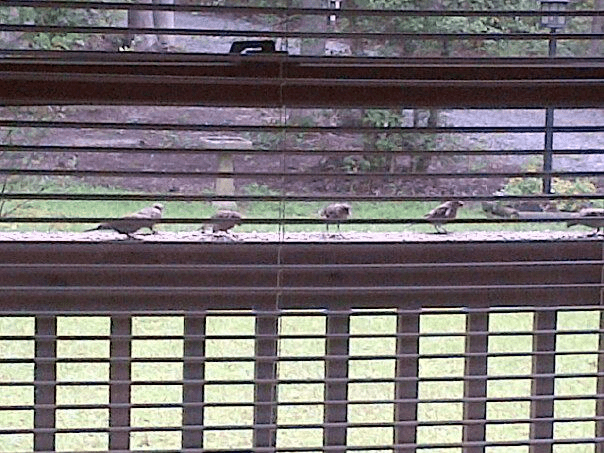
The truth is I accepted some deaths nearly immediately. Letty is the best example. We saw it coming eighteen months out and we talked about it often, particularly her take on the post-life expectations. She told me to look for the birds feeding on the porch and she’d be among them. She told me she’s just going to close the door behind her. So by the time July rolled around and she slipped away, acceptance of that new reality was already on the table.

Dave was more difficult having not told a soul about his impending death due to cancer. Richard was a shock but his self-isolation from society for several years prior to falling and dying made his death closer to acceptance than any sort of anger or denial.

They’re all different, and Ms. Ross is clear that the stages weave in and out of our consciousness, rising then receding, and just when acceptance seems at hand, depression might pop back on the scene.

The thing is acceptance is about knowing someone you love is gone and finally learning to accept that your new reality is one without them and learning to live that way. The less involved someone has been in your life, the easier acceptance becomes. Dave and Letty and Fr Dan and Dad maintained an absolute presence in my life, so accepting their absence, particularly since with the exception of my father, the rest all checked out at nearly the same time, has been more difficult. Accepting is a sense of no longer being lost when a particular time of the day might have been occupied by conversation or even texting, a long walk to the Farmer’s Market or a slow walk around the mall. The instinct might remain to wish you could do that again, or at the very least to slip into a funk because you can’t do that again. But acceptance is being able to remember those times, smile, appreciate how lucky you were to have at least had them, and continue.

Caution: Just when that happens, depression might snap back. Just saying.

These stages are circular.

In any case, when my father died, acceptance was easy because of the conditions of those last few years, but to this day I have trouble sometimes understanding that loss of security, even at my age. There’s something about the loss of your father that says, “You’re on your own, Pal,” even if I was an AARP member when it happened.

What I have found interesting is the larger picture here that I’m trying to frame for myself. Accepting the deaths of the primary people in my life from all stages of my life—Eddie from childhood, Dave and Bobbie and Debbie from high school, Joe and Cole and Dave from college, Richard from a time I was learning to live on my own, and through those years and the rest of my years until recently, Dad, Letty, and Fr. Dan, has caused an unexpected twist: the acceptance of my own death. While it has not become something I welcome, it has become something I don’t worry about, as if everyone else on my team went on ahead and is waiting, but that’s not right either.

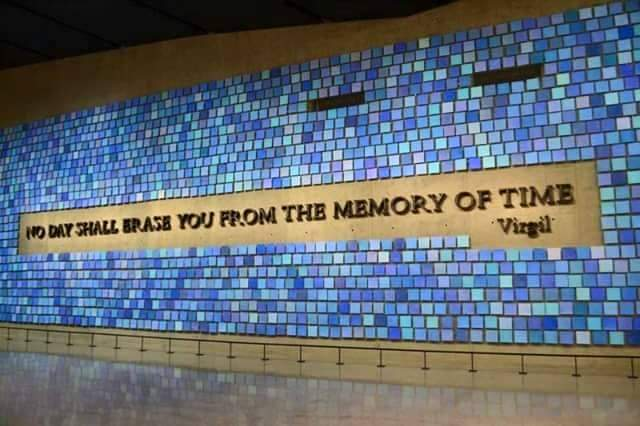
Maybe it is just that I accept that the world keeps turning without them, and so must I, maybe even by living more, experiencing more, particularly for those who left too soon. Acceptance for me—and this isn’t for everyone—means that death is more a motivator, like a new teammate; we’re working together here, this unusual macabre mentor whispering in my ear through the absence of my friends and family, “Keep going,” or as Virgil noted, Death “twitches my ear and says, ‘Live. I am coming,’”

Acceptance comes quickly when you hope for someone to no longer suffer, but it soon evaporates and is replaced by those other stages, like soccer players on a pitch replacing each other, taking a break so that the entire Grief Team remains strong. Eventually acceptance will return and dominate until it is our turn to put others through those same stages with our own departure, closing that door behind us.

For me there has been one exception, and those who knew Fr. Dan, and more specifically had a relationship with him like I did, as many have had, my “acceptance” of Fr. Dan’s death was nearly immediate. Of course the suddenness of his death, particularly only a day after we talked and hours before we planned to talk again, allowed Denial to dominate, but with Dan it is different. It has to do with his spiritual presence in all he did, his nearly reincarnation of the life of St. Francis and how Dan discussed saints and holiness as if they were brothers and sisters and he was already in and out of the otherworld, and more often than not it felt like he was heavenly from the start and took some time to visit us on occasion. This is difficult to explain, but he was not of this world anyway, so his departure from it seemed right. Letty wanted to stay, as did Dave and all the others. But Fr. always struck me as someone who couldn’t wait to die despite his absolute love of life and nature and all that exists, not in any depressive, suicidal way, but as if he knew something we didn’t, and we’d just have to see for ourselves.

People over the last six months have not missed the chance to remind me “you don’t get over one’s death or grief, but you learn to live with it, live differently.” Yeah, I know, and I do appreciate the sentiment and concern, but while acceptance is the ultimate goal, denial remains my favorite.

The Yankees lost the World Series (how’s that for a non-sequitur—hang in there) and while I’m not a fan having pulled for the Mets during the playoffs, once the Mets were out of it, as a native New Yorker I had to pull for the Boys from the Bronx. I know many Yankee fans, including close friends and a handful of misguided cousins, and I could observe the five stages of grief play out over the course of the last twenty-four hours. Denial, of course, that they could make it that far and lose so swiftly, despite the game they kept for themselves. Anger, of course; I mean they left the bases loaded with one out! Come on! That lead to bargaining of what could have been done differently, followed by the harsh reality you could see on the players faces after the Dodgers won, and, of course like all players of all games, eventual acceptance that this one got away but wait until next year. Having been a Bills fan for decades I’m well used to the routine.

So Liz’s efforts to label the stages of grief allow us to stretch beyond just death and find them applicable to many situations. But at the end of it all is death, which for the rest of us is the beginning of life without someone we loved and still love.

When I go for a walk I think of these people, and sometimes simply by having a wandering mind I end up in some pseudo conversation with them, talking to Letty about the floods in Spain, talking to Dad about his putting, talking to Fr. Dan about how hard it is sometimes to keep going.

And in my head he tilts his head back and smiles that wide smile, lets out a small laugh, and says, “I know Bobby, I know. It’s exciting, isn’t it? To not always know what happens next?”

In these days now when this happens, he walks away just then and I watch him move into my neighbor’s cornfield like James Earl Jones, and I turn to see Letty staring at me, saying, “He’s right Bawb. You need to keep going. Just ask him,” and she points behind me where I see Richard bouncing from foot to foot, saying, “She’s right Bob! Move your tooshie!” and that thought makes me laugh out loud, until depression settles back in, and just as EKR warns, it gets heavier and heavier, and heavier, until I put it down and spin back into denial, wondering what everyone is up to that day, out doing their own thing in the world.

But I know better.

You’re the color of the sky
Reflected in each store-front window pane
You’re the whispering and the sighing of my tires in the rain

You’re the hidden cost and the thing that’s lost
In everything I do
Yeah and I’ll never stop looking for you
In the sunlight and the shadows

And the faces on the avenue
That’s the way love is

–Jackson Browne
Letting Go of Small Hands

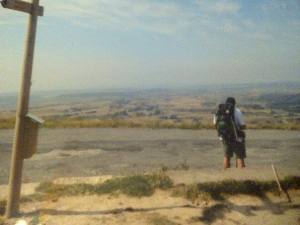
We don’t get up early enough. We don’t play with the kids enough. We don’t walk on the grass enough, we worry too much about losing. We don’t throw the ball enough, hike through the woods, climb the low trees, eat fruit off the vine, go for a drive. We don’t tell enough stories, listen to records, dance for no reason at all. We don’t call old friends who are hard to find, aunts and uncles who made us laugh, stay longer with our parents talking about the times we had, talking about the rain. We don’t journey enough to places close by, we don’t find beauty in what there is plenty of, we don’t appreciate what is common, we don’t celebrate what is in our grasp. We’ve lost the art of contemplation, of solitude, of fasting, of quiet walks. We forget the world exists in each step, the saints and martyrs, philosophers and missionaries walk with us, whisper about the temporal state of life, the immortal flight of a bird. Life is the way we sit around and laugh until two. Life is the feet on the coffee table, the tie undone, the kids asleep in their beds. Life is the sound of water in a pool, the sound of tea poured into china cups, the sound of distant thunder at dusk. Life is unwrapped gifts, cards in the mail, the smell of bacon on Sunday morning; drinking beer with friends on Friday night, the first cold day in autumn we need to wear a sweater, life is the spring grass showing beneath the melting snow. It’s the mother in the door waving to her youngest child moving away. It’s the father at the observation deck waving to his son on the plane. It’s the letting go of small hands; it’s the giving away of the bride, it’s the days that pass without a phone call.

Life is the distance between a falling leaf and the ground.

Observations

Observations

Michael texted from Spain a few days ago. He was boarding a train. I don’t know where he was going, and I’m pretty sure he didn’t either. I don’t know where he gets it from. The empanada doesn’t fall far from the oven.

**

Mark Z is in a hearing and META is being sued by hundreds of parents across many cases because FB and Instagram might be “dangerously addicting,” with bad influence on their tweens, including suicide. Question: Where the hell were the parents when the kids were nose deep in tech? Why aren’t parents of fat kids suing Hershey’s? Why aren’t the parents of wired kids with enlarged hearts suing Red Bull or Monster? Why aren’t the parents reading to their kids when they’re toddlers and teaching them the value of imagination? Why aren’t they instilling in them the value of life and individuality? Oh, that’s right, they’re on Facebook talking about who they saw at their college reunion.

**

Three months ago on Facebook I said Trump is not interested entirely in Venezuela as an endgame, that it was solely a means to and end, that he wants Cuba. Yesterday they announced their support of the current interim president in Venezuela, and it won’t be long before a deal is cut to get their oil at rock bottom prices. Meanwhile, no fuel or food has entered Cuba and they are quite literally dying, with no tourism, not business, no nothing. But wait, “we” can save them. Putin doesn’t care; especially if in exchange djt backs off his barely-there-anyway support of Ukraine. I think djt and the hotel side of his life has been Havana Daydreaming for quite some time.

**

I now have about forty pounds of Hershey’s chocolate. I use the cup holder on the treadmill at the Y to hold the wrappers.

**

Michael is now in Prague. I told him about the strudel; he told me about the Pilsner.

**

Ilia Malinin came in eighth place, falling twice in his free skate. Good. Here’s why: I support the US team, of course, but not his outrageous ego. He is the self-proclaimed “quad God,” and in one interview before the games he wondered not in any joking way why anyone questions his excellence. He dropped to eighth place; hopefully he dropped his ego as well.

**

Conversation a few days ago at Big Johns, a convenience store about twenty miles from here:

Guy eating chicken (I kind of know him so I felt comfortable responding) : “It’s those fucking Antifa’s. They can all fuck themselves.”

Me (I stopped eating all meat, including chicken, but that’s neither here nor there): “Holy Crap! You support Hitler! Stalin!!”

Guy: Fuck no! (laughs) Hell, no I don’t support them!!

Me: But…but…they’re fascists!!

Guy: Damn right they are!

Me: So you’re against them and people like them?!

Guy: Damn right, Bob! What the fuck?

Me: So then you’re against those fascists???

Guy: Yeah (chicken spray).

Me: You’re…you’re Anti Fascist! Antifa!

Guy: Not the same thing! (silent) Is that what Antifa means?

Me: Yes.

Guy: Fuck, I thought it was the name of some radical anti-Trump group!!!

Me: Well, yeah, it is.

**

When the fog starts to lift but is still in the trees and resting above the pond and river, my mind is focused and everything in my life seems clear and obvious. We need nature to clarify that which is muddled by cinderblock and drywall. We need nature to remind us to breathe.

**

The last thing Dave texted to me was “And we’ll all be together again.”

The last thing Fr. Dan said to me was “I’ll call you tomorrow night, Bobby.”

The last thing Letty said to me was “I love you, Bawb. Look for me with the birds on the porch rail.”

The last thing my mom said to me was “I’m so confused.”

The last thing my dad said to me was “What hotel am I in? HA! Hotel! I wish I was at a hotel! What hospital am I in?”

The last thing Eddie said to me was “I’ll call you this weekend.”

The last thing Cole said to me was “I hope your journey on this earth reveals itself to you.”

So now I wonder on a daily basis what the last thing I say to someone is. I’d hate for it to be something negative or down, something benign or flippant. Despite my Roy Kent tendencies, I’m determined to keep Ted Lasso in mind when I’m with others, especially when I leave others.

The last thing I say to most people is “see you soon,” or “talk later.” That’s normal I suppose, and somewhat hopeful and mostly about right.

Mostly.

Today I Discovered

I’m thinking of doing a kid’s show. Maybe an adult show but as if we’re kids. I’m not sure; I just thought of it when I started typing just now. But it could work.

I’ll call it Bob’s Log House. or Bob’s Got Way Too Much Time on His Hands.

I’ll play a song for all the seniors as we sit in a circle around a bowl of Cheese-Its and a few bottles of Mike’s Hard Lemonade, and I’ll play “Today,” or “This Land is Your Land,” or “I’m All Out of Fucks.” A bowl of gummies to share, perhaps.

And then we can have a special guest. Someone to explain Medicare, or someone to explain K-Pop. And there will be questions and I can move from person to person like Phil Donahue, and tilt my head slightly as if my follow-up question should be carved in marble for its brilliance. Then we’ll give the guest a BGWTMTHH t-shirt and coffee mug. It’ll be great.

Like SNL and other shows, we can have a News Update, and I could comment on what’s happening in the news, in Ukraine, Iran, Venezuela, and, of course, Greenland. I’ll keep the information as valid and accurate as possible, but since it’s my show I might toss out the occasional declarative observation, such as, “Apparently the President is attempting to get away with as much as he can in his first two years since he knows once the GOP is voted out of congress, he is fracked.” Or, “The Bills look good to beat the Broncos this Sunday.” I’ll keep it light, of course.

And I’ll finish each show with a stroll outside to the river; it doesn’t matter what the weather is since the weather was here first and I’m just passing through, and sometimes we need the storms and winds and rain to remind us we can still feel something, that all of the emptiness we constantly sense from others, slips out of our mind when a crisp wind comes down the Rapp and tightens our skin. And we’d walk to the river as I and whatever special guest might join me–sometimes my son, sometimes Kevin from next door or Wayne from the village, and maybe sometimes artist William Clarke or Governor Abby Spanberger–walk quietly until we both toss out short comments about what we discovered today.

Like how I just learned that if you take the pit of an avocado and slice it up, boil it until the water is dark, then let it become lukewarm, it is a powerful pain reliever to rub on your joints and skin, better than the emu stuff even.

Or how in Switzerland it is illegal to own just one guinea pig, or that Australia is wider than the moon (and way wider than the Mississippi), or that a shrimp’s heart is in its head, or how Romans used to drop a piece of bread in their glass before raising a glass, hence, to make a “toast.”

I have more. And you will hear them if you watch the part of the show where some guest and I walk to the river and mention that the shortest regional flight in the world is on Loganair and goes the entire 1.7 miles from Westray to Papa Westray, Scotland, in about 90 seconds. People will love this segment and it might make BGWTMTHH a viral hit.

And it’s educational so I could have gotten a grant from the Corporation for Public Broadcasting, but they’re gone so I can point out in that quick segment the irony of the defunding of the CPB because a tiny tiny tiny fraction of NPR’s budget comes from the CPB; the vast majority of that money was going to local NPR stations to help fund local programming, so now those shows are being cancelled, but the stations have to fill the time with something and since they pay one fee for NPR no matter how much or little of it they use, they are filling in the empty local timeslots with MORE NPR. So that DJT in his effort to get less NPR by defunding CPB, is helping to spread the bass-heavy, treble-absent voices of America. Who doesn’t love irony. I could have an Irony segment where I sit on my porch eating bacon and talk about irony.

I will never run out of material.

Like how when someone is cremated, the eyes vaporize. They just, well, vaporize. And I can’t shake that one. I think of all the beauty in the world, all the fields of the Netherlands with windmills and canals, and the dusty trails of West Africa, or the village streets of Mexico, or the rivers–all the rivers–and the tears from unbearable sadness and unforgivable laughter, and the idea that the eyes don’t so much burn up as much as they vaporize like a tissue tossed on a firepit that lifts into the air, into the darkness, its light fading quickly, and it is again part of the air and the world. That. That the eyes vaporize. Maybe I’ll end one of the shows on that, and the picture can fade out to quick images of places that are too beautiful to look at sometimes, and the faces of people who live inside my soul.

Tune in, my friends, for the new Netflix show, “Bob’s Got Way Too Much Time on His Hands.” Coming soon.

Life is Beautiful

It is January 3rd. Again. Spins around every winter, and over the last few years it seems as if we dropped a few summer months, maybe some weeks in October. Because it is January again, and my chances of reinventing myself are growing fewer.

Like anyone else, I would do a lot of things differently, especially over the course of the more recent years. But I can’t. The best I can do is start now, and keep starting. As many times as it takes.

Because, honestly, life is beautiful, but we insist on talking about the ugly. And as Confucius pointed out: Life is easy, but we insist on making it complicated.

Much peace my friends.

If I had my life to live over

by Nadine Stair

*******
If I had my life to live over,
I’d dare to make more mistakes next time.
I’d relax, I would limber up.

I would be sillier than I have been this trip.
I would take fewer things seriously.
I would take more chances.
I would climb more mountains and swim more rivers.
I would eat more ice cream and less beans.
I would perhaps have more actual troubles,
but I’d have fewer imaginary ones.

You see, I’m one of those people who live
sensibly and sanely hour after hour,
day after day.

Oh, I’ve had my moments,
And if I had it to do over again,
I’d have more of them.
In fact, I’d try to have nothing else.
Just moments, one after another,
instead of living so many years ahead of each day.
I’ve been one of those people who never goes anywhere
without a thermometer, a hot water bottle, a raincoat
and a parachute.
If I had to do it again, I would travel lighter than I have.

If I had my life to live over,
I would start barefoot earlier in the spring
and stay that way later in the fall.
I would go to more dances.
I would ride more merry-go-rounds.
I would pick more daisies.

In The Year 2025

For some years now I’ve spent time toward the end of December thinking about the significant moments of the year, which can often include some tragedy, of course. But I quickly became a fan of this wide-lens scan of the previous twelve months. It helped me focus on moments that meant something instead of memories just bouncing around my brain, turning them into little more than some passing haze between other, seemingly more important hazy thoughts. It didn’t take long to figure out that those five significant moments truly were the most important days of the year, and they deserve a more intense recollection. So I listed them for myself and thought about them, focusing, concentrating, then almost reliving them. Yes, even the sorrowful parts.

These are the five that emblazed themselves into my mind so that even just a brief touch of an aroma might bring back the day with complete clarity.

Gwynn’s Island, Virginia. Michael submitted a few pieces to a juried art show at the Island’s museum, and as a result he had to make several trips there to drop off the work, to go to the opening, and then to pick the work up after the show, so I joined him. We hiked the beach one time and ate at one of our favorite Mathews County places, Richardson’s. It is always relaxing when we go on one of our hikes through the trails or along the various coastlines of the area. On that day we dropped off his work and discovered the hidden gem of a museum with artifacts dating back to John Smith’s sojourn there and his storied subsequent swim in the Chesapeake not far from here, where he was stung by a stingray, giving the point its name. But the second trip there was most memorable as the turnout for the art opening was excellent, and they set up an excellent table of food and wine, while the artists and guests admired the work. An art historian and teacher sat as judge, and Michael’s work won first place. Her explanation of her choice was touching and as an art appreciation professor myself, I truly admired how well thought out her choices were (this isn’t Dad speaking, really). One of his rewards for first prize was a gift card to the popular local joint, Hole in the Wall, where we ate on our third trip down. This all seems fast and so local to rank as one of the five moments of a year, but it is hikes like these, combined with the display of his work, that brings such peace I cannot find many other moments during which I’d rather spend my time.

Curious Men: Lost in the Congo. While the official release date for my new book is not until January 4th (as that is the birthdate of the subject of the book), it is available already and receiving the copies in the mail meant more to me than my other works. This one was very personal, and it had been a monkey on my back for forty-five years. The work has been through so many versions, I cannot honestly tell you the final version is the best one, but it is the one that I believe works best for me now. In the end, I discovered the book was not about me and not about my friend. It is about trying to figure out life when out on your own for the first time, and what we choose to pay attention to and choose to ignore. What is most significant about this work and the release of the book is this one is the first book I’ve written which was done so entirely for me. I wasn’t thinking about audience, about others who knew the story, not thinking about critics or publishers, editors or bookstore owners. It was for me. It is the most honest thing I’ve written, and I still could have taken five more shots at it and not been completely satisfied. Releasing this book has more significance than I could ever possibly convey (and it is doing very well thank you very much).

Spirit Lake, Utah. Okay, so this one is special. We drove up in June to an area where snow still drifted across the trails and the temps at night fell into the low forties at best. No running water, no electricity, a wood burning stove in a cabin the size of an SUV, with a firepit off of a porch out front. Our cabin was “Sacajawea,” and we left it often to walk down the hill to Spirit Lake, lay on the dock and watch the stars, or more often to hike some of the trails climbing above 11K feet, where a few times we saw moose. Rarely in my life have I been that relaxed, that detached from everything which causes stress, and able to say what I wanted and talk for hours without any thought about how it came out. I was never so present. How often do we find ourselves so much in the present moment that all matters of concern slide away? It happened that entire trip.

The Netherlands. The only tense moment of this trip was at the end, when I was returning the car to the rental lot at the airport, and I accidentally left the airport and found myself on an interstate headed back to Amsterdam, and a sign which read, “Next exit 14 miles.” I texted to say I’d be really late getting through security, then I sped, spun about some cloverleaf, slipped into the rental lot thirty minutes later and tossed the keys to a man who wanted to inspect the car. I took off running and panted my way through security. The rest of the trip was perfect. To walk the fields where Van Gogh walked and painted, to stay in an Airbnb just a mile from where he lived with his parents in Neunen, to dodge bikes and cars in Amsterdam and stumble upon a festival in Volendam. I will say here that I had a blast, laughed endlessly, remained silent for hours without worry of the quiet, and wondered

beyond words what circumstances found us there with such presence of mind. There was the small village where a stroll into someone’s backyard yielded a take of water buffalo cheese and yogurt, and I met my new friend, Sparky the Water Buffalo. An old woman in a housedress came out to her own barn where we looked in cases at water buffalo ice cream and other items, to sell the goods without a word of English. By far, however, the highlight of the trip was a small ceremony for Staff Sergeant Edward L. Miller of Pennsylvania who died on December 17th, 1944, at the Battle of the Bulge, and where I stood silent while his niece rubbed sand from Normandy in his name, made an etching of his stone, and met the family who has taken care of his grave since the war. While they spoke to each other, I looked about these grounds of the American Cemetery at Margraten, at the more than 8000 fallen soldiers, and said to one of our hosts, “These men were no older than my students,” and the weight of war, of the Miller family’s loss, of this memorial journey across four thousand miles settled in my chest. What an honor to be part of this in a small, outside way. I can still smell the freshly mown grass as they were cutting it while we stood nearby. I can still hear the voice of the young woman at the park who spoke with such respect and honor. What a day. What an incredible trip. I’ll leave off the part about driving in Delft.

Mom. On April 12th my Mom, Joan Catherine Kunzinger, died at almost 92 years old. Joanie was the smartest, most honest, most caring, most loving woman I have ever encountered. Her strength as a young girl who had to take care of her siblings, as a young bride with two and then eventually three kids, as a wife taking care of Dad when he was not well in the last years of his life, and as a widow who hauled herself around absolutely always laughing, appreciating the fact she was simply alive and grateful. That is the word for Mom: Grateful, for everything, She could make friends with a lamppost and everyone I’ve ever met who met Mom, loved her. Her solidly Irish and Italian background came through strong, and she was forever a New Yorker. But Mom was at home wherever she was. I was fortunate enough to make more than fifty short videos of her talking about her life, but I cannot watch them without breaking down. Still, here’s the significance of her being on this list this year: She wasn’t expected to die. Not when she did. The day before I left for the Netherlands, I made a video of Mom in which she recites a poem about tulips, and laughs. I promised her I’d

bring her cheese, and she was very excited (despite her predictable “oh please don’t go to any trouble” comments). Two days after I returned but was still at my sister’s home in Pennsylvania, Mom fell while getting up from Bingo, and she hit her ribs on the chair. She never recovered as her paper-thin lungs were already beyond strained. I made it home in time for her to look in my eyes while she lay in her bed. Her eyes swelled a bit when she saw me, but she quickly fell back to sleep. She died that night after I had driven home.

But here’s the thing about this: I have in front of me a picture of the family the morning after the funeral, and we’re on the boardwalk in Virginia Beach, clearly and appropriately enjoying each other’s company, just as Mom would have wanted. My sister made a comment when captioning the picture about this being “Mom’s legacy.” That hit me well. There is her life, right there, in the three kids, the five grandkids, the five great-grandkids, and it’s only just starting. Mom taught me through example to appreciate just the reality that we are alive now, but not for long, so we must love. I never got to tell her all about Amsterdam as she was very excited about me going and was looking forward to hearing about everything. Instead, I ate her cheese. She would have laughed at that.

The days Michael and I spent at New Point Comfort before the art show, the narrative of Curious Men and why it means so much to me, Spirit Lake, the Netherlands, Mom—all of these are the most significant moments of the past year because of the people; only because of the people.

    I hope from now on when I recall events from my past, I recall them solely because I had the chance to love and be loved and let that always be what I remember.

    Wait. Loss.

    In my youth Dad always walked down the small staircase on Christmas morning to plug in the lights while my siblings and I waited. Mom would have stacked our gifts in separate piles under the tree, and after the three of us exchanged our own gifts earlier that morning in my sister’s room, we’d gather on the steps and wait. When the tree lights lit, Dad would call out “Okay, you can come down now,” and we would, each of us steered toward our own third of the presents.

    Mom was our Santa back then, waiting in lines for the right gifts, hoping she doesn’t ever again buy my sister the wrong album, trying to get it right, not knowing of course that she couldn’t possibly get it wrong. She’d be in the kitchen as soon as the presents were open so she could make the stuffing and prepare the pies for the relatives coming that day. And then later, after everyone had gone home and the five of us were again alone, Dad would emerge from his closet with books for each of us. This was special as it was common knowledge that Mom did all the shopping, but in the case of the books, Dad shopped himself, wrapped them himself, always picking out the perfect one for each of us, and would “surprise” us with them that night. It is a tradition I continue with my own son. Those days of “Dad’s Books” happened it seems just months ago, and the times that Mom worried she used too much spice in the dressing seems to have occurred weeks ago, but it could not have been. They both made it seem as if we had hundreds of holidays together with just the five of us, but it wasn’t even two dozen. That’s what time does when you’re complaining about the cold or the crowds or the difficulty finding just the right thing to give someone–it passes. Fast.

    October 2015

    I remember sitting in the uncomfortable recliner next to the hospital window and thinking, If I’m here a few more days, I might take down the clock; laminate the list of television stations he will never watch; ask to fill in the information on the empty whiteboard I’ve stared at for four days, note the nurse’s name, cross off the faces from frowny to happy to indicate his pain tolerance. If he had more time, I might move his bed closer to the window.” Three times I moved his food trays, trice-daily reminders he hadn’t regained consciousness, into the bathroom. I can still smell the aroma of onion soup he never knew existed.

    Most certainly I would move the two boxes of blue latex gloves from the wall inside the door to the wall outside the door. Nothing says “If I touch you, I might die” like blue latex gloves. I would silence the incessant beeping from the health monitor above his head.

    I didn’t mind the wait. As sure as I knew his blood pressure, blood oxygen level, and pulse, I will miss the wait, the slim possibility, the sliver of “just maybe.”

    The text from my brother read, “He’s gone. Come back over.”

    I dismissed class just after 8:30 and left for the hospice center a few miles from the college. I forgot to tell the students it would be a few weeks before I returned. I drove to see my suddenly late father.

    We took turns saying goodbye again, this time after the fact. He looked gone—as if he’d been dismissed, like he transferred or simply dropped out. I held his bare arm below the sleeve of the green golf shirt they provided. I wondered if all the patients had the same shirt. The entire building had a sense of oneness, of warm togetherness, like all the nurses should have the same name, and all the patients looked like my dad.

    I kissed his withdrawn face. I thought he might feel cold, but his arm felt warm as if from the sun during all those days at the field coaching my brother in Little League, and from sitting all day in the baseball stadium bleachers, buying me hotdogs, letting me keep score as he showed me how to fill in the small boxes.

    When I took his folded hand in mine, it felt stiff, but not from some medical transition; no, more like his muscular grip back when he took my infant son in his arms and laughed, his eyes wider than space, his laugh deeper than love, just moving his grandson up and down as they laughed and my son reached for his nose, for his glasses. I reached for those glasses now, unused on the nightstand, and held them.

    A week earlier I stopped at the hospital to check on him, expecting another day of quietness after a week of unconsciousness. But I walked in to see his eyes wide open, staring at the ceiling, then at me.

    “Well hello,” he said in his baritone voice.

    “Hey Dad, how are you?”

    “I’ve been here since 4:30 this morning.”

    “You’ve been here for four days.”

    “Four days! What hotel am I at? Ha! Hotel! I wish I was at a hotel! What hospital?”

    He could have been thirty years younger. After a long, slow year-long erosion from dementia, I had not heard Dad so lucid in several seasons.

    “You’re near home, Dad. You’re at the hospital right near home.”

    “It is serious, then?  Tell me.”

    “You have pneumonia, Dad.”

    “So I probably don’t have much longer, do I?”

    And that nurse came in and Dad checked out, turned his head and closed his eyes one last time just days before he died. That night I rode in the transport ambulance to take him to hospice.

    If I had more time I might tell him about my failures, my shortcomings. But there is never enough time.

    April 2025

    We were in a cheese factory shop in Volendam with baskets of cheese wheels to bring home. I held a bag of four wheels and thought about who I can give them to after I separate them. “I’ll give one to Mom,” I said.

    Stateside, I stopped at my sister’s home in Pennsylvania when Mom’s nurse called to say she had fallen while rising from her chair at bingo, and she hit her ribs on the chair, bruising the bones around her already-weak lungs. Her nurse, Max, held the phone so Mom could talk. “I’m so confused,” Mom said to my sister and me, and I said I’d be home the next day. A while later another nurse called. “Your mother is transitioning.” She’s becoming a man? I momentarily wondered, not trying to be funny; I truly had never heard anyone reference the stage between being not at all dead and about to die as a “transition,” but I suppose it is as good a euphemism as any. Certainly, “Your Mom is dying,” appears a bit colder, but I still think I’d have preferred such directness over the “I’m so afraid to say what is happening that I’m going to wrap it in obtuse verbs.”

    The next night I leaned over her sleeping body and she opened her eyes and they welled up, and I said “I love you, Mom” and she fell quickly back to sleep. Later that night my brother texted. Mom was gone. That was either eight months or eight years ago.

    I miss the waiting, especially this time of year when I’d be waiting to give her some gifts—probably flowers and a gift certificate to take her to a nice lunch. She reached the age where those gifts of time spent together were the most valuable.

    I miss making videos of Mom, and how for every one video I recorded I deleted four or five because they were too ridiculous to publish. I miss those outtakes now.

    I miss seeing Mom in the foyer of her home waiting for me to drive up the circle to pick her up, a wide smile followed by an “Oh, it is so good to get out for a bit! You know?” I knew. She didn’t care if we just drove around. I’d park the car at the market and she’d wait for me as I ran in to get her bananas, fudge stripes, and flowers.

    That last time I saw my dad before he entered the hospital he had sank a twenty-two foot putt on the practice green and looked at me with such a proud and excited reaction it’s as if my entire life collapsed into that moment—the golf when my brother and I were young on the Island, that time Dad and I went to see Jaws when it first came out, or when he and I went to Disneyland in California; our lunches every week after he retired but before Mom had. Strangely, I think I felt the loss of my father before he even died because of his ebbing mind and misunderstood timeframe. Loss comes unexpectedly and often out of joint.

    The last time I saw my Mom I told her I’d be in Amsterdam and we were going to Keukenhof to see the acres and acres of flowers, and would she like me to bring her some tulips. She stared at me a long time, and I waited, and more time passed, with my phone video playing, and still I waited wondering if I had lost mom right then, until finally she smiled and recited a poem from her youth.

    It was worth the wait.

    Merry Christmas Mom. I’ll put on some Christmas music for you—some of your beloved Andy Williams. And Merry Christmas to you too Dad. I’ll plug in the lights Christmas morning and later that night I’ll give Michael a book, and I’ll be thinking of you.

    May 23, 1925-October 21, 2015

    Dad died ten years ago this Tuesday, the 21st. Words can’t express how I miss him. The following essay first appeared in Kestrel: A Journal of Literature and Art, as well as my collection Fragments, and anthologized in a few other publications. It was the last piece of my writing I am aware my father read.

    12063306_10207030426106557_3199067376729529480_n

    Instructions for Walking with an Old Man at the Mall

    First of all, he’s walking, you’re joining him. Don’t stop if he doesn’t. Don’t keep walking if he doesn’t. You are a shadow, an imitation.

    Stand on his side where he can better hear you. If he can’t, repeat yourself as if for the first time, no matter how many times. Never say “never mind.” When he tells you something, you have never heard that story before, even if you can repeat it word for word. When he tells you about the baseball games with his Dad seventy years earlier, they are new stories, and your response must sound genuine. When he tells you about the time he went swimming at camp with his friends, and how when they went to retrieve their clothes from under a boat they found a snake, be amazed again, ask what happened. Laugh again since he will laugh.

    When he pauses in front of a store, don’t question it. At that moment, allow his sole purpose in pausing is to look at whatever item is in that display. He might mention how he used to own that tool, those pants. Let him know you remember; do not make a big deal that he remembered. He needs you to know he didn’t stop “to rest”—he stopped to look at the display. When he says he could use that new suit, a new pair of shoes, or a new whatever is new, agree. If he happens to stop in front of Frederick’s of Hollywood, there’s no need to joke; it will only emphasize he couldn’t get past a place he would never stop with his son. This time he simply couldn’t continue. Talk instead about his grandkids. Talk about the rain. Do not talk about old times. There’s no need to recall the time he drove you to the airport for a flight to college and you saw him hours later waving to you onboard the plane. Avoid bringing up the time just the two of you spent the day at Shea Stadium when you were a child. Instead, ask about the Mets and if he happened to catch the game last week. You know he did. Let him tell you about it.

    When he seems tired but doesn’t want you to keep stopping, stop to fix your shoe, to read a sign; look for a bench and suggest you sit and talk. He’ll ask about your son; he’ll ask about work. Have something to say other than “fine, Dad.”

    Do not look at your watch. Do not check your phone; most definitely do not check your phone. Leave both in the car. Do not indicate in any way he is keeping you from anything. No other time is relevant anymore. But you will grow tired and restless. If he senses this, he will insist you leave. He will say he knows you have a lot going on, and he’ll say he’ll see you later, and he’ll do whatever he can to make you feel he is completely fine with it. Stay anyway. Then sit a bit longer. Do not ask about the doctors; the walk is to forget about the doctors. Do not quiz him on medicine or schedules. He is out for a walk, you joined him, it is something about which he will tell others—that he went for a walk at the mall and his son was there and joined him. Do not let his story end with “but he had to go.”

    When he can’t remember where he parked his car, ask if he parked in the usual area. He did. Sit down for a few minutes. It will come to him. There’s no need to ask probing questions like “which stores” or “what street” he was near. Just sit a while. He’ll remember. You’re not in a rush.

    When you leave the mall be near him as he steps from the curb, but do not help. He will be fragile and unstable. The step from curb to parking lot is a leap; he used to do it with you on his shoulders and two others running out front. Let him step down on his own but be ready. He bruises easily and a simple scrape is a trip to the doctor. Have the patience he had when your childhood curbs seemed like the cliffs of Dover.

    Don’t say “I guess I’d better get going.” Don’t make plans. Don’t make any comment to indicate he did well or that it was a “good walk.” He didn’t do well and it wasn’t a good walk. He’s older now. He’s slower now, but he knows this. Really, once the walk is done, the time spent together always seems to have passed faster than we recall. He knows this as well.

    12143183_10207071237766823_459922957598238343_n

    Let Go

    Taxi Driver by Martin Scorsese (1976) | SP Film Journal

    It’s the second week of classes and something new and exciting is happening that reminds me of my first days away at college: No one is using their phones. They are actually all in class talking to each other and to me, and listening. I have no idea why.

    The first time I went away by myself, other than a few extended trips with a high school friend of mine to Chapel Hill, North Carolina, and camping in the mountains, was my freshman year at college. That was a nine-hour drive from my home, so returning on a weekend was simply out of the question. This was a time when communication by today’s standards was archaic. We had no cell phones, no computers, no answering machines if we even had a regular phone, which I didn’t. Mine was a payphone at the end of the dorm hallway which I shared with ninety, often drunk guys. So even if someone did try to reach me, one of us on the floor would not only have to hear it ring, but we’d have to muster up the energy to walk down the hall and answer it. Doing so then entailed learning who the person was calling for, walking to that person’s door, banging until they answered as you yelled “Bob! Phone!” and then return to bed without letting the caller know if the person was even home. So no “message” would be left.

    We wrote letters, on paper, with stamps and envelopes, and walked them to the post office on campus. But with papers to write, parties to attend, basketball games, and hikes along the river, letter-writing was not a priority. Instead, when we went away to school, we went away. Gone, out of their lives. See you in someday.

    I arrived that first year in August and returned to Virginia Beach in November, and during that time away, while I often called my father at his office due to his toll-free line, and my mother much less often due to my lack of ability to plug the payphone with quarters, I didn’t talk to a single high school friend in any way for three solid months.

    But when I got home. Oh, wow, when I returned home that first Thanksgiving weekend, I headed to my friend Mike’s house, and our friends Dave and Michele and Kathy and Patti all came over, and we sat out back or went to Pizza Hut and we talked. We told stories and talked and laughed so hard I can still picture us sitting there like it happened last week.

    We had so much to catch up on. I told them about college, about the hills of western New York, about my roommate and floormates and others I met and became close to. I told them about apple picking in Albion, New York, with a friend, or about how two other friends and I drove to the Billy Joel concert in Buffalo and got lost on the way back. I had an endless bag of stories to share with them, and they caught me up on life there. Dave was married, Michele had her first son, another was still out in Nashville and another in nursing school.

    We all looked different than four months earlier. Older somehow, despite the probable lack of change. But nineteen is a time when even just a little bit of maturity comes from the slightest change. We met new people, added new dimensions to our personality and experiences. I was hitchhiking to Niagara Falls, Jonmark was doing well in Nashville, Mike was doing traffic and news for a local television station. We had stories to tell that we would never have had to share if we all stayed a part of each other’s lives on a daily basis. What’s more, other people entered our narrative. When you break off completely and start anew elsewhere, you learn new ways—it truly is that simple. I’m not suggesting that one doesn’t mature and learn and grow without leaving. But one point is indisputable: I had no idea what any of them had been up to, no clue. And they couldn’t possibly conceive of what I’d been doing. And there was no device save the US Postal Service to keep us informed.

    So we had to catch up, and I had new friends.

    You see, something unexpected happened that I just now tried to tell my students about. When I returned to college, the same thing happened as when I went home that first time. It had only been a week since I left for Thanksgiving, but upon return, I could not wait to see my new friends, those I was literally living with, ate with three meals a day, walked home with at three am, cried with. The few days away from them felt longer than the time away from those friends from high school I’d known for some years. Something was different. All those changes that had scared me to death before leaving for college turned out to be the best thing for me, and that time then would not have been nearly as significant had those changes occurred while still holding the hands of friends through some WIFI umbilical back to the beach.

    Fast forward.

    During my first few years teaching college in the early nineties, I’d walk down the hallway toward class and could hear the students talking, multiple conversations overlapping about the weekend, about plans, majors, transfers, food, concerts, about life, all of it. New friends mostly, evolving into new relationships, new ways of thinking. I’ve seen strangers become partners become parents. And after a long college break, it took ten minutes to quiet down the room, everyone catching up, seemingly happier to be back then to have gone home to begin with.

    But that eroded; slowly at first, and then with discouraging speed. When I approach a room for class these days, it might as well be empty for the silence. It’s easy to think it is, until I turn in the door and see twenty-three students sitting silently, staring at their phone, texting the same friends they’ve been texting since seventh grade, not knowing even the names of those next to them, one of whom might be their significant other, or a friend with similar interests, or someone with familiar plans and hopes. They don’t seem to even care.

    They’ve never learned the art of missing someone, the value of silence, the strength that comes from a complete lack of ability to communicate. The time spent in their own thoughts, without music, without social media, without letting go for a period of time without knowing what happens, has slipped away. College students remain knee deep in high school conversations well into their collegiate years, and it leaves them all with a much more provincial perspective.

    Today, just now, that seemed to change again, and my students–all away from home for the first time–talked to each other, learned names, made plans. It felt right, like some semblance of humanity has survived the technological advances.

    There was a time we were all prodigal children, and those we loved embraced our return from that unreachable place we went to, be it away at school or another state. And we learned how love can survive such incommunicado. I once went twenty-two years without talking to someone and then spent two straight days catching up. And honestly, I don’t think I would have appreciated her half as much had we never lost touch. It helps to let go, to follow different paths and not be tethered by technology, and then find each other again and find out how friendship has little to do with constant communication.

    And more, during those times I was somewhere else–Arizona, Massachusetts, abroad, and had no means of reaching someone, I discovered more about myself than I ever would have by holding on. I see my students now using expressions I had thought were long gone:

    I hope to see you soon.

    Keep in touch.

    Drop me a line.

    How have you been?

    So, what happened?

    I have missed you.

    These simple phrases have brought me such growth, such love, and such peace, they remind me that the strongest connections come after letting go.

    The Rest of Me

    I ask my students the same question the first class every semester. I pull a chair into the middle of the front of the room, ask them their names and where they’re from, and we talk about the area, hobbies, majors, quirks, travel favorites, and more. Half the class—I find it a priceless investment in time as they warm up, get to know me and each other, find themselves more able to talk throughout the semester, ask questions, share ideas.

    Then I sit quietly for a second and ask them the same question every time:

    What are you capable of?

    What do you think you are capable of? I don’t mean “What do you hope you can do?” but what tangible proof from previous experiences has convinced you it is worth reaching out a little further than your grasp this time because you know you can do it?

    It’s not an easy question to answer because it is difficult to know if we can achieve that which we have not yet attempted, so at best we need to guess. And even the most educated guess is still hypothetical. Yeah, I lose a few at this point, but I usually can reel them back in by jumping that chasm to the goal. “Okay then,” I continue. “What do you wish you were capable of?”

    I remind them that unfortunately, every semester the evidence gets worse that freshmen in college are capable of anything other than having technology complete their assignments for them. I insist, then, that one of the finest results of college beyond the degree and the friends and the job prospects is the sense, the absolute pure sense, of accomplishment. To achieve something, to find out we are capable of so much more than we thought, becomes part of one’s bloodstream.

    I asked myself that recently, the Capable Question. It was my birthday, sixty-five years to the day after I showed up at the now defunct Shore Road hospital in Brooklyn; one year to the day after Letty “closed the door behind her.” I looked back at what I have done with my life, who is in it and who no longer is, and who is again, and the good news is I’ve been around the block a few times and that’s one thing I always wanted to do. The bad news is as it turns out the block isn’t in my neighborhood.

    Sometimes I don’t know where the hell I am. For a person who has traveled as much as I have, I still need direction an awful lot of the time.

    So I asked myself, “What are you capable of?” I figure I still have a couple of decades, surprisingly. Maybe more on a good day, maybe just a few weeks when my mind downshifts. But let’s call it twenty years.

    I just agreed to a location to perform a one man play in New York. My book Curious Men comes out in just a few months. My book Office Hours comes out in about eighteen months. My fig trees need watering. I’m thinking of getting a new cat or two. Maybe a dog. A goat for sure.

    A few months before she died, Letty and I sat in Starbucks at the beach and after a lot of laughing, she said, “I always thought I’d be here past sixty-five, Bawb. I just never thought it would all be over; my life would be completely done at sixty-five.” I nodded. I tended to avoid trying to come up with a response. She didn’t want one. She wanted me to listen, to hear her existence, to be there while she was being alive. After a while she leaned forward and said, “Since I’m not using the rest of me, you can have those years. I trust you to use them well. What will you do with them?”

    I thought about it like she had some power to give me twenty more years. “I am going to walk the Camino de Santiago again. I’m going to drive through the northwest for a few weeks. I’m going to take a river cruise in Europe with a friend of mine. I’m going to camp in Havasu Falls.”

    “…and?”

    The perfect response. “And?”

    This is all to bring up a point:

    After something I wrote went online about a month ago, several people, some I don’t know, wrote to tell me how good it is that someone my age still thinks I can do something new. They wanted me to know how much they are behind me no matter how outrageous it is that I’d try something besides enjoying retirement.

    Two things here: One, I have no idea what they’re talking about. And two, Seriously? I mean, I’m sorry you took a nose dive as soon as you were eligible for Social Security, but I can’t wrap my mind around that mentality. Maybe it’s because retirement is somewhat irrelevant if you never really worked to begin with, but also in the world of arts, in the realm of love, there is no “retirement.” You can’t turn it off, you just can’t. And I want to spend my time with people I care about, seeing things together. I felt the same way when I was in my twenties. Did you guys grow tired of those you know?

    “Someone my age” my ass.

    I’m not going to republish the litany of accomplishments by people in their seventies and eighties. If you understand then you’re not sitting around lamenting anyway; and if you don’t, you’ll just shake your head.

    I have done okay until now, and parts of my life turned out to be riddled with circles, as if Einstein was right—there is no actual “time,” humans have just made it linear so we can comprehend our passage here. Well, I’ve never been good at staying inside the lines anyway.

    Honestly, I don’t know what’s going to work and what won’t work from day to day. I just hope for the best for the rest of me.

    But, at the risk of being in over my head, here’s my plan: To speak my mind, about love, about hopes, about what is working and what is not. To keep writing as long as I have something to say. To fulfil some plans that I can’t shake.

    I’ll retire when I’m dead, and then I’ll close the door behind me. If something should happen to abort those plans, feel free to take the rest of me and see what you’re capable of.