Instead, this:

I started this blog twenty-three times tonight and ended up with nothing. It is one of those times when nothing I write comes close to what I want to say.

So instead, this:

for Dave

“I counted my years and realized that I have less time to live by, than I have lived so far.

I feel like a child who won a pack of candies: at first, he ate them with pleasure but when he realized that there was little left, he began to taste them intensely.

I have no time for endless meetings where the statutes, rules, procedures and internal regulations are discussed, knowing that nothing will be done.

I no longer have the patience to stand absurd people who, despite their chronological age, have not grown up.

My time is too short: I want the essence; my spirit is in a hurry. I do not have much candy in the package anymore.

I want to live next to humans, very realistic people who know how to laugh at their mistakes and who are not inflated by their own triumphs and who take responsibility for their actions. In this way, human dignity is defended and we live in truth and honesty.

It is the essentials that make life useful.

I want to surround myself with people who know how to touch the hearts of those whom hard strokes of life have learned to grow with sweet touches of the soul.

Yes, I’m in a hurry. I’m in a hurry to live with the intensity that only maturity can give.

I do not intend to waste any of the remaining desserts. I am sure they will be exquisite, much more than those eaten so far.

My goal is to reach the end satisfied and at peace with my loved ones and my conscience.

We have two lives and the second begins when you realize you only have one.”

~Mário de Andrade (San Paolo 1893-1945) Poet, novelist, essayist and musicologist

That Student

Its the end of a semester, finishing up today, and I sit and remember one of my favorite moments as a professor; ironically, it was a day I encouraged a student to quit school. Honestly, not everyone belongs. Not yet.

A student comes to see me. He says he can’t handle the pressure of school. I tell him I think he’s a good student and he says yes, he can do the work, he just can’t stand it. He hates it, he says. He gets bored fast. It’s a good conversation, honest. Had we been somewhere else we would have talked over beers. He looks at his watch and says he has to work in a few hours and sighs. He runs his own roofing company but hates that too. He has six grand invested in equipment and no help and he just dreads doing the work now. He says he’s at some fork in the road, two paths that look the same so he’s frozen, easier to just stay put. He gets quiet and stares at a photograph on my wall of a village in Africa. Looks nice he says, like he wants to say anything to forget what he’s really thinking about. Then he remembers and sighs again. He’s quiet for some time and I find myself drifting.

I worked at a bar. Good money and mindless work; the kind of work where if you don’t think too much about what you’re doing, you can keep on smiling. I know I spent a few years there but it seems like it was always winter, all grey and bone-cold. One morning I woke on a bench near a lake in a state park near my country house, but I didn’t know how I got there. I had to work a few hours later but never made it. I drained my accounts, stuck a little aside, then bought a ticket to Africa. Turns out changing my life, kicking my own ass out of the same ‘ol same ‘ol, was as easy as jumping off a cliff knowing you’re either going to land on your feet or learn how to fly. Boring disappeared from my life.

But this student has trouble talking about it, so I talk: I tell him I get that feeling in my chest too. Tight, constricting, difficulty breathing. You know what I’m talking about. It’s the sense that something needs to change. It’s the Philosophy class with five minutes left of three hours and the prof starts another chapter because there are still five minutes left; it’s the meeting you can’t tolerate but you’re in a row of seats with too many people on both sides so you can’t leave; it’s that this-homily-is-way-too-long feeling. It’s the feeling you’re just one day away from something else, but then that day comes and you find yourself one day away from something. It’s the Whitman poem about astronomy; the wide awake at three am feeling and you can’t move so you stare at the alarm clock. Exactly, he says. I’m always staring at the clock, he says. I’d love to know what you’d do, he says.

I tell him about that bar somewhere I didn’t belong. I remember working and then not working but I don’t remember what happened between the two. I just recall waking up one day in the peace-of-mind of another world, centuries away from being behind bars; like I could finally breathe on my own. I let him know I remember dreading the moment between what was and what was next so I just kept pouring drinks, and he nods. He knows. Then I say that one day I didn’t. It was that simple. He looked at me like I was looking in a mirror. Then he says he’s going to work and he leaves. I went to class slightly high on remembering, still somehow slightly down, suddenly lethargic.

Six months later he sends me a postcard from Australia. Don’t know when I’ll be back, it says. When I am, let’s get some beers and talk. I look forward to it but, of course, way leads on to way, and I doubt he ever came back.

Cathy Kunzinger Urwin, Ph.D.

Today my sister turns seventy-years-old.

Let’s start with this: My sister should be dead. Some years ago Cathy was diagnosed with aggressive stage four ovarian cancer. She had to undergo treatments in Philadelphia, knowing the odds of surviving even for just a couple of years were slim. She continued to work daily in Princeton, New Jersey, forty-five minutes from home, and she battled the monster. To the point: If you know anything about my sister, you know that ovarian cancer, even stage four, didn’t stand a chance. That was more than ten years ago, and not only did she defeat the cancer, not long ago she was told she is completely cancer-free and doesn’t need to return.

First picture ever of the three of us with Mom, Point Lookout, NY, 1960

Of course. That’s Cathy. One of my heroes.

I thought about telling “Cathy stories” here, like how she got my copy of the then-brand-new Let it Be album by trading me a Bobby Sherman album. Or how she let me use her guitar all I wanted. Or how she sent me care packages, made me ceramics like a seagull mug and another of a seagull standing on one wing, a beautiful rug she made of a seascape, and a pillow she made of Fozzie the Bear. How she introduced me to the music of John Denver which carried me through some difficult nights as I went out on my own, and how she sent me a plaque she made with the lyrics to John Denver’s “The Eagle and the Hawk.”

Cathy and Fred holding up their chubby brother

She doesn’t recall but I do how during the Watergate fiasco, my history-major sister quizzed me relentlessly in who the primary players were at the hearings. I was thirteen and she was in college, so I didn’t really see her too much after I turned twelve. But I ended up at the same college some years later to discover she had left a mark at our alma mater, graduating seven years before I did, but her former professors knew who I was because of her. I let them know quickly I was not my sister; an always straight A student who excelled in her studies, particularly in history, eventually earning her doctorate at Notre Dame where she met her loving and devoted husband, Greg.

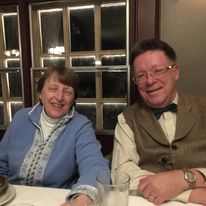
Cathy and Greg

I’m not going to provide details of the myriad times she ended up being the butt of my jokes and those of our brother Fred. I will say she is such a fine cook and baker that her food should be in restaurants, she is an excellent writer of both history and other subjects, authoring the fine and definitive book Agenda for Reform, about Winthrop Rockefeller. I’ll not embarrass my sister with stories of her dancing to the “Hokie Pokey” at a resort in Downingtown, Pennsylvania, or bring up the complete drenching she received on the Roman River Rapids ride at Busch Gardens in Virginia, where she apparently didn’t know she’d get wet, to which her son replied, “Ma! It’s Roman River Rapids! What did you think was going to happen!”

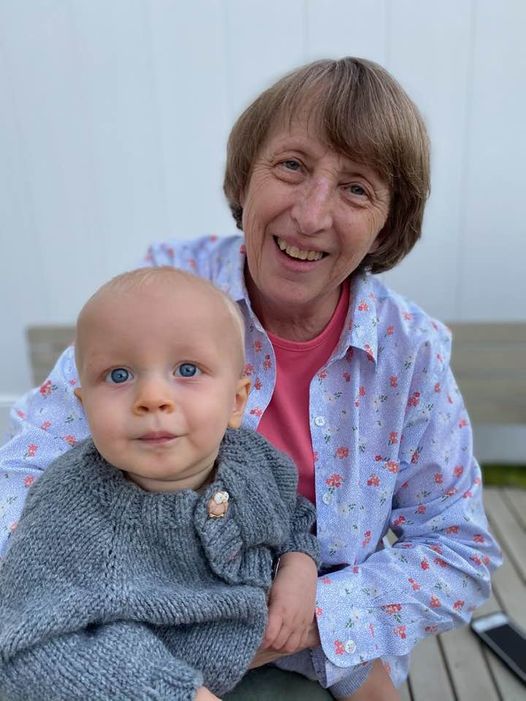
Cathy with Lyra

I’m going to save the story of calling her one August day in 1988 just seconds after she received beautiful news that would change her life; how she became a committed and loving mother; a passionate grandmother, which only deepened her love for her husband and the rest of our family.

Cathy with Henry

There are too many details necessary to explain the time I finished a reading at a major conference and afterwards a woman approached me and asked if I was related to Cathy Kunzinger Urwin. When I told her, she said, “I’m with the Winthrop Rockefeller Center in Arkansas and we’ve been trying to reach her! Her book Agenda for Reform is the best work written about Rockefeller and the work he did, and we want to invite her to a symposium.” I was never so proud of my big sister, and I really don’t remember much about the rest of that three day conference, but I remember that.

The three of us at the World’s Fair, Flushing, NY

And I’m going to keep to myself the history we’ve shared not solely as brother and sister but as friends. And readers do not need to be reminded of what it means to have an older sister; how she is counselor, surrogate mother, teacher, patient audience, how she teaches scared younger brothers how to care about others, how to show compassion, how to think of others first. Few people with an older sister don’t already know she is a security net for the most challenging of emotional events, how she listens, how she is tolerant.

“Life is paper thin,” my friend Toni Wynn once wrote. Sometimes we all take each other for granted, forget to check in, see how life has been treating us. On the one hand we might talk often enough to know our sisters are there if we feel like calling. On the other, we don’t let them know nearly enough, not nearly enough, how much they mean to us.

Happy Birthday Cathy.

Cathy and me, 1988

But I can’t avoid this one, just for old-time’s sake:

For Cathy:

(Re)Solution

I wish we could design our own year, like some magical date book we get for Christmas that comes with a special pen, and we sit near the fire, pour some wine, a bowl of gummies. and start with January, marking away at how the year will go. And, whoosh, it just happens.

It used to feel that way, didn’t it?

But lately as I get closer to the New Year, I feel more like a first-time marathoner dragging my tired ass across the finish line. I used to hold that C.S. Lewis wasn’t far off when he said, “There are better things ahead than any we leave behind,” but not so much lately.

I don’t like feeling this way. 

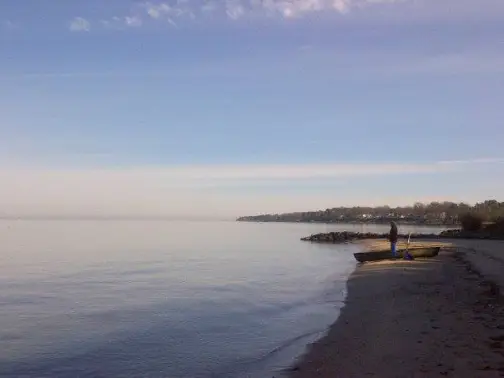
It’s the last week of December and the full moon is on its way out with the old year. It is beautiful, and the air is chilly, but still, and quiet, and clear across the river to the north and the bay to the east is nothing but the same peace. The few lights of Windmill Point are faint, and the stars fill the sky despite the bold, recessive moon. It’s hard to imagine anyone anywhere is awake. I am absolutely alone, save some ghosts. It’s not as depressing as Frost’s darkest night of the year; poor guy. No, though too many of us will do anything, as Jung suggested, “to avoid facing their own soul.” But I’ve learned to embrace three a.m. I’ve taken to these internal battles between what I need to get done and what I need to never do again.

I won’t rehash the news here; but we demonstrated this past year just how far below the angels we truly are. The human race has mastered the art of being inhumane. It is hard to get up some mornings, for me anyway. I certainly hope the hostility and sheer madness and genocide of 2023 doesn’t hemorrhage into 2024. Lao Tzu is on a loop in my head: “If we do not change directions, we may end up where we are heading.” One truth is absolute for me: I’ve spent way too much time accepting the things I thought I couldn’t change only to discover later through time and self-analysis that I got it wrong; I totally could have changed it.

So tonight in this indescribable, beautiful stillness of peace, and with a calm soul, I’ve decided this year to open the magical date book and make note of what the next year will be, and what it won’t be. I’ve talked it over with my other selves who tend to gather around this time of late night/early morning, and we all agree—if I work together on this, I can turn things around. It seems time to listen to some long gone old friends still whispering at this hour, telling me to trust myself, and not to forget that we can’t do a damn thing about the world at large; each of us is a constituency of one.

This coming year some of my hopes are based less upon what I want to happen and more focused on what I don’t want to happen anymore. But where in the list of resolutions does one make note of something that won’t ever happen again? Where do you put that on your calendar?

When I was working at a health club in New England, the owner and I talked often about how the most promising members of the club–that is, the ones most likely to stick with it and go the distance–were the ones who came with what we called “a quiet resolve.” We didn’t know what drove them, and they didn’t post signs or make announcements; they didn’t have mini celebrations along the way; they didn’t make it something separate from their life that needed to be tackled or climbed or conquered. If there had been social media then, these driven individuals would not have posted a single word about their accomplishments. They simply came in, did their thing–sometimes a little more each time–wiped off the sweat and went about their business.

That is not a resolution. That is resolve. There is a difference. One is a statement; the other is a way of being. So, the question is do I have the resolve to quietly yet decisively change the things I can? I’m not going for the wisdom to know the difference; not this year. Maybe 2025.

It’s a beautiful late night here along the Chesapeake, and these early morning stars reach beyond my imagination. Perhaps some of us need to forget about that “to do” list we tend to create this time of year, and simply “let the old ways die,” as Jason Isbell noted. That just might be the solution to a lot of issues that wake me up to begin with.

The Dead

I guess the first was Karen. Karen was from Pennsylvania–this was quite early in my career and I had just moved back to the Beach from Pennsylvania myself, so I could relate to her writing. She spoke in class about adjusting to being away from home for the first time. Her husband was military and they were stationed here. Her paper was about the changes. I sat on my couch and read about her excitement to start life anew and all the places they would finally see together like they planned. She took a job–not because she needed the money, she wrote–but because she wanted to do something. So she took classes and got a new job as a server at the North Witchduck Inn in Virginia Beach. She got lucky, I read; another worker had been fired and she filled the opening in the place not far from their home.

I had just put her paper down and moved on to the next when the phone rang and it was the provost of the college. He wanted to tell each of her professors before we heard it on the news. The fired server and her boyfriend returned to the North Witchduck Inn and shot four people in the back of the head, execution style, including Karen. For a few years I held on to that paper. It reminded me how in a class filled with “I’d rather be anywhere else but here” students, someone was glad to be present, to be truly present.

Then there was Mark. Mark stopped me in the library and asked if we could talk. He had just received orders he was headed to Kuwait for the first Gulf War, and he was told to get his “affairs” in order. “Talk about telling you you’re going to die,” he said. I assured him everyone going overseas in the military is told to make sure their affairs are in order. We laughed a while about nothing; really nothing at all. The smallest of things that day were funny, the simplest of moments were beautiful. We walked to his car and he showed me a picture of his son. We talked about how when he got home our boys could play together. I don’t remember Mark’s last name, but I will always remember his face.

Tricia and I used to talk at the copier every day. We talked about music and travel. We talked about food and how the smell of cinnamon buns is better than the aroma of coffee. She had braces and said her students haven’t said anything about them yet, but she was certain they noticed. I remember her asking if I noticed her braces and I laughed out loud, right there, like the laughter was my answer, then I said, “Well, T…yeah! They’re right there! But they’re beautiful. I can’t imagine you without them. They’re just so you!” We laughed a long time. T got depressed easily and I could usually tell from the faculty workshops about recognizing various issues with students when she was in a down cycle. The dean came to me and said Tricia’s medicine was messed up and her husband found her hanging in the kitchen.

Stay with me. Please.

Then there was Rachel. Dear, beautiful, full-of-life Rachel. On a study abroad in St. Petersburg, we walked freely down Nevsky Prospect, the Fifth Avenue of the city. I was right behind Rachel on the crowded street so we were all pretty close to each other. As usual, she was engaged in taking pictures and writing in her notebook, jotting down “Kazan Cathedral” which was just to our right. Of all the people I’ve traveled with—numbering well over four hundred—Rachel was by far the most diligent about drinking it all in, making notes, taking countless photographs. She always smiled anyway and could make everyone around her laugh, and there on the other side of the world she was in her element. She absorbed every single moment. In the evenings she’d come into my room and show me what pictures she had taken that day and double-checked their locations. Then we’d sit and talk about her impending motherhood, what it’s like being a parent—my son had just turned ten. We walked past Kazan Cathedral; she was absorbed in her notes and stepped right off the curb and into the cross street where a bus was ripping past us at forty miles an hour. I was close enough to Rachel to grab her hair which she had pulled back in a pony tail, and I yanked her back into my chest, and the bus was close enough to knock her bag out of her hand on into the street. Those around us screamed and Rachel turned back somewhat unaware of what had just happened. “He saw me,” she said, to which I replied, “Yeah, he did. He just didn’t care. Pedestrians don’t have the right of way here.” We picked up her belongings and in no time she was back into enjoying her tour of Russia; my heart didn’t settle down for hours. The last time I saw her she brought her daughter, Shaylyn, to my office. This beautiful woman with her beautiful little girl was so excited to move on with her life; she’d be a single mother, she told me, and hoped she could set a good example. Then we remembered the bus in Petersburg, laughing at the nearly tragic outcome, and she assured me I had saved two lives that day. I laughed and told her I was just glad she hadn’t cut her long, curly hair. “Yeah that hurt, by the way,” she joked, grabbing the back of her head.

Her daughter has her eyes.

Not much later, in May of 2005, the little girl’s father went to find Rachel who was hanging out with some friends at their apartment. When she refused to let him in, he cut a hole in the screen and climbed through. Rachel ran out the back door and called 911. Her ex walked through the house and shot four people killing two of them before he found Rachel hiding outside. She had called 911 and the operator had to ask several times what was going on, but Rachel was quiet, until finally she replied, “He saw me,” and her ex put his gun to her skull and shot her in the back of the head, killing her instantly. This one breaks my heart.

I sat in class last week and watched my students do group work. A few engaged students carried the rest, but more than half the class kept reading their phones, staring out the window, messing with their hair. “What are you doing here?” I asked in a general fashion. They were quiet. “What are you doing here?” I asked again. They just stared at me. I remembered the rule of threes: First time they hear it; second time they think about it; third time they start to understand it, so I hit it once more: “Seriously,” I said. “What are you doing here?”

They remained quiet.

Bobbie slipped slowly inside herself. First alcohol, then drugs, then homelessness, until this beautiful woman who became a neonatal nurse was found dead next to a dumpster. Carrie OD’d and ended up in a brain center where she kept telling me the same joke when I’d go visit to talk to the patients: “Knock Knock. Who’s there? Cargo. Cargo who? Cargo beep beep.” We’d always laugh and she’d keep laughing long after I moved over to Dave who was learning to walk again. Carrie was a biomed major, graduated high school early and had applied for Drexel University to transfer and had just been accepted. The stress got the better of her and she “used a little something to keep her nerves in tact.” Dave was found in the garage. He brought the dog.

“For the next project,” I told my students before leaving on a reading trip to Ohio two weeks ago, “I want you to tell me what you are doing here. Include your short range and long term plans. Include your hidden ambitions, your unspoken dreams, that secret that can ignite your internal motivation. Tell me what you hope this moment looks like when you look back five years from now.”

They stared at me. No one, not one, not a single student: NOT. ONE. TOOK. NOTES.

I asked Geoff, who bares a stringing resemblance to Johnny Depp, and is someone I can usually count on to keep up, what they need to do. “Write about what we’re doing here.”

“And?”

“And…be ambitious with it.”

I repeated what I had said, asking them to write it down, which they all did–on their phones. Fine. I looked at a woman on the right side of the room. Sometimes I hope to see Karen. Or Rachel. I asked her the name of the woman immediately next to her who she had been talking to during group work for a half hour for the fourth time this semester, and it was already late October. “What is her name?” I asked. She looked out the side of her eyes as if the woman wore a badge.

I stared at them. “What are you people doing here?”

I am haunted, some days. Not by the dead or their memories; not by the tragic loss of life and the repulsively early departure of far too many souls–a dozen more of whom I’ve left out of this. I am haunted by how easy it is to not live at all. I stopped at the door. “If it makes you feel better, most of the time I have no idea what I’m doing here either.”

They laughed, and I thought of Bobbie. They laughed and the woman introduced herself to her classmate of ten weeks, and I thought of Karen. I thought of Rachel and Trish–adorable Trish. They laughed and I realized not every moment should be one of ecstatic joy. But we certainly should be closer to life than death, shouldn’t we?

Oh, and there’s Kevin, who simply disappeared, and Charlotte, who just three weeks ago tried to kill herself. Charlotte is transitioning and has just about as little support as a person can get. I leaned against the door jam and asked if they understood the assignment. So I asked again, knowing, waiting, certain someone would give me the answer I absolutely knew they all knew, and someone finally did.

“What are you doing here?”

“It’s required.”

I smiled. “No. It’s not,” I said. “You’ve been deceived. Certainly to attend this college, to graduate, this is a required course. But nothing is required of you anymore. You’re not children. You can tend bar in Key West. You can hike across Europe. You can be anywhere, do anything, and you, for some apparently unknown reason, chose to be in my class on this day at this hour and sit and stare at your phones even though you could be anywhere else.” I laughed at the last part. “Anywhere!”

“With that in mind,” I added, “What are you doing here?”

Oh, and Bo, who got killed when the car he was riding in hit a tree on the way to Florida. And Eddie. Dearest, kindest Eddie. And Marcus. Jamal. Chris. Joe.

Karen wanted to have kids. Rachel wanted to be a teacher. Mark wanted to come home and bring his son out for ice cream. Bobbie wanted to dance.

All she ever wanted to do was dance.

Listen:

https://www.youtube.com/watch?v=Kg-Qdrr3XSk
A Wealthy Soul

I fell through the ice on a frozen lake in northern Norway in March of ‘95. It was two in the morning, twenty below, and I followed two friends across the snowy ice toward a road on the other side. I heard the ice crack and I stood still, a green band of aurora borealis bent just above us, and I stood still like Wile E. Coyote—suspended for just a moment listening to the ice crack—and thought, “oh, wow, shit,” and went through.

I landed just about ten inches below the surface on another ice shelf. I stood just deep enough for frigid water to cover and fill my boots about calf high. I waited for the next crack when Joe turned and we froze in fear of us both plunging into the lake. This wasn’t the first time I’d walked on thin ice, but previous mishaps were mostly metaphorical. I stood with icy feet; my heart pounded in my chest ready to plunge into my stomach when the ice again cracked. Nothing. Our friend John turned and laughed. “It’s day melt,” he said, ahead of us by twenty feet, already on the shore. “The surface ice melts a bit each day then freezes at night, but it’s thin. That’s what we were walking on. The second layer you landed on is probably six feet thick.” 

“Why didn’t you go through?” I asked, John was six three and not a light man. 

“I was first,” he said. “I loosened it for you.” “Why didn’t you watch where you were going?” John asked.

“I was looking at the northern lights,” I told him. He looked up and nodded, “Oh yeah,” he replied. “I didn’t notice.”

WTF?! I thought.

I sloshed to shore, took off my socks, and stood at the end of a fjord when across a field six moose stood taller than us all. I put my boots back on and watched the moose move toward us. They were bull-like, each one heavier than the three of us combined. The night was still, and the air was calm. To the north lay nothing but wilderness for a thousand miles; the Arctic Circle sat a hundred miles south. I was soaked in below zero temperatures, green bands of borealis bent above my head, the moose moved toward us, and I never felt so awake, like sleep wasn’t part of the Human idea. Awake. The northern lights lingered as if in water, as if the sky was submerged and the green bands couldn’t bend faster than the deep blue flow would allow, and we floated between. The moose moved closer. I held my breath. Two leaped just beyond our reach and bounced over the ice with absolute grace.

That moment, right then, will never go away.

I’ve been thinking about life lately, the highs of accomplishments and the stress that comes with obligations, and I looked out across the bay this morning, took a deep breathe in the chilly autumn breeze, and thought about how grateful I am for having such wealth for just about my entire life. Truth be told, I have always been wealthy.

Like the tram ride at Lake Baikal in Siberia or just about any day in Spain, the sunsets in Tucson and just about any evening at the river. We rise every morning and gaze at life around us, but how often are we awake, I mean completely and blatantly awake? Sitting here tonight I understand for all of the gives and takes of life, I’ve had the privilege to be wide wake for most of it.

I mean Alive. It doesn’t hurt to take stock of those moments from time to time to remind us when we need a slap across our attitude to snap us back to the awareness that we are always alive if we choose to be.

Like sitting on the sand at the Gulf of Mexico drinking coconut rum and laughing; standing between cars on a train ten thousand miles from home; knee deep in the Great South Bay singing Harry Chapin songs; waist deep in the Congo in the rain; that lunch with my son, my brother, and my dad at the beach; riding a motorcycle from Amsterdam to the Zuiderzee; lunch at La Caverna after buying blankets; breakfast on the dirt in Dakar; clawing my way to the Wind Cave in Utah. 

Studies tell us that most of us sleep a third of our lives and most of us work a third of our lives. And now at my age with hopefully about a third of my life left, I’d like to spend as much of what amounts to one third of that third being fully awake before the ground falls beneath my feet.

My grandparents’ attic; my mom’s laugh, salt water on my lips. My dad’s deep “very funny” response to a joke, that time I stayed with my brother at Notre Dame and we stood in the student section and watched the Irish destroy Air Force.

Pigeons at a graveyard on the Gulf of Finland. 

The way Eddie and I would hike forever through the marshes of Hechscher; sitting behind third base at Shea in ’69; hitchhiking to Niagara Falls–an hour and a half drive that took us an hour and a half to thumb up there from college, but we began our hike back at 5 pm and were still walking at 3 am. The end zone at Rich Stadium when they retired Simpson’s 32. My sister’s guitar and how I played in Steve’s basement, how I listened to Jonmark in just about every venue in Virginia Beach, how I played my way through college, that time singing and playing “Danny’s Song” with KL in the dressing room before a gig, the midnight sun in St Petersburg in June of 99.

Oysters on ice. A good slice of pizza. The smell of food grilling. A blanket of stars.

The colors of autumn outside my home in New England, the smell of cider drifting down from the mill in Sterling. Running into an old friend in a new place. 

A cow driving to work. My dog hiding beneath the bed during a storm. My son holding his too-big-for-his-arm’s bunny. The way when I returned from a month in Russia when my son was two, he grabbed his zoo book of pictures, climbed on my lap and would not let me get up. 

An email from someone I had not heard from in twenty-two years. The first green showing through the snow in spring. The leaves just past peak. The sound of waves. The sound of kids laughing. An old couple holding hands. 

The front edge of an idea. That feeling of outrageous anticipation when you decide to do something brand new. The way you one day realize who you are and that you’re okay with it. 

Pachelbel’s Canon in D. Bach’s Joy. Walking down an old street in St Augustine and hearing a guitar player singing Marley’s Redemption Song like it was Bob himself. Chasing ghosts at the old lighthouse.

And other moments:

“Yes sir, it’s a boy.” 

“He’s gone. Come back when you get this.”

“Hey…it’s me.”

I can tell you how much money I have made from working in hotels and health clubs, from teaching college and writing books, but I can never calculate the wealth of my life. Can you? Can you measure the moments on a spreadsheet? Can you figure the net value of that time you saw your dad waving to your plane from the observation deck at the airport? The value of those last lucid moments when he seemed young again? The priceless moment your son’s voice cracked and changed. That moment you realize it would have worked out just fine if given the chance. That moment you realize sometimes the most painful moments are the ones that taught you who you need to be and what you are made of.

We are alive. Now. Today. And yet people hold grudges, people don’t forgive, people don’t realize how fast it is, people don’t look up to watch life bounce across the sky.