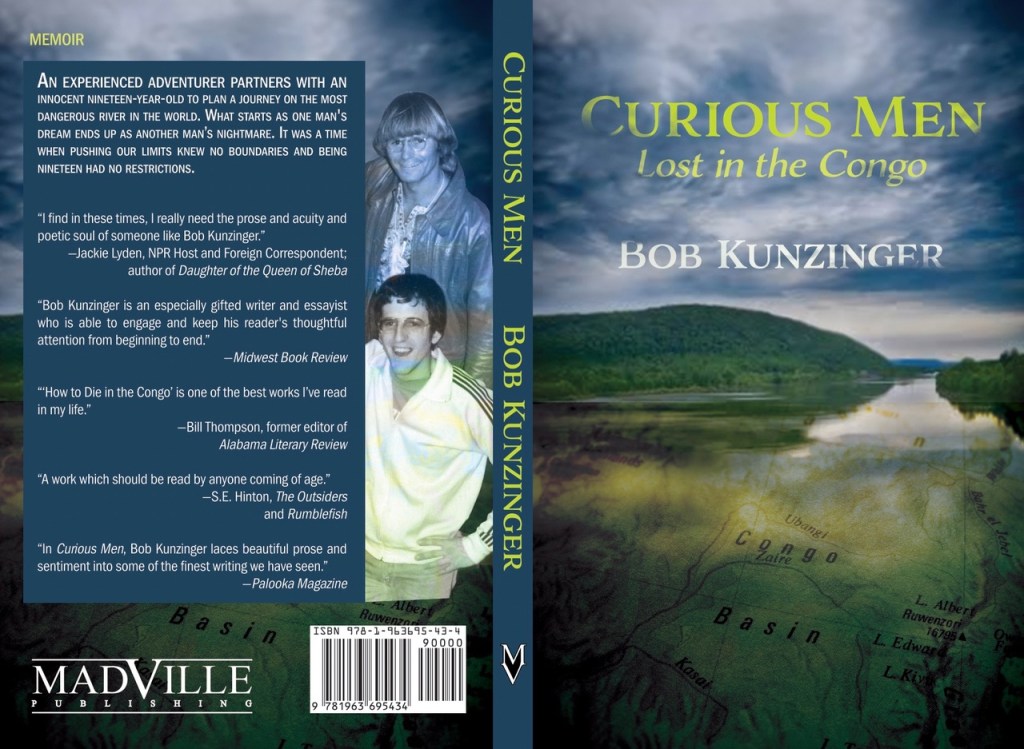
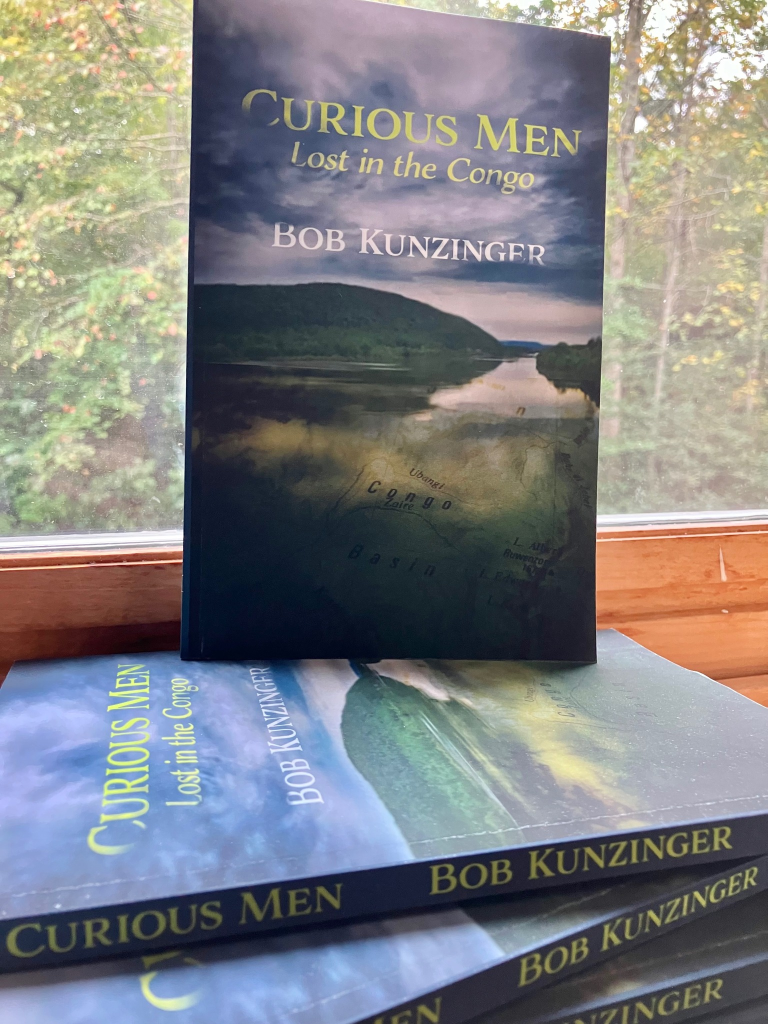
Announcing the release today of Curious Men: Lost in the Congo. Order by tapping the link below the video: Thank you for supporting independent presses and artists. Many thanks to Kim, Bill, and Jacquie, and everyone else at Madville Publishing.
Here’s a video about the writing of the book, the living of the book, and the time that has passed:
Memory is as fluid as anything in our lives. What happened and what “seemed to happen,” as writer Tim O’Brien points out, can often be confused. When looking back we might have a habit to recall what seemed to happen, reality having been washed and hung out to dry over the course of decades. Sometimes though we can recall nearly ever nuance of a time in our lives for its significance, its uniqueness, or its romance. I have a pretty sharp memory when it comes to many events. A friend of mine and I were talking not long ago about how we can both remember nearly every detail, everything, about a period in our lives so long ago you’d think it was from another life. Many of us have times like those which, for whatever psychological reason, we can summon up to the point of remembering the clothes we wore on a particular day.
My basic memory for most things is pretty solid. I remember all my phone numbers and license plates, and, worse, the phone numbers and license plates of friends of mine. The old joke about song lyrics holds true with me, but so do the times spent with extended family. One of my only memories of my paternal grandfather was him weeding a lot he owned next door to his house on Long Island. He died when I was five, so I was no older than that, probably still four. But I picture that day, those moments, perfectly.
Some years ago when Meanwhile in Leningrad came out, someone asked how I can remember the conversations I had with survivors of the Siege of Leningrad, who at the time I knew them were in their eighties, and I wrote the book several years after our conversations. I said, well, first of all, they’re never going to find or read the book, so there’s that. But more accurately, when a woman sitting on a bench holding my hand tells me about dragging her dead husband and son across the city to leave in a mass grave, and she sat with me clinging to their photograph sixty years later, I will not forget any of it. Much of the writing in that book falls in that category. Did the conversation happen verbatim? Doubtful, but the gist of it is pretty damn accurate. There’s an old journalism method that when you write the piece and include quotes from someone, call them up and read what you wrote to them and ask, “That’s pretty much what happened, right?” Nearly all the time they’ll say yes. Can you remember the words, exactly the words, you spoke an hour ago? Exactly. If that’s not possible as in this case, I rely on memory and notes.
Memory is reliable or not depending upon just how present we are during the event. That time so long ago when we said we could remember everything: We were both very much present at the time, we lived the example of what would later be called “mindfulness.” Of course we remember. Likewise there are times I so shut out of my memory it’s like they never happened at all.
Still, some events are so close to my soul I would need the team from Matrix to come extract them.
Like what happened in 1980 and 81, when I was a freshman and sophomore in college, the subject of my forthcoming book, Curious Men, from Madville Press. Of that time then, I remember everything. I watched, studied, and listened so intently that this memoir could be considered a documentary for how clear the details remain to me four and a half decades later.
I like that “memoir” includes the Spanish word “oir,” to hear, because much of memory stems from what we hear, and as a nonfiction writer I am bound by listening to the world around me, sometimes to the one sitting in front of me, and those sounds of vowels and consonants and the musicality of language I know will never escape my recollection.
My friend, colleague, and former officemate, Tom Williams, once introduced me at a reading as a non-fiction writer by saying, “Here’s some shit that happened to Bob and the best he can remember of it.” That’s pretty spot on. Despite a degree in journalism, I never had what it took to do the job in the traditional sense like so many I graduated with, some of whom have won prestigious awards for their work. I was definitively not up to that task. But I could handle the feature work, the “Let me tell you what just happened to me” work, just fine. In college, my friend Deb used to help me with news stories and I’d help her with features. We knew our strengths. I had a column in the college paper for which I ventured out into the community and did something, and then I wrote about it. I went horseback riding in Machias, New York, flew planes in Wellsville, kayaked the lake in Allegheny State Park, and sat on the ground behind campus at Merton’s Heart. Those events I could remember. I knew how to be present. Most of those activities were out of my wheelhouse at the time, so recalling what happened was easier. I was paying closer attention, sometimes just so I wouldn’t die.
Memoir is like that. If we can’t remember it we’re certainly not going to write about it.
But not this time, not this book. Summation: As a college freshman uninterested in the normal activities of my floormates–that is, drinking and drinking–I felt lost and disconnected from everyone. Then a family friend returned from the Peace Corps and asked me to help him plan a trip, solo, on the Congo River. So I did.
Long story short, it didn’t work out and his trip became mine. The first half of the book takes place in western New York. The second half in the Congo.
Still, that’s not what the books about.
Most of it takes place now, in every classroom across America where nineteen-year-olds sit and try and find something worth doing, something that reaches deep inside them and wakes them up. I’ve been staring at nineteen-year-olds for thirty-six years and one thing hasn’t changed: they’re scared out of their minds. They’re alone in a new place far from home living in a room this size of their car with a total stranger, and every adult within earshot constantly wants to know their plans for their major, their careers, their lives. It is often unbearable.
I was exactly like that back then. Until a friend walked into my life and said, “I have an idea. I need your help.”
We were so young.
So that’s what this memoir is about: About that time back then. What we did and how and why we did it, yes, but mostly about being nineteen and far from home looking for a reason to exist at all.
I had an unconventional youth. Specifically, I did not lead the normal life of a nineteen-year-old away at college. While my floormates were drinking heavily and sleeping until noon, I was at classes early to get them out of the way so I could head out to the Allegany River, or up to Niagara, or out to Chautauqua Lake, canoeing, listening to fascinating stories from a friend of mine, helping him plan his return to the Congo River for an adventure I couldn’t possibly contemplate prior to then.
I have two books coming out next year. The first, Office Hours, is a “Sedaris-like story-telling” of thirty-five years of college teaching. The second, Curious Men, is about that time back then in college myself, planning the Congo trip, turning a first semester probation they said was due to grades but I knew was due to complete indifference, into an honor-roll semester due to my sudden acute interest in absolutely everything. A friend of mine used to ask, “You mean that year you were on crack without ever touching a single drug?”
Yes, that year. Nineteen.
Memoir writing is a challenge for the need to engulf yourself in the emotions of a time that was apparently significant enough to warrant a book, yet absent enough of those same emotions so the reader can find the bigger picture of the narrative, the part that must reach up and out of itself into their lives, show them their emotions instead of displaying my own.
I brought this up because I just finished it, the book, Curious Men: Lost in the Congo. As a point of reference, though, and in full disclosure, I started it forty years ago. I’m a slow writer.
But the primary question publishers, publicists, agents, and–what do you call them? Oh yeah, readers–ask is, “What’s it about?”
So that needs to be split into two answers. Most people mean “What happens” when they ask what it is about. And that’s fine and not too difficult to answer: A friend asked me to help him plan a canoe trip—solo—on the Congo River. I did, and he went, and he never returned. Eventually, I went. But I returned—most of me anyway. This might be of interest to readers, particularly those who have enjoyed my writing in the past, or those who like adventure, distant places, rivers. Mysteries, even. Possibly psychology. But that “what happens’ response makes it all seem very 1981ish, and little more.
Which means there must be a second answer for this to work. And that is the true response to “What’s it about?”
In this case, it’s about being nineteen-years-old. It’s about being on my own for the first time, out from under the parental umbrella only to be thrust into a world where countless adults want to know my plans for the rest of my life, my major, my summer internship possibilities, my “declaring” of a focus for my entire career before I’d even taken a single class, all the while living with someone I’d never met on a floor with ninety guys I’d never met who seemed to insist I drink despite my desire not necessarily to not drink, but not to drink because they insisted; and all of us with two bathrooms, one payphone, and honestly little guidance to navigate. This wasn’t the military where some sergeant told us what to do when to do it how to do it but never why. We were paddling out in the deep-end, completely solo. Hence, the drinking and the need to join the pack. Just because I didn’t end up face down in the stairwell every night doesn’t mean I didn’t understand the draw of the need to do so. It’s just that I found my own alcohol of sorts.
I found another outlet, something well outside the box, and in doing so ended up with a working knowledge of a few African languages, an understanding of the fauna of equatorial Africa, a comprehension of diseases, some knowledge on how to temper loneliness, and a taste of a particular lesson I couldn’t find in my mass comm classes: outrageous adventure is simply a matter of deciding to do something and following through. I discovered that I didn’t need to follow some template to be alive. I learned that maybe it was everyone else who didn’t fit in. At least that’s what I told myself at the time as a defense mechanism.
But something changed over the years. You see, I’ve been staring at nineteen-year-olds for thirty-five years now and that alters the narrative some.
In the end, Curious Men is not about Africa, it’s not about the Congo or anyone in particular; it is about being nineteen and scared, and how that has changed in the decades since I ate sun-dried fish while bantering in Lingala, and most importantly, learning how to jump, knowing, absolutely understanding, that once you jump, you’ll either land on your feet or you’ll learn how to fly. Unless you don’t. Then you need the “What’s it about?” to step to the plate. Sure, it takes place in rural western New York and ruraler central Africa, but the narrative and the theme often divert.
Indeed, I’ve been staring at nineteen-year-olds for thirty five years now, and students today are no less timid then then, no less adventurous, no less interested. The difference is they are infinitely more distracted, bending toward convenience and accessibility, seeking and finding adventure on a screen, through gaming and TikTok, and I don’t doubt that if I were nineteen today the rivers I sought out would be virtual from the safety of some Virginia Beach bedroom. Maybe I was born at the right time, back when you sat around some diner eating wings and talking until some spark ignited, and you drew maps and made lists on the back of placemats, and then, most importantly, you followed through.
Curious Men: Lost in the Congo, is, as S.E. Hinton (The Outsiders) wrote, “A story that should be a must read for all teenagers—and adults alike for that matter.”
I’m just deciding now on the dedication. That’s a tough one. In ten books I’ve ever only dedicated one; The Iron Scar: A Father and Son in Siberia is dedicated to my father and my son. I’m not sure yet I am going to do so this time, but I’m leaning toward this, a variation of sorts of something Richard Bach once wrote:




 a view from this wilderness