Mint and White Hawthorn

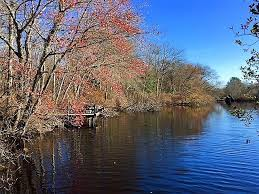
Connetquot River

The tide is low this afternoon, and the vapors from the marsh saturate the air along the road all the way up the hill. I know this smell, low tide. I’ve inhaled it since I was nine years old when we moved to a small village on the Island where the Connetquot River meets the Great South Bay. My friend Eddie and I would walk the bay and meander through the marshes along the waters of Heckscher State Park next to the town, and it filled my senses so that when I walk now along the Rappahannock half a century later and the small creeks near Aerie during low waters, I still smell my youth. In so many ways those years seem like I see them just below the surface, sometimes exposed when the water recedes.

But here, now, when the tide rolls in, the refreshing smell of salt water and Atlantic mist overtakes everything, like it did back then too when the fog horns out on the Great South Bay called through the wet and cool mornings.

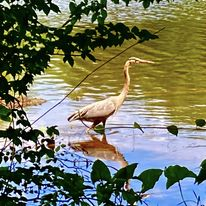
Today the muddy marsh is exposed with reeds and fiddler crabs, small bubbles from submerged frogs, and periwinkles everywhere, hundreds of them; thousands. Herons pull their fragile legs up out of the mud as they walk, and above me several osprey circle and dive for small fish and crabs in the Rapp. Soon they will make their pilgrimage to South America for the winter only to be replaced locally by eagles.

I come here to clarify my confused and often anxiety-ridden mind. Everyone needs a place like this, akin to that “safe home” kids designate during hide and seek—if you touch it before anyone touches you, you’re safe. This is that for me, when I’m here no one can touch me; I cannot be “it” when I’m surrounded by water and salty air, even at low tide. And if I close my eyes this could be the marsh running behind the greens at Timber Point, and boaters might be headed out to Fire Island or just across the river to Oakdale and West Sayville, and sometimes I feel like I’m twelve when my mind would drift during Social Studies at seventh period to the waters of Heckscher and the muddy flats off of Montauk Highway.

Those are familiar names to me, but probably not most others. And those places at that time still belong to me. Just like the aroma of the marsh near Aerie; that’s mine too, and the sound of gulls and osprey and herons, and diesel engines of fishing boats before dawn, and the water lapping on the riprap and sand. Those smells and sounds belong to me; always have. Of course many others know and have absorbed these visceral aspects of life as well, but that’s not what it feels like when you’re alone at a marsh, relishing the peopleless world, and the only sound is the call of gulls, and your sole desire is to roll out with the tide and see what happens; it has the same enticing pull as the comforting tug home up the hill, as strong as the moon’s grip on the tides. We are seventy-percent water, after all, and so is the earth. Being near the ocean or this river and bay helps me keep my balance, like some sort of metronome. It’s always been that way.

Nature has always been my safety net no matter where and when life happens. It is predictable in its controlling and haphazard way. It is non-judgmental; it isn’t distracted. It is as consistent now as it was for the native Americans who hunted on this land, and perhaps some nomads before that, as ancient and consistent as whatever life lived here, died here. Nature asks nothing of me except to be left alone. It’s all I ask of it.

I left the marshes of the Island fifty years ago next June. And even though I’m not there and Eddie is gone, I know the marshes still line the shore of the Connetquot, and out on the Bay the fishing boats cross before dawn. The salty air I’ve always inhaled is in my DNA, and it still hangs out on the reach just below our consciousness. I don’t know how long I might have survived without nature to steady the tides of my moods as they move in and out, pulling me further afar right before I’m trust back ashore. In so many ways my life is one of extremes.

I have been around the block since my days on the Island, and just when I thought I had grown tired and weary of fighting the tides; just when it seems life was more akin to the salt flats out on the Great Salt Lake with a shoreline that will never recover, I notice some sunset beyond the pulsating marsh and it settles me again, moves me right back into the moment where nothing had ever happened and nothing will ever change, for a little while anyway.

It’s like that here, at the river, just down the hill. High tides are exciting and fill me with a sense of awe and possibility, hope, but when the tide pulls back out, that ebb exposes nature for everything it is with its raw and beautifully honest frame filled with nature’s debris. I wish I could see myself with such blatant honesty.

I wish I could always feel so at home, safe and untouchable. How much of our identity can be traced to our youth and those places we chased each other through after school, explored and conquered on summer afternoons? If I lived in the city, miles from any semblance of the salty marshes of the South Shore, would I still feel the tug of the tides? I tell people I found this land here at Aerie by accident. I tell myself that. Sometimes I feel like I should turn around and find Eddie a few steps behind, whispering to himself the lyrics to some Harry Chapin song, asking if we should go swimming in the bay.

September is just days from now, and the August heat, the rise of gnats in the hazy air, the stillness of often stifling walks along the Rappahannock are once again slipping behind me. I believe that like Jay Gatsby I can be melancholic, some strong desire to “reach out and hold it back” overcomes me when the weather turns, and to be honest, Nick’s retort that “there’ll be other summers” is simply not good enough. Not when so many of them fade so fast. Not when the afternoon sun can so easily burn off the mist of our youth.
Chronology, Two

Great River

We had a dog. Sheba. Briefly. She and my mother were terrified of each other. 

And a pool in the back on the edge of the woods where honeysuckle grew, and where we built a small fort out of scrap lumber repurposed from building sites down our road. Before the pool went up, my siblings and I had to pick the stones out of the dirt so they wouldn’t rip the liner. In summer we barbecued in the stone fireplace on the patio and swam with visiting cousins. When I smell honeysuckle, I remember that pool. I remember working on the fort with my friend Eddie who told me one night before heading home when the streetlights came on to watch out for lunatics. I said I didn’t know what a lunatic was, but he left. A few minutes later when I walked past the pool, he jumped out and screamed and scared me to death. We laughed and I called him crazy, and he said, “that’s a lunatic.” When I smell honeysuckle, I think of Ed.

We were protected by our parents’ forcefield, and secure in our innocence. But it wasn’t innocence, was it? Everyone was in tune then; the music did that. It kept us informed about what was going
on in the world; in Ohio, in Vietnam, in Watts; indeed, for what it’s worth, the music was a constant reminder that there was something happening somewhere, even if what it was wasn’t exactly clear. We knew all the words, and the words were ours to build with in the woods, or hike with along the Bay, through Timber Point Golf Course, and along the river to the reeds where an old duck blind was our morning refuge.

Geez, we were twelve. When you’re twelve everything is brand new and it’s all yours, and nothing, absolutely nothing isn’t feasible. That was how life was in Great River in the late sixties and early seventies. An idealistic village surrounded on three sides by an arboretum, a state park, and the Great South Bay. The fourth side was the main road, Montauk Highway, but it was so far removed from us we could wander the woods and streets for hours and never consider heading that way. Only at six pm when Walter Cronkite arrived did news like Vietnam sneak into our consciousness.
At home, Watergate remained a presence because my sister was a history major focusing on politics, and she constantly quizzed me about the players. “Who is John Mitchell?” “Who is G. Gordon Liddy?” This wasn’t history though; it was current events during my junior high years. I had no way of knowing that a half dozen years later I’d sit with Liddy alone in an office at college. When I hear about him now, though, I don’t think of our conversation. I think of our kitchen table in Great River and my sister.  

Mitchell was the Attorney General.

Dad grilled Italian sausage when family from the city or friends from the old neighborhood came over, like Joe and Rose Fontana. Or when cousins came. They didn’t come too often though, other than those who lived four miles up the road. No one back then would make the drive from Nassau County ALL. THE. WAY. OUT. to the South Shore of Suffolk County. Forget about it. Recently I looked it up. The distance from the inconceivably far reaches of my old neighborhood to the new house in Great River was a pilgrimage of twenty-two miles. Seriously, that’s how far it is now from my house here at Aerie to the first stop light. Back then it might as well have been in Kansas. We weren’t going back.

We never do go back though, do we?

Every Thanksgiving my aunt and grandmother would visit. My dad’s mom would play some piano, and Mom would be in the kitchen making everything you’d imagine she would make on Thanksgiving, while Dad and my brother watched football. Sometimes, especially in the early years in the house, my brother and I would toss the football, or tackle each other, or play whiffle ball. We built the first fort together; an outhouse looking thing. And we played Risk and some sports card/dice game about baseball I can’t remember anymore, but I can picture perfectly. We knew everything—absolutely everything—about baseball. We moved in the same year the Mets moved to first place, and everything in life was working. The Jets were winning; the Rangers and the Knicks were winning. Armstrong walked on the moon. And I learned about the music being played just upstate at the village of Woodstock.

We were one of the first homes on this road, and very quickly other twelve-year-old’s moved in. We’d walk to the deli and the post office. We’d walk to the docks at the Connetquot River. Everything was improving.

That’s just the way it seemed back then.

The way friends came and went, and I don’t remember—I mean I have no recollection at all—of ever being inside unless it rained, and even then. We simply stayed outside. Steve and Todd and I played baseball, and Eddie and I marked every trail of Heckscher State Park. For years we stayed outside, even in winter, bundled to the bay breeze. I loved how we were then. Early in the mornings in spring and fall I could lay in bad and hear the fog horns of the fishing vessels headed out toward Montauk or across to Fire Island.

But it was baseball that dominated my summers. The way we always played in Steve’s backyard, and the fence to the Campbell’s yard was a homer. The way I couldn’t hit to save my life in little league, but there on the property I slammed so many balls over that damn fence I felt like Ed Kranepool or Tommie Agee. The way we never tired and we’d quit mid-day and pick it up at twilight. The way even then I’d walk back up Church Road and through the side door to the kitchen where we always, always, had dinner together when Dad got home. The way Cathy would quiz me. The way Fred would talk about what interested him at school and about his trip to Mexico, or to the camp out past the Hamptons that one summer. 

When we prepared to move south, my friends all signed a baseball. Steve Delicati, Todd Long, Craig Long, Camille Villano, Lisa Villano, Frank and Richie and Tom and Paul. And Eddie, who never liked baseball.

When people ask where I’m from, I never know how to answer. New York? Virginia? Deltaville? When they ask where I grew up, though, I say Great River. Because we moved there when I had just
turned nine and we moved out; well, I suppose part of me never did. I can picture every square foot of that house, can name every road in the village, remember the trail that ran along the back of the town to the creek, and remember where the soft spot in the fence was at the arboretum that allowed Eddie and I to explore the old Bayard estate.

Sometimes when I think of that town I imagine if I were to drive the four hundred miles north to the end of the Southern State Parkway, and head down Timber Point Road, make a left on Leeside Drive, and another left onto Church Road, I’d see us all, young, laughing riding monkey-bar bicycles with banana seats, and chasing time like it was never going to end.  

That town is in my blood, and just a couple of years ago, Eddie and I made plans to return there to eat at the old Great River Inn, which had become an Italian Restaurant. That was the plan, anyway. Maybe someday I will. I’ll park outside the old house and walk, wonder what happened to the old folks, what happened to my old friends, and I’ll get a table in the back and raise a glass to my childhood, to growing up, to innocence and coming of age. And to Eddie’s memory.

We will always be twelve-years old, Eddie and me.

The Moon and My Own Private Ghosts

My moon, today

It’s not easy finding the constant in life. You think—or at least you hope—it will be people, and sometimes, but rarely, a particular person, but that doesn’t always hold to be true. People change, they come and go, they die, they just die, and while that’s not unexpected or even unusual, it still creates that ripple, that slight adjustment which a constant helps steer you through.

The constants in life mean everything.

Today while out for a long walk to clear my head, to figure out where yet again I most likely screwed up, I looked up at the moon and understood there is my constant. The moon, yes, but all of it—the water and the marsh, the woods, the sounds of the rest, and all the rest included.

From the start it was always nature. When I was still in the single digits we moved to a house in walking distance to a state park, the Great South Bay, a river, and an arboretum. Even behind the houses before the highway, which anyway ended right there, were woods and a mysterious trail leading to “the creek.”

When we moved my constant came along. We lived on a river and I could canoe clear out to the Chesapeake right from my own yard. I’d ride my bike all over the city, but in particular along the boardwalk and clear back through a new state park to a smaller but beautiful different bay. It was always nature that saved me from loneliness, from anxiety, from the awkwardness of me.

It simply never changed. At college I never felt either mature enough or hip enough to engage much with others, except if separated by a mic, but the river—that river running along New York’s Southern Tier saved me more than a few times, and my hikes up to the Heart where Thomas Merton used to sit and write in his journal, or overnighters out in the National Park not far west.

And Niagara. Canada. And my go-to safety net, Letchworth State Park.

Bring on Arizona and the Sonoran Desert, the Catalinas, the canyons with waterfalls and paths. I’d head up to Kitt Peak and watch the stars, or up Mt Lemon and watch the snow just miles from friends in shorts. I was safe there.

In many ways I never matured. Some might say my constant is immaturity then. Okay, perhaps. I admit I am more interested in hiking through woods watching birds than I am just about anything else. I moved to New England and hiked Mt Wachusett most weekends; I lived on a reservoir and walked out to the Old Stone Church and sat for hours playing my guitar hoping no one could hear, praying someone would listen.

Africa.

The trails at the small but memorable Pinchot State Park in Pennsylvania.

Here. Aerie, where hawks and eagles nest, and osprey teach their young to fly, and deer, opossums, fox and countless birds make themselves at home, because it is their home. I’m a guest.

Nature has no concerns. It is its own constant. It has no financial obligations; it does not have to ask anyone for help again and again; it does not answer to differing opinions or lie about its past. Nature does not judge, it does not question, or answer for that matter.

I know these trees, like I still know the ones Eddie and I climbed in Hechscher, like I still know the ones bending over like “girls throwing their hair over their heads to dry in the sun” along the Allegheny where my friend Joe and I used to wade for hours, dry fish on the rocks, and talk about wilderness and time.

Everyone above is gone. They’re just gone. But the nature of us is there, as well as nature itself. I wander for hours with my ghosts, talking about back then, talking about what’s next.

Today through the branches the half moon stood stark in the dark blue sky, and I swear not one other human could see it. Sure, you have a moon to admire in your world, but it’s not this one. Because this one knows Eddie and how he warned me one night when walking through the trails just after sunset to lookout for lunatics. I didn’t know what that was so I asked what a lunatic is and he said never mind. When I thought he had left to go home, I walked further past some grove and he jumped out and screamed, and I screamed, loud, and I called him crazy. And he laughed and said, “That’s a lunatic.”

My moon knows that story.

The trees here know about the time my dad and I sat on the porch and he couldn’t remember the names of some loved ones and he couldn’t see how sad I was. And they know about the time he let my son tie him up in a lasso and put a small cowboy hat on his head, and my father and my son laughed. That’s in the air; that’s out there, waiting for me to cut through the path on the west side of the property.

I have much on my mind, and a great deal of it I would rather not discuss with many people. And that’s not healthy—keeping it in like that. So I go outside and share it with the waiting trees and the ghosts I bring along. Certainly it is all internal monologue, but it’s always been that way, when Eddie and I wandered the woods singing Harry Chapin songs, or Karen and I canoed the Lynnhaven talking about how far the river reached to the south, through the marshes. I was always in conversation, connecting to the wilderness.

A friend of mine in Colon, Germany, but who is from Poland, calls me “the Man from the Country.”

“I was born in Brooklyn,” I told him.

He looked around when he was here and we walked to the river many years ago, and said, “This is not Brooklyn, Bob. This is a jungle. You live in a jungle.”

So it is. But it’s an honest jungle, with a river and a bay and a moon.

Nature lets me off the hook. Nature holds me responsible. It teaches me to be honest with myself and, in turn, with others. It teaches me to be quiet, to let others think what they want.

I have lived, lived very much “out loud” as it is fashionable to say. Oh, I have certainly lived. But it is in nature I am alive. There’s a difference. You know what I mean. There is a difference. You know exactly what I mean.

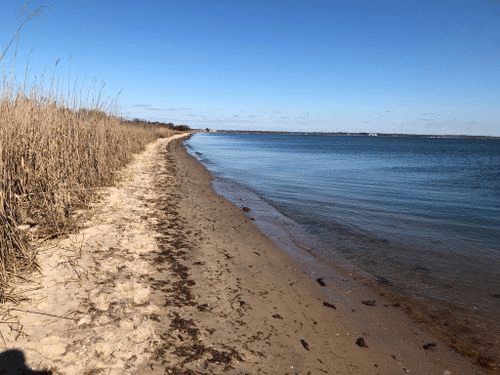
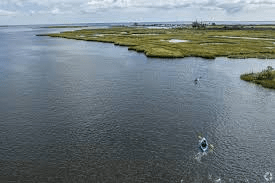
The Great South Bat at Hechscher State Park

The Rain

The View from my Office Window

It has been raining steadily since early this morning, and it’s in the mid-fifties today, going toward sixty or more by Tuesday. This reminds me of the rainy days when I was a child and I’d lay on the den floor and watch old black and white westerns all afternoon. I enjoyed seeing the blazing western Sun and the sweat on the cowboys’ foreheads all the while our yard swelled from hours of torrents.

Like today. The leaves are somewhere between summer and winter, with carpets of amber and red running the length of the driveway and all along the Aerie trails. Even the porch, which has remained dry because of no winds today, has scatterings of leaves right up to the log walls and on the furniture. The river is calm, and a slow endless hum of rain on the surface is both peaceful and somewhat melancholy. Sometimes when the riverfront is barren and the mist rises from the storm, I can hear some faint call of kids on innertubes, or the distant grind of a jet ski passing out toward Parrot Island. It reminds me of those beach sounds when I was young, on the Great South Bay or at Point Lookout on the Atlantic, and some music drifts from the blankets of other family’s, and the low murmur of adults talking about some trip to the city while kids yell from the surf break. Those sounds are my life’s soundtrack; they are embedded in me as much as the sound of my own voice. Sometimes some nearby transistor radio would toss over Ralph Kiner’s voice announcing a Mets’ game, and I’d tune into that while laying on my stomach on the blanket.

But today’s connection is the rain and how it sounded on the awning in Massapequa, or how it sounded in the trees of Heckscher when Eddie and I would wander the trails not minding being soaking wet, not minding the ebbing of the days of summer and fall.

That was then.

Now, the rain comes in steady streams then lightens up, then heavy again, but never stopping; not today. Outside my office window here across the driveway is nothing but woods for quite some distance, and if I look out long enough I can usually see deer, even in the rain, and opossum. At night in the flood of the porch light I can see the fox at the edge of the woods nosing her way in wet leaves looking for apple cores I leave out. She will eat a few, then she will mouth a few to bring to her kits. I have never seen her den, but I imagine it is not far and is fairly dry—or at least protected from the weather.

Today I did nothing. Earlier, I caught up on writing classes and finished an article for a deadline and then organized the area around this desk, but once that was done by late morning, I did nothing. Today is the day I decided to undo myself, neatly put my pieces spread out on the floor, clean off each one slowly, clear out the buildup from years of neglect, and then carefully put myself back together. So the rain is good—it is cleansing, it is like some late autumn baptism.

Once classes are done and the leaves have fallen and the cold air comes on, undoubtably taking me by surprise again, I will clear the leaves off the driveway, clear the paths by raking the leaves into the woods, and get the firewood ready for winter. The house is well-heated, but I like fires in the stone fireplace. It feels safe, though I’m not sure why since I never really feel threatened by anything. Still, there seems to be a difference between not feeling any threat and feeling “safe.” I know at least one person knows exactly what I mean.

In 1981 or ’82, a friend of mine and I took a van to Rochester from college to pick up a piano he bought for his campus apartment. He worked for the university. On the way home we stopped at Letchworth State Park and hiked for a while, then we stood next to the stone wall which overlooks some waterfalls. It was autumn, and the leaves were at their peak. It was like standing in a state of Grace; it was like stopping time and all civilization could breathe better. We talked about music and other normal early-twenty-year-old conversations, and then after some time of quiet, he said, “You ever think about how every year we pass the exact moment we will die?” I stared at him a minute and said, well, to be honest, no—it never crossed my mind—until then. He laughed and added, “I don’t mean that in a morbid way, but if someone died on November 10th at 11:12 am, then every year before his death he passed that tragic moment not knowing its significance.”

I made some jokes about morbidity and how he managed to bring down what had been a really good moment, and we laughed for a long time. We even sat in the back of the van and played the piano and sang while a few other tourists stood by and listened. It was a good day. Before we drove off, he said, “I guess it’s just that sometimes I wonder how many autumns I have left. Probably a lot, sixty or so maybe. But who knows.”

That was exactly forty years ago, and I’m glad to say he is still with us, though we lost touch a long time ago. But we’re both in our sixties now, and we are closer to 100 years old than we are that afternoon. So there aren’t a lot of fall days left to enjoy this suspension of seasons; this literal “change” of nature.

And so I too have decided to change. I need—must—let the old ways slip off and fall away and gather at my feet before I continue this pilgrimage. No doubt it has been beautiful—in the big picture I have had one hell of a string of seasons in my life. But it seems like a fine time to go dormant and get back in touch with my roots a bit, understand again where I was going to begin with.

The rain stopped about two paragraphs ago. It is dark grey still, and the moment of what would have been a sunset if not for the grey skies has passed, so it is getting dark. I’ll put the porch lights on soon and look for the fox, most certainly I’ll see some opossum. I’ll sit on the porch a while and have some tea and for a little while I’ll notice how beautiful the fallen leaves are having served their purpose, having made way for the new leaves to come.

June 18th, 1975

Heckscher State Park, Long Island


I’m cleaning closets and donating clothes and other items I no longer need. Some are just old collectibles in boxes shoved beneath beds and in the attic. If I could fit junk in the crawl space under the house I probably would. I have too much stuff. Soon, most of it will be gone, but it isn’t easy deciding what to keep. I can easily make a case for retaining every item. Sometimes it is comforting to pull out an old trinket and tell stories about what happened. I have an ashtray from a resort in Palm Springs from when I was fifteen, but I can’t mention it without my mother reminding me how I wandered alone for hours in rattlesnake country in the San Jacinto Mountains. I’m keeping that one. There are postcards and paperweights from family vacations and solo trips out west. Most of it is going. I can remember what happened without a cheap plastic prompt. And if I can’t remember then the item is a waste of space.

But last night I came to what I call the “Long Island Box.”

At fourteen years old we moved from my childhood home on the Island to Virginia—that was over half a century ago; so far in my past I am closer to ninety than I am to then. And so much has happened since those days to make those first fourteen years little more than a title page; at best a brief introduction to the rest of my life. In fact, it seems that boy might easily be someone else save one particular item: the baseball my friends signed and gave me when I moved. On the rare days I pick it up it connects us across time and distance. I can look at the ball as proof I actually knew those people, and if I were to go back to Long Island, I’d almost expect to see them in their youth. Memories trick us into thinking of some places as special when, in fact, it is usually a particular time we relish. The truth is, when I hold the ball I don’t want to go back to New York; I want to go back to 1975.

When we were young we played baseball; we listened to music; we hiked the woods of Heckscher State Park; we skated across the Connetquat River and waded well into the Great South Bay. We hopped the fence of the Bayard Cutting Arboretum and camped out and kept secrets; we built forts and fought over stupid things. We came of age during the Vietnam War, and music was part of our blood. Now as if to symbolize all those days, I have the baseball. The names have not faded even while most of the faces have, though I certainly can conjure up the idea of who they all were. Over the years I’ve been back to New York, but never saw those friends again. Still, when I return I say I’m going “back” to New York, not “up,” as if New York will always be a time more than a place.

When those friends gave me the ball that last day, I wanted to stay in that town and finish growing up with Steve and Todd, Eddie and Paul, Janet and Lisa and Essie and Norman and Mike. So the ball remains my sole possession from life before the fall. I have wondered if we had stayed would I have pursued my burning desire to play baseball, or would the music and restlessness that eventually took over my life catch up with me anyway. Smack dab in the middle of my youth, in a small idealistic town, in a time when my friends and I were pushing the limits and planning our exit strategy, I got traded to another existence five states away. I have no regrets at all, but I have the baseball, and it teases me toward the proverbial road not taken.

Now I’m thinning out my collections of books and art, pawning off possessions and boxing up souvenirs. I have no emotional connection to many of these things other than the people I met along the way. But now I also have my own books and journals for when the memory fades. The further through life I paddle, the more I’m interested in what I can enjoy at the time, not stow away like pirate booty. How many times do we buy things while traveling, bring them home and display them, and eventually replace them with new souvenirs? Even if I do take the items out and look at them or show people, the significance eventually ebbs. I have stories and memories, and sometimes I have a longing to return, but I quickly realize that an object is not a memory, it is a symbol, a window through which we can watch our youth. I can hold the ball and see us in Steve’s backyard, yelling as we ran the bases, and I can still smell the marsh near the river that time we found an old shack for duck hunters and carved our names in the walls. The ball is proof I was there and it all happened. Souvenirs play an important role in moving on. They keep us from carrying the guilt of complete abandonment. Once in awhile I pick up the ball and can hear their voices calling across the yard, across the years.

Sometimes I get this crazy idea that we’re all going to meet at a pub, probably on the Island, and hug and laugh and drink and tell stories of then. It will be across the river in Oakdale, on the water, and we’ll get tables on the deck. Eddie and I will make fun of Todd for the way he used to follow us through the marshes and kept cursing whenever he stepped in the mud. Steve will talk about baseball and the terrifying afternoon I hit a fly ball right at the sliding glass door on the back of his house. We’ll both remember at the same time how we used to see who could hit the ball over the roof, and then we’d retrieve it from the street and see who could throw the ball the farthest. And right at that moment I’ll pull the ball out of my pocket and show them how bad their signatures were when we were young, and we’ll laugh and pass it around, but in the presence of these people the ball will suddenly seem irrelevant. We’ll break into a chorus of the Zombies “Time of the Season” like we used to while walking to the deli. Then we’ll order more wings and beers and someone will inevitably have to leave early because of family obligations. Still, for a few short hours we’ll gather and maybe convince the bartender to play some early seventies music like the Beatles “Let it Be” album. And Todd and I will tell everyone how we were sitting in his room listening to the radio when the story came through that they broke up. It will get quiet and someone, probably Janet, will say she has to leave, so we’ll all stand in the parking lot and shake hands, and hug, and say we must do it again. They will drive off but I’ll wait, because that’s how I see this going down. I’ll stand there four decades after seeing them last and wonder how it is possible to live this long and still remember details. I’ll be glad I went back, but I’ll remind myself I really must move on and simplify my life, so I’ll turn toward the river and wonder just how far I can still throw a ball.

We didn’t drift apart; we grew up. The ball will go back in the closet, and my friends will go back to their faraway towns scattered from Long Island to Florida. All of us probably keep neat houses with boxes stowed behind stairs just beyond reach. Even this house I’m organizing and which I built twenty years ago is little more than a hotel to occupy as long as possible before I check out and others make themselves at home. Maybe someone will find my baseball behind a cabinet, and the names will be worn off when the kids here take it outside and toss it around. Anyway, it’s a ball; it’s probably how it is meant to be used.


(photo of the Great South Bay at Heckscher State Park)