Fr. Dan Riley, ofm

Fr. Dan at the campus ministry, 1980
On the porch at Vic’s Cabin, Nov ’79

I was nineteen, Dave Szymanski eighteen, and Fr. Dan Riley thirty-six years old. I met Dave because I simply met him; I’m not sure where or when but we were both J majors and worked for both the campus newspaper and radio station, WSBU, 88.3 FM. I met Fr. Dan when just weeks into my freshman year I caught the Russian flu and ended up in the infirmary, and he’d come by every evening and sit bedside and we’d talk; instant friends.

Early that fall we started a radio show. Dave and Fr. Dan were hosts and I was the producer and engineer. “Inscape” aired every Saturday morning for an hour, with open discussion about spiritual matters, a deeper conversation with a new guest each week, and a musical artist for interludes. The guests included Fr. Mathias Doyle, college president, Charles Osgood, CBS newsman and St. Bonaventure favorite, author Fr. Roy Gasnick, an expert on St. Francis of Assisi, and Fr. Irenaeus Herscher, campus librarian and archivist, close friend of the late Thomas Merton, and namesake of what would become Mt. Irenaeus (yes, named after the good priest, not the saint himself).

One fall day in 1979, Fr. Dan and I met early for breakfast at Mary’s in Allegany, and we walked in the chilly air for an hour and talked about hopes and fears, about friendships and families, and we continued that conversation consistently until July 23rd, 2024—the day before he died. We talked, we texted, we emailed, snail mailed, visited each other, and shared writing—he sent copies of my book Penance to a dozen friends of his, I sent copies of his book Franciscan Lectio to a dozen friends of mine. I have piles of letters from Dan; over 300 spanning four decades. We consulted each other. When Dave died, his widow asked me to call Fr. Dan. When he answered the phone before I could speak, he said, “Bobby! I’m glad you called! I don’t like you anymore and I don’t want to be friends with you!” and despite his eighty-one-year-old frailty, he laughed the laugh he is known for by tens of thousands of students across five decades. He added, “Brother Kevin is sitting right here, and I want to tell him something. Kevin, it’s Bob. We don’t like him anymore,” and they both laughed. Then I said, “I’m not calling you for a good reason” and he slipped right into Franciscan-priest mode, his voice going deeper and more serious, and I gave him the news of Dave’s death. For some time we remembered those innocent days in the Fall of ’79.

Jimmy Carter was president, the Iranian hostage crisis (kids, watch Argo to understand) was underway, and Inscape—a Merton term for escaping within—was on the air, and one of our early guests was Fr. Irenaeus, the featured music was from James Taylor. The theme music for the radio show which lasted for two years was by Dan’s fellow Rochester native, Chuck Mangione’s “Hills Where the Lord Hides.” Reference: This was forty-five years ago this fall. Dan, Dave, and I with a dozen others were about to go on a retreat to a place called “Vic’s Cabin,” and it would be the first of many retreats in various mountain areas over the next four years while he looked for a permanent location for spiritual retreats for students.

On that show, the three of them talked about retreats as Fr. Irenaeus spoke softly and with such kindness about how his friend Fr. Louis—Thomas Merton—thought retreats were essential to the human soul, and the same of St. Francis. He said he personally believed a true retreat, however, was about community as well, where people can be alone, yet with others, in silent prayer but in living gospel. Fr. Dan smiled wide, his brown mustache stretching to his ears, him nodding, repeating, “Yes, exactly.” After the show we walked Fr. Irenaeus back to the friary. A few days later he was hospitalized for several months and died not long after that. Fr. Dan and I walked back to the dorm we both lived in and sat in his apartment on the fourth floor and talked about the retreat scheduled for early November.

I graduated. I moved about: Arizona, Massachusetts, Pennsylvania, all the while exchanging letters with Fr. Dan, and in early May of 1989 I drove to what had become Mt. Irenaeus near West Clarksville, New York, to spend the weekend talking to him, helping out around the two-hundred or so acres. Construction on the Holy Peace Chapel had begun, but only the frame was standing at that time, and Dan and I worked on a small stone edging of a path to run through the woods to the chapel entrance. It was in the upper sixties and we laughed and talked for hours, noting the beautiful spring day and the budding trees. On Saturday morning I woke to his bellowing laughter and walked into the small hallway of the original house of peace for the mountain. He walked me to the door and pointed—it had snowed six inches overnight.

Everyone left over the course of the next few hours, but I stayed by his insistence to enjoy the weekend and write—I did, and the journal by my side now is called “These Days: The Weekend Alone at Mt. Irenaeus” but I’ve never published it. Still, I noted many of our conversations from the previous day, including Dan’s fear the Mount would become too big to handle; too popular to remain personal.

No one was there and they had not stocked the pantry yet except for cereal, so I spent the next two days eating Captain Crunch and walking through the pines in snow, surrounded by absolute peace, taking advantage of the chance to inscape.

But everyone who knew him, which was everyone who went to St. Bonaventure University since the mid-seventies, has stories about time with Fr. Dan Riley. The first time I met his family, they kept calling him Billy (Fr. Dan’s birth name is William) and I joked “I’m going to start calling you Fr Billy from now on,” and he quipped—with his dark eyes peering across his glasses at me to demonstrate his seriousness, “No. You’re not.”

When my son had a solo show of his abstract art at the Quick Center for the Arts on campus, Fr. Dan let Michael know his old friend, Tony Bannon, former director of the George Eastman Museum of Photography and the oldest photography museum in the world, thought Michael’s work was one of the best and most unique catalogs of photography he had ever seen. Fr. Dan seemed so proud, and so energetic about all people and the moments we shared. Not long ago before his passing he recalled how he enjoyed telling Michael what Tony had said.

But listen, everyone who knew him has stories. It is what raises Fr. Dan up from the status of “friend” to the realm of mentor, truly, without equal, the seeming recurrence of St. Francis of Assisi himself in virtually every way, for Fr. Dan’s influence on students, community, and faculty of the university helped him almost single-handedly, like Francis, rebuild the church in the hearts and souls of us all.

Late one night a couple of years ago he and I sat in the House of Peace drinking Baileys and he nodded toward a poster on the cabinet entering the kitchen. It says, “Ending World Hunger Starts Here: Please Don’t Waste Food.” “I remember when you had those posters made,” he told me, “and when you started the World Hunger Committee on campus your sophomore year.”

“Yes,” I said. “I told one of the Wintermantels—I think Dan—what I wanted it to look like and we made thirty of them. I’m glad one survived to be here at the mountain.”

“Whenever I look at that or think of the outreach programs for the hungry, I think of you,” he told me, and I realized how far I had strayed from those days. It was then I understood why Dan and the mountain remained a place that I needed to return to from time to time to understand who I am at the core.

***

My mother was very ill and on July 23rd, 2024, I texted Fr. Dan. He called me immediately and we talked awhile, laughing of course, and he said he would pray for her, naturally. I told him I had a reading up North the end of September and planned to come by the mountain to visit if he would be there.

He said, “Yes, Bobby, I’ll be here. I’ll always be here for you. I can’t talk right now, he said, but I’ll call you tomorrow night.” When I hung up, I received this text: “I certainly will be remembering your mother in prayer. Probably Kevin is coming by and I’ll ask him to have the community hold her in prayers as well. Your memory of her certainly will bring you comfort even though eventually when someone you love dies there is great pain. Peace, and all good my dearest friend. Dan.”

The very next night I walked from the hospital to my car to find my phone lit up with messages. I remembered then that Fr. Dan had said he’d call me that night, but the messages weren’t from him. They were about him. My dear friend had died that day, July 24th, 2024.

Yes, memories bring comfort despite the great pain. I wonder often why we lose our innocence to such a damaging degree that we need to go back to find it. At retreats back then–particularly that first one at Vic’s Cabin, we talked about how to carry that peace with us instead of looking for it out in the world. One night not long later I was depressed for what could have been a dozen reasons, and I wandered to Dan’s room where three of four guys were hanging out talking, and I joined them. Eventually, they left, and I told Fr. Dan how much better I felt just sitting and talking, and I wondered why. Dan smiled and said. “Bobby. You brought the peace with you this time.”

Amen.

I imagine now Dan is off in the hills where the Lord hides.
At Mt. Irenaeus the day we worked on the path to the chapel
At Mt Irenaeus House of Peace the night we drank Baileys and remembered
The poster at Mt Irenaeus, originally hung in the campus ministry in 1980.

65

It’s that time again. When I was born Dwight Eisenhauer was president and Richard Nixon was his vice. The average household income was just over $5000 a year, the average house just about twice that and the average new care just about half.

I appear on the scene just hours after the first fifty-star flag had been revealed noting Hawaii, and a week before the Pulitzer Prize winning Harper Lee book To Kill a Mockingbird is published.

Benin, Niger, Ivory Coast, Ghana, all gain independence, and Aretha Franklin makes her first recording. Cyprus, the Central African Republic, and Chad gain independence. And in August, the Beatles with Pete Best perform for the first time with their new moniker in Hamburg.

Belka and Strelka board Sputnik with forty mice, two rats, and a rabbit and actually make it back to earth alive.

Hurricane Donna rips up the east coast and in my home state of New York, Governor Nelson Rockefeller declares September 19th Grandma Moses Day in honor of her 100th birthday. She was born at the start of the Civil War and died when I was a toddler. Time is deceptively swift.

I’m amazed by the people I shared this space with. First and foremost, birthdays remind us in fine mathematical style that we are alive and are still part of the population which constantly expands like bottle rockets in the deep blue sky. It bends my small mind to think of this reality that I’m certain everyone knows but few contemplate: I shared this planet with every other human who ever breathed the air. Read Carl Sagan’s “Pale Blue Dot” as a brilliant reference.

Just in my lifetime: Mother Theresa. Malcolm X. Neil Armstrong. Jimi Hendrix. Pope Paul the Sixth. Lech Walesa. St. John Paul the Second. Thomas Merton. President General Eisenhower. Elvis. Pablo Picasso. Albert Schweitzer.

Rwandan Tutsis. The Lost Boys of Sudan. Steven Biko. Pol Pot.

I shared time with these people; these saints and sinners brushed my sleeve simply by sharing the earth during my stay. I have a loose connection to miracles and massacres.

This world has some serious issues; always has. It is at best, though, a hotel, and every once in a while I take a look at the register to remind myself who else stayed here. Alexander the Great, Charlemagne, Mohammed, Ivan the Terrible, Ghengas Khan, all guests just over the slope of the horizon, just beyond some small slice of linear time. On the same human trajectory as mine but before is Geronimo, Moses, Jesus, think about the gentle bend of time, the careen of place that separates me from the disciples, the Visigoths, the founding fathers. All here but just before.

Closer to now, when I look inside the lines of my coming and going, I can see the souls who at one time or another shared with me this spinning blue wad. Not short of miraculous, we claim the same particles of stardust, and that’s what keeps me looking around when I walk down some city street; I want to know who on earth is with me on earth.

Time has ripped past. I was born a month ago. I waded through foreign rivers last month. My son was born last Tuesday. Fleeting. Swift. Impatient. And my thin life falls on the same graph as Richard Wright and Ernest Hemingway.

Carl Jung lectured during my youth, and Ty Cobb watched the same Mets players as me. When I was still cutting new teeth and outgrowing my Keds, I could have headed downtown with my Dad and possibly been on the same train as William Faulkner, ee cummings or Marilyn Monroe. I might have passed them on the street, maybe stood in line at some drug store counter with my mom and behind us because of the blending of circumstance might have been Sylvia Plath or Sam Cooke; Nat King Cole; Otis Redding. We have overlapping lives. On a Venn graph, we share the shaded space.

Judy Garland and I watched the New York Jets in Super Bowl Three. When I was born World War One vets weren’t yet senior citizens and World War Two Vets were in their thirties. Vietnam isn’t history to me; it is my childhood, my early teens. The fall of Saigon was announced over the loud speakers at my high school.

There are empty fields save monuments and markers where soldiers died defending this land against the British, against ourselves, and they stood where I stand and watched the hazy sun rise. Same sun; same beach, same blessed Commonwealth. Don’t mistake history for “back then.” Those people just happened to check out before us. It could have been us. It is us now, watching the orange moon like we do, noticing the calm river, sharing time with loved ones, thinking about others. Getting ready to die since it won’t be long before our lives overlap with the crying call of a newborn Einstein. Did you see that boy running at the park? That girl climbing the tree at her home? Did I just pass by some senator, some Cicero or Socrates, some St Augustine?

Like a couple today buying the same house that young lovers lived in centuries ago, like sour-dough starter. Like a relay race.

My adult son is trying to get a shot of fireworks in front of the moon, but the angle is wrong. When he was just five months old I held him with my hand over his ear, the other ear against my chest, as we watched fireworks out over the Atlantic in Virginia Beach. That was last Friday or so.

What a life. How many times do we reinvent ourselves? How often do we stop in our tracks, get out of the rush and inertia of humanity pushing from behind, and let it all go by, catch the moon over the Chesapeake? Why do we so rarely rest easy in the love of those near and of those still far away when our stay in this world in our time is brief at best.

I love getting older, knowing more people, turning the pages. I miss my mom and dad, I miss Dave and Fr. Dan, and I miss Letty. My parents lived longer than I thought and the others I really didn’t think would check out as soon as they did. Thank Buddha for Ghosts and reincarnation. Just in case I watch the birds on my porch.

Listen, please:

The Words of the Profits

Oklahoma State Superintendent Ryan Walters said during a board meeting that, “Every district and every classroom will have a Bible in the class and they will teach from that Bible.” Essential to his motivation is what Supt. Walters said next: “It is an historical document that needs to be taught.”

Mr. Walters is right. Everyone should read the Bible, be taught its significance in the history of humanity, the peace it provides to the multitudes, the carnage it caused on so many. Truly, it is impossible to teach about US or world history without understanding the Bible; its influence on why the early immigrants came here should be understood from the primary source, not some secondary hearsay such as biased preachers or well-meaning but uninformed, untrained Sunday School instructors. The Bible’s despicable use as a tool by slaveowners and overseers to perpetuate slavery is a solid example of how having a complete understanding of the Bible can only help students understand this country’s origins and shortcomings. If schools insist on an all-inclusive curriculum including the horrors of that history as well as the belief systems, all source materials should be read and understood, so long as those materials are not, shall we say, taught as gospel. Of course the Bible is a document of ministry and the peace that some can find in worship, but it was also a tool of dehumanization, and students should have the opportunity to know that. All of it. Yes, Mr. Walters, I agree; let’s educate these people.

But to defend your line of reasoning for its use in the curriculum, classes in World History, Sociology, Political Science, and the Humanities cannot be taught fairly unless students read the Koran and the Torah as well, and other often ignored texts detrimental to understanding who we are and how we got here. Just those three texts alone are not only part of the foundation in understanding what motivated civilizations to migrate, fight, create borders, attack enemies, defend sacred grounds, and more, they are at the root of current conflicts throughout the Middle East.

There is absolutely no disadvantage to having more information”

Oh, and to exclude the writings of dissidents such as Martin Luther and John Calvin, Karl Marx and Friedrich Engels, would be to pretend most of European history from the early 16th century on did not occur, so make sure the acquisitions department gets ahold of these texts as well; clearly our kids need to know all the information, not just what we find convenient for our beliefs, because I promise you, others have read all those texts and are therefore better equipped. The words of Calvin and Luther, Mohammed and Buddha, redefined thinking throughout the world, challenged borders, crushed political systems, and instigated revolutions–everyone needs to know this in order to move forward. And Marx with Engels created ideas which remain at the heart of every conflict and negotiation with the Soviet Union, and then Russia, China, Cuba, and North Korea. To not have students read the Communist Manifesto is to allow those we disagree with most and those with whom we will have the highest level of aggression to have the intellectual advantage, because I promise they’ve read our constitution and declaration. The Russians have studied American culture–I know, I taught it to them. So on top of the Bible, stack the Koran, the Torah, the Manifesto….oh, there’s more.  

There is absolutely no disadvantage to having more information. I want our grandchildren to have read all of these texts: the Bible, the Koran, the Torah, the writing on the subway walls, the graffiti in Basque country, the samizdat documents distributed among rebellious youth in a failing Banana Republic; the Karma Sutra, the banned books in Florida, the crappy texts that become soft-porn films, those ever-popular wizard stories, and the Swifties comments on TikTok. I want them to understand the religious ramifications, the political dissidence, the social movements, and today’s fleeting fads. All of it. However, we should certainly worry who is disseminating that information. You want to start with the Bible, that’s fine. But to stop there–and please pardon this trite truism–is to send them with a knife into a gun fight. They need all of it, Mr. Walters.

Here’s a simple question: If your children are going to grow up and likely work with, negotiate with, or fight against people of different faiths as well as varying political and social mores, do you want them to have more information than their counterparts, or less?

Peace. Out.

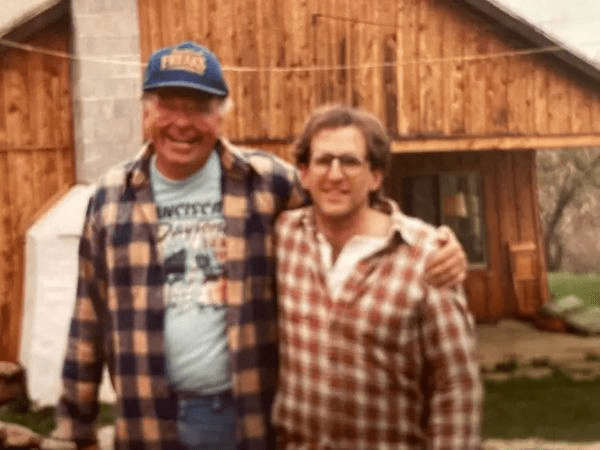
The Peaceful Priest on the left/the asshole on the right/1980’s

A friend of mine is a Franciscan priest who remains calm no matter what happens.

We are not alike.

He is compassionate, understanding, patient, and saint-like. He is perfect for his job and does it 24/7; that is, he is one of those rare souls that couldn’t be anything but some sort of man of God. If he gets stuck in traffic, for instance, he keeps it all in perspective. If someone cuts him off, his response remains, “They really must be in a hurry. I hope they’re careful.” Or, “Wow, God bless them and watch over them, they really must be anxious about some appointment.” His is a peaceful soul.

This contrasts directly with my “Use a frigging turn signal, butthead!” approach. When entering a tunnel and the traffic decelerates from sixty to forty, the good Father cares: “Oh, thank our Lord they are all being careful going into this tunnel. It really must be frightening to so many people.” I handle it with my own style: “It’s a tunnel. IT IS A TUNNEL! It is not a brick wall! Wilie E. Coyote didn’t paint the f***ing thing! The Road did NOT shrink! It’s a damn TUNNEL!”

We obviously address frustration differently, which makes me wonder how we ended up this way. Would Monastery-Bob and Professor-priest keep their temperaments? If I lived on a mountain in prayer would I be less likely to want to kill the cashier for needing a pen to subtract $5 from $20?

I was like him once, my friend the peaceful priest.

When we met during college we talked a long time about peace and where it comes from. To search for peace in the world is a fruitless act. Even if we find it, it can disappear with war, with stress, with distractions and interruptions. It is like turning to others to find what you want to do with your life; it must come from within. And peace, too, must be a spring, not a shower. I always liked that thought.

I once went to Father’s room and found dozens of people drinking beer and laughing as they told stories about their lives. Afterwards, I said I had a great time and found it strange that I could feel so lost among friends on one day and on another feel so connected and centered. He said, “Bobby—tonight you brought the peace with you.”

Man, he made it sound so simple: Bring the peace with you.

So a few years ago when some dirtbag student of mine called me an asshole in class, I thought of Father, and how it is never the situation but how we handle it. I could picture him with his wide smile and deep laugh and huge hands on my shoulders telling me I’m going to be just fine. I brought the student into the division office and sat the little bastard’s ass in a chair while I filled out a withdrawal form. Before I could finish the paperwork, however, and before he stopped crying, I decided to give this “peace” thing a shot.

“Are you scared?” He looked at me. “College, I mean, the assignments? Are you worried?”

“I suppose,” he said, calming down.

“Why?”

It took him a long time to answer something other than the moronic, I don’t know. “I’m not a good student. I was never good at school.”

“You get confused?”

“Yeah,” he said, nodding, knowing I hit on his fear.

“Yeah,” I said. “A lot of people do. I know I did. What you might try doing is stepping back a bit. Sit to the side and watch everything from a distance for awhile—get some perspective. Instead of calling me an asshole, ask me some questions.”

“Right,” he said, with not just a little indignation.

Bring the peace, Bob. Bring the peace.

“Sometimes we need to see things from a different point of view.”

He was quiet a long time and I believed I got through to him, and I wondered what he pictured as I recalled sitting in Father’s room listening to stories of scared and lost students like myself still trying to get a handle on our place in the world.

“Wow, thanks for your psycho-babble bullshit, Dude,” he said.

I took a breath, thought of Father, and told the little prick to get out of my site; that Hardees is hiring and someone has to clean the toilets.

It’s a gift, really, knowing one’s place in the world.

I headed home thinking about peace and frustration, fear and anxiety. He’s where he should be, this former student of mine. He’s out in the real world where he can seek out only those challenges he knows he can conquer. He is part of the masses that only face what they’re not afraid of. I wondered, though, how often I only face what I know I can conquer.

Bringing peace to an otherwise hostile environment is a difficult task and it gets harder when we watch the world simmering in anything but serenity. Maybe that’s why I, too, often avoid the challenge and instead wander down country roads, watch the water ebb and flow rather than suffer the anxiety hurled at us from the news of Ukraine, of Gaza, of DC, of course. It’s why I don’t drive during rush hour, avoid fast food restaurants and box store checkout lines. Hell, maybe I’ll just start giving everyone A’s so less people will call me bad names.

Yes. Let there be peace and let it begin with me, Bob the Asshole. I’m going for a walk and I’m bringing my peace with me.