Pando

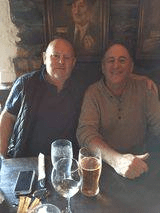
“Baby” John Walsh and me

I sat against the wall in Durty Nelly’s, an old Irish pub next to the Bunratty Castle near Shannon, Ireland. The bar was packed and next to me was the only available place to sit: a wide, stone windowsill looking out over the running creek below as the place had been a mill at one time. The window has bars on it, otherwise the drop is straight down about fifteen feet. A short, quite Irish-looking Irishman sat on the sill and drank his beer. It was loud from music and talking so that even my companion and I had to yell to hear each other.

The Irishman leaned toward me, his legs dangling above the floor. “Last time I was here I drank too much and fell out the window into the creek. That’s why they put bars up!” He toasted the air and drank, and it was easy to believe him even though the scenario was unlikely. He came straight from central casting, acting all the part of Barry Fitzgerald in The Quiet Man.

After I spoke, revealing my Yankeeness, he asked where I was from and what we were doing there. “Connemara!” he exclaimed. “The wild west!” We laughed as his response was common and I had previously noted that the Wild Atlantic Way which runs through the western portions of County Galway and all of Connemara were indeed rustic, scenes from Banshees of Innisfree shot there, as well as The Quiet Man and others. I told him my ancestry is Irish, Connacht, and in particular County Galway, noting Connemara specifically. He asked the relative surname.

“Walsh!” I screamed over the noise. “There’s some McCormick and others for sure, but Walsh is the Galway connection.

He stood up, set his beer on our table, pulled out his wallet, removed his license, and handed it to me. “Baby John Walsh is the name! Nice to meet you cousin!”

When I returned home, I thought about how connected everyone really is; how I could make trips to Bavaria or Sicily and have similar experiences, pushing out the concentric circles of my DNA. Actually, we do that socially all the time. In one family we usually break down the “lines” by aunts and uncles. Outside the family such as here in the village near Aerie, the families of many watermen have been here since the 1600’s and so when you talk to natives in town you slim down where you are “from” by creeks. “Oh he’s from over near Broad Creek.” “He’s from Mill Creek.” “Her family is down on Stove Point.” But if I head up-county, I simply say I’m from Deltaville. They wouldn’t know the Duck Pond near Parrot’s Island. When I’m down at the college, I note I live “up on the Middle Peninsula.”

You see where it goes.

When traveling as I just did to western Maryland, “I’m from Virginia” suffices. In Ireland, I usually don’t need to expose my already obvious “United States” origin, but for those who know our country, I’ll add the state.

I suppose if we ever end up on Triton, I’d pull out my license and signify to some other-worldly writer that I’m from Earth, just past Mars on the right.

What captivates me about this is the closer our ancestry is to others, the more likely we are to get along. John Walsh and I would have talked anyway since we drank beer next to each other, but once we realized we shared that name the conversation grew deeper, and I learned he wrote restaurant reviews, and he did, in fact, fall out the window into the creek on several occasions.

My brother spent time with Kunzingers in our ancestral village of Lohr a. Main, Germany. I’m Facebook friends with two Michael Kunzingers. One is my son, and the other a mathematician in Austria whose great great great great something or other is the same GGG as mine, back in the early 1800s. It’s just that his line of family never left the old world as mine did in the 1850s.

We all have the same roots no matter how far apart we grew up and eventually branched out, stretching our posterity across distant ideas.

I’m reminded of what now seems like a trite mentality from perhaps the sixties when those coming of age declared against the supporters of the Vietnam War and later the threat of Nuclear War, “We are all one family! The Human Family! We are one race!”

But it’s true. We are. And if nothing else we often drink the same beer, choose the same corner of some obscure pub and maybe bump into a distant cousin.

John Edgar Wideman wrote that everyone needs two parents, four grandparents, eight great-great grandparents, then sixteen, then thirty-two; and that’s just five generations back. He acutely notes that less than two hundred years ago, sixteen men and sixteen women made love. None of the couples most likely knew any of the other couples, living as far apart as Kings County, New York, and County Galway, Ireland, and never met any of the others in their lives, not knowing what would eventually be true—that it was all part of some grand conspiracy to set in motion the DNA which would eventually create you.

We are rooted in our past, which means we are truly rooted in each other to some degree. I understand that doesn’t mean we will get along. Tradition tells us the first two brothers certainly didn’t.

But we are here. Together on this world. At the very least we can have a beer and compare notes I should think.

Pando. The world’s largest tree.

Just a Good Stretch of the Legs

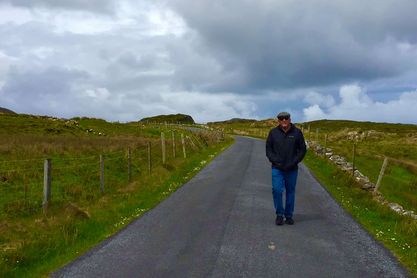
On the rainy walk on the Renvyle Peninsula

It’s raining at Aerie today, a heavy wet rain which if it wasn’t sixty-five degrees outside would be snow, the kind that weighs down pine branches and snaps the limbs of the smaller trees.

The sound of the rain is relaxing on the skylight above my head, and out the window the woods are foggy with a mist which looks cold but isn’t. It’s a good day to walk. When I was getting ready to do the Camino ten years ago this Spring, I walked in all kinds of weather from the rare snowstorms to the common downpours. Only lightning keeps me at bay; I don’t do lightning. Even inside I prefer to not sit under this skylight during a lightning storm.

But today is okay, with the rain and the warmth and my work for the colleges all caught up. I’m arranging some material for Ireland, figuring out a trip to West Virginia and Ohio, dreaming about Spain. I often dream about Spain. Remembering Ireland.

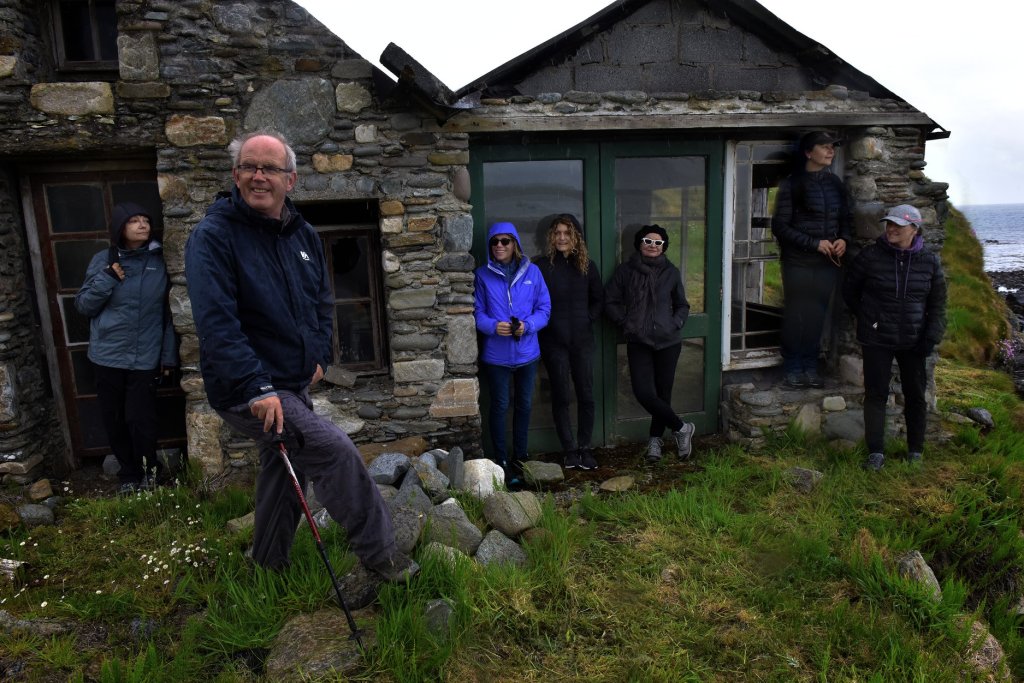
The last time I was in Connemara it rained one day, one out of about eleven days. That was in June that year, and the rest of the days were sunny and pleasant. It just so happened, however, that the one day it rained was a scheduled hike throughout the Renvyle Peninsula with famed archeologist, Michael Gibbons. Of course, being in Ireland, and him being one of the fine personalities of Ireland who jumps into bogs to show how dangerous they are and has a sense of humor which directly lines up with mine, none of us minded the rain. We walked through the crumbling graveyard of the Seven Daughters, took a break from the weather in an abandoned house overlooking the ocean, wandered for miles in the wide “wild west” of Connemara, along roads stretching past ladder farms and peat fields, and stood and listened to Michael talk about Standing Stones standing right in front of us, and dilapidated famine homes, and the Twelve Bens—mountain peaks stretching to the north, and curious customs he told us about with endless hysterical anecdotes. In all of my travels, that day, with Michael and my companions, was one of the most memorable.

With Michael Gibbons (foreground) et al, taking a break from the rain.

But I was going to say before the walk about Connemara came to mind and all the matter-of-factness about the rain, as Frost might have said, that today is fine here along the Rappahannock, and the rain won’t keep me from meandering to the water, listening to the foghorns on the fishing boats coming back from the Bay.

I was talking to someone earlier this week about Ireland, about the Renvyle Peninsula where we go, and he asked if I was from there, my ancestry that is. I was proud to answer yes, that in fact a large swatch of my DNA hails from County Galway, in Connacht, and while everyone who travels there automatically feels right at home, I felt some connection we all sense when returning to a place our forefathers come from. I felt it in Brooklyn, too, the first time I returned as an adult and walked the streets where my father and my grandfather grew up, and my great-grandfather too. It was like that in Ireland, in Connemara. I didn’t know my great-grandfather of Brooklyn any more than my ancestors of Connemara; I am as connected to them all.

Looking toward the start of the Twelve Bens

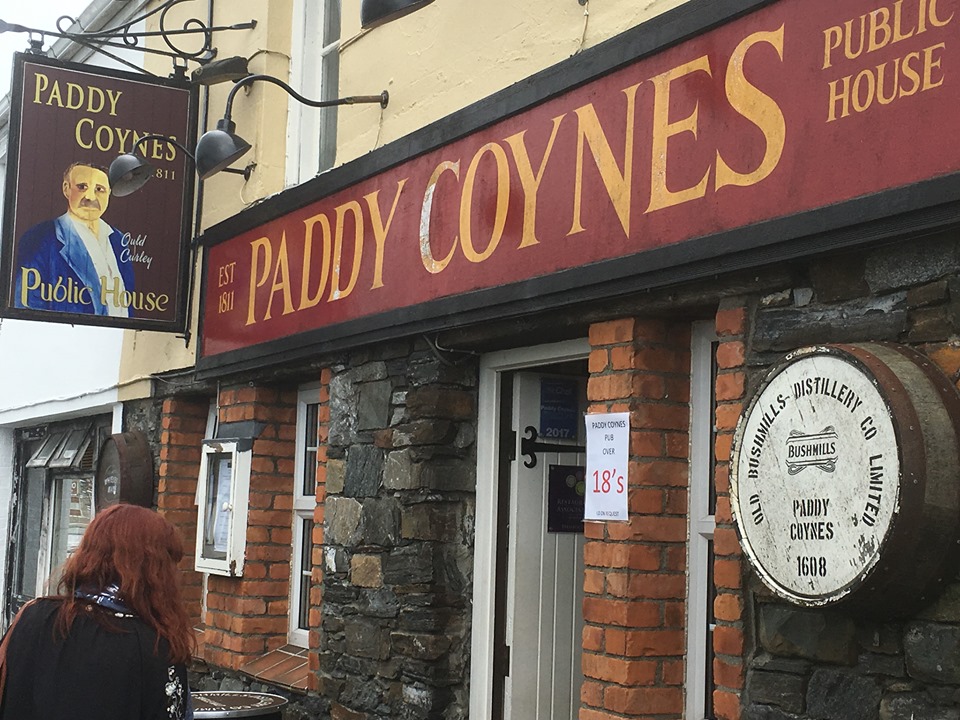
One evening we all went to dinner at Paddy Coynes in Tullycross, about two miles away. It dates back to 1811—new for Ireland—and is one of the popular pubs in western Ireland. We swapped stories, had oysters and lamb, whiskey and beer, Irish coffee, and readied to leave when I told everyone I had decided to walk back. A few protested, particularly Jacki who knows the roads better than anyone and whose roots run deep in the area. The roads are curvy and lined to the edge with high hedges, and traffic flows on the opposite side than what we are used to. Plus, it would be getting dark soon. Will, whose family is from the neighboring county, seemed more pleased than worried.

“It’s only two miles, and besides if it gets dark it is easier as I can see headlights and simply saunter from one side of the road to the other.”

They stood around talking about the meal we had just completed, and I left. The first mile is fine, with a wide road and wide shoulders, knee high walls and fields stretching clear to the east. On the west side of the street, houses sat back from the road behind Irish gates and Irish lawns—green of course.

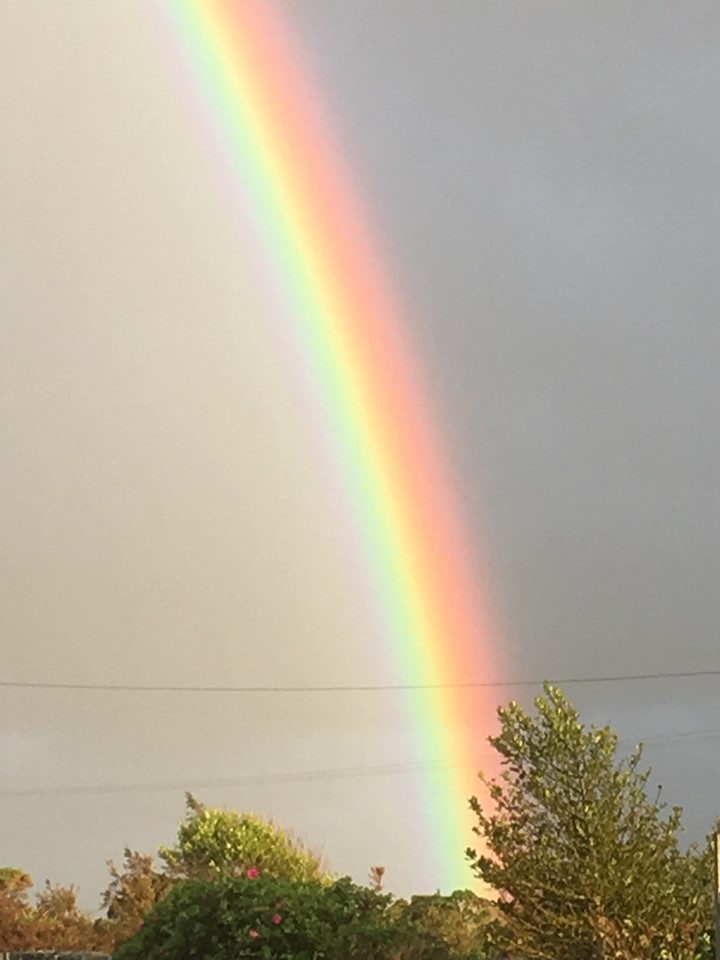
The rainbow over Tullycross

At the one mile mark I came to a crossroads with some houses and a pull-off area. I turned to look for the van, which had yet to pass in the time it took me to walk the mile, when out across the reach was one of the most beautiful rainbows I had ever seen, bold, and welcoming me to the Republic in fine Irish tradition. A car pulled over and the driver got out and took pictures, and then he and I talked a bit about rainbows and Paddy Coynes and Renvyle and America and writing and, finally, Guinness, and we sat on his nearby porch and continued our conversation for an hour, drinking beer and swapping stories. When it was time to leave, I decided to walk the last mile along the beach, this awesome Wild Atlantic Way, which I imagined my ancestors might have walked as well, dreaming perhaps of America.

Here’s what I did not know:

  1. The stretch of beach does not go straight down the coast to Renvyle House, but instead jetties out into the Ocean and then winds back, making the one mile walk about three and a half.
  2. There are cliffs—not high, about twenty feet, along the water, with a rocky beach; rocky like baseball and softball size rocks everywhere.
  3. The tide was coming in.

I was about forty-five minutes into my walk when I realized I could no longer see lights anywhere. I enjoyed the walk though, albeit on wet rocks while I was wearing slick-soled Vans more appropriate for standing on the deck of a boat. A few times the waves crashed close enough to wash up my legs to my thighs, and it was only when I turned a bend and the closest lights I could see down the coast, hoping it was Renvyle, were still well more than a mile away.

I slipped once and landed on my butt in the sand, my pants wet but my phone safe. I checked and had received a text from a friend back at the house: “Where are you? We’re all in the lobby! We didn’t pass you coming back.” I quickly replied. “Walking home now, slowly. I met a local man who invited me for beers on his porch.” Okay, I knew that sounded way more planned and carefree than my impending very possible dragging out to sea by a rogue wave on the rocks of Connemara.

Eventually, I could no longer walk along what was no longer a beach—excuse me, rocky path—and I looked up at the cliff and realized it was easier to climb than I had thought. A sheep looked down at me, almost as if to say, “You know we’ve been watching you this whole time. You’re a moron.” I moved up the sandy and grassy side of the cliff with relative ease as there was plenty to hold onto, and I made it to solid ground, a grassy field spotted with cattle and sheep, and in the dark distance a house, presumably the hand who owns these herds. I walked freely, sheep moving out of the way, me moving around cows, and climbed over several small fences and kept walking another thirty minutes, climbing fences and dodging livestock until I could see the lights of Renvyle just a few hundred yards away.

I made it to the beach near our place, and I walked to the front door and walked in to find most of my friends hanging out, drinks in their hands, listening to music, warm by the peat fire in the large fireplace. Will looked up from his camera to ask how it was. I told him about the beers, and he said it was the perfect Irish experience to have, and he was happy for me. Then I quietly told him I walked down the beach instead of the road, and he said, “Yeah, I figured.”

“I think a sheep called me a moron.”

“I know that sheep,” he said, and we laughed.

the peat fire at Renvyle House

A friend of mine says since I was born in a water sign, it makes sense that I’d be more comfortable along the Atlantic coasts on both sides of the pond than anywhere inland. Sure, part of me buys that, but just as much of me understands I’ve been coasting along sandy beaches since I’m nine years old and feel more comfortable doing so than in any hallway I’ve frequented.

But another part of me, the DNA part, likes to believe I followed some ancient path my great-great forefathers followed when they dreamed of America, wondered if they’d ever get there, wondered if they could simply ride the tide out past the Twelve Bens, past Achill and Inishturk, across the North Atlantic.

Yes, the actual sheep who laughed at me