This is Part Four of a Five Part Series here at A View.
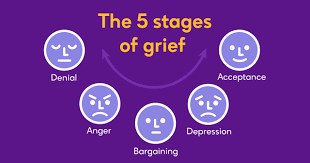
Elizabeth Kubler-Ross’ On Death and Dying defines the five stages of grief as Denial, Anger, Bargaining, Depression, and Acceptance.
Essentially:
- Denial: A natural reaction to loss, denial can help people slow down the grieving process and avoid feeling overwhelmed. It can also be a way to try to understand what’s happening.
- Anger: A common reaction to the frustration of no longer being able to live in denial, anger can feel like an emotional outlet as people adjust to a new reality. It can also provide temporary structure and a connection to the person who died.
- Bargaining: People may try to change the circumstances that are causing their grief, such as hoping that things will improve if they take certain actions.
- Depression: A stage of grief
- Acceptance: A stage of grief where people find control and figure out how to proceed
PART FOUR:
Depression:
Here’s One:
Dad once tried to buy a Snickers Bar from vending machine at a golf course. I hadn’t been nearby, but when I walked over he was getting angry. “Oh geez!” (Dad’s version of cursing). He said the machine was broken even though he kept trying to get it to work. He wanted number 110, the Snickers, and when he would push the “1” but before he would hit it again before moving to the “O,” it immediately gave me a pack of gum. I pointed out there was actually a button that said, “110” and he only had to hit that button. He pushed it and the bar dropped, and I reached in for him to grab it and found four packs of gum. He wouldn’t mind me telling that story. Dad had a great sense of humor, though my tale would have been followed with a sarcastic laugh and a deep “Very funny” comment.
That story both makes me laugh and makes me sad.
When my father died, I wasn’t exactly depressed by his passing, not in the traditional meaning of the word; Dad had not been well for quite some time, and at ninety years old with dementia, his beautiful life as we knew it had ended long before his death. The depression I have about him is from him no longer being here, no longer around to talk to. I am depressed when I recall the grace of those days we spent walking at the mall, lunches around Virginia Beach, golf with my brother and son, sitting watching sports on television. Dad was a relatively quiet man, and he rarely spoke of his youth, but he celebrated ours and the childhoods of his children and grandchildren (and great grandchildren) every moment he could. It is his absence that hurts, the void, the knowing he no longer knows us, thinks of us, breathes.
Sometimes I think of him and can’t help but laugh at the endless great times we had; and I was fortunate enough to live near him right up until his death. Other times I think of him, something small, like his baritone “Yes Dear” when my mother asked him something, or the way he sat in his chair on holidays and watched everyone else talking, laughing, and he always looked so proud and happy, and when I remember those moments, it hurts, the goneness of him hurts. I don’t cry, which is odd to me since a passing line in Ted Lasso might make my eyes swell, but neither do I think clearly for a while.
Elizabeth Kubler-Ross points out something essential about grief—it is not linear. Depression and anger may weave their way around denial, and at any given time one might snap out of anger and cry for hours. When Letty died I was immediately—and even in those pre-death months—depressed. When Dave’s widow told me of his long illness and subsequent death, depression struck me like a baseball bat. The denial came a little while later and I liked it so I stayed there. But the depression makes its presence known at odd times. Predictably in the middle of the night when my mind can’t find anything positive to counteract it all, but also in random spurts, like driving past a mall dad used to walk at, and now they’re tearing it down. The mall didn’t depress me—the fact they’re tearing it down hurt.
But there is another facet to Stage Three which complicates the narrative. Depression has multiple layers.
Let’s start with this: I battle depression. It isn’t melancholy exactly, and it isn’t sadness either; it is a complete sense of malaise, or, in simpler terms, it is sometimes not giving a damn about a blessed thing. A doctor once told me this might be why I try to live so very consciously, taking risks and exploring. A person like me just might need a bit more stimulus to accept the reality of life. A chronically depressed person (which doesn’t mean we’re always depressed; it means depression may very likely come and go for the rest of our lives) may have no intention of killing themselves, but they’re not against the idea of evaporating either. It is complete indifference. It is this: In Woody Allen’s Radio Days, a young boy who won’t do his homework anymore is taken to a psychiatrist who asks him why he won’t do it. The boy responds, “The sun is going to burn out in four billion years.” “So?” the doctor responds. “So what’s the point?” the kid says.
See, I get that. Not that I don’t understand the point, of course. But when someone cycles through a low in the depressive state, everything seems irrelevant.
Yeah, that’s not what we’re talking about here. E K-Ross bends it like this: Depression as Stage Four is a very specific “Situation” borne depression. The absence of someone’s laughter, not because they moved away or are ignoring you but because they no longer exist in this world, no longer contemplate the changing leaves, no longer taste or hear or feel, no longer imagine, no longer have any form at all, and when one acutely focuses on that reality, it can be overbearing. That thought, right there, that from now until the sun dries up, someone we love is simply not returning, that any chance you had to enjoy their company has passed, is depressing.
So too is a Jackson Browne song which cries out exactly what I was thinking about someone I loved. It’s everywhere, these depressive triggers. Some are obvious—like that damn Chevy commercial with the family visiting the grandparents at Christmas and a nearly comatose grandmother goes for a ride with her teenage granddaughter—”Sunshine on my Shoulders” on the radio—I can’t even watch that one anymore. OD—Obvious Depression. Some are subtle, like the sound of ice in a glass (Scotch on Tuesday nights with Dad) or peach pie (Dad loved Mom’s peach pie).
The death and subsequent goneness of them is not directly the trigger. If someone asks about my father and I say he passed away in 2015, it doesn’t directly depress me. But if they asked when was the last time I met my dad at the mall to go for a walk, I just might be incapacitated for the afternoon.
The sound of a golf ball leaving the tee, announcers calling a baseball game on a summer afternoon, the aroma of turkey in the kitchen while a football game is on in the other room, remembering, sometimes just remembering.
Stage Four is the weight on the chest. I remember a neighbor when I was young who not only lost a baby in infancy but lost her husband and her thirteen-year-old daughter to a car accident one rainy day. Sometime not long after that, her son found her in bed, dead, and it was said her heart just gave out. Depression can literally kill, of course, but it can equally kill the spirit, disengage any humor, and dissolve all sense of hope. It leaves one questioning what they did wrong that they are alone now (Bargaining), leaves one pissed that they didn’t tell others how much they love them (Anger), renders them useless laying on the couch in the dark on a sunny afternoon until they can convince themselves it is simply a bad dream, and the deceased is actually at work (Denial). Depression is the umbrella that all other Stages must cower beneath.
When I get depressed, I remember something to laugh about.
Here’s another one:
When his dementia had progressed but when he was still quite functional (which he remained until his final trip to the hospital), he thought there were two Joans (my mother). An upstairs Joan and a downstairs Joan, though I’m pretty sure he thought there were simply two women, and one of them was his wife. One morning when he woke up, my mother—the upstairs one–asked if he wanted to go out to breakfast. He agreed. My mother went downstairs, and sometime later he came down and when she asked how he was doing, he said, “The lady upstairs wants to go out to breakfast, and I said yes, but I really don’t feel like it.”
That makes me laugh every time, as I know it would make him laugh, and the only depressive element to it is my brilliant father’s deteriorating mind. No, depression hits me worst when I recall our trip to Disneyland in California when I was fifteen—just the two of us—that’s a great memory that gets me down. It’s the time he brought me to college one fall and stood around talking to my friends and me like he just didn’t want to leave, like he thought he might not see me again, before leaving. It’s the time he brought me to the airport for a flight out of Norfolk and we shook hands and he left two hours before my flight, but when the plane taxied to the end of the runway near the observation area, I could see him outside his car waving to the plane, not knowing if I could see him or not, that tears me apart.
I don’t think I told him I loved him until he was very old. I wish I could have done so earlier…
Damn. Negotiating again. Always negotiating.
Sometimes when it gets bad and I’m coldly aware of how much I screwed up my life and could use his presence—he never gave advice, but he listened very well—I sit and wait for denial to snap back to attention and save me, and I can go about my business still a little depressed, but this time because I forgot to give him a call before he headed to Florida.
Depression never goes away, it just simmers, often without me even noticing, but also without me feeling completely relaxed. Ever. People tell me “You don’t recover from someone’s death, you just learn to live with it.”
Yeah, I know. And I appreciate the condolences and empathy. But what is not admitted is that while we live with it, yes, the truth is we do so a little slower each time, a little less of ourselves than we had been.
 a view from this wilderness