Out Like a Lamb

“Mary had a little lamb

whose fleece was white as snow

and everywhere that Mary went

her lamb was sure to go”

Which in reality was a small schoolhouse in central Massachusetts where Mary Elizabeth Sawyer walked each day from her farm, followed by the lamb.

I’ll come back to this.

I worked for some time at a quaint inn in Sterling, Massachusetts. The restaurant with a small lounge and several rooms upstairs sat just near the Wachusett Reservoir, at the bottom of a hill in the village. It was owned by the Roy family, and Al Roy had studied cooking in France. His son, Mark, ran the restaurant and inn, along with his wife Patti. The staff consisted of about ten of us. Dave was a chef, Tom the bartender, Rich—a student at the time at the Culinary Institute of America—assisted Dave, and the wait staff. We were like family and shared each other’s lives.

I’d go hawk watching at the Quabbin Reservoir an hour west with Dave and his wife, and often Cathy and Stacy and others would come to my place—an old yellow house just down the shore of the reservoir a few miles past the cider mill—and sometimes after the dining room closed we’d sit around and have a drink and talk. There were funny times, like when I went out one cold winter night to put the trash out and the only other person left was Cathy who was placing the fine China plates out for the next evening’s guests, but I locked myself out. I went to the back windows of the dining room which faced the wooded hillside, standing two feet deep in snow, and knocked on the window. It scared the crap out of Cathy and the stack of plates sailed out of her arms and crashed to the floor. She screamed. I laughed. It was an accident, truly. Or when a couple from Quebec came to dinner just as the dining room closed and kept just Tom and me there for hours, well past midnight. Dave had closed up the kitchen after their meal and went home, but they still had wine and dessert. At about 1 am they left and when I opened their bill folder to see what kind of tip they left on the $40 tab for keeping us there so late, the credit card receipt showed no tip at all. I cursed loud enough for Tom to laugh and say, “No tip, huh?” and when I picked up the folder, a $100 bill was underneath.

Some tragic times as well, mostly January 28th, 1986, two months to the day after Thanksgiving, and just about a week before I moved to Pennsylvania. Most Americans will never forget this day, but it was particularly poignant for those of us in New England since Christa McAuliffe had lived just across the border in New Hampshire, and on that morning and afternoon, the inn was packed with people—many friends of Christa’s—to watch the Challenger launch on television. I was tapping a keg of Budweiser and looked up as Patti said, “Oh wow, that doesn’t seem right.”

It was completely silent, followed by cries. I can still smell the beer, hear the dishes from the kitchen, Cathy saying, “What’s going on?” and Tom behind the bar quietly repeating, “Holy Shit. Oh wow. Holy Shit.”

But today I remember a happier time there. Thanksgiving Day, 1985. Forty years ago next week. We had a limited menu of Turkey, Scallops, or Prime Rib, and we were booked for all three seatings. The last guests left about 7 that night, and after we cleaned the dining room and the kitchen, we all sat around a bunch of tables pushed together and had a full meal with all three entrees, bottles of wine, pies, and stories, constant and hilarious stories. It was a beautiful time in my life and I loved where I lived, what I did, and the people I spent my time with.

But something had to change; I knew this. I did not know what needed to happen, but something else needed to be next. I had graduated from college, traveled through Mexico, lived in Tucson, managed a health club, and was happy, but stagnant, and this state of being, albeit pleasant, contradicted my very nature. It would not be long before I would turn in my notice and move to Pennsylvania, but on that Thanksgiving where a dozen misfits all sat around the table together laughing and drinking and wishing it could be like that forever but knowing it had to change—and would, for every single one of us—I got up to open another bottle of wine but instead walked out the front door to see that even more snow had accumulated on the couple of feet we already had.

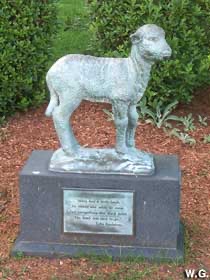
I walked to the center of the village just a half block away and found a statue I’d never seen before. It was of Mary Elizabeth Sawyer’s lamb. Mary is the young girl in Sterling, Massachusetts, who had a small lamb that followed her everywhere, including school. It was a big event in the small school, and the next day a classmate of Mary’s, John Roulstone, a year older than Mary, handed her a poem he had written about the event. The poem had three stanzas—the first of which is at the top of this page.

Some years later, a poet, Sarah Hale who lived not far from there, published a small book of poems which contained a longer version of the poem, but Hale insisted it was original and based upon imaginary events. The controversy lasted for some years, well after both Mary and Hale had died. Until Henry Ford—yes, that one—investigated the incident and not only sided with Sterling’s own Mary, but purchased the schoolhouse from the village of Sterling, moved it to Sudbury, Massachusetts, and then published a book about Mary.

Back to me.

I stood at the small statue watching snow slowly cover the lamb’s wool now truly white as snow, and waited in perfect silence, listening to the quiet of rural Massachusetts. I can feel that moment today, that sense of peace braided with a sense of restlessness. I had to leave. I had to stay. Back then for people my age riding the tail of the Baby Boomer generation, the urge to “change” something usually meant going to the liquor store for boxes, filling them with books I’d never read again, tying them up with string, and moving somewhere else. Boston was out of the question—geez, an hour to the east was too far. Staying meant improving my life where I was—figuring out how to take the best of my situation and improve it, and I stood in front of Mary’s lamb and knew I didn’t know how to begin to do that. I only knew how to pack up and leave; that I was good at.

I went back in and grabbed the wine bottle and while I was opening it, Mark came in the kitchen.

“Where the hell have you been? We’re a bottle a head of you!”

“I was talking to the lamb.”

“What lamb?”

“Mary’s.”

“Ha. Oh. Well…”

“Mark, I think I’m going to have to turn in my notice, but, I don’t know, maybe January, maybe February. I need to find something else to do.”

“Oh wow, well, okay. We can talk about this later. You’re here for the holidays, though?”

“Yes, of course.”

We drank wine. I suddenly felt a little out of place, more like a visiting cousin than immediate family.

At the end of the night, everyone had left, Mark and Patti had retired upstairs, and just Cathy and I were left, she placed the dinner plates out for the next day, and I put out the trash, where I accidently locked myself out.

I moved. Cathy moved. Dave opened his own restaurant. Tom died. And the Sterling Inn fell into disrepair over the next few decades, abandoned, with vines taking over the building, the parking lot cracked and covered with weeds. Someone bought it from the Roy family a few years ago with the intent of restoring it to its full original glory. Same red trim; same black shutters. But some town controversy has kept it from proceeding. I miss the place. I’m glad I moved but I’m sorry I left.

That was forty Thanksgivings ago. Some memories follow us around, waiting for us to notice them.

Best Cheese I Ever Had

So here’s one I wrote and let it go. It’s partially told in a piece in my short collection Howl at the Moon (Cuty Wren Press). It came to mind this morning because I’m leaving in a few days for Amsterdam, and I’m sure there will be cheese involved.

I was in the Netherlands about twenty years ago, maybe twenty-five. I lectured at the University of Amsterdam and talked about art and Van Gogh and death. Normal stuff. In class one day, which was open to visitors and in which everyone was required to speak English, an older woman whose late husband was an artist sat in for the lecture, and afterwards she gave me an etching her husband did of a local cathedral. When she learned I was going to find a way up to the Zuider-zee, she offered me her son’s motorcycle for the day. Students gathered to talk about Van Gogh and about America and more. While the woman and I spoke, they talked amongst each other. One guy asked another if she was working that night and she said no, but the next night she was. He told her he’d come by. Another said it hurt to speak in English, and the young woman said it’s good for him to learn, that she wants to learn as many languages as she can. They all talked about van Gogh’s art.

That night on my way back to the hotel, I walked through the Red Light district to use a computer at a Brown Café to tell my officemate about how it was going so far. The windows of the district display scantily clad women, select lingerie on the floor, a couch, maby velvet, sensual surroundings and lighting. They move about tenderly like flesh and bone mannequins, and when a prospect passes, they urge him to pause, consider coming in for a quick turn. They whisper to them in Dutch, in English, French, German. There’s a back room for the business end of the exchange. I kept walking.

The next morning was one of those movie-set days with a perfect temperature, ideal soft breeze, postcard tulips and windmills, dikes running roadside holding back calm waters. I rode out to a Volendam café on the docks where som sailor just back from the states finished washing down his ketch, and we talked about his Atlantic crossing, about the Chesapeake Bay where he had been, and about the cheese he had on deck which he shared with me. We went in the café for a beer and the waitress offered some Gouda and bread with eel and herring. She said the cheese was from a small factory just a few miles away and that I should go, so I did.

Inside the cheese factory—a small barn-type building—a young man and woman stirred a vat of vlaskaas cheese which was sharp, and they told a half dozen of us how gouda is made and molded into wheels and how we shouldn’t refrigerate it, and how healthy it really is, being a hard cheese, including aged, smoked, and toasted. I bought two wheels for fresh gouda and stacked them in my pack and walked outside where a few other travelers from a bus sat at a picnic table.

A Dutch girl about twenty-five eating cheese and drinking white wine asked me to sit with her, and when I told her she looked familiar she said she had been at my lecture, and she swept her blond hair behind her ear and that’s how I knew her—she did that the entire reading, it kept falling forward and she kept sweeping it back and I thought Geeze just tie it back already. I told her simply I recognized her.

She offered me a glass of wine and retrieved a plastic cup from inside, and I shared her cheese. Her name was Abby and she came up to get a few wheels for her family and one for her. After about thirty minutes and a glass of white, the bus driver called for them to go so she left and said she’d hoped to see me again, and I walked toward the bike to leave. The cheese was heavy but I was glad to have it, and the perfect day made me not care so much.

That night I packed for my trip home the next day and decided to head back to the Brown Café to write again to my officemate back home to tell him about the ride out to the North Sea and the sailor and the hair-sweeping blond. I did so on the upper level of the first café I came to where the open door swept the smoke from the hash up to the internet café section so that by the end of my email I couldn’t spell anything correctly.

I left the café and strolled around the district where people drank espresso and the aroma of various smoke filled the narrow streets and top-shelf women worked the windows, and if you can see this coming you must believe me that I certainly didn’t see it coming at the time: I turned a corner and glanced at a blond in a prime-site window, and it was her, Abby, the hair girl with the cheese, and she motioned to me like I was just another passerby, but then recognized me and sat up more from where she had been prone on some pillows and her white lingerie lingered just a bit behind, and she pulled her strap back on not trying too hard to do so, and she pressed against the glass and urged me to come inside, motioning toward the door on the left. I thought about just walking by but that thought didn’t hold so I went in just to say hello. She cut me a slice of the cheese she had bought that day and she pointed that out, that it was the same wheel of cheese that we shared earlier, and that thought seemed to connect us closer than I cared, but it hung there between us. I had one slice of the vlaskaas on the table and said I didn’t want her to lose business on account of me, and that I really had no intention of patronizing her profession, and she smiled and said she understood. I left, and on the way out I passed the guy from class who had asked her if she was working that night. He glanced at me and I laughed. This is not like the colleges at home, I thought.  

On the way home I walked by the Van Gogh museum one more time. It was quite in that part of town, and I stood in the cool night air, the sweet aroma of flowers everywhere, and remembered Vincent’s words about Sien, a prostitute who lived with him for a while with her young daughter. About her he wrote to his brother, “I believe there is nothing more artistic than to love people.”

Next week I’ll be there, at the museum, at the village where he lived a while with his parents, and along the canals. Just look at how everything in our lives moves on, grows and changes and, eventually dies. We age and hold out hope that some of who we used to be remains, knowing, of course, that is true only for a little while. Since I walked those streets last, friends and loved ones have died and my world has changed time and time again, but this week I’ll walk along that avenue and the hallways of the van Gogh museum where his work remains on permanent display, and I’ll think about the man who was nothing more than a peasant who lived with a prostitute, didn’t make any money in his last ten yers, lived off of his brother, was disliked and consdiered a leech and a failure by everyone including the best artists of the day who for the most part said his work had no hope. And I’ll think about that as I pass people sleeping on benches in the park and wonder which ones are artists and which ones of us merely pass judgement.

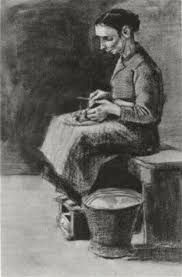
Van Gogh Drawing of Sien Peeling Potatoes

Love. And Time.

It’s Fourth of July week and I’m about to get older, and I’m in a café on the Bay thinking how I’d love for this place to be open at night, late, like 4am, and sit and have beers or wine and talk to strangers about where they’ve been, literally and figuratively. I’m sitting here thinking about the the past four or five decades. “Fortunate” doesn’t come close to describing this pilgrimage; but something is different lately. I’m just turning sixty-four and I’m outliving so many people I know. This makes me curious about what’s next, about this brief span before me. I thought I’d grow tired by now, start to unwind, but curiously I find myself gaining momentum.

Here’s a decidedly oversimplified explanation of what runs through my mind on an almost daily basis: We are going to die, of course, but we have no idea when, and even if I live to my mother’s age of ninety-one, that’s just twenty-seven years form now. That’s nothing. And after that we close the door behind us and slip into that nothingness of never being this way again, through the eternal and infinite future of all futures. My point is, to be trite, “Today is my moment; now is my story.”

And today while sipping a cappuccino and after talking to a couple who are sailing down the bay to cross back to the Netherlands, I felt awake, like that crystal-clear awake you have sometimes after it rains. Like all of my senses were cleansed and rebooted. Happy Birthday to me.

To be sure, I’ve had my share of everything: I’ve had a lot of chances to travel. I’ve walked across Spain, trained across Siberia, drove around North and Central America, stood in rivers from the Connetquot to the Congo, and I’ve followed a herd of moose through the woods in Northern Norway. But still it simply isn’t enough; not on this abbreviated timeline. There’s not enough time, never enough love, too much wasted energy, too many spoiled days and nights, not nearly enough love.

In looking back, the moments that stick out most in my mind are the ones where I stepped out of my comfort zone and risked being embarrassed, rejected, and humiliated. Sometimes those things happened, to be sure, but those times are still better and more memorable than sitting safely at home watching reruns of an old show, watching other people live still other people’s lives.

Oh there have been moments. And they all have one thing in common; my memories are of the people I was with completely engaged with each other. It might have been my son in Spain and Russia, or just us taking pictures down at the river. It could have been sitting on a beach in Florida or drinking champagne while watching a sunset on the Great Salt Lake.

Sitting around a club I ran in Massachusetts after hours and swapping stories, laughing, eating pizza from down the road after all the people left. It’s the one am stop at Ocean Eddies on the pier in Virginia Beach in the late ’70’s for a drink and a talk with someone from somewhere else, nothing but the sound of waves crashing under us.

One Fourth of July I was in Massachusetts and drove to Boston to watch the fireworks and I stopped at the Bull and Finch Pub, made famous for being the model for “Cheers.” I sat at the bar and had a beer and got talking to someone who was there to play music. I told him I had played and he asked me to play a short set during one of his breaks. Okay, so this is an example of knowing as sure as I’m sitting here that ten minutes after I said no I’d be absolutely pissed at myself, so I said yes. Rarely am I 100 percent in the moment, not distracted by next or was, but moments like that I am present, completely present–like on the Camino or the Train or the Lake or the river. I said yes and risked being myself. I even had the balls to play “Please Come to Boston.” When I got home to my house on the reservoir that night, I got out my guitar and played while my cat Huey sat on my knee and listened.

Alive. I was so freaking alive that night. The next day friends came by for my birthday and I told them about it and they were excited for me but like with most things in our lives, you absolutely had to be there. I was.

Geez I’ve been fortunate.

But there was one night in particular which stands out a bit more than most of the others. It took place in a bar which long ago burned down. We called it The Shack because it had no name.

This happened about twenty-five years ago.

Just off the Gulf of Finland not far from an exclusive hotel but well in the woods was one of this world’s coolest bars—a dive really—a place to drink and sing and meet people you’d never want mad at you. It was small, with broken-down shed-like walls and windows which barely kept out the storm blowing off the Baltic one May night in the nineties. It was well after midnight and we ordered a bottle of Georgian Merlot and several plates of shashleek, a Russian shish kabob dish. A gypsy band showed up, including a guitar and violin player I’d met before and had played with there along with a friend of theirs, a woman singer. Hours passed as we played and sang and drank. There were four others, three of them, a waitress, the owner and his cat, and we sang and drank while what must have been that hurricane from The Perfect Storm slammed to shore. This duck blind of a building sat amongst birch trees, but that simply made me more aware of the weather, wondering when one might topple through the roof. It was exhilarating, an adrenaline rush that had nothing to do with the wine. It was being alive, right then at 3 am, with total strangers, live gypsy music, Georgian wine, and shashleek, that kept us awake. It felt dangerous, subversive, but it was just a bar in the woods.

I had been in my hotel room, ready to call it a night since the next day we were all going on a river cruise, but I got dressed to head back up the beach to The Shack and have some wine. I didn’t want to wake up the next morning and wished I had gone. The storm hadn’t yet kicked up. But it was coming; you could see it in the haziness of the midnight sun.

The band took a break and came to our table and we spoke in broken Russian and English about the storm and how we hoped it wasn’t high tide soon since the water was just a hundred feet west, maybe less. Then Alexi, a two hundred eighty pound drunk Russian who hated Americans started screaming at us like he had the first time I ever met him, the first time I walked in the place a few years earlier. He had kept to himself mostly since then, sometimes talking to me, mostly not, but this night something got under his skin and he screamed at me like he did that first time, “I hate Fucking Americans.” He startled me, but he had a drink in front of him, and another regular customer, a friend of the gypsy band, was sitting with him and told him to quiet down so he did.

But then I saw his eyes. They were deep and vacant, like he’d seen a ghost, and when he saw me watching him he stood up and said, “I hate fucking Americans!” and he tossed his beer at me. Sasha, the guitar player, stood up and yelled at him in Russian. But just then thunder, with a sound like the sky opening up and dropping two tons of hard earth on our shack, rattled the walls and ceiling and we all cringed. I thought for sure one of the birch trees cracked and was going to kill us all. I went down on the floor with my friends and the gypsy band, and Alexi cursed and fell against the back of his chair. He suddenly looked so small, and the thunderclap crashed on us again, this time blowing open one of the windows, and rain and wind sheered a path across our booth and against the other wall. Dima put his violin under his coat and our shasleek flew off the table onto the floor. The shack cat went for it but the wind and rain chased him back under the bar and into his bed.

Another flash of light lit up the shack and Alexi was trying to hide under his table but he was too big, and just as he glanced out the window on his way to the floor, he stopped and stared. I was watching him, and he looked out the window for some time, then looked at me, and with a nod he said, “Horosho. Horosho” which means, “okay. It’s okay.” And he looked out the window again when the window slammed back and forth. He grabbed it before it hit him and he held it a second, staring out over the Gulf. He looked at me as if to ask me to come see but he didn’t know how. Instead he closed the window and latched it again and turned and sat down. He nodded to me, “Horosho. Edeesuda.” It’s okay, come here. A few of us gathered and sat at his table, and Dima took out his violin. Alexi smiled at me, looked out the window and peered with a stoic face, then turned and smiled again. He looked at the waitress and said “pivo,” beer, and he motioned to us all so she brought us all beer. The rest of the night we laughed and sang songs. I asked Alexi what he saw outside but he just nodded at me and said, “I hate fucking Americans,” and we laughed and toasted and Dima played, then Sasha joined in and then the woman singer, and the beer tasted good. Alexi sat quietly the rest of the night.

The storm passed and the sky quieted down. I almost had stayed at the hotel that evening, turned in early, read in bed. Those are all good things, quiet ambitions which keep me grounded and invested in whatever happens next. But that night I didn’t. Like the time we went Ghost Hunting at midnight at the Saint Augustine Lighthouse, or when my son and I sat up all night in the town square of Portomarin, Spain, because we couldn’t find a place to stay. One time a friend of mine and I hitchhiked to Niagara Falls and it took no longer than it would have to drive, but coming back we walked for eight hours along dark roads through small towns. But if we had been given a ride right away, I’m not so sure I’d remember we even made the trip to begin with. We talked a lot that night, and I wish I could walk like that with more people, and talk, and just walk quietly too.

Sometimes you have to stay up until dawn to understand what’s hiding behind the night. It’s the rest stop at three am with two truckers talking about the next town; or the sound of wildlife in the desert brush, or tall pines scraping together in winter in the woods with no light but the moon. It’s walking up an Arctic path at four am in snow-deep March with Northern Lights bouncing past like a bull whip; or lying on my back on a cot in a compound in Africa beneath more stars than could possibly exist, the distant sound of someone chanting the Koran. It’s walking out of a shack in the woods after a storm passed, the sun just lifting over the raised bridges, ears buzzing from loud live music. It’s the perfect silence on a salt bed and the music of family talking about old times, talking about now. My new year needs to start not just remembering the beautiful path it has been so far, but what made it beautiful to begin with. Its enjoying the passing of time, as JT wrote.

On that night on the gulf after the storm, after the music and the wine, when I stood in the quiet light of morning and shook hands with Alexi as we went separate ways, most likely for good, I began to understand that this crudely brief life of ours is best punctuated with those we love.

Sliced Bread

Note: I wrote this piece nearly exactly as it reads below not long after the invasion of Iraq. Originally, I sent it to Dan Latimer, who at the time was editor of The Southern Humanities Review. He rejected it. About a year later at a reading in Atlanta, I read this, and Dan came up after and said, “I love that piece! Is it published? I want to use it in the SHR.” It was a few years later after he published several other works of mine I told him of his initial rejection of “Sliced Bread.” A year after the initial publication, Dan wrote to congratulate me; “Sliced Bread” was noted in Best American Essays, edited that year by Adam Gopnik. Since then it has been anthologized several times and even taught at a university in Taiwan. It remains one of my favorite pieces. I watched Oppenheimer again the other night and thought of this. Thank you for reading/sharing.

Sliced Bread

Tennessee Williams ate cornbread, as does Bill Clinton. Hemingway ate anything toasted. Vladimir Putin likes pumpernickel, named, according to spurious account, by Napoleon during war with Russia when he demanded a loaf of bread for his horse, Nicole, and shouted, “Pain pour Nicole.” Jacques Chirac chooses French from the Mediterranean region while Vincente Fox finds southern Mexico’s flatbread best with paella and beans.

Reagan liked sourdough. Nixon, a connoisseur of fine food, enjoyed sliced wheat bread and lightly buttered popovers, as does Margaret Thatcher. Thom Jefferson like Sally Lunn, of course. Mao didn’t eat bread. Stalin soaked black bread in beer and Lenin liked rolls. Alexander the Great relied upon some form of flatbread, while Ivan the Terrible ate black bread. Seafarers fared fine on hard biscuits inedible without sopping up soup or grog, and the staff of life literally saved the lives of millions during the nine-hundred-day siege of Leningrad during World War II, when bakers mixed breadcrumbs with sawdust to trick the stomach into feeling full. While mothers waited for food, while children starved to death, the Nazis pounded the city from the south with endless bombings. Hitler ate rye.

Which made me wonder about George W. Bush, so I Googled “Bush + Bread” and came up with “Damper Bread—a favorite in the Australian Bush.” Campers eat this horrific outback specialty in the wild. They bake damper in the hot ashes of the campfires in the outback dirt. It tastes disgusting but the sustenance is often necessary. Still, this tells me nothing, and I don’t think Bush bakes bread in the ashes of his Crawford ranch.

But just below that entry is “damper bomb.” This small exploding device can be manufactured at home for just dollars and will smoke out or kill anyone in the house. The damper bomb how-to page notes, “This is not a smart idea.” I should think not.

This same search, however, exposes “Smart Bombs” as a brilliant result of precision technology. They’re designed with a sensor system that uses a battery and onboard controls. Instead of just being dropped from an airplane as dumb bombs are, smart bombs are dropped then guided to their computed targets. They essentially become heavy gliders. Dumb bombs, however, fall helplessly.

So I searched “dumb bombs” further and found “Dum Bread.” This is a round loaf that indentured servants brought to the Caribbean from India after slavery. The dough was sweetened with coconut and placed in a covered skillet and fried on coals. More coals were placed on the lid. Later, wheat flour was added to the dough and the result was called Smart Bread. It can sit heavy in the stomach, however.

Equally difficult to digest is Daisy Bread. It is the most popular treat at the Lighthouse Bakery in England. It is dense, but pulls apart into pieces that resemble daisies. For an extra few pounds hungry daisy-eaters can add soup. The cook admits the weighty combination. “It’ll warm you up, though,” he says.

So will the infamous Daisy Cutter Bomb.  This cutter is essentially a dumb bomb weighing in at fifteen thousand pounds with more than six tons of explosives. Someone thought this was a smart idea. These bombs were common in Afghanistan but became most popular in Vietnam, where soldiers were hungry for landing-zone clearings. One of these twenty-seven-thousand-dollar-apiece bombs could clear an area three-quarters of a mile wide, including all buildings and rock formations. One of the problems with the Daisy is that the pilot must fly low, right over the target, so the wind won’t carry the bomb off course. They cost a lot of dough for such dangerous operations.

The fact that I searched for Bush and Bread and came up with bombs at first seems ironic. Not so much. Since I’ve already stumbled upon heavy bread and bombs, I look for the two in one shot and come up with MOAB, the Mother of All Bombs. This weighs in at twenty-one thousand pounds with nine tons of explosives. It’s the largest non-nuclear bomb in the world and is considered a Smart Bomb because of its gliding ability through GPS. It sprays a highly flammable liquid mist and then explodes about six feet above the ground for maximum impact. This monster is the size of a Jeep Cherokee. In 2002, Donald Rumsfeld said as far as weapons were concerned, the MOAB was the greatest invention since…well, how trite.

Truckers often stop at the Moab Bakery and Brewery in Moab, Utah. There they serve a popular bread bowl filled with whatever soup customers desire, along with some fine microbrew, for a few dollars. Moab is appropriately named; it means “beautiful land,” and Utah sure is beautiful. Of course, Moab also rests above one of the world’s largest uranium deposits.

The name has a biblical reference as well; it means “of the father.” Turns out that after Lot escaped from Sodom, his two daughters got him drunk and had sex with him. They both gave birth to sons and named the oldest Moab, whose primary diet consisted of salted bread. The territory in which they settled became known as Moab and one of the leading Moabites was Ruth, the great-grandmother of Kind David, whose lineage cuts directly to Christ. The first breadline, perhaps.

To go back:

Ancient Mesopotamians nearly nine thousand years ago chewed wheat grain. Eventually, the pulverized from, heated, tasted better, especially when they accidentally added yeast. It didn’t take them long to figure out that pulling off some of the old dough to use as starter for new dough would speed the process, and sourdough was born. In about 1000 BC, they grew a new strain of wheat which allowed them to make white bread. They ate thirty different varieties and washed it down with their most popular brew—beer. This all spread to Greece, which carried it to Italy, where grain and bread became the primary sustenance and monetary unit. Soldiers didn’t mind so much if they missed out on the meat, but don’t dare short them the bread. And the Roman welfare state was based on the distribution of grain to the citizens. Eventually, the government even baked the bread for them.

In 186 BC, the bakers formed a guild, making baking a separate profession. They enjoyed special privileges and theirs was the only trade carried out by freemen, not slaves. The members of the guild were not allowed to mix with regular people and were prohibited from attending events at the coliseum for fear they would be “tainted,” contaminated with the vices of ordinary folk. Romans loved rich breads with eggs and butter, but their favorite was white bread, made with special wheat grain, and to eat white bread indicated one was special. However, bakers considered it somewhat stupid, recognizing what the rest of the world would discover later—dark bread simply tastes better. Bakers believed it was bad taste to eat white bread.

Still, throughout most of history, white bread was an elite product since the grain was more expensive, and darker breads were distributed to the poor. Eventually, that switched and darker breads became renowned for their taste, making them more expensive. Through the dark ages, bread helped humanity rise above the plagues. Bread prevented suicide; bread filled young stomachs when nothing else worked; it was used for trade, as a status symbol, as an aphrodisiac. During the French Revolution, the Bread Riots nearly collapsed the government, giving rise to the myth of Marie Antoinette’s insensitivity: her supposed declaration that the poor, for whom bread was too good, should eat cake instead. Beer and bread were the two staples of life throughout the Middle East for centuries. Mothers used to send their children to school with both.

But even the Egyptians, who greatly improved bread-making recognized that the origin of the process and the best-tasting bread came from Mesopotamia, where the Euphrates and the Tigris rivers form the Fertile Plain.

Modern-day Baghdad.

The irony is so thick you can slice it.

The wheel was invented here, and the great mathematicians of ancient Greece recognized the Fertile Plain area as the source of their inspiration. Ancient Mesopotamia gave the world the first metal-working, architecture, city-building, urban planning, legal system, medical writings, cobblestone streets, and even beer. All of these six millennia and billions of loaves of bread ago.

The first bread with a name was called Lotus Bread. Flatbread with little or no yeast, it was used mostly to sop up oil and gravy in the meal so as not to allow anything to go to waste. Pita is a modern form of this. Roti in India; hleb in Russia; pan in Spain; brot in Germany; ogi in Basque; pao in Portugal; ekmek in Turkey; non e barbari in Iran; and in Iraq, khubz—the correct name for pita, taken from the Hebrew and Arabic. It’s the most widely eaten bread in the world. The Body of Christ is a middle-Eastern recipe. Michelangelo ate pita, as did the first popes. It is available at the Lotus Bakery in England, which also makes bread and rolls from the finest spelt flour, grown in the Middle East for nine thousand years. Today, farmers grow nearly a thousand varieties of wheat grain but still only one strain of spelt. And according to the Lotus Bakery it is easier to digest and tastes better than wheat.

The Lotus Bombing Principle is more difficult to swallow.

This declares that an independent government has a right to defend itself with whatever method is not prohibited. Here’s the problem: the World Court, in determining that states have the right to use nuclear weapons to defend themselves, ironically determined that states have the right to choose a course of action that could conceivably lead to the extinction of humanity. But not allowing the state that right would not allow them to carry out an action that is not prohibited under the law of the World Court; the “lotus” principle. Confused?

Simple: The world governments with money and know-how set out to find and extinguish nuclear weapons of mass destruction from the arsenals of governments considered “high risk,” Bush’s “Axis of Evil” members. And how do they find them?

Yeast.

As it turns out, yeast functions like a scout, or a canary in a coal mine. If yeast cells are exposed to dangerous chemicals they change color and die. Scientists genetically modified yeast so that when something happens to its cells they change color. These yeast cells are placed on the backs of cockroaches—a species which can apparently survive a nuclear war. The roaches are then sent into places where someone might hide dangerous chemicals or weapons. These yeast cells can stay alive for several days, and that is long enough to keep an eye on the little indestructible suckers to see where they’ve been and if, when they come out, the yeast cells have turned color.

So war and bread apparently need each other. However, I still need to know the president’s favorite bread. In need of aspirin as well, I wander to the drug store, where the clerk watches Oprah, and who’s her guest but the Commander-in-Chief himself. I watch the way one watches a NASCAR race: waiting for, just expecting, an accident, but she keeps the questions relatively simple. One of them is his favorite food—I can’t believe it.

“Oh,” the president says, “I love peanut butter and jelly on white bread.” I pegged the president as a white bread loafer from the start, with maybe an occasional drift toward tortillas. But any WWII Navy personnel could predict he’d go for the PBJ because the PBJ-1 was the US Navy’s designation for the famous B-25 Mitchell Twin-engine bomber. It had a mounted upper turret and retractable radar unit  along with the ability to carry a single torpedo fitted outside the bomb bay. One of the Mitchell’s finest hours was the Doolittle Raid in which Jimmy Doolittle led a group of PBJs off the carrier Hornet in a bombing raid of Tokyo. Many years later, President Reagan and Vice President George H.W. Bush awarded Doolittle the Presidential Medal of Freedom for “dropping the bombs that led to the end of the war.” During Doolittle’s tours overseas, he was allotted four ounces of bread per day.

According to Saint Don Bosco, a nineteenth-century Silesian priest, our only salvation from the bombs that will rain down is the “bread of life.” Saint Don would have eaten mostly flatbreads from Northern Italy. The year Bosco died, Van Gogh wrote that he ate only “bread and whatever beer I can borrow from the innkeeper from the night café to keep myself from suicide.” Van Gogh liked sourdough. Snoopy eats wheat toast. My son likes hard-crusted Italian. My father likes white bread; he voted for Bush.

In America last year we spent about seven billion dollars on bread. The workers who built the pyramids were paid in bread. The great fire of London started in a bakery. Of the more than six billion people on the planet, nearly five and a half billion of them rely upon bread as their primary nourishment. Meanwhile, that same number has at one time or another in the last five years been in some sort of volatile conflict.

Julia Child once wondered, “How can a nation be great if its bread tastes like Kleenex?”  Henry Miller said you might travel fifty thousand miles in American without once tasting good bread. Gandhi said there are “people in the world so hungry that God cannot appear to them except in the form of bread.” Francis Bacon said acorns must have been good enough to eat until bread was found. And he wasn’t far off; the first bread probably tasted nutty.

Bread is a slang word for money. Bread is the staple of life, both nutritionally and spiritually. Thomas Merton wrote, “Stale bread is much closer to crumbs and I am humbled by that.” Plato believed an ideal state “where men would go to their grave old was one where people ate locally grown whole grain wheat.” Socrates, on the other hand, believed whole grain bread to be pig food. Christ probably ate Parthian bread, and the loaves that fed thousands were a similar variety. “Companion,” literally translated, means one with whom we “break bread.” Bread is the staple of civilization; it keeps the seams from unraveling.

When a movie fails in the United States, it is considered a “bomb.” When it succeeds in London it is considered a “bomb.” In both cases the word comes from the Latin, bombus, which means “a booming sound.” Bread, on the other hand, is derived from the Hebrew, which is known in some lexicon circles as the “mother of all tongues.” To brew, the root of the word “bread,” is to concoct. No wonder warm beer and bread have been linked since biblical times. Certainly those downing loaves of Parthian must have been getting bombed along the way. Dwight Eisenhower said, “Every gun that is made, every warship launched, every rocket fired, signifies in the final sense a theft from those who hunger and are not fed.” Eisenhower liked Irish soda bread.

Robert Oppenheimer, director of the Manhattan Project, upon watching the first atomic explosion in 1945 quoted a Sanskrit verse from the Bhagavad-Gita. He whispered, “I am death, destroyer of worlds.”

Oppenheimer loved white bread, lightly toasted, with butter.