The Shed

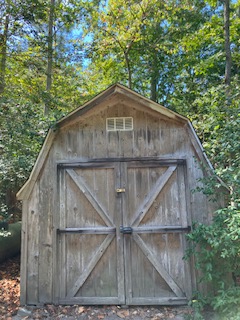
The Shed was twenty-feet deep by eight feet wide, with two windows, two lofts, double doors, and sturdy enough to withstand everything except Hurricane Isabel.

Of course, I bought the shed to hold supplies when I was building the house. Before I started, when I had first cleared the small portion of the property for the home, I had this shed delivered figuring I might need to sleep in during bad weather while up here for three of four days in a row seventy-five miles from the place in Virginia Beach. Michael and I went together to the shed place in Virginia Beach. Some guy paid for it but never picked it up so I bought it brand new for a song and the father and son team I bought it from delivered it seventy-five miles, across the Hampton Roads Bridge Tunnel, across the still-narrow Coleman Bridge, the Piankatank bridge, and down my winding driveway through the woods—for twenty-five dollars. I also bought them lunch.

It didn’t take long, as it tends not to take, to have stories to tell from the shed.

Back in ’99 we had fifteen inches of rain in two days and the water ran from the river side of the property down to the woods beyond the shed. I had the shed leveled off the ground by about eight inches on blocks, so the water rushed toward the door but instead dug crevices under the shed. The shed, miraculously was dry, but impossible to get to.

Isabel didn’t do a thing to the shed, but she knocked down thirty oak trees here at Aerie, and one of them lingered for weeks right above the shed. I knew it had to come down but this was a job I couldn’t pull off myself. Scavengers wanted more than fifteen thousand dollars to clear the fallen trees, so I said I’d do them myself, which I did, but I was afraid to cut the half-fallen tree in fear it would crush the shed. Instead, another storm just a few months later cracked the trunk and it crushed the back half of the shed for me. I remembering thinking, “Hell, I could have done that.”

So in the lemonade tradition, I made the back half into a greenhouse with plastic sheets for the roof, but it didn’t really work, and over time the mold and mildew and various snakes and wood rot got the best of The Shed. It took about twenty-seven years.

One time early when Michael was about five, we played hide and seek as we often did, and I ran in the shed while he was still too far away to follow me right in, but he could see me. I then climbed out the back window and settled behind the back wall. I heard him come in the shed and was quiet for a minute then said, to no one in particular, “Holy Cow, How did he do that? Daddy?”

I remember how we laughed.

We built things with wood and made signs and birdhouses. None of them were well done but they were all perfect. Occasionally we’d take a break and play “Voices.” That is, we’d recreate “Wind in the Willows,” and I was the voice of most of the characters—Badger, Toad, Moley, even the stoats.

And we kept the sporting equipment in there and played frisbee, football, golf, and ring toss, which we still do nearly thirty years later when outside barbequing.

The bikes he kept in the shed got bigger, and the toys were relegated to the loft while more accessible spaces were reserved for tools, chemistry sets, then inflatable kayaks and eventually equipment to hold his art supplies and frames.

When he was little, he would tie me up in a chair with a lasso his uncle sent him from Texas, and he kept lizards and frogs in tanks until he couldn’t feed them anymore and would let them go behind the shed, in the woods.

He kept buckets of fake snakes and lizards in there when he was young, and when the roof collapsed and water raged in, it carried the rubber reptiles out the door and under the shed. The next day I spent an hour reaching under the shed and pulling out the toys, until one reach pulled out amongst the fake snakes a real one with red and yellow and black, and I forgot the rhyme about poisonous snakes so I just threw everything as far as I could.

There were other days like that.

But there’s a hole out there tonight. And Michael is in Ireland, far from the fallen shed. It had to come down. I had to do it now or we’d be still out in the still standing shed telling stories.

I destroyed the last of it a few hours ago, and I rested on the nearby patio remembering the times we shared for his entire life, and the talks we had—so many talks we had safe in the shed, just the two of us, about growing up and traveling and things that frustrated us, and things we were scared of. Out in the country like this along the bay when a father and son go into the shed, usually it is for some form of punishment, “a whooping” as they say. Well I never had a reason to punish Michael; but we did have plans to make, so out to the shed we’d go, and he’d make notes on wood with a nail, and we’d plan adventures like training across Siberia or walking across Spain.

We kept tools in that shed, and mowers, bikes, grills, and more. And memories filled the spaces between everything else. We let a lot of memories occupy that space.

Funny though. I sat out there today when I had finished knocking it down and thought about the next week or so during which I will haul away the remnants, clean up the ground, lay down some field stones and mulch in front of a much smaller, new shed, put a few chairs and a small table there, and I tried to imagine the new way it will be, and it made me a bit sad, of course, but excited for a new place to talk. But lingering a bit in the hot afternoon air was the sound of ten-year-old Michael playing his harmonica and the distant hint of his unchanged voice asking if I want to play hide and seek.

There are some things that shed kept safe for us I’ll never be able to destroy.    

Now:

Next:

100

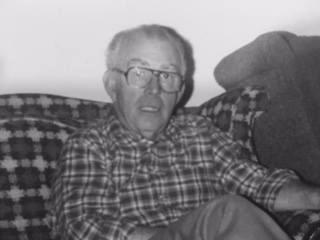
Frederick W. Kunzinger: May 23rd, 1925 to October 21st, 2015

Dad had a toll-free number, so for most of my life when I traveled I could call him at his desk for free. I’d be about to enter Mexico through Nogales, Arizona, and I’d find a pay phone and tell him I was going back down for more blankets and some Kahlua. He’d laugh and offer his “Well be careful” in his deep voice, and for some reason I always knew, despite his desk job on Wall Street and in Virginia, his troubled feet which kept him out of the service, I knew he wished he were out there with me. I once called from Massachusetts to tell him I wouldn’t be able to call for a few days because I was going whale watching off of Maine with a friend, and he was truly excited. I wasn’t going whale watching, though; I was flying to Virginia along with his entire extended family to surprise him for his sixtieth birthday. When he came in his house and he saw me among the crowd, he actually looked disappointed that I wasn’t out on some vessel in the Maritime Provinces. That was Dad. Quiet. Proud. And kinder than just about any person I’ve ever known.

Funny how I just assume all dads should be like him. And maybe to each of us in some way our own father is the model. I’m guilty of not emulating him earlier. As much as my memory tells me he worked a lot–leaving the house for the Long Island Railroad at the crack of dawn and returning barely in time for dinner five days a week, and after dinner, coffee, the newspaper, he’d watch television, burned out from another long day on Wall Street, somehow he fit us all in without complaint–ever–as if nothing else mattered but being around family. What an example he set without ever offering one single word of advice. That’s how to Dad.

When my son and I traveled across Siberia by train for a book project which became The Iron Scar: A Father and Son in Siberia, the original writings from the trip, many of which were published while he was still with us, were written in the form of letters from me to him about Michael and me headed through Russia. In those pages I wondered if he was such a good father because he lost his own Dad when I was just five, and perhaps we are never completely fathers or sons when we’re between two living generations. Eventually, the book became a narrative instead of a series of letters, but he is always present in the pages. At the time of the trip and subsequent year or so while working on the book, he was slipping away just as my son was coming of age to head out on his own, so comparison was instinctive, and I could say with complete objectivity that my son turned out to have the same personality–kind, caring, without judgement–as my father. It was somewhere near Irkutsk I understood that my father lives on in the way my siblings and I as well as our kids live our lives.

For a man who worked all the time, though, he was always there: He brought me on my first flight, first class, from Norfolk to LA when I was fifteen. He taught me to drive. He would come by my office after he retired and see if I had time to go to lunch. Mom and us kids were his life; and when family visited our house for holidays or just a Sunday afternoon barbeque, he was in his glory. Nothing mattered to him more than us; that was clear though he never, ever said so. That’s how to do it.

Random thoughts:

I saw him cry twice. The evening of the day my sister told him she was diagnosed with aggressive Stage Four Ovarian Cancer, and the evening of the day she told him she beat it.

The last thing I wrote which he could read, according to my mother, was “Instructions for Walking with an Old Man at the Mall.”

His face always lit up every time my then-toddler son and I would “accidentally” run into him at the stores.

Every Tuesday night we had Scotch. I hated Scotch but I loved Tuesday nights.

Every Super Bowl we sat in his living room and watched while eating wings and shrimp. It is the only time I ever saw him eat chicken wings, on Super Bowl Sunday.

He loved watching baseball and golf. To this day, when I hear golf or baseball on television, I think of Dad and miss him again.

He would go downstairs first on Christmas morning to plug in the tree lights. With a smirk at 5: 30 am he’d quip “I thought I told you no one up before nine!” He would wait until Christmas night when our relatives had left and we were all sitting around to give us each one last gift, books he picked out with each of us in mind.

I never knew my grandfathers. But my son and my father were as much friends as they were anything else. They were together a lot for Michael’s entire life until he was twenty-two, and we’d play golf regularly, especially when my brother came to town, and every month or more the three of us or the four of us would go to lunch at the beach, and sometimes we’d just go to his house while Mom was still working and sit and talk, or go out on the porch and watch the birds out on the river, and when Michael was still a toddler he would take his hand and walk him to the edge of the water to look for wildlife. I could have posted hundreds of photos of the two of them, and perhaps just as many as the two of us since Michael always had a camera with him.

But I see no need. I can hear his voice as clearly as I can hear these keyboard keys, see his face as if he was sitting right here. I’m not in denial about Dad’s passing at ninety-years old, ten years ago this October, but it isn’t unusual still for me to have a conversation with him, or almost pick up the phone to call him about going to lunch. I suppose it will always be that way, and I’m okay with that.

Some days are tough, of course, just as they must have been for him after his dad passed when Dad was just forty-years old. But he never showed it that I recall; he just continued to Dad us, and I am lucky–fortunate, blessed, grateful, honored, humbled–he was my father.

From The Iron Scar: A Father and Son in Siberia:

I guess you have to be a parent to understand what kind of child you were. You need a basis of comparison that goes beyond the parent-child relationships of cousins or friends. It must be later, years later, when you understand what he would have wanted you to ask, what he wished you had shown interest in, how close–or not close–you were. Turns out we were so much closer than I knew, and I could have asked anything, but I never did.

Happy Birthday Dad. I love you.

The Lasso Way: A Needed Philosophy Today

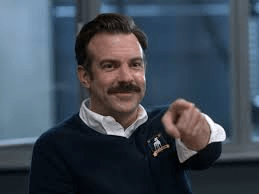
When my brother suggested I watch “Ted Lasso,” I trusted his judgement. He had already nailed it with a few other shows, including “Eureka.” The first time through I enjoyed it immensely, the acting, the writing of course, the timing. It took a few episodes to understand this was not simply a series of set-up/punchline comedy, a method I despise. And it took a few times through the entire three seasons to recognize the primary overall theme at the heart of creator/producer/writer/star Jason Sudeikis’ efforts: This show is all about fathers and sons. 

When I struggled with transitioning my book The Iron Scar from the “who gives a shit” stage to the essential-to-be-published “readable and relatable” stage, the answer came while in a writing seminar in Ireland where I had been formulating the final draft of a series of letters from myself to my dad while traveling with my son across Siberia. Writer Elizabeth Rosner, almost as an aside, asked me why the chapters are formulated as letters. “I don’t know,” I told her. “Bad bad answer” she said. I pulled together a response about wanting to have three generations on board, and the reality of my son becoming an adult and moving on in the world the same time my father was approaching his final days. But I still couldn’t answer so I came home from Connemara and chopped my manuscript to small pieces. A few weeks later in a conversation with a friend in Texas, I said, “Tim, I’m losing focus on the theme.” He responded, “I’m not. This is all about fathers and sons. About moving on while trying to hold on. And the metaphor of the train is nothing more than setting.” Between the time my son and I rode the train and the time I wrote the book, my father died. I heard once that the loss of a parent is the greatest loss of security we can face, even at fifty-five years old. Not because we aren’t able to handle the turmoil of life on our own but because that foundation has been rocked. 

So I rewrote the entire book as a narrative that takes place on the trans-Siberian railway, with all the characters and unknowns that trip entails, but that’s not what it is about. It’s about relationships, about being between two generations who are about to transition. 

Back to Ted.

Sudeikis masterfully weaves every possible father-son relationship into what on the surface is a comedy about an American football coach hired to the helm of a British premier league soccer (football) club. 

Right away we have the estranged father as Ted Lasso separates from his wife, and his young son remains with his mother. We also soon learn the powerful impact his own father had on him and the fallout from his father’s suicide when Ted was just sixteen. In England we meet the team, including Jamie Tartt, whose father is physically and verbally abusive, Sam Obisanya, whose father is more of his best friend and mentor, Nathan Shelley, whose Dad is demanding of his son’s talents and seemingly never satisfied, Leslie (male) Higgins who is the proud and dotting father of five boys, Roy Kent, who becomes a surrogate father to his niece, and of course Ted himself, who moves into the father-role to the entire team, the individual players with which he has various degrees of parental conflicts and resolutions.

This is listed as a comedy, but it absolutely fits the bill as a drama as well, placing it in the same vein as shows like MASH which walks that thin line between laughter and tears. 

But this isn’t about that. We are in a drama that has become laughable, and the line between what’s funny and what is tragic is a shadow at best.

Both the Mother and Father figures in our lives have served to keep grounded the best efforts of humanity throughout history. We need either to recognize the example or play the part. Almost all aspects of society rely upon those roles to set the strong example with seemingly unconditional love as we push through difficult moments. When hope seems fleeting and one feels “lost in a pathless wood” as Frost proclaims, that Maternal strength or Paternal guidance is almost always enough to help us keep going, knowing that whatever happens we’ll be okay. Even if we lose, we suffer those losses together, and we move on. 

There seems to be a lack of parental symbolism in the world, in the nation, in our lives. In fact, more often than not those who should be in those roles these days are appearing more like Jamie Tartt’s abusive and untrustworthy father. It would be perfect if we could always rely upon Sam Obisanya’s Yoda-like dad to turn to, but that’s not the hand we’ve been dealt. In fact, it feels like we’re a player down right now and this time it’s the captain of the team who is absent. That loss of security can be overwhelming. 

I do not want to judge. In fact, if we are to do so, I remember Ted’s line, “I hope that either all of us, or none of us, are not judged by our weakest moments, but what we do with it if and when we are given a second chance.” But our foundation has been rocked, and it’s getting harder to find solid ground these days. So we must do what the team does and depend upon each other, pass to each other when we don’t have a clear shot, hold each other up when we’re flailing, and celebrate each other when we work things out. 

We will get through this time we are in. We might have to switch our game plan, but we’ve got each other’s backs, and that might be enough. 

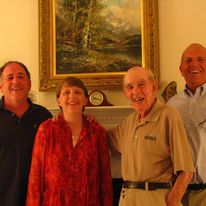
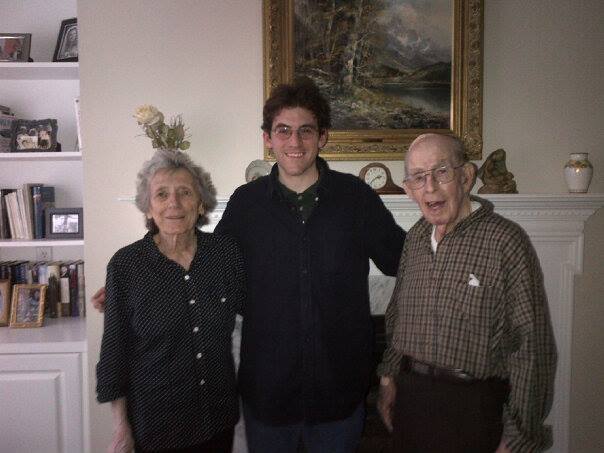
My brother, my son, and my dad, 2015

Departure Signs

Some stories are difficult to write about for a variety of reasons. This falls into that category, but not for the reasons one may conceive, such as “too sad,” or “too morbid,” both of which I write without much trouble.

No, this is about diction and sound. It relies heavily on the reader “hearing” particular words phonetically so one can understand the misunderstanding.

Here’s what happened:

Many years ago I drove my parents to Norfolk International Airport for a flight to Islip, Long Island. It was early, just after six, and nothing was open at the airport food court yet except an “A&W Root Beer” joint serving breakfast biscuits and coffee. Dad was still tired, so he and I sat at a table while Mom went to get two coffees and two breakfast sandwiches for them. I opted out.

I could hear my mother repeating the order several times to the Filipino woman working alone behind the counter, and frustration grew between both of them. After fifteen minutes of Dad wondering where Mom disappeared to, she returned with a brown tray with their order.

“Somethings not right,” she said.

“Why?”

“It came to $27.50.”

“Airport food is very expensive,” my father chimed in, reaching for his bacon, egg, and cheese biscuit.

“That sounds wrong, Mom.”

“I couldn’t understand a word she said.” And at that, Mom grabbed the sandwich out of Dad’s hand, put it back on the tray, and walked to the counter.

“They’re speaking Spanish. No wonder.”

“No Dad, it’s Tagalog.”

“Why don’t you help your mother. You speak Spanish.”

I walked to the counter. The woman looked at me. I simply repeated what my mother had said from the start, that the sandwiches and coffee should have come to just over $8. I swept my hand across the plate and showed her the receipt for $27.50, and she put four more sandwiches on the tray. I took them off and asked if she was the only one there. She walked into the kitchen.

Exasperated, I put my hands on the counter with my head down and said, mostly to myself, but my mother could hear, “We’re not going to get anywhere unless we speak Tagalog.”

My mother stood up as if she had new life breathed into her. “Well! Then let’s speak to Galag. Is he the manager?

The woman returned with an older, Filipino gentlemen, and my mother, very politely, told him, “I’m sorry but we paid almost thirty dollars for sandwiches that only cost about eight, so we’d like to speak to Galag.”

“Mom…” (it was hard for me to speak as I was laughing)

“I think my son here knows him, but we’d like to speak to Galag immediately.”

“I don’t understand!” the man said.

“Is Galag here? We’d like to speak to Galag please.”

“I speak English,” he said to her, and then, just as I was finally calm, added, “I’m sorry but it takes quite a while to speak Tagalog.” I lost it when Mom looked at me and asked when the flight leaves and if we had time to wait for him.

The man, figuring out the problem quickly, refunded all of Mom’s money and gave her new sandwiches for free. On the way back to the table, she turned to me and said, “How do you know Galag?”

Dad had wandered across the hall to Starbucks which had opened by then.

I was at Mom’s this week. We talked about Long Island, and about Dad, who passed away eight years ago on October 21st. I think of him when I’m in airports, or when I see a payphone. He had an 800 number at his desk back when the only way to call home was “long distance,” and it cost a fortune. So throughout my techless twenties, I was able to talk to Dad several times a week. I’d call from the Arizona/Mexico border, from New England, New Orleans, and everywhere in between. He was a quiet man with a deep sense of humor. One of my biggest regrets in life is I am not more like him.

In their later years I brought them to the airport or Amtrak more than a few times. Once, we were on the train and I disembarked just before they left. But it turns out my officemate Tom, who knew them, was on the same ride north and kept them company the entire way. Another time I brought Dad to some flight somewhere, I forget where, but we had a drink at Phillips Seafood Restaurant in the airport and talked about travel and books and plans. When we talked like that I felt close, of course, but also more connected; as if we shared something larger than ourselves. I could always tell when he was thinking about travel, though he rarely went very far. He didn’t miss a chance to talk to his kids about it, though. The signs were there to show me where his mind was; the way he liked to ask where I was going next. The way he listened so closely, responded always with such encouragement.

The first time I flew in my life I was fifteen. Dad had a convention in California, and Mom refused to fly. So Dad and I dropped her off at the Amtrak Station in Norfolk, played golf, and went home. Spent the next day around the house and then we went out to dinner together. The following day we flew to Los Angeles business class—my first ever flight—with dinner menus and a large screen on the wall so all the passengers could watch a movie together. It was Rooster Cogburn with John Wayne. We arrived in LA, rented a car, and drove to the train station and waited for Mom to arrive. We laughed about that for years.

One time we remembered that story when he brought me to the airport to fly back to Buffalo for college. He said he couldn’t stay, so he shook my hand and left. I got something to eat, wandered around, found my gate, waited, boarded, and the plane taxied out to the runway.

It had been about ninety minutes, but when I looked out the window, I saw Dad at the observation parking lot standing near his car, waving.

“My life has been a poor attempt to imitate the man.”

–d fogelberg

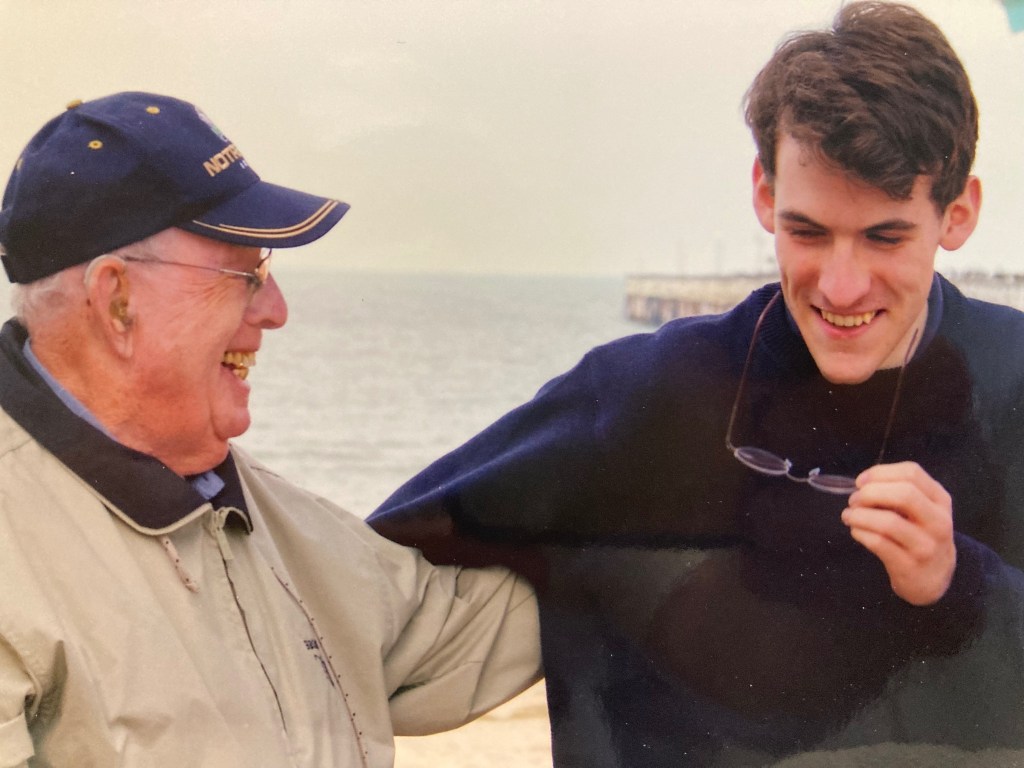
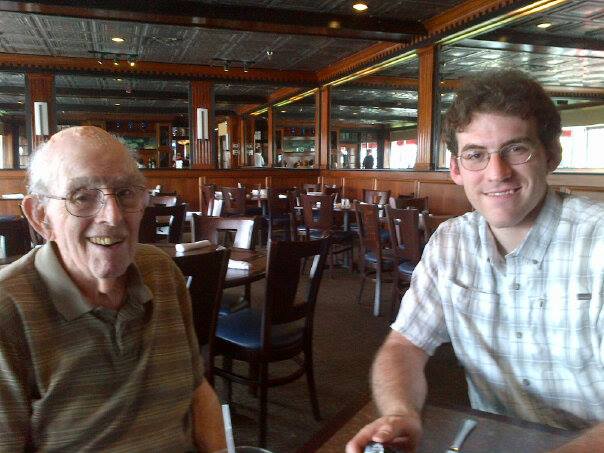
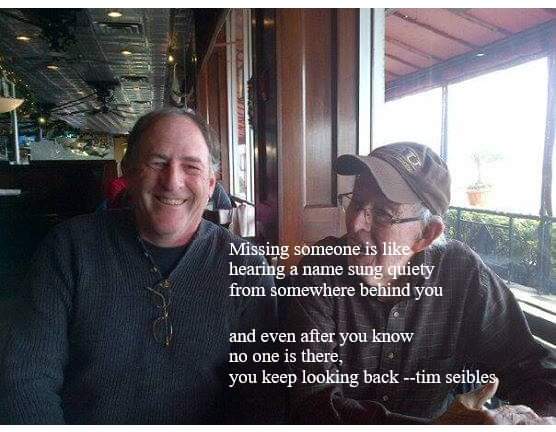
Me with Dad at Mahi Mah’s Restaurant in Virginia Beach (photo by Michael Kunzinger)