Denial: Part One of Five

This is Part One of a Five Part Series here at A View.

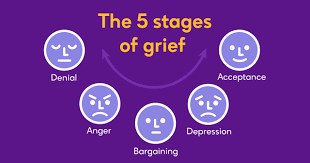
Psychologists teach us there are five stages of grief. Personally, I believe there are a few dozen, but I’m counting overeating, drinking, the gummy-chewing stage, the Marvel Universe binge-watching stage, and several others, but for the sake of brevity, let’s go with Elizabeth Kubler-Ross’ count-em-on-one-hand list of stages, from her book On Death and Dying (so right away we’re not in a good place).

The Fantastic Five: Denial, Anger, Bargaining, Depression, and Acceptance, or DABDA, as I just decided to use for sake of association.

First, here’s an AI generated overview before I slaughter them:

DABDA:

  • Denial: A natural reaction to loss, denial can help people slow down the grieving process and avoid feeling overwhelmed. It can also be a way to try to understand what’s happening.
  • Anger: A common reaction to the frustration of no longer being able to live in denial, anger can feel like an emotional outlet as people adjust to a new reality. It can also provide temporary structure and a connection to the person who died.
  • Bargaining: People may try to change the circumstances that are causing their grief, such as hoping that things will improve if they take certain actions.
  • Depression: A stage of grief
  • Acceptance: A stage of grief where people find control and figure out how to proceed 

PART ONE:

Denial:

I’m good at this—really in all aspects of life—but given the chance to forget that someone I love is dead, I’m all over it. This is most easily accomplished if you live a great distance from the deceased, or if you have had little contact over the years. Denial is convenient when you have a lot to do and thoughts of someone you love who recently passed or even not so recently slow you down. Kubler-Ross doesn’t disparage denial, but she does suggest it is best to move through it honestly. And I will, eventually. I understand it is simply self-preservation that I assume my father is at home watching golf (this one is hard to do since my mother no longer lives in the same place they did, so I am too aware of his goneness), Letty is visiting family in Italy, Eddie is playing blues in the city, Dave is misunderstanding lyrics at some coffee shop in Tampa, and Fr Dan, well, Fr Dan was already half in heaven to begin with. He’s not gone as much as he now plays the role of advocate. Richard made denial easy by his convenient disappearance from society and media several years ago. In my mind he’s home watching old Jane Fonda exercise videos.

It’s not easy to remain in this stage sometimes; there’s got to be a gummy that aides in denial.

But I see no reason we all can’t just assume those we love are off doing other things and they’ll be back in touch at some point. “It’s not healthy” Liz Kubler-Ross writes. Why? Why is it better to “accept” they are gone and won’t be coming back than it is to “accept” that they’re in Thailand playing Mahjong? It works for me, and I’m able to function properly without facing the reality that for the rest of forever, eternally foreverness, throughout the future of infinite time, I will never see these people again. They were here briefly; now they are gone.

“They’ve gone ahead,” people say.

“They’re in a better place,” people say.

“You’ll see each other again someday,” people say.

My mind holds onto that last one, yes, but not the way they mean it in some ethereal ghosty way. No. We’ll see each other again when they get back from Machu Pichu. I can’t wait to see their pictures.

Listen, I’m not dumb; I know they’re dead. Dave was in denial of death and told no one. Letty wasn’t crazy about it but moved toward it with class. Fr. Dan had no idea; neither did Eddie. Richard fell, so it’s doubtful he knew. Result: they’re not coming back, ever, and as Mr. Croce aptly pointed out: “Photographs and Memories, Christmas cards you sent to me. All that I have are these, to remember you.”

Yes, I know.

But grant that my considerably better mood and more focused work ethic come from an absence of acceptance of such significant losses.

I recently attended a writing seminar about grief, and the moderator—poet Anne Marie Wells from Northern Virginia—asked us to think about synonyms for grief for five minutes and write them down. To do so I had to briefly abandon my denial stage, but it seemed Kubler-Rossy, so I agreed. Anne Marie distributed a poem wherein the poet (not her) had synonyms for “grief” which were more personal than any formal understanding of the emotion.

I took the blank sheet of paper and wrote “SYNONYMS FOR GRIEF” at the top, slowly and neatly, OCDish, taking it slowly in an effort to eat up some of the allotted time. I started with the obvious: sorrow, misery, sadness, anguish, distress, agony, torment.

But I didn’t believe it. I couldn’t feel it in my stomach where true grief exists. I jotted down a few more: sadness, depression, helplessness. They felt empty. Dictionary words. Pointless.

I put down the pen and reread the poem. I looked at the clock and still had three minutes in the exercise. I stared across the library where the seminar was held, and I saw a guy at the computer with headphones on. He looked like my childhood friend, Eddie, who was killed by a car while walking out of work one night. I thought of Harry Chapin—a connection Eddie and I had.

I flipped the page over and tried again:

“Synonyms for Grief.”

Cats in the Cradle. Golf on television on a Sunday afternoon. Brussels in September.

La Vie En Rose (That one rips me apart. Grief incarnate).

Paul Simon songs. Seared tuna. Hard cider.

Wham’s “Wake me up before you Go Go.”

Black and white photographs. Change jingling in a pocket. Coors Light.

French accents.

Okay, so I wrote “French accents” fifteen minutes ago and went for a walk. My chest hurts.

Grief.

Grief sucks. It can be damn near suicidal. I get it Lizzy, I really do. It can also be cleansing; it can make us stronger, and yes, of course I grieve; I just did.

But denial is where it’s at. I’m running up to the post office and see if Letty sent a postcard. I might stop by the club to watch some golf, alone since my son’s traveling and Dad lives too far away. Then I’m going to finish the manuscript that was due last month about a friend of mine who is now living in a village in South America.

I just might be able to denial my way through the rest of my life. But that would piss Elizabeth off, and Anger is Stage Two. Some other time. For now, I prefer having nothing to be angry about.

Denial: Letty

Instead, this:

I started this blog twenty-three times tonight and ended up with nothing. It is one of those times when nothing I write comes close to what I want to say.

So instead, this:

for Dave

“I counted my years and realized that I have less time to live by, than I have lived so far.

I feel like a child who won a pack of candies: at first, he ate them with pleasure but when he realized that there was little left, he began to taste them intensely.

I have no time for endless meetings where the statutes, rules, procedures and internal regulations are discussed, knowing that nothing will be done.

I no longer have the patience to stand absurd people who, despite their chronological age, have not grown up.

My time is too short: I want the essence; my spirit is in a hurry. I do not have much candy in the package anymore.

I want to live next to humans, very realistic people who know how to laugh at their mistakes and who are not inflated by their own triumphs and who take responsibility for their actions. In this way, human dignity is defended and we live in truth and honesty.

It is the essentials that make life useful.

I want to surround myself with people who know how to touch the hearts of those whom hard strokes of life have learned to grow with sweet touches of the soul.

Yes, I’m in a hurry. I’m in a hurry to live with the intensity that only maturity can give.

I do not intend to waste any of the remaining desserts. I am sure they will be exquisite, much more than those eaten so far.

My goal is to reach the end satisfied and at peace with my loved ones and my conscience.

We have two lives and the second begins when you realize you only have one.”

~Mário de Andrade (San Paolo 1893-1945) Poet, novelist, essayist and musicologist

And what if you knew

A full moon is hanging through the winter branches of the oak trees on the far east side of the property, and clear across the sky, Mars is lingering behind Jupiter with Venus shadowing the big planet. It’s as if they should hold their breath before sinking below the earth’s surface.  

It’s a clear night, cool but not cold, and Orion is ablaze with its blue headlights on in the upper right corner. It looks like a comet ripping open the Hunter’s bow. I stare that way a while half expecting to see the belt suddenly spin in a circle like the old Orion Pictures logo. It doesn’t.

The sky saved me again tonight.

Earlier a friend of mine asked, “So what would you do?” It’s a real question, a serious one few of us decidedly consider more than during a passing whim of light conversation.

What would you do if you knew you had less than a year to live?

Read that again and take it seriously.

I’m sure the romantic in us would like to burn out a la Tim McGraw’s “Live Like You Were Dying.” Skydiving, Rocky Mountain Climbing. But it’s not likely.

The bills are debilitating, and the energy is fried. People we love live all over the country these days, and you probably don’t want everyone coming to you as if every single day is last rites. Plus they have to work, tend to their own days and nights.

The answer is probably not too varied from the answer we already have while hoping and expecting to have several dozen years left: See those you love as much as possible, work if you can to pay bills and not leave a mess behind for others to deal with, maybe travel if you can.

What will you do in those months before you “close the door behind you”?

First, I’m certain I’ll be keenly aware of all the projects I started writing or planned to write but didn’t get to. I’ll remember that I wanted to become more serious about playing guitar. I’ll remember that I was going to make next year’s garden the best one ever, and plant fig trees, and get a dog. I was going to go back to the Camino with Michael and train across Canada. A friend of mine and I were going to go to the Netherlands. We were going to do a European River cruise.

I was going to restain the house.

But those long-range plans will all be suddenly moot. I suppose that the best we can hope for is we get to the end of our dreams before the end of our days.

Still, I’m pretty sure what I would want to do. I’d get up early and sit at the bay and watch the sunrises whether it was sunny or not. Something I do on a regular basis anyway, but I’d do it more. And more still.

And I’d go to the river with my son and watch the sunset, skip stones, feed the gulls. We’d talk about art and music, about movies and travel. And we’d note all the colors in the sky as the sun disappeared up the Rappahannock.

I’d invite friends over, sit on the porch on a warm summer evening, have a few drinks, some music in the background, and talk about the baseball game, talk about what people we know are doing, about Molly’s new book or Rick’s new essays. We’d laugh about that time we….and we’d get quiet when someone mentions next Christmas. We’d change the subject to how beautiful it is out.

“And when the morning light comes streaming in

We’ll get up and do it again.

Amen.”

I won’t look at photo albums from the Island, or watch videos from when my son was small; God no, no videos. I won’t talk about any more seasons, no. Just this one.

I will talk about my dad, About Cole. I’ll tell funny stories about Dave and Bobbie, about Rachel and Trish.

I’ll speak of how I never could get the African story right, knowing that the truth of that time would be coming with me. And then I’ll finally tell everyone about something else, something beautiful, something still nearly completely mine.

What would you do if you knew?

I’d call everyone I love, but not to say goodbye or even to tell them. I’d just say I felt like saying hi, catching up. And we would, and we’d laugh, and we’d say we have got to get together, that it’s been too long, and not to let another five years go by. Then I’d call the next person, then the next.

I’d remind myself that the truth is I’ve already lived completely out loud and nearly always on my terms, and it has been enough for a half-dozen lives. No kidding. I’d keep telling myself that. Because it’s true. What a journey it’s been so far.

Okay, the superstitious Irish side of me is thinking even posting this blog is a bad idea. But the ballsy New Yorker in me is thinking to lay it all out there right now, because you never know, like Eddie who at 11:45 pm one December 15th was talking to a coworker, and at 11:52 pm he was dead on the street, a car hit him. He never saw it coming.

He had no idea. We have no idea.  

And there’s the thing: Knowing allows you to rewrite the ending how you want your character to finish this story. But not knowing allows you to exit completely unaware of what didn’t get done without having to face the fact that most things didn’t get done simply because you simply didn’t bother to do them. No mysteries to unravel, no excuses and fallacies to face—just reality—you just didn’t bother to do them.

Life happens that way. So does death. Knowing roughly when you’re going to die forces you to face knowing how much you didn’t live at all to begin with.

Maybe tomorrow morning that can be different. Another sunrise, or the first; another phone call to an old friend to thank him or apologize or to just say hi. Another glass of cider on the porch listening to the Mets, talking about that time we….talking about that time we didn’t…and maybe a sunset, most certainly a sunset.

Maybe tomorrow the lines won’t bother me, the rude clerk at the convenience store won’t bother me. Perhaps by lunch time I’ll realize that sitting on the deck at the café working on that editorial for the paper is refreshing and satisfying. Or that talking to students about potential, about the hope of what comes later, about the swiftness of now and the thinness of life, is more projection than it is lecture. And I’ll feel good about it. And they’ll look forward to another class. So will I.

And I’ll come home, and again, at least one more time again, get out the telescope and watch how Venus is tucked away, shy. And we’ll stare toward that blue blaze on the upper right corner of Orion, and understand that life is expanding, faster and faster, running out into the distance, and only those who are told they’ve got a limited amount of time left on this planet seem to understand what that means.

And the stars won’t seem so far away anymore.