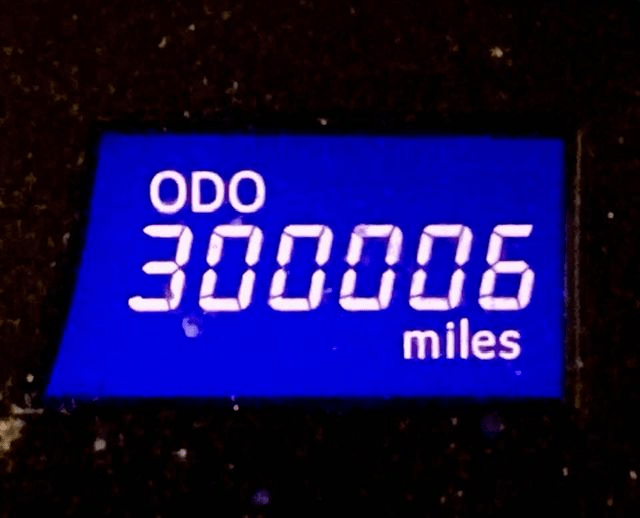
The odometer on my Toyota Camry just flipped to 300K. My mother gave me the car when her neuropathy prevented her from driving any longer. She bought it new in 2014 and when I took it over in late 2017, she had racked up 14K miles. Yes, it was literally driven by an elderly woman just to go to church. Since then, I have been to Florida a bunch of times, western New York several times, Ohio, Utah several times—no wait; I flew there. Prague once, but, again, by plane. Still, my math tells me I could have driven to Prague thirty-three times round trip, or Nogales, Mexico, one hundred and twenty-nine times.
I drive a lot. To steer Paul Simon into this, “If some of my homes had been more like my cars, I probably wouldn’t have traveled so far.”
Working backwards, my Toyota Highlander is still going at 430K miles; my son took it over and is careful now to only drive in on short trips; but, hey, Toyotas rock. I traded in the Hyundai Santa Fe when it reached 180K, and I had the Jeep Cherokee towed to Doc’s Auto Parts in Hartfield, Virginia, when it turned 225K miles old. When that car had just 8000 miles on it, someone rammed me from behind at 55 miles per hour and sent me 100 feet into a ditch. Ultimately, the car was repaired, but they could never fix the gas needle and for the rest of its life empty was full and full was empty.
Out in the driveway but not running right now is a 2000 Infiniti G20 with 325K on it, and while it needs a new battery and fluids replaced, and new tires, and maybe a good de-molding inside, my mechanic in the village says it’s still a great little, sporty car that runs well, and which a propane delivery driver once offered me $3K for without knowing anything about it.
I bought a POS from a colleague for a few hundred dollars, and while the felt roof kept falling in, the trunk floor had a hole in it, and this Dodge Lancer Turbo had no reverse gear at all for the last two years of its life, I personally put 150K more miles on it than it had when I bought it. My son grew up in that car–not literally–and it was laid to rest at the Goodwill Donation Center in Virginia Beach, Virginia.
My red Chevy Spectrum spent some time in Pennsylvania and more time in Virginia, but that crappy little car kept me cruising for 180K before I swapped it out for a Toyota Corolla, which rolled over roads for 140K miles.
My first car was a Chevy Monza, and like my current car, had been my mother’s for just 10K miles before it was mine back in the early 80’s. That car gave me geography lessons for many years, pulling this restless soul across country, out to LA, down through Mexico more times than I can count, its trunk packed tight with blankets and Kahlua, across Route 10 through the fifteen-thousand-mile wide state of Texas, to New Orleans, up through Nashville, up through Ontario and Quebec, through years in New England and endless trips to Boston and the Cape; it spun out of control down an icy hill in Worcester and slammed into a tree above a graveyard and the poor little guy fractured a few bones and ruptured a lung. After it had recovered, Richard Simmons rode in that car, and just a few weeks later Huey the Cat came home in the backseat to my reservoir house; it climbed Mt Washington, Mt Wachusett, and once broke down not far out of Manhattan after a museum trip to the city, but I was sick as a dog and my friend Liz had to drive us home after we changed the flat tire and discovered the smoke pouring out of the car was from lack of oil. I had no idea. That car of mine moved my shit from Massachusetts to Hershey, Pennsylvania, where it sat downwind from the chocolate factory on East Chocolate Avenue, then to a small village in the middle of nowhere.
The day that power-blue Monza died I had packed it full of an old girlfriend’s clothes and odds and ends to drive to her mother’s house forty-five minutes away when, symbolism not lost on me, the engine exploded and fell out just outside Annville, Pennsylvania. A friend picked me up, helped me finish my delivery that day, and then I sold it for two hundred dollars to a car guy I knew from the bar next to where I had lived in Hershey. On that day it had 255K on the dial and two Mexican blankets still in the trunk. I carried them home.
Not including rental cars, my Dad’s Nova which I drove from 1975 to 1983, and friends’ cars in college, I’ve driven roughly 2,171,000 miles, or 77 trips around the world, in forty-one years. That’s over thirty-six thousand hours behind the wheels.
I don’t know a damn thing about cars. I never had any interest, and when they broke down I had them fixed by people who do have an interest. I’m not mechanically inclined by design; I never cared. But I did the vast majority of this driving before GPS, before cell phones, before anything more than paper maps and bad road signs, when asking directions led to conversations, and sometimes to friendships. When getting lost was the most beautiful part of life and finding a phone to call for help could be a several-hour ordeal, especially if you’re west of Tucson at three am where wild boar wait for idiots like me. Man, the stories I could tell. Do people even have stories anymore? Everyone knows exactly where they are going, and that’s a shame.
We have lost the art of getting lost, of driving down strange roads in unfamiliar places, like the Sonoran Desert, or western Mexico, or Georgia. We have slipped away—too far away—from throwing a backpack in the trunk of the car, swinging by AAA for a few roadmaps, and heading out of town a few hours before the sun comes up, and then just after dawn you stop for coffee and breakfast at some roadside dive, and you ask where you are, and you ask where they think would be a good place to go.
We have left behind the immediacy of pulling over to figure out which way to drive and seeing some roadside attraction sign and stopping for an hour. I love rest stops, truck stops, scenic overviews where on some late afternoons you can see the highway below running off into the distant mountains, disappearing into the hazy dusk, sometimes music on the radio, sometimes the windows open and nothing but the sound of wind and somebody’s truck tires whining up ahead.
The car, that highway, that distant anywhereness of driving, is what keeps some people from giving up completely. It’s the hope of somewhere else; it’s the promise that can come from leaving a place and heading to another place you don’t yet know.
“Sometimes I get this crazy dream that I just take off in my car,” Harry Chapin wrote, followed by, “But you can travel ten thousand miles and still stay where you are.” Yeah, that’s true. But I’d rather have done the two million and ended up where I started then never to have left to begin with.

 a view from this wilderness