Pando

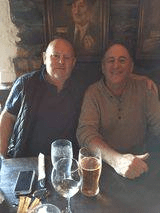
“Baby” John Walsh and me

I sat against the wall in Durty Nelly’s, an old Irish pub next to the Bunratty Castle near Shannon, Ireland. The bar was packed and next to me was the only available place to sit: a wide, stone windowsill looking out over the running creek below as the place had been a mill at one time. The window has bars on it, otherwise the drop is straight down about fifteen feet. A short, quite Irish-looking Irishman sat on the sill and drank his beer. It was loud from music and talking so that even my companion and I had to yell to hear each other.

The Irishman leaned toward me, his legs dangling above the floor. “Last time I was here I drank too much and fell out the window into the creek. That’s why they put bars up!” He toasted the air and drank, and it was easy to believe him even though the scenario was unlikely. He came straight from central casting, acting all the part of Barry Fitzgerald in The Quiet Man.

After I spoke, revealing my Yankeeness, he asked where I was from and what we were doing there. “Connemara!” he exclaimed. “The wild west!” We laughed as his response was common and I had previously noted that the Wild Atlantic Way which runs through the western portions of County Galway and all of Connemara were indeed rustic, scenes from Banshees of Innisfree shot there, as well as The Quiet Man and others. I told him my ancestry is Irish, Connacht, and in particular County Galway, noting Connemara specifically. He asked the relative surname.

“Walsh!” I screamed over the noise. “There’s some McCormick and others for sure, but Walsh is the Galway connection.

He stood up, set his beer on our table, pulled out his wallet, removed his license, and handed it to me. “Baby John Walsh is the name! Nice to meet you cousin!”

When I returned home, I thought about how connected everyone really is; how I could make trips to Bavaria or Sicily and have similar experiences, pushing out the concentric circles of my DNA. Actually, we do that socially all the time. In one family we usually break down the “lines” by aunts and uncles. Outside the family such as here in the village near Aerie, the families of many watermen have been here since the 1600’s and so when you talk to natives in town you slim down where you are “from” by creeks. “Oh he’s from over near Broad Creek.” “He’s from Mill Creek.” “Her family is down on Stove Point.” But if I head up-county, I simply say I’m from Deltaville. They wouldn’t know the Duck Pond near Parrot’s Island. When I’m down at the college, I note I live “up on the Middle Peninsula.”

You see where it goes.

When traveling as I just did to western Maryland, “I’m from Virginia” suffices. In Ireland, I usually don’t need to expose my already obvious “United States” origin, but for those who know our country, I’ll add the state.

I suppose if we ever end up on Triton, I’d pull out my license and signify to some other-worldly writer that I’m from Earth, just past Mars on the right.

What captivates me about this is the closer our ancestry is to others, the more likely we are to get along. John Walsh and I would have talked anyway since we drank beer next to each other, but once we realized we shared that name the conversation grew deeper, and I learned he wrote restaurant reviews, and he did, in fact, fall out the window into the creek on several occasions.

My brother spent time with Kunzingers in our ancestral village of Lohr a. Main, Germany. I’m Facebook friends with two Michael Kunzingers. One is my son, and the other a mathematician in Austria whose great great great great something or other is the same GGG as mine, back in the early 1800s. It’s just that his line of family never left the old world as mine did in the 1850s.

We all have the same roots no matter how far apart we grew up and eventually branched out, stretching our posterity across distant ideas.

I’m reminded of what now seems like a trite mentality from perhaps the sixties when those coming of age declared against the supporters of the Vietnam War and later the threat of Nuclear War, “We are all one family! The Human Family! We are one race!”

But it’s true. We are. And if nothing else we often drink the same beer, choose the same corner of some obscure pub and maybe bump into a distant cousin.

John Edgar Wideman wrote that everyone needs two parents, four grandparents, eight great-great grandparents, then sixteen, then thirty-two; and that’s just five generations back. He acutely notes that less than two hundred years ago, sixteen men and sixteen women made love. None of the couples most likely knew any of the other couples, living as far apart as Kings County, New York, and County Galway, Ireland, and never met any of the others in their lives, not knowing what would eventually be true—that it was all part of some grand conspiracy to set in motion the DNA which would eventually create you.

We are rooted in our past, which means we are truly rooted in each other to some degree. I understand that doesn’t mean we will get along. Tradition tells us the first two brothers certainly didn’t.

But we are here. Together on this world. At the very least we can have a beer and compare notes I should think.

Pando. The world’s largest tree.

My DNA

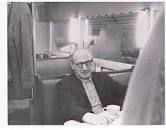
Joe “Pop” Urso, my mother’s father

Growing up I was German/Irish. That was a standard combo on Long Island. Even Robert Duvall in The Godfather says, “I’m German/Irish” to the film producer.  The German might be obvious from the name—my great-great grandfather came from Lohr en Main, Germany, in the 1850’s with his three brothers. The Irish is my maternal grandmother. In fact, DNA shows me at 51% Irish (some slipped in from my father’s maternal family as well). But that should have been it. This is simple arithmetic. Mom—Irish. Dad—German and Irish.

But when I was fifty-seven-years old I found out my maternal great-grandfather was Giuseppe Urso, a stonemason from Sicily, and his son, my grandfather, Joe Urso (Pop), owned the Metro Diner in Albany, New York. My mother suspected from her youth that the man she knew and loved as her father was not, in fact, her father. The details aren’t important, but when she was born in 1933 life in Brooklyn had not advanced between the Irish and Italian immigrants. It turns out my very Irish (McCormick) grandmother fell in love with a very Sicilian man in the neighborhood. Apparently, both of their fathers forbid any wedding despite her pregnancy (to be fair no one knows if they yet knew about her pregnancy). This was real—this was a time when marrying someone not from your village was taboo, let alone from enemy territory. So Joe headed to some family friends in Scranton, Pennsylvania, and Catherine met and married Ernie—the man my mother knew as her father.

In Florida one day at lunch with my brother, who had done some research online and ended up in contact with someone who popped up on the family tree after all of us had done the DNA thing, he told me about the Urso family, about Giuseppe (Mom’s grandfather) and Joe (her father), about the forbidden romance.  I had never heard the name Urso in my life. But serendipitously, that night while standing on the ninth floor of a building at the University of Tampa, I looked out the window to the next building where in huge letters read, “FRANK URSO BUILDING.” No relation, but creepy nonetheless.

Then I found an article about Pop Urso, Metro Diner owner, who had two sons—Joe and Jim, and how Jim took over the family business until the diner closed in the ‘80s. The author of the article was Jim’s nephew, Jack Urso. Then I read Jack’s bio: Jack Urso teaches college English at a community college and has a blog. Nearly identical to my bio. So I wrote him, the first line of my email said, “This is going to be the strangest email you’ve ever received.” He replied with a beautiful letter, and thirty minutes later I received an email from Jack’s sister, Annmarie. We corresponded a lot with pictures and information, all of us amazed at the undeniable resemblance between my mother and their father Joe—Mom’s younger brother by about eight months, and a nearly identical resemblance between Mom and her father, Pop. It seems Pop left Brooklyn and hightailed it to Scranton where he married a woman and had a son just eight months after Mom was born (Joe–Annmarie and Jack’s father). No one knows if Pop knew about the pregnancy. My new cousins told me about “our” grandfather. Then I read Annmarie’s email signature—a college professor at the same SUNY college where one of my dearest friends of four decades works.

So I texted my friend. “Liz, do you know Annmarie Urso?”

“Hey Bob. Yes, of course. How do you know her?”

“She’s my cousin.”

“WTF???!!!”

Yes, exactly. WTF?

Eventually when I did meet Annmarie, it was as if we knew each other our entire lives.

***

Writer John Edgar Wideman wrote in his book Brothers and Keepers that everyone needs two parents, four grandparents, eight great-grandparents, then sixteen, then thirty-two, sixty-four, one hundred and twenty-eight. He comments how about two hundred years ago sixty-four men made love to sixty-four women in various places, none of the couples ever meeting at all in their lifetime, all in some grand genetic conspiracy to eventually create you.

I love the stories of ancestry. What did they do for a living? Who excelled, who disappeared, who emigrated and who stayed behind to tend to family matters? We all have our stories, and the fact we are “present” makes our stories less interesting or even relevant much of the time. But one hundred years from now will some young man be looking through old documents to see what I did for a living? What happened to me? Will someone wonder why some of my story is from Long Island and some from the South? What questions will I leave unanswered?

Here’s the answers as they stand now:

I’m 51% Irish, mostly because of my mother but very strongly my father as well as his roots return to Connemara, and that’s where my chart places more than half my blood. I’m 21 percent Italian—specifically, northern Sicilian. If we use the old-fashioned, commonsense method of determination, my ancestry is traced to Ireland (maternal grandfather), Italy (other maternal grandfather), Germany (paternal grandfather), and English/Irish (other paternal grandfather). But under this reasoning my German should be about one quarter or so as well, but it barely makes a reading at 6 percent. In fact, I have more “Jewish People’s of Europe” in me than German, though I have no clue as to what JPE is exactly.

Still, my maternal grandfather owned a diner in Albany, the other a glass company in Brooklyn. Their fathers were a stonemason and a butcher respectively. Those men and their wives left their homes for whatever reason—war, famine, disease, hope—and came here without means of communicating with home except by hand-written letters which could take months each way. No, it was a time when those brave souls left everything well aware they most likely would never be back and never see any of those left behind ever again. We can’t begin to wrap our mind around this concept when we talk several times a day to all living generations no matter where in the world they live.

My parents come from what we commonly call the Greatest Generation, but their parents might be part of what could be named “The Bravest Generation.” The sacrifices they made to ride on a sliver of hope are inconceivable.

Mom has olive skin and hazel eyes, different than her fair-skinned and blue-eyed brothers and sister. The suspicion lasted her entire life, though always deep in the background, and certainly not anything the rest of the family knew, let alone talked about. It was ancient history. Except while growing up in the Bushwick section of Brooklyn, kids would point out how she looked different than the rest, and her maternal grandfather, she remembers, did not like her—the Irishman who forbid his daughter from marrying the Italian leaving room to believe they all knew who Mom’s real father was and were not happy about it. Through the years we all joked how Italian she really is—not in some insightful way, but in her lifestyle—her sister-in-law and best friend for many years were both Italian and taught Mom the art of cooking their food. It is ironic now, of course, but somehow quite fateful.

Last week my mother and I were talking about her Sicilian family and how thrilled she is to know the truth about it all thanks to DNA and my brother’s dive into our ancestry. She loves that Annmarie calls her “Aunt Joan” and sends her pictures, and was sad to learn that both her “new” brothers had passed away before she knew this. Annmarie said her father would have been thrilled to know he had a sister. This made Mom both so happy and a bit sad. I said that my new cousin Jack and I joked about writing about it and Mom got excited. “Please do so, at least before I die!” she quipped. “Really, I would love for you to write about it before I am gone.” She’s proud of her new old lineage. We looked together at pictures of her father, Pop, and the uncanny resemblance. I commented on the photo, noting how much she looks like him, and not much at all like her siblings. She asked again to remind her of who’s who in her father’s family. It isn’t age or mental capacity; this is all brand new. “I’m not sure I can remember it either, Mom,” I told her. “I don’t know all the facts; no one does.”

“Well write what you know,” she said.

Now, on the wall of my mother’s apartment is a large picture of my parents on their wedding day seventy years ago this week. Mom was nineteen. Inserted in the frame in the right corner is a small photograph of her father Joe “Pop” Urso taken when he was nineteen. The eyes and mouth are identical, and the skin tone. It’s crazy, this DNA, these connective songlines that make us descendants and ancestors.

One would think that with such technology the world would better appreciate how connected we all are. In my ancestry chart I can go back almost to where my ancestors roamed during the days of hunting and food gathering. It turns out we all can.

The article written by my cousin Jack Urso which I read and enticed me to first get in touch with him:

http://www.aeolus13umbra.com/2014/04/the-last-days-of-metro-diner_4589.html

Mom and Dad’s wedding day when she was 19 years old, and Pop Urso when he was 19