(Re)Solution

I wish we could design our own year, like some magical date book we get for Christmas that comes with a special pen, and we sit near the fire, pour some wine, a bowl of gummies. and start with January, marking away at how the year will go. And, whoosh, it just happens.

It used to feel that way, didn’t it?

But lately as I get closer to the New Year, I feel more like a first-time marathoner dragging my tired ass across the finish line. I used to hold that C.S. Lewis wasn’t far off when he said, “There are better things ahead than any we leave behind,” but not so much lately.

I don’t like feeling this way. 

It’s the last week of December and the full moon is on its way out with the old year. It is beautiful, and the air is chilly, but still, and quiet, and clear across the river to the north and the bay to the east is nothing but the same peace. The few lights of Windmill Point are faint, and the stars fill the sky despite the bold, recessive moon. It’s hard to imagine anyone anywhere is awake. I am absolutely alone, save some ghosts. It’s not as depressing as Frost’s darkest night of the year; poor guy. No, though too many of us will do anything, as Jung suggested, “to avoid facing their own soul.” But I’ve learned to embrace three a.m. I’ve taken to these internal battles between what I need to get done and what I need to never do again.

I won’t rehash the news here; but we demonstrated this past year just how far below the angels we truly are. The human race has mastered the art of being inhumane. It is hard to get up some mornings, for me anyway. I certainly hope the hostility and sheer madness and genocide of 2023 doesn’t hemorrhage into 2024. Lao Tzu is on a loop in my head: “If we do not change directions, we may end up where we are heading.” One truth is absolute for me: I’ve spent way too much time accepting the things I thought I couldn’t change only to discover later through time and self-analysis that I got it wrong; I totally could have changed it.

So tonight in this indescribable, beautiful stillness of peace, and with a calm soul, I’ve decided this year to open the magical date book and make note of what the next year will be, and what it won’t be. I’ve talked it over with my other selves who tend to gather around this time of late night/early morning, and we all agree—if I work together on this, I can turn things around. It seems time to listen to some long gone old friends still whispering at this hour, telling me to trust myself, and not to forget that we can’t do a damn thing about the world at large; each of us is a constituency of one.

This coming year some of my hopes are based less upon what I want to happen and more focused on what I don’t want to happen anymore. But where in the list of resolutions does one make note of something that won’t ever happen again? Where do you put that on your calendar?

When I was working at a health club in New England, the owner and I talked often about how the most promising members of the club–that is, the ones most likely to stick with it and go the distance–were the ones who came with what we called “a quiet resolve.” We didn’t know what drove them, and they didn’t post signs or make announcements; they didn’t have mini celebrations along the way; they didn’t make it something separate from their life that needed to be tackled or climbed or conquered. If there had been social media then, these driven individuals would not have posted a single word about their accomplishments. They simply came in, did their thing–sometimes a little more each time–wiped off the sweat and went about their business.

That is not a resolution. That is resolve. There is a difference. One is a statement; the other is a way of being. So, the question is do I have the resolve to quietly yet decisively change the things I can? I’m not going for the wisdom to know the difference; not this year. Maybe 2025.

It’s a beautiful late night here along the Chesapeake, and these early morning stars reach beyond my imagination. Perhaps some of us need to forget about that “to do” list we tend to create this time of year, and simply “let the old ways die,” as Jason Isbell noted. That just might be the solution to a lot of issues that wake me up to begin with.

A Good Stretch of the Legs

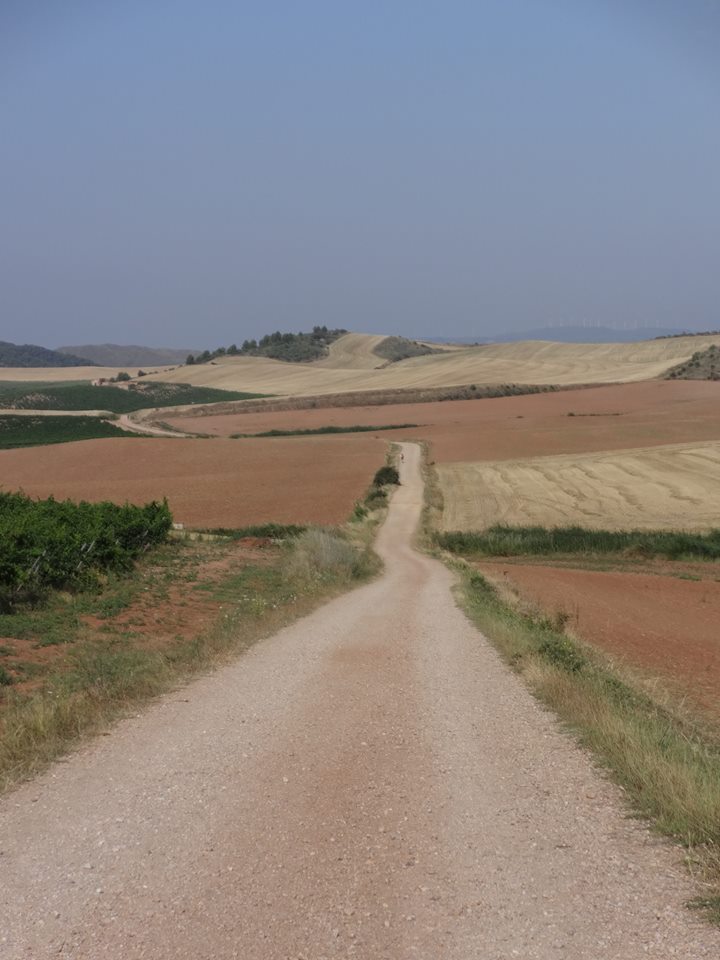
In the summer of 2025, with hope and luck, I’m going to return to the small French village at the foot of the Pyrenees, and I’m going to start walking. Again. I’m going to slow my heartrate down to the length of my gait, and my world will stretch no further than the next kilometer. I’ll stop in thousand-year-old chapels and centuries-old pubs. I’ll drink café con leche every morning along with fajitas patatas, a glass of juice, and a baguette in my pack for the moments of rest, to share with others while we talk about where we’re from. In the afternoons I’ll find an albergue and sit at a picnic table with a bottle of rioja and a small meal, and new friends from Italy and the Netherlands and Nigeria will join me. It’s what we do.

And like last time, I’ll tell stories, and we’ll all laugh, and I’ll be in a fine mood the entire time. Just like last time. And it will again be genuine, not some façade forced by a preoccupied mind.

It is what I should have been doing for decades. No kidding. My life would have been drastically improved had I discovered Spain ten years earlier. I suppose each of us eventually careens into life as it should be. It simply seems most people I know collided earlier than me. I read once we all live out all periods of our life; it’s just that not everyone lives them out in the same order, some aspects delayed for one reason or another. The part where I unearth what brings me peace? Very recently. But that’s no surprise; at least not to me.

***

For far too many people, life can sometimes feel like everything changes at once; as if the Gods conspire to let all the difficult aspects of life accumulate until their collective voice announces, “Now!” and all the old ways are no longer relevant, the old friends no longer available, the old hopes and dreams seem adrift on some frayed tapestry of old expectations. And you feel just past the point where good times still seem plausible. It is the proverbial edge, and many people balance on that jagged edge on a regular basis.

Such is depression. Such is the crash of anxiety. Random afflictions are certainly less random when the smallest of circumstances consistently pinch that nerve between “everything’s fine” and “everything is going to fail.” I’ve been this way before. I’ll be this way again. A lot of us have, right? The “this too shall pass” and “it is what it is” lectures do not work.

You attempt to tackle the entire list of worries, but you know you’re never going to pay all the bills, you know you’re never going to finish the projects, and you are absolutely convinced you’re never going to get the car fixed, the oven fixed, the world fixed. You suffocate in the wash of world failures too, not just your own. So you seek some form of peace, some sense of escape, no matter what it takes to find it. Reason recedes to almost a suggestion, and what seems irrational and drastic to others can somehow make perfect sense. You don’t so much “decide” anymore; and it isn’t about “giving up.” Whatever happens next is simply the only exit in what became a cattle chute void of options. No one gets it. They think you should have simply “gotten over it.” They say, “Had we known.” They say, “What a waste.” They say, “We had no idea.” “We’ve done all we can.” “I didn’t know.”

Of course not. The depressed, the anxious, the one with deep, inescapable demons is more likely than not to make you laugh, get excited about plans, is always there with a sharp and funny story. No one knows; even they don’t know.

***

St. Jean Pied de Port, France, to Santiago de Compostella, Spain, is just under nine hundred kilometers—roughly five hundred miles. If you drive, you can make it in just about eight and a half hours. If you walk it takes about six weeks. I’m a walker.

I’ve been there before. I’ll be there again. It’s what psychologists call “the value of anticipation.” We all need something to look forward to. It can’t be out of reach or near the realm of fantasy. Yet it can’t be so obtainable that achievement becomes routine. As Lily Meola sings, “It’s not big enough if it doesn’t scare the hell out of you.” Yet it can’t be too big. Yeah, life for the afflicted can be a juggling act. In broad daylight you can keep those balls going, hands down. At three a.m. there’s a tendency to hear them all crash on the floor and scatter like delusions.

Welcome to how the world is for more than ten percent of the population. They must find their own truths, despite what others expect. And they carry their own baggage filled with failures and misunderstandings like backpacks, and the best anyone can hope to do is put them down and move on. Here’s the thing: the worst part of some psychological ailments is often the inability to see past the next hour, beyond the next mile, yet the ironic solution to those very same inflictions is to decidedly and quite purposefully not see past the next hour or beyond the next mile.  

You see, when you look too far down the path, and your blinders keep out the light of hope, there is no suspense to keep you turning pages; there is no reason to anticipate the resolution. Life is anything but dynamic.

***

Basque country is my favorite part of the Camino. Navarra. It runs from St Jean south to near Pamplona, and you pass locals who still speak this rare language, and all of the ones we met before, all of them, were friendly, helpful, and hopeful for your journey, as if they each have some personal stake in your every step.

The first day is the hardest. Straight up hill for twenty miles. No kidding; a forty-five-degree angle at times. After that it levels off to just mountain hikes akin to the Catskills until Galacia, where some climbing is involved. But by then, a month later, the body doesn’t mind and the mind doesn’t doubt anymore. And the vistas and the visitors from all over the world keep your mind occupied, and after a week south of France—less maybe, four days—an unhurried pace takes over, and the entire world is arranged by where you’re going and where you “might” stay that night. Somewhere just south of Pamplona, just as the Camino bends to the west, you’ve shut down the part of the mind that begs for self-criticism and doubt, and you feel more free, lighter, but you can’t define it, not exactly. You just know it is easier to breathe; it is easier to sleep. All of the complications which haunt you dissolve. The ghosts recede.

***

Of course, our normal life can be a journey with some “hypothetical destination.” But a journey with some semblance of hope can be the difference between feeling alive and feeling dead all the time, where having an ordinary day is an extraordinary achievement.  

How many of us make plans just beyond our reach, a little past our current condition? It truly might be what saves us. Some of us anyway.

It’s well past time to change the narrative.  

It’s time to go back to Spain.

Breakdown Dead Ahead

This morning I woke up about four from a dream so real I looked around the room expecting to see people from a place I used to work; people who just a few deep minutes earlier were sitting next to me in intense discussion. I sat in bed aflush with images of standing in hallways, sitting in my office, standing before classes, walking from building to building; or the early days out in portable buildings, walking to the market with my officemate for lunch.

My heart raced and my breathing became labored and shallow. My BP spiked and my mouth went completely dry. I got up and headed out to the river where the water found my resting pulse. Some seabirds dove for breakfast, and I watched an osprey carry a fish to a nest. Dolphins swam by. The dolphins don’t know about my dream. The osprey might.

With a nod to Jason Isbell: Maybe it’s time to let the old ways die.

I rode that train for almost thirty years, one-way, full speed. When I disembarked, it took me some time to get my bearings; I still can’t always find my balance. Usually I can forget that period of my life, but when I remember incidents, or, like last night, when I wake up awash in the past, I shake.

It is difficult to explain.

There’s nothing from that time I need any longer, and nothing to gain from remembering. It has taken me five years to figure this out, always assuming that since I spent so much time—literally half my life—wading through those murky waters, it must be essential to carry at least some of it forward. But no—and this is where one can get their money’s worth out of therapy: Simply, no. Nothing. Oh, of course at the time the paycheck and benefits, the ability to travel the world on someone else’s dime, all worked for me. But that inner-core sensation that I’m “contributing” my “verse” to the bigger “play,” well, that never materialized for me, so thirty years of pouring oneself into the same bucket with a hole in the bottom is quite discouraging. Don’t misunderstand me; it had serious advantages over nearly every other profession. This isn’t about that. In fact, I still do it somewhere else, and I love it. It was there. It was then. Some people who try and remind me I did some good, had a positive effect on some people, and should be proud of that period, are missing the point. I know what happened; I was mostly there at the time. It is irrelevant. Like watching your favorite baseball team score six runs in a game but lose ten to six. Yes, remind them of how great they did scoring the six runs; then step back.

This is about the self-preservation necessary by living a life which outpaces the past. Sometimes—granted, not always; in fact recently I wrote fondly of my time at a health club in New England where I know I had a positive effect as well, and about where I wish I would have a vivid dream, of course—but sometimes there are no glory days and there is no sense of melancholy. Sometimes those tethers simply tug at the scars, open old wounds. You have to let it go. It’s not always an amicable separation; sometimes it’s a reminder of wasted time, and the best psychological recourse is akin to a bad divorce. Or, better, like you never met the person to begin with. Yes, that would be better—some dreams can kill.

The idea of “moving forward” is so simple and common that the axioms to do so are abundant, and they all are a variation of the need to “face forward” and “take small steps.”

Let’s go deeper:

A nervous breakdown in movies is nearly always represented as a person freaking out, flailing their arms, and screaming or crying or otherwise needing to be slapped upside their head. This makes sense since some visuals are needed. But the reality is a nervous breakdown can be as subtle as the rain. Certainly there can be “emotional outbursts and uncontrollable anger,” but more often it is what cannot be shown appropriately on a screen that dominates the symptoms: withdrawal, a sense of being overwhelmed, not wanting to interact with others, feeling burnt out, moody, low. Your self-esteem evaporates, you feel worthless and unqualified for anything, you make illogical requests, you assume nothing is going to work. You stop showing up. You make horrible, self-destructive decisions to the point that those who had faith in you lose their desire to help.

At first, after a major change, after that significant about face, what you do not yet realize is a nervous breakdown can come disguised as a welcome surprise. It is, in fact, similar to mania in that the person might feel overly optimistic.

Here’s how the experts break it down:

  • The honeymoon phase – The first stage of a nervous breakdown is referred to as the “honeymoon” stage and is particularly noticeable when undertaking new work responsibilities or initiatives. There are no warning signs of a nervous breakdown at this time. You are, on the contrary, enthusiastic and committed to your work. You are also highly productive and eager to demonstrate your potential in any way possible. If you do not avoid overworking or implementing effective strategies to deal with stressful situations and get enough rest, you will gradually progress to the next stage.
  • The onset phase – This stage is reached when you recognize that certain days are more stressful than others. You have insufficient time for personal needs, family, and friends. As you struggle to keep up with your stressful schedule and workload, your productivity levels begin to diminish. And you may begin to experience some mental and physical symptoms of stress, such as headaches, anxiety, changes in appetite, high blood pressure, and an inability to concentrate or focus. 
  • The chronic stress phase – Chronic stress sets in when you do nothing to manage the mounting stress of work or other commitments. As a result, your productivity levels decline, and you may start to feel overwhelmed. You begin to withdraw from social situations and exhibit symptoms of mood disorder. In extreme circumstances, some individuals may start to self-medicate with alcohol or drugs to escape their overwhelming negative emotions. 
  • The burnout phase – Burnout occurs when an individual has reached their limit and can no longer function normally. During this stage, you will neglect your personal needs and self-care and continue to isolate yourself socially. Along with other physical symptoms, headaches and fatigue may intensify. 
  • The habitual burnout phase – Those unable to recover from burnout and whose symptoms have become a part of their daily lives attain this level. This phase can have a detrimental effect on your career, relationships, and health and cause burnout syndrome or other long-term complications. Therefore, getting assistance as soon as possible is imperative if you are experiencing this phase of a nervous breakdown.

Usually comfort is found in extreme retrospect; that is, you look to times before the place of the fall, when that proverbial garden was still green and the metaphoric apple was still on the tree. You reach back for help from those you knew before all of that time, those without association.

And sometimes you get it, though usually not because there is an overwhelming urge in society to tell people it is a “phase” and they’ll “move past it.”

Ask them to do that to a soldier just back from war; tell them their issues are just a phase and they should move past it. How about this instead: listen. Tell them you’re there if they need you. Call them more than once to see how they’re doing, to talk about something completely present and benign.

Semantically, the words “nervous” and “breakdown” are deceiving because it isn’t the same “nervous” one feels when the roller coaster is clicking to the apex of the ride; it is an internal, simmering, indefinable nervousness more akin to complete and absolute helplessness so that even talking seems irrelevant. And it isn’t a “breakdown” in the category of the car no longer running because the starter is broken. It is more like a stall; all the parts are working, but you have a complete sense of an inability to move. You’re a deer in the headlights.

And often, quite dangerously, there is the overwhelming need to just end the thought process that fuels all of this.

Ask that soldier just back from war what their instincts are when they’re feeling this way. It isn’t to “talk about it” or be told anything at all. And the mere fact one might have to take drugs to get them through is a daily reminder swallowed with water that something is not right and any sense of hope is clearly synthetic.

So what is to be done?

Ironically, you accept that it was a phase you went through, and it is time to move on. You just do not, do not, absolutely do not want to be told that.

Because the dreams will come and you’ll see faces of people you used to eat lunch with, used to share an office with, and your depression with force you to wonder why you wasted so much time with people who couldn’t give a rat’s ass you ever existed at all. And that just fuels your sense of worthlessness. And the cycle begins.

Every single person has to decide for themselves how to deal with this. And no one can tell them how; even a therapist, though any therapist worth their weight already knows this and simply helps someone discover these things on their own.

It is as individual as your dreams.

If it were me? I mean, just speaking hypothetically here, but if it were me what would I do to somehow shed those deeply rooted and tightly clasped feelings of worthlessness?

My instinct of course would be to leave like I did throughout my twenties. Maybe I’d go back to Spain, or perhaps sail south on a forty-one foot Morgan Out Island named Pura Vida. Maybe I’d move to some mountains somewhere and go hiking. Yes, that would be nice too. That therapist worth their weight would somehow suggest that having plans like these, escape plans, is essential even though you know you’ll never follow through on any of it. That isn’t the point; the point is about possibility, about choice, about regaining that often taken for granted ability to make our own decisions, something that seems completely gone to a person with this level of depression and hopelessness. They need to feel possible.

It’s kind of like hope but not really. Hope implies some form of stagnancy, of waiting. It needs to be more kinetic than that, like saying, “Hey, let’s get an Airbnb in the Netherlands,” or “You know I think I’ll walk the same route this time instead of doing the Portuguese Route.”

Imagine a brain whose sense of “possibilities” has been extracted. Just for a moment, imagine a person who has not even a remote sense that anything good can possibly ever happen again.

That’s what we’re talking about.

And if you walk into any store today, anywhere, one out of every twelve people are feeling helpless. One out of every twenty completely abandoned.

+++

On the wall of an office I was in a few weeks ago is a poster of an open sky across some western vista. The quote from Richard Bach is one I remember from when I was young.

“Here’s a test to see if your mission on this earth is complete: If you’re alive, it isn’t.”

Too simple? Too elementary? Too, excuse me, pedestrian?”

Maybe.

But I saw the poster and thought of Spain, so there’s that.   

Too Early for the Sun

Sometimes you have to stay up until dawn to understand what’s hiding behind the night. It’s been a tough two days, and I need a significant diversion. For me, anyway, I find hope in the same time of day that can push me over the edge; late night, early morning, just after the tigers come out but too early for the sun.

Like a rest stop at three am with two truckers and a couple of local high school kids screwing around, or the sound of wildlife in the desert brush, or tall pines scraping together in winter in the woods with no light but the moon. It’s walking up an Arctic Path at four am in a snow-deep March with Northern Lights bouncing past like a bull whip; or lying on my back on a cot in a compound in Africa beneath more stars than could possibly exist, the distant sound of someone chanting the Koran. It’s walking out of a shack in the Russian woods after a storm passes and you see the sun just lifting over the raised bridges, ears still buzzing from loud live music. That’s when you know it’ll be okay.

In Portomarin, Spain, one night, my son and I stayed up as long as we could because the rooms were all filled. We hung out in a small café until one am and then walked around the misty, cooling waterfront. Then we settled on the town square with covered walkways running next to a medieval church. Against some storefront we pulled together folding chairs and wrapped ourselves in whatever we could and tried to sleep in rapidly dropping temperatures. A kid on a bike did tricks on the steps of the church until three am which anyway kept me amused. But for a brief time after that, it seemed like dawn would never arrive, like I totally screwed up, and I couldn’t believe I would put myself and, worse, my nineteen-year-old son in danger. But at 4:30 we got out our flashlights and headed west. You can see a million stars in Spain at 4:30 in the morning, and the darkness makes the silence nearly sacred.

If I can make it past the tigers, I’m usually just fine. Better than fine.

That shack in the Russian woods was just off the Gulf of Finland—a dive really—a place to drink and sing and meet people you’d never want mad at you. It was small, with broken-down shed-like walls and windows which barely kept out the storm blowing off the Baltic one May night in the nineties. I use past tense since sometime just after 911 it burned to the ground. But back then, it was well after midnight, closer to dawn than dusk, and we ordered a bottle of Georgian Merlot and several plates of shashleek, a Russian shish kabob dish. A gypsy band showed up, including a guitar and violin player I’d met before, along with a friend of theirs, a woman singer. I played with them for thirty minutes or so, and hours passed as we sang and drank. I long ago forgot what night-terror sent me walking into the Russian night, let alone up the beach into the woods and this shack, but I did, and we sang and drank while what must have been that hurricane from The Perfect Storm slammed to shore. This duck blind of a building sat amongst birch trees, but that simply made me more aware of the weather, wondering when one might topple through the roof. It was exhilarating, an adrenaline rush that had nothing to do with the wine. It was being alive, right then at three am, with total strangers, live gypsy music, Georgian wine, and shashleek, that kept me awake and okay.

But those are extremes, aren’t they? Right before that, you wake up in a sweat and your heart is racing and your mouth is bone dry, and you know everything is going to fail. The hot water heater blows out and you can’t afford the five grand for a new one, the car needs work, the dentist is waiting for the call back, things are tight, and your chest gets tighter. You are at that line, the one some use as an excuse to check out, the one that can terrorize others into submissive acceptance, but the one some simply cross. I keep thinking of that line from Dar Williams: “And when I chose to live, there was no joy it’s just a line I crossed.”

.It doesn’t have to be a broken down bar or some desert hike. It could be a porch, and you sit there with tea and note the coming of the first birds, and you have an hour on the sun. And whatever it was that shoved a hot blade into your chest just thirty minutes earlier has been doused by the deluge of the new day, the sky, dark blue, then pale yellow.

There is no miracle. It is something on the other side of hopelessness; the place too many people I know could not hold out long enough to find.

One night in Virginia Beach some years ago when someone dropped a brick wall right in my line of trajectory, I could not sleep so I went to the oceanfront, walked on the pier I have walked out on since I’m a teenager, and sat listening to the surf in the still-dark night. A fisherman walked up the pier on his way to try his luck and he stopped to adjust his bucket and gear. I asked if the water seemed flat enough for good fishing, and he said he didn’t think so, but he added, “I ain’t got no other reason to get up, so I’m here. I guess I’ll find out.”

We laughed, but not really.

When a hot water heater breaks it sounds like the surf; it wakes you up, sends you ankle deep on hardwood floors for mops and valves and towels. And you know you can’t do a damn thing about it, and you know it’s going to be a long time before you can, so you go back to bed telling the tigers to go ahead, have at it.

But the whippoorwill is doing her thing, and a few house wrens have come out of the nest. If it’s early enough you grab a bottle of cab, head to the café table on the front porch and fill a small glass, and you look east, out over the bay, and wait for that sliver of light. It’s not so bad you tell yourself. You don’t need help you tell yourself. And you remember some story that was told to you to hold on to for just this moment. Like this one: When I lived in the Sonoran Desert, I would spend a lot of time at the San Javier Mission down Route 19 toward Nogales. There I learned that the Navajo used to run toward the sunrise every morning to visit and welcome the spirits who watch from the sky over their people below.

When the priest at the mission told us that story, a friend of mine said she thought it was beautiful how they ran toward the sunrise, but I couldn’t help but wonder what they were running from. What tiger’s grasp did they narrowly escape, barely pushing across that line?

If you ever see a picture I have taken of dawn, the sun slipping out of the water on the horizon, you’ll know I ran there, narrowly escaping some grasp, to welcome the new day.

So Far Away

When I came up here to Aerie to mark off the corners for the contractor to dig the footings for the house, my father and son both came with me. Michael was just three at the time and climbed the stacks of logs and other materials, using the brand-new shed as a fort. My father and I held opposite ends of a long measuring tape and put pre-marked sticks in the ground.

We talked about the drive up—it was a Saturday—noting how it wasn’t as bad as he thought it would be from Virginia Beach.

“This place really is centrally located,” I reminded him. “About an hour and a half to the beach, about an hour to Richmond, two fifteen to DC, and two and a half to the mountains. Plus a river and a bay.” We had a great time that day and had lunch in Deltaville before driving back across three bridges, one tunnel, and two interstates to his house.

A few weeks later I was fiddling around the property while waiting for a delivery of stones, and a neighbor walked up the long, winding driveway to introduce himself. Roland and I talked for hours about where we were from, and he filled me in on some of the local places to eat. Then he said, “You know, Bob, I don’t know if you’re aware of this, but we’re really centrally located here.”

“Yes, I know,” I said. “My father and I were just talking about that not long ago.”

He nodded and said, “Yep, the village is only three miles from here, and there’s an Exxon/711 about two miles the other way next to a bank. And if you don’t mind a really good, pretty drive when gas isn’t that high, Urbanna has some nice shops and is about fifteen miles from here. I head over there once a month or so.”

Perspective.

Here’s how I deal with the “So where do you live?” question:

When I’m in Deltaville: “Down Mill Creek toward the river and duck pond.”

When I’m in Virginia Beach: “Deltaville” (technically, “Wake,” but most people understand the much larger though still miniscule Deltaville).

When I’m in western Virginia: “Where the Rappahannock River meets the Chesapeake.”

When I’m in New York or Florida: “Virginia,” but if they’re also from Virginia, “Middlesex County, half hour northeast of Gloucester out near the Bay.”

When I’m in Europe: “the United States.” If they know the States, then I’ll add “Virginia.” Once, an annoying Russian salesman kept asking, “Where are you from specifically?” So I said, “Down the end of Mill Creek near the river.” He said he didn’t know where that was, and my friend Mike said, “Are you kidding?? Everyone else around here in the market knew exactly where that is!”

But usually, just “The States.”

I suppose if I were on the International Space Station I could say, “Down there. Now. No, wait….Now.”

This relative form of measurement works beyond geography. A dear friend of mine died at twenty-seven. Did he know that at twenty-six he was already, relatively speaking, an old man? When my father was my age he still had nearly thirty years left. More often than not I feel closer to ninety than sixty, but then I haven’t looked at my medical map in a while, so I could just be near a rest stop still as close to my thirty-year-old son’s birth as my own death.  

The farther away from a place we are, the more abstract it seems. If I look at my house from the sky, I might notice a swirl of trees with endless green all year from the pines and holly. Then a brown roof on the house at the end of a long scar through the woods to the road. But when I’m standing on the front porch, I see how badly I need to re-stain the logs, how much I have neglected the driveway turns, and how much fallen debris remains in the woods. I am more engulfed by the property and the home when I’m here, of course. It floods me, making it hard to see much else. I don’t mind—it is one of the reasons I live here.

But lately I’ve been realizing that my mind needs to be more centrally located. I can drift too close sometimes to melancholy or even bouts of depression—I don’t necessarily mind as they remind me of what a beautiful journey it has been so far and help keep people who I have loved and lost close to my heart. Likewise, being so engulfed in nature here as I am, I often find myself not too far from some state of presence—in the moment and appreciating every aspect of nature. The river and the bay are my companions, the woods too. This brings me peace and often I can come quite close to some euphoric state.

But if I move too close to one or the other for too long, or too far away, I find myself in a state of confusion and worry. Lost. My balance is thrown off and I can easily fall into the terrain of regret and sorrow, or the Oz-like, false sense of safety that comes from a mind at peace. I need both, but I would like them equally at arm’s length—close enough to find, far enough away to avoid.

When I’m here on the river for too long, I need to go. I get restless and I need to head out—see more, discover more. It is simply my DNA and I don’t know how else to explain it. Florida, Prague, Spain, the Rockies. But after being on the road a bit I almost can’t breathe right until I’m sitting on the rocks on the Rappahannock, watching the sun slide away again, listening to the geese or the osprey.

When I was young, we moved from our home in one county on the Island to another. We returned a few times to visit friends on the block, but rarely. It was so far away that it might as well have been in Topeka. Geez, it was only twenty-one miles away! When I leave my driveway now, I drive further than that just to get to the first stoplight. But back then, distance was measured in necessity, and if we didn’t have a need to go back, we didn’t.

Me, well, I always have a need to go back, even just for a little while. It’s only dangerous if you go back and stay there, unable to cut the tethers. But I’m careful enough to make sure I’m looking ahead as well, appreciating the anticipation, spying as much on hope as what was.

Seasons Out of Time

Seasonal Affective Disorder | NCCIH

My doctor hit me with the normal “How are you doing?” and then asked, because I’m on some BP cocktail, if I get depressed.

“Yes, of course.”

“Do you ever feel suicidal?”

“Some semesters, sure.” Turns out doc doesn’t really have a sense of humor. “No, never.” We talked some more and he said, “Well we may want to check into having you talk to someone to see if you have Seasonal Affective Disorder. SAD.”

“Isn’t it possible I simply don’t like winter? When it is cold I shrivel up. I miss my flip flops and shorts and the hot sun and the salty water. It’s Winter. I’m going to be bleh until well into Spring. I mean, I like snow, I really do, it’s just that it sucks.”

He laughed and told me to take care and come back in six months and I assumed he meant when my mood improves, and we talked some more but I knew something he couldn’t possibly know about me: humor is my go-to response when I really don’t know what to say.

Sometimes you can sense some sort of lethargy this time of year revealing itself in blatant ways, like not wanting to go to work, not filling out some forms or editing some article, not bothering to return important calls completely out of a sense of avoidance, as if you might be able to wait long enough and all of this will pass—this stuff that brings you down, and to be honest, you’re not really sure what that stuff is. The idleness of society maybe, the constant sense of impending doom reported in all forms of media about democracy, about pandemics, about weather, about climate, about the economy, about depression and isolation. You have no reason to take any of it personally, but some people can’t let it go, and it weighs heavy, so you aim for avoidance, which unfortunately ends up a heavier burden.  

Sometimes the withdrawal is subtle. You can sense yourself not trying as hard or caring as much, like eating whatever is around instead of thinking it through, not going for a walk because you don’t want to be bothered putting on a coat or dealing with any sensory change. You’re sitting; you’re comfortable, and you’re numb. It works. Numb is good.

In both situations you are absolutely aware of it, like an alcoholic staring at a glass of whiskey and saying to himself, “This is a really bad idea.” But he drinks anyway because not drinking means “dealing” with a life that just doesn’t seem to have any silver lining. The irony? Going for a walk helps. Filing out the forms, returning calls, all help by providing a sense of accomplishment and forward motion, like checking things off the to-do list, it leaves you with the hint that if you keep going there’s something worthwhile on the other side.

There’s the rub. It seems you keep reaching the other side and there’s still nothing there to lift the spirits, not this season anyway—more hostility in the east, more pessimism in our government, more variants on deck ready to step to the plate after Omicron smacks a triple into right field. So you try a little less at one task, and it spirals from there. You realize your handwashing time has dropped to about 12 seconds. It’s not depression; it’s ghosting, it’s, well, yeah, it’s depression, but not in the deeply caving sense; in the “whatever” sense.

The problem with this type of malaise is it can be debilitating to you without being scary to others if you are not suicidal. The truth is, the vast majority of people who deal with depression are not contemplating suicide and will never kill themselves, which is what most friends fear most, and when those friends learn that is not part of the equation, they feel better. But that can often make it worse since the objective is for you to feel better, not them. But that’s fair since you know what they don’t: that a different suicide exists, a slow erosion of sorts, which anonymously eats away at ambition and accomplishment, takes the edge off of energy and momentum. It’s the guy sitting at a bar nursing a beer, nowhere to go despite having a million things to do. It’s the one on the park bench watching people walk by but not noticing a single one of them; it’s the inability to concentrate, the disinterest in listening, the short responses to questions, the inability to make it through the most basic of activities. Rational thought has nothing to do with it. “Knowing” what to do is not relevant. Your mind is suspended, your thought process withdraws into some elementary state.  

On the one hand it’s situational—financial problems, relationship problems, blizzards. But it can also be chemical if you don’t have medical help. It’s addiction without restraint. It’s a combination of these, and it is unpredictable because the same thing that leaves you in bed staring at the ceiling feeling hopeless can drive you to your feet to tackle whatever it is that left you prostrate to begin with. It is a conundrum that plays handball in your brain.

“They say the first step in dealing with a problem is admitting you have one.”

Yeah, okay; no one I know in this situation has much of a problem admitting it.  

But what’s step two? Because the guy at the bar with the beer, the woman in the park, the man at the river watching the tide roll out, all know exactly what the problem is. But their brains are aflush with fog, their anxiety has disabled their decision-making capabilities, and their strongest assets and most celebrated talents that normally keep them going the rest of the year, are no longer applicable since they carry a sense that those traits are probably what brought them to this place to begin with. They sit and wonder what if. They sit.

“Maybe if I had just…”

“Perhaps I should have…”

“Fuck it.”

At some point it seems you stop fighting altogether and are either not afraid to hit bottom, or you hope to use that bottom to bounce back, not afraid to fail since it can’t be worse than this. It is extreme but that is part of the diagnosis—extremes, polar reactions—sometimes both in one day. Sometimes within one hour.

More often than not, the guy on the corner holding the cardboard sign didn’t “decide” to quit, didn’t give up, but “felt” a pressure that he no longer could handle or define, caught in some stream of disconnect and hopeless confusion. Sometimes the one who does, in fact, tragically go that last fatal step didn’t “decide” to do anything at all, and that is the point. Suicide is not a decision. It is one step beyond decision making. The vast majority of people who deal with depression have that in check, less so in the dead of winter, of course.

But that’s not you. Truly. And that is the problem; you really aren’t suicidal at all. And when suicide is not part of the equation, others feel that you must be “okay,” or “going through something right now.”

Yeah, winter, you’re going through a snow bank. This is the worst time of year for many people with depressive issues. Seasonal Affective Disorder is real and feels like all of the above. Nothing helps but time, but time to some people sounds like the slow drip of icicle melt.

Other people try to help so they talk about the weather or sports or anything at all with enthusiasm and a sense of caring, but it often makes it worse, only emphasizes that others get excited about the minutia while you can no longer find value in a sunrise.

But the disguises are nothing short of cunning. I’ve known people fighting depression who on the outside resonate as the very poster image of Carpe Diem. I’ve been friends with people who contemplated overdosing on Monday while making plans for Tuesday, who loved others more than the average soul but only wanted their puppy nearby at checkout time, and people who fought depressive ways by pushing adventure to the limit, and beyond. “What a lust for life!” people exclaimed. They had no idea.

It isn’t exactly depression, by the way, though it is easier to simply call it that because it certainly wears the same eyeshadow as depression. It is indifference; it is a vague inability to muster the energy to lift your spirits enough to give a damn about anything. It’s not like you woke up depressed so you decided to stay on the couch all day; you simply don’t care that you’re on the couch to begin with. Complete apathy. You’re not down about anything; you simply don’t care.

Ironically, for most of these afflicted people, life is amazing, every half-beat is a moment of “miracles and wonder” which is why you cannot comprehend the misuse of time. The abuse of time in so short a life, you think, is as suicidal as the abuse of substances, and that can be depressing as well.

It is the time of year when you wake at three am knowing nothing is going to work, and you’re going to lose your house and your sense of security and no answer makes sense, no way forward seems rational. Equally, the dawn can come with new ideas and hope, and if you push those moments far enough into the morning, you just might be able to make a day of it. But January has 285 days. And February is several months long. March? Well you well know that March is merely a tease. April comes and breathing is easier. May, and nothing stands in your way. You know exactly what I mean.

On the outside you seem to be fine. On the inside you’re grasping the thin rope of enthusiasm with clenched fists, pretending all will be well, but your insides—much against your will—are shredding at the thought of what to do next.

You “hang in there.” You “get through it.” You suffer the trite suggestions of others who simply can’t understand what the big deal is. That’s okay though, you think. Really. There are no solutions, per se. Just more questions. And “hang in there” is at the very least an acknowledgement you really aren’t trying to dismiss your very existence; it just happens sometimes.

This afternoon I went to the river where a bitter breeze is pushing down from the west. There’ll be ice tonight somewhere, and snow, but I sat reminding myself I have been there, touched that ring of undefinable despair, and I’ve moved through it, sometimes with difficulty, often with ease, always with the knowledge that I’ve had one freaking incredible life so far, and time enough left, I hope, to continue my pilgrimage well into the next mood swing. But there are moments, collisions with frustration at the gap between the way things are and the way things should be, that catch some people off guard.

Eventually you remember that the seasons, like everything else, change. And love, despite its bad reputation, is holding the other end of that thin line you’re grasping.

“I can guess what he was laughing at

But I couldn’t really tell.

Now the story goes that Adam jumped

But I’m thinking that he fell.”

-jackson browne
First the COVID-19 pandemic, now winter….is seasonal depression coming my  way? — Dear Pandemic