It’s been a year since Dave died. A year next week on my birthday since Letty died, a year two weeks later since Richard died and then Fr Dan, then Billy…
There was more to say. But then, of course, there is always more to say, isn’t there?
That’s the lesson, I suppose, if one were to look for a lesson: Say it now.
“These days I seem to think a lot about the things that I forgot to dofor you,
and all the times I had the chance to.”
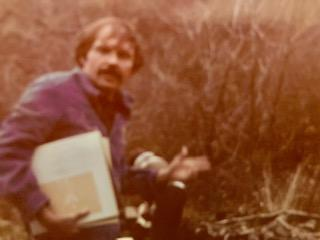
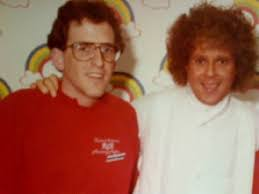
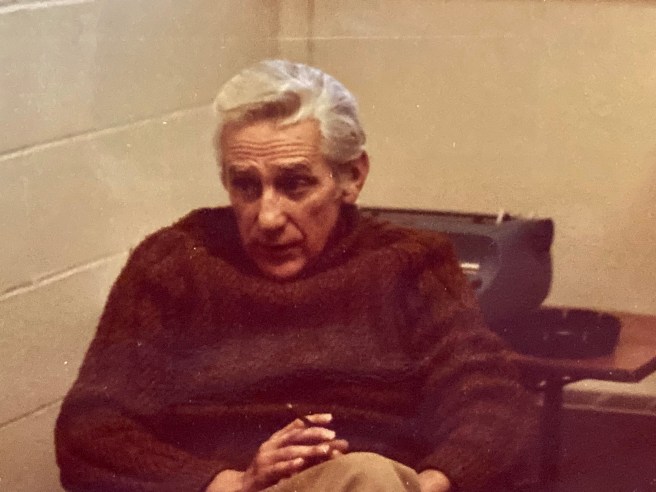
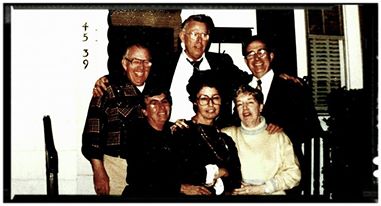
Fr. Dan Riley, ofm
Bobbie Roehren Buckman
Fr. Brennen Fitzgerald, ofm
Mom
Dad
Dave Szymanski
Eddie Radtke
Letty Stone
Fr. Dan Riley, ofm
Richard Simmons
Dad and Mom
Pete Barrecchia
Fr. Dan
Cole Young
Dad and his siblings, Howard, Ed, Audrey, Phyllis, and Joan
Doug Dunn
Rachel Scher
Letty
My cousin Bill (with my cousin JoAnn)
Dave Weir (on left, with Mike Russell)
You’re the color of the sky Reflected in each store-front window pane You’re the whispering and the sighing of my tires in the rain
You’re the hidden cost and the thing that’s lost In everything I do and I’ll never stop looking for you In the sunlight and the shadows
And the faces on the avenue That’s the way love is
I don’t remember losing track of you You were always dancing in and out of view I must’ve thought you’d always be around
Sometimes you can sense some sort of lethargy this time of year revealing itself in blatant ways, like not wanting to go to work, not filling out some forms or editing some article, not bothering to return important calls completely out of a sense of avoidance, as if you might be able to wait long enough and all of this will pass—this stuff that brings you down, and to be honest, you’re not really sure what that stuff is. The idleness of society maybe, the constant sense of impending doom reported in all forms of media about democracy, about pandemics, about weather, about climate, about the economy, about depression and isolation. You have no reason to take any of it personally, but some people can’t let it go, and it weighs heavy, so you aim for avoidance, which unfortunately ends up a heavier burden.
Sometimes the withdrawal is subtle. You can sense yourself not trying as hard or caring as much, like eating whatever is around instead of thinking it through, not going for a walk because you don’t want to be bothered putting on a coat or dealing with any sensory change. You’re sitting; you’re comfortable, and you’re numb. It works.
Numb is good.
In both situations you are absolutely aware of it. Going for a walk helps. Filing out the forms, returning calls, all help by providing a sense of accomplishment and forward motion, like checking things off the to-do list, it leaves you with the hint that if you keep going there’s something worthwhile on the other side.
There’s the rub. It seems you keep reaching the other side and there’s still nothing there to lift the spirits, not this season anyway—more hostility in the east, more pessimism in our government, more variants on deck ready to step to the plate after Omicron smacks a triple into right field, and fires in LA so out of control it’s hard to watch or imagine. So you try a little less at one task, and it spirals from there. You realize your handwashing time has dropped to about 12 seconds. It’s not depression; it’s, well, yeah, it’s depression, but not in the deeply caving sense; in the “whatever” sense.
The problem with this type of malaise is it can be debilitating to you without being scary to others if you are not suicidal. The truth is, the vast majority of people who deal with depression are not contemplating suicide and will never kill themselves, which is what most friends fear most, and when those friends learn that is not part of the equation, they feel better. But that can often make it worse since the objective is for you to feel better, not them. But that’s fair since you know what they don’t: that a different suicide exists, a slow erosion of sorts, which anonymously eats away at ambition and accomplishment, takes the edge off of energy and momentum. It’s the guy sitting at a bar nursing a beer, nowhere to go despite having a million things to do. It’s the one on the park bench watching people walk by but not noticing a single one of them; it’s the inability to concentrate, the disinterest in listening, the short responses to questions, the inability to make it through the most basic of activities. It’s writing endless emails about nothing to others in some attempt to reach out; but that just backfires. Rational thought has nothing to do with it. “Knowing” what to do is not relevant. Your mind is suspended, your thought process withdraws into some elementary state.
On the one hand it’s situational—financial problems, relationship problems, blizzards. But it can also be chemical if you don’t have medical help. It’s addiction without restraint. It’s a combination of these, and it is unpredictable because the same thing that leaves you in bed staring at the ceiling feeling hopeless can drive you to your feet to tackle whatever it is that left you prostrate to begin with. It is a conundrum that plays handball in your brain.
The guy at the bar with the beer, the woman in the park, the man at the river watching the tide roll out, all know exactly what the problem is. But their brains are aflush with fog, their anxiety has disabled their decision-making capabilities, and their strongest assets and most celebrated talents that normally keep them going the rest of the year, are no longer applicable since they carry a sense that those traits are probably what brought them to this place to begin with. They sit and wonder what if. They sit.
“Maybe if I had just…”
“Perhaps I should have…”
“Fuck it.”
At some point it seems you stop fighting altogether and are either not afraid to hit bottom, or you hope to use that bottom to bounce back, not afraid to fail since it can’t be worse than this. It is extreme but that is part of the diagnosis—extremes, polar reactions—sometimes both in one day. Sometimes within one hour.
More often than not, the guy on the corner holding the cardboard sign didn’t “decide” to quit, didn’t give up, but “felt” a pressure that he no longer could handle or define, caught in some stream of disconnect and hopeless confusion. Sometimes the one who does, in fact, tragically go that last fatal step didn’t “decide” to do anything at all, and that is the point. Suicide is not a decision. It is one step beyond decision making. The vast majority of people who deal with depression have that in check, less so in the dead of winter, of course.
But that’s not you. Truly. And that is the problem; you really aren’t suicidal at all. And when suicide is not part of the equation, others feel that you must be “okay,” or “going through something right now.”
Yeah, winter, you’re going through a snow bank. This is the worst time of year for many people with depressive issues. Seasonal Affective Disorder is real and feels like all of the above. Nothing helps but time, but time to some people sounds like the slow drip of icicle melt.Others say you’ll get over it, it will pass, hang in there, talk to someone. Yes, all of the above, but right now–right this minute–you need help and you don’t know it.
Other people try to help so they talk about the weather or sports or anything at all with enthusiasm and a sense of caring, but it often makes it worse, only emphasizes that others get excited about the minutia while you can no longer find value in a sunrise.
And the disguises are nothing short of cunning. I’ve known people fighting depression who on the outside resonate as the very poster image of Carpe Diem. I’ve been friends with people who contemplated overdosing on Monday while making plans for Tuesday, who loved others more than the average soul but only wanted their puppy nearby at checkout time, and people who fought depressive ways by pushing adventure to the limit, and beyond. “What a lust for life!” people exclaimed. They had no idea.
It isn’t exactly depression, by the way, though it is easier to simply call it that because it certainly wears the same eyeshadow as depression. It is indifference; it is a vague inability to muster the energy to lift your spirits enough to give a damn about anything. It’s not like you woke up depressed so you decided to stay on the couch all day; you simply don’t care that you’re on the couch to begin with. Complete apathy. You’re not down about anything; you answer “fine” because you really are fine; fine’s a fine word; vague and indifferent. It has the definitive weight of a horse shoe and the value of fog. “I’m fine, really,” should never be left alone with a person who fights depression.
Ironically, for most of these afflicted people, life is amazing, every half-beat is a moment of “miracles and wonder” which is why you cannot comprehend the misuse of time. The abuse of time in so short a life, you think, is as suicidal as the abuse of substances, and that can be depressing as well.
It is the time of year when you wake at three am knowing nothing is going to work, and you’re going to lose your house and your sense of security and no answer makes sense, no way forward seems rational. Equally, the dawn can come with new ideas and hope, and if you push those moments far enough into the morning, you just might be able to make a day of it. But January has 285 days. And February is several months long. March? Well you well know that March is merely a tease. April comes and breathing is easier. May, and nothing stands in your way. But in January it is safe to say yet difficult for others to understand that May hasn’t even been invented yet. It doesn’t exist and neither will you by then.
On the outside you seem to be fine. On the inside you’re grasping the thin rope of enthusiasm with clenched fists, pretending all will be well, but your insides—much against your will—are shredding at the thought of what to do next.
You “hang in there.” You “get through it.” You suffer the trite suggestions of others who simply can’t understand what the big deal is. That’s okay though, you think. Really. There are no solutions, per se. Just more questions. And “hang in there” is at the very least an acknowledgement you really aren’t trying to dismiss your very existence; it just happens sometimes. Depressed people do not feign depression; they feign contentment.
This afternoon I went to the river where a bitter breeze is pushing down from the west. There’ll be ice tonight somewhere, and snow, but I sat reminding myself I have been there, touched that ring of undefinable despair, and I’ve moved through it, sometimes with difficulty, often with ease, always with the knowledge that I’ve had one freaking incredible life so far, and time enough left, I hope, to continue my pilgrimage well into the next mood swing. But there are moments, collisions with frustration at the gap between the way things are and the way things should be, that catch some people off guard.“You’ve been like this before,” a dear friend told me not long ago when things were less than fine. “And you’ll be like this again.” And all you can think is, “Yes I will, like right now.” But what she meant was this is you, this is part of your DNA, this is as much you as your skin. What she meant was there is no “fighting” the tigers that come at night. Better to sit and dine with them, and wait. Just wait.
AndEventually you remember that the seasons, like everything else, change. And love is holding the other end of that thin line you’re grasping.
I’ve been released And I’ve been regained And I’ve been this way before And I’m sure to be this way again Once more time again
The sun came up today; I guess I shouldn’t be surprised. People out on the highway going to work, rubbing their eyes. The morning flock came calling as kids ran off to school. Autumn leaves kept falling, following nature’s rule.
It seems I forgot. This happens to me a lot.
I need to head back to Boston; I need to be northbound. Feel the chill sweep down from the Berkshires and stop at the cider mill in town. Climb to the summit of Wachusett to watch kettles of hawks fly by; maybe drive up to Ringe, New Hampshire, to the Cathedral in the Pines.
I need to find that peace again. I’m tired of waking up in pieces.
I’ve been to the side of a canyon on New York’s Southern Tier and imagined it some foreign land then swam in the river, ate sundried fish, laughed at the infinite possibilities, threw caution to the wind. I once walked fifteen miles in the heat of the Sonoran Desert after my car broke down—no cell phone, few truckers with CB radios, just walking and dust, and I’d do it again, that silence, the distant hills of Mexico. Drove on over to New Orleans one January in some cold snap, drank wine watching a Dixie Jazz Band on Bourbon Street.
How can I forget that day? Why did I forget that day?
I woke up this morning at four am and grabbed my phone and read the news, turned over, went to sleep. Woke up a few hours later and headed to the bay, bothered by the reality of what comes next, until a gull flew by, and the bay like glass could pass for a blue mirror, sat like it did for watermen for centuries, like it has for those of us who dreamed of sailing away, like I dreamed of doing after reading Robin Lee Graham’s account of his five year journey around the world in the sixties during a decade of war and turmoil, and found peace, and the Great South Bay back then looked just like this today, just this morning after the news and the shock of it all.
No one’s going to slow me down.
“No one’s going to know I’m gone.”
After the last one I went to Florida and watched a manatee make his way north along the gulf shore and I was in the moment, alive, then, as life should be, as it always should be. Like the time a deer walked up to me in the woods of the Southern Tier and ate some bread I had in my hand, nibbled my palm, pushed her head against my chest, while my friend the late Fr Dan watched from a porch, like he sent her himself to come call me in for breakfast. That’s being alive. That’s me aware and present.
I need to ride again that ferry to Nantucket, pull my sweater around my neck, my face damp of saltwater, my heart solidly present and strong. It’s just up there, due north and to the right. Right now.
Life has not paused, will not pause, will not disappoint, cannot be compromised or negotiated with. Not my life anyway. Not for a speck of an insignificant bad decision. Not for this moment nor any implications for the next term. I can be too present to be distracted by yesterday’s or tomorrow’s false suggestions.
Venus is in the western sky before dusk tonight, bright right above the sliver of a moon. And just past there is some kid from the Island who once wanted to travel in space, who settled for Plan B, who measured the reach from Brooklyn to eventual nothingness and discovered there’s too much distance still to cover to not recover from some passing disappointment, some temporal distraction.
“Show don’t tell” said my writer friend Tim in Texas. He was talking about the narrative, but so am I when I thought and then said aloud to myself, “Show, don’t tell,” and thought again about the Netherlands and Connemara, about Boston, about the peace I know on Merton’s Southern Tier and the presence I know here at Aerie.
Yeah, the sun came up today; I shouldn’t be surprised. No one rewrites what I write. No one gets to decide where this narrative is going but me. Not today.
This is Part Five of a Five Part Series here at A View.
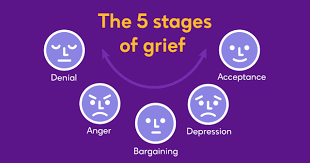
The five stages of grief as outlined in Elizabeth Kubler-Ross’ On Death and Dying are Denial, Anger, Bargaining, Depression, and Acceptance.
To wit:
Denial: A natural reaction to loss, denial can help people slow down the grieving process and avoid feeling overwhelmed. It can also be a way to try to understand what’s happening.
Anger: A common reaction to the frustration of no longer being able to live in denial, anger can feel like an emotional outlet as people adjust to a new reality. It can also provide temporary structure and a connection to the person who died.
Bargaining: People may try to change the circumstances that are causing their grief, such as hoping that things will improve if they take certain actions.
Depression: A stage of grief
Acceptance: A stage of grief where people find control and figure out how to proceed
PART FIVE:
Acceptance:
The truth is I accepted some deaths nearly immediately. Letty is the best example. We saw it coming eighteen months out and we talked about it often, particularly her take on the post-life expectations. She told me to look for the birds feeding on the porch and she’d be among them. She told me she’s just going to close the door behind her. So by the time July rolled around and she slipped away, acceptance of that new reality was already on the table.
Dave was more difficult having not told a soul about his impending death due to cancer. Richard was a shock but his self-isolation from society for several years prior to falling and dying made his death closer to acceptance than any sort of anger or denial.
They’re all different, and Ms. Ross is clear that the stages weave in and out of our consciousness, rising then receding, and just when acceptance seems at hand, depression might pop back on the scene.
The thing is acceptance is about knowing someone you love is gone and finally learning to accept that your new reality is one without them and learning to live that way. The less involved someone has been in your life, the easier acceptance becomes. Dave and Letty and Fr Dan and Dad maintained an absolute presence in my life, so accepting their absence, particularly since with the exception of my father, the rest all checked out at nearly the same time, has been more difficult. Accepting is a sense of no longer being lost when a particular time of the day might have been occupied by conversation or even texting, a long walk to the Farmer’s Market or a slow walk around the mall. The instinct might remain to wish you could do that again, or at the very least to slip into a funk because you can’t do that again. But acceptance is being able to remember those times, smile, appreciate how lucky you were to have at least had them, and continue.
Caution: Just when that happens, depression might snap back. Just saying. These stages are circular.
In any case, when my father died nine years ago, acceptance was easy because of the conditions of those last few years, but to this day I have trouble sometimes understanding that loss of security, even at my age. There’s something about the loss of your father that says, “You’re on your own, Pal,” even if I was an AARP member when it happened.
What I have found interesting is the larger picture here that I’m trying to frame for myself. Accepting the deaths of the primary people in my life from all stages of my life—Eddie from childhood, Dave and Bobbie and Debbie from high school, Joe and Cole and Dave from college, Richard from a time I was learning to live on my own, and through those years and the rest of my years until recently, Dad, Letty, and Fr. Dan, has caused an unexpected twist: the acceptance of my own death. While it has not become something I welcome, it has become something I don’t worry about, as if everyone else on my team went on ahead and is waiting, but that’s not right either.
Maybe it is just that I accept that the world keeps turning without them, and so must I, maybe even by living more, experiencing more, particularly for those who left too soon. Acceptance for me—and this isn’t for everyone—means that death is more a motivator, like a new teammate; we’re working together here, this unusual macabre mentor whispering in my ear through the absence of my friends and family, “Keep going,” or as Virgil noted, Death “twitches my ear and says, ‘Live. I am coming,’”
Acceptance comes quickly when you hope for someone to no longer suffer, but it soon evaporates and is replaced by those other stages, like soccer players on a pitch replacing each other, taking a break so that the entire Grief Team remains strong. Eventually acceptance will return and dominate until it is our turn to put others through those same stages with our own departure, closing that door behind us.
For me there has been one exception, and those who knew Fr. Dan, and more specifically had a relationship with him like I did, as many have had, my “acceptance” of Fr. Dan’s death was nearly immediate. Of course the suddenness of his death, particularly only a day after we talked and hours before we planned to talk again, allowed Denial to dominate, but with Dan it is different. It has to do with his spiritual presence in all he did, his nearly reincarnation of the life of St. Francis and how Dan discussed saints and holiness as if they were brothers and sisters and he was already in and out of the otherworld, and more often than not it felt like he was heavenly from the start and took some time to visit us on occasion. This is difficult to explain, but he was not of this world anyway, so his departure from it seemed right. Letty wanted to stay, as did Dave and all the others. But Fr. always struck me as someone who couldn’t wait to die despite his absolute love of life and nature and all that exists, not in any depressive, suicidal way, but as if he knew something we didn’t, and we’d just have to see for ourselves.
People over the last six months have not missed the chance to remind me “you don’t get over one’s death or grief, but you learn to live with it, live differently.” Yeah, I know, and I do appreciate the sentiment and concern, but while acceptance is the ultimate goal, denial remains my favorite.
The Yankees lost the World Series
(how’s that for a non-sequitur—hang in there)
and while I’m not a fan having pulled for the Mets during the playoffs, once the Mets were out of it, as a native New Yorker I had to pull for the Boys from the Bronx. I know many Yankee fans, including close friends and a handful of misguided cousins, and I could observe the five stages of grief play out over the course of the last twenty-four hours. Denial, of course, that they could make it that far and lose so swiftly, despite the game they kept for themselves. Anger, of course; I mean they left the bases loaded with one out! Come on! That lead to bargaining of what could have been done differently, followed by the harsh reality you could see on the players faces after the Dodgers won, and, of course like all players of all games, eventual acceptance that this one got away but wait until next year. Having been a Bills fan for decades I’m well used to the routine.
So Liz’s efforts to label the stages of grief allow us to stretch beyond just death and find them applicable to many situations. But at the end of it all is death, which for the rest of us is the beginning of life without someone we loved and still love.
When I go for a walk I think of these people, and sometimes simply by having a wandering mind I end up in some pseudo conversation with them, talking to Letty about the floods in Spain, talking to Dad about his putting, talking to Fr. Dan about how hard it is sometimes to keep going.
And in my head he tilts his head back and smiles that wide smile, lets out a small laugh, and says, “I know Bobby, I know. It’s exciting, isn’t it? To not always know what happens next?”
In these days now when this happens, he walks away just then and I watch him move into my neighbor’s cornfield like James Earl Jones, and I turn to see Letty staring at me, saying, “He’s right Bawb. You need to keep going. Just ask him,” and she points behind me where I see Richard bouncing from foot to foot, saying, “She’s right Bob! Move your tooshie!”
and that thought makes me laugh out loud, until depression settles back in, and just as EKR warns, it gets heavier and heavier, and heavier, until I put it down and spin back into denial, wondering what everyone is up to that day, out doing their own thing in the world.
But I know better.
You’re the color of the sky Reflected in each store-front window pane You’re the whispering and the sighing of my tires in the rain
You’re the hidden cost and the thing that’s lost In everything I do Yeah and I’ll never stop looking for you In the sunlight and the shadows
And the faces on the avenue That’s the way love is
This is Part Four of a Five Part Series here at A View.
Elizabeth Kubler-Ross’ On Death and Dying defines the five stages of grief as Denial, Anger, Bargaining, Depression, and Acceptance.
Essentially:
Denial: A natural reaction to loss, denial can help people slow down the grieving process and avoid feeling overwhelmed. It can also be a way to try to understand what’s happening.
Anger: A common reaction to the frustration of no longer being able to live in denial, anger can feel like an emotional outlet as people adjust to a new reality. It can also provide temporary structure and a connection to the person who died.
Bargaining: People may try to change the circumstances that are causing their grief, such as hoping that things will improve if they take certain actions.
Depression: A stage of grief
Acceptance: A stage of grief where people find control and figure out how to proceed
PART FOUR:
Depression:
Here’s One:
Dad once tried to buy a Snickers Bar from vending machine at a golf course. I hadn’t been nearby, but when I walked over he was getting angry. “Oh geez!” (Dad’s version of cursing). He said the machine was broken even though he kept trying to get it to work. He wanted number 110, the Snickers, and when he would push the “1” but before he would hit it again before moving to the “O,” it immediately gave me a pack of gum. I pointed out there was actually a button that said, “110” and he only had to hit that button. He pushed it and the bar dropped, and I reached in for him to grab it and found four packs of gum. He wouldn’t mind me telling that story. Dad had a great sense of humor, though my tale would have been followed with a sarcastic laugh and a deep “Very funny” comment.
That story both makes me laugh and makes me sad.
When my father died, I wasn’t exactly depressed by his passing, not in the traditional meaning of the word; Dad had not been well for quite some time, and at ninety years old with dementia, his beautiful life as we knew it had ended long before his death. The depression I have about him is from him no longer being here, no longer around to talk to. I am depressed when I recall the grace of those days we spent walking at the mall, lunches around Virginia Beach, golf with my brother and son, sitting watching sports on television. Dad was a relatively quiet man, and he rarely spoke of his youth, but he celebrated ours and the childhoods of his children and grandchildren (and great grandchildren) every moment he could. It is his absence that hurts, the void, the knowing he no longer knows us, thinks of us, breathes.
Sometimes I think of him and can’t help but laugh at the endless great times we had; and I was fortunate enough to live near him right up until his death. Other times I think of him, something small, like his baritone “Yes Dear” when my mother asked him something, or the way he sat in his chair on holidays and watched everyone else talking, laughing, and he always looked so proud and happy, and when I remember those moments, it hurts, the goneness of him hurts. I don’t cry, which is odd to me since a passing line in Ted Lasso might make my eyes swell, but neither do I think clearly for a while.
Elizabeth Kubler-Ross points out something essential about grief—it is not linear. Depression and anger may weave their way around denial, and at any given time one might snap out of anger and cry for hours. When Letty died I was immediately—and even in those pre-death months—depressed. When Dave’s widow told me of his long illness and subsequent death, depression struck me like a baseball bat. The denial came a little while later and I liked it so I stayed there. But the depression makes its presence known at odd times. Predictably in the middle of the night when my mind can’t find anything positive to counteract it all, but also in random spurts, like driving past a mall dad used to walk at, and now they’re tearing it down. The mall didn’t depress me—the fact they’re tearing it down hurt.
But there is another facet to Stage Three which complicates the narrative. Depression has multiple layers.
Let’s start with this: I battle depression. It isn’t melancholy exactly, and it isn’t sadness either; it is a complete sense of malaise, or, in simpler terms, it is sometimes not giving a damn about a blessed thing. A doctor once told me this might be why I try to live so very consciously, taking risks and exploring. A person like me just might need a bit more stimulus to accept the reality of life. A chronically depressed person (which doesn’t mean we’re always depressed; it means depression may very likely come and go for the rest of our lives) may have no intention of killing themselves, but they’re not against the idea of evaporating either. It is complete indifference. It is this: In Woody Allen’s Radio Days, a young boy who won’t do his homework anymore is taken to a psychiatrist who asks him why he won’t do it. The boy responds, “The sun is going to burn out in four billion years.” “So?” the doctor responds. “So what’s the point?” the kid says.
See, I get that. Not that I don’t understand the point, of course. But when someone cycles through a low in the depressive state, everything seems irrelevant.
Yeah, that’s not what we’re talking about here. E K-Ross bends it like this: Depression as Stage Four is a very specific “Situation” borne depression. The absence of someone’s laughter, not because they moved away or are ignoring you but because they no longer exist in this world, no longer contemplate the changing leaves, no longer taste or hear or feel, no longer imagine, no longer have any form at all, and when one acutely focuses on that reality, it can be overbearing. That thought, right there, that from now until the sun dries up, someone we love is simply not returning, that any chance you had to enjoy their company has passed, is depressing.
So too is a Jackson Browne song which cries out exactly what I was thinking about someone I loved. It’s everywhere, these depressive triggers. Some are obvious—like that damn Chevy commercial with the family visiting the grandparents at Christmas and a nearly comatose grandmother goes for a ride with her teenage granddaughter—”Sunshine on my Shoulders” on the radio—I can’t even watch that one anymore. OD—Obvious Depression. Some are subtle, like the sound of ice in a glass (Scotch on Tuesday nights with Dad) or peach pie (Dad loved Mom’s peach pie).
The death and subsequent goneness of them is not directly the trigger. If someone asks about my father and I say he passed away in 2015, it doesn’t directly depress me. But if they asked when was the last time I met my dad at the mall to go for a walk, I just might be incapacitated for the afternoon.
The sound of a golf ball leaving the tee, announcers calling a baseball game on a summer afternoon, the aroma of turkey in the kitchen while a football game is on in the other room, remembering, sometimes just remembering.
Stage Four is the weight on the chest. I remember a neighbor when I was young who not only lost a baby in infancy but lost her husband and her thirteen-year-old daughter to a car accident one rainy day. Sometime not long after that, her son found her in bed, dead, and it was said her heart just gave out. Depression can literally kill, of course, but it can equally kill the spirit, disengage any humor, and dissolve all sense of hope. It leaves one questioning what they did wrong that they are alone now (Bargaining), leaves one pissed that they didn’t tell others how much they love them (Anger), renders them useless laying on the couch in the dark on a sunny afternoon until they can convince themselves it is simply a bad dream, and the deceased is actually at work (Denial). Depression is the umbrella that all other Stages must cower beneath.
When I get depressed, I remember something to laugh about.
Here’s another one:
When his dementia had progressed but when he was still quite functional (which he remained until his final trip to the hospital), he thought there were two Joans (my mother). An upstairs Joan and a downstairs Joan, though I’m pretty sure he thought there were simply two women, and one of them was his wife. One morning when he woke up, my mother—the upstairs one–asked if he wanted to go out to breakfast. He agreed. My mother went downstairs, and sometime later he came down and when she asked how he was doing, he said, “The lady upstairs wants to go out to breakfast, and I said yes, but I really don’t feel like it.”
That makes me laugh every time, as I know it would make him laugh, and the only depressive element to it is my brilliant father’s deteriorating mind. No, depression hits me worst when I recall our trip to Disneyland in California when I was fifteen—just the two of us—that’s a great memory that gets me down. It’s the time he brought me to college one fall and stood around talking to my friends and me like he just didn’t want to leave, like he thought he might not see me again, before leaving. It’s the time he brought me to the airport for a flight out of Norfolk and we shook hands and he left two hours before my flight, but when the plane taxied to the end of the runway near the observation area, I could see him outside his car waving to the plane, not knowing if I could see him or not, that tears me apart.
I don’t think I told him I loved him until he was very old. I wish I could have done so earlier…
Damn. Negotiating again. Always negotiating.
Sometimes when it gets bad and I’m coldly aware of how much I screwed up my life and could use his presence—he never gave advice, but he listened very well—I sit and wait for denial to snap back to attention and save me, and I can go about my business still a little depressed, but this time because I forgot to give him a call before he headed to Florida.
Depression never goes away, it just simmers, often without me even noticing, but also without me feeling completely relaxed. Ever. People tell me “You don’t recover from someone’s death, you just learn to live with it.”
Yeah, I know. And I appreciate the condolences and empathy. But what is not admitted is that while we live with it, yes, the truth is we do so a little slower each time, a little less of ourselves than we had been.
This is Part Three of a Five Part Series here at A View.
The five stages of grief based upon studies and writings, such as Elizabeth Kubler-Ross’ On Death and Dying, include Denial, Anger, Bargaining, Depression, and Acceptance.
Essentially:
Denial: A natural reaction to loss, denial can help people slow down the grieving process and avoid feeling overwhelmed. It can also be a way to try to understand what’s happening.
Anger: A common reaction to the frustration of no longer being able to live in denial, anger can feel like an emotional outlet as people adjust to a new reality. It can also provide temporary structure and a connection to the person who died.
Bargaining: People may try to change the circumstances that are causing their grief, such as hoping that things will improve if they take certain actions.
Depression: A stage of grief
Acceptance: A stage of grief where people find control and figure out how to proceed
PART THREE:
Bargaining:
At the end of The End, an obscure Burt Reynolds movie with Sally Field and Dom Delouise, after spending the entire film trying to die due to his terminal illness, Reynolds finds himself drowning in the ocean and decides he wants to live after all, bargaining with God. “Please God, if you save me, I’ll donate all of what I have to the church!” he screams as he tries to swim to shore. The closer he gets, however, the smaller the percentage. “Really God, save me, and thirty percent of everything…twenty….yes, fifteen percent of everything!”
We’ve all done this. “I’d give anything if…” That’s bargaining. We’d trade our right arm for one more day. Even Willie Nelson would trade all his tomorrows. “Let her live at least until July and I’ll never again…” fill in the blank.
Bargaining is as much a part of living as death. It serves a purpose; that a loved one’s death was not in vain, and how we live our lives can change as the result of that death.
The following diction is all negotiation:
Honestly, I’d give anything to be back in Hechscher State Park on the Great South Bay walking through the trails with Eddie, climbing the now-gone ruins of the old beach cabana along the water. How I’d kill to be back in some small café with Dave at two am having eggs and toast and laughing. One night Dave grew depressed because “even musician George Benson had become violent” he exclaimed as Benson’s song “Give me the knife” blasted from the speakers above us. Dave was so serious and maudlin about it I couldn’t stop laughing. Finally, I explained he was singing, “Give me the night,” to which Dave burst out laughing at himself. Geez. Yeah, give me that night, one more time. Give me one more morning at the radio station, Dave ripping headlines off of the UPI machine to read on air, all the while talking to me about his family in Buffalo. One more time, God, Buddha, whoever. Just once more.
And need I suggest that if I had riches, I’d trade them right now to spend another day walking with Letty to the farmer’s market? One more—damnit—just one more evening watching a Mets game with my dad. I’d head down to the crossroads and negotiate my soul for that one.
But bargaining is more than some ridiculous quid pro quo we try and slip in without anyone noticing, as if it can bring someone back to life, or sometimes bring ourselves back to life. It is how we keep our lives moving forward after someone dies. “From now on I’ll be kinder to people,” we say. “From here on out I’m going to let people know I love them,” we promise ourselves. But do we? So many negotiations are empty.
I don’t think I consciously slipped into the role of negotiator. But I know—I mean I happen to know for a fact—that the morning a high school friend of mine took his own life, he tried calling me in my office, but I didn’t bother answering as I was tired. Give me that moment back, of course. But why? Would that stop his determined mind? Who do I think I am that I entertain the idea that picking up that phone would have kept him out of the garage? But that’s not the point of Stage Three. We say and think those things as a method of imposing control over something we have no control over. It helps us say, quite astutely actually, I can’t save my friend’s life, but I can save mine.
We do that because it allows us to believe in things we would never accept under normal circumstances. If Eddie had left work even twelve seconds later, we would have had lunch that Christmas and reminisced about all those years hiking the trails of Heckscher. And I won’t say it, but until I am seventy I’ll think how I would have done anything to know Dave was dying so I could have taken my guitar to Tampa and sat at his bedside, and we would have sung that damn song about being seventy, just seven years early. It would have been a dream fulfilled that I could have carried with me for both of us. What would I have to do to make that happen? I would do it.
That’s Stage Three. It somehow reminds my subconscious that even though Eddie is gone and Dave is gone, our plans are still here, and their deaths do not necessarily mean my death. Stage three is the bridge from loss to that adjustment we must make to move on without those we love.
The day before Fr. Dan unexpectedly died, my mother had been in the hospital, and it didn’t look good for her. I texted him her condition, and he texted back. A few minutes later he called. He told me he had an appointment the next day but to call that following night and we could talk when he had more time.
When I retrieved my phone after work that next night to do just that, messages came through informing me of Fr. Dan’s death. That brings us to the “if only” part of life, that is bargaining with ourselves. Never again will I put off my friends, never again will I not help a friend who needs my help, never again.
But we do, don’t we? We put them off and we stop helping or even stop calling. As a society we promise we will do better after every damn school shooting, after every war, every natural disaster, we will do better to protect our children and our allies and our neighbors. It makes us feel better about ourselves and what we can do while we are still alive, and it helps us negotiate their deaths as something other than pointless.
I should point out that grief and grieving does not have to be about death, but when it is, it is called bereavement.
Well I’m focusing on bereavement grief, because I’m holding to the notion that if the ones who cause your grief are still alive you are still able to love, to forgive, to move on or even sometimes go back. So, sure we can call that grief the same way my mother used to take a deep sigh and say, “Why do you kids give me so much grief?!” But grief from death is directly related to the finality of the incident. She’s gone. He’s gone. They’re all just gone, dust, ashes floating in the Med, a corpse in some Florida graveyard.
Kris Kristoferson wrote, “I’d trade all my tomorrows for one single yesterday, holding Bobbie’s body next to mine.” Yeah, negotiation, Monday morning quarterbacking.
Regret.
The thing is, there might be no better time for regret than those days surrounding the death of a loved one. Yet people say, falsely I believe, “I have no regrets.” Well, hell, I do. Tons. They keep me sharp, make me evaluate my actions so I can avoid those same mistakes, they remind me to call people who are still alive knowing I regret not calling those who are gone, I’m talking forever gone, stardust, ashes in some Russian picture frame, ashes in some Southern Tier Franciscan Friar cemetery. Gone.
Yes, I cherish my regrets as emotional sticky notes reminding me to keep in touch, sometimes even to wear my heart on my sleeve.
E Ross suggests most of the bargaining taking place is with death itself, negotiating a longer stay in exchange for some vague and inconclusive adjustment to one’s lifestyle. “Just let me live long enough to see my kids be able to take care of themselves” is a good one for several reasons. It is fair to want that, but it leaves off the trade. It is a bargaining with ourselves to explore what is important in life. I don’t care if I die before the next James Bond film comes out, but let me live long enough at least for “this” to occur.
But I need to let Ms. Kubler-Ross speak for herself on this one:
Before a loss, it seems like you will do anything if only your loved one would be spared. “Please God,” you bargain, “I will never be angry at my wife again if you’ll just let her live.” After a loss, bargaining may take the form of a temporary truce. “What if I devote the rest of my life to helping others. Then can I wake up and realize this has all been a bad dream?” We become lost in a maze of “If only…” or “What if…” statements. We want life returned to what it was; we want our loved one restored. We want to go back in time: find the tumor sooner, recognize the illness more quickly, stop the accident from happening…if only, if only, if only. Guilt is often bargaining’s companion. The “if onlys” cause us to find fault in ourselves and what we “think” we could have done differently. We may even bargain with the pain. We will do anything not to feel the pain of this loss. We remain in the past, trying to negotiate our way out of the hurt. People often think of the stages as lasting weeks or months. They forget that the stages are responses to feelings that can last for minutes or hours as we flip in and out of one and then another. We do not enter and leave each individual stage in a linear fashion. We may feel one, then another and back again to the first one.
Right. For example, stirring those memories to write about Stage Three brought me right back to Stage One, denial. I like it there and it seems to have taken to me as well. I’m too rational to not know I can negotiate for decades and never bargain Letty back to life, never compromise Dave back to his wife or Fr. Dan back to be able to call that following night to ask about my mom. It’s not going to happen. I know this, and yet somehow bargaining helps us pretend, like kids playing in the yard, that we can make things alright if we “just do this one thing.”
If only it were that easy, Liz. If only.
One last thought about Eddie A. Radtke, musician, friend. We were rarely apart throughout our youth on Long Island. Then I moved to Virginia—pre cellphone pre computer, pre anything. But we wrote letters, and he would send the want-ads from the NY Times and Newsday for me to give my father along with real estate listing from Great River. Our youthful brains insisted we could make this work. It didn’t, obviously, and we both indicated how we would do anything to erase my move south. Eventually we lost touch. Then after more than forty years, social media brought us back together. It turns out we had everything in common; in particular, music. We spoke on the phone often for a year or more, and then finally we made plans to meet right after the holidays, but one December evening he was struck and killed by a car when he was walking out of work.
I’d give anything to have had the dinner a month earlier, to sit one more time and sing “Cats in the Cradle” together like we did in our youth, laughing at how we used to call each other in early mornings and sing as loud as we could, “There’s got to be a morning after!” from ThePoseidon Adventure, and we’d laugh our way down the street to one or the other’s house. Give me that once more.
Seems all I’ve been doing lately is negotiating.
“It’s not too late, not while we’re living. Let’s put our hands out in time”
This is Part One of a Five Part Series here at A View.
Psychologists teach us there are five stages of grief. Personally, I believe there are a few dozen, but I’m counting overeating, drinking, the gummy-chewing stage, the Marvel Universe binge-watching stage, and several others, but for the sake of brevity, let’s go with Elizabeth Kubler-Ross’ count-em-on-one-hand list of stages, from her book On Death and Dying (so right away we’re not in a good place).
The Fantastic Five: Denial, Anger, Bargaining, Depression, and Acceptance, or DABDA, as I just decided to use for sake of association.
First, here’s an AI generated overview before I slaughter them:
DABDA:
Denial: A natural reaction to loss, denial can help people slow down the grieving process and avoid feeling overwhelmed. It can also be a way to try to understand what’s happening.
Anger: A common reaction to the frustration of no longer being able to live in denial, anger can feel like an emotional outlet as people adjust to a new reality. It can also provide temporary structure and a connection to the person who died.
Bargaining: People may try to change the circumstances that are causing their grief, such as hoping that things will improve if they take certain actions.
Depression: A stage of grief
Acceptance: A stage of grief where people find control and figure out how to proceed
PART ONE:
Denial:
I’m good at this—really in all aspects of life—but given the chance to forget that someone I love is dead, I’m all over it. This is most easily accomplished if you live a great distance from the deceased, or if you have had little contact over the years. Denial is convenient when you have a lot to do and thoughts of someone you love who recently passed or even not so recently slow you down. Kubler-Ross doesn’t disparage denial, but she does suggest it is best to move through it honestly. And I will, eventually. I understand it is simply self-preservation that I assume my father is at home watching golf (this one is hard to do since my mother no longer lives in the same place they did, so I am too aware of his goneness), Letty is visiting family in Italy, Eddie is playing blues in the city, Dave is misunderstanding lyrics at some coffee shop in Tampa, and Fr Dan, well, Fr Dan was already half in heaven to begin with. He’s not gone as much as he now plays the role of advocate. Richard made denial easy by his convenient disappearance from society and media several years ago. In my mind he’s home watching old Jane Fonda exercise videos.
It’s not easy to remain in this stage sometimes; there’s got to be a gummy that aides in denial.
But I see no reason we all can’t just assume those we love are off doing other things and they’ll be back in touch at some point. “It’s not healthy” Liz Kubler-Ross writes. Why? Why is it better to “accept” they are gone and won’t be coming back than it is to “accept” that they’re in Thailand playing Mahjong? It works for me, and I’m able to function properly without facing the reality that for the rest of forever, eternally foreverness, throughout the future of infinite time, I will never see these people again. They were here briefly; now they are gone.
“They’ve gone ahead,” people say.
“They’re in a better place,” people say.
“You’ll see each other again someday,” people say.
My mind holds onto that last one, yes, but not the way they mean it in some ethereal ghosty way. No. We’ll see each other again when they get back from Machu Pichu. I can’t wait to see their pictures.
Listen, I’m not dumb; I know they’re dead. Dave was in denial of death and told no one. Letty wasn’t crazy about it but moved toward it with class. Fr. Dan had no idea; neither did Eddie. Richard fell, so it’s doubtful he knew. Result: they’re not coming back, ever, and as Mr. Croce aptly pointed out: “Photographs and Memories, Christmas cards you sent to me. All that I have are these, to remember you.”
Yes, I know.
But grant that my considerably better mood and more focused work ethic come from an absence of acceptance of such significant losses.
I recently attended a writing seminar about grief, and the moderator—poet Anne Marie Wells from Northern Virginia—asked us to think about synonyms for grief for five minutes and write them down. To do so I had to briefly abandon my denial stage, but it seemed Kubler-Rossy, so I agreed. Anne Marie distributed a poem wherein the poet (not her) had synonyms for “grief” which were more personal than any formal understanding of the emotion.
I took the blank sheet of paper and wrote “SYNONYMS FOR GRIEF” at the top, slowly and neatly, OCDish, taking it slowly in an effort to eat up some of the allotted time. I started with the obvious: sorrow, misery, sadness, anguish, distress, agony, torment.
But I didn’t believe it. I couldn’t feel it in my stomach where true grief exists. I jotted down a few more: sadness, depression, helplessness. They felt empty. Dictionary words. Pointless.
I put down the pen and reread the poem. I looked at the clock and still had three minutes in the exercise. I stared across the library where the seminar was held, and I saw a guy at the computer with headphones on. He looked like my childhood friend, Eddie, who was killed by a car while walking out of work one night. I thought of Harry Chapin—a connection Eddie and I had.
I flipped the page over and tried again:
“Synonyms for Grief.”
Cats in the Cradle. Golf on television on a Sunday afternoon. Brussels in September.
La Vie En Rose (That one rips me apart. Grief incarnate).
Paul Simon songs. Seared tuna. Hard cider.
Wham’s “Wake me up before you Go Go.”
Black and white photographs. Change jingling in a pocket. Coors Light.
French accents.
Okay, so I wrote “French accents” fifteen minutes ago and went for a walk. My chest hurts.
Grief.
Grief sucks. It can be damn near suicidal. I get it Lizzy, I really do. It can also be cleansing; it can make us stronger, and yes, of course I grieve; I just did.
But denial is where it’s at. I’m running up to the post office and see if Letty sent a postcard. I might stop by the club to watch some golf, alone since my son’s traveling and Dad lives too far away. Then I’m going to finish the manuscript that was due last month about a friend of mine who is now living in a village in South America.
I just might be able to denial my way through the rest of my life. But that would piss Elizabeth off, and Anger is Stage Two. Some other time. For now, I prefer having nothing to be angry about.
Note: This is a very serious one. Read. Share. Forgive. It’s all we’ve got.
This is for Dave W, Bobbie B, Bud D, Tricia K, and the one’s who live with those unseen wounds which simply won’t heal.
***
A broken limb is obvious. A cast, a sling, a set of crutches or even a knee cart, and people can see the problem, understand the delays and compromises. We move aside or assist in any way we can.
What happens when someone injures their mind, breaks their thought process, when a person cracks their perception of reality and ration? The world is quick to judge the results of some unseen wound festering in their frontal lobe. “They’re lazy,” we say; “They’ve given up,” we say; “They keep asking for help and I’ve had enough,” we say. No one replies to the unfortunate soul with some walker, “No, sorry. I’m not helping you anymore.”
Well, in both cases the likelihood of one asking for help is pretty slim anyway.
Monsters such as depression, anxiety, and nervous breakdowns can destroy a person’s ability to function. People can’t think as clearly so they lose jobs, they make bad financial decisions and lose money and property. “They could have done something else; they could have sought help from a professional if that was true,” we say.
And when nothing makes sense anymore and the world is too much with them and there is absolutely no meaning in anything—when numbness overtakes the idle sadness, they find a way out.
The truth is suicide is not always the result of depression; it is not always a person simply giving up. In fact, it is often seen by the psychologically afflicted as the perfect solution. It is not doing harm; it is solving problems. The mind no longer functions the same as others’ minds. If they even want to ask for help, they don’t even know what it looks like to ask for anything in particular, so they seek solutions on their own, like sleep, like cutting off contact, like shutting the brain down for good. It is not life they fear or wish to escape; it is their mind. It is a difficult task to escape one’s own thoughts.
“There is medicine for that,” we say.
Not really. Sure, there is medicine to help someone cover up the wound, like a Band Aid, but the sore doesn’t heal as much as it is buried. The infection will return as soon as
well
as soon as it rains, or when the next call comes from a creditor because they can’t work enough to keep up, or, worse, when a call doesn’t come any longer from friends and they suddenly remember they were better once, and they won’t be like that again. But even that’s not accurate since they simply are like this now, and apparently always were, and the moment it happened is an allusive memory.
Because while in the movies when someone has a nervous breakdown, they flail their hands and scream, cry, and someone might slap them, tell them to snap out of it, in reality that’s not what happens. The truth doesn’t play well on film. In reality they say nothing. They might drink, of course, or become addicted to some pain reliever, some vice that keeps their brain in the moment like alcohol or other self-defeating measures that keep their mind from dwelling on some past or future attack, but they might just as easily sleep all day, or more likely not sleep at night. They try and work but the ability to focus is gone; not ignored or delayed—the actual part of the brain that helps them do work or see a reason to exist at all has a hole in the middle of it, the circuits are infected and surrounded by puss, but no one can see that, so it can’t possibly be anything other than “a phase,” “laziness.”
Later, afterwards, people say they didn’t know, “They always seemed fine.” “I thought they were going through something.” “They said it was no big deal.”
They say, “I wish they had asked for help.” They say, “I did all I could.”
They say, “What a shame.”
Indeed.
Did Hemingway have another novel, Van Gogh another masterpiece, Robin Williams another routine for the thousands of kids he used to visit in hospitals?
Depression and mental illness often caused by a mental breakdown can cause lives to rip apart, and the only explanation they have when they ask for help again and again is “I’m trying.” And eventually that simply isn’t good enough no matter how much they are loved.They live out on the fringe, they hold signs, they sleep on grates. Likewise, they live in country houses and city apartments. They seem to try, they try to seem to fit in.
Maybe if they wore a cast, had sutures across their forehead. We like to see problems before we help solve them. We don’t offer help to people when we don’t know they’re suffering; how could we? Unless we know them well.
And that’s the problem. No one knows them at all. They’re funny and outgoing. They make light of serious situations. They can work a room. So they either never ask at all or, when they do so too often say “I need help,” it is difficult to see how. “Again?” we reply. “Why now?” we ask. The thing is in a few days they will not even remember they ever asked for help to begin with. This is true; the compromised brain actually blocks that out completely. To us they can either be absolutely silent or seem constantly desperate; but to them it just happened.
Here’s the problem:
How can we find that line between someone who really needs help and someone who just needs a bit more tough love? What do we do if there is no visible “mistake” that needs correcting? What do we say when they say nothing at all, or if we do ask if they need help, they say, “No thank you, it’ll be fine,” more out of a notion of being too embarrassed to say yes. Too ashamed. They’d rather…what?
They’d rather die. To be sure. I remember a phone call early one morning when I just didn’t want to hear it again. I remember a visit from someone who needed more than I could give. I recall calling once and the phone kept ringing. I’ll never forget that one.
Where is the line between knowing whether we helped enough and we could have done more?
Honestly, it runs right down the middle of the rest of our lives, and we walk it aimlessly, hoping we made the right call, that there was nothing we could do. Even if we’d rather be on the side of foolishness, helping people way more than they probably deserve, we can’t ever know.
So we call and talk, stop by, we get them to laugh because apparently we think laughter is the best medicine.
That’s not how a nervous breakdown plays out. Trust me on this one. But there is no Habitat for Humanity that helps people rebuild their minds. So they lose everything: their homes, their families, their purpose. And there’s not a damn thing we can do about it. Well, sure there is, but the place between knowing and not knowing is dark and difficult to navigate.
So. What do we do?
We forgive them for finding a solution the rest of us thinks is foolish. We forgive them for believing that the pleasure found by watching their kids and grandkids grow, watching another sunset with someone, laughing at lunch with friends, still isn’t worth the pain—the constant and debilitating pain—that comes constantly to infect their mind; constantly, day and night. Even their dreams are saturated with pain.
Forgiveness for something we do not understand is a monumental task. But then for some, so is life.
If you need help, Call 988 immediately.
If you know someone who needs help, Call them.You don’t have to know what to say. Say anything.
If you are living with the memory of someone you feel like you could have helped more, it isn’t your fault. It isn’t their fault. Forgive them. Forgive yourself.
Remember what we learned as toddlers: How would we want them to react if it was us? What would we want them to remember if it was us?
Not everyone is fine. It’s that simple.
Bob Kunzinger writes the weekly blog, A View from this Wilderness, which premiered in January 2016, and is the author of eleven books, including the forthcoming Office Hours, as well as hundreds of articles in national and international publications. He lives in Virginia.
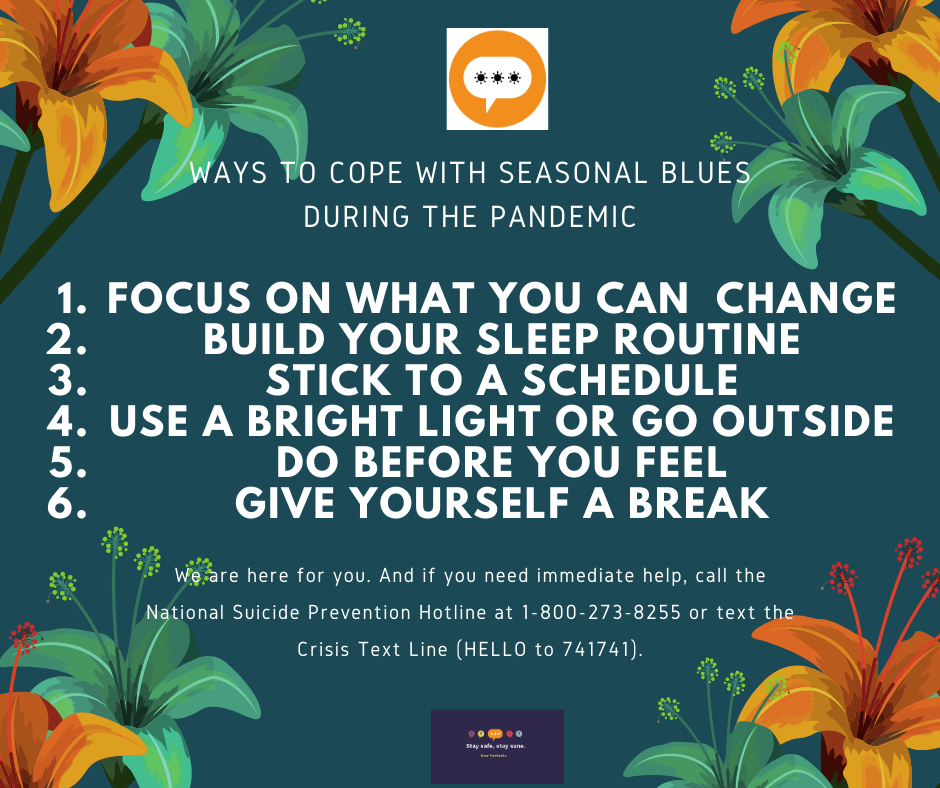
Sometimes you can sense some sort of lethargy this time of year revealing itself in subtle ways, like not wanting to go to work, not filling out some forms or editing some article, not bothering to return important calls completely out of a sense of avoidance, as if you might be able to wait long enough and all of this will pass—this stuff that brings you down, and to be honest, you’re not really sure what that stuff is. The idleness of society maybe, the constant sense of impending doom reported in all forms of media about democracy, about pandemics, about weather, climate, Ukraine, Gaza, shootings, political attacks, corruption, the economy, about depression and isolation. You have no reason to take any of it personally, but some people can’t let it go, it is so overwhelming and it weighs heavy, and you wonder how can you hold out hope for anything, let alone just one good day, when humanity is humiliating itself; so you settle for avoidance, which adds to the isolation, which fans the grief.
And you wonder what happened to everyone; what did you say or do to create some distance with family or friends, which may not be true at all, but with Seasonal Affective Disorder, it’s exactly true, and it’s your fault, clearly, and you know you’ve made mistakes but you know also what no one else does, that some contact can cure, even for a short while, some malaise.
You can sense yourself not trying as hard or caring as much, like eating whatever is around instead of thinking it through, not going for a walk because you don’t want to be bothered putting on a coat or dealing with any sensory change. You’re sitting; you’re comfortable, and you’re numb. It works.Numb is good.
Going for a walk helps. Filing out the forms, returning calls, all help by providing a sense of accomplishment and forward motion, like checking things off the to-do list, it leaves you with the hint that if you keep going there’s something worthwhile on the other side. You convince yourself it is the medicine side effects.You tell yourself the mistakes you made are in the past; you know it doesn’t matter.
There’s the rub. It seems you keep reaching the other side and there’s still nothing there to lift the spirits, not this season anyway—more hostility in the east, more pessimism in our government, more variants on deck ready to step to the plate after some new mass shooting smacks a triple into right field. So you try a little less at one task, and it spirals from there. You realize it’s not depression; it’s, well, yeah, it’s depression, but not in the deeply caving sense; more like in the “whatever” sense. You tell yourself you’re not even close to suicidal; then you read telling yourself that is a bad sign.
More spiraling.
The problem with this type of malaise is it can be debilitating to you without being scary to others if you are not suicidal. The truth is, the vast majority of people who deal with depression are not contemplating suicide and will never kill themselves, which is what most friends fear most, and when those friends learn that is not part of the equation, they feel better. But that can often make it worse since the objective is for you to feel better, not them. But that’s fair since you know what they don’t: that a different suicide exists, a slow erosion of sorts, which anonymously eats away at ambition and accomplishment, takes the edge off of energy and momentum. It’s the guy sitting at a bar nursing a beer, nowhere to go despite having a million things to do. It’s the one on the park bench watching people walk by but not noticing a single one of them; it’s the inability to concentrate, the disinterest in listening, the short responses to questions, the inability to make it through the most basic of activities. It’s writing endless emails about nothing to others in some attempt to reach out; but that just backfires. Rational thought has nothing to do with it. “Knowing” what to do is not relevant. Your mind is suspended, your thought process withdraws into some elementary state.
On the one hand it’s situational—financial problems, relationship problems, blizzards. But it can also be chemical if you don’t have medical help. It’s addiction without restraint. It’s a combination of these, and it is unpredictable because the same thing that leaves you in bed staring at the ceiling feeling hopeless can drive you to your feet to tackle whatever it is that left you prostrate to begin with. It is a conundrum that plays handball in your brain.
The guy at the bar with the beer, the woman in the park, the man at the river watching the tide roll out, all know exactly what the problem is. But their brains are aflush with fog, their anxiety has disabled their decision-making capabilities, and their strongest assets and most celebrated talents that normally keep them going the rest of the year, are no longer applicable since they carry a sense that those traits are probably what brought them to this place to begin with. They sit and wonder what if. They sit.
“Maybe if I had just…”
“Perhaps I should have…”
“Fuck it.”
At some point it seems you stop fighting altogether and are either not afraid to hit bottom, or you hope to use that bottom to bounce back, not afraid to fail since it can’t be worse than this. It is extreme but that is part of the diagnosis—extremes, polar reactions—sometimes both in one day. Sometimes within one hour.
More often than not, the guy on the corner holding the cardboard sign didn’t “decide” to quit, didn’t give up, but “felt” a pressure that he no longer could handle or define, caught in some stream of disconnect and hopeless confusion. Sometimes the one who does, in fact, tragically go that last fatal step didn’t “decide” to do anything at all, and that is the point. Suicide is not a decision. It is one step beyond decision making. The vast majority of people who deal with depression have that in check, less so in the dead of winter, of course.
But that’s not you. Truly. And that is the problem; you really aren’t suicidal at all. And when suicide is not part of the equation, others feel that you must be “okay,” or “going through something right now.”
Yeah, winter, you’re going through a snow bank that’s three months thick. This is the worst time of year for many people with depressive issues. Seasonal Affective Disorder is real and feels like all of the above. Nothing helps but time, but time to some people sounds like the slow drip of icicle melt.Others say you’ll get over it, it will pass, hang in there, talk to someone. Yes, all of the above, but right now–right this minute–you need help and you don’t know it.
Other people try to help so they talk about the weather or sports or anything at all with enthusiasm and a sense of caring, but it often makes it worse, only emphasizes that others get excited about the minutia while you can no longer find value in a sunrise.
And the disguises are nothing short of cunning. I’ve known people fighting depression who on the outside resonate as the very poster image of Carpe Diem. I’ve been friends with people who contemplated overdosing on Monday while making plans for Tuesday, who loved others more than the average soul but only wanted their puppy nearby at checkout time, and people who fought depressive ways by pushing adventure to the limit, and beyond. “What a lust for life!” people exclaimed. They had no idea.
It isn’t exactly depression, by the way, though it is easier to simply call it that because it certainly wears the same eyeshadow as depression. It is indifference; it is a vague inability to muster the energy to lift your spirits enough to give a damn about anything. It’s not like you woke up depressed so you decided to stay on the couch all day; you simply don’t care that you’re on the couch to begin with. Complete apathy. You’re not down about anything; you answer “fine” because you really are fine; fine’s a fine word; vague and indifferent. It has the definitive weight of a horse shoe and the value of fog. “I’m fine, really,” should never be left alone with a person who fights depression.
Ironically, for most of these afflicted people, life is amazing, every half-beat is a moment of “miracles and wonder” which is why you cannot comprehend the misuse of time. The abuse of time in so short a life, you think, is as suicidal as the abuse of substances, and that can be depressing as well.
It is the time of year when you wake at three am knowing nothing is going to work, and you’re going to lose your house and your sense of security and no answer makes sense, no way forward seems rational. Equally, the dawn can come with new ideas and hope, and if you push those moments far enough into the morning, you just might be able to make a day of it. But January has 285 days. And February is several months long. March? Well you well know that March is merely a tease. April comes and breathing is easier. May, and nothing stands in your way. But in January it is safe to say yet difficult for others to understand that May hasn’t even been invented yet. It doesn’t exist and neither will you by then.
On the outside you seem to be fine. On the inside you’re grasping the thin rope of enthusiasm with clenched fists, pretending all will be well, but your insides—much against your will—are shredding at the thought of what to do next.
You “hang in there.” You “get through it.” You suffer the trite suggestions of others who simply can’t understand what the big deal is. That’s okay though, you think. Really. You absolutely know, logically, it is chemical; while at the same time you absolutely know, logically, the world has moved on without you. There are no solutions, per se. Just more questions. And “hang in there” is at the very least an acknowledgement you really aren’t trying to dismiss your very existence; it just happens sometimes. Depressed people do not feign depression; they feign contentment.
This afternoon I went to the river where a bitter breeze is pushing down from the west. There’ll be ice tonight somewhere, and snow, but I sat reminding myself I have been there, touched that ring of undefinable despair, and I’ve moved through it, sometimes with difficulty, often with ease, always with the knowledge that I’ve had one freaking incredible life so far, and time enough left, I hope, to continue my pilgrimage well into the next mood swing. But there are moments, collisions with frustration at the gap between the way things are and the way things should be, that catch some people off guard.“You’ve been like this before,” a dear friend told me not long ago when things were less than fine. “And you’ll be like this again.” And all you can think is, “Yes I will, like right now.” But what she meant was this is you, this is part of your DNA, this is as much you as your skin. What she meant was there is no “fighting” the tigers that come at night. Better to sit and dine with them, pour some Bailey’s on the rocks, and wait. Just wait.
AndEventually you remember that the seasons, like everything else, change. And love, despite its bad reputation, is holding the other end of that thin line you’re grasping.
Because nothing else matters but love. Nothing.
I’ve been released And I’ve been regained And I’ve been this way before And I’m sure to be this way again One more time again
I heard an interesting comment on NPR last week. When talking about someone who died by suicide, the victim’s brother said he didn’t think his sibling didn’t like life anymore as their mother had suggested, but just didn’t like one particular part of life, and somewhere over the course of time—maybe weeks, maybe months or longer—the poor man hyper focused on that one aspect until it became a monster, blocking his view of any other aspect of existence remotely salvageable; even the finest reasons to continue were saturated with the pain of one part, perhaps even a small part, of life.
On the one had it made their mother feel a bit stronger—that her late son did not despise life, and in particular perhaps not the life she and her husband had built for them, but one thing happened, who knows what, and that overtook him despite the beauty around him. He couldn’t see past that monster any longer, and in his then-compromised view, nothing else existed any longer. Life became about the pain-inflicting monster, so killing oneself seemed the only clear way to end the pain.
On the other hand, for those who still know someone with some form of depression, particularly situational depression and not chronic or manic depression, being able to unearth and understand that aspect of life which has the potential to take over a person’s mind can help isolate it and, over time maybe, destroy it. At the very least the knowledge of the issue might help others keep it in perspective, perhaps even eliminate it.
The surviving brother then, almost off-handedly, said, “I wish we had gone hiking more.”No one picked up on it; at least not on air. But I did. It slid right in my thought process and simmered all day. His brother must have been considering how things might be different if he had helped replace the monster with something more powerful, more soul-owning. For them, apparently, hiking. Had they gone enough times, or consistently enough anyway, for the deceased to have discovered that hiking was his life and he now could own that choice, his routine and whatever negative issues came up—a problem with a partner, finances, even simple malaise that chronically depressed people will never be able to explain—would be minimized by the power found in something positive.
It doesn’t have to be hiking. Could be music, sports, food. But something active, something visceral and kinetic.
I asked my students the other day how much time each day do they spend watching other people live their lives or pretend to live life. That is, how much time are they stagnant viewing other people’s happenings on tv, movies, TikTok, etc. I’m not talking about going to events like sports or lectures or the like. No, those are very participatory. I mean the dead-brained observation we do that when we’re done—or better stated, when we take a break–we are exhausted, and we never did a damn thing.
The suicide rate among college-aged students is about 2 percent, about 1100 per year, and about 25% know of someone who killed themselves, and just over that percentage thought about it themselves, all of them offering as their primary motivators pressure, helplessness, relationships, loneliness, and money.
It takes just one issue to debilitate a person, make them feel hopeless, and all the time in the world trying to balance it with positive acts cannot extract that monster from the mind, and eventually ration slides away so that suicide is not a conscious decision but in itself a rational act to eliminate the pain, which by that point is all there is.
And later people say they wish they knew, they say they would have helped. The man on the radio said, “He asked for help; we told him we had helped him all we could and he had to do this alone.” He was riddled with guilt, but then realized that the way he could have helped may not have been clear to either his brother or him at the time. One just assumes the help one asks for when in a bad place is the only way to help them out of that place, but that’s not always accurate; in fact, it is often hardly ever accurate.“I just should have been there more, called and asked how he was doing more, had lunch,” the brother added. Exactly.
Yes. He should have, but not because of his tragic loss, but because we are humans, responsible for each other, and I am so guilty of not being there for others it is disturbing. I can change that, but there are some things I cannot change.We can at least change the things we can. I’ll leave the wisdom part for someone else.
I guy I knew a long time ago told me a story about a friend who couldn’t see past a bad relationship, a mentally abusive relationship, and saw no way out of it, particularly since they just had a baby girl. In all other aspects of his life he was okay, very giving, impossibly kind to others, but he felt he had nowhere to turn. His mother ignored him, his father tried to help but without emotion, making it difficult. And he thought his friends had moved on. One morning the troubled one called a friend, but the friend didn’t answer the phone. The friend was pretty sure he knew who was calling and that he was probably depressed, but he didn’t want to deal with it at that moment. Three hours later the guy I knew called to tell him that the troubled one killed himself. He told the friend that the widow told him his last outgoing call was to the friend. He thought it would make him feel good to know the dead guy was thinking of him, probably missed him. He had no way of knowing that the man had ignored that very call. I knew these people; and it is easy to say there was nothing anyone could have done, but that simply isn’t true. We just tell ourselves that. Certainly we may not be able to save someone’s life, but we can save some time for them. It’s a tough call but an easy decision; make the call, stop by, go for a walk. Grab some tea.
Give them a reason.
We are here for each other. It’s all we have. We are only here for each other. We can’t save others if they don’t want to be saved, but by trying to help others we just might end up saving ourselves.























 a view from this wilderness