On This Silent Night

The Blue’s Brother’s Light Display

It’s misty tonight but not raining, and all the lights have halos from the soft air. Today I slowed down after sixteen weeks of not, followed by a few days of noise–it was all in my mind, of course, but noisy just the same, so this evening I decided to slow down and after standing on the front lawn looking at the moon through the haze in the east, I drove down into town.

I put on some solo piano music from George Winston’s December and rolled slowly past the fish market to the real estate office where Steve and Randy Blue have the best lights I’ve seen. They have music synced with a radio station across the river, and the largest tree in the front keeps beat with the sounds, but I kept my windows rolled up and just listened to George’s deep rendition of Variations on Canon in D. Kids with parents ran through the paths between light displays, and I assume they were yelling, or calling out what they saw, but I heard nothing. Just George and Pachelbel.

I stopped next door at 711 and bought some hot chocolate, talked to Wayne a while in the parking lot, but families started moving past the Nutcracker display to the parking lot, so I drove off toward the bay, pausing in front of Hurd’s Hardware. Jack Hurd has the entire front window filled with illuminated Christmas trees in various colors, and on the left side the trees are several deep. This window against a black sky with no other stores around makes it more silent than it should be. I turned off the car and the radio and rolled the window down and still heard nothing but quiet, a faint spill of music from the light display at the realtors.

Behind Hurd’s and across the street is the village branch of the county library, and tonight my son worked while a local Y hosted kids who had entered their artwork to be hung in the library gallery in the back. I rolled down the street and looked back into the window. This, right here, is one of my favorite things to do in the dead of a cold night in December; to see kids and families laughing and warm inside a window, not able to hear them, but watching them play and talk while outside I can see my breath and my face is tight from the cold. At one table near the front Michael talked to a woman, while over near the door a few kids entered to head back to show their parents their work.

On the way home I rolled into the IGA and could see Kristin from the museum and one of her kids at the checkout, talking to the clerk, laughing. The lot was empty, mostly because it’s Monday but also the rain, and I headed to the river, rolled down the windows, and turned off the car and sat quietly. Out on the Norris Bridge I could hear the whining of truck wheels moving across to White Stone, and the light at the airfield was circling, indicating someone will land at some point tonight, probably Mike in his PT-13 headed back from some weekend show. All of this going on yet all I can hear is the lapping of the Rap on the sand and the slow movement of a heron about fifty feet away in the marsh. To my right in the windows of the yellow house across the reeds is a blue light of a computer or television flashing on the walls.

I like the peace I find when I am outside looking in at Christmastime, and some rebirth of familiar connections take hold of everyone. It is fleeting of course, but present for now. I enjoy watching these flashes of life around me. I try not to be creepy and prefer only to look in public spaces like convenience and hardware stores, but it is nice to catch a place like the library where so much activity is going on behind my music, like shadows on some cave wall. But this year is different than last. Some of the people I used to talk to every day have gone silent, somewhere beyond the ideas and anticipations of those still here. So my world in general has gone mostly silent in the past several months for the first time in three decades.

So tonight I decided a drive made perfect sense; not only because it fills me with some sort of hope to see life being lived, but also because I’ve always been just outside looking in.

This happens to a lot of people, especially this time of year; we have a sense that we’re better off a step back, perhaps a small part of the conversation but not participating as much as others, preferring instead the safety of the next row back instead of the circle of talkers; we are more comfortable on the patio bench quietly watching the stars until someone else who feels awkward comes out and quips about needing some air. That’s where I am, away from the small talk, and I turn around, place my elbows on some wrought iron fence behind me, and look in a everyone laughing. I am okay a step back.

But at the river I sat in silence and thought about why this distance works for me.

It is safely consistent. I know blindfolded how to walk through most of the Blue’s Brother’s light display, and I know Wayne and Maria will be at 711 at this hour. Monday nights Michael always works the library, and Jack’s trees make everyone smile for a few weeks. They make me smile anyway, and I appreciate that. It is predictable and consistent at the end of a year that has been anything but either.

So I drove around listening to Winston’s version of Bach’s Joy and felt completely and literally at peace. Life is out there, through the windows, in the market and the front steps of the convenience store. The kids in the library laugh like Michael used to when I brought him in to sit at those same tables two and a half decades ago. This is what we can count on when we are running out of things to rely upon; that Christmas will bring out people with lights and once dark window displays are somehow almost personified, the trees in Jack’s window display appear more like watermen at the cafe standing around talking about the coming snow.

I slowly rolled down my long, winding driveway until I reached the lamppost near the lawn at the house. The porch is lit with white lights, as usual, and the wreathes illuminate the walls and windows. I had one other significant loss this past year; the Penguin, affectionately known as Pengy, died last January. His wires were shredded from years of moisture and his skin simply popped. Sad really, because I liked seeing him for twenty years at the corner of the porch.

But things change. I have new light displays now someone sent me, and after tonight’s Chocolate Bailey’s on ice I’m not going to care so much anyway. But I do have a suggestion: Turn off the music except for something peaceful, and stay outside for a bit–watch life for a while from the outside, observe it’s consistent laugher and predictable love. Watch others enjoy the moments they have together while they still have those moments.

But don’t stay out there too long. The love is inside.

Hurd’s Hardware, Deltaville
west on the Rappahannock tonight

The Reach

One of a huge fleet of boats hauling up nets of menhaden for Omega Protein of Reedville

Four men in their seventies are at another table at the café. For a while they talk about a trip one of them took to the mountains, and he describes the farms out there, the slopes and crops, the height of the corn and the how dry the air is and the effect of the lack of humidity on the growth. He saw some pheasants and deer, and he saw some cottonwoods which if you cut it up for firewood will quickly rot if it gets wet. It was a bus trip, and he must admit he spent a good deal of time sleeping on the bus. 

Then they talk about dead friends, two of whom passed last week. Both had cancer and one is believed to have caught it in Vietnam. The dead vet’s wife is in hospice and doesn’t know he died. “Doesn’t know he was sick,” says another. “Doesn’t know she was married!” laughs a third and they all laugh until one shakes his head and says, “Shame really. Such a loving couple.” They are quiet a bit and sip their coffee. It’s raining today, and it isn’t hot. It’s cold in the cafe and I wear a sweatshirt. 

Then they talk about boats. 

People in Deltaville for the most part are farmers or watermen, often both. Corn, butter beans, soybeans, tomatoes, wheat, flounder, bass, oysters. Crabs. Inevitably, the talk turns toward the commercial fishing conglomerate in Reedville up the bay that’s been fishing the mouth of the Rap for menhaden for well more than a hundred years and were out there in their fleet of ships again this morning. Omega Protein cooks and grinds the fish for nutritional supplements as well as feed for livestock. No one eats menhaden except the larger fish, in particular bluefish and bass, but they’re a cash cow for fish oil. Still, the watermen will tell you the truth, that the fish of the bay are being starved off because of the over farming of menhaden. One guy’s grandson is working out there on the boats holding the tubes that suck up the millions of small fish out of the nets and pumps them through a filter system and then into the hold. The fleet pulls out five hundred metric tons of the little suckers every year.

“Down at the mouth of the bay, and up bay in Maryland, those fishermen doing okay. We’re dying here in mid-Chesapeake,” one says. He eats a breakfast wrap the sole worker walks back. She hands him a small bag of chips and says she didn’t forget, and they all laugh.  

Then one of the men sees the college sticker on the back of my laptop. 

“Bob, you work at that college? I heard you’re a professor.”

“I am.”

He nodded. 

“My wife read one of your books. Got it at the library.”

“Well. Thank her.”

He nodded.

“Wayne would read it,” says another, “but he only knows so many words.” They all laugh. Oh, these men read. The details and depth of their knowledge of weather, sea conditions, fishing practices, equipment updates, agricultural spill, fertilizer, engines, oyster conditions, and more is extensive, and I’ll turn toward them for what the weather will be like in the next week quicker than any other source. 

“So you been to Siberia?” Wayne asks. Before I can answer, another points out the obviousness of the question, but Wayne says he’s just making conversation.

“I have.”

“I ain’t been nowhere. The mountains on a bus trip. Fredericksburg once.”

“And Richmond, Wayne. You went to Richmond that time.”

I’ve been thinking a lot lately about this contrast. I’ve been around the block, and a significant number of my neighbors have not been very far at all. Growing up it perplexed me. The world is massive, with so much variety in people, vistas, foods, customs, and more that to spend your life not exploring seemed a waste of a life, like vacationing in London but only going to see Big Ben every day. 

But we’re just curious about different things, is all. I can navigate easily through more than a few foreign countries. So can these men; foreign to me, anyway. From Reedville to Havre de Grace, Tangier to Cape Charles, and Windmill Point to Point Comfort and on, dead reckoning if they must, navigating the depths and dangers beneath them, the changes in the tide, the wind, the mood.

Oh these men read. They read the clouds and can communicate the narrative arc of storms, they read the waves and the tides and can tell what the antagonist will be today, when the skies will clear, when the flounder will return, when to head home early and when to push it.

They are masters at their lives, and while they are often prisoners to the weather (and international conglomerates), they are, most of them, still their own bosses with boats much more costly than my home.

These guys killing time at the café are part of the backbone of this country, and we’re sitting a few hundred yards from the famed Stingray Point where, according to spurious accounts, John Smith was stung by a stingray. They walk into the café or the convenience store or IGA in work boots, sometimes raincoats.

One complains again about Omega. “I saw them out off Windmill again, five am.”

“Come on Jimmy. You know as well as me if you had the money to get one of them boats they got you’d be sucking up the menhaden too. Sheeet.”

“You go out today?”

“Yeah, Out and back.”

“Anything?”

“Tomorrow.”

“I suppose.”

They sit quietly and Wayne shows a picture on his phone of the bus he rode with his wife and a group to the mountains.

“You working on some new bestseller Bob?”

“Not today,” I say.

“Tomorrow then,” he says, and nods.

Cool Change

It’s raining. The sky is deep grey, like it’s never going to clear. A steady breeze is pushing down the river, and out on the bay a fog has settled. No one is out in the village, not at the IGA, not at the convenience store. A worker stood smoking a cigarette under the overhang and said, “Ain’t no one been here today. A few for gas is all. Beer for the game. Quiet.” I bought a coffee and left the change on the counter so he could stay outside and finish his Marlboro Red. “You watching the game, tonight?” he asked when I came out and sat on the bags of logs.

“Some. Michael’s headed to a violin concert by a touring musician down at the episcopal church on 17, so I might head over to the 606 to catch the second half.” The 606 is a pub run by some guys from Australia who also have an Irish pub attached to it, though that part—The Quay—is hardly ever open. Next month it will be, obviously.

“Good food.”

“Yes, and Fosters.”

He took a drag and snubbed out the butt in the ashtray on top of the huge cement garbage can. “I better start wings and pizza. Gonna be a rush on wings and pizza soon.”

“I’m just going to have one draft and head home and eat there.”

He nodded. “Philly gonna win.”

“Okay.”

“Don’t talk to me about KC’s defense. This is going to be all Philly.”

I sipped my coffee.

“You don’t care do you?” he asked.

“Not really, no. Go Bills!” We laughed.

“This rain ain’t never letting up. I think it supposed to do this all night.”

I looked out at the Exxon sign. $3.25 a gallon for regular. A white truck pulled in and parked next to the kerosene pump. He pulled out a blue can and put it on the ground.

“Yeah, it’s pretty steady.”

“Don’t it bother you? All this rain? It’s starting to bother me.”

“Not really, no.”

He held the door open for Bubba, who said hello, commented on the weather, asked how Michael’s doing, and went in to pay. I sat thinking about Sundays, the pace, the slow erosion of hours. I thought of Sundays in my childhood when it rained and I’d lay on the floor and read or watch football or an old black and white western. I almost felt like the aroma of pot roast should drift out of some kitchen. Onions.

I thought about the book.

Yesterday at a local shop, Nauti Nell’s, Michael and I stopped to see if they had any books he liked. The shop has stationary, enough nautical equipment to build several sea-going crafts, candles, Old Bay seasoned peanuts, and more, and one of the finest book collections—mostly used—about the Chesapeake, and sailing in general, anywhere.

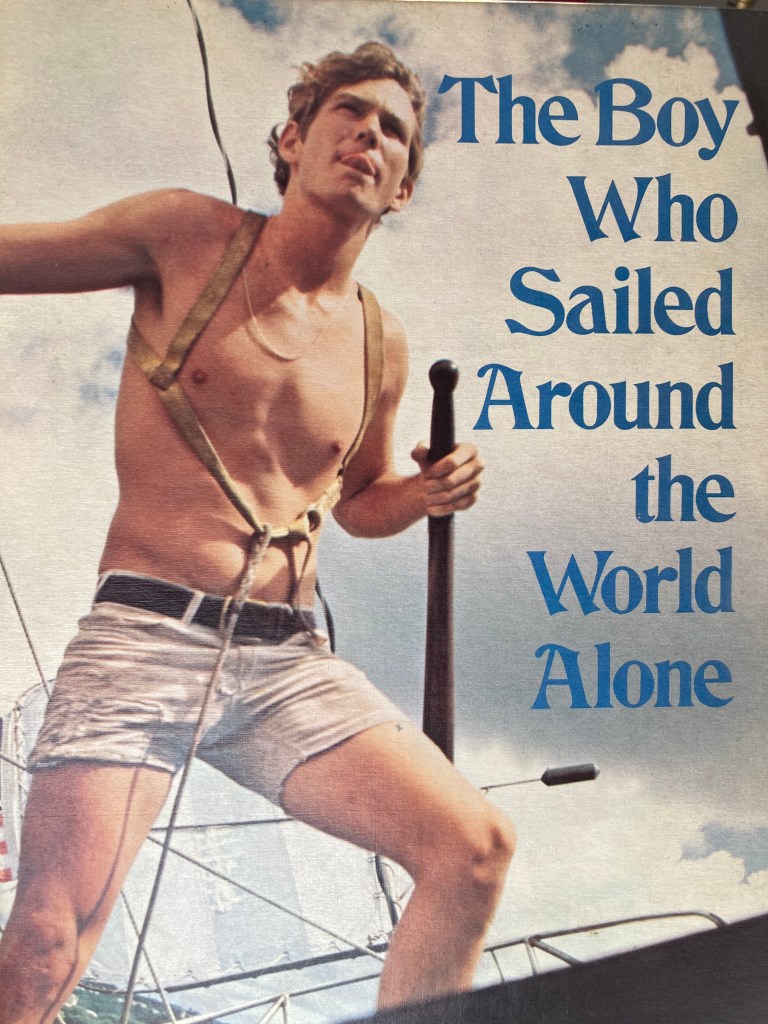
I’ve told this part before: Growing up, my dad would give each of us a book for Christmas. He shopped for them himself and picked up books which he believed met our personality. I still have almost all of them—James Herriot’s All Things Great and Small series, A Walk Across America, Bound for Glory, and more. But the first one and the one that had the most impressionable impact on my way of thinking was Robin Lee Graham’s The Boy Who Sailed Around the World Alone; the young adult version of his bestseller Dove.

Through the years of moving, packing and ditching things, selling and losing things, I lost that one. The irony is that was the one book that I specifically remember waking me up, making be think of something beyond my tight little world.

Yesterday I turned a corner inside Nells, and there it was, same publishing year, same hardback everything. I opened it slowly half-expecting to see “Merry Christ Robert, Love Dad, 1974” scribbled inside.

Five bucks. I didn’t even have my wallet, so I dug the change out of a canvas bag in my car. Then last night I read it again for the first time since Gerald Ford was president.

I do have the adult version, Dove. In the mid-90’s, not long after Michael was born, I acquired a 26’ Columbia sloop—identical to Graham’s boat. I worked on it most of my free time, and bought a copy of the book for inspiration. When Michael was three he’d come with me and sit in the cabin playing with his Legos as I worked on the deck and the rigging. I didn’t plan to sail around the world, of course. But I did think about circumnavigating the Chesapeake. If it had been slightly bigger and a little less leaky, I could envision myself sailing it to Florida, across to the gulf and up the southern coast.

It was my very first dream that I recall with such specificness and with such clarity. Previous ambitions involved some sort of magical realism, like when I wanted to build a rocket and fly to space, or when I wanted to design and build a car that could also go in water and on snow. Early on I set myself up for failure.

But the boat was different. Even in my early teens it was real. We lived at the water on Long Island’s south shore, and I was around boats all the time, albeit other people’s boats. And Graham’s YA book had lots of pictures and details of how he came up with the plan and saw it through.

My boat sank in Broad Bay in Virginia Beach. The police called me at Aerie and asked, “Did you own a 26’ Columbia?” Honestly, they used past tense.

Michael was not happy about the loss of his Legos still in the cabin.

Bubba came out of the store. “$6.35 a gallon for kerosene. Geeeeeez. You’d think with all the marinas and boats and users in this town it would be cheaper!”

This seventy-something-year-old man has sailed quite far from here, as have most of the people in this small village. It is what they do. “Deltaville: Sailing Capital of the Chesapeake” the sign says when you enter town from 33 to this place, the very end of the road before hitting the Bay. “Deltaville: A Drinking Town with a Boating Problem,” says it all, and the fact there are three times more boats than people here.

I thought of Joshua Slocum, the first American to circumnavigate the world, and my favorite, Laura Dekker, now the youngest person to do so. And of course, Graham, who lives in Montana now, fifty years after returning from his five-year journey.  

It’s nice to have dreams, to find some old ones literally on some shelf somewhere. To pick them up and blow off the dust and remember that ancient and very real spark, the one that helped you turn some corner toward adulthood.

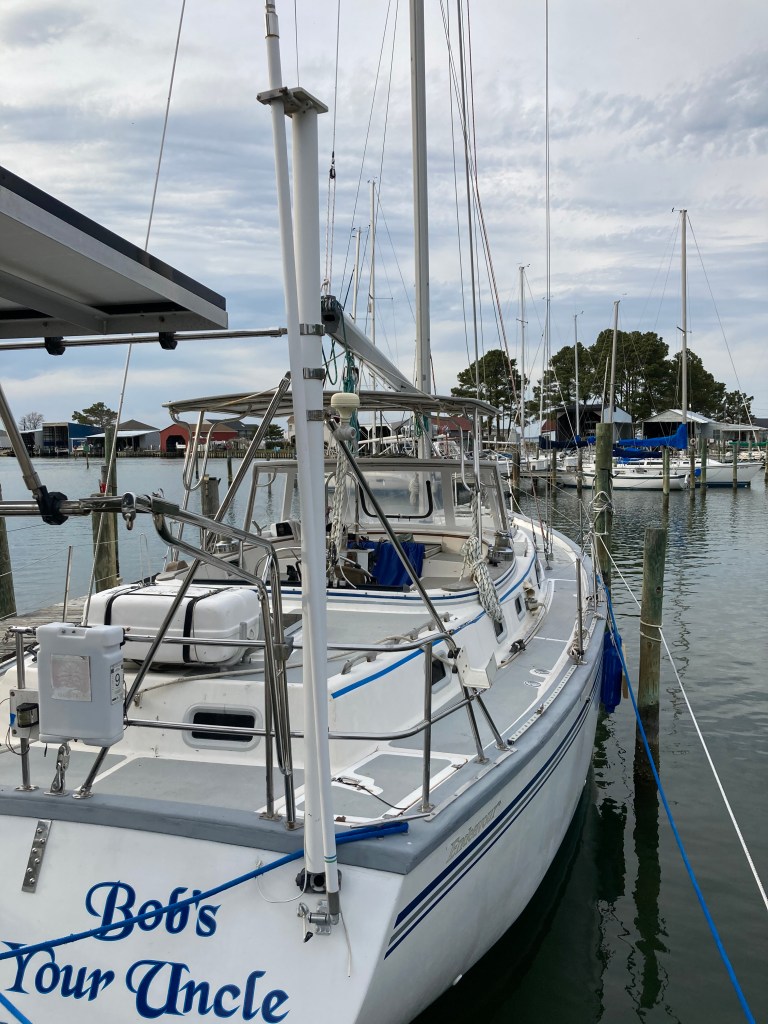
I drove to the bay and walked in the rain on the docks at Stingray Marina, noticing the sloops, a couple of Ketches, one conveniently called, “Bob’s Your Uncle.” I thought of the Morgan Out Island down at the slip in Wilmington, the one with charts of the intercoastal. “Begin Again,” it’s called.

Do we move on from our youthful dreams because they’re not practical or because we don’t know what to do next? When are we simply too old?

It would take real gumption to chuck it all and take off, open it up wing on wing and glide past all the excuses and hesitations. But “not just ordinary gumption,” as Paul Thoreau once wrote, “But three in the morning gumption.”

And who’s got that?