From This Green Hill

This article, the most shared of any I’ve written, originally appeared in the Washington Post, May 29, 2016.

From This Green Hill

by Bob Kunzinger

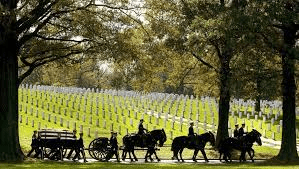
I was at Arlington National Cemetery and stood near a small wall on a tranquil hillside, and I could see Washington, D.C., the Washington Monument and other memorials to our Founding Fathers.

The unobstructed view looks out upon our nation’s capital, where for almost 250 years some of these souls have challenged the balance of power. A few of our former leaders lie just feet from this unassuming spot: an eternal flame for John F. Kennedy, a small cross for his brother Robert and, for their older brother, Joseph, one of the hauntingly familiar headstones. Across these green fields in all directions stand thousands upon thousands of marble markers, all carefully carved with the names of veterans and spouses, their birth and death dates, battalion or division and rank and conflict, a cross or a star, variations of both. A flag.

From this protected promontory I could see century-old oaks. Magnolias and dogwoods shrouded headstones like commanders keeping their soldiers safe. The Tomb of the Unknowns, mausoleums, small, singular sarcophagi and miniature monolith monuments stood scattered across acres of fields of fallen men and women who once stood as strong as those very stones that mark their last battle.

From this green hill I could see wildlife. I watched brave birds feed at an arm’s length away and then scatter to the safety of a nearby branch. Starlings perched upon headstones, and striking red cardinals gazed from the low branches of a tall maple. It was theirs, once, as were all the battlefields and all the cemeteries from Winchendon, Massachusetts, to the Texas Coastal Bend, before these battles took their toll, and men — boys — were buried in this wilderness.

From this tear-soaked soil I could see Vietnam, its rivers and forests where death kept too close to birth, whose beauty and wilderness taught men to pray and made brothers of them all. I could see the village battles between unknown enemies and blameless boys who should have been home riding bikes and reading books. I could see the more than fifty-thousand Americans never to become authors or professors, scientists or librarians, gathered beneath this field where their legacy is our common charge.

Beyond the Potomac, I could see Korea, the Philippines and New Guinea. The voices of spouses still crying for a husband to come home, women, standing alone too young, holding the small hands of children starting their fatherless flights toward tomorrow. I could see the medals and markers, veterans hugging veterans above a brother’s eternal assignment, saying, “It should have been me.” “He gave it all.” “He saved my life.” “He was too young.”

From this hallowed ground I could see Normandy. I could see the parachutes falling under the cover of night. I could see rows upon rows of men who marched side by side through shallow, blood-filled, mine-laden water toward the only hope left. I could see the hillside and the secured toehold. I could see the American flags on Omaha Beach and Utah Beach. I could see the graves of those forever beneath foreign soil and the ships returning with thousands of heroes. I could hear taps, the prayers of priests, the commanders’ thank-yous, the nation’s solace.

From this sacred spot I could see into France, the sacrificial fields, the trenches that saved the lives of our great-grandfathers. I could see the muddy, barren no-man’s land where brave men crossed only to lie here, now, beneath crosses too many to mention.

From this vantage I could see the heirs of Lexington and Concord. I could see Saratoga and Yorktown. I could see the battle for freedom, the commitment to integrity, the promise to defend. I could see the fight for the greater good. From this spot on a green hill I could see a small group of men standing like stone walls against England and claiming with absolute clarity and without compromise that we will be free. We will stay free. We will not fail.

From that green hill, from that perspective on such honorable sacrifice, I could see what bought our freedom. I could count the crosses, the sum of which cannot be measured, whose cost cannot be calculated.
Instead, this:

I started this blog twenty-three times tonight and ended up with nothing. It is one of those times when nothing I write comes close to what I want to say.

So instead, this:

for Dave

“I counted my years and realized that I have less time to live by, than I have lived so far.

I feel like a child who won a pack of candies: at first, he ate them with pleasure but when he realized that there was little left, he began to taste them intensely.

I have no time for endless meetings where the statutes, rules, procedures and internal regulations are discussed, knowing that nothing will be done.

I no longer have the patience to stand absurd people who, despite their chronological age, have not grown up.

My time is too short: I want the essence; my spirit is in a hurry. I do not have much candy in the package anymore.

I want to live next to humans, very realistic people who know how to laugh at their mistakes and who are not inflated by their own triumphs and who take responsibility for their actions. In this way, human dignity is defended and we live in truth and honesty.

It is the essentials that make life useful.

I want to surround myself with people who know how to touch the hearts of those whom hard strokes of life have learned to grow with sweet touches of the soul.

Yes, I’m in a hurry. I’m in a hurry to live with the intensity that only maturity can give.

I do not intend to waste any of the remaining desserts. I am sure they will be exquisite, much more than those eaten so far.

My goal is to reach the end satisfied and at peace with my loved ones and my conscience.

We have two lives and the second begins when you realize you only have one.”

~Mário de Andrade (San Paolo 1893-1945) Poet, novelist, essayist and musicologist

 stēlla

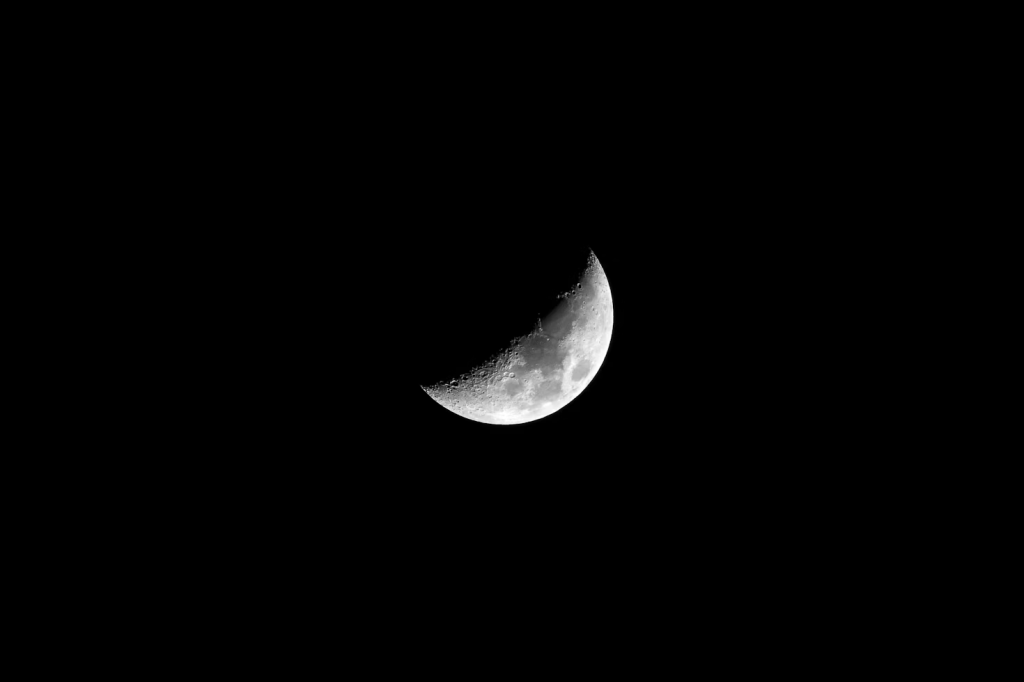
The moon last week through the telescope looked like a golf ball, the dimple-craters and the bright white side imbedded in the mud of the dark side. We looked at it a long time with the perspective Apollo 8 must have had when it orbited the place, moving around it like Tiger Woods circling his next putt.

It’s cold, but still, and the air off the bay bites a bit, and some rustling in the leaves makes me think the fox is around tonight, or a cat from a house through the woods, but it is how it should be–we seem to look at the stars most in winter because it gets dark so much sooner, the air is cleaner, the humidity low.

But last week despite the bright half-moon, the sky was dark and the telescope picked up an amazing nebula all ablaze not far from Orion, shining out from billions of years ago. It is the middle star on the belt and the brightest nebulae up there. I’ve needed perspective lately. When “the world is too much with me” and “life is like a pathless wood,” it is good to look at the same stars as did Copernicus and Galileo and ancient astronomers who saw bulls and crabs and horseheads where I can only see a random sampling of bright dots, like dots on a map.

And the top half of a golf ball stuck in the mud of space.

“Why, I ask myself, shouldn’t the shining dots of the sky be as accessible as the black dots on the map of France?” wrote Van Gogh to his brother, Theo. “Perhaps we take death to reach a star. We cannot get to a star while we are alive any more than we can take the train when we are dead. So to me it seems possible that cholera, tuberculosis and cancer are the celestial means of locomotion. Just as steamboats, buses and railways are the terrestrial means. To die quietly of old age would be to go there on foot.”

I like that, the illusion that death is another mode of transportation, and those we love and lose here are simply on some galactic pilgrimage. I have several books about the stars given to me by my brother, by my son, and I’ve read them, returned to them for reference, for maps, and I have such trouble remembering the names of space stuff. I mostly use my cellphone app, point, and then say with absolute authority, “I’m nearly positive that’s Avior. I think it’s a star in Corina if I’m not mistaken.” But I swear ten minutes later if anyone asked me to repeat it, I couldn’t.

So I’ve started making up my own star names, like the International Star Registry, only specific to Bob. Deep in the Pleiades I can see “Cole,” leaning into the other stars, preaching, pushing them into agreement about the colors he should use to paint Jupiter with all her moons. And what used to be Lesath in the Scorpio constellation according to my Backyard Guide to the Night Sky is now “Eddie.” I can almost hear some Janis wailing from his band of Red Dwarfs. “Dad” is clearly Polaris, my North Star, up there to guide me if I wish, follow him when I’m lost. I wish I had turned to him more when I couldn’t find my way.

Now, I know from these books from my brother and son that the brightest star in the night sky should be Sirius. Orion’s belt points right at it, yet more than a few times I’ve mistaken it for her sisters, like Vega and Canopus. So I’m saving her, putting a sticky note on Sirius. I have a special name for her I’m keeping to myself and will send to the Star Registry—though I doubt they’ll change the name of such an important celestial body; but I will, if only in my mind. And I’m going to memorize her location so I can go outside on a clear night and talk, reminisce, find a bit of permanence in an all too temporal existence.  

(nee Sirius)