This piece was originally published in an independent journal and subsequently as a chapter in my book Prof: One Guy Talking.
Boxing Day
I had been teaching about three years when the president of the college called me into his conference room. It was autumn, and it rained that day so not only did the impending meeting occupy my thoughts, but the weather made everyone miserable. Fog settled heavy on the James River behind the buildings, and just the walk from the parking lot left me wet and sticky. I sloshed into the leather seat in his spacious office. The river ran behind his windows, the water and fog blending. The Monitor- Merrimac Bridge Tunnel appeared little more than a shadow of a river crossing. The only lucid thought in my mind was knowing the professor he planned to fire wasn’t me– I would play the role of messenger. He thanked me for driving to his office and moved right to business. “Tell me truth here, Bob. Is she crazy?”
She was an African-American, PhD professor. Short and rather rotund, her Islamic chador shrouded her dark darting eyes. She hid in bushes some early mornings, garrisoning herself from evil attacks of campus maintenance workers and other faculty. Sometimes after class she walked home by advancing from tree to tree, looking about, scanning the parking lot for followers. We had been hired together, and when we first talked we talked long about Africa, where I had been and where she had longed to go. I showed her a picture of the village chief, a tall thin man who in the photo is searching for a place to settle down with his prayer mat in the sub-Saharan dust. She stared at the picture a long time. It was just a few months later she spouted profanities across the library tables to other workers, accusing them of casting a spell on her. It was another two years before the President called me in and asked me if I thought she was crazy.
“Compared to who?” I asked. I quickly qualified myself as not being able to determine anyone’s mental state. True, a professor who hid in the hedges and crouched behind trees because she thought she was being followed appeared, on the surface at least, insane. But who was I to say? In my time teaching college, I have often desired to flee to the cover of rhododendrons. “I don’t know,” I said. “She’s a great teacher though. She knows her stuff.”
“Bob, she yells across the library–yells–at other personnel–screams for them to stop following her. Last time they were just replacing light bulbs.”
“Yes, sir, that’s true. But it’s not my call. I’m her colleague.”
I was also Assistant Division Chair at the time, and while this denoted nothing when assessing other full-time faculty–least of all their mental state– it placed me in a position where the woman in question trusted me. In fact, I was the only one she talked to most of the time. To avoid the obvious lawsuits, the administration looked for someone she trusted and felt comfortable around to end her career. The college was being both cunningly cautious and blatantly cowardice. While I am a white, Catholic professor, we still had more in common than others. I’d traveled extensively through Islamic Africa, and we talked often of village life, and she asked about people, about their lives. So when she started to cower in the dark corners of campus with what can best be perceived as paranoid schizophrenia, I was the medium through whom the administration communicated.
“She can’t stay,” the president said.
“Okay.” I answered. At the time, I really didn’t care either way. A puddle had formed at my feet, and my sweater smelled like a dead animal in a Moroccan marketplace. He offered me coffee.
“Bob. We’d like you to offer her three choices. One, she stays, but if the pattern continues, she will be fired. That will give us time to document more of these incidents. Two, she transfers to another campus. When people there start following her and she yells at them, that would mean it’s her, not us and we would need to let her go. Third, she can resign now, we’ll pay her contract for the rest of the year, and she leaves on good terms with recommendations.” I thought, You are going to recommend her? To who? But what I said was, “Wow, Dr. This is somewhat beyond me here, don’t you think? She simply checks too many boxes for you to do it yourself, doesn’t she?”
He was quiet for a moment. “You’re the only one she trusts, Bob.” Clearly, the legal issues lingered like the fog on the James River. I asked what he wanted to happen, though I already figured that out, and said I’d talk to her.
When I was leaving I said, “You know, sir, I don’t get paid enough for this.” He laughed. Of course, because it’s so laughable.
I sat in my office, just across the hall from the victim. I wondered where the line was between being mentally stable and out in left field, thinking I should know exactly where it is since I step over it so often. To be honest, all three offers seemed low and outside–academic spitballs. I’m crazy for doing this, I thought. But then more than a few college profs of mine wandered well into the outfield too often during the season.
One philosophy professor I had in college brought us to the campus grotto with magazines where we proceeded to rip them apart and toss them in the air. He insisted that one group of philosophers believed eventually the pieces would land in their original design. My anthropology teacher lived with aboriginal Australians in the thirties and spent each class telling stories of trips to Alice Springs, and he’d dance a small Australian dance, the music playing somewhere in the recesses of his mind.
My advisor would haul a television into class to watch the Giants play Thursday night football. He’d profess the advantages of eliminating first person from our work, and add an occasional exclamatory “Damn it, give up the running game!”
One professor I had was a priest who taught a course in parapsychology. The street name of the course was “Spooks.” In his youth he was an exorcist in France and had been dealing with the paranormal for sixty years. He always left the front row of every class empty in case former students or colleagues who had died might show up to sit in. Once, when the door was slightly ajar, the wind blew in and swept it all the way open and then slammed it shut. We were silent until Father quietly stated, “Oh, Larry, I’m so glad you are joining us” We laughed. He didn’t.
As a professor, I once worked once with a colleague who would walk into class the first day and exclaim, “Nearly all of you will get no better than a C,” and he was right–he failed more than three quarters of the students in every class he taught.
During my first year teaching, a student entered my office and complained about himself. He started a business by buying six grand worth of equipment but didn’t have the time to run it, and while he wrote excellent essays, he couldn’t get them turned in by the due dates. He apologized, saying he’d have to drop the course. After some time, he asked if I were him what I would do. I told him that wasn’t fair, that I could look back those six years to twenty-three and know so much more than I had known, but he told me that was exactly why he was asking. He charged that hadn’t I sometimes wished that at twenty-three I had talked to someone.
So I told him. “Okay, if I were your age, I’d sell it all, put three grand in a strong money market account and take the other three grand and disappear. I’d get out of the collegiate predicable setting and do what Eleanor Roosevelt recommended ‘Do one thing dangerous every day.’ I’d be gone. Africa maybe, South America definitely. I’d stay away from expensive places that are merely mirrors of our own big cities. I’d search it all. Three grand will last a long time if you do it right and you’d still come back to a good bit of money to start in a direction you are sure of.”
He left, laughing, telling me he’d love to do something like that but he wouldn’t know where to start. “You’re crazy,” he said.
A few days later a colleague asked if I knew the guy. Lianne was from the genre of professors who knew all the students’ names, where they came from and what they needed to work on. Still, she had her occasional moments of doubt.
She said “Bob, Kevin came by. He was in my developmental English class, and he seemed excited about your conversation. God, I wish someone talked to me like that back then.” Lianne was in her mid-thirties at the time, one child and one on the way. We talked for some time about those choices, about working instead of going to school, about discovering life. We talked about my persistent uneasiness when standing still, about her dedication to her students and her love for teaching. “I just wish these students would really understand how necessary it is to really live life and not just follow someone else’s path!” she would say firmly. I’ll never forget going down the hall to her office six months after that conversation to show her the postcard Kevin sent me from Sydney, Australia, with a note, simply stating, “Don’t know when I’ll be back. Thanks.” A few years later Lianne died of cancer. She was so young. The post card is still around somewhere. So, too, in some way, is Lianne.
When she died I asked myself, “Why am I doing this? What am I doing here?” Teaching is an occupation where you can tell other people how to do things you don’t actually do yourself. Most writing instructors don’t actually write. This isn’t to say that to teach psychology teachers should be disturbed (though the ones I have known for three decades certainly have had issues). Sure theorists are necessary to measure differences and calculate shifts in perspective. But I’m one who believes in understanding the swamp by walking through it. Because it is a swamp, all of it. The pieces will never fall back into place no matter how many times you toss them in the air. In the real world, “C” is average and most of us are just that. And sometimes someone really is out to get us, nudging our psyche to the margins, forcing us to duck into the hedges. Sanity sometimes hides in the fog. We look for the obvious outcasts somewhere on the playing field when the insane might be sitting next to us in the box seats.
I once taught a class about the structure of argumentative essays when a student in the front row, lit only by the glow of the overhead projector, screamed out to the quiet class, “I JUST HAD A GREAT BOWL OF SPAGHETTI!” That became consistent in her weekly rants. As she yelled to the walls, we learned about her new laptop, her broken down car (one student shivered from the thought of her behind a wheel), of her boyfriend’s (more shivering) mental problems. But then I walked across campus and saw students with bent elbows, cell phones squeezed to their ears, yelling at parents about dinnertime. Eighteen-year-old’s smoking in ten-degree weather, rocking back and forth, complained of the wind. I see educated minds quieted by medicine, illegal drugs, alcohol, and pain relievers. Students sit quietly in class safe from the brutal reality of being beaten at home. From our benign perspective we all pass judgement on what others should be doing, decisions they should make, how to best improve the path they find themselves on. One faculty member I knew put smiley faces on returned papers, graded them with crayons, and held pot luck dinners during class. A professor of mine at Penn State screamed at students every day telling us we were worthless and wasting our time, and worse, his time, because our brains were filled with immoral crap. He gets paid for that– more than I do. Crazy? Give me the hedges any day.
Once when I was still in college, a few minutes before philosophy class a friend of mine and I tore a Newsweek into pieces and then put it back together on the ground near the front desk. We scattered a few pieces about to make it seem natural, and when Dr. Kelly entered, we called him over: “Dr! Look!”
He laughed for ten minutes. “Thank you, gentlemen” he said and never addressed the subject again. It was years before I figured it out. Years.
A few days after seeing the president, I was in a faculty meeting when the drugs finally kicked in. Unfortunately, I wasn’t taking them. But the hyperactive freak throwing his glasses across the room in disagreement over some freshman composition concern calmed down and kept quiet. Thank God. Still, it woke me up. I sat staring at the wall listening in cartoon fashion to my colleagues. Their voices came out as one long whir like the nonsensical sound of teachers in Peanuts cartoons. My shirt felt tight about my neck like I couldn’t breathe, and I thought of a Whitman poem, “When I heard the Learned Astronomer,” wherein the student gets sick and dizzy listening to someone talk endlessly about astronomy and doesn’t feel fine until he walks out and looks up in “perfect silence at the stars.” My blood pressure rose like Icarus, and I was burning up. I feared I might crash while discussions continued about whether the research paper should be taught in freshman composition one or freshman composition two. No one wants the responsibility of turning a freshman class into a difficult class.
We have faculty meetings that department chairs expect us to attend. They include textbook committees to determine which ones, often costing more than the course, are most beneficial to the “stereotypical student.” Some people still believe faculty teach classes, hold office hours and go home. The entire make-up of college courses, texts, student committees, articulation agreements, transfer policies, and enrollment caps is chaired and championed by faculty. Professors meet to talk about composition courses, to discuss pedagogy, they meet to argue developmental courses and to discuss transferring students to transfer courses once they understand at least eighty percent of the material that should have been learned in fourth grade anyway. No one wants to be there but they discuss it all with enthusiasm because they believe in what they do and know that these issues, how they are handled, how they are resolved, will not only provide a sense of accomplishment beyond the classroom, will offer excellent fodder for their curriculum vitae and allow them to choose their wars instead of being assigned battles by the division chair. And they know as years go by their decisions affect the way American college students learn, how they conduct themselves, and how they will succeed after college. These meetings we attend, or blow off, tilt the tables of the American workforce.
Still, everyone is watching the clock.
Eventually, I left the department meeting only to be accosted by the Spaghetti Student in the hallway wanting to know if Ernest Hemingway wore green pants when he shot himself. Back at my office I found eight students waiting. None of them wanted advice on papers or suggestions on topics but wished merely to confess to me about how the humidity in their houses ruined their printers and the only person left at home to feed Grandma is a fifteen-year-old sibling who isn’t back from rehab yet. Every time my office turns into this sort of confessional, the room spins, the hallway dissolves, and I can’t breathe. So I slip outside and always waiting there, smoking, are students who never showed up for an earlier class and proceed to tell me about some car problems that didn’t get flushed out until after class was over, though they really hustled, and they deliver all this with a straight face as if I’d never been to college and didn’t blow off classes, or as if a twelve-year-old couldn’t see through their backwards, pathetic excuses.
So I keep walking, passing most with my head down, taking the long way around to my mailbox since a three-minute walk can take fifteen if it’s between classes and I am spotted by students with reasons to see me other than collegiate. I’m not fast enough though and my choices are the student who wants to show me his poetry even though I told him I don’t know anything about writing poetry or the faculty member who wants to discuss textbook choices for the next semester and maybe we could do so at his house with a small party and invite all the faculty for a potluck textbook brain session. If I hesitate too long, I’ll never get to my car fast enough to get a drink before my next class, so I duck into the hedges and wait, pulling my baseball cap down over my eyes, hoping no one notices even though I know–I mean I know– I’m being followed. But I’m too late and the faculty member comes close and says, “Bob, do you want to get some lunch and talk about textbooks, and all I can think of to say is, “I JUST HAD A GREAT BOWL OF SPAGHETTI!” and he leaves me alone. Finally.
Back at my office, I still had to offer the three choices to the victim, so I knocked on her door. She had been kneeling, praying, and stood awkwardly, with my assistance and apologies. She seemed totally lucid, completely at ease, and I didn’t know if that was good or bad. She settled down and asked, “Am I going to be fired, Bob?” I told her the choices, and, unfortunately, with some tears, she asked what I thought she should do. I gave her the picture of the village chief searching for a place to put his prayer mat, and she nodded. Part of me wanted to tell her to fight–to get a lawyer and battle this out, but I couldn’t figure out why. So I said, “You’re hiding in hedges. You’re yelling at colleagues across the library.”
“I’m not crazy, Bob.” She paused and looked at the cinderblock wall. “What would you do?” she asked.
Now whenever anyone asks me that, I always think of Sydney, Australia, and smile, picturing Kevin wandering down some beachfront. Sometimes when someone asked “What would you do?” I think of my son because back then whenever someone asked a stupid or difficult to answer question, I tried to imagine how I would want the teacher to respond if it were him. I found patience and restraint this way, and just a little bit of balance, though, true–not always. Sometimes I crossed the line, tossed my notes into the air wondering if they’ll all come down in one piece
I thought of Kevin recently and about his postcard and realized he never came back. And this professor with her prayer mat and concrete understanding of American literature never came back either, mostly because we never do go back after we leave a place.
A few years later I didn’t go back either. But shortly before leaving, I was teaching class one windy day when the door swung wide open, startling students. I stared for a moment and said, “Oh Lianne, come on in,” and everyone laughed.
Except me.
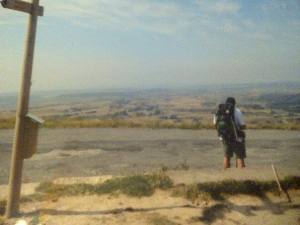




 a view from this wilderness