Just, before Dawn

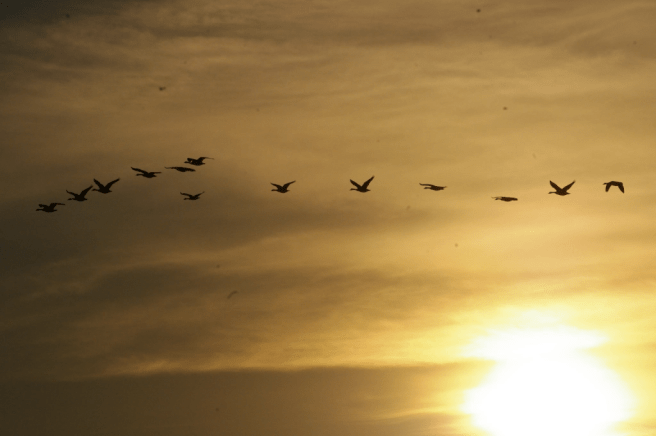
I rose early this morning since I needed to be in Norfolk by 8. That’s okay, though. I am drawn toward the early morning hours of dawn when I feel ahead of the world, and I can sense some small hint of hope. The geese flew by headed to the river, and to hear life around the water in those moments motivates me. Before the sun rises, often just after the first sliver of light reaches up across the bay, I can hear osprey and other sea birds who at that hour never seem to mind my presence.

But earlier, when that glimmer on the eastern horizon is still merely a possibility, I have taken to walks by moonlight, sometimes not even that. In the woods where I live and down along the water, something is going on. There is life out there wide awake and moving through the dark hours like spirits who need to finish their errands before the sun gives them up.

Fox come about the edges of the woods looking for scraps of food or the peels and rinds of bananas and melons. I can stand patiently off the side of the drive and one fox will wander across the yard from the woods behind me to those on the south and stop before disappearing again beyond the laurel, and he will stare at me, relaxed, nosing around the base of a tree where I occasionally put food. Then he’s off—not swiftly or in fear, but nonchalantly, demonstrating that he lives here as well and has decided to stretch his legs. That’s all.

Owls, too—some barred but mostly screech owls, perch in the oaks and elms, sometimes swooping down and moving through branches with precision. But my favorite are the geese which cover the night sky in flocks sometimes so enormous the swoosh of their wings alone creates a breeze, and their call to “Go! Go! Go!” is startling.

Closer to home, out front near the edge of the trees, deer nearly always feed on the dew-soaked grass and often the hostas, and if they sense me sitting on the porch or standing in the clearing, they will look up, briefly, ears turned forward—just for a moment—and then return to their grass, not minding me, aware just the same.

And it is then, when I am well acclimated with the night and my eyes have adjusted, and my soul too has adjusted, that I think of my way in the world, the motivation behind the turns and hesitations, my purpose of this passing in time. Oh, do I ever have an internal monologue underway with long-gone friend now gathered in my nocturnal imagination. There’s Cole nodding his head and insisting I follow my own path. I can hear him clearly when I’m out there, see his small sardonic smile as he says, “Come on Kunzinger. You know how to do this, stop waiting for approval or it’s never going to happen.” And there, too, is another friend whose smile is as wide as dawn pressing his sense of adventure into my spirit with an “all or nothing” carelessness about him which brings me up short yet livens my ambition. In one brief moment I am eased by no longer thinking of them in the past tense, but just as quickly, we all move on; usually just as the sun surfaces.

The sky in the distance across the reach lightens ever so slightly, from dark, almost Navy blue to something slightly more pale, like powder, and I’m alone again—the fox rushing off into the woods, the geese at rest in the harvested field or at the river’s edge, and the murmurs of chickadees and wrens and cardinals chase away what’s left of the stillness, and even my friends bow off, and I have trouble separating memory from imagination. So I get in the car and head south to the city where I simply don’t belong.

It’s as if time offers a small reward for some of us who stay up late or get up early to gather as much out of our moments as we can. Then, just briefly, it eases me back into this new reality I never anticipated. It remains for me the most honest time of day, the most just, when all thoughts have a chance of pushing through the darkness, and the truth about what we are here for is ironically illuminated.

I’ve started to live for the deep hours of the night at the twilight of dawn.

Bulldozer Leadership (and herons)

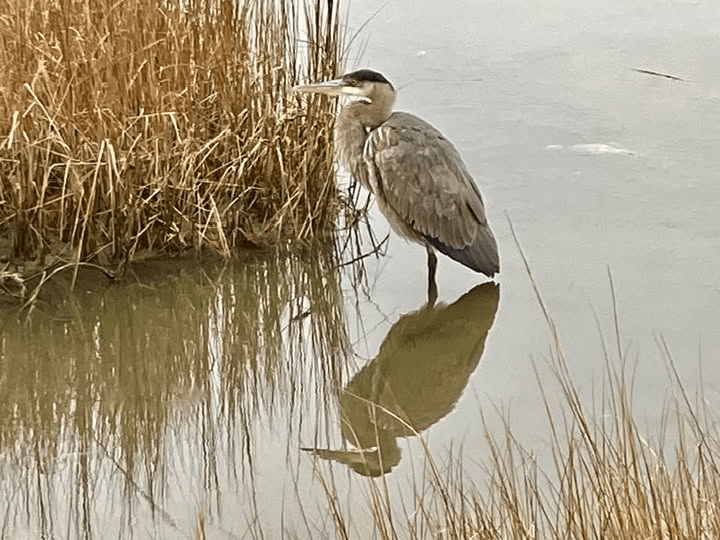
This morning a heron—the same one that seems to be there every day all day long—caught a fish in the icy pond at the bottom of the hill. My presence didn’t disturb her as she fished out small crabs and one six inch or so fish. She seriously did not appear to be stressed at all; not even when my phone rang. I left quietly so she could eat in peace.

It’s the morning of January 20, 2025, and here at Aerie along the Rappahannock River and Chesapeake Bay, it’s cold; temperatures won’t rise above 35 degrees Fahrenheit. It’s sunny, which somehow saves the day.

There’s a transfer of power taking place today, fyi.

Strength has two determinants: The ability to overpower if one so desires to do so, and the ability to refrain from such actions simply because one can. The first is the result of many factors including money, relationships, status, and position. The second is the result of character. It is a symptom of intelligence and humility. The vast majority of leaders in history shared the first, but only the truly “great” leaders embodied the latter.

True strength is the ability to overlook, to forgive, to accept without judgement, and to understand without pretense. Any other action is usually a characteristic of those who fear, those with low self-esteem. The need to overpower the weak and degrade the defenseless is the result of an absolute conviction no one but them can possibly lead, so they simply use what can best be described as “bulldozer leadership” by using the mechanisms at their disposal for their own sense of security, albeit a false one.

Strength is the ability to accept criticism and learn, the ability to recognize the truth despite its contradiction to one’s own belief system and accept that truth. A true leader delegates and discerns instead of dictating and determining.

The Reverend Dr. Martin Luther King, Jr. seemed to embody those characteristics. He recognized that the true power was when the people stood up—or in some literal cases, sat down—for what they knew was right, to destroy what was unjust and degrading. He knew such an ideology could mean his death from those without the strength or character to accept that truth. But he also knew that true leadership perhaps above all else means sacrifice for the greater good.

I am spending today at the river, watching the heron feed and the geese fly. The ice on the tide has gathered for more than thirty feet out and that hasn’t happened here in several years. At the Bay the current is strong enough to keep from freezing, but Buffleheads dive and rise continuously, oblivious to the goings-on just 100 miles to the northwest.

I wish things were the way they used to be, when leaders acknowledged, even if only publicly, another’s victories and strengths, when there was hope for inclusion and safety in truth. I really do.

Dr. King said, “A genuine leader is not a searcher of consensus but a molder of consensus.” Where is that leader?

I’m headed back to the heron to watch her eat fish. It’s going to be cold for a while, but I have hope things will change. King also said, “We must accept finite disappointment, but never lose infinite hope.”

These Days

I like to sit in my green writing chair my father gave me years ago and look past my books and paintings into the wilderness which surrounds my home. The first time I sat here at Aerie, it was winter, and the birds could not find food in the morning’s snow so a slow spread of seed across the porch rails brought nature as close as possible without opening the windows. House wrens, warblers, robins, cardinals, downy woodpeckers and others all winged in from the apple trees to the rail, grabbed some seeds or stood and ate them there. Next to the porch is a larger than me thorn bush covered in red leaves which the birds use for hiding. They popped in and out from the bush to the porch and back to grab more of the only food around. Eventually they all work their way back to the woods by dodging from tree to tree like soldiers moving forward on a night raid. The thorn bush first, of course, followed by a quick flight to the first holly. From there the apple trees, despite their dormant branches, are fine for resting because of the snowy limbs. The last leg is a short one to more holly at the edge of the woods. Once there they seem to pause, look back as if they are wondering if they had enough, or if they forgot anything, and then they disappear into the high branches of dense forest. Later they’ll return.

I have found two ways to experience nature. First by moving through her: Sunday drives, evening strolls, afternoon hikes, morning runs, and any average commute. We take in what we can, view the variety of colors in spring and the fall foliage. But I’ve driven the route to work enough times in two decades to really not see it at all anymore. Are the trees taller? I assume they must be, but a change cannot be noticed by one who watches it grow. I cross three bridges along the way and two of them have been rebuilt since I started. Still, my mind is elsewhere when nature simply rests there sixty-five miles an hour slower than me. We can’t always be aware of nature; I understand this. But I’m not fully sure I know what it is that distracts me to begin with. There are other means to move through nature: A few years ago my son and I trained across the vast empire of eastern Russia, across the Steppes and hills of Siberia, and to the pacific coast. Along the way we saw thousands of acres of birch forests and hundreds of small, curious shacks all painted royal blue. I could never drive across Siberia, so the train would have to do, but the journey left me with more questions than answers. Who works out there? Are the dilapidated gulags we passed empty or just in ruins? What kinds of wildlife did we pass, mostly at night, just beyond the trees away from the tracks? Surely a grizzly or two or a Siberian tiger stood and watched us roll along.

As if extremes exemplified my existence, the following summer we walked the medieval pilgrimage route from southern France to Santiago, Spain, on the Camino de Santiago. The Camino is five hundred miles long, and at just about three miles an hour or so means every Basque slug, meseta insect and Galacian fly could be personally experienced and known by name. We watched the colors of the sky change and stood still every few kilometers to take in the vistas, drink some coffee, and walk the rocky paths again. To drive that distance takes roughly eight hours. It took us five weeks. One sees more when moving slowly. It is simple physics. But in the end we are still moving through.

Which leads me to way number two to experience nature: Sit still.

I took pictures of birds outside my window, and then I put down the camera and watched. They tilt their heads when they eat, as if they can’t see the food unless their eyes face down. Most varieties get along well, but the chickadees are little bastards. They’ll chase away or dare anyone, squirrels included. Yellow warblers are neurotic and Cardinals look pissed off though I think they really just want to be left alone, like old writers.

It is strangely the same in winter. But I’ll never forget that first winter in this chair. I simply stared at the bare brown branches against the gray sky. Somehow the white snow on dark green holly leaves brought the yard to life. I have lived here for twenty-six years but it seems I never before sat and stared at trees, at birds’ wings just inches away, at the patches of green grass surrounded by a dusting of snow. Even walking across the yard would have chased away these observations as quickly as the birds would have scattered into their hiding spots. As if my Siberian questions needed the balance of answers, I looked about the yard and witnessed more in an hour than I had for three weeks on the rails. Usually it is in Spring that we pay attention to the trees, when bare branches give way to buds, which give way to new life. Or in the autumn when we calculate our driving times on Sunday afternoons for when the leaves will be at their “peak.”

I sat perfectly still, doused in the narration-free documentary playing out before me, and discovered something phenomenal: Trees are always at their peak.

They stand strong like church steeples. The thick brown branches reach up, shirts off, muscles taut, every bone exposed, wrestling, bent at the elbows, visible like some skeleton x-ray against a low, gray sky, or a deep dark blue sky, or a snowy dirty white sky, and these trees don’t balk, they don’t flinch. They dare every aspect of deep winter weather. The wind moves through unnoticed, and snow catches crevices and freezes further growth for months. What wonder it is to watch their stern and steady rise, proof of decades, sometimes centuries, dug in for winter, standing guard in forests and backyards, unable for a while to block the sun, bare enough for us to listen at night to the geese. Starlings settle on naked limbs, thousands of starlings like leaves land, rest awhile, then leave, the trees once again alone waiting out winter, as if to say they’ll let winter leave when they’re damn well ready.

I used to think time went by so fast. I remember my dad sitting on the porch in our backyard watching birds outside the screened-in porch. He was a relatively quiet man but loved to watch the birds. One time he and my mom watched a pair of cardinals teach their young one to fly. They watched it fail a few times until it finally took to the air, making it to the nearest branch, not far from the porch. I never had time for that when I lived there. I wonder if my parents, maybe like the cardinals themselves, were both thrilled to see me leave the nest but sad at how fast I found my wings. Now I sit in his chair watching a robin work through the seed on the rail, and I realize it isn’t time that moves too fast—it’s me.