Then and Now

Flipping baseball cards on a summer day. The boys in my neighborhood did  this when we were kids. Us girls ju… | Childhood toys, Childhood memories, Baseball  cards

A million years ago I flipped baseball cards with friends on the sidewalk outside our home in Massapequa Park. I’d sit on the cement in my dungarees and Wildcats little league t-shirt with a stack of Topps cards in my left hand, ready with one in my right hand between thumb and index finger, hoping to take the stack on the ground between us. The older cards were limp and ripped in places, but the new ones were stiff, still dusty from the hard stick of gum that came with them.

I’d turn over a rookie Tom Seaver or a Cleon Jones, not knowing then that I held several thousand dollars in my left hand, and since at some point the following year I had the entire 1969 New York Mets squad, at some point I held tens of thousands of dollars. I only knew I wanted to kick some baseball card-flipping butt before I had to head back inside for dinner. We were about to move further out on the Island, to a new house out near the Great South Bay, and who knew when I’d have another chance to do this.

Life was about flipping cards. Ask anyone who was nine back then—they’ll back me up on this.

Everything was easy. For me, anyway. On the other side of the planet the Vietnam War was in full swing, my uncle on his way over, a friend’s brother on the next street was not coming back. And just upstate, music fans would gather in a month at Max Yeager’s farm, while just fifty miles away in the city, the Mets were in last place for the last time, heading in a matter of months to a miraculous championship. Hippies walked down Main Street, the Beatles were together and going strong, Nixon was reelected, and Steve Bezos just turned five.

Just about the time I lost the Seaver card, somewhere above us Apollo Ten was orbiting the moon, doing surveillance for their successors, Apollo Eleven, a few months later. Funny, now it occurs to me that up until that point I lived in a world where we still had never walked on the moon. I wonder what we compared tasks to before we could say, “We can land a man on the moon, but we can’t…”

In any case, I followed the Apollo mission, didn’t care about Tricky Dick, preferred the Birds to the Beatles , and baseball was the universe. I was eight, for God’s sake. My voice hadn’t yet changed.

Yeah, seriously; a million years ago.

That was back when my friends had no last names. They were simply Charlie and David and Chris and Tommy, and Kathleen, the Little Read Haired Girl Kathleen. We had a pool and block parties and barbeques, and sometimes there were blackouts and everyone came out into the twilight evening, my friends and I chasing each other, the adults standing around in the cooling summer air, talking about how, “Over in Amityville they still have lights, and a few houses on Euclid, but they’re out down on Park Lane, and all the way down East Lake.”

Lights. No Lights. Whatever. I was eight.

My cousins lived too far away to ever think about visiting on a whim—a good thirty or forty miles, and the ice cream man would come, and the television was a big black and white console on which my sister would watch Gunsmoke and Bonanza and my brother would watch Star Trek and the Olympics from Mexico City and I’d watch cartoons or Andy Griffith. And I’d watch baseball when it wasn’t blacked out to local viewers because the game over in Shea Stadium hadn’t sold out.

And at night after the Late Shows ended, if I was still awake in bed and one of my parents had fallen asleep on the couch, I could hear a man’s voice declare, “That is the end of our broadcast day,” and the screen would get fuzzy with a low buzzing noise all night. Didn’t matter which of the five available channels was on, they went off the air.

The friends I have now were from all over the place back then. Rick was probably about to leave high school and hitchhike across the country, Tim was playing high school football in Philadelphia; the other Tim was a lieutenant humping his way through the marshes of Vietnam, and Sean was learning from his father upstate the value of giving, of volunteering. And when I think of my friends back then, well, who knows where they are now? I think about them when I pass through Kennedy Airport or the rare times I’m on the Island and stop in a store, wondering if I just walked by or stood in line behind someone that at one time a million years ago was my absolute best friend; the one I’d know forever. It was so easy then. When you’re eight you’re simply always going to be eight—no discussion. Your parents will always be there, your siblings will always wake up early with you on Christmas morning to exchange gifts before you head down to the living room to see what is under the tree, and baseball card-flipping is more important than school.

Sometimes I have to try hard to make myself realize that that eight-year-old was me. That it wasn’t some kid I saw in a movie or read about, or a child someone told me about. That was me, legs crossed on the cracked cement sidewalk on East Lake Avenue, the same me that sits now near the river and listens to the approaching flock of geese, watches the descending sun, feels the faint brush of something familiar, like a song I once knew or a memory of someone that was kind to me. The same me that barreled across Siberia with my own son, who is now more than twenty years older than I was back then.

I’m at the other end of this game now. It’s late, and I’m tired. I have some writing to finish for readings next week, and a few deadlines looming, and I walked out on the porch and listened to the cold night, the clear, star-filled night, mid-winter night that is colder than it should be here on the bay. A friend of mine believes in reincarnation, believes we come back as, well, some other living form, whether another human like the Dalai Lama does, or as an orangutan, but as something. I’d be okay with reincarnation, but I want to come back as me. I want to do this again, make those mistakes again, fall in love again, have my heart broken by the same girl again, play golf with my father and brother, receive care packages from my sister when I was at school, move into those dorms again, play tennis again. Hurt and give and cry again.

If we agree eighty years is about a life, anything more than that is a bonus—overtime, if you will, then I’m now entering the fourth quarter. Games have been won or lost in the fourth quarter. Some of the greatest plays in history were made in this part of the game.

Back in 1969, the Mets turned a losing season into a winning streak now universally called miraculous more than halfway through the season. But as Mets catcher Jerry Grote pointed out, “It’s not a miracle, it is persistence, it is determination, it is faith in yourself and each other.”

It’s not over yet. And it just might be that the best resource I have so I can face whatever comes next on this pilgrimage is that eight year old boy somewhere inside who could flip baseball cards with the best of them.

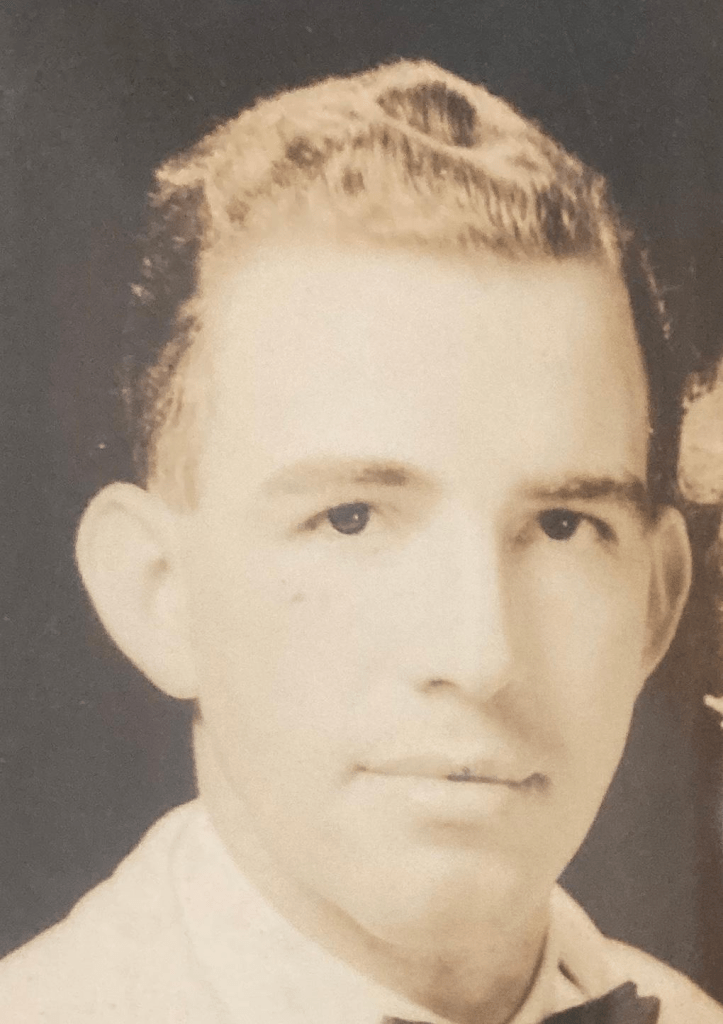
Ya Gotta Believe. By Jay Horwitz | by New York Mets | Mets Insider Blog

Cycle

for Dad, born May 23, 1925

Frederick W. Kunzinger on August 23, 1952

originally published in Kestrel: A Journal of Literature and Arts

On May 23rd, Dad would have been 97 years old.

I.  Little League

          My dad coached my team, the Wildcats, and hit us grounders during warm up before each game. When we’d practice our batting Dad pitched to each of us. He never treated me any differently than the others on my team, though they weren’t friends of mine, and even though I couldn’t hit the side of a barn. I was nine and we all played hard. It was 1969 and the Mets went from last to first. Like me, their ninth season of existence, and like me, little was expected of them.       But they started winning. I cut out a coupon from a carton of milk for free tickets and we went to Shea to watch them win. Dad helped us move through the parking lot and up the colossal cement stadium steps with ease in time to see them move from three runs down to one run up. Some player hit the “cycle” Dad said; he had hit a single, a double, a triple and a homer. I looked toward first base and a man behind that dugout held a sign that said “You Gotta Believe.” He had other signs, too. One said “Let’s Go Mets!” and everyone chanted “LET’S GO METS!”  The infield was the cleanest dirt I’d ever seen and the outfield a shade of green television couldn’t convey. The stands were abuzz with talking and cheering and old men drank beer and their sons ate peanuts or hot dogs and the summer suddenly seemed alive.       I wanted to breathe baseball.

          The next day the Wildcats played some rival Long Island team and I told Dad I wanted to drive in some runs. “Here’s the deal,” he said. “You hit a home run and I’ll buy you ice cream every day for a week.” Everyone on the team laughed. It was laughable.

          On my second at bat, though, I felt stronger than Cleon Jones and took a high pitch and sent it over the first baseman’s head into right. I was around second when it rolled to the chain-link fence. I couldn’t hit but I could run fast. By the time someone threw the ball to the cut-off man, I was across home staring at seven straight days of ice cream. Dad was quiet back then, never a man of words; but I could see how proud he was that day.

          For years that story stayed in the family, everyone making fun of my appetite for desserts. “Put ice cream in the deal and the boy can produce,” they’d joke.

          But I kept thinking of that sign behind first, the man who stood up the whole game holding up different placards. The one that blinded me was “You Gotta Believe!” which he held up after the homer that gave the Mets the win. I saw that sign all the way home that day, and all the way home the next.

          When the Mets won the World Series three months later, he held up one last sign: “There Are No Words!”

          Growing up doesn’t come with instructions. I’d look at Dad and see the man with the sign. It’s a lot of faith, a lot of support. He was a great coach. He knew I couldn’t hit worth a damn; but he didn’t stop me from playing ball.

II.  Sons

          Big Al came in the Harris House Pub by eleven thirty every morning for a few Buds and a pack of cigarettes. He couldn’t see well and moved slowly. He’d sit at the bar and talk about his son and how he doesn’t call anymore, and how he hasn’t seen him since he was young, who told him once: “I’m not spending my days dogging it for my blind dad.” Al gazed with difficulty across thick glasses and walked the snowy streets with his hand touching the wall. He’d stop every block and rest, but eventually he’d swing open the old door to the pub and sit on his stool. He’d order his Bud and begin the questioning.

          “Who played in the first world series and who won?”           I’d laugh and make a few drinks for other customers then wander into the back. I’d return with ice for the bin and say,

“Pittsburgh versus Boston, 1903 and Boston won …um…five to three!”

          “Excellent, Bob, here’s another quarter,” he’d say and laugh, telling his friend Kenny at the next stool how I was a walking encyclopedia of baseball facts. “Who struck out the most batters in his career?”  I’d return from the kitchen with hot food for another customer.

“Too easy, Al, I grew up watching him when he was with the Mets!

Nolan Ryan!” Two bits more hit the bar.

          A co-worker figured I had a baseball book in the back but I didn’t.

 An hour later: “When was the first professional baseball league formed?”

          I’d roll out a keg and while tapping it tell him, slowly as if in a state of recollection, “18…7…1.”

          Kenny followed me to the kitchen door after one of Al’s questions and heard me on the phone: “Hey, highest batting average.

Cobb? What was it? Got it, talk to you soon.” I turned and he laughed.

“Some sports hotline?” he asked. “Dad,” I told him.

          “Cobb. 367,” I said, placing another beer on the counter without charging him. Al never lost a dime.

           Back when payphones were standard my father had an 800 number at his desk, and wherever I traveled in the United States I could call him for free. I’d tell him where I was and how life was, and he’d tell me what was new with him and my mom. A certain peace permeated the air back then. A sense of silence drifted through the desert and plains and mountains as I moved through, the comfort of calling always in my mind. If I felt lost I knew Dad would answer and we’d talk about nothing, but it meant everything.

          Dad’s hearing is weak now, and he rarely talks on the phone. He watches the games with subtitles on, but they don’t always keep up with the announcers’ rapid-paced reporting. It’s harder to see the score box on the television and sometimes keeping track of what’s going on can be frustrating. When that happens he tells me about his boyhood in Brooklyn, the Branch Richie days of the Dodgers, and going to Ebbetts Field with his friends or his father. He still knows the players’ names, the records, and where they went after the Dodgers went to California. I tell him the time so he can watch the weather, and we talk about the Mets. We’ll complain about a weak bullpen or celebrate their clutch hitters, and we enjoy that the season passes slowly, but baseball has nothing to do with it.

III.  Instructions for Walking with an Old Man at the Mall

          First of all, he’s walking, you’re joining him. Don’t stop if he doesn’t. Don’t keep walking if he doesn’t. You are a shadow, an imitation.

          Stand on his side where he can better hear you. If he can’t, repeat yourself as if for the first time, no matter how many times. Never say “never mind.” When he tells you something, you have never heard that story before, even if you can repeat it word for word. When he tells you about the baseball games with his dad seventy years earlier, they are new stories, and your response must sound genuine. When he tells you about the time he went swimming at camp with his friends, and how when they went to retrieve their clothes from under a boat they found a snake, be amazed again, ask what happened. Laugh again since he will laugh.

          When he pauses in front of a store, don’t question it. At that moment, allow his sole purpose in pausing is to look at whatever item is in that display. He might mention how he used to own that tool, those pants. Let him know you remember; do not make a big deal that he remembered. He needs you to know he didn’t stop “to rest”—he stopped to look at the display. When he says he could use that new suit, a new pair of shoes, or a new whatever is new, agree. If he happens to stop in front of Frederick’s of Hollywood, there’s no need to joke; it will only emphasize he couldn’t get past a place he would never stop with his son. This time he simply couldn’t continue. Talk instead about his grandkids. Talk about the rain. Do not talk about old times. There’s no need to recall the time he drove you to the airport for a flight to college and you saw him hours later waving to you onboard the plane. Avoid bringing up the time just the two of you spent the day at Shea Stadium when you were a child. Instead, ask about the Mets and if he happened to catch the game last week. You know he did. Let him tell you about it.

          When he seems tired but doesn’t want you to keep stopping, stop to fix your shoe, to read a sign; look for a bench and suggest you sit and talk. He’ll ask about your son; he’ll ask about work. Have something to say other than “fine, Dad.”

          Do not look at your watch. Do not check your phone; most definitely do not check your phone. Leave both in the car. Do not indicate in any way he is keeping you from anything. No other time is relevant anymore. But you will grow tired and restless. If he senses this, he will insist you leave. He will say he knows you have a lot going on, and he’ll say he’ll see you later, and he’ll do whatever he can to make you feel he is completely fine with it. Stay anyway. Then sit a bit longer. Do not ask about the doctors; the walk is to forget about the doctors. Do not quiz him on medicine or schedules. He is out for a walk, you joined him, it is something about which he will tell others— that he went for a walk at the mall and his son was there and joined him. Do not let his story end with “but he had to go.”

          When he can’t remember where he parked his car, ask if he parked in the usual area. He did. Sit down for a few minutes. It will come to him. There’s no need to ask probing questions like “which stores” or “what street” he was near. Just sit a while. He’ll remember. You’re not in a rush.

          When you leave the mall be near him as he steps from the curb, but do not help. He will be fragile and unstable. The step from curb to parking lot is a leap; he used to do it with you on his shoulders and two others running out front. Let him step down on his own but be ready. He bruises easily and a simple scrape is a trip to the doctor. Have the patience he had when your childhood curbs seemed like the cliffs of Dover.

          Don’t say, “I guess I’d better get going.” Don’t make plans. Don’t make any comment to indicate he did well or that it was a “good walk.” He didn’t do well and it wasn’t a good walk. He’s older now. He’s slower now, but he knows this. Really, once the walk is done, the time spent together always seems to have passed faster than we recall.

          The seasons, too, pass faster. He knows this as well.

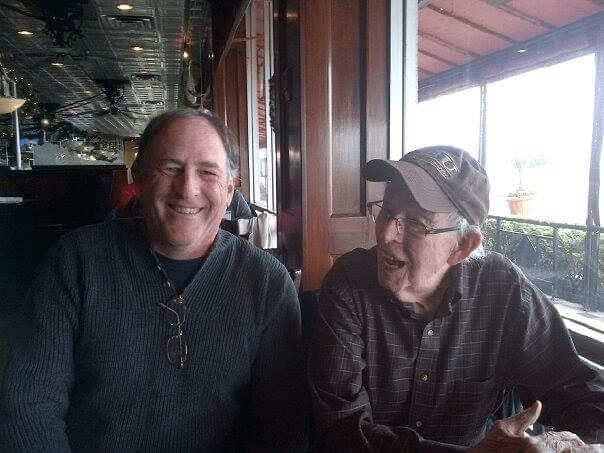
at Mahi Mah’s, Virginia Beach c.2014
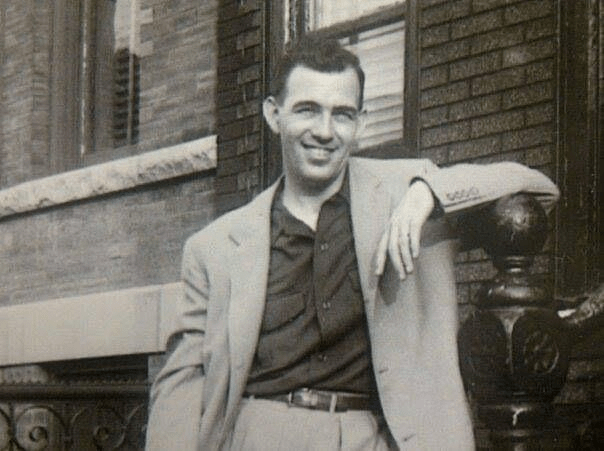
Marion Street, Bushwick, Brooklyn, NY 1952