The Shed

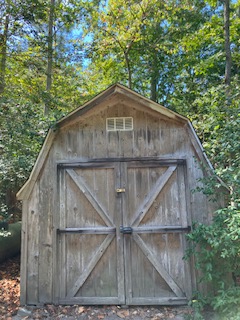
The Shed was twenty-feet deep by eight feet wide, with two windows, two lofts, double doors, and sturdy enough to withstand everything except Hurricane Isabel.

Of course, I bought the shed to hold supplies when I was building the house. Before I started, when I had first cleared the small portion of the property for the home, I had this shed delivered figuring I might need to sleep in during bad weather while up here for three of four days in a row seventy-five miles from the place in Virginia Beach. Michael and I went together to the shed place in Virginia Beach. Some guy paid for it but never picked it up so I bought it brand new for a song and the father and son team I bought it from delivered it seventy-five miles, across the Hampton Roads Bridge Tunnel, across the still-narrow Coleman Bridge, the Piankatank bridge, and down my winding driveway through the woods—for twenty-five dollars. I also bought them lunch.

It didn’t take long, as it tends not to take, to have stories to tell from the shed.

Back in ’99 we had fifteen inches of rain in two days and the water ran from the river side of the property down to the woods beyond the shed. I had the shed leveled off the ground by about eight inches on blocks, so the water rushed toward the door but instead dug crevices under the shed. The shed, miraculously was dry, but impossible to get to.

Isabel didn’t do a thing to the shed, but she knocked down thirty oak trees here at Aerie, and one of them lingered for weeks right above the shed. I knew it had to come down but this was a job I couldn’t pull off myself. Scavengers wanted more than fifteen thousand dollars to clear the fallen trees, so I said I’d do them myself, which I did, but I was afraid to cut the half-fallen tree in fear it would crush the shed. Instead, another storm just a few months later cracked the trunk and it crushed the back half of the shed for me. I remembering thinking, “Hell, I could have done that.”

So in the lemonade tradition, I made the back half into a greenhouse with plastic sheets for the roof, but it didn’t really work, and over time the mold and mildew and various snakes and wood rot got the best of The Shed. It took about twenty-seven years.

One time early when Michael was about five, we played hide and seek as we often did, and I ran in the shed while he was still too far away to follow me right in, but he could see me. I then climbed out the back window and settled behind the back wall. I heard him come in the shed and was quiet for a minute then said, to no one in particular, “Holy Cow, How did he do that? Daddy?”

I remember how we laughed.

We built things with wood and made signs and birdhouses. None of them were well done but they were all perfect. Occasionally we’d take a break and play “Voices.” That is, we’d recreate “Wind in the Willows,” and I was the voice of most of the characters—Badger, Toad, Moley, even the stoats.

And we kept the sporting equipment in there and played frisbee, football, golf, and ring toss, which we still do nearly thirty years later when outside barbequing.

The bikes he kept in the shed got bigger, and the toys were relegated to the loft while more accessible spaces were reserved for tools, chemistry sets, then inflatable kayaks and eventually equipment to hold his art supplies and frames.

When he was little, he would tie me up in a chair with a lasso his uncle sent him from Texas, and he kept lizards and frogs in tanks until he couldn’t feed them anymore and would let them go behind the shed, in the woods.

He kept buckets of fake snakes and lizards in there when he was young, and when the roof collapsed and water raged in, it carried the rubber reptiles out the door and under the shed. The next day I spent an hour reaching under the shed and pulling out the toys, until one reach pulled out amongst the fake snakes a real one with red and yellow and black, and I forgot the rhyme about poisonous snakes so I just threw everything as far as I could.

There were other days like that.

But there’s a hole out there tonight. And Michael is in Ireland, far from the fallen shed. It had to come down. I had to do it now or we’d be still out in the still standing shed telling stories.

I destroyed the last of it a few hours ago, and I rested on the nearby patio remembering the times we shared for his entire life, and the talks we had—so many talks we had safe in the shed, just the two of us, about growing up and traveling and things that frustrated us, and things we were scared of. Out in the country like this along the bay when a father and son go into the shed, usually it is for some form of punishment, “a whooping” as they say. Well I never had a reason to punish Michael; but we did have plans to make, so out to the shed we’d go, and he’d make notes on wood with a nail, and we’d plan adventures like training across Siberia or walking across Spain.

We kept tools in that shed, and mowers, bikes, grills, and more. And memories filled the spaces between everything else. We let a lot of memories occupy that space.

Funny though. I sat out there today when I had finished knocking it down and thought about the next week or so during which I will haul away the remnants, clean up the ground, lay down some field stones and mulch in front of a much smaller, new shed, put a few chairs and a small table there, and I tried to imagine the new way it will be, and it made me a bit sad, of course, but excited for a new place to talk. But lingering a bit in the hot afternoon air was the sound of ten-year-old Michael playing his harmonica and the distant hint of his unchanged voice asking if I want to play hide and seek.

There are some things that shed kept safe for us I’ll never be able to destroy.    

Now:

Next:

Talk about Opening Doors

My Yellow House in New England

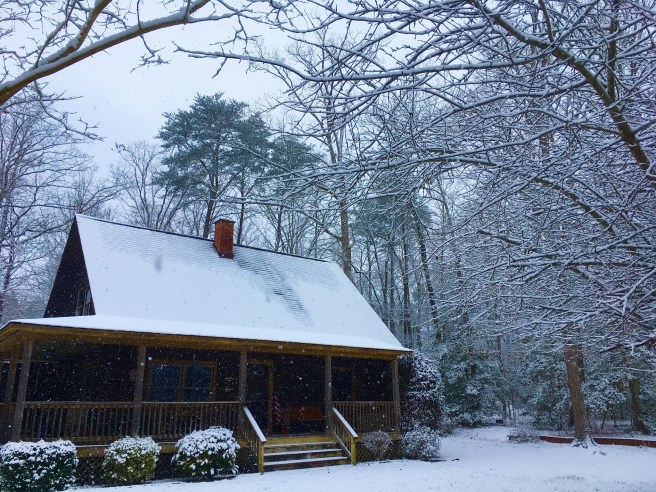
I found an old silver key while cleaning my closet floor.  For years it might have been there shoved in the corner under the lip of a log, fallen perhaps from pants pockets or my winter coat.  I don’t recall losing a key or changing a doorknob.  Perhaps it opens some old lock on the old all-glass door on the side porch. At the start back then strangers would meander down the winding driveway through the woods to the house and cup their hands against the reflections on the door windows to look around. I replaced that door with a solid one and put a no-trespassing sign up front.  

Older, I think; the place in Wellsville, Pennsylvania, where I came home one July morning to find plants and flowers in the entrance and at the top of the stairs for my birthday. It was the first place I lived where I gave someone else a key. Or it might be from my first house in New England, where the door stuck in winter when the frame froze.  I’d spend hours shoveling my steps and those of the old woman across the street who delivered mail.  She’d bring apple pie for my efforts or leave one for me with Sam at the Deacon’s Bench antique store.

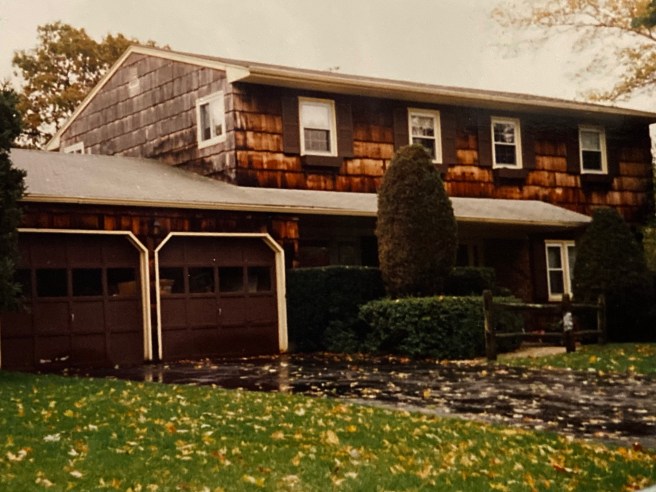
But that key was gold.  Now I think this one some souvenir from my childhood home on Church Road, the two-story colonial where I owned my own first house key though I never needed it since after playing ball or riding bikes all day along the Great South Bay, I’d run in the back door full stride and laugh the way childhood makes you laugh for no reason at all.

I can’t recall now what this silver key might be for, though I’ll keep it, resist the urge to throw it away as evidence shows I clearly resisted before.  After all, it still opens doors to places I never thought I’d return.

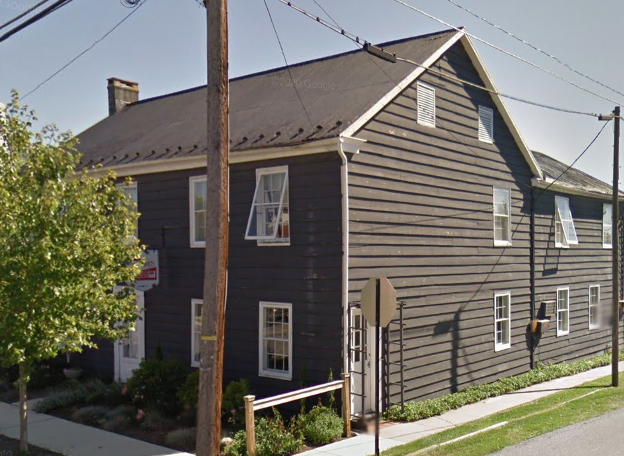
My childhood home on the Island
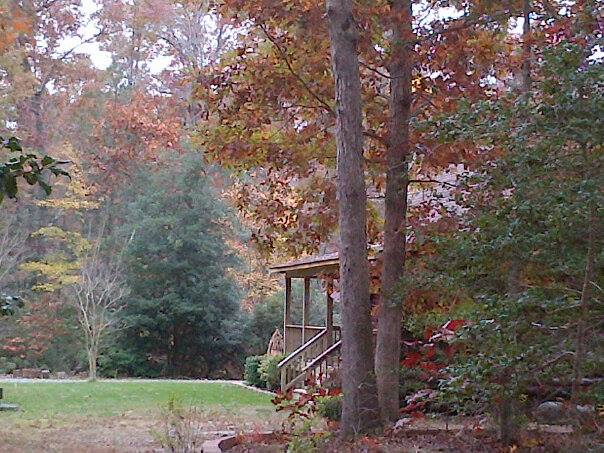
Aerie
The Wellsville House

Aerie: noun: 1. A Hawk or Eagle’s Nest. 2. Bob’s Home.

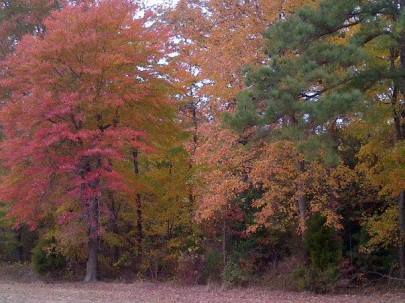
It’s colder today, and a strong wind blows out of the northeast, off the water, and the last of the leaves are letting go. It’s desperately Autumn here along the Bay. Yesterday the colors were brilliant, at their “peak,” and today they are muted. Tomorrow the leaves will mostly have fallen. I walked the paths just now here at Aerie, and the skin on my face feels tighter, the back of my neck is cold.

The sound of dry leaves and the wind is immediate. The clouds are low and dark—steel blue—layered deep clear past the horizon, as if they’re keeping out the rest of the world. They threaten, of course, but somehow they protect as well. It only took a few turns around the property and a meander past the duck pond and river to let go of the world for a while. Genocide cannot find me here; bombings will not find me here. Invasions and deficits and brashness and ridicule cannot locate me when I’m here at Aerie, and the sky is low like this, and the only sounds are the leaves in the wind and the water pushing back on the rocks, and the geese over the recently harvested fields.  

I left home far more than I should have. It was always interesting and exciting to come home after a month somewhere else and see how so much had changed; leaves either completely fallen or fully alive. I am glad for the places I’ve been and the people I’ve grown close to in my travels. But in retrospect it seems I was mostly out there looking for something allusive, some semblance of peace, perhaps. And today walking up the hill from the river I realized it might be the kind of peace I find here at Aerie. I almost find it here in Spring, working in the garden, osprey calling above while teaching their young to fly; and in Summer when we scull out on the Rappahannock, up the inlets to the west, stopping for oysters at a small grill near the bridge. In Winter, when deer and fox come closer to the house looking for food, finding apples, and I can sit on the steps for hours teasing one fox closer, and then closer still, and she eats a few slices before taking a large core in her mouth to bring back to her den to share with her young.

But it is Fall, of course, when I come closest, and the smell of leaves is deep, and white oak burns in the fireplace, and we heat up apple cider and I can sit on the patio at night for hours, bundled against November, working on something in my mind, remembering the reach from some other time.

Last week I walked to the river and a bald eagle stood in the field to the east where corn had been just a few weeks ago. It never fails that every time the eagles return this time of year, I remember a song by one of the primary influences in my life for my love of nature–John Denver. He wrote, “I know he’d be a poorer man if he never saw and eagle fly.” I always knew it to be true; I just never dreamed it would happen from my front porch. I have hiked in the Rockies, and I’d hike there every day if I could. And I’ve walked across the Pyrenees, through the Berkshires, along the Camino de Santiago where I must return to truly unearth that peace. Yet here where the Rappahannock meets the Chesapeake is where all my songlines converge.

It’s colder today, and grey. The paths are covered in leaves, as they should be this time of year, and my son is baking biscuits and heating up apple cider downstairs. I have some serious metaphorical hills still to climb, but today, outside, I can hear squirrels arguing, and the driveway is covered in acorns. A close friend of mine pointed out recently that to him Autumn is hope, it is life tucked away for awhile giving us a chance to start over in a few months. He’s right, of course, but I wish I could slow the whole thing down. I don’t want things to change so fast anymore. I like the sound of the leaves as I walk the paths, the colors as I lay in my hammock and watch them fall. I find peace in the carpet of stars at night, out early enough in these winter months for me to spend hours looking up, wondering. My anxiety settles down when I sit on the patio at night and hear rustling in the woods as the fox comes to call. I have lost so much faith in humanity it is difficult to write about. I need a breath; I need to be restored. It seems that despite our potential to banish the evil in the world, we continue to falter. But here at Aerie on the eastern edge of Virginia’s Middle Peninsula, something eternal is happening even as life let’s go and settles softy around me, marking time like decades.

Simplicity is Gained

Aerie

Time to return to the wilderness.

I sat on the front porch tonight for a bit. Birds had been chirping for quite some time; cardinals, house wrens, and a couple of cooing doves somewhere in the woods to the southwest. When I was on the patio I sat and cupped my hands and blew through my thumbs to make a similar sound, though I doubt I fooled them. The thing is—they went quiet for awhile and then only replied when I made the noise again. I like to think I was telling them something or warning them, though they probably sat on a branch somewhere talking to each other about my opposing thumbs.

Those thoughts were fleeting—no worries. What stayed with me, however, looking out across the front yard into the woods, looking down the darkening path to the east and where it bends back toward the distant driveway, was thoughts about other paths in other places. The trails of eastern Virginia I’ve hiked with my son, the paths at Mt Irenaeus in western New York, the steeper, thin-air paths of Utah that wind straight up to the wind caves. I’ve walked paths I’ll remember forever and a few I wish I could forget, both in reality and metaphorically.

But the true path that always comes to mind, which set the standard and raised the bar, is the Camino de Santiago in Spain. It terrifies me that a pilgrimage across Spain that I can recall like I did it last month out west actually happened ten years ago next summer. It is with me still, but, unfortunately, many of the lessons I thought I learned there have slipped away. I came back convinced I had it right—I’d simplify, I’d organize and stay focused and follow through, but, as Jim Croce aptly reminds me, “So many times I thought I was changing then slipped into patterns of what happened before.”

Yeah. Damnit.

It’ll remain warm here for quite some time, but today there was a breeze off the bay that felt somehow foretelling of autumn. It wasn’t “cool” by any means, but certainly pleasant, welcome. As someone pointed out to me last week: “Summer isn’t through with you yet.” That’s fine; often come mid-September I want to “reach out and hold it back,” as Jay Gatsby desired. Almost all the time, I am like that.

Not this time. No. I’ve almost got my ducks in a row, and I’m casting aside as much as I can of old habits and tired routines. We are always looking for “kicking off” dates to start anew, to really “gather up our forces and get out of yesterday.” There are plenty to choose from: New Year’s and birthdays are probably the most common. But as a professor I have the added commencement of late August, early September, when classes start. This is the time of year everything is brand new, and my attitude is new, my hopes and ambitions, just like students I’ll face each week, just like it was for me forty-something years ago this week. It happens every year, but this time it is a bit different. I’ve worked very hard at separating myself from the umbilical cords of failed approaches and misguided directions. So this time is something closer to my return from Spain, when I knew, I mean I had the absolute conviction, that my destiny was my own. I thought that powerful knowledge would last, but it slipped through my mistakes and shortcomings.

This time, however, it won’t for one very essential reason: I’m older now, and I’ve reached the age where I know I’m running out of do-overs. And I sat on the porch thinking about Spain, about the summer of meandering, both physically and psychologically, and how I was focused on each moment, and I followed through with plans every day while there. I didn’t think in big ideas and sweeping hopes. I thought in small pleasures and that idea of simplicity.

I need to do that again, and for the first time nearly since returning from Spain, most certainly within a few years of returning, I find myself in a position to be able to do just that, and mean it this time when I say, “I’m through wasting what’s left of me.”

I’m at my desk now, an hour ago having left the circling hawk and the frightened doves to do what nature does. It is later and the sun is gone—it sets so much earlier now than just a few weeks ago. Someone across the river is shooting off fireworks. I never thought of Labor Day as a celebration to set off fireworks, but, well, maybe I shouldn’t ignore the symbolism of such New Year’s overtones.

It took ten years for the Camino to truly make sense to me. I’m a slow learner.

You know what? Maybe I’ll just go back to Spain.

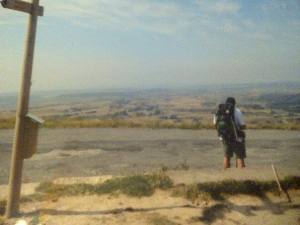
Spain