This Year (Can’t End Fast Enough)

What a year. Just, well damn, just, what a year.

For the first time in fifty years—1974—I have no reason to go to Virginia Beach other than a Bloody Mary at the Beach Pub or breakfast at Ocean Eddies, and of course to visit my father’s resting place. 1974 was the year my parents purchased a house on the Lynnhaven River, and this year my mother left the Beach for Williamsburg. It’s odd, really, not needing to go to a place I needed to go for five decades. And while I’m the sort that never needs a reason to go somewhere, I’m painfully aware that Virginia Beach has permanently aligned itself with other towns of my past, such as Massapequa Park and Great River. Oakdale and Wellsville.

Forty-five years ago this past September I met two people that would change and influence me for years—Fr. Dan Riley, who would visit me every night late in the infirmary for a few weeks while I had the Russian flu, during which time we bonded and came up with the idea of a radio show—Inscape. And Dave Szymanski, who joined me many mornings every week in the campus radio station as we tried to figure our way through the gives and takes of that freshman year—him pulling news off the wire, me spinning albums, both of us talking, sharing, hoping. Both of them died this year, exactly forty-five years later, and I meet them sometimes in my mind when I need some advice or companionship.

Forty years ago I walked into a hotel room in Worcester, Massachusetts, thinking I was trying out for a part time job as an exercise instructor at some local health club, and walked out that day a member of the management staff of that club, working for Richard Simmons. It was a wild ride for a while, and the fall of ’84 found me moving into a beautiful yellow house near a reservoir, making a ton of money from America’s Favorite Exercise Guru, and having a blast while getting in shape. This year, forty years later, Richard died, reminding us all it doesn’t matter how full of life we are, how much joy we bring others, eventually we too pass all too quickly.

Thirty-five years ago this past summer my car broke down in the parking lot of Tidewater Community College. This was pre-cell phone of course, so I wandered into an office to use a phone to call AAA. While on hold, the dean—Bill DeWeese—said to his assistant—Eleanor Shannon—that he needed someone to teach Humanities on Wednesdays. I hung up and got the job. One week later I stood outside the door of my first class waiting for students and talking to a woman in an office across the hall. She had a heavy French accent and in those first five minutes we laughed more than I had the previous five months. Letty welcomed me to the college, and the next day we went for coffee. Eleanor passed away some years ago, Bill last year, and Letty this past July, nearly thirty-five years to the day after we met.

Thirty years ago this year I made my first of two and a half dozen trips to St. Petersburg Russia. Prior to that initial journey with my colleague and friend Joe Antinarella for a grant with the Commonwealth, it was much more difficult to travel there. But through the years I watched the city move from vacant streets without advertising or western influence, to restaurants and concerts, European clothing lines and shoe stores, American coffeeshops and fast-food joints, and we wandered freely throughout the backstreets of the Window to the West, knowing Peter the Great’s idea of a “New Amsterdam” had finally been fulfilled. And now, thirty years after that first month-long stay, the streets are again vacant of advertising and western influence, and I cannot go back, nor do I plan to go back.

Twenty-five years ago I made my first of many trips to Prague. It was a month-long stay as I taught at Charles University, was befriended by the great Czech writer, Arnost Lustig, and read all the works of one of the more influential writers in my life, Bohumil Hrabal. I also discovered Pilsner and Terezine, the Hunger Wall and 19 Nerudova Tea Room where I wrote an entire manuscript at night over apple strudel and Irish Crème tea in just over three weeks, and some years later published it as Penance. Since then I’ve come to know Prague as well as I know any city, though much there has changed. It seems change tends to happen.

We like round numbers, don’t we? We like even years, silver and golden anniversaries. More people showed up for the fiftieth anniversary of Victory Day in St Petersburg than the forty-ninth. More people observed a moment of silence on September 11th, 2021, than the same day a year earlier or a year later. We count in decades, we measure in leap years. You can buy birthday cards for someone’s 45th or 50th or 60th, but not their 64th, as if there is less reason to celebrate a life until they finish some imaginary five-year plan.

Still, on this fiftieth anniversary, I understand that I have no real reason to return to the Beach anyway, other than see my Dad’s headstone and tell him about the Mets. I remember the city like it was last week, and what a time it was, managing the hotel those summers during college, attending gigs with my oldest friend, musician Jonmark Stone, and lounging on the beach or at Ocean Eddies back when the drinking age was eighteen. I’m not nostalgic—we had our day in the sun; a lot of them, and I’m lucky enough to carry those memories with me. When I talk to Jonmark on the phone we don’t reminisce, we talk about when we can make our next tee time or when I might get out to Indiana. No, looking back is fine, really, as there’s always going to be something there for me, but it’s not nearly as productive as looking ahead. Fr Dan and Letty would agree; Dave maybe not so much but I didn’t love him less because of his instinct to recall our Glory Days at the radio station.

Many of my habits ended this year, some for the better and some absolutely for the worse, but they ended just the same—they aren’t sitting just behind me in some fog. They’re done. No more weekly phone calls or thrice a week walks. No more late-night Bailey’s on Ice at a mountain on New York’s Southern Tier. That’s why I knew as fall slipped away that this New Year’s is going to be an important one; this is not going to be the same old lang syne.

This year I’m traveling again. First stop, the Netherlands. This year two books are slated for release, one about teaching college, Office Hours, and one I started more than forty years ago and which I finally completed, Curious Men, which tied me to the past for four decades, and which ironically enough is about a time in my life I learned to jump first and invent the parachute on the way down. Perhaps I was simply in denial back then, or a little too angry. For certain I was depressed. But if I understand psychology correctly, this is the acceptance part. And just in time, too. It’s nearly New Year’s.

I understand most people live between the two, comfortable in the daily life of here and now, glad for the past, at the same time they have prepared for their future. Their New Year’s Resolutions are practical and fulfilling, and while some are broken, a birthday is an inevitable chance for a reboot.

So this year, borrowing from Fitzgerald’s Jay Gatsby, I have but one resolve. This year, after the loss of three people I spoke to nearly daily, the completion of a manuscript that on a daily basis brought me back to when I was nineteen-years-old, and a nearly complete amputation of a city that shaped my very existence, as my one resolution for 2025 I’ve decided to simply get out of my own way. In the words of John Denver, who has been there for me from the start,

It’s time to make mistakes again

It’s time to change the show

It’s time and time and time again to find another way

It’s time to gather forces and get out of yesterday.

Happy New Year everyone. Thank you for another year of reading my small entries here.

Acceptance: Part Five of Five

This is Part Five of a Five Part Series here at A View.

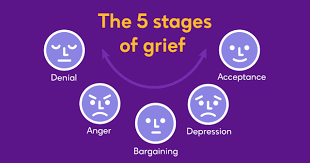
The five stages of grief as outlined in Elizabeth Kubler-Ross’ On Death and Dying are Denial, Anger, Bargaining, Depression, and Acceptance.

To wit:

  • Denial: A natural reaction to loss, denial can help people slow down the grieving process and avoid feeling overwhelmed. It can also be a way to try to understand what’s happening.
  • Anger: A common reaction to the frustration of no longer being able to live in denial, anger can feel like an emotional outlet as people adjust to a new reality. It can also provide temporary structure and a connection to the person who died.
  • Bargaining: People may try to change the circumstances that are causing their grief, such as hoping that things will improve if they take certain actions.
  • Depression: A stage of grief
  • Acceptance: A stage of grief where people find control and figure out how to proceed 

PART FIVE:

Acceptance:

The truth is I accepted some deaths nearly immediately. Letty is the best example. We saw it coming eighteen months out and we talked about it often, particularly her take on the post-life expectations. She told me to look for the birds feeding on the porch and she’d be among them. She told me she’s just going to close the door behind her. So by the time July rolled around and she slipped away, acceptance of that new reality was already on the table.

Dave was more difficult having not told a soul about his impending death due to cancer. Richard was a shock but his self-isolation from society for several years prior to falling and dying made his death closer to acceptance than any sort of anger or denial.

They’re all different, and Ms. Ross is clear that the stages weave in and out of our consciousness, rising then receding, and just when acceptance seems at hand, depression might pop back on the scene.

The thing is acceptance is about knowing someone you love is gone and finally learning to accept that your new reality is one without them and learning to live that way. The less involved someone has been in your life, the easier acceptance becomes. Dave and Letty and Fr Dan and Dad maintained an absolute presence in my life, so accepting their absence, particularly since with the exception of my father, the rest all checked out at nearly the same time, has been more difficult. Accepting is a sense of no longer being lost when a particular time of the day might have been occupied by conversation or even texting, a long walk to the Farmer’s Market or a slow walk around the mall. The instinct might remain to wish you could do that again, or at the very least to slip into a funk because you can’t do that again. But acceptance is being able to remember those times, smile, appreciate how lucky you were to have at least had them, and continue.

Caution: Just when that happens, depression might snap back. Just saying. These stages are circular.

In any case, when my father died nine years ago, acceptance was easy because of the conditions of those last few years, but to this day I have trouble sometimes understanding that loss of security, even at my age. There’s something about the loss of your father that says, “You’re on your own, Pal,” even if I was an AARP member when it happened.

What I have found interesting is the larger picture here that I’m trying to frame for myself. Accepting the deaths of the primary people in my life from all stages of my life—Eddie from childhood, Dave and Bobbie and Debbie from high school, Joe and Cole and Dave from college, Richard from a time I was learning to live on my own, and through those years and the rest of my years until recently, Dad, Letty, and Fr. Dan, has caused an unexpected twist: the acceptance of my own death. While it has not become something I welcome, it has become something I don’t worry about, as if everyone else on my team went on ahead and is waiting, but that’s not right either.

Maybe it is just that I accept that the world keeps turning without them, and so must I, maybe even by living more, experiencing more, particularly for those who left too soon. Acceptance for me—and this isn’t for everyone—means that death is more a motivator, like a new teammate; we’re working together here, this unusual macabre mentor whispering in my ear through the absence of my friends and family, “Keep going,” or as Virgil noted, Death “twitches my ear and says, ‘Live. I am coming,’”

Acceptance comes quickly when you hope for someone to no longer suffer, but it soon evaporates and is replaced by those other stages, like soccer players on a pitch replacing each other, taking a break so that the entire Grief Team remains strong. Eventually acceptance will return and dominate until it is our turn to put others through those same stages with our own departure, closing that door behind us.

For me there has been one exception, and those who knew Fr. Dan, and more specifically had a relationship with him like I did, as many have had, my “acceptance” of Fr. Dan’s death was nearly immediate. Of course the suddenness of his death, particularly only a day after we talked and hours before we planned to talk again, allowed Denial to dominate, but with Dan it is different. It has to do with his spiritual presence in all he did, his nearly reincarnation of the life of St. Francis and how Dan discussed saints and holiness as if they were brothers and sisters and he was already in and out of the otherworld, and more often than not it felt like he was heavenly from the start and took some time to visit us on occasion. This is difficult to explain, but he was not of this world anyway, so his departure from it seemed right. Letty wanted to stay, as did Dave and all the others. But Fr. always struck me as someone who couldn’t wait to die despite his absolute love of life and nature and all that exists, not in any depressive, suicidal way, but as if he knew something we didn’t, and we’d just have to see for ourselves.

People over the last six months have not missed the chance to remind me “you don’t get over one’s death or grief, but you learn to live with it, live differently.” Yeah, I know, and I do appreciate the sentiment and concern, but while acceptance is the ultimate goal, denial remains my favorite.

The Yankees lost the World Series

(how’s that for a non-sequitur—hang in there)

and while I’m not a fan having pulled for the Mets during the playoffs, once the Mets were out of it, as a native New Yorker I had to pull for the Boys from the Bronx. I know many Yankee fans, including close friends and a handful of misguided cousins, and I could observe the five stages of grief play out over the course of the last twenty-four hours. Denial, of course, that they could make it that far and lose so swiftly, despite the game they kept for themselves. Anger, of course; I mean they left the bases loaded with one out! Come on! That lead to bargaining of what could have been done differently, followed by the harsh reality you could see on the players faces after the Dodgers won, and, of course like all players of all games, eventual acceptance that this one got away but wait until next year. Having been a Bills fan for decades I’m well used to the routine.

So Liz’s efforts to label the stages of grief allow us to stretch beyond just death and find them applicable to many situations. But at the end of it all is death, which for the rest of us is the beginning of life without someone we loved and still love.

When I go for a walk I think of these people, and sometimes simply by having a wandering mind I end up in some pseudo conversation with them, talking to Letty about the floods in Spain, talking to Dad about his putting, talking to Fr. Dan about how hard it is sometimes to keep going.

And in my head he tilts his head back and smiles that wide smile, lets out a small laugh, and says, “I know Bobby, I know. It’s exciting, isn’t it? To not always know what happens next?”

In these days now when this happens, he walks away just then and I watch him move into my neighbor’s cornfield like James Earl Jones, and I turn to see Letty staring at me, saying, “He’s right Bawb. You need to keep going. Just ask him,” and she points behind me where I see Richard bouncing from foot to foot, saying, “She’s right Bob! Move your tooshie!”

and that thought makes me laugh out loud, until depression settles back in, and just as EKR warns, it gets heavier and heavier, and heavier, until I put it down and spin back into denial, wondering what everyone is up to that day, out doing their own thing in the world.

But I know better.

You’re the color of the sky
Reflected in each store-front window pane
You’re the whispering and the sighing of my tires in the rain

You’re the hidden cost and the thing that’s lost
In everything I do
Yeah and I’ll never stop looking for you
In the sunlight and the shadows

And the faces on the avenue
That’s the way love is

–Jackson Browne

Acceptance: Fr. Dan Riley, OFM