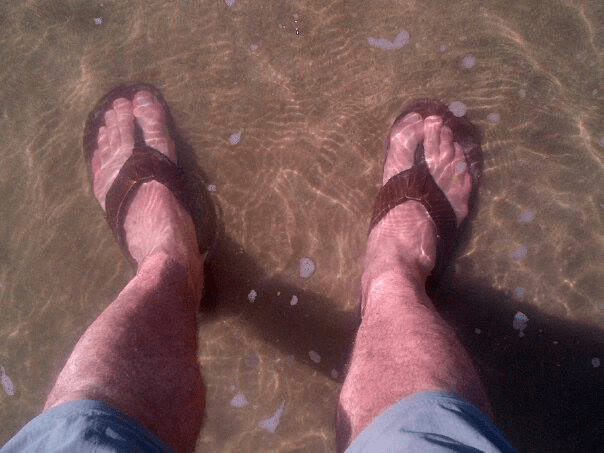
Flip Flops

This work was originally published in “Barely South Review” about twelve years ago. It has since been anthologized and often pops up around 911.

“Death plucks my ear and says, ‘Live. I am coming. Live now.'”

–Virgil

I went to the local hardware in Hartfield and bought a sickle—a huge rake-like piece of
steel only instead of a rake at the end there is a double-edged sharp, wavy blade made to rip
through branches, thick weeds and other bone-like growth. Eighteen dollars.

The front of my property is wooded, and on a few acres toward the river, I spent some
time clearing out brush and unwanted vines. I piled it up to haul away, but before that could
happen, other more tenacious weeds—small trees really—took over the area. Some I pulled out,
some I mowed, but I couldn’t grasp to tug out the tougher ones—so the sickle. One warm
morning while alone I put on shorts and flip flops, grabbed the sickle and walked the six hundred
of so feet through the woods to swing away at a small grove. None would rip out easily, so I
aimed for the fences, came down from my right with major-league force and tore through the
vines like an axe through balsa. I attacked one after another, muscles taught so that sweat came
fast, and I made progress. Then I stepped to swing at what looked like a thick, knotty growth at
the bottom of the stump. It was a Virginia creeper vine. Sometimes these monsters look rooted
but aren’t. But what do I know; I’m from New York. So I swung at it like A-Rod. The blade
passed through as if the weed were nothing more than a figment of my imagination, and with all
my energy plus a good deal of inertia, the metal blade ripped into my left ankle.

I like flip-flops. I grew up on the beaches from Long Island to Virginia, so I’ve been
wearing them since I’m a kid. I actually had one pair for ten years, sometimes rigged with a thick
paperclip to hold them together. My feet from April to October have a thick white stripe across
the tops seen only when my flip flops are off. I teach in them. I walk in them. I even mow the
lawn and chop wood in them. Despite what many have said, they are not the cause of the blade
Tarantino-ing my ankle. I don’t remember my foot slipping. I do remember almost not going out
to cut the underbrush to begin with because I couldn’t find my flip flops. What a different story
this would have been had I not come across them on the back porch.

When it happened, blood exploded like water in a hose that’s been held back by bending
and then released. My ankle, foot and flops looked as if dipped in bright red paint. I hobbled the
six hundred feet to the back of the house to wash off the wound, bandaged it, then went back out
to cut more wood; I was wired from adrenaline, my ankle didn’t hurt too badly, and to be honest
I had a lot to do.

That night I iced it. I kept it clean. I was fine. Really.

A week later my leg was pitting a bit when I pushed my thumb into my shin. Excess fluid
I figured. Prior to the whacking, I had been running up to eight miles a day, prepping for the
Rock and Roll Half, so one evening when I was feeling a bit more hyper than usual, and the
swelling moved to both legs—a feat I could not comprehend from injuring one ankle, but I don’t
have a medical degree—I stopped at Kroger and spotted a blood pressure machine. This can’t be
right, I thought, when the first reading came up 270 over 190. I did it two more times and both
readings came pretty close to the same. At the checkout I let them know the machine was
broken. We all laughed at my numbers—even the bagger laughed and put the laundry detergent
on top of the bread. It was that funny.

The next day, worried about my ankle, I washed off my flip flops and went to the doctor.
He took my blood pressure. Again. Again. He asked why I was stupid enough to wear flip flops
while doing yard work. I pointed out I wacked myself above where any shoe would have come
anyway. He asked if I were doing cocaine, heroin, or any other substance, asked if I had
shortness of breath, dizziness, if I had thrown up, fell down, or otherwise felt corpselike. He took
my blood pressure again. He asked how long I felt hyper. “Years,” I said, and he took my
pressure again. Then he sent me to the emergency room. Average BP—260 over 175.
Tests. IVs. Tests. On and on it went for several hours. Nurses came, two doctors stopped
by, some punk there to visit a friend who had overdosed came by to check out my vitals because
my blood pressure was the talk of the ward. The nurses upped the meds. Finally the doctors said
based upon my blood vessels behind my eyes and various tests, my blood pressure had
apparently been that high for probably some years, and that if it wasn’t for the fact I’m totally
healthy otherwise with excellent results from blood and other tests, I’d have had a major stroke.

I asked the cause. The doctor shrugged. Genetics; in a high stress situation for far too
long; a combination, he said. They brought it down to 190 over 95 and sent me home with meds
to bring it back to normal. They told me to keep exercising and that because of my medicines I
could do the marathon, but to be clear, I’m going to be very weak for awhile until I adjust to a
life where I’m not pumped on triple doses of double shots coursing through my veins.

A few weeks later at a follow up where my pressure was at 110 over 70 the doctor told
me in complete agreement with the cardiologist and another doctor, had I not gone in, I’d have
most likely had a major stroke trying to run the half, and probably would be dead. I asked why I
didn’t have one while doing the eight miles a day prior to the Great Sickle Incident, and he was
quite professional about it: I don’t know, he said. I really don’t know. You should have. Good
thing you wacked your ankle, he said.

Yeah, thank God I wacked my ankle. And I thought how often that happens. Good thing I went back for the keys. Good thing I stopped for coffee. Good thing you kept me on the phone, or I’d have been at that intersection just at that moment.

“Good thing I watched Monday Night football on the 10th and overslept: I work on the
85th floor and I’d have been right there,” the stock broker said in the street to the television crew.
As the towers tumbled, he counted his blessings.

Good thing Larry Silverstein, owner of the lease of the World Trade Centers, has a wife
who made him go to his dermatologist appointment that morning instead of yet another meeting
in the North Tower.

Good thing Chef Michael Lomanoco of “Windows on the World” broke his glasses and
had to stop at Lenscrafters that morning to get them fixed.

Good thing Lara Clarke stopped to talk to her friend, actress Gwyneth Paltrow, in a
chance meeting down in the village that morning making her late for her job on the 77th floor.

Thank God singer Patti Austin, booked on flight 93, had to leave Boston a day early
because her mother had a stroke and she had to get back to San Francisco on the 10th instead. “I
went back and forth all day about when to leave,” she said.Thank God actress Julie Stoffer and her boyfriend had a wailing fight that morning and
she missed Flight 11.

Actor Mark Wahlburg is still haunted by that same Flight 11 to LA, which he missed at
the last minute when an 11th hour invitation to a film festival sent him to Toronto instead. He has
nightmares thinking about who took his place on the flight. He would have been sitting next to
Family Guy creator Seth McFarland who also missed that flight when his manager gave him the
wrong boarding time and he was fifteen minutes late. He, too, still has bad dreams, he says. But
thank God, he says.

It’s chance. It’s the phone call, the caught light, the traffic backup. It’s changing your mind. It’s
sticking to the plan. It’s oversleeping, insomnia, an upset stomach. It’s a few seconds. It’s the
wrong shoes. It’s the stroke of luck.

Life in the Margins (Part two of two)

When I was in my late teens my father and I played golf one afternoon at his club in Virginia Beach. About the third hole a man caught up to us and played along. He was good; a driver, short chip, one putt player. I was not. I had the same clubs but more often than not sliced it to the right or bounced it into a water hazard. I didn’t have a temper, but it wasn’t unusual for me to put my club back in my bag with some force, as if to say, “Don’t even think about coming back out until you know how to hit the ball straight!”

I did this after I butchered an easy fifty-yard chip shot by clipping it straight to the right into a lake. I cursed, of course. The golfer was standing nearby waiting to hit his second shot to my fourth.

“Can I give you some advice?” he asked. I sighed. First of all, no, no you cannot, because I’m nineteen and I don’t take advice, and because I don’t even know you. But noting my dad just a few yards away I opted for sportsmanship.

“Sure,” I sighed.

He paused. “You’re not good enough to get mad.”

I stared at him.

He continued: “Really, how often do you play? Do you take lessons? Do you have the best clubs? If you played all the time and took lessons, well then you could be upset at not improving. Otherwise you’re just wasting good energy.”

Ever since then, I have not only relaxed and enjoyed the game, I play better. After a while I applied this to most aspects of life, not in a way to find an excuse to not try, but to relieve the stress that comes from going through life doing things everyone else seems to simply be better at than me. It also motivated me to get into the game a bit in those areas I do have some game.

Awkward Transition Section:

I gave an assignment not long after September 11th, 2001, when my students would have been in their teens during the attack. I wanted them to reflect on what will remain one of the most significant days in our lives. How, I wondered, do they remember that day? I thought it was a good assignment—a specific event but a vague enough request for them to wander where they wished.

One student wrote of her aunt who never made it out of the South Tower. Another wrote about her sense of horror and disbelief, which, she wrote, she could never correctly capture on paper. Several actually commented they didn’t think it affected their lives at all while others spit out what they kind of paid attention to with one ear from local television reports—about heightened security, conspiracy factors, the indescribable loss of life that spontaneously erupted on TV that morning. But one student’s piece caught my attention. He wrote, in part:

In a way, September 11 demonstrated, more than any one phrase can contain, the strength of our Constitution. The day became the beginning of a new era of the democratic process, and the definition of how we will defend our liberty, maintain our principles and remember our purpose—to stand as an example of humanity’s potential. It was Memorial Day. It was Victory Day.

I read this with amazement. I asked for the rough draft and received exactly what I knew I would: A similar, hand written version with some words written differently and others crossed out. Excellent.

“You plagiarized this,” I said, which, understand, is rare for teachers to say. We receive copied material all the time, but nearly never have enough proof to say, directly, “You didn’t write this.” In a world of AI generated essays, it gets even tougher, but I ask them to ask themselves if they’re good enough to plagiarize correctly. I remind them in order to pull off an AI paper or plagiarized work they need to have a deep understanding of my requirements for the essay, the style I’m looking for, the specific language, the relevant references, and to be frank, I let them know, most of them aren’t good enough writers to plagiarize that well.

But this kid nailed it. “I didn’t plagiarize that!”

I smiled. “Yeah, you did.” My small laugh, I think, pissed him off. He continued to challenge me. Normally, plagiarized papers frustrate faculty members when they know an assignment was plagiarized—either from another student or from one of the many web sites offering papers for sale, or more recently for various AI sites— but can’t prove it. So when proof does come along, while it’s disappointing to have such lazy ass students,  it’s not just slightly satisfying to stop them in their tracks.

“Yes, you did. Tell me why you shouldn’t fail.”

“Because I didn’t plagiarize it.”

“Okay, I’ll tell you what. I want you to bring me a copy of the original. If you do, I’ll let you redo the assignment without penalty.” I figured the embarrassment would be sufficient.

Once a student turned in a paragraph she plagiarized from our own text. Another time a student turned in a paper right out of the psychology textbook assuming I wouldn’t recognize that his in-class writing had the ability of a seventh grader and the essay he turned in was written by Freud.

I don’t think they’re simply overworked. They’re bored. What they’re doing is staring at me and thinking of everything else. In the front row is the guy with his fingers in his mouth, gnawing on his fingernails, pulling them out wet every once in a while to observe his work and then shift his focus to a different cuticle. In the back row some dude’s pretending to write notes while he’s reading his text messages on his cell phone.

Certainly, some things really are boring, and sometimes it’s difficult to find the relevance. I know; I was a student.

Too many aren’t listening. And I totally understand. There’s too much noise. Streaming services, reels, TikTok, internet scrolls, deadlines, term papers, credit card bills, car repairs, moving in, moving out, daycare, spouse abuse, deployment, speeding tickets. The pace of life is at Mach 7, and we’re teaching from a stage coach—no wonder they’re bored. They haven’t yet realized that life is infinitely more interesting from the stage coach; that life exists in the margins as well as the headlines, and we should not simply focus on the large, obvious lessons we underline but the small details where we learn what we are and are not good enough at to get upset to begin with.

We’re too busy for that. Before they’re out the classroom door, students are calling each other, talking and walking from building to cars, elbows bent, phone tucked tight to their ears. We’re completely plugged in. There’s no time to think. Don’t stop, don’t listen, and don’t figure it out. Just keep yourself plugged in to create the illusion that something’s getting done.

And we keep missing the good stuff because we don’t have time. A college where I used to teach had a reading by one of America’s leading poets, Reetika Vazirani. Maybe a dozen people showed up. There was enough room for her cute two-year-old to run around the auditorium, climb across chairs and make everyone laugh. Reetika’s poetry was magic. Students who did show up sat looking at their laps while Reetika read:  

Little by little, I’ll figure it out

I’ll say to them, Relax, we’ll live to be a hundred

I’ll sort things out.

And her child danced down steps toward the small crowd. They missed that for the noise. Noise, that unlike the rest of our lives, won’t ever fade but instead will grow in intensity until it blends to the point of saturation, and becomes inaudible, an undercurrent of indiscernible distraction.

I can’t help but sympathize with students. They see the careers of their parents or friends, and they know at best the future holds the slow erosion of enthusiasm.

Early before class one day, I waited for my student with the plagiarized 9/11 paper to show up. Some papers are so moronic I pray they were plagiarized just so I don’t have to believe one of my students wrote that crap. I read a paper once which began, “Shakespeare wrote Hamlet almost a decade ago.”  Another paper I received once had the same page printed three times. When I pointed out the mistake, he said he couldn’t think of anything else to write but knew the paper had to be 800 words, so he just copied it a few times.

When the student with the plagiarized paper returned, I was ready. “Ah, did you find it?” I asked when he came in and tried to sit down without looking at me.

“No,” he said, as I knew he would. Pride sucks.

“It’s okay. I brought a copy. Shall I read it to you?”

“No.”

“Great! Here goes:”

I believe our best education has nothing at all to do with the classroom or the assignments or the degree. It’s between the lines and off to the side of the narrative where we discover the best of what we need. This isn’t original; in fact, it’s a thought and practice older than formal education.  I don’t remember much from grammar school, which they called it then because they still taught grammar there. But I do remember my teacher taking us all out one April afternoon to lie in the grass on our backs and stare at the sky while she told us about the tragedy aboard Apollo 13 going on right then in space above us. All the discussions about what went wrong and how they might not make it back were irrelevant until we rested in the grass and stared at the sky.

The thing is, we’re all the same. Conditioning has them believing that life is supposed to be some Reality Television show. There’s no plot, no writers, no purpose.  Suicide is the second leading cause of death among college students behind accidents. In fact the rate is higher among college students than it is for the same age group who aren’t enrolled in college—you know why? Because life is infinitely more interesting than most of the crap we’re fed in school. No one cares about most of the material we spend so much time preparing.  In the real world, however, we tend to seek out challenges we know we are up to, where in college students face new levels of expectations, and when they’re not up to the task they complain instead of asking themselves if they’re good enough to be there to begin with, if they’re willing to get better. They’re trying to make sense of it all—or want someone to help them, and when they can’t they rely upon what others have done and plagiarize that.  No wonder they’re bored. Hell, I’m bored.

Sometimes I try and picture my students as toddlers and help them not in a childish way but in a way which I hoped faculty had helped my son, as if he were their own. Was he paying attention when teachers taught?

Was I?

Recently I remembered Reetika’s son, who ran through the vacant auditorium while his mother read poetry. Shortly after that reading, just before taking her own life, Reetika—riddled with psychological challenges—killed her son. I’m tuning that one out. There’s no lesson there. Sometimes I picture my son at twenty, wondering which of my students he would have been like and how would I have answered his questions, approached his plagiarized paper.

I stared at the young man that plagiarized the 9/11 story and asked if he were ready. He turned his head to one side, trying not to make eye contact. “Hey, it’s from the local paper! Well, let’s see:

“There are still no words for September 11’ by…”  I stared at him: “Oh my god, Dude, should I go on?” He laughed a little at my sarcasm because he knew what came next and because, really, it’s so laughable.

“There are still no words for September 11’ by…” I stopped and looked at him. “You’ve got to be kidding,” I said.

He spoke quietly: “I didn’t know you wrote it.”

“Where’d you get this?” I asked. A friend of his gave it to him from his developmental English class but had taken my name off his copy.

“I was set up,” he said.

“You think? Do it over. Here. Now. You’ve got the whole class.”

I opened the door and the class came in. I talked about something, I forget what since I wasn’t really listening, and after class everyone left and he gave me his paper. He wrote:

September 11th scared the hell out of me. I was only fifteen and our country was being attacked. I remember rumors that a bomb had been planted at the State Department and I really thought it was just starting, that we were at war right here in America. My brother was nineteen at the time and in the Army in North Carolina, and I couldn’t sleep. Our teacher talked to us about it during the following period at school, but I wasn’t listening. I was thinking of my brother and about war. I was thinking about how a few hours earlier my friends and I were talking about how some guy bought us beer that weekend and we hung out in Croatan, and suddenly none of us was talking at all, and no one wanted to. We just stood around and said, “Damn,” and we were scared.

He found his voice. “I’m disappointed,” I said. “This is way better writing than the one I wrote that you tried to plagiarize.”

“See you Thursday.”

Most students don’t find their own voice or would even hear it over all the noise. When things finally do settle down and it gets quiet and the cell phones are turned off, most of us wouldn’t know our own voice. Maybe we’re scared. I know I am. Maybe we don’t want to know what we sound like, preferring instead to fall into some mainstream composite of expectation and predictability. I tried to tell my son to figure things out for himself. Don’t rely upon being taught, but instead, learn. They’re not the same thing. I hope he listened.

And I’m certain he hoped I listened as well. I tried to pay attention, but it was hard back then with the constant noise of students and papers and classes and all the other voices in my head. So sometimes, too often I suppose, it was difficult to always pay attention and listen to everything. And that scares me.

Turns out it is the small stuff that mattered. It’s the details I should have paid attention to. In class I wonder if I have any right to get angry when they’re cheating with AI; I mean, maybe if I were a better professor they wouldn’t do it. But it’s more than that: In the hallways, in conversations, in all lessons I want to drill into them that the larger objective is not difficult to digest; it is the details that we need to spend more time focusing on. It’s the same for college students as it was for toddlers. You see, I had this fear when my son was little that I would get mad at him one day and he would turn to me and say, “Dad, you’re not a good enough father to get mad. Maybe if you’d practiced a little more.”

What He Said

It’s raining out, and I can hear thunder in the distance. It is supposed to be like this for the next day or so, and seeing as how I’m finishing up the semester, I made some tea, grabbed a snack, and have set in to grade writing assignments.

The good news is, these students, unlike where I worked fulltime for thirty years, do their own work. The bad news is not all of them. I have two papers I must investigate; that is Google various phrases, unique sentence structures. Easy, since previously I could expect a dozen or more per semester. These days early in the semester I tell stories about previous attempts at intentional plagiarism, and I always conclude my pontificating with this story:

Some of you have heard this before; it bears repeating, so allow me to plagiarize myself:

I gave an assignment in October of 2005 asking for students to dig into their memory and write five hundred words about September 11th, 2001. I wanted them to reflect on what will remain one of the most significant days in our lives. When the attacks occurred, these students for the most part were about fifteen, so as early teens they had very guttural, organic reactions. How, I wondered, do they remember that day? I thought it was a good assignment—a specific event but a vague enough request for them to wander where they wished. One student wrote of her aunt who never made it out of the South Tower. Another wrote about her sense of horror and disbelief, which, she wrote, she could never correctly capture on paper. Several actually commented they didn’t think it affected their lives at all while others spit out what they kind of paid attention to with one ear from local television reports—about heightened security, conspiracy factors, the indescribable loss of life that spontaneously erupted on TV that morning. But one student’s piece caught my attention. He wrote, in part:

In a way, September 11 demonstrated, more than any one phrase can contain, the strength of our Constitution. The day became the beginning of a new era of the democratic process, and the definition of how we will defend our liberty, maintain our principles and remember our purpose—to stand as an example of humanity’s potential. It was Memorial Day. It was Victory Day.

I read this with amazement. No student, I thought, could possibly be that stupid. While I admired his choice, I remained baffled by his idiocy. I asked for the rough draft and received exactly what I knew I would: A similar, hand written version with some words written differently and others crossed out.

“You plagiarized this,” I said, which, understand, is rare for teachers to say. We receive copied material all the time, but nearly never have enough proof to say, directly, “You didn’t write this.”

“I didn’t plagiarize that!”

“Yeah, you did.” I think he was put off by my small laugh.

He continued to challenge me. Normally, plagiarized papers frustrate faculty members when they know an assignment was plagiarized—either from another student or from one of the many web sites offering papers for sale— but can’t prove it.

“Yes, you did. Tell me why I shouldn’t kick you out right now.”

“Because I didn’t plagiarize it.”

“Okay, I’ll tell you what. Go do some homework. I want you to bring me a copy of the original. If you do, I’ll let you redo the assignment without penalty.” I figured the embarrassment enough would be sufficient.

Once, a student turned in a paragraph she plagiarized from our own text. Another time a student turned in a paper right out of the psychology textbook assuming I wouldn’t recognize that his in-class writing had the ability of a seventh grader and the essay he turned in was written by Freud.

Not long ago I Googled  the term “college papers” and found the top ten of about 4,750,000 sites including essaytown.com, papercamp.com, duenow.com, term-paper-college.com, schoolsucks.com, chuckiii.com and, my favorite, smarttermpapers.com, where on the home page they offer “custom papers” with the following guarantee: “A 100% original document based on exact requirements given by you!” What is bothersome is their promise that “all writers hold at least a master’s degree.” But my favorite highlighted guarantee is that “all papers are plagiarism free—we use a plagiarism detection program to ensure that all texts are original.” When I tell my students that the papers are plagiarized the minute their name is placed at the top, they don’t really get it.

When students plagiarize and I know it but I can’t really prove it, I have to decide if I am to bluff and call them on it, spend time doing research to try and find the original source, or, since all writing is subjective and can be criticized, rip it to pieces anyway giving a C or D to the student who worked so hard at finding a professional piece that met my requirements. I did that once and the student, without thinking, exclaimed, “But this was in Time Magazine!”

I had a student once complain I didn’t accuse her of plagiarizing. She said she thought the work was brilliantly written and that she was convinced I would demand of her the origin of the information. Some are that good. Some papers are so moronic I pray they were plagiarized just so I don’t have to believe one of my students wrote that shit. A paper I received once had the same page printed three times. When I pointed out the mistake, he said he couldn’t think of anything else to write but knew the paper had to be 800 words so he just copied it a few times. I started to tell him that was not a good idea and he interrupted complaining of the requirements and how I am being unreasonable.

The mystery to me is why they would be involved in any activity during which they decided they simply haven’t got the ability, so they have someone else do it. On the surface the motivation is clear: The dude wants an A in my class and he’s too busy to get all the work done and watch TikTok videos. But something deeper is amiss; the generation of students currently calling themselves sophomores or juniors have become accustomed to finding work instead of figuring it out. Since birth, they have been taught to “find” the answers, to “find the directions” to “find the best rating for some diner.” The ability to figure it out has receded. No one asks for directions anymore when we used to also inquire, “And where is a great local place to eat?” No one asks others to take their picture, when doing so can often lead to a conversation, which can lead to the discovery of unsearchable information. The best answers are most often spontaneous; and the secret formula to writing is originality.

To use someone else’s work is to say, quite clearly actually, “I’m simply not up to this, so I’m going to pretend I’m better at it than I am.” Some call it cheating. I call it a reality check. If you need to plagiarize in order to continue on a particular path, you’re on the wrong path.

Step off.

Back to the assignment: When the student with the plagiarized paper returned. I gleefully asked (a bit too gleeful I suppose), “Did you find it?” No, he said. To be honest I didn’t expect to see him again.

“No,” he said, as I knew he would.

“It’s okay. I brought a copy. Shall I read it to you?”

“No.”

“Great! Here goes! Hey, it’s from the Virginian Pilot! Well, let’s see:

“’There are still no words for September 11’ by…” I paused. “Oh my god, Dude, should I go on?” He laughed a little at my sarcasm because he knew what came next and because, really, it was so laughable.

“’There are still no words for September 11’ by…” I stopped and looked at him.

“You’ve got to be kidding,” I said.

He spoke quietly: “I didn’t know you were the one who wrote it.”

It’s raining harder now, and the temperature is dropping. Time to put another log on the fire, get some hot water, and fill a bowl with Cheez-Its. Of course.

Pre/Post

I was three, just a few months older than John-John, when his father President John F. Kennedy was shot. I don’t remember the incident at all, nor am I aware of a difference in temperament before and after that fateful day in November of ’63. But I’m told it was distinct, black and white, an absolute clarity in “before and after” references. I’m told Kennedy came with hope, with promise, with lofty goals like landing a man on the moon and cleaning the earth, the Peace Corps, the hope of peace in general. He was young and so was most of the population as the first wave of baby-boomers came of age. Things were good.

Camelot.

I saw footage of the event only in great retrospect years later. People talked about conspiracy theories, they talked about Vietnam and Civil Rights; and they talked about the subtle differences of expectation and hope before and after November 22nd, 1963. But I only ever understood a post-Dallas world; there will always be something lacking in the narrative for those of us who didn’t experience life back then, in the times before Dallas. There will always be some subtle element we will never be able to grasp.

***

I used to ask my writing students this week every year, what do you remember? How were your parents that day?  Their work covered the spectrum from indifference to passionate recollections of military members who had returned from Afghanistan and Iraq. And, predictably, as the years went by the details became less clear, less “involved,” and more repetitive to what they heard from others, from history class even.

I don’t ask those questions anymore. None of my current college students were yet born September 11th, 2001.

They couldn’t know that before 911 our thought process was different, more hopeful, absent of impending doom. We still had that absolute conviction that whatever happened to us as individuals and as a nation was still pretty much in our hands. They have no idea that before that day we looked forward to what was next, not fearful of what might happen. Our daily vocabulary was absent of phrases involving extremism, terrorism, anthrax, and Fallujah. These concepts were real and among us, but they affected others, were problems for others, were handled by others. Our attitudes of issues concerning Afghanistan and Iraq and terrorism back then are similar to my students at this campus in Virginia worrying about what is happening to students at some college eight thousand miles away. We were peripherally aware of a situation, that’s all.

***

Higher education has once again become more of a world of industrial education, where students expect that the sole purpose of their classes should be to prepare them for employment, where enrollment is plummeting not just because of cost but because of the greater population of teenagers not seeing a point to it, so there is a desperate need for the study of philosophy and art. Am I being too optimistic? Am I tilting at windmills? I suppose.

But In a world which has adjusted to constant violence and invasion, where disease is rampant and the climate is killing us, I can’t think of a better time for educators to emphasize the potential of humanity. But technology is our new curriculum, and students today are convinced it is the sole foundation of whatever they do. But “it has become appallingly obvious,” Einstein said, “that our technology has exceeded our humanity.”

“Intelligence plus character is the goal of a true education,” Martin Luther King, Jr. insisted. Yes, let’s go there. Let’s get back to that pre-911 thought process. It seems we are in dire need of starting over. Now. The earth is dying and the human race is watching it all happen on Instagram and TikTok. In this culture, we cannot teach anyone what “hope” was like in the before times; all we can do is hope. Educators first must be examples. In these times, those of us older than forty are by virtue of memory social historians who can remember a world of possibility and promise. We were there.

According to Plato: “The direction in which education starts a man, will determine his future in life.” Shouldn’t we start with hope? With possibility. We didn’t used to have to teach those ideals, but my students weren’t born when those once innate concepts were foundations instead of today’s cyber security and terrorist activities.

I cannot teach these people what life was like before terrorism terrified our cities. I can perhaps describe what it was like to sit at a table for lunch at Windows on the World completely absent of fear and enjoy the view. I can talk about crossing borders without interrogation, walking family members all the way to the plane for their departure, carrying pretty much anything I wanted on board a flight. I can talk about what wasn’t talked about, places we never heard of.  I can ask them why it isn’t like that anymore and what do we need to do to find our way there again.

Now I ask them to write what they think is humanity’s greatest strength, most encouraging potential. The papers are sparse. Their minds draw a blank; and it isn’t their fault. If the terrorists succeeded in one aspect in affecting American culture, it is this: We used to think about what can go right; now we think about what might go wrong.

That’s as tragic as the difference between pre and post can get.