Vincent van Gogh

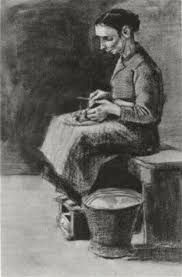
Vincent van Gogh was born on March 30, 1852, and died at birth. His parents buried him in the entrance to the graveyard in the church where his father was an Episcopalian minister. Exactly one year later to the day, the couple gave birth to another boy and named him after his dead older brother. Vincent van Gogh was born March 30, 1853, and spent his youth seeing his name and birth date on a headstone when he went to the church.

He tried working in a bookshop, as a tutor, an art dealer, and a preacher in the mines of Belgium. He spoke multiple languages, read Hugo in French and Dickens in English. He fell in love with his cousin and lived for some time with a prostitute and her daughter. For the last ten years of his life he lived entirely off of his brother, sold only a painting and a scattering of drawings, fought with every artist he knew and rarely paid his bills. He was belligerent and sick with syphilis, manic-depression, and epilepsy. He was considered a bum by every contact he made, and only two art critics thought he showed any promise at all. At thirty-seven he shot and killed himself.

That was 135 years ago this July. We’re still talking about him.

By today’s standards, he would be outcast and dismissed as a man who wasted his life pursuing a passion with no hope of even making a living at it, let alone gaining any success. He would be quickly forgotten.

A few years after his suicide, Vincent began to be recognized for his innovations in art, his vision as an expressionist, and his deeply-moving letters to his brother about life, love, God, hope, art, and death. Today he is considered one of the most influential artists in history.

I’m going to the Van Gogh Museum in Amsterdam next week followed by a reading I’ll be doing at the Van Gogh Library in Neunen, Netherlands.

It started when I was a freshman in college, and a dear friend, the late artist James Cole Young, gave me a three volume set of letters Van Gogh wrote to his brother and other artists. I mostly ignored it for a few years, until in Massachusetts when I went home after work each night and read them several times, intrigued by two seeming contradictions: One, he wrote extensively about his inability to gain any attention at all in the art world and other artists’ bad opinion of his work, yet he became one of the greatest artists of all time; and two, he stated often his thrill for being alive, for life itself, for everyone, and he wrote of the insane idea of taking one’s own life, yet he did just that. So I looked further. As a graduate student, I wrote a one man play as one part of my Masters in Arts and Humanities at Penn State and performed it at the Olmstead Theatre in Pennsylvania, under the direction of the late playwright Eton Churchill. Eventually, my work Blessed Twilight: The Life of Vincent van Gogh was released in 2018. It is all first person from Vincent’s letters.

In just over a week I get to hang out where he lived and wander aimlessly down the same streets of Neunen. Perhaps I’ll even drink some absinth

Most people love Vincent’s art. But I like his writing.

Like this:

In a painter’s life, death perhaps is not the hardest thing there is. 

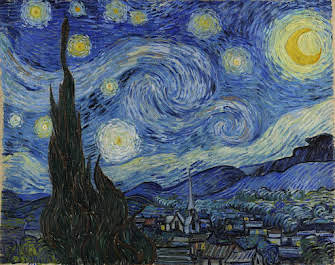
The earth has been thought to be flat. It was true, and is today, that between Paris and Arles, it is. But science has proven the world is round and nobody contradicts that nowadays. But notwithstanding all of this people persist in believing that life is flat and runs from birth to death. However, life too is probably round and very superior in expanse and capacity to the hemisphere we know at present. For my part, I know nothing of it. But to look at the stars always makes me dream as simply as I dream over the black dots of a map representing towns and villages. Why, I ask myself, should the shining dots of the sky not be as accessible as the black dots on a map of France? If we take a train to get to Rouen, we take death to reach a star. One thing undoubtably true in this reasoning is this: that while we are alive, we cannot get to a star any more than while we are dead we can take the train. So it seems to me possible that cholera and cancer are the celestial means of locomotion just as steamboats and railways are the terrestrial means.

To die quietly of old age would be to go there on foot. 

I feel more and more that we must not judge God on the basis of this world; it is a study that didn’t come off. What can you do in a study that has gone wrong if you are fond of the artist? You do not find much to criticize; you hold your tongue. But you have a right to ask for something better. It is only a master that can make such a muddle as this, since then we have a right to hope that we’ll see the same creative hand get even with itself. And this life of ours, so much criticized and for such good and exalted reasons—we must not take it for anything more than what it is and go on hoping that in some other life we’ll see a better thing than this.  

–Vincent van Gogh

Best. Professor. Ever.

To start, one of my students wrote this sentence: “The iridescent luminescence of the phosphorescent fungi, a phenomenon both ephemeral and mesmerizing, cast an ethereal glow upon the cavern’s labyrinthine corridors.”

I am a bloody brilliant professor. It took me more than thirty-five years to reach this level of excellence as a teacher, but at last I have proof of my abilities to teach college freshman to produce excellent work. Allow me to set aside any semblance of humility for this moment to suggest some rewards should be forthcoming. Teacher of the year, perhaps; a newly-imagined accommodation introduced this year for the purpose of honoring me, maybe. If there is still a Department of Education, maybe a plaque on a wall. 

For the first time in my career, more than fifty students (out of sixty five) wrote nearly perfect papers. Every sentence structured with absolute perfection, diction equivalent to PhD candidates of some Ivy League institution after the work has been combed by editors with a thesaurus, and not a single comma out of place, even the Oxford commas; every single one of them exactly where they should be. 

There’s more. Oh, and wait for the Big Reveal.

The expert sources, despite their association nearly exclusively with universities in Southeast Asia and India, all precisely attributed. What is especially satisfying is that I managed to enable my students, on only their second paper ever in a collegiate class, to write better than any student I have had since the end of the Reagan administration. These magnificent students used compound sentences with five-syllable words with such accuracy and topic-specific precision I have a renewed faith in this country’s education system. Bravo! primary, middle, and high school teachers! You have passed to us college instructors the finest composition writers in a generation.  

But here’s the real reason to celebrate: These students are all high school students taking my college writing class in a Dual Enrollment Program. Again, Bravo! And, well, just Wow! And imagine, they’re almost all just seventeen-years-old.

Okay, so this can’t be a unique situation, one might think, and therefore not worthy of the accolades I suggest. So here’s more: This all happened in the past few weeks in West Virginia where 27% of high school students failed to meet the reading proficiency. And according to an extensive study by the University of Wisconsin of English Learners in Middle Schools and High Schools Pre, During, and Post Covid, English scores declined steadily and significantly just about the time my current students were in ninth grade. The most dramatic decline was in writing skills, followed closely by listening skills. And yet, I pulled their previously unrecognized talents out of the hidden depths of their inattentive minds and produced extraordinary students writing exquisitely ideal papers. 

I’m that good. 

Some suggest I investigate the possibility the papers were ChatGPT generated, but I say there’s no need. I understand their defense of AI with the car-replaces-the-horse analogy, and that the need to know how to write the essay is secondary to their ability to know how to find one that meets the requirements when they need to do so. The previous example in education might be the Texas Instruments primitive calculator replacing the slide rule. I do understand. But these seventeen-year-old Best-Essay-Writers EVER students would not use such devices since I specifically and clearly instructed them that to do so would result in failing the course and possible expulsion from the university for Academic Dishonesty; why would anyone smart enough to write such pristine essays at the same time be dumb enough to risk their entire college career and subsequently their livelihoods by cheating on a college essay by plagiarizing, even if from a computer? Nay! This work must be original! 

Honestly, I had doubts at one time that I ever should have been teaching college. I wanted to raise goats. But I’m convinced now that this path I stumbled onto was the right one. I have written my own essays for more than forty years, shared them with best-selling authors and acclaimed writing faculty at the finest colleges for suggestions and assistance, and have an extensive publishing record–pardon my lack of humility here. I just write this to highlight the fact that I find myself surrounded by minors–for only a couple of these students are yet eighteen-years-old–who have clearly surpassed anything I have been capable of, editing and sentence structure wise, I mean. Nothing can be done about how dreadfully boring their essays are. But I do not grade college compositions based upon their level of “excitement.” No, these 900 and 1200 word essays, all in perfect APA format, stand alone as unblemished. 

I’ll be straight–I was a bit worried at the beginning of the semester when I posted on the online discussion board for each of them to explain their interests, hobbies, and hopes for their future, and the responses were riddled with incomprehensible fragments and more dangling modifiers than I’ve ever seen dangled before. But my worries where unfounded. After just five weeks I have successfully produced a stellar group of writers, all in a school district ranked 41st out of 55 in the state. All in a state ranked last–50th–in overall education.

At the very least I deserve a raise. 

The Joanie Channel

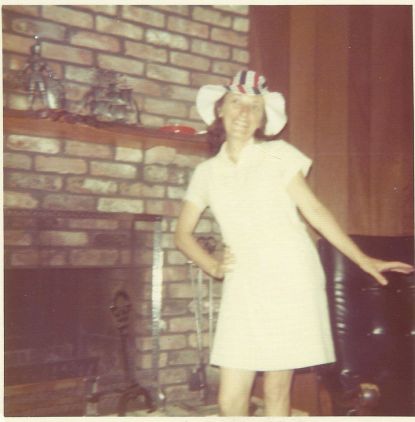
Joan in the Great River house, circa 1969

On June 22, 2002, my sister sat at our parents’ kitchen table and recorded an audio interview she did with them about their lives, about life during the depression and World War 2. She asked other questions, and just like Terri Gross on Fresh Air, did a great job of bouncing off of their responses. She sent copies to my brother and me about five years ago, and when I sat to listen to them, a few things struck me. One, my father was precise in his responses, and my mother was hysterical in hers. He was 77 at the time, and Mom was 69. But what hit me hardest was hearing our father’s voice for the first time in half a decade. I can hear his voice in my mind, of course, but to actually hear his voice like he was sitting there made him young again. The last few years of his life I was around him all the time and his dementia grew worse and worse. So when I played the cd, I heard not just my father, but my father younger, still alert to everything. It was nice to push past the sound of his weak and confused voice that had filled the corners of my mind and hear him as he had been. Ironically, at the same time it makes it hard to listen.
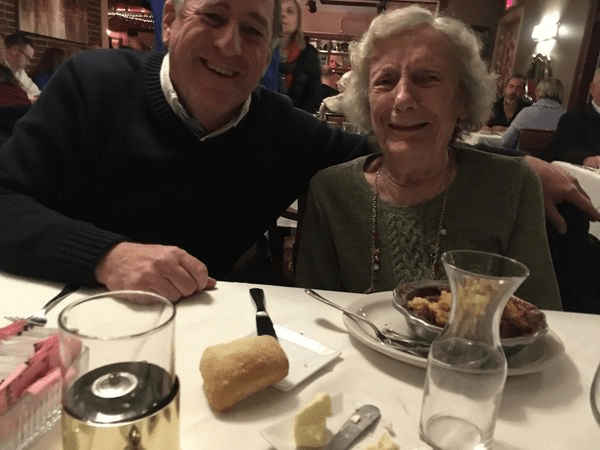
About two years ago while out to lunch I randomly recorded a video of my mother talking about something. I don’t remember what and the video is gone, but the idea took hold, and for the last two years every couple of weeks when we were at lunch or getting coffee, I’d ask her a specific question, or I’d encourage her to remember a particular time in her life. Note that she is one of the funniest and smartest people I’ve ever known, and understand too that she has had quite the life from the streets of Bushwick, Brooklyn, to Long Island, to Virginia Beach, and now in Williamsburg, Va. There are fifty plus videos here, but I recorded more than a hundred and deleted many. Some were redundant, and some in the past year or so I got rid of when Mom would struggle with a memory, or lose track of what she was talking about.

Still, this is decidedly not about Joan Catherine.

It is about time. This has everything to do with the brief flash of time we have to share with each other. Watch how a person can at once both change so much and still be themselves, who they are in their heart. The truth is at some point as we age we realize that we must set aside our anger and anxiety and arguments, and we seem to do so far too late in life. In the past year I’ve lost a half dozen people I loved very much who were my confidants and companions, and every one of them died relatively young, three of them in their early sixties. At the same time, my mother has nose-dived into a wall, fallen and slammed her head on a porcelain tub, fallen on the floor, faced cancer–again–had a pacemaker put in, battled neuropathy, and moved from her spacious condo where she lived with my dad, to an independent living apartment in Virginia Beach, to an assisted living apartment in Williamsburg, and she just keeps going. Last July she was in the hospital with pneumonia and sleeping eighteen hours a day, and the doctor did not think she would leave the hospital. Yesterday we went to lunch at an Italian restaurant and she woofed down a massive piece of tiramisu. She Just. Keeps. On. Going. And always with a sense of humor. She talks here about her move from Brooklyn to Long Island, from there to Virginia, and about how patient she can be. Or not. She sings the Banana Song, Woody Guthrie, a Shampoo commercial, and in one of my favorites when she had no idea I was taping from the cup holder of my car as we drove along, she sings “New York, New York.”

But this isn’t about Joan. This is about brevity. When we look ahead–when we anticipate–time can slow to a tragically slow pace. But when we look back, when we recall, we can transport our mind instantly to another era, as if it happened two seconds ago. This makes it seem like time goes by so fast. But it is the same now as it was when we were children. That’s the thing about time: it is dependable. Not one fat second will lose an ounce on my account. But the older we get, the more we recall instead of plan, so the clock can be deceptive. In these videos, Mom is full of energy, sitting up and laughing, with immediate recall of incidents an hour earlier as well as two generations ago; at the same time, here Mom is wearing oxygen, sometimes softly gasping for air, and her memory is nearly non-existent.

Time. It is the only measurement that matters. And we are endlessly distracted by the news and entertainment and the stress of finances and politics and health. But all of it slides away when we start to list what is essential. Then, the answer is easy: each other. That’s it. People leave us, sometimes slowly and sometimes with the swiftness of a cool, autumn morning that takes us by surprise. But they do, in fact, leave.

These videos are in no order, so one of Mom recently trying to remember her Uncle’s name might be followed by one of her looking stronger, heavier, talking about her favorite foods. I decided against a strict chronological order so that instead of watching a woman’s slow decline as age takes hold, we can see how life is, in the words of my friend poet Toni Wynn, “Paper thin.” I will add more to her page as time permits. Thanks for enjoying our mother’s beautiful sense of humor and simple take on what matters the most.

Note: There are some videos on the “Video” tab, but most of the videos are on the “Shorts” tab. Please check out both. And “follow” The Joanie Channel.

https://www.youtube.com/@TheJoanieChannel/shorts

Lecture: Day One

Not for nothing, here are three definitions straight from my lecture on the first day of my Critical Writing and Thinking course:   

Fact. A fact is anything independently verifiable. No one should disagree with the facts unless they haven’t done their homework to find out what is and what is not factual. There are no such things as alternative facts; true facts can be verified and are not obtained from biased individuals with personal agendas. They come from independent sources. Note: The opposing side of an argument would still agree with the facts.

Opinion. A lot of people have the wrong opinion about what an opinion is. It is not how you feel about something. We’ll get to that. It is a “judgement based upon the facts.” So the value of the opinion is dependent on whose judgement it is. Ideally, experts; that is, people who have taken the time, education, and research to find out as much information as possible about a particular idea and disseminate the results for us. They know more about the subject than anyone else and have no agenda in the results. Their experience at being able to decipher information through time and in consultation with various other independent researchers, validates the perspective.  If someone offers an opinion without finding out the expertise or validity of the source, the opinion is in question and often wrong. Yes, it is possible to have a bad or wrong opinion if the judgement is not based upon independent experts.

Belief. This is what many think of as an opinion. A belief is a judgement based upon faith. Not necessarily religious, but that too. It is a conviction not based upon anything directly and empirically verifiable, but through trust. No one is wrong for their beliefs as they are not opinions, that is, judgements based upon facts; they are judgements based upon convictions.

Here’s the example:

No one questions that when we buy a house and we need to get it inspected, we are wholly concerned about the opinion of the inspector. We want expert inspectors to tell us what is wrong and right with the place and present factual evidence, and we certainly don’t want an inspector who works for the seller and only has their welfare in mind, nor do we want one who doesn’t have the experience and expertise to do the inspection to begin with. No one questions this, but there are people who insist the opinion of a botanist about political affairs is valid. It is not. The botanist has beliefs one may align with—so be it, but do not pretend the information is valid from independent sources.

This leads to the most important question in all of discussions about politics, world affairs, and finances. It is also the question I tell my students is the primary concern of every professor from the time students write a paper for freshman comp to when they obtain a PhD:

Where did you get your information?

That’s it. Everything else isn’t even worth discussing without first establishing that the opinions and facts come from independent, verifiable sources who can study not only historical trends but predict pretty accurately what is likely to happen based upon that knowledge. This is what economists are best at, and so too political scientists. They are able to say, “Based upon these legal notations and previous attempts in various situations, the most likely outcome of these actions is….”

Hope and faith have nothing to do with it.

The emotion swirling through today’s atmosphere is unprecedented, and some of it isn’t because decisions being made are necessarily wrong but because they are unprecedented and seemingly dangerous as they negatively affect millions of people. Those people who are affected—all of us actually—want to know upon what basis these decisions are being made to do whatever it is being done, and who are the independent and valid experts who suggested those actions to begin with. A full disclosure of that information from researchers and experts would curb much anxiety.

No one should be out to change another person’s convictions. But if there is an argument at hand, the only way to win is by presenting facts and opinions, not beliefs, and one must maintain the belief that others will accept those facts and opinions.

The Lasso Way: A Needed Philosophy Today

When my brother suggested I watch “Ted Lasso,” I trusted his judgement. He had already nailed it with a few other shows, including “Eureka.” The first time through I enjoyed it immensely, the acting, the writing of course, the timing. It took a few episodes to understand this was not simply a series of set-up/punchline comedy, a method I despise. And it took a few times through the entire three seasons to recognize the primary overall theme at the heart of creator/producer/writer/star Jason Sudeikis’ efforts: This show is all about fathers and sons. 

When I struggled with transitioning my book The Iron Scar from the “who gives a shit” stage to the essential-to-be-published “readable and relatable” stage, the answer came while in a writing seminar in Ireland where I had been formulating the final draft of a series of letters from myself to my dad while traveling with my son across Siberia. Writer Elizabeth Rosner, almost as an aside, asked me why the chapters are formulated as letters. “I don’t know,” I told her. “Bad bad answer” she said. I pulled together a response about wanting to have three generations on board, and the reality of my son becoming an adult and moving on in the world the same time my father was approaching his final days. But I still couldn’t answer so I came home from Connemara and chopped my manuscript to small pieces. A few weeks later in a conversation with a friend in Texas, I said, “Tim, I’m losing focus on the theme.” He responded, “I’m not. This is all about fathers and sons. About moving on while trying to hold on. And the metaphor of the train is nothing more than setting.” Between the time my son and I rode the train and the time I wrote the book, my father died. I heard once that the loss of a parent is the greatest loss of security we can face, even at fifty-five years old. Not because we aren’t able to handle the turmoil of life on our own but because that foundation has been rocked. 

So I rewrote the entire book as a narrative that takes place on the trans-Siberian railway, with all the characters and unknowns that trip entails, but that’s not what it is about. It’s about relationships, about being between two generations who are about to transition. 

Back to Ted.

Sudeikis masterfully weaves every possible father-son relationship into what on the surface is a comedy about an American football coach hired to the helm of a British premier league soccer (football) club. 

Right away we have the estranged father as Ted Lasso separates from his wife, and his young son remains with his mother. We also soon learn the powerful impact his own father had on him and the fallout from his father’s suicide when Ted was just sixteen. In England we meet the team, including Jamie Tartt, whose father is physically and verbally abusive, Sam Obisanya, whose father is more of his best friend and mentor, Nathan Shelley, whose Dad is demanding of his son’s talents and seemingly never satisfied, Leslie (male) Higgins who is the proud and dotting father of five boys, Roy Kent, who becomes a surrogate father to his niece, and of course Ted himself, who moves into the father-role to the entire team, the individual players with which he has various degrees of parental conflicts and resolutions.

This is listed as a comedy, but it absolutely fits the bill as a drama as well, placing it in the same vein as shows like MASH which walks that thin line between laughter and tears. 

But this isn’t about that. We are in a drama that has become laughable, and the line between what’s funny and what is tragic is a shadow at best.

Both the Mother and Father figures in our lives have served to keep grounded the best efforts of humanity throughout history. We need either to recognize the example or play the part. Almost all aspects of society rely upon those roles to set the strong example with seemingly unconditional love as we push through difficult moments. When hope seems fleeting and one feels “lost in a pathless wood” as Frost proclaims, that Maternal strength or Paternal guidance is almost always enough to help us keep going, knowing that whatever happens we’ll be okay. Even if we lose, we suffer those losses together, and we move on. 

There seems to be a lack of parental symbolism in the world, in the nation, in our lives. In fact, more often than not those who should be in those roles these days are appearing more like Jamie Tartt’s abusive and untrustworthy father. It would be perfect if we could always rely upon Sam Obisanya’s Yoda-like dad to turn to, but that’s not the hand we’ve been dealt. In fact, it feels like we’re a player down right now and this time it’s the captain of the team who is absent. That loss of security can be overwhelming. 

I do not want to judge. In fact, if we are to do so, I remember Ted’s line, “I hope that either all of us, or none of us, are not judged by our weakest moments, but what we do with it if and when we are given a second chance.” But our foundation has been rocked, and it’s getting harder to find solid ground these days. So we must do what the team does and depend upon each other, pass to each other when we don’t have a clear shot, hold each other up when we’re flailing, and celebrate each other when we work things out. 

We will get through this time we are in. We might have to switch our game plan, but we’ve got each other’s backs, and that might be enough. 

My brother, my son, and my dad, 2015

The Five Things I did This Week Assignment

Despite my dislike of djt and em, two of the deplorables, I am intrigued by the assignment put forth by the South African/Canadian currently in charge of the United States; to record five things I accomplished this past week and send it to my boss.

I don’t really have a boss, per se. Never did actually. I mean, at the college I have a supervisor, but we’re trusted enough to be left alone to do what we need to do to accomplish the college’s mission. That’s the thing about good leadership; it lets the people who know what they’re doing do what they know. In my twenties I ran a health club and in my late-teens and early twenties I managed a hotel and in both cases my boss was either across the country or across town. So while in all those jobs I had someone above me, likewise in all those cases, they let me do what I needed to do.

My point is I am not sure to whom I should send this Muskian request of five accomplishments, so I decided to put it out here in the Wilderness, where thousands can View what I’ve been doing this week which I believe warrants that I continue doing what it is I do.

  1. I made a list of what I would do if I wanted to rule indefinitely without anyone able to stop me. I’d fire all the Generals who are responsible for insuring checks and balances is taking place. I’d fire the chief counsel at all branches of the military along with the Chair of the Joint Chiefs to make sure if there is any sort of “delay” in my leaving office, I will have the military and the ones fighting on my behalf in court all on my side. I would trim down all branches of the government which could somehow seize my power back financially, and I’d discontinue media access to press conferences to anyone who did not agree with me, so that the propaganda is not directly from my office but from the media’s lack of coverage of dissenting opinions. This is just a brief list so far and I know it is ludicrous to think congress or even a conservative senate would allow this to happen knowing their legacy depends upon the preservation of our country, but I had to accomplish something this week and I chose this.
  2. I filled out the form and made an online promise to participate in the march on Washington in defense of DEI employees, for LGBTQ+ rights, for diversity and inclusion in the military, and more. I am confident my chosen supervisor genius inventor idiot would never fire me for wanting to make sure as many people as possible in this country no matter their backgrounds, their gender, their identification, race, religion, or any other aspect of their humanity that these two feckless weaklings take issue with, have as much opportunity as possible to make this country greater than it already was.
  3. I asked my critical thinking and research students to find one federal program that was cut and investigate what are the long-term losses by the programs demise that are apparently compensated for by any short-term financial gains. And if there aren’t any gains in the long run, I asked them to find out who will be responsible for fixing it. I suggested they start with the many medical and health assistance programs which save the lives of children around the world, which prevent the spread of deadly diseases such as Ebola, or anything they want really. It is up to them. I suggested they wear masks while doing the research as measles is getting bad again.
  4. I walked through the woods and along the trails here at Aerie. I wandered down to the river and sat on the rocks and visited with some ghosts I’ve known for some time. We talked about the changes that find us now, and how they leave me so cold and so scared. I told my spirited late friends that thinking of them brings me peace, and maybe because of the heart trouble and kidney cancer, and the heartbreaking brain tumor, that they are free from this slow erosion of democracy and now they don’t need to watch. I laughed and thought of how they all might respond, and then I remembered what a writer once said, that “so long as I have breath and the ability to write, I will remain here to fight another day.” And so I shall. It was a beautiful walk and reminded me too of what is important. I miss my ghostly companions.

Which leads me to number five:

  • I’m writing a group of songs. I’m about halfway through. Let’s call them folk songs, but let’s also call them protest songs. I’ve taken out my guitars and they stand obediently on their stands near the window. I have a pile of notes and scribblings and some complete sheets of paper with phrases and lines and irony and metaphor. I tried doing something similar to this forty-five years ago when I was a young, immature college student badly playing coffeehouses. I couldn’t write well at all then. Now I can. And at some point I’ll record and upload the group of—let’s call them Go-Fuck-Off-Don and Elon songs—to Youtube, and at that point I’ll complete my “five things I did In Class Today Mommy” assignment properly. Maybe the album will do so well I’ll receive a Kennedy Center Award.

Oh Right! Number Six: Turn down Kennedy Center Award.

So what’s on your list?

Parenthood: A Lesson in Algebra

I’ve told this story before.

When Michael was about three or four, he used to play “Sir Michael the Knight.” Sometimes it would be on the sand in the yard of a beach house we rented one winter where we would build elaborate castles and he’d be Sir Michael and I was the dragon inevitably slain by the knight, culminating in my plunging death into the castle. Most often he occupied himself on rainy days when he would don his shield and sword and cardboard helmet and then barrel around the house. One time he ran through his grandmother’s home, cardboard sword before him, through the kitchen to the living room to the dining room and back into the kitchen, several times always calling “Sir Michael the Knight is going to slay the dragon!” or “You can’t get away from me dragon!” as he passed again, his voice fading in some Doppler effect as he disappeared into the kitchen, emerging around the corner seconds later. On one turn he was mid-sentence running into the dining room when his shoulder clipped the table and his feet flew out before him and his entire body slammed to the floor in perfect professional wrestling fashion. I jumped from the couch when I heard his head hit the ground, but he only lay there a second before he said, “Sir Michael the Knight hurts himself bad.” He got up and kept running.

He is still running. Michael turns thirty-two tomorrow; half my age. When he was born, I was thirty-two times his age, and now we’re down to twice his age. He’s aging, I’m not, is how I like to look at it.

What’s crazy is the obvious math here: The time it took for me to get to Michael’s birth is the time it took to get from his birth to now. It makes me examine everything I did in those first thirty-two years, and it was a lot. By the time he was born I had been around the block, to be sure. Time pushes us in multiple directions. A week from now seems a stretch compared to thirty-two years ago. Anticipation slows down time, but recollection instantly thrusts us back to one moment like it just happened. And when I look back at what happened, I often wonder how I’m still here. But all of those years are nothing at all compared to what we’ve done since 1993. It’s been one hell of a ride.

It isn’t unusual to find us at a local oyster bar splitting a dozen and drinking hard cider. Together we’ve ventured to various east coast spots like Long Island and the Outer Banks of North Carolina, trained across Europe and Asia on the Trans-Siberian Railway, and walked across Spain. We’ve seen more together than most fathers and sons get to experience in a lifetime. I am constantly aware of this and deeply grateful.

But none of those journeys compare to the pilgrimage we make to the river every evening when we’re both home to take pictures of the setting sun, and we wander around in silence to listen to the water and watch the wildlife. One of us might mention a colorful cloud formation or the approach of an osprey, but mostly we take pictures and point out the peacefulness. This has been a steady routine since he was four; the picture taking started just a few years later. In the summer the sand fleas can be unbearable but we tolerate them, swatting our legs and faces determined to remain at the river a bit longer. In winter we bundle up ready for whatever wind whips down the Rappahannock toward the bay.

Over these nearly three decades we must have taken thousands of pictures. I prefer to point my camera up at the ever-changing cloud formations picking up the last bit of light from the fading sun. I try not to allow anything “earthbound” into the frame, including trees or even the water. I like the fluidity of clouds, how beautiful they are ever so briefly before they dissipate. Michael aims at the surface, seeing hues and shapes that swirl and gather and disperse as fast as he can find them, capturing just the right combination of color and design before the tide takes over.

It is about perspective.

He’s been around the world on his own. Ireland, Spain, Cuba. And he holds together the art community here on the Bay. He’s done alright. When someone asks who he is like in the family, I don’t have to hesitate: My father. And I wouldn’t have it any other way.

These days I prefer to look forward. There’s a lot to look forward to, and more often than not these days it is separate from each other, but always letting each other know how it’s going.  I am not sure where Michael’s headed next but wherever it is and for whatever reason, I am confident it is with faith, a sense of humor, and an instinctive ability to be kind to people. I am as excited as he is about what’s laying out there ahead of him in that land of hopes and dreams.

Happy Birthday, Sir Michael.

Tirade

Let’s be clear: This information is accurate. For more than thirty-five years I’ve made a good living teaching research methods to ensure validity in collegiate essays. All support needs to be thoroughly investigated, not by finding a source, and not a few sources, but no less than three independent-from-each-other sources to guarantee the accuracy of the information. Further, only after a spin as Devil’s Advocate to guarantee all sides have been considered and all perspectives anticipated can anyone trust the validity of the content.

So, that being understood, President Donald J. Trump is out of his mind. He is ruining this country and has convinced a majority of its voting public that what is happening is for their better good.

In the past ten days—his first ten days in his second term—he has done the following:

Allowed energy exploration and production on Federal Lands, including offshore sites, for critical minerals and fossil fuels, removed regulations which favor electric cars, and canceled all previous orders already in place to avoid such disasters to the environment and sustainability.

He also declared a National Energy Emergency which allows the executive branch to have more power to facilitate projects, including putting pipelines across land. Note that solar and wind power are excluded from this declaration.   

Withdrew from the Paris Climate Accord. Again.

Allowed the government and companies to fully avail themselves of Alaska’s vast lands and resources to drill for natural gas.

This dictator declared that all agency heads should review all previous criminal enforcement, civil enforcement, and intelligence conduct, decide if it was politically motivated, and hold those actors accountable with possible criminal prosecution and punishment.

This neo Hitler-in-charge has reclassified career federal employees as political appointees, which means if they don’t sway to political pressure they can now legally be fired.

Donald J Stalin revoked security clearances for dozens of intelligence officials who agreed with former president Joseph Biden.

He terminated all diversity, equity, and inclusion programs in the federal government. Yes, this homophobe and racist bastard ordered that all agencies report to the OMB director a list of all employees in DEI positions. They have sixty days to comply or they will be fired.

This genital-grabbing, foul-mouthed accused rapist has mandated that the federal government will henceforth recognize only two genders: male and female, and they must be referred to by the term “sex” instead of “gender identity.” That alone would push him toward a failing grade in my class for ignorance in diction, but that’s a rabbit hole I’ll avoid for now. For now.

He has established with psychopathic South African born genius and immigrant in favor, Elon Musk, the Department of Government Efficiency, or DOGE (how clever) to cut government spending, which on the surface isn’t a poor idea, but it works only if those charged with carrying out the mission have a clue as to the cause and effects of financial spending in the government. Most foreign aid, for example, isn’t a gift, but allows trade to occur with benefits to the US, allows use of airspace for military and commercial use, and prevents war—it prevents war. Again, Foreign Aid Prevents Wars. That should be branded on his stomach.

He wants to “clean out (note the sliver of space between his phrase and the word “cleansing” often used during the holocaust) the Gaza Strip. He and Musk have already stated the “resort potential in the lands of Gaza.”

He has ordered that the rights guaranteed in the First Amendment should not be interfered with, which includes disinformation, libel, and lying even when it harms others, and that anyone in the last four years who did interfere with his ideas of the above will be investigated and punished.

Take a minute to get a drink or take a shower.

Okay,

This old man withdrew the US from the World Health Organization, which includes cancelling a Biden Administration order to cooperate with the WHO in the case of a future pandemic.

He has ended the moratorium on the Death Penalty and ordered the USAG to pursue the death penalty “whenever possible,” and that State prosecutors, who are not bound by the federal order, are still “highly encouraged” to do the same. “Highly encouraged” is how Trump spells “do it or I’ll ruin you.”

He signed a new order which revoked a Biden order which promoted voter registration, and the same new order makes it easier to reshape election maps.

There’s more, but that’s for another time. Some of these directives still must pass congress’ scrutiny, but they are in place and on their way to being status quo, which is how nazis defined every small new law against Jews which built over the course of the thirties leading up to the holocaust. The view from this wilderness is grim. We have entered an age in America where the person in charge, over the course of several decades, gained the admiration and trust of a great deal of mostly under-educated Americans who never learned how to measure the effects of another’s actions; who never learned to investigate the repercussions of carrying out an act which on the surface seems logical enough but has ramifications which can not only damage this country, but can directly lead to its demise. He’ll have the support of right-wing media outlets, whose “commentators” have no experience at all in government, political science, military strategy, or economics. But they’ll mouth off in agreement anyway because then they’ll be famous and rich and maybe even given a cabinet position, and many Americans will listen and agree because the ten-second soundbite is easier to comprehend than the research necessary to find out the truth.

The truth is tariffs will cause prices to rise drastically, and he’ll lie about how it happened. Policies will damage all sustainability programs and environmental protections at a time we are dangerously close to crossing the tipping point, and he’ll claim as he has before that the statistics are made up by left-wing radicals.

Left wing radicals, like scientists, economists, Nobel laureates, every living former president, the leading minds in the military and political science worlds, and historians who measure these things from the past nearly 250 years. And writers.

With President Trump cozying up to dictators and morally corrupt billionaires, this sycophant will not stop until he undoes the twenty-second amendment and heads toward more terms with his pal Vlad Putin.

Listen, I know many people who support this con-artist. Some are friends and some are relatives, and they all voted for him for some specific reason which they could not find in former vice president and presidential candidate Kamala Harris. Some may have even voted for him for no other reason than they didn’t want a woman or person of color in office, which in itself is a repulsive reason. And some of these aforementioned realities they will either deny or defend. Some wanted him in office to ensure more conservative judges, and some because they simply can’t stand diversity. There’s absolutely no arguing with them; it’s a waste of time to engage with people who won’t take the time to understand the long-term effects of a narcissist at the helm.

I’m sure most of those people aren’t even reading this. But if they are—if you are—please understand I don’t directly contend conservative programs and missions. I don’t agree with them, but that is for the voter to decide. What I am disappointed in is the lack of ability of so many to do the homework necessary to learn firsthand that the man is a liar of the highest order, who couldn’t give a damn about anything but himself and his power and popularity, and it is going to crush us all—ALL of us—in the end.

He has to go.

Looking for Space

I don’t fit in. That’s okay.

When I was young I certainly had friends, but I was never completely comfortable around anyone—it probably explains my ease in front of a crowd instead of in a crowd. When I was growing up, Eddie and I would wander the state park and sing, and even with him, my best friend, conversation came with a melody and lyrics. Things don’t change. Honestly, I’m much better and more myself in front of two-hundred-fifty people or more than I am with three or less. The art of small talk has always eluded me; in fact, I wrote a relatively successful piece entitled just that, “Small Talk.” It’s not my thing.

I could never involve myself in the minutia of life. I was always better at big picture jobs—a hotel, a health club—where the objectives were clear and the conversation was kept to a minimum. So you can see the irony coming, right? Yes, thirty plus years teaching and discussing and reworking writing by college students, very often one-on-one. I always fell back on my health club training. That is, I became not so much a professor of grammatical skills or syntax as much as I was a motivator.

Big picture themes. That’s my wheelhouse.

So I never fit in at departmental meetings or brown bag discussions. In those places my mind shut down when endless conversation ensued about how to word one sentence of a document or the need or not the need for the Oxford comma, and on and on and blah blah blah and whomp whomp whomp…They didn’t want me there anyway. They didn’t mind me there, but they knew–I knew–I had no idea what they were talking about, not because I wasn’t smart enough; I just didn’t care so much and it showed. I didn’t take it personally. They argued about policy and pedagogy and pedestrian approaches to the diaspora of whatthefuckever. I watched a hawk outside. It seemed more important.

I went to a high school reunion a few years ago. I knew just four people there. Kathy, her sister Patti, our friend Michele, and…okay three people. In retrospect that makes sense—I didn’t really do much in high school. My friend Mike and I did announcements, and that left the appearance I was involved, but I wasn’t. There was a mic, a room, and hallways between me and everyone else. Perfect.

In college it was the same. I was very involved, but scrutiny of that involvement is illuminating for me. Radio station (alone in a studio talking to the campus); coffeehouses (alone on stage in front of a crowd of people I couldn’t see anyway because of the lights); weekends with keg parties and drunken floormates found me borrowing a car and heading for Niagara Falls alone or with one friend. I was more comfortable around the resident directors and priests who were often alone in their apartments, or driving to Canada, then my floormates.

Throughout my life, even when I did participate, what I participated in is defined by the singular concept of “one.”

Tennis is an isolated sport.

Guitar can be played without accompaniment.  

Writing. Oh hell, I’m not even there when I’m writing.

Walking. Hiking. In college it was the Allegheny River, in Tucson I’d drive down and wander the empty streets of a Mexican village, and in New England I’d hike to the top of Mt. Wachusett where kettles of hawks kept my attention for hours.

Nature.

I find myself more comfortable in nature because it doesn’t mind failure, it pays no attention to shortcomings and disappointments. It simply allows us to exist as we are without judgement or ridicule. It doesn’t care who is in charge. And in the end, Nature is in charge anyway.

This afternoon after the storm I sat on some stones at the river and watched the choppy waters, the heron gliding across the duck pond toward the marsh, a kingfisher perched on a wire, and the distant, dark clouds building again, bringing more rain again.

It was a few moments of absolute peace of mind.

A thought about this: The peace of mind thing is not easy to obtain. It is not an absence of sounds and conversations, it is an internal escape from one’s own internal disturbances; the constant interior monologue about everything from the practical (money, transportation, deadlines) to the emotional (sick friends, relatives), to the fleeting irrelevance in life that get their claws in your thoughts and won’t release. So finding peace of mind is not easy to do just because my surroundings are quiet and natural; it just makes it easier. I have found peace of mind in the midst of a thousand people and felt trapped inside a panic attack when alone on a beach. This is definitely a mental thing.

So I sat on the rocks in a rare moment of internal quiet, the still waters of my mind undisturbed by some psychological pebble, and I looked calmly across the river and realized something profound: nature doesn’t necessarily want me there either. It was not created for humans, it is not set up for people. It’s why the heron flew off because of me but not because of the egret or the eagle or the osprey. It is why the tide will ebb and flow based upon the natural phenomena of the moon and the sun, gravity and storms—not because of anything or anyone anywhere.

Nature has a whole other level of confidence. Still, it’s as close as I have come in life to being myself, being out there. Hiking in the mountains, canoeing, simply walking down the coast toward some other where.

Some people never find their reason for being here; they let the world saturate their thoughts like a swollen river and swallow them, giving up, giving in, letting that minutia like money and disappointing others get the better of them. It’s easy to do; it happens. I suppose most people don’t ever feel completely comfortable around others, a bit of self-consciousness slips through. But for me it isn’t that, exactly. I don’t feel uncomfortable around others; I’m okay in my own skin. It’s more of a feeling of always thinking I should probably be somewhere else.

Counselors have said since counselors have been saying things that it is essential to find your place in the world. I agree. I’m not sure I ever will, but I certainly agree, and at least I know where to look.

I’ll be outside. Don’t come.

Bulldozer Leadership (and herons)

This morning a heron—the same one that seems to be there every day all day long—caught a fish in the icy pond at the bottom of the hill. My presence didn’t disturb her as she fished out small crabs and one six inch or so fish. She seriously did not appear to be stressed at all; not even when my phone rang. I left quietly so she could eat in peace.

It’s the morning of January 20, 2025, and here at Aerie along the Rappahannock River and Chesapeake Bay, it’s cold; temperatures won’t rise above 35 degrees Fahrenheit. It’s sunny, which somehow saves the day.

There’s a transfer of power taking place today, fyi.

Strength has two determinants: The ability to overpower if one so desires to do so, and the ability to refrain from such actions simply because one can. The first is the result of many factors including money, relationships, status, and position. The second is the result of character. It is a symptom of intelligence and humility. The vast majority of leaders in history shared the first, but only the truly “great” leaders embodied the latter.

True strength is the ability to overlook, to forgive, to accept without judgement, and to understand without pretense. Any other action is usually a characteristic of those who fear, those with low self-esteem. The need to overpower the weak and degrade the defenseless is the result of an absolute conviction no one but them can possibly lead, so they simply use what can best be described as “bulldozer leadership” by using the mechanisms at their disposal for their own sense of security, albeit a false one.

Strength is the ability to accept criticism and learn, the ability to recognize the truth despite its contradiction to one’s own belief system and accept that truth. A true leader delegates and discerns instead of dictating and determining.

The Reverend Dr. Martin Luther King, Jr. seemed to embody those characteristics. He recognized that the true power was when the people stood up—or in some literal cases, sat down—for what they knew was right, to destroy what was unjust and degrading. He knew such an ideology could mean his death from those without the strength or character to accept that truth. But he also knew that true leadership perhaps above all else means sacrifice for the greater good.

I am spending today at the river, watching the heron feed and the geese fly. The ice on the tide has gathered for more than thirty feet out and that hasn’t happened here in several years. At the Bay the current is strong enough to keep from freezing, but Buffleheads dive and rise continuously, oblivious to the goings-on just 100 miles to the northwest.

I wish things were the way they used to be, when leaders acknowledged, even if only publicly, another’s victories and strengths, when there was hope for inclusion and safety in truth. I really do.

Dr. King said, “A genuine leader is not a searcher of consensus but a molder of consensus.” Where is that leader?

I’m headed back to the heron to watch her eat fish. It’s going to be cold for a while, but I have hope things will change. King also said, “We must accept finite disappointment, but never lose infinite hope.”