Leave Death for the Poets

d042df7d654d5b91ac5ad2ac35bba9f0-800x600x1

At a creative writing workshop someone asked the standard “Where do you get your ideas from?” question. I used to say, “Trenton. I use a mail-order catalogue,” but I realized that was somewhat snarky. Now I quote my good friend Tim Seibles:

Some things take root in the brain and just don’t let go

I love when someone says exactly what I’m thinking. Saves me time.

As for ideas, yes, that’s how it works. I might be out for a walk along the water, or perhaps driving somewhere, and one thought leads to another, and then just the right song comes on, or a smell—yes, sometimes it might be an aroma that makes me think of a place, and then the receptors in my head are off and running; I’m just along for the ride, somehow simply a spokesperson who never really gets the translation right. That’s the problem with writing; it is never right. If someone looks at a piece they’re working on and very comfortably suggests there is nothing more that can be done, I am weary of reading it.

But of all the writers I know it has always been the poets who can get me to sit back and say, “Yes! Exactly.” I can carry on conversations all day long about a subject and then toss it around in my head for a few days, write it out, readdress it, and pour some decent energy into it, only to turn to a few lines some poet wrote and I find the need to burn my work. I’ll do it too; I’ll sit here with a match and hold the pages while they flare up. It has a very cleansing effect.

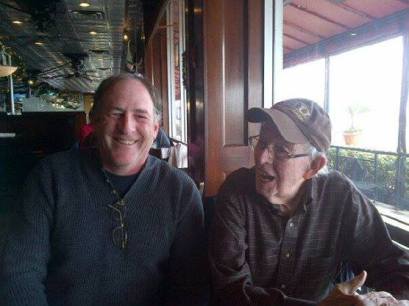
Here’s an example: Tim and I went to lunch at this same divey joint in Norfolk we always go to, and we talked. We talked about our fathers, or about something in the news. We talked about a variety of things that good friends talk about; no, we rarely talk about writing. Well, somewhere over the course of the last year I have several times talked about my dad, about how I miss him; I know Tim gets it so I don’t’ have to say much, but still, talking is always helpful. Unfortunately, my words are trite, predictable, and lazy descriptions of how missing a person feels. Of course, I’m not trying to compose a play; I’m just talking about my dad. Still, I want to get it right.

Then not too long ago I flipped through one of Tim’s books and came across this:

Missing someone is like hearing a

name sung quietly from somewhere

behind you. Even after you know no

one is there,  you keep looking back.

I could write a thousand lines about how I miss my dad, but that covers it. That’s poetry.

Anyone who listens to a lot of music knows what I mean. Some lines just say it all.

I have tried to write essays about nature, already handicapped by the vast selection of the genre from people such as Thoreau, Muir, and E.O. Wilson. In my files are dozens of starts in an attempt to finish a piece about the fall of the year and the coming of winter. Those brain receptors often click into the passing of time, the end of things, the changes beyond our control. I wrote one “epic” diatribe that might be the most bloated piece of crap I’ve ever attempted. The only way to make it more pretentious would have been to have it translated into Latin. Then Frost does this:

So dawn goes down to day,

Nothing gold can stay

Asshole.

I prefer conversations, of course. I like to sit and have a beer and talk about our dads; I like running into a friend and grabbing a bite and laughing about simple things like sports and movies. But I also like reminders of our glide across this thin layer of life.

Over the course of the past several years I found a way to handle my frustrations when I can’t find the right words to express our need to celebrate being alive. I call a friend and meet him for lunch. I head to a favorite café and have a beer and talk to strangers. Every single one of my closest friends was, at one time, a complete stranger. I walk along the water and watch the dolphins breech and disappear. I feel the coolness of morning give way to the warmth of the sun on my face.

I am surrounded by poetry.

I sat in an Irish pub in Prague once during a soccer match between Dublin and Manchester United. The excitement and roar of the crowd, the explosion of being in the moment, alive, then, ever-so-briefly, was poetry.

There was the time my friend Tom and I sat on a rock in the mountains west of Tucson and watched the sun work its way across the desert. Or that same year when Renee and I walked through a Mexican village and found a restaurant inside a cave where, incredibly, someone who had babysat her sat at another table. Or when Michael and I walked past the small sign that said “Santiago de Compostella” five hundred miles and five weeks after we left France. Or when we watched the seals at Lake Baikal.

Poetry.

Or Tuesday nights after I finished teaching and Dad and I would have some Scotch.

The sound of the golf ball dropping into the cup.

The sound of cardinals on the porch, looking for food.

Waves.

A very long hug from an old, old friend when we knew there was no reason on earth we should have lost touch.

My dad’s laugh.

His deep “Hello.”

A name sung quietly from somewhere behind you

11139373_10205989968335763_1044172444966323755_n


Walk On if You’re Walking

inthestreets-300x224

On Saturday, January 21, 2017, I sat on the foggy banks of the Chesapeake Bay in Virginia, far from the crowds of New York and DC and LA and cities across the country and around the world, where women—and men, of course—marched. In those crowds was a significant number of family members—Cathy, Jeannie, Janessa, Erin, Barbara, Fran, Tricia, Shannon, Morgan, Rachel, Suzanna, and many more—and those are just some of the women (it’s a big family).

Also on that day my Facebook feed was filled with comments from Republican friends urging everyone to get along. “It is time to gather behind our president and see what he can do.” You get the idea; comments common from both parties at the start of a new administration. They are normal, supportive words urging unity. I have never had a problem with the sentiment, until now.

Many of us who do not bend to the right did, in fact, give a chance to presidents in the past, like Reagan, George H. W. Bush, and even his son, though to a lesser degree the first time because of the nature of the decision in 2000. But again in 2004, despite disappointment, Democrats pulled it together and did their best to move forward. The same can be said of most Republicans after both Clinton wins and both Obama wins. Respect for the winner has always been a mainstay of the American public, albeit coupled with dissent.

But this time is different. The new president has proven through action and words that he disrespects women. He thinks he can “grab them by the pussy” because he is famous; he made fun of a former beauty contestant because she gained weight; he wondered who would vote for a particular female opponent “with a face like that”; and he made dangerous, unprofessional, and immature statements, such as, “We will bomb the shit out of them,” and “Tell them to get the fuck out.” His behavior is not acceptable in a classroom, an office meeting, or at a dinner table. Despite the political differences of both parties during the administrations of previous presidents, it wasn’t difficult to respect them as men. President Donald J. Trump is not, in the eyes of a majority of Americans as well as leaders of many nations throughout the world, including leaders of the Republican party, a person one can respect or trust.

Many people questioned the march. They do not understand that this was not an Anti-Trump march; it was an effort to expose unity among the women of the world to be recognized as equal. But how telling it is that people immediately associated the Women’s March as anti-Trump; when women did the same thing in March of 2015 during the Obama administration, no one claimed it was an anti-Obama demonstration. Perhaps because Mr. Trump has from his youth established himself as anti-women, disrespecting and degrading them at every turn. So, yes, in part this particular march exposed the lack of support for Mr. Trump. A real leader would have supported the efforts of everyone who marched.

I urge my right wing friends to understand that our lack of ability to quickly gather our crumbled hopes and stand behind the president has much less to do with policy than it does character—he has none. And if anyone suggests character is not necessary or even secondary for such a powerful position, he or she should study the art of nuance, of subtly, and quickly take a crash course in international relations. I cannot stand behind a man or support someone who is little more than a street punk. Quick observation: if Barack Obama made any of the comments about women and minorities that Mr. Trump has, he would have been eliminated very early on; laughed off the stage. And I would have been at the front of the mob—that behavior is unacceptable, and everyone—everyone—knows it. Mr. Trump is a bad human being and the people who marched and the tens of millions more who support them simply do not respect the man. If this were simply a matter of policy differences, anger and fear would be replaced by profound disappointment with a “try again in four years” mentality. But policy has little to do with this: he is unpredictable, crass, and too antagonistic to converse with world leaders who are frankly far more intelligent.

I understand the reaction to such rhetoric is for me to “leave the country if you don’t like it.” On the contrary, I’ve traveled extensively throughout the globe and I know first hand this has the potential to be the best country in the world, and I certainly love my homeland. So I will do what real leaders from the early days of this republic guaranteed I can do through their foresight: Protest.

Some people march, like my sister and others did this past Saturday. Some will write their congressional leaders, some will even run for office. We do what we do best for our individual contributions to this Great American Experiment. As for me, I can open a dialogue at the university to insure that at least some small groups learn how to become well informed. And while I am no Thomas Paine, I do have some common sense when it comes to writing, and I will do so. I will not attempt to challenge Mr. Trump’s policies—I do not have enough political savvy, almost as little as him. I will not attempt to suggest particular actions. And I will most certainly respect the Office of the President, while I do not respect the current occupant of that office. No, I aim to remind as many people as I can that how he acts, how he treats women, how he disrespects people of color, how he lacks decorum, grace, and character, is unacceptable, and he does not represent what Americans are like.

When he ran his own company he rightfully could act however he wished. This is the first time in this man’s life he has ever applied for a job and works for someone else—us. Yes, my Republican friends, we will, of course, honor the Electoral College and recognize Mr. Trump as president. But we will do so the same way I should hope our counterparts do so during Democratic administrations—by exposing every possible violation of ethics, character, and morality. And if anyone suggests I should not throw stones but instead I should look in a mirror and hold myself to the same standard, I have two responses. One, I try to everyday, and while I am desperately far from canonization, surpassing Mr. Trump in those areas is not difficult—the man shows no sign of humility or self-restraint and that combination is both dangerous and insulting to the forty-four who came before him.

And two, I did not choose to run for office, he did.

We are going to watch what he does every single day, Democrats and Republicans alike. We have to; it’s in all of our best interests. But he has already proven he is not up to the task of common decency. And if anyone believes his repulsive remarks and disgusting attacks on women and minorities is acceptable or excusable, then you’ve completely misunderstood the role of the president on the world stage.

I agree, my Republican BFF’s: we should all get along; we should have unity and we should see what he can do. But ask yourself this: Would you accept his behavior in anyone close to you? At the office? At home? This might be the first time in electoral history the President of the United States was held to a lower standard than just about any decent-acting human being in the most menial of jobs.

Yes, we are giving him a chance, of course. But we will march on; some on the streets of New York and DC and Houston and Seattle.

And some on the back of the First Amendment.

untitled

One Brief Political Blog

untitled

Bear with me here.

A significant number of Americans, not a majority but a vocal minority, did not like the president, thought him to be illegitimate, thought they needed a change, saw the country going in the wrong direction, did not like the people surrounding him in office, did not believe anything he said, and therefore stepped to the plate and voted him out. Some other day someone else can argue the electoral college. For now, this is reality.

I majored in journalism and studied under some of the finest old-school journalists in the business. Russell Jandoli, Pete Barracchia, and others, whose bio’s include places like Stars and Stripes, The New York Times, and more, were my advisors. I went to school and have known some of the best in the business. It is why I left journalism; I could not play at that level, nor did I remotely desire to try. But because of that background and professors like George Evans, who demanded the most accurate and verifiable sources during our research studies class, I learned how to pay attention and have the patience to check all the sources. I am proud of that background. It can also be intensely frustrating.

But it is time for that now. We have entered a dangerous age with an unpredictable leader, and historically the strongest method of keeping him in line, of insuring our Republic is not compromised, is by turning again to those well-trained and experienced journalists who provide the most accurate reporting possible. This is the worst time for sensationalism, for ratings concerns, for caring about corporate sponsorship. It is a time to trust the best among the Fourth Estate to provide us with verified information.

I hope what they tell us is we were all wrong. I hope beyond reality that four years from now I am humiliated for thinking this repulsive man would make a bad president. But if I am not wrong, it is only through true journalism that I will know.

And if things don’t go well and we think we need a change; if we see the country going in the wrong direction; if we don’t like the people surrounding him in office; if we don’t believe anything he says; we need to step to the plate and vote him out of office.

Every journalist of worth is going to sit over this man like a hawk. It is what they do best. Trust me.

images

Channeling Richard Simmons

il_570xn_759181539_75ij

When I was in high school the light switch in my bedroom was a bronze plate we picked up in Charlottesville while visiting Monticello. Inscribed around the cream-colored on/off switch was this simple Jeffersonian quote: “Freedom is the right to choose.” There was more, but the switch smack dab in the middle made it difficult to read.

So whenever I had put the light on I could read at least that part of the quote. One day I was reading that quote and the light went on. This historical trinket suddenly became current. I did not have to go to college; it was an option. I did not have to stay in the crappy job I had; I did not have to follow one career path. What at the time seemed like inevitable destinations became simple choices I could make—or not. The indirect effect of this knowledge was to quit complaining about what is not going well for me and either accept it or change it—kind of a cousin to the serenity prayer. In essence: I put myself in whatever situation might be questionable and, therefore, I can take myself out of it simply by choosing to do so. I became aware of something everybody else seemed to have known instinctively: it’s my life and I can do with it what I choose.

This comes with responsibility, of course. I don’t want to make choices that hurt others. I don’t want to make choices to satisfy me now while compromising my future; and I don’t want to make choices good only in the long run but destroy my sense of now. It’s not easy, this balance; in fact, it can be profoundly complicated. Talk about the power of language: the simple phrase, “Freedom is the right to choose,” comes with unspeakable responsibility.

In 1985 I sat on a platform next to Richard Simmons, just him and me, with about fifty mostly women from Worcester, Massachusetts, at the end of a one hour workout I conducted which Richard had joined in the middle. I turned the cool-down over to him. The cool-down was the last five minutes or so during which we motivated the people to keep at it. Richard was the best at this.

He calmed everyone down and said, “You feel trapped, don’t you.” He teared up but honestly it was sincere. “You feel like you don’t have any choices, don’t you? Your husbands ignore you. They make fun of you at the mall. You stopped looking in the mirror, didn’t you?” Everyone nodded. It was absolutely silent. He was good. A crowd had formed at the open doors to the studio. “The only time you feel in control and good is when…you eat…isn’t it?” Everyone laughed and agreed.

“You’re not trapped! Freedom is your right!” he said. “Your freedom doesn’t belong to anyone else. It is yours. It is the most precious gift you have! Don’t hand it over to anyone.

“You can choose to eat something else. You can choose to laugh when people laugh at you. You can choose to feel good about yourself. If you stay home and don’t do something for yourself that helps, it is because you decided to stay home; don’t blame anyone else. If you go for a walk, if you ignore people who make fun of you, it is also because you decided to. It is your choice. Remember that.”

I saw some lights go on in the studio; women looked up seemingly suddenly empowered.

We all stood up and he hugged everyone in the club. Everyone. I finished working that day, moved, taught college, and more than doubled my age. I walked into class last week and asked people why they chose to come to college. It was the first day and for many the first time in college. No one could answer me. I made some suggestions about the future and majors and moving forward and blah blah blah but they just stared at me. They didn’t even nod.

So I asked again: “What are you doing in English Comp?”

Almost like a chorus, their response was, “It’s required.”

I swear for a moment I could hear music coming from the studio speakers, hear Richard’s overly-excited voice bounce off the walls followed by his calm voice which reached into each person’s fears and settled them down.

I looked at the class. “No. It isn’t. You’re eighteen, at least, you’ve graduated high school. This is not required. Nothing is required of you anymore. You can be here or join the military or get a job or hitchhike to flipping Key West and serve tables at Captain Tony’s. This is a choice. You freely choose to sit in that seat this day and take this course. The sooner you remind yourself you don’t need to be here the better you’re likely to do in this course.” They stopped looking at the cell phones and paid attention.

We talked a while but I was only half-paying attention to what I was saying. Part of me thought about the times I complain about my job, other situations in my life, the conditions in the world; the sense of doom and apprehension which saturates society right now. Sometimes we don’t get to choose, or when we do it doesn’t go our way. What then? What if I DID show up to exercise but I’m still not losing the weight? What if I DO want to be in English Comp but I just don’t understand the material? What happens when even when I choose, I do not feel awash with the glory of freedom?

Jefferson wasn’t dumb. So I went back and looked up that old quote.

“Freedom is the right to choose, the right to create for oneself the alternatives of choice. Without the possibility of choice, and the exercise of choice, a man is not a man but a member, an instrument, a thing.”

Property. Without exercising our right to choose, we are not free. There is no difference between someone who is not free and someone who chooses not to exercise those freedoms.

Richard’s favorite cool-down comments were about choice. “You have two choices,” he would say. “You can choose whatever blocks your way to slow you down, or you can choose to do what it takes to overcome it. You can choose to take control of your situation, or you can choose to hand that choice over to someone else. But if you do, it is still your choice.”

I got more out of that job than anywhere else I ever worked.

img-20170116-01840

Attendance Policy

denial


The semester starts now and students will fill the classrooms ready for their lives to begin. Unfortunately, they think they can do so whenever they want. Some stroll in saying they got stuck in traffic, but they do so carrying coffee from Starbucks. Some are late because they couldn’t find a parking spot and I tell them if they got here so close to class time that finding a spot was an issue, they left home too late, and they’re never going to make it in the corporate world. I share with them Lee Iacoca’s decision to eliminate all personalized parking spots at Chrysler. He said if you’re doing the job right, you’re there early enough not to need a reserved space anyway.

Some stand in the hallway talking to some significant other about not being able to bare being without that person for another hour. Some stand up half way through the class and leave, apologizing, saying they had the wrong class even though they were looking for biology lab and I had just spent thirty minutes talking about creative writing. That doesn’t bother me, but in some other class somewhere is the student who was supposed to be in mine, and that student strolls in to my class half an hour late saying he was in the wrong class. He says when the professor started talking about dissecting a rabbit he wondered if it was creative writing after all. Ironically enough it could have been.

Please understand that this problem—showing up to class late—is chronic and widespread and over the years has gotten worse. There is recourse, however. We can count them completely absent if they walk in the door even a few seconds after we start lecturing. When they’ve missed fifteen percent of the course, including tardiness, they can be withdrawn with or without a failing grade. This rule is required to be on every faculty member’s outline. I put it on there but to be honest I don’t always adhere to it. I teach many military students, and after class, those who arrive late often show me their duty sheet and talk about a colleague who needed counseling. We learn to know what excuses are legit or not. Unfortunately, some of the tragic excuses are valid.

I really try not to be a prick. And it isn’t the “showing up late” that is a problem specifically, anyway; they can get the notes from someone. The bigger issue is their sense of individualism at a time they should be demonstrating their ability to work with others and respect them. When someone is late, that person is basically saying, “Whatever you are doing is no where near as important as what I am doing, so you’ll just have to wait.” This is true if someone is late for class, for dinner, a date, anything. See what happens if you show up late to a job interview. College degrees are common. 4.0 GPA’s are everywhere. So I like to ask my students what do they need to do in this class to stand out as someone worth recommending to another college or for a job? Because showing up on time and doing well is where the class expectations start. When they regularly show up late, they’re already not worth recommending; they’re just in the way.

And they have the excuses ready, so we have the policy. We can play with the wording how we wish, and every semester I adjust it just a little. One of the more frustrating fall semesters I noted that attendance was not an issue. I wrote that I didn’t care when they strolled in. I wrote that I know they have so many other obligations, so I wished to help out any way that I could. If they arrived late, the outline stated, I’d be happy to type up the notes and give them to them, and follow it up with individual phone calls to make sure they understood the material. I would even brew a pot of coffee, I wrote. Very few students understood my sarcasm.

But like my military students, the other students with legitimate tardiness because of kids, jobs, illness, and more, are the ones who call to apologize and usually get the work done ahead of time anyway. Those who do have valid reasons to be late are usually the ones who never are. No, it is almost always the lazy ass, howl-at-the-moon stupid ones with no jobs who live at home that show up late. One guy came in eating an Egg McMuffin saying he just woke up and rushed in as fast as he could (except for stopping for breakfast, of course). Several students over the years have reeked of alcohol. One woman showed up late, yelling, “Do you have any idea what freaking time it is?”

So this semester I’ve once again updated my course outline in anticipation of the lateness that is only getting worse. The dean of the department still needs to approve this:

Attendance Policy:

“What is so fucking difficult about getting to class on time? Let’s simply assume traffic is heavy, the weather is bad, accidents are everywhere, and the parking spots are taken. Get your ass in the chair by the time class starts or go home and come back when you grow up into a responsible human instead of an entitled little shit who thinks you can show up when you damn well feel like it. If you are late to work or don’t show up, you get fired, if you are late to class or don’t show up, you fail. Either way, F. It’s a great fucking letter. And as for your oh-my-god-this-is-the-best-ever excuse, we’ve heard it already. And no, you AREN’T paying me. You can’t come close to affording me. If you’re not ready to attend class, go in the hall, call your parole officer and say college just didn’t work out after all.”

I know the dean well enough to know she will at least want to approve this one. So I’m going to give this a shot for awhile. Now, back to the rough draft of my course outline.

I have to finish the Cell Phone Policy.

Student late for class


In Defense of Melancholy

stingray-024-2


The days following New Year’s are always the ones we inevitably balance by looking back and looking ahead at the same time. We assess and dismiss and excuse and celebrate our actions and inactions from the last year, and we resolve to act and hold back in the year to come. For me it is hard enough to do one of those things, but both simultaneously is a juggling act which makes my mind melt out of my ear. I need to process things differently than others I know. I made my resolutions and so far I’ve held to them both, so now as I walk outside where nature forgives my shortcomings, I take some time to look back. I love looking back.

I get up early in the morning by design. I like to listen to that pre-dawn stillness which in no time at all a thousand voices will disturb. I like the way the light holds off a while, almost as if it asks permission to spill across the sky. And then slowly the silence creeps off and hides behind some trees somewhere just before the phone rings, before the traffic picks up, before it is time to track time again and multitask.

I spend some of the morning looking forward to the day and some of the day remembering, but mostly I prefer to simply be present as the sun comes up and the morning flock feeds behind the oyster boats on the bay.

And I like the steady rain in the late afternoon. My son and I take pictures of the local waterways just about then, or we are home throwing the football; on those days neither of us can catch the slippery skin, but we don’t care. We are so much in the moment, eyeing down the ball, blinking at the wetness on our faces, knowing we’ll be inside and dry soon enough, soon enough indeed.

I like to walk along the river and recall a friend’s voice from college telling me everything I’m doing wrong as he loved to do, always with a laugh; or my grandmother’s voice when I called telling me she would let me go almost as soon as she answered because she knew I “had to get going.” I love how I can see clear as sunlight my father putting his fingers up to show me how much Scotch he wanted, the same amount every time. I love how I remember that so well I can still see him sitting there and hear him saying, “Just about this much, thank you” to the point I can’t breathe. Some people go lifetimes without missing their dads, cursing them for convoluted reasons. I love how I loved and was loved so that now my eyes sting. Why would anyone not want to feel this way? Why would anyone wish to avoid the sadness that comes with good memories?

If I could take only one memory with me when I move into an age of forgetting, it would be walks to the river, my son on my shoulders, the sun on my back, those moments. Or the times we went fishing when he was four, never catching a thing and never caring. Or maybe the sound of house wrens just before dawn, or the whippoorwills just after dusk. I’d like to take that feeling of an open fire on my face and the cool night on my back. Or the sound of my father’s voice telling me to sleep well. Or my mother’s laugh, the way she takes a long breath. I’d like to forget all the times I got angry, all the times I was critical, and replace them with the memories of all the times I listened to the sound of rain on the canvas awning at our home when I was a child.

I know I’ll want to remember one more time the foghorns on the Great South Bay drifting through the air, my brother and sister still asleep, my mother making coffee, my father in his bed. I take it the grand design allows we forget the minutia as we age, but I’ll salvage what I can. I like remembering the way my son laughed uncontrollably when he was two and I chased him across a field. Or the echo of the speakers at my high school football game, or the sound of cars off in the distance when my friends and I would hang out in someone’s back yard or neighborhood street on a Friday night, laughing, telling stories about nothing at all.

Sometimes now when I am out for a walk, I stand at the water and wonder where everyone is. And I look up the coast and imagine my childhood friends, now adults, sitting with their families, reading the paper, watching a movie, most likely long ago forgetting what we did when we were young. But I’m glad they’re there, just a few decades away, somehow still part of some shared history.

I embrace melancholy; I celebrate memory. This is not to say I don’t spend the majority of my time planning and moving forward to what’s next. It is just that in the early morning, before the sun has had her say, before I am about to walk into the realm of a thousand voices and the movement of life, I like to remember that it’s been a good ride so far.

The length of a lifetime from the beginning looks nothing at all like the brevity of that life from the end, like standing on a diving board terrified to leap, knowing you have to anyway for all the others lined up behind you waiting to have their chance. It’s your turn so you jump despite the fear of how far it is to the water, but when you “rise again and laughingly dash with your hair,” you look up at where you started and think, that wasn’t so far at all.

No, it isn’t far at all. Which is why while planning ahead I also like to find a friend and say, “Hey, do you remember that time we…”

And then we laugh a long time. Until we cry.

phone-march-2013-009-2

Dis Qualified

mic

A quick lesson from Journalism 101:

Experts are the individuals who have the most facts, usually gathered across multiple degrees and a long career. They are not the ones whose sole qualifications are smooth looks, a smooth voice, and, if possible, a sense of humor. The Fourth Estate demands expertise. “Fair and Balanced” is an amateur attempt at a quick Brand. It makes no sense. Real news is often not fair. Real news covers the facts, the verifiable facts, the indisputable facts no matter where they lead, and if they only lead in one direction then we all head that way. That is journalism. That is fair. Fairness is found in the research to unearth the absolute facts, not in the reporting. And balance has nothing to do with results. Thoroughness in research is where the balance exists.

I teach research methods. We discuss the best sources and how to eliminate the false ones, how to validate the authority of the source, and how to insure a phony source isn’t presenting itself as an authority. This is a challenge in a world where verification before publication is nearly non-existent.

Then we discuss the significance of knowing how to do this. I tell them it isn’t just for when someone in their future says, “Quick, write me a well-documented research paper with excellent sources.” That probably won’t happen again after college. It’s so when they’re finding the right company to work for, the best investment for their income, and the best advice on health and medical issues, they know they’re not being misguided by incomplete information.

It also helps when listening to pundits pontificate about what’s best for our country, our families, and our children. I don’t want advice from my neighbor who “also had that condition” on what medicines to give a family member. I prefer a, you know, what do you call it? Oh right, a doctor.

And yet, honestly, most people are doing just that: taking advice from people who are more qualified to grow vegetables than they are to suggest who should run our country. These fools have thrown a damp blanket over true journalism, which insists upon validation of all sources. In essence, the most popular disc jockeys in the country, they call themselves commentators, are making everything up as they go.

Sean Hannity is a conservative talk show host who discusses political topics and influences millions. His education? He dropped out of NYU and Adelphi. It was his radio experience that enabled his charismatic presence to cover for his lack of expertise in anything he discusses. In the world of Mass Communications, he is not a journalist, though he plays one on TV.

Rush Limbaugh is another conservative talk show host discussing political topics and influencing millions more than Hannity. His Education? He dropped out of Southeast Missouri State University. His radio experience enabled his smooth voice and sharp wit to cover for his lack of expertise in anything he discusses.

These two have absolutely no background or degrees in journalism and how to verify information properly, or political science, or any experience in either politics or journalism beyond being disc jockeys with opinions.

We simply don’t need another DJ.  

Here is a disturbing example: Mike Savage has written multiple best-selling political books supporting his commentary as a syndicated talk show host, though his three degrees are in botany, medical anthropology, and nutrition. He is not a journalist, not a political scientist, and not funny.

Thom Hartmann, as well, is one the most successful progressive talk show hosts as well as a business mogul, but his degree in Electrical Engineering from Michigan State didn’t qualify him for the multiple best-selling books he has written about politics. That came from his popularity in a completely unrelated field, broadcasting. Hartmann, like the others, used his popularity to present himself as an expert on politics, instead of the true experts who become popular because of their authority on a subject.

And these same DJs are the same people who lead the masses in knocking Main-Stream-Media. Let’s have a gander at a couple of the more popular commentators these other frauds have attacked: Chris Cuomo is a lawyer who is the brother and son of NY State Governors. Megyn Kelly, most famous for being ridiculed by President-elect DJ Trump, has a political science degree from Syracuse and a law degree from Albany. Come on. If you want to know what might have the worst effect on your future when congress changes laws, who do you consult? A botanist? Two college dropouts with no experience in either law or politics but managed to stretch a college DJ gig into a career because they have good voices? Or a lawyer with a political science degree; another lawyer whose family has been in the governor’s house for decades?

To teach at a university, you must have a terminal degree in the field you teach. I teach writing, as such my undergraduate degree in journalism, as well as my second graduate degree in creative writing directly informs my instruction.

This is a no-brainer. My brother-in-law, for instance, is a well accomplished tenured historian at Temple University and author of multiple definitive volumes in history, but he can’t teach chemistry. No one no one no one at all, no one at all, anywhere—no one—questions this. And education is not the only occupation which requires employees be learned in the areas they work. The oil industry hires scientists in their research and development divisions, corporations mostly rely upon those with an MBA to handle their financial plans and investments, and very few marketing directors have a degree in criminology.

But unfortunately, what you need to be qualified for a particular job is no longer clear. If you’re going to manage a health club, should you be an expert in fitness? Management? Business? Nutrition? Any one of them would be effective but only one of them would not be sufficient. This is why people often work in teams, staffs, faculty.

Administrations.

Can you imagine an entire staff at any business or office where none of the staff has direct experience in the field? Inconceivable. Can you imagine what would happen if the people consulted for the most important decisions were not experts in research and investigation but instead radio personalities or billionaires with experience in a completely unrelated business?

You get the picture.

So how do we understand the dangerous trend in recent years to dis an individual’s outstanding qualifications for something more appealing, more Reality Television-like? Facts never used to be so pliable; truth came after excruciating research and triple-checked sources. Informed individuals stood down when that research showed them wrong. Trust was a given.

The same criteria used by many people in this country to choose a president would not get them a passing grade on a research paper in a freshman composition course. Misinformation is childish. Incomplete information is embarrassing.

And inexperienced, uneducated, unqualified commentators are not journalists, they’re not advisors and they’re not looking out for our best interests. They’re simply dangerous.

phds


Dad’s Books

michael-cell-number-2-472-2

I have a collection of books I received on Christmas nights through the years. All Creatures Great and Small by James Herriott, A Walk Across America by Peter Jenkins, Bound for Glory by Woody Guthrie, Robin Lee Graham’s Dove, and more. Of course, Christmas morning was filled with the normal toys, candy, clothes, sporting goods, one year a bike, a guitar another, a whirlybird which my Uncles commandeered for the day, and many more memorable gifts. Honest to God, we were very lucky; it was an awesome childhood.

But the books have a different history. While Mom and Dad collaborated in many things, like in most families my mother was Santa when it came to shopping, wrapping, hiding, and organizing the gifts. She went to great lengths to make sure she spent exactly the same amount on each of us. And while I really don’t think we were spoiled, mostly because our parents made sure we appreciated everything, I also don’t remember ever thinking there was something I was expecting but didn’t get; that is, I was never disappointed. Yes, Mom did well. On Christmas morning as we unwrapped our presents, we’d make sure to say, “Wow, thanks Mom!” even on gifts we saw coming. By the end of the morning, though, we’d make sure to also throw in “and Dad” to the thanks, but he didn’t mind when we didn’t, ever.

And like in most families we drifted into that quiet period after opening gifts when we were engaged in our new items, and Mom was getting breakfast ready as well as dinner for the company which inevitably filled the house. Dad would read the paper, and Christmas, which really started when we returned home from Midnight Mass, would do its magic.

But later in the day after everything settled down, Dad would emerge from some quiet place and have a stack of gifts for us, chosen, purchased, and wrapped by him alone.

Books. It was amazing how he seemed to know exactly which ones to choose, and I don’t remember him ever asking what we were interested in. He just observed and took it from there. He’d hand us each a book he had signed inside with a “Merry Christmas, Love, Dad” and the year. I don’t remember when the tradition started but it had to have been early since one that I received was The Boy Who Sailed Around the World Alone, which is the kids’ version of Dove. I wasn’t yet a teen.

As the years went by we came to anticipate the books earlier in the day, though he usually held out. There were some exceptions; like one year when he gave us each money. I bought Illusions by Richard Bach and asked Dad to sign “Merry Christmas, Love, Dad” in the book anyway. Another year he replaced the books with Broadway tickets to see Katherine Hepburn in “West Side Waltz.”

It became my favorite part of the day. It wasn’t just the books, though. While I cherish the memories of Christmas evenings on the couch or stretched out on the floor with our books, it was also a specific moment I got to share with my father and keep up on a shelf . 

I have kept the tradition going since my son was born. Winnie the Pooh, Curious George, Hamlet, anything by Dr. Seuss, Charles Schulz, or Thor Heyerdahl, and more fill his shelves. We really do formulate our lives based upon what we’re exposed to growing up. Michael has the kindness of Pooh, the curiosity of George, Schultz’s sense of humor, and Heyerdahl’s sense of adventure. Go figure.

I try and wait until the end of the day, but it doesn’t always work out that way. Now I understand that Dad didn’t just give us books; he gave us his sense of understanding, of knowing, of remembering and anticipating. When I look at the books Dad gave me, they absolutely anticipate my life—music, adventure, the sea. What did he think was going to happen with a list like that? Actually, probably exactly what did happen.

As the years moved on and we all moved out, we started giving him books; he absolutely loved reading. We had to coordinate sometimes so we didn’t get him the same one, and I don’t think we ever did. He received volumes about Brooklyn, about baseball and golf, about history—one of his passions. The last book I bought him was a first edition copy of John Grisham’s first book, A Time to Kill. He loved Grisham’s work. That book is on my shelf now alongside the books he gave me.

I thought the book exchange between Dad and me would end, but they have not. I can’t give him books anymore, so I write them. When I started working on a book about Michael and me training across Siberia, I knew it was going to be framed as a series of letters to Dad from me about our trip. Several pieces have already been published but I have a long way to go. I want to get it right. I want it to be a book he would have bought for me, signed, wrapped, and given to me late in the day, just when I thought I was getting tired, when his gift would wake me up and send me on some adventure well into the night.

Merry Christmas Dad, Love, Robert

books_with_bow

“Has this ever been published?”


siberia-phone-316

An editor who reads this blog wants to publish one of the entries from much earlier this year. This is not normal. Anything “published” is generally not considered for publication by someone else unless it is an anthology of some sort. Material published in blogs—really anything online, including Facebook—is considered published. Period. This is why for the most part when I am writing something if I decide it has journal/magazine/newspaper worthiness, I don’t publish it here.

In fact, I have several categories of writing. There is the “blog” file, which includes material more akin to a diary entry than any essay I would attempt to convince an editor to consider. Usually the material is too provincial or “me” driven for wide appeal. I try and make most work relevant to more than my ego-driven world, but when they really remain little more than observations and digressions, I file them for the blog.

Then there is the “reading” file. These may include publishable work that is not yet ready to be published, but more often includes “bar” driven work which hopefully never will be published. The latter is crowd-driven and doesn’t always translate well to the page, despite the popularity at a reading. One example is a piece I wrote about a language mishap with my mother at the airport. On paper it doesn’t work because you can see the punchline coming.

The “in progress” files are those that I have every intention of combing through and sending to journals, magazines, and newspapers. They don’t all get finished, let alone accepted, but these are the ones with potential. This is why you’ll rarely see me write about Siberia or Spain on this blog—that material is still in the “in progress” file for future publication elsewhere. Maybe. Hopefully. 

I have a “great line” file, filled with notes of, well, observations and digressions, which may or may not end up in any of the above publications. This often also includes lost grocery lists and to-do lists from my office. I found my license in this file once. 

Sometimes crossovers occur. One morning last May I sat at Panera and blogged about my trip to Arlington National Cemetery. Within minutes of hitting “publish” I reread it and thought it might be good enough for a newspaper and sent it to the Washington Post. About ten minutes later they accepted it and asked if it had ever been published. I went back to this blog, deleted it, went to Facebook and LinkedIn and deleted any reference from those sites, and wrote back and said “of course not.” Luckily their acceptance was only minutes after it appeared on here so only a few people might have read it. And recently, I heard a story about one young woman who was accepted in the New Yorker, a game-changer for any writer. Unfortunately, her mother or someone she knows was so excited she published it on Facebook, and the New Yorker pulled the piece. That makes my stomach hurt and it wasn’t even me. Stories like that are why writers are a bit protective of where the work goes. The definition of “published” now seems to be anywhere that is beyond a writer’s own computer.

Still, this is the first time for me that a publisher read the blog and wanted to put it in a journal.

Hopefully none of these distinctions reflects quality. The real file breakdown for me is more content driven. If something has content with broad appeal, I’ll work it for “other” publication, so that isn’t an issue. Still, content often tells me which file it goes to.

I like to think this blog is akin to a few of us sitting around a table at a pub long after most people have left, and the conversation moves from hysterical to ridiculous to some philosophical point, where we are savoring the last drink and take whatever we were talking about and, well, digress. This makes the writing more personal and, hopefully, more universal at the same time. In the end, the best stories cannot be recorded. They must be lived. It can be a hard balance for this writer between “living” my life and “writing” about my life. I tend to bend in favor of “living.” There is no file for that, so some stuff just won’t end up anywhere.

Sometimes my son and I will be out taking pictures and note how the absolute beauty we see just isn’t being translated in pictures at that particular time. With the eye it is indescribably brilliant, but the shutter speed and F-stop just didn’t do the job. Writing is like that. Some subjects cross my mind when I’m out for a walk and I can’t wait to write about them. But when I do, they fall embarrassingly short. Like how grateful I am to be able to spend so much time outside; or how much I miss having Scotch on Tuesdays with my dad, or how much I want to pick up a phone and call my friend Cole, or Dave, or Trish, but they’re gone, and I can never correctly capture the emotion which falls between grabbing the phone and putting it back down.


messy-paper-164668

News Cycle

spring-2012-skies-080-2

This past Sunday morning I listened to the news while I drove home from a village across the river. No wonder I am on blood pressure medicine. People argued over the choices of the transition team for the new administration. An NFL player was shot and killed during a road rage incident. An Oakland resident complained about the response time of the paramedics to a deadly fire. Protestors in North Dakota waited for reinforcements from a group of veterans. Political analysts all agreed at the dangers of a pre-inauguration phone call to Taiwan. A man from Nevada did very well on the quiz show with NY Times Crossword Puzzle editor Will Short. Oklahoma State lost.

I turned into the driveway and wound my way through the four hundred feet of woods to the house and remained outside all afternoon. I found myself in desperate need of a little peace of mind. It seems the seasonal changes in nature are the only persistent and predictable aspects of life. When I am in the woods or walking along the water, I could as easily be ten-years-old as fifty-six, and it could as easily be 1969 as 2016. I could be on Long Island, or in central Massachusetts, or here at home, finishing off a cup of tea on the porch as wrens come and go for safflower seed.

Yesterday the sky looked like it might snow though it was in the fifties. It had that low gray layer of late autumn haze out over the bay so that I could look right at the sun. It was pale yellow, almost a mere shadow of a glow. Just a few days ago the sky was so deep blue it was as if there couldn’t possibly be a storm anywhere in the hemisphere; one of those days. As far across the bay as I could see, and to the west up the river, nothing. Not a single disturbance moved the water or the trees or even the marsh-reeds, which tend to bend at the slightest brush of breeze even when a heron takes flight.

So I stayed outside all day yesterday. Mostly I raked, but I also moved planters around, piled empty pots behind the garden shed, and cleared off the trail in the back woods where deer bed down at night, and at dusk a fox always scurries around waiting for Michael to toss some leftovers into the brush. The oaks are nearly bare, except for a few that keep their leaves until spring. This land has mostly hardwoods, so the view above isn’t impeded anymore, but down at eye level an abundance of holly keeps the property green all year. The laurel, as well, remains, and a little higher up the thin pines stay green.

It might snow this year. It seems every year snow falls more regularly. Three years ago it snowed so much I don’t remember it clearing out enough to see the grass until well into February or March, which for this part of Virginia out on the Chesapeake is unusual. I’ll take it, or the heat, doesn’t matter. Ice cold hands from doing work without gloves or a back covered in sweat in August are equally satisfying. I like being in nature, wearing it, letting it penetrate beyond the visual so that all of my senses come to life.

From my perspective in these woods, whether the view be unobstructed across fields and waterways, or blocked, able to see only the nearby thicket like shadows on the wall of a cave, it is a beautiful world; despite the news today we live in a beautiful world. While humanity votes in and casts out, the natural world bends and turns and spins and thrusts itself forward in endless revolutions of perpetual next. This country is still an infant, despite what we call history as well as histrionics. It teethes on change and feeds on self-indulgence. To be fair, it always has.

But this country, where the river has ebbed and flowed for tens of thousands of years, and the watermen still cross the reach each day before dawn like their great-grandfathers did, is stronger than any news cycle. Here in the early morning a channel marker rings and the oyster boats return to their docks by the time the morning news anchors have poured their first cup of coffee and sign on to keep us informed about what is “important.”

I have no argument in nature. I have no sense of conflict. The paths are not compromised by a lack of decorum, the deer are not prone to an absence of character, and the osprey and eagles which frequent these skies do not suffer from questionable integrity. Nature is neither crass nor belittling; it does not lie. The trees remain firm in their convictions, the birds—with one exception—do not mock other birds, and the skies, whether cloudy or clear, have no ulterior motives.

leaves-012-2