Scotch and Water

backyard

It’s the 21st. I miss my dad. 

As odd as it may seem, it isn’t simply “my father” in the paternal sense that I miss; that’s an abstract we all understand.  If I tell someone I miss my father, the response is normally a generic, “Oh I bet.” or “I understand.” I am not a fan of vague comments or emotions. So it isn’t that I “miss” my dad; it is the small things that rip at my seams, like seeing someone eating a bowl of blueberries or a cup of she-crab soup, the sound of ice in a glass, someone jingling coins in his pocket, baseball. The sound of golf on television, the aromas of Thanksgiving Day, the opening theme music for “Law and Order,” lunch specials at boardwalk restaurants, cardinals in spring…

On Tuesday nights my dad and I drank Scotch. Dad always liked J & B, a blend to which he probably became accustomed early on. On occasions he drank Chivas, aged just right, and a few times he had a bottle of Edradour in the house. On Tuesday nights we poured two glasses on the rocks. Routine is important and I’d get there about nine and was no sooner in the door when he’d jokingly say, “My coaster seems to be empty,” or something similar with a laugh and a welcoming smile. I’d put my things down and offer to pour, and he’d insist he was just fooling and didn’t mind at all getting our drinks. He would walk in the kitchen and I could hear the cabinet and the ice and the heavy bottle he put back in the cabinet, never leaving it on the counter for more because we never had more. He’d return steadily and slowly and hand me my glass and we’d raise them to toast and he’d say, “Well,” nodding his head politely at a loss of words, and I’d interrupt and say, “to your health,” to which he would again nod and with his deep voice reply, “and to yours.”  Then we’d watch baseball, not really talking much. It was late and we were both usually tired. He sipped his Scotch.

But I don’t like Scotch, so I preferred to pour. When I won the politeness contest and he sat in his recliner while I went in the kitchen, everything was the same but instead of Scotch in my glass I had mostly water. Dad’s eyes had faded in those last few years and he wouldn’t have noticed the lighter tint of my drink. And anyway, it wasn’t about the Scotch. We sat together a long time those Tuesday nights and he would turn once and say, “Boy this is good, isn’t it?” and I’d agree. Sometimes I felt guilty and would pour a bit more for myself as well, but usually only when it was a single malt. After a while he would head upstairs to bed. Then I’d sit alone in peace after a long day, but inevitably I’d wake up and wish he had stayed up longer even just to sit quietly. I’d promise myself that the next Tuesday while drinking Scotch I’d make more conversation, talk more about the game or about my day or anything really, since he wouldn’t have minded even turning the game off, but the following Tuesday would come and like clockwork I’d be silent and he’d be tired and we’d watch baseball and he would go to bed. It was always fine.

My father aged well, and sitting with him on Tuesday nights was the purest time I had during those days. I can still hear him saying, “My hand feels very light,” or “Sure I’ll have a small glass,” even while my coat was still on, and sometimes I can recall it with a laugh, but other times, when I stop in at night and his chair is empty, the television off, it is too real to think about.

When Dad first retired I’d bring his toddler grandson to the mall where Dad walked in the afternoon and we’d “run into” Grandpa. I never promised either my father or my son we would meet so as not to disappoint either if we didn’t. But when we did, nothing could distract Grandpa from walking around at the apex of three generations. Dad’s smile exploded with happiness when he watched his young grandson run toward the toy store, or when we stopped for ice cream and Dad would pretend to lick some of my son’s cone. The two of them would laugh hysterically until my son offered him an actual lick, which Dad always refused with a strong, “Thank you very much.”

Once it really was an accident, meeting Dad at the mall. On that occasion my son and I walked around and discovered Dad sitting on a bench, taking a break. His face lit up, of course, when this small boy ran up to him. So did mine. I always wished that had happened more often. It was as if an ordinary day of routine was suddenly cracked wide open by this small but exciting surprise. I avoid thinking about that too much, about not doing that more.

I believe the spontaneity of unexpected meetings must have made it seem more like my own youth, when siblings and cousins and countless friends lived close by and visiting was normal, and running into each other at the store was an ordinary occurrence. Dad missed those times when relatives came by on a regular basis; he lived for family. So sometimes seeing his grandson at the mall was a beautiful mixture of possibility and recollection.

When that did happen I would often hang back as we walked so it felt to both of them like they were alone. They discovered the stores together and Dad always allowed his grandson to pull him into the ones he wanted, namely the toy store or the bookstore. Dad bought more than a few books on those visits.

Somewhere in my attic is a box of those books from those days. I am glad we kept them, though I have no intention of looking in the box. I thought of those walks when he died, about our lunches at the beach, about watching baseball and playing golf. After the funeral we all went to a restaurant, and my now adult son ordered Scotch. Perfect.

Perhaps when I become a grandfather, my son will take those books with him—I am sure of it. And when I sit somewhere with my own grandson on my lap to read to him, I’ll picture some inconceivable moment in the past when my father and my son laughed hard together turning the pages, and I’ll think about the passing of time and the persistence of memory. I’ll offer to pour a Scotch for us, and my son will insist I stay seated and he’ll retrieve them himself, knowing, of course and without offense, in that particular instance, it is my own father I’ll be thinking of.

ma

Do You Copy?

ff8b15a1781cc03656d9d7eaa51c78df

Three students plagiarized papers I graded this weekend, and it reminded me of what has become a classic story around the college from some years ago.

I gave an assignment in October of 2005 asking for students to dig into their memory and write five hundred words about September 11th, 2001. I wanted them to reflect on what will remain one of the most significant days in our lives. When the attacks occurred, these students for the most part were about fifteen, so as early teens they had very guttural, organic reactions. How, I wondered, do they remember that day? I thought it was a good assignment—a specific event but a vague enough request for them to wander where they wished. One student wrote of her aunt who never made it out of the South Tower. Another wrote about her sense of horror and disbelief, which, she wrote, she could never correctly capture on paper. Several actually commented they didn’t think it affected their lives at all while others spit out what they kind of paid attention to with one ear from local television reports—about heightened security, conspiracy factors, the indescribable loss of life that spontaneously erupted on TV that morning. But one student’s piece caught my attention. He wrote, in part:

In a way, September 11 demonstrated, more than any one phrase can contain, the strength of our Constitution. The day became the beginning of a new era of the democratic process, and the definition of how we will defend our liberty, maintain our principles and remember our purpose—to stand as an example of humanity’s potential. It was Memorial Day. It was Victory Day.

I read this with amazement. No student, I thought, could possibly be that stupid. While I admired his choice, I remained baffled by his idiocy. I asked for the rough draft and received exactly what I knew I would: A similar, hand written version with some words written differently and others crossed out.

“You plagiarized this,” I said, which, understand, is rare for teachers to say. We receive copied material all the time, but nearly never have enough proof to say, directly, “You didn’t write this.”

“I didn’t plagiarize that!”

“Yeah, you did.” My small laugh, I think, pissed him off.

He continued to challenge me. Normally, plagiarized papers frustrate faculty members when they know an assignment was plagiarized—either from another student or from one of the many web sites offering papers for sale— but can’t prove it.

“Yes, you did. Tell me why I shouldn’t kick you out right now.”

“Because I didn’t plagiarize it.”

“Okay, I’ll tell you what. Go do some homework. I want you to bring me a copy of the original. If you do, I’ll let you redo the assignment without penalty.” I figured the embarrassment enough would be sufficient.

Once a student turned in a paragraph she plagiarized from our own text. Another time a student turned in a paper right out of the psychology textbook assuming I wouldn’t recognize that his in-class writing had the ability of a seventh grader and the essay he turned in was written by Freud.

I Googled  the term “college papers” and found the top ten of about 4,750,000 sites including essaytown.com, papercamp.com, duenow.com, term-paper-college.com, schoolsucks.com, chuckiii.com and, my favorite, smarttermpapers.com, where on the home page they offer “custom papers” with the following guarantee: “A 100% original document based on exact requirements given by you!” What is bothersome is their promise that “all writers hold at least a master’s degree.” But my favorite highlighted guarantee is that “all papers are plagiarism free—we use a plagiarism detection program to ensure that all texts are original.” When I tell my students that the papers are plagiarized the minute their name is placed at the top, they don’t really get it.

When students plagiarize and I know it but I can’t really prove it, I have to decide if I am to bluff and call them on it, spend time doing research to try and find the original source, or, since all writing is subjective and can be criticized, rip it to pieces anyway giving a C or D to the student who worked so hard at finding a professional piece that met my requirements. I did that once and the student, without thinking, exclaimed, “But this was in Time Magazine!”

I had a student once complain I didn’t accuse her of plagiarizing. She said she thought the work was brilliantly written and that she was convinced I would demand of her the origin of the information. Some are that good. Some papers are so moronic I pray they were plagiarized just so I don’t have to believe one of my students wrote that shit. A paper I received once had the same page printed three times. When I pointed out the mistake, he said he couldn’t think of anything else to write but knew the paper had to be 800 words so he just copied it a few times. I started to tell him that was not a good idea and he interrupted complaining of the requirements and how I am being unreasonable.

The student with the plagiarized paper returned. “Ah, did you find it?” I asked when he came in and tried to sit down without looking at me.

“No,” he said, as I knew he would.

“It’s okay. I brought a copy. Shall I read it to you?”

“No.”

“Great! Here goes:”

 “Hey, it’s from the Virginian Pilot! Well, let’s see:

“’There are still no words for September 11’ by…”

“Oh my god, Dude, should I go on?” He laughed a little at my sarcasm because he knew what came next and because, really, it’s so laughable.

“’There are still no words for September 11’ by…” I stopped and looked at him.

“You’ve got to be kidding,” I said.

He spoke quietly: “I didn’t know you wrote it.”

17955168-a-vintage-pen-on-a-handwritten-paper-Stock-Photo


Ptolemy’s Ghost

grass

We looked at the stars again. I don’t know their names and no matter how many times I read about them or someone explains them to me, that part of my brain simply doesn’t operate well. I know Orion because of the old Orion Motion Pictures; that’s it. It is the same part of the brain that doesn’t allow me to remember names of students or division meeting times. And the truth is, I don’t need to know any of that information. I know the faces of my students; I see hoards of faculty heading toward the same room around lunchtime and I follow them in, and I look up at the brilliant miracle of science spread out across the heavens. Who needs names?

Some nights the temperatures are freezing, but that is usually because of no haze or cloud cover so the stars are even more brilliant. With the small scope we can see the rings of Saturn and four of Jupiter’s moons. We’ve also seen Venus and Mars, and a herd of constellations that start with a P or a C, I forget. One of them is Pleiades, I know that. They are the seven sisters, which alone made me shiver and go back inside.

I do know the big dipper when I see it, and once I saw the Southern Cross a long time ago on a continent far, far away. I assume the really bright star I see often in the south is either Alpha Centauri or Vega, but I really don’t care one way or the other. I’m not going there, teaching astronomy, or trying to impress anyone at all. I did take an astronomy class in college, and on one cold night we took a powerful telescope to the hill inside the cemetery and took turns scanning the sky. When it was my turn I said, “This is out of focus; it’s all fuzzy,” to which the professor looked and exclaimed, “Holy Shit you found a nebula!”  My roommate said, “The Marvel Comics alien superhero??” The professor laughed then told me I didn’t discover one but I did point the telescope toward a fuzzy patch someone else had discovered. Cool. I’m not unromantic—I wasn’t oblivious to the idea that I was staring deep into space, across billions of years ago toward eternities from now.

I can’t wait for clear nights at home when we can see stars in the darkness across the bay or the river, but what I enjoy looking at the most is the moon. I never tire of staring at the craters, especially when it is a half-moon, which makes the craters so much easier to see than when the moon is full. Michael will point the telescope toward Saturn’s rings or Jupiter’s moons and I’ll say, “Yeah, nice, now let’s look at our moon again.” He always obliges, but I understand why it isn’t as important to him as it is me.

In the late sixties I was just another kid like so many caught up in the space race, following the Apollo missions as they came close to the moon, orbiting it, sending back images of its surface. I had a brown jacket with a NASA patch sewed on the sleeve and an American flag on the other. I knew every aspect of space travel—the speed needed to exit the earth’s gravitational pull, how the Saturn V rocket was built, the space inside, the Space outside, the purpose of each mission, and the names of every single astronaut.

I turned nine in July of ’69 and we just moved into our new home. I remember my sister sitting on the floor and I joined her as we watched Walter Cronkite dictate the actions of Neil Armstrong and Buzz Aldrin while Michael Collins orbited above them. The next evening I remember going outside and looking up at the sky, knowing they were up there and wanting more than anything to go there someday.

That dream faded, but not the spirit of the dream. Maybe because it was the first serious ambition I remember having other than wanting to be a baseball player or an ice cream man. I wanted to train at NASA and be an astronaut. Of course. It wasn’t because I liked the science—my brother is the scientist in the family. No, it was because I like the ambition of it all, the pursuit of something seemingly impossible, literally otherworldly. Even at nine it meant to me that despite the turmoil of the sixties we still kept our eye on the ball and refused to believe we could not get there. I am not sure the succeeding generations have a comparable ambition, at least not one as grand. Mars? Someday. Not yet.

So my son and I often go out and look at the stars and the full moon, and whenever I do I have hope again, despite the problems with the Russians (like in ’69), or bad race relations (like in ’69), or protests on campuses (like in ’69). It seems we have lost that spark, just a bit, and that’s okay for people like me who had that time, had that foundation of combining dreams with plans, ambitions with determination, like NASA did when I was young. But I wonder what the nine-year-old’s today turn to for that lesson of hope, that example of integrity and focus. What field do children’s fathers bring them to just before sundown to sit on lawn chairs and wait for what happens?

Humanity needs something larger than itself to shoot for. We can over-focus on tragedies and deceptions, leaving us the impression that today’s headlines are the beginning and ending of our existence. In the midst of such madness, striving toward an almost impossible ambition provides the perspective necessary to keep moving forward, to keep hope, to keep enough integrity to recognize we can do better than this. The greatest minds combined in the history of humanity have not yet figured it all out; but the pursuit itself was their purpose. We have focused too close to home for our goals, aiming merely to achieve; what a disappointing ambition.

Maybe too many people think everything’s already been discovered. I’m sure others felt like that every step of the way from the Dark Ages through the Renaissance. And for the record, it wasn’t Galileo who first mapped the moon after seeing it through his telescope. That inaccurate historical note goes to Englishman Thomas Harriot who mapped the moon in July of 1609 several months before Galileo; 360 years nearly to the day before my sister and I sat on the floor and watched Neil Armstrong step down onto the lunar surface.

Can we reach the stars someday? Hell, I can’t even name the damn things, but I’m glad someone smarter than me is mapping the way. It was U.S. astronomer and pioneer of Dark Matter, Vera Rubin, who noted the discovery of the far reaches of space more than anything else should teach us humility. We all could use a little humility these days, some reminder that we are at best merely guests here, moving through, making room for others hundreds of years from now to look up at the skies and marvel at the nebula, be amazed again at the craters on the moon.

lunar-eclipse-sep-28-2015-michelle-wood-1


O’er Moor and Mountain

cole

I am selling my art.

I love art and have been surrounded by it most of my adult life. But I like to make left turns, and sometimes doing so means adjusting various aspects of life. And for me, now, it means selling art, making room for other things, and pursuing a much larger ambition for which, now that I analyze it, the art work was an investment to begin with. Time to climb out of this lane and onto the next level.

I teach a course at Saint Leo University called “Journey’s of the Narrative.” It is about the odysseys we find ourselves on in life, with historical as well as literary references. I loved bringing in my copy of Homer’s Odyssey, translated by Pope, to show them something other than electronic (that piece of art is not for sale). We talked about pilgrimage, about journey, about pursuits. And we also discussed trials and tribulations met along the way.

Last night we discussed “character flaw.” The conversation moved from Odysseus to Don Quixote to Santiago of Old Man and the Sea and Alie Fox of the Mosquito Coast.  Pride seems to dominate, some vanity, a little bit of delusion. I asked which character they most related to. The guys chose Santiago, mostly because of his persistence and stubbornness, plus they are mostly NAVY retirees. The women chose Louise of Thelma and Louise (no one chose Thelma, who I think was the stronger character). One woman chose Alie Fox, saying she could totally see herself chucking the “dying American way of life” and carving out a new existence in some jungle until she happily lost her mind.

I always choose Cervantes’ most famous character. I don’t mind tilting at windmills. I have no problem with self-deception. I know someday someone’s going to hold up a mirror so I can see my character flaws, but until then the quixotic ways of life have worked for me. I think my most recent dynamic moment came when I realized sometimes we establish one way of existence for the purpose of moving to another. It’s time for what’s next.

So I’m selling my art. On the one hand it is symbolic–the art work represents a professorial collection of beauty and accomplishment. On the other it is practical–I need the money to fund what’s next.

And what’s next?

I can’t say, really. No, really. I have no idea. I just know I need to climb on the donkey and work my way up whatever new hillside I come across. I saw a lot of windmills in Spain; maybe I’ll go to Spain. That seems appropriate. 

You know it can be just as stressful knowing what’s going to happen down the road as it is not knowing at all. If I back up, four years ago I had no idea the Camino de Santiago existed; since then I’ve walked it with my son, am going to again, and written several articles about the journey. It has, in fact, realigned my life in a way. Two years before that the idea of riding the Trans-Siberian Railroad was a punch line to an outdated joke, but not only did we ride the long version, my next book is about the journey (well, not really..it’s about fathers and sons kinda, or more about the journey theme again, but that’s not right either). 

Our lives are riddled with examples of left turns and roundabouts we never anticipated but later can’t fathom life without them.Richard Jones was working with tension springs when one of them fell to the ground–the slinky. George Crum was a chef in Saratoga Springs who got pissed off when a customer kept sending back her potatoes because they weren’t done enough, so he cut them really thin and fried them to a crisp. She loved them, he made them a menu item, and potato chips were born. My favorite is the Kellogg brothers who left a pot of grain boiling on the stove for way too long and the dried up mess became corn flakes. 

George Halas played outfield for the Yankees but hurt his hip. He was replaced by two new players–Sammy Vick and Babe Ruth. Halas’ injury made it possible for Ruth to get game time every day, but it also enabled Halas to start the Chicago Bears and become one of the greatest football coaches of all time.

You never know. Maybe I’ll coach football. Maybe I’ll buy a slinky. I think I left something boiling on the stove. Who knows what might happen. My car broke down in the parking lot and I got a job teaching  college. I sold some of my art collection and….

How far down the road can you see? No. This instead: Just how far down the road do you really want to see?

quixote


On a More Serious Note

14th-street-pier-ash-wednesday

If nothing else, I can count on nature. I have always thought that way, that if everything else were to fall apart, I can walk and watch the water ebb and flow, the changing leaves, the wildlife. It brings me peace both being there and knowing it is there, a foundation of sorts, the original “space” before the deluge of humanity. I’m okay when I am there. It is honest.

I was telling this to someone who asked what I do when I get depressed or feel hopeless.

I head outside, I said. And I really never feel hopeless because I chose a long time ago not to put my “hopes” in other people’s hands. Sure other people will determine how successful some of my life is, whether job opportunities or writing or even relationships, but “hope” I insisted, is best sought internally and not motivated by external approvals.

I’m not qualified to talk about this, I said. We were walking to the counselor’s office. It was windy but sunny and warm.

Back up:  

Langston Hughes wrote a short poem which reads:

                                                   The calm,

                                                   Cool face of the river

                                                   Asked me for a kiss.

I write that on the board for my creative writing students and inquire what they think the title is. I let them read it a few times and think about it. Titles are amazing; they can not only reveal content for the reader before the piece even begins, they can also completely change the tone and direction. In this case, the normal responses include “Swimming,” “Intimacy,” and even “Ego.”  Only a few ever come close to the poet’s intended tone.

Hughes’ title is “Suicide’s Note.” Go ahead, read it again.

It makes sense really. People contemplating suicide most likely don’t see it as violent or offensive or even hurtful, but simply a sense of peace which awaits. If death provides their only conceived escape, then no matter how violent that death is, it pales in comparison to the hurt hurled at them on a daily basis, even if that hurt is misconceived; it is real to them. It is not a matter of a “bad moment” in their minds. It will not pass, in their minds. It will only get worse, in their minds.

Gwendolyn Brooks, in her poem “To the Young Who Want to Die,” wrote:

                                                Sit down. Inhale. Exhale.

                                                The gun will wait. The lake will wait.
                                                The tall gall in the small seductive vial
                                                will wait will wait:
                                                will wait a week: will wait through April.
                                                You do not have to die this certain day.

Someone contemplating suicide might argue this.

I became interested in Vincent van Gogh when my friend Cole Young gave me his complete letters. In them, two particular contradictions caught my attention. One, van Gogh was despised by so many who knew him; critics and artists alike thought his work to be trash; he was a complete failure—but he went on to become one of the most influential and celebrated artists in history. And two, he wrote extensively to his brother about the beauty and grace and gift of being alive, yet goes on to kill himself. On the one hand he had many afflictions, including chemical imbalance, which might have led to such an ending, and further it has been suggested he didn’t kill himself at all but local teens shot him. In either case, he told his brother who was at his side in those last hours that he wanted to die; that “death is not the worst event in a painter’s life.” I was curious so I read much about depression and suicide, including William Styron’s beautiful, personal work, Darkness Visible.

I don’t know about depression as a disease, nor am I prone to it. But friends of mine certainly are, and many members of the military whom I’ve taught on the local bases certainly are.

And in some scary way some of my literary heroes have been: Hemingway most famously; Bohumil Hrabal of Prague “fell” out of a fifth story window; Tim O’Brien has written often of his depression; David Foster Wallace most recently.

This girl on campus is suicidal.

Twenty five years ago (Dear God twenty five years ago) a friend of mine killed himself. There have been others since then I’ve known who took their own lives. An adjunct friend of mine who took the wrong medicine, a former student upon returning from Iraq, some guy I knew in Pennsylvania who killed himself at a press conference. But my friend twenty-five years ago was the first.

Simply put, he wrote a note for his boss telling him he quit. Left another on his front door saying he was in the garage. He took the dog, closed the door, started the car, and died.  Since then his daughter grew up, moved on, married, and is a mother. His friends have jobs, houses, families, down time. We laugh, sit around sometimes and drink beer, listen to music, talk about old times, talk about what’s next. To us, our current “old times” came after he checked out—that much time has gone by. Now he’s the guy we used to know who buried his future in a cloud of carbon. It will always be 1992 for him. We don’t talk about him that much. In just a few years he’ll be gone longer than he was ever alive anyway. But so will us all. That’s the part he couldn’t wrap his mind around; that this life isn’t very long at all anyway.

This morning the sun seemed to come out of the ocean with such persistence and boldness I think it would have chased away the most severe of storms. I get energy from the morning; it is like a caffeine boost that rips through me until the next one. Things go wrong, things fall apart, tragedy can loom sometimes, but we keep waking up, even if sometimes we have to change the game plan. But not everyone can pull themselves up by the bootstraps; not everyone can talk themselves out of that long, dark tunnel. Whether it be situational or chemical, not everyone sees things with hope.

The girl on campus is a straight A student.

So many people are depressed these days. The country might not be going the way we want it to; jobs may not be available, bills are hard to pay, friends are hard to find, and sometimes sleeping in seems like the best solution. I don’t know if the girl on campus has a medical condition or was taught somewhere that failure was not an option (in most college suicide cases, grades are high). I do know that the suicide rate for college students is much higher than the same age group of those not in college. I think that’s because in the real world we seek out challenges we know we can meet, but in college, students are faced with so many unknown requirements and unanticipated difficulties. No one taught her one of the most essential lessons in life—that failure and success are not opposites. If her problem is situational and not chemical, I wish someone would have taught her not to define herself by external events like school and peer pressure and others’ expectations.

I’m not qualified to write about this either.

That’s why the poets. I stood once in the hospital room of one of my college mentors, Dr. Russell Jandoli. He had heart problems and at that time would recover, but while visiting we talked much about writing, of course, but also life itself. He was a man of few words. He said, “Mr. Kunzinger, leave death for the poets.”

And so I shall:

                                   You need not die today.
                                   Stay here—through pout or pain or peskyness.
                                   Stay here. See what the news is going to be tomorrow.

                                   Graves grow no green that you can use.
                                   Remember, green’s your color. You are Spring.

                                                                                       –Gwendolyn Brooks

640px-vincent_van_gogh_1853-1890_-_wheat_field_with_crows_1890

Face Value

18793590-Khokhloma-Seamless-Pattern-Background-Stock-Vector

I’ve made a few dozen trips to Russia and on each trip bought a few dozen pieces of Khoklama. This is traditional, Russian hand painted wood, usually bowls, spoons, vases, and even swans and tables. Mostly I bought bowls, but hundreds of these beautiful red and black and gold gifts are stowed about the house in Rubbermaid storage containers. These things ended up in boxes, behind shelves and in drawers. I like them. I use some for coins, some for pens, some for flowers or a candle, or candy. One holds exactly a one pound bag of M and M’s. Really, I could open a gift shop and make some serious rubles.

One of the first times I traveled to Russia in the early nineties shop-keepers still weren’t trained in selling these things and when I asked how much for the beautiful hand-painted bowl with the lid the woman said after much discussion with her colleague, “How about one dollar?” I’m still somewhat certain had I negotiated I could have walked out with two or three for a buck. But as it was, a dollar seemed fair for what would eventually cost in the same shop seventy five to one hundred dollars. I bought twenty that first time. I gave them as gifts, I used them, and I stowed them away. Once one broke and while part of me was disappointed since it came from one of my early trips, it wouldn’t be missed.

When my son was younger he liked to dig. He was convinced somewhere on our property, which sits near the Rappahannock River near where the troupes marched during the Civil War, is spent ammunition. He may be right. There are mounds along the perimeter that resemble casements, and a few seem too much like burial hills. So he dug. And it was Michael who came up with the notion that if we buried a few dozen broken Khokloma bowls, a few spent bottles of vodka, and perhaps a torn up book written in Cyrillic with some beets in an old campfire, a thousand years from now archaeologists will rope off the area and attempt to figure out the trade route that brought Russians from Western Europe to central Virginia. Future Phds might note these ancient people most likely couldn’t survive due to a fondness of bad alcohol.

Recently a horde of Bronze Age weapons was unearthed in England. From this very cool discovery of what resembles small shovels, pick-axes, and what can best be described as head-cracking-open thingys, researchers and other people who know determined the Bronze Age inhabitants of that part of England were violent nomads who couldn’t organize enough to conquer each other. Okay, on the surface I can see where it appears that way, but perhaps they just liked each other. Maybe those small Bronze Age bronze tools and so-called weapons were their version of our cold war stockpiles of nuclear threats so we won’t attack each other. They may, in fact, have meant to defend themselves against aliens but when they arrived they all got along simply divinely and they buried their hatchets in celebration of inter-galactic accords and from that time we gained the expression, “Let’s bury the hatchet.” Who the hell knows? Maybe they were the Bronze Age equivalent of ashtrays from seventh grade shop. The shovel and head-cracking-open thingys were all they could figure out how to make. “It was supposed to be a lamp, Ma!” little Zorr might have whined. “Oh honey it looks lovely,” his mom answered in a pre-British accent as she tossed it in the neighborhood pile of trash.

They didn’t recycle. Time passes.

So we’ve decided to make an archaeological compost pile. This one, Russian, perhaps in a few years after several more trips to Prague, another pile on the other side of the property made from Czech glass and pottery. We might even toss in some torn and tattered nonsensical language and send the diggers searching for a new Rosetta Stone to break the code of these Slavic people speaking odd English in America.

Yes, we are scientists of a different era, ready to guarantee future funding of necessary research projects insuring jobs to graduate students a thousand years from now. We are doing our part. Open the vodka, have some M and M’s, let’s get started.

But first I need to unearth something closer to my own surface, some relics from my recent past. I’ve gathered information and ambitions through time and place and often it is difficult to see how they match up. Did the farm house in Pennsylvania where I spent some intensely happy days in ’86 have anything to do with the Mexican blankets? And those stories an old friend of mine told me while driving to Niagara Falls on random weekends; are they related to my trip across Siberia or Spain? On the surface these events seem so disjointed, but when I dig deeper and understand the language of time a bit more, it all starts to make sense. While Browning believed, “The past is in its grave,” Jackson Browne said of the past, “I’m looking back carefully. There’s still something there for me.”

I like to walk carefully through the woods near home. If I am not paying attention I might think I’m walking through Heckscher State Park on Long Island’s South Shore where I spent many happy years; or it could be the Berkshires, or the Enchanted Mountains of Western New York. I believe if I were to look at my life many years from now to trace my journey on this earth, what on the surface seemed decisions as random as the ricochet of a pinball, underneath it all I would fine everything connected by passion and desire and some quixotic need to keep digging.

heckscher-state-park

Now She’s Gone

swans-017-2

Six swans have made their home here at the river. I saw them for the first time last night and then again this morning. The water today is absolutely still, like glass, like ice, and looks more an inverted sky than brackish river-water.

My son says the swans have been there for a week or more. I hope they’re here to stay, at least a while, but more likely they have been fooled by the warm temperatures—in the seventies—and are headed north. Soon they’ll reach the Southern Tier of New York where the weather is not so kind right now, and turn around, questioning their internal clocks.

And osprey, too, glided from the duck pond across the river to Windmill Point—a mile and a half across the river where the Rappahannock meets the Chesapeake. Osprey are abundant here on the Bay, but not now; not yet. Usually we are still graced with bald eagles, which don’t get along with ospreys and so they somehow split the seasons between them. Apparently our osprey friends who return late every spring from Central and South America cut their getaway short.

In Tennessee a friend of mine woke one day this week to flowers blooming in his backyard and questioned the month; in Utah and Colorado the ski season has yielded to floods from melt and rain, and in Texas my retired brother just keeps playing golf in short sleeve shirts. The seasons are out of whack and it is difficult to determine when something is dying and something is coming to life.

This isn’t about global warming. I stood a long time last night watching the swans, listening to one of them hiss, the water quietly lapping at the rocks and sand. I want to appreciate them as long as I can. I was relieved they were still there this morning. I’m sure before long they’ll be gone, and who knows which one of us will not be here next year. I’m plagued with persistent thoughts of “enjoy this while you can, you never know.” I think that comes from my maternal grandmother whom every time I would say “Talk to you soon, Grandma” to on the phone would answer, “God willing.” I laughed back then.

This is why art history; this is why journals and writing. This is why long walks along the river and Bay. I spent Thursday night at the fine Chrysler Museum in Norfolk, Virginia, with my art students, and I am always grateful for the likes of Fra Angelica, Monet, Sisley, Rodin, and more. They used their talents to isolate time and pass it on to us, centuries and millennia later. We can stare at the work of the good Dominican painter and see the beauty of his subject matter, of course, but also see the 15th century, the European sentiment, the philosophical bend, the life of then.

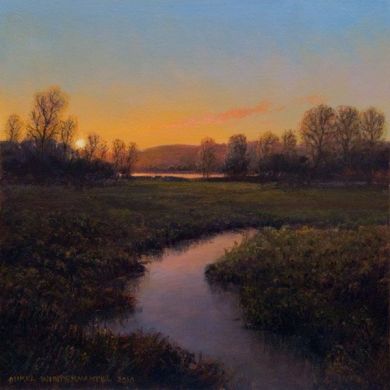
This morning I watched the swans and recognized the extremes in my world. There is the art of it, for example, made permanent by artists such as my friend Mikel Wintermantel, whose landscape paintings hang in my house, or my son’s own abstract water photos which fill my soul with such calmness. They bring instant peace of mind as well as transport me to pastoral locales I love to wander; but there is also the temporal reality of it, as moments pass, as loved ones pass, as we realize the greatest treasures can’t be recreated or often even remembered—only experienced, now. Right now.

The swan spends her life hissing. It is a gentle sound, and I don’t know better but it is almost as if she is trying to harmonize with the water or the soft breezes through the reeds along the shoreline. But right before she dies she lets out a long, serene call, just before the end, as if to offer us one last beautiful moment before she leaves us for good.

It is, literally, her swan song.

Sometimes when my mind is clear and I’m not distracted by the give and take of going and coming back, I can sense every aspect of nature in the constant call of her swan song. It is then that I am inspired to do the same, to stop hissing and make every call as beautiful as I can, even if I do wake up ready to try it again the next day. It is how I wish I could be all the time, to bring as much beauty as I can, to see as much beauty as I can, as often as I can. And then tomorrow—God willing—do it again.

7a74760187c14da86df85cf589c9da4a
Mikel Wintermantel

1301 K Street

imrs

I spent a good deal of time in Washington DC when I was younger. Not enough to know it well, but certainly enough to develop an extended, deep appreciation of not just the architecture, but the foundations upon which those structures and monuments were built. No one needs me to linger through a litany of historic and political references and landmarks, footnoted by great Americans with sometimes fate-bending accomplishments or sometimes questionable motives. From the portrait gallery to the Lincoln Memorial, to King, Vietnam, Jefferson, and World War Two memorials to the outrageously symmetrical Capital and the tonnage of objects at the Smithsonian, just walking by these places is a humbling experience; more of an event, really.

And right in the middle of it all, gently set back from the center of the mall, is the White House, the President’s Mansion. To think that a handful of people over the course of the past two centuries changed the course of human events just inside the fence across from Lafayette Park, moves almost everyone who walks by, pauses, takes a picture and then a deep breath, and moves on.

I drove into town last week and rolled slowly by the White House, and I got depressed. No, I’m not going to criticize, analyze, lambaste, ridicule or even remotely pass judgement on who is inside and what is going on, except to say I was depressed. I normally sensed the occupant of the White House moved about inside with purpose, of course, but did so always rooted in respect for the position and the place and the people who came before. I just assumed the president would always carry the weight of this country in his or her arms with the strength of our history in his or her spine. I often disagreed with policy and perspective, but I never doubted motive or morals. Still, last week I was sad by what seems to be a mockery of over two hundred years of checks and balances, of respect, of dignity, of morality, of history and the human condition.

I went to a writer’s conference, hung out with some friends, ate, drank, laughed, and forgot about where I was until I went to the Ford’s Theatre. I couldn’t watch the play without also glancing up at the box where Lincoln was shot, and I thought about how even now, more than one hundred and fifty years later, the respect citizens have for this sacred location is unwavering. Later, I walked north and wondered just how this country is going to survive. I didn’t turn toward any problems over trades and economic sanctions and immigration and fences and treaties and ecology, but instead I worried for the rapid erosion of our sense of self. We always lived in this country with the historic and absolute truth that the people who worked in these places would at the very least act with a firm conviction for the future of humanity. And I just don’t believe that is the case any longer. This is not a partisan problem, it is quite concretely a matter of trust that we can face our problems with honesty, integrity, and for the better good of us all. And I was depressed for the first time in all my travels to Washington, D.C. because of the seeming absence of honor and respect for institutional memory. Gone. Depression turned to worry. Worry turned to Pinot Grigio.

Then I got to 14th and K Streets. There against the evening sky is the most bold, imposing building on this side of the Capitol. Most of the office lights were lit though it was after eleven p.m. and I had the immediate sense that something subversive and determined and important was going on. This, of course, as noted in majestic letters at the top near the two towering points illuminated by red lights, is the headquarters for The Washington Post.

I stood and stared and remembered my youth at college, listening to lectures by real journalists explain how the American Experiment is still strong because of the Checks and Balances not just of three branches of government but because of the Fourth Estate. Now, in a world my late advisers could never fathom, where true, honest reporting is as rare as it has ever been since the days of Rome’s first newspaper, the “Acta Diurna,” it seemed to me while I stood on the street looking at the monstrosity of a building that it was now, somehow, rebel headquarters. I have a strong sense of security knowing that if we are ever under attack from within, we have at our disposal some of the world’s and history’s most dangerous weapons—trained journalists who know how—often better than administration insiders—to find the truth and disseminate it to the world.

These guys are good. 47 Pulitzer Prizes, 18 Nieman fellowships, 368—friggin’ 368—White House News Photographers Association Awards, and still counting. The work of writers Bob Woodward and Carl Bernstein, along with Editor Ben Bradlee, brought down the Nixon White House because of persistence and an unwavering commitment to accuracy and the truth.

Journalism history is riddled with examples of one honest voice deafening the screams of a thousand liars. Ida Tarbell unearthed the secrets of Standard Oil and the Rockefeller’ empire, redirecting the rivers of investigative journalism, Upton Sinclair’s famous work concerning the meat packing industry forced the development of the Pure Food and Drug Act and new standards in the packing industry. Murrey Marder of the Post exposed Senator Joseph McCarthy’s hearings and brought an end to them and the senator. David Halberstam of the New York Times wrote extensively about Vietnam and Seymour Hersh, also of the NY Times, changed events in this country by writing about what became known as the My Lai Massacre. These people and others championed investigations, often life-threatening, to get at and expose the truth. This has not changed by one syllable. It might seem as if the pure waters of honest journalism have been diluted by the brackish facts of a million streaming tributaries, but there are some organizations whose commitment to truth is so grounded in history and tradition that they can still be counted on to call out the criminals and charlatans.

At the top of that list for internal investigations of governmental affairs are the two men who inspired my choice of major in college—Woodward and Bernstein.  

I’ve been to DC many times through the years but for one reason or another either I never walked up that way or simply never noticed, but there I was standing on K Street, at first feeling depressed and even frightened for the future of the country, then suddenly at ease.

Because it occurred to me at nearly midnight on a clear, cold evening in our Capital, that the building on K Street might just be the most important piece of real estate in Washington DC right now.

2017press-corps3-960


Their Future is Not Their Own

golden-tiger

I sat in the Golden Tiger in Prague drinking a Pilsner when I figured out the problem with my students’ view of their future. First, a quick story:

I spent a great deal of time in both St. Petersburg, Russia, and Prague, the Czech Republic. I met some people in both cities whom became dear friends: artists and writers and business people. A colleague and I received a few grants to discuss American culture to Russian faculty who would be teaching American authors. This was the early nineties when communism had only recently “ended,” and Boris Yeltsin was president.

We discussed Miller’s “Death of a Salesman” and Douglass’ Narrative of Frederick Douglass, among others.  One example of the problems we faced is trying to help faculty teach “Death of a Salesman” and needing to explain commission sales, insurance premiums, and the American Dream. The faculty and citizens we met throughout the city all wanted to know everything about the United States, about democracy, about capitalism and the entertainment industry. They wanted to be us. But no one really understood how to do it. We told them to have patience; it took the United States a few centuries to get it right and we were still stumbling. But their primary problem was something different: no one in Russia had ever lived under any form of government that was not oppressive. And their history showed no difference; the Czarist system had its unique form of oppression but not any better than the Soviet system. Democratic principles were never, ever part of the country’s vocabulary.

Prague was slightly different.

When I taught a seminar at Charles University I was lucky enough to work with and become friends with best-selling Czech author Arnost Lustig. He grew up in Prague, survived the Terezine Ghetto, survived Auschwitz and the Nazis, and spent half of his time in Prague and, after the Soviet crackdown in 1968, the other half in Washington, DC. 

We sat one afternoon at the Golden Tiger and talked about the differences between Russia and Prague. It was an enlightening discussion. He pointed out that Prague was quite democratic for many years, and remained so even after the Soviets took over after World War Two, and by the late 1960’s, Rock and Roll, left-wing politics, and the hippie culture took the area known as Bohemia to heart and culminated in what was known as the Prague Spring—the first “Spring” of its kind. Then the Soviets sent in tanks and crushed the movements for another twenty years before the Velvet Revolution. But he said the reason Communism never worked well in Prague is because of “institutional memory” of so many of the citizens. “The Russians never knew freedom so well, so in the ‘90’s they really didn’t know how to handle it, but we knew freedom, we knew how to live with Democratic principles, so we really never took well to Communism to begin with. Like oppression of the Russian people is inevitable again because it is what the people are comfortable with and understand, Democracy in the Czech Republic was equally inevitable.”

When there are people to remember what it was like before, there are people to help us understand what is wrong with how it is now.

My freshmen students were, for the most part, two-years-old on September 11th, 2001. Even my older students were not nearly old enough to be out of grade school. All these people have ever known is a country looking over its shoulder, a Department of Homeland Security, the threat of terrorism in an era of wars, a life of sharing information online, of surveillance, of alternative facts. They’ve only ever known the need “to be protected,” “to report suspicious behavior,” to be weary of the monster on the other side of the Island.

They missed the whole America where we had the absolute conviction our future was our own, where the inalienable rights were not based upon criteria, and where respect of our government and the democratic principles proven for two centuries was universal, even if some of those countries didn’t like us very much.

My students for the most part came after the whole “hope” thing. They didn’t have any “moonshot” ambitions. They never had a chance to demand walls be taken down and gates be unlocked. This, right now, is their reality. It is one of apprehension and suspicion.

We can teach them the history and the social sciences behind the pre-911 way-of-life in the United States, and the world for that matter. But it is unlikely they will comprehend something we show no signs of ever heading towards again. So what are we left with to balance the increasingly questionable future these students have apparently decided to try and improve simply by their act of being in college to begin with?

I turn again as I have before on these pages to one of the most important letters written in the 20th century. It was composed by a contemporary of my late friend Arnost, as they both managed to survive a Nazi death camp, and the letter was published by Haim Ginott:

“I am a survivor of a concentration camp. My eyes saw what no person should witness. Gas chambers built by learned engineers. Children poisoned by educated physicians. Infants killed by trained nurses. Women and babies shot and killed by high school and college graduates. So I’m suspicious of education. My request is: help your students to be human. Your efforts must never produce learned monsters, skilled psychopaths, or educated Eichmanns. Reading and Writing and spelling and history and arithmetic are only important if they serve to make our students more human.”

berlin-flag

At Any Cost, Art

Saint-Cecilia-picture

I applied for a $25K NEA grant to finish a book about fathers and sons. It takes place in Siberia, in Spain, and in Brooklyn. It’s been an ongoing project for a few years, and recently I’ve had an excellent string of acceptances of excerpts, placing eight since January first alone. I am grateful beyond words for the placement of the work, and I know it is primarily because I’ve touched on something personal—relationships between fathers and sons, across time and miles and often across prayer or memory, has a universal appeal.

I planned on using the NEA grant, if it had been accepted, to finish the work both in Spain this summer and in Brooklyn in the fall to wrap it all up.

Then….DJT. Maybe since he is axing support of the National Endowment of the Arts he will give me the money. He had a father who set him up well; has three sons who also are set up well. Maybe he would read what I have so far and it will touch him a little, especially now that Baron Trump is in New York while DJ is in DC. Maybe he would read some of my work and, after sending me a check for $25k to finish it, he would wonder how his own son was doing at the other end of the shuttle to New York. Maybe he will read a few of my pieces and wish he could sit at Baron’s bed while his son sleeps and whisper confessions to him. He might suddenly see his son as a sleeping confidant, while somewhere in Virginia this minor writer is trying to record a few thoughts about his own father, his own son, and the space between them.

Damn, I should be writing fantasy fiction.

As for realistic means like the soon-to-be drained-dry NEA, it appears as if all bets are on hold, and myself along with other hopefuls striving to get some good work done in a world without patrons any longer, will miss the cut by one president. When I heard the NEA was in his crosshairs, I kept hoping he thinks it means Newly Elected Assholes, and simple wants to extinguish the reference. Apparently the NEA, along with so many other arts and humanities groups that support artists, is taking money away from other endeavors of the newly elected Populist Movement.

Oh to have been born in the last century where wealthy patrons paid for the expenses of artists for no other reason than they understood the contribution artists make to the world. When I realized I had run into this wall, that there was yet another set back to finally getting this done, I went for a walk. And when I came home I didn’t throw my work away; I didn’t put it in boxes in the back of the closet, and sigh, saying, “Maybe some other time.” I didn’t open a new blank file and start on a new project about butterflies or an essay about feeding birds and drinking iced tea. I kept working; a little on Siberia, some on Spain, both about fathers and sons.

The journalists recently told to shut up in DC and NY did not rush out and apply for bartending jobs. Leftwing news shows didn’t start running reruns of “The Apprentice.” No, we kept doing what we do. This is where the arts differ from business: we don’t declare bankruptcy even when there is no money, we don’t shut the doors and try something else.

The history of the arts is the history of civilization; from the cave art in France to the sharp-witted drawings by Goya in Spain, to the underground French newspapers, we record what is going on in civilization so everyone knows. It is how we pass along truth whether about our democracy or our dads. Thomas Paine couldn’t get anyone to publish “Common Sense” which told this New World we had it in our power to start anew. When someone in Philadelphia took a chance, lives changed. Paine did not quit. The dissidents who were exiled to Siberia did not silence artists from Dostoevsky to the Decembrists. Solzhenitsyn is more remembered and influential than the men who sent him away. Trying to stop an artist from expression is like trying to stop a river from going downstream: the thought will be created and disseminated. It isn’t an option. We can’t be fired, sidelined, and certainly not silenced.

Something a businessman could never understand is that artists are not in it for the money. Money does come in handy to more efficiently get work done and published; I could use the $25K. But it isn’t a goal; the art is the goal. A businessman may build the most beautiful hotel in Washington DC, but it is a waste of money if no one stays there. But for artists the work must be produced whether or not anyone ever hears it because we know if it is worth its salt, eventually someone will experience it, sometimes not for quite some time. Orwell’s 1984 is more relevant now that when it was written in 1948, as is Common Sense. Artists live by that old Japanese saying, “Just because the message is not received, doesn’t mean it isn’t worth sending.”

I’ve been to Siberia, been to Spain, and, well, Brooklyn is in my blood. It will take me longer this way, but it isn’t like I have a choice. I’m  still going to Spain this summer and Brooklyn next fall. I’m actually more motivated now. It might even be possible that if the NEA and NEH and other organizations which support artists are shut down, we will see an increase of some of the most inspired and subversive art to rip through society in a generation. And when this administration is past and the Republic has survived, it will be the artists that record these times; it will be the writers and filmmakers and musicians who will pass along to posterity what happened here. DJT can spin this however he wants, but I suggest anyone in the street can more easily name ten artists before they can name five businessmen.

I’ll get it done.

“There was a father who had a son. He longed to tell him all the reasons for the things he’d done. He came a long way just to explain. He kissed his boy while he lay sleeping then turned around and headed home again.”

                                                                                                     –paul simon

NEA_logo