Dad’s Books

My mother was Santa when it came to shopping, wrapping, hiding, and organizing the gifts. She went to great lengths to make sure she spent exactly the same amount on each of us. And while I really don’t think we were spoiled, mostly because our parents made sure we appreciated everything, I also don’t remember ever thinking there was something I was expecting but didn’t get; that is, I was never disappointed. Joanie did okay by us.

On Christmas morning as we unwrapped our presents, we’d make sure to say, “Wow, thanks Mom!” even on gifts we saw coming. By the end of the morning, though, we’d make sure to also throw in “and Dad” to the thanks, but he didn’t mind when we didn’t, ever.

And by late morning we drifted into that quiet period after opening gifts when we were engaged in our new items, and Mom was getting dinner ready for the company which inevitably filled the house. Dad would read the paper, and Christmas, which really started when we returned home from Midnight Mass, would do its magic.

But later in the day after everything settled down, Dad would emerge from some quiet place and have a stack of gifts for us, chosen, purchased, and wrapped by him alone.

Books.

It was amazing how he seemed to know exactly which ones to choose, and I don’t remember him ever asking what we were interested in; he just observed and took it from there. I have a collection of books I received on Christmas nights through the years which includes All creatures Great and Small by James Herriott, A Walk Across America by Peter Jenkins, Bound for Glory by Woody Guthrie, Robin Lee Graham’s Dove, and more. He’d hand us each a book he had signed inside with a “Merry Christmas, Love, Dad” and the year. I don’t remember when the tradition started but it had to have been early since I received was The Boy Who Sailed Around the World Alone, which is the kids’ version of Dove. I wasn’t yet a teen.

As the years went by we came to anticipate the books earlier in the day, though he usually held out. There were some exceptions; like one year when he gave us each money. I bought Illusions by Richard Bach and asked Dad to sign “Merry Christmas, Love, Dad” in the book anyway. Another year he replaced the books with Broadway tickets to see Katherine Hepburn in “West Side Waltz.”

It became my favorite part of the day. It wasn’t just the books, though. While I cherish the memories of Christmas evenings reading on the couch or stretched out on the floor, it was also a specific moment I got to share with my father and keep up on a shelf. 

I have kept the tradition going since my son was born. Winnie the Pooh, Curious GeorgeHamlet, anything by Dr. Seuss, Charles Schulz, or Thor Heyerdahl, and more fill his shelves. We really do formulate our lives based upon what we’re exposed to growing up. Michael has the kindness of Pooh, the curiosity of George, Schultz’s sense of humor, and Heyerdahl’s sense of adventure. Go figure. I try and wait until the end of the day, but it doesn’t always work out that way. One year my father bought him a small collection of classics, another year a Peanuts Christmas Treasury. He keeps that one right next to his Works of Shakespeare.

I understand now that Dad didn’t just give us books; he gave us his sense of understanding, of knowing, of remembering and anticipating. When I look at the books Dad gave me, they absolutely anticipate my life—music, adventure, the sea. I’m not sure the books influenced me as much as Dad understood something about me which the books brought to light. I was never the avid reader Dad was or my son has always been. And I think he knew that too, choosing books which had less to do with the art and more to do with the dreams that a good book can unleash.

As the years moved on and we all moved out, we started giving him books; he loved to read. We had to coordinate sometimes so we didn’t get him the same one, and I don’t think we ever did. He received volumes about Brooklyn, about baseball and golf, about history—one of his passions. So when I started working on a book about Michael and me training across Siberia, I knew it was going to be more about fathers and sons, ancestry and posterity, than about locale. That is why the book, The Iron Scar, is dedicated to both him and my son. I want it to be a book he would have bought for me, signed, wrapped, and given to me late in the day, just when I thought I was getting tired, when his gift would wake me up and send me on some adventure well into the night, send me, as the Madman Dr. William Minor once pointed out, “to the end of the world on the wings of words.”

We don’t leave home when we are eighteen or twenty-two. We depart nearly immediately upon learning words, stringing them together, making associations with objects and then ideas and then possibility and hope. We cross borders when we’re toddlers and time travel through adolescence. From Gilgamesh on we slip this mortal coil, escape depression with Styron, evade anxiety with Balzac, and relish in the quixotic realm of Cervantes. Every Christmas afternoon my father gave us books filled with foreshadowing. For me, on so many levels from travel to profession to livelihood, whether he knew it or not, he anticipated my life.

Merry Christmas Dad. Thank you for the words.
We Are Stardust

Let’s start with this: Every single day, 100 tons of meteorite dust coats the entire planet. You, me, the cars, buildings, everywhere, everything. It is so miniscule, of course, that we don’t even know it is happening, preferring instead to wait for the Leonid shower, or the Perseid, the Geminid, or even the Urid, to run outside and watch the shooting stars every twenty or thirty seconds on a clear moonless night. Who isn’t transfixed by that? No one says, “Hey, I’m covered in microscopic meteor dust; make a wish!”

But who isn’t freaked out by the thought of meteor dust in their hair? On their ice cream cone? I’m not making this up either; I’m not good at fiction.

But wait, there’s more:

The temperature at the core of the earth is the same, about 10K Fahrenheit, as the surface of the sun. I love symmetry but part of me wonders if The Great Thermometer simply stops tracking at 10K.

Earth is the only planet not named for a God, and no one knows who named it, though the etymological roots are Germanic and Old English. Still, I’m thinking some Brit named, oh I don’t know, Charles Earth, tagged this rock.

Scientists–the ones who know what they’re talking about because of generations of research and have less ability to create a fiction than I do–say the planet is about 4.5 billion years old, but humans of any sort have only been here for about 450,000 years (if you are even sorta kinda considering posting a response about how the earth was created in April about 6000 years ago, go away now). Now, if you do the math, and divide the history of the universe into a day, homo walketh uprighteth has been doing so about ten seconds. Of that ten seconds, each of us has been here about…gone.

Gone. Another human is gone. Another three thousand. A 911 every single day this week. People don’t listen. We’ve so adjusted life to be “convenient” (think Smart Phone, think Wifi, think online everything, think curbside, think Drive-thru, think Lunchables) that too many believe if some aspect of life is inconvenient, they’ll just redefine reality to accommodate what they want.

The percolator becomes Mr. Coffee becomes a Keurig. How many people know their friends’ phone numbers? Their own? Ever been in a store in the middle of checking out when the “connection” fails on their register, and the clerk who can’t write script or add without a phone stands there completely perplexed? That. We are completely, arguably, most definitively (enough?) reliant upon the 2500 operational satellites orbiting the earth (about 6000 actually are orbiting, but more than half simply don’t work–how inconvenient).

So here’s the thing: According to scientists who constantly work on and adjust the Asteroid-Satellite Collision Probability, when a meteor or other such space object hits a satellite, the rock “vaporizes into hot, electrically charged gas that can short out circuits and damage electronics, causing the satellite to spin out of control.” Don’t worry about being hit–it’ll burn up on reentry into the planet’s atmosphere. No, that’s not the problem.

See the problem? Yes, no more satellite. And if a large such space rock plays pinball with Space X’s system of communication, we here are earth are, as they might say on “Eureka,” simply fracked.

So it comes back to meteors. Stardust. The naked-to-the-eye coating which exploded countless zeros away from here several billion years ago, arriving, now, in 2020, on our chocolate swirl cone.

The greatest scientists in the world have trouble wrapping their mind around this simple idea: we, Earth, Charles E’s very own planet, are an anomaly. Even if you are like me and believe somewhere in the deep recesses of unthinkable distance are planets with lifeforms playing Scrabble and drinking Pinot Noir, astrophysicists like Stephen Hawking, Neil Tyson, Carl Sagan, and Brian May can’t tell you where, and they’ve looked with equipment so advanced some of it has left the solar system, some landed on moving asteroids, and some is scooping up dirt like it’s dog poop on the moon and bringing it back. And they don’t know.

But they can tell us around 100 tons of meteorite dust coats the earth, and us, daily.

I sat at the river this morning. Unplugged and, to be honest, uninterested in much. I felt like going for a long walk in the mountains, or sitting on the sand at the gulf and quietly have a drink and watch for manatee. Still, I was just as content to look out at the Norris Bridge two miles up river, and the cars and trucks crossing the mile and a half span headed North, up toward DC, up toward New York, up, just further and further up. I couldn’t hear them, but I could catch the glint of sun on their cars. Closer, on the river, some bufflehead ducks surfaced then dove again. A workboat headed out from Locklies, out to check some traps I’m guessing.

And that clock that says we’ve only been here for a few seconds? Make it a day-long clock that runs roughly 6 am to 9 pm, and each ten minutes is a year, giving you a generous ninety years–six years an hour. What time is it for you? Go ahead–get your phone so you can do the math.

For me it is four in the afternoon. The sun is no longer at its full strength, dinner will be ready soon, and I just took another short break. I can’t focus on the minutia in life; never could. Someone asks me about subject verb agreement and I’m wondering why we can only see about 2000-3000 stars, not “millions” as we feel when standing at the bay on a clear, moonless night. And my frustration at knowing I have so much I want to see, so many glasses of wine to drink with friends in European pubs and small quaint villages, brings me to the brink of psychosis when someone actually screws up simple comma rules. Part of me wants to say, “Come on! This isn’t rocket science! It’s a fracking comma, for God’s sake!” and another part of me wants to whisper, “You’re doing fine. It’s just commas–I knew what you meant. Now go, bathe in the miracle of meteorite dust! Buy a cone and wait for it!!”

Seriously, we’ve drifted far too far in 450,000 years; so far astray from the essential; so far afield from what matters.

We’ve got to get ourselves back to the garden.

Image may contain: sky, plant, ocean, outdoor, nature and water

The Advent of Winter

Again, the wilderness:

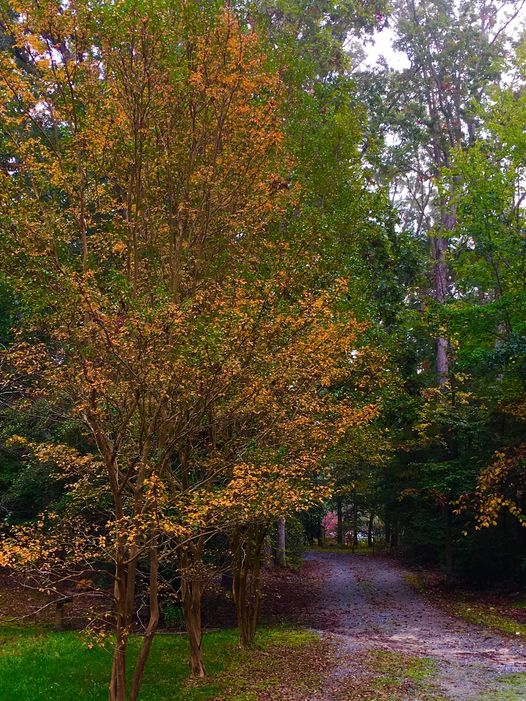
The winds finally subsided this afternoon after two days of strong southerly and then northeasterly breezes bringing the temps down and the leaves down and my mood down as the final leaves fell and I switched from flip flops to Vans to head outside. Winter is here.

Still, my spirits received a lift as the sky went blue, dark blue, almost edge-of-space blue, and the bare branches at the tops of oaks and maples reached out like tan and white boney fingers against that sky. It is stunning, and I love that the colors of autumn are followed by equally beautiful branches of early winter. There’s something about the raw barrenness of the top limbs which, to me, feels strong, confident, even when—especially when—they reach back into a strong gale of a passing storm.

I like the fallen leaves and leave them on the lawn and paths as long as possible. Partly because they sound like some Copeland measure when I walk through them and partly because the resulting mulch is really good for the ground and partly because I’m busy, but eventually I clear the lawn and the paths, as I finished doing just before the storm this week. It is always one of the ways I can tell winter has arrived: As autumn progresses from late September through October and even November, I might, sometimes, rake and clear some areas, but inevitably the gentlest of winds returns the leaves and more, and despite the multitudes on the bushes and the porch and the paths and the driveway, the tops of the trees still look like mid-July and my work feels somehow in vain. But now as November closes and the advent of December finds me pulling out sweaters and socks, the bare branches mean even after a storm like we had yesterday, the cleared areas are still clear, the driveway still visible, and we can move back to the firepit on the patio and know no bugs will bother us again for quite some time.  

Coastal Virginia has one cold-weather issue I’ve never been able to adjust to. It is wet; chilly to-the-bone wet, humid-cold wet like I’ve been doused in ice water before putting on my clothes. Forty degrees here can feel like ten in western New York where when I’m there in winter, not just as a college student forty years ago but as recently as last year, I can go outside in just a sweater and feel fine because of the dry air. The same happened when I lived in central Massachusetts. But here along the bay, when the weather calls for wind chills, we take it very seriously, because even without the wind the air can hold that frozen feeling out there like breathe, like fog, and just like that forty feels like four and it takes a while to warm up. Other than that I’m fine with winter here on the river, and I know that Steinbeck was right when he wondered what good is the warmth of summer without the cold of winter.

But the true sign the weather has changed and is not returning to any false summers or even hints of autumn is the call of geese coming up over the trees in the west, and the flock appearing a few dozen at a time out over the fields, and then more, and more, until hundreds and hundreds fill the sky so I can hear the wings pushing them along and their call can be deafening. They settle in the barren cornfield just to the east, and it is almost always right before twilight so that if I plan my walk right, I can be midway between the house and the river and watch them fill all the areas. It has an eternal quality, like rapids, or the distant sound of thunder, like some primordial ritual playing out the same as it played out for thousands of years. My turn to observe what at one time happened without voyeurs, without the stubble of plowed corn.

This is the time of year to keep the feeders filled, the baths filled until the freeze, and to sit inside and watch flocks of titmice, wrens, and cardinals find the porch rail and the backs of the wicker chairs. Some even balance on the windowpane, the outside reflected on the glass so that they might even believe they’re on some odd branch. And then one afternoon the first of what will be a half dozen or so times, a thousand—more—starlings will turn the sky black as they move in unfathomable synchronized fashion to the trees, filling them so that from below, the branches look filled with black leaves, like summer but a monochrome version of summer, and you can hear them from inside so that you have to leap up and head outside, only to disturb them and then the vibrations fill the air again as they move off for some forest upriver. It is a sight and sound to behold, to be sure.

Certainly, I miss warm weather, the early autumn walks through the paths here at Aerie, still in my flipflops, still in shorts. I miss waking up and walking right outside without a concern about what to wear. But now, on the front edge of winter, I feel more a part of something larger than the season itself; it’s as if time on this land, on this Middle Peninsula, has layered itself instead of remaining linear, and I have a sense of winters past, long ago, when this land was part of some nearby plantation, and some of my neighbors ancestors worked the nearby acres against their will, and on a still, cold night, when the geese have settled down and the branches reach out bonelike in their graveyard of oaks and beechwood, I sit still on the patio and listen closely and I wonder about the sounds of centuries past, during the winter, when some people simply could not beat back the chill, the to-the-bone cold.

New York Extends Labor Protections to Farmworkers - Handel Food Law

Superfluity

This Is How To Sound Smarter By Improving Your Vocabulary

I was in the village this morning, and while normally I feel right at home, today I had an overwhelming sense of monachopsis. It might have started at 711 where three customers were arguing with the generally pleasant cashier about mask-wearing. It turned a bit violent and left me in a deep state of kudbiko. One woman kept screaming “I want to get it! I want covid!” with bulging eyes, and I turned to the masked man behind me and said, “Now there’s a woman of lachesim!” and laughed, but he just stared at me.

It was creepy, so I re-approached the subject: “Seriously, my friend, someone like her leaves me downright liberostic, doesn’t it do that to you?” but he would not converse. He just stared at me a long time, to some vague point of opia. Creepy indeed. I knew talking was pointless since I already had a feeling of sudden adronitis.

I stood watching the argument go down to a point of anecdoche, and the guy exactly six feet behind me struck me with a serious case of exulansis, so I just grew quiet and watched. It was then, just after nine with a cup of coffee in my hand I could not even sip through my mask that I found my self sonder. It was surreal; almost, I swear to you, a feeling of enouement.

That’s when the exposed-mouthers stopped yelling and the door stopped opening and the cashier stopped cashiering, and I was all at once perfectly still with rubatosis. I wondered what in the world I was doing in a 711 anyway! It made no sense; it was all nodus tollens! Seriously! I’m not exaggerating! Part of it, I’m sure, was altschmerz, of course, and a larger part of it was occhiolism, as anyone would probably empathize with. Right then I wished for some form of duality, I longed to escape this onism, mostly because I knew once I bagged this line of people who can’t move because they all already bit their donut or opened their can of coke or sipped their coffee or doused their big bite with hot sauce, I knew once I was free and finally turned into my driveway I’d absolutely be rockkehrunruhe. Clearly. Besides, I couldn’t leave yet only to find myself in a state of complete ellipsism, so I returned to staring at the hopefully Covid-free companion behind me reaching for another éclair. I looked at him a long time and my mind rolled right into a jouska. Whose wouldn’t? In it, we act as authorities and tell everyone the stats of the pandemic, and they all stand quiet in a state of kenopsia, almost as if we were bathed by overwhelming chrysalism.

Eventually, they stop arguing but it was too late, I was struck by claustrophobia, seriously close to the point of mauerbauertraurigkeit. I’m being completely honest.

So I left and went down the street, still masked of course, to the bookshop, walked in and stood in complete vellichor. Mmmmmm. I gazed at the books, the signs and ladder leaning against the top shelf, the light brown/tannish atmosphere, and just had to grab a picture! So I took out my phone and captured just the right angle of books and an old man in a chair reading an old, dusty volume of Chaucer, his cane leaning against the wall, steam rising from a cup of tea, and I just knew I had to send that to the local paper—what a shot! I thought, and showed it to the owner, who was much more diplomatic than the cashier at the entirely inconvenient convenience store, and he said, turning away slightly, “Oh, yes, everyone loves to take that shot of him while he is here,” and I found myself completely vemodalen.

I decided to go home and sit on my porch and continue studying my notes for my class on inexplicable emotions.

So formulaic. Geez.  

23 emotions people feel but can't explain: coolguides

Don’t Forget

It’s Giving Tuesday and we all have our charities to which we prefer to donate. I’m partial to the Parkinson’s Foundation, the National Cancer Institute, a few local concerns like the library and the Deltaville Maritime Museum, and the St Francis Breadline in New York City, the oldest continuously operated breadline in the country which feeds over four hundred people a day, every day, since 1930.

And the Dementia Society of America (which is in Doylestown, Pennsylvania). There is something about someone who used to be so sharp, but isn’t anymore; someone who had nearly perfect recall but no longer does; someone who confuses night and day, parents and offspring, movies and reality, that has a subtle existence just in the margins of our lives, quiet souls, who prefer to remain on the peripheral so as not to be a bother, but as such, often go unnoticed.

Not being able to remember and forgetting are not the same thing. The first carries the conviction something never happened at all while the latter is a cognitive trick of memory—I remember it occurring I just can’t recall the details. We all forget things, all the time, and the older we are the more likely things dissolve into some hazy once-was, like a movie we once saw but long ago forgot the plot, or a story someone told us instead of the plotline we ourselves lived out. Hopefully, our lives are filled with memories, and we are glad to recall, since there is no point in being sad at remembering happy events. But Milan Kundera is right when he says the biggest struggle is between memory and forgetting.

If I could take only one memory with me when I move into an age of forgetting, it would be walks to the river, my son on my shoulders, the sun on my back, those moments. Or the times we went fishing when he was four, never catching a thing and never caring. Or maybe the sound of house wrens just before dawn, or the whippoorwills just after dusk. I’d like to take that feeling of an open fire on my face and the cool night on my back. Or the sound of my father’s voice telling me to sleep well. Or my mother’s laugh, the way she takes a long breath. I’d like to forget all the times I got angry, all the times I was critical, and replace them with the memories of all the times I listened to the sound of rain on the canvas awning at our home when I was a child.

I know I’ll want to remember one more time the foghorns on the Great South Bay drifting through the air, my brother and sister still asleep, my mother making coffee, my father in his bed. I take it the grand design allows we forget the minutia as we age, but I’ll salvage what I can. Sometimes now when I am out for a walk, I stand at the water and wonder where everyone is. And I look up the coast and imagine my childhood friends, now adults, sitting with their families, reading the paper, watching a movie, most likely long ago forgetting what we did when we were young. But I’m glad they’re there, just a few decades north of here, somehow still part of some shared memory.

I like remembering the way my son laughed uncontrollably when he was two and I chased him across a field. Or the echo of the speakers at my high school football game, or the sound of cars off in the distance when my friends and I would hang out in someone’s back yard or neighborhood street on a Friday night, laughing, telling stories about nothing at all. The train whistle on some lonely stretch of forever in eastern Siberia, or the bells of St Esteban’s Church just north of Pamplona, when we wandered the rafters and rang the oldest bells in Navarra.

I will never remember it all, but I can remember—forgive this—clear as a bell some people in particular, their every laugh, their every movement, and also the places, the backstreets and lesser locales, all of this despite the endless ringing of noise and cities and traffic and talking and on and on.

That is why I remember to get up early in the morning. I like to listen to that pre-dawn stillness which in no time at all a thousand voices will disturb. I like the way the sun holds off a while, almost as if it asks permission to spill across the sky. And then slowly the silence creeps off and hides behind some trees somewhere just before the phone rings, before the traffic picks up, before it is time to track time again and multitask.

I spend some of the morning looking forward to the day and some of the day remembering, but mostly I prefer to simply be present as the sun comes up and the morning flock feeds behind the oyster boats on the bay.

And I like the steady rain in the late afternoon. My son and I take pictures of the local waterways just about then, or we are home throwing the football; on those days neither of us can catch the slippery skin, but we don’t care. We are so much in the moment, eyeing down the ball, blinking at the wetness on our faces, knowing we’ll be inside and dry soon enough, soon enough indeed. I am sure I will remember those days. I am sure I will.

I celebrate memory. This is not to say I don’t spend the majority of my time planning and moving forward to what’s next. I very much do; I have to. It is just that in the early morning, before the sun has had her say, before I am about to walk into the realm of a thousand voices and the movement of life, I like to remember that it’s been a good ride so far. We all like to remember that. No one thinks ahead and contemplates a complete loss of thinking back.

And anyway, there’s too much to remember if a life is well lived. The length of a lifetime from the beginning looks nothing at all like the brevity of that life from the end, like standing on a diving board terrified to leap, knowing you have to anyway for all the others lined up behind you waiting to have their chance. It’s your turn so you jump despite the fear of how far it is to the water, but when you “rise again and laughingly dash with your hair,” you look up at where you started and think, that wasn’t so far at all.

It isn’t far at all.

Dementia Society of America | Official Site | United States

The Snow Turned Into Rain

Note: At the end of this is a video. Please watch the first moments to see an essential letter about this subject.

Two People Walk Along Boardwalk Above A Lake At Sunrise Stock Photo -  Download Image Now - iStock

“And as I turned to make my way back home the snow turned into rain”

This afternoon a friend left me with a question: Did the snow, in fact, turn into rain, or is the rain a metaphor for his tears? I’m sure he was being rhetorical, but I couldn’t get it out of my head. And before you jump to conclusions and push out “OMG! Clearly he was crying!” consider this:

We can assume Dan and his ex, whose name was Jill, by the way, are in Peoria, Illinois, since that is where Dan is from and the song implies that she hasn’t seen him since before he did well. This is an old lover he met in a grocery store on Christmas Eve, so they both were probably home visiting folks. Had he ran into her somewhere else, like Colorado where Dan lived at about the time the song had hit the charts and before, when he would have been composing it, he would have had to fit in a lyric something like, “Holy Shit! What are you doing in Colorado?!” but his lack of surprise at her being there at all, while circumstantial, seems solid enough to demonstrate they were in Peoria.

The average temperature in Peoria on December 24th is a high of 36 degrees Fahrenheit and a low of 23 degrees. This is interesting because with the averages of both extremes rocking it pretty close to the freezing point, it is more than a little plausible that it would snow and turn to rain or perhaps even rain and then turn to snow. I’ve spent my share of winter days in northern regions—central Massachusetts, western New York—and more than a few times a snowy evening gave way to rain as the winds shifted from the south and cloud cover warmed the atmosphere enough. The literal interpretation of this line is a fair assessment of what was going on for Dan and the architect’s wife that Christmas Eve.

However, they couldn’t find an open bar. Now I’ve only driven through Illinois and spent a weekend in Chicago in the summer; otherwise, I’ve no first hand knowledge, but everywhere else I’ve been, particularly during the late seventies, bars were open on Christmas Eve. In fact, more than a few songs were written about such people seeking some company there. In Illinois, the drinking age changed from 18 to 21 in 1979, exactly when the song was written (released in 1981), so it is plausible with less foot traffic due to the tight-assed regulations imposed on the military-aged citizens of The Sucker State (I didn’t make that up), the bars were, in fact, closed, forcing Dan and his beer-guzzling, clumsy friend to drink in the car.

So now we’re in the car, and, as a result, we’re back in high school, which is exactly where this mastermind of a songwriter wanted us to be. Two kids drinking beer in the back of a car; the one scenario that can take a woman who doesn’t love her husband and a famous musician and make them both feel seventeen again.

Who doesn’t get that?

Who doesn’t understand what it’s like to be at the start again, just for a quick, blissful moment, reminiscing about when you had nothing but plans, little else but hope? The song was released on his double album platinum album, The Innocent Age.

Of course.

It’s a brief, Goose-Island Stout induced walk through the high school gym, the Friday night football game, holding hands. It’s talking quietly about family, about what happened after what happened, about the road and the hits, about parents and siblings. “One went to Chicago,” Dan might have told her, “the other to St Paul.”

I’ve been seventeen a few times. Once, I sat on the boardwalk steps reminiscing about what could have been with an old friend who could have been. Of course, we all do. And we talked about our common friends, about how sad it was what happened to Dave, and to Bobbie, and a few others. And how I kept in touch with one and didn’t the other, and how another friend and I simply drifted apart, despite how close we were all those decades earlier. We had just come from having a glass of wine and some tuna, and we walked a bit until we came to that point we had to go separate ways to get to the cars, and we sat and talked a while longer, not wanting the afternoon to end, knowing it already had, knowing it had ended so many years earlier.

And she gave me a long hug—it was hard to breakaway—and said she’d keep in touch, though…

And I turned back down the boardwalk to head to my car, and I turned my collar up against the wind coming from up the beach, and I wiped the spray from the ocean off my face.

Flight

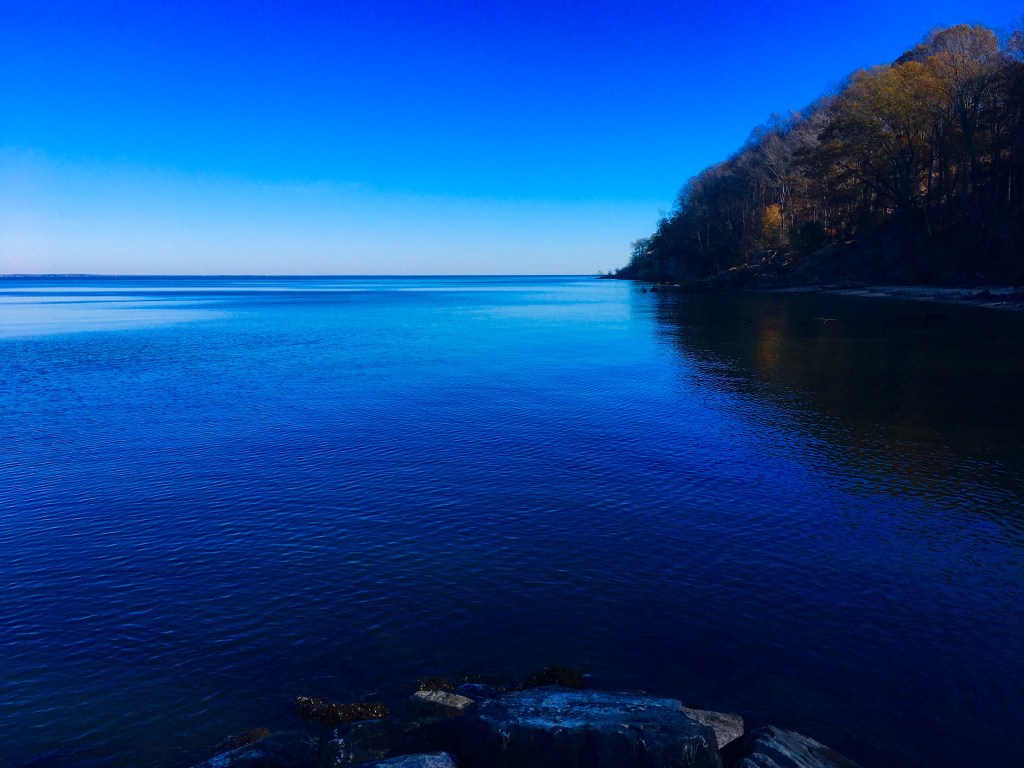
My son and I sat on a jetty in the Potomac River at Westmoreland State Park taking a break during a hike. The sun was strong and the water still, and the sky so clear the horizon out on the Chesapeake faded to something like royal blue. We had walked sandy trails on hilly terrain for a few hours, through seagrass and hardwoods, and ended at a retreat area where a man fished for spot and talked about not catching anything, though he clearly understood Thoreau’s decree that “many men go fishing all their lives not knowing that it is not fish they are after.”

We climbed further along the rocks to the end, and we rested there for quite some time and talked about nothing, about other places up the Potomac to hike, about art and writing, and about how we were surrounded by some of the most picturesque scenery we had seen in some time, and I laughed at how my photographer son neglected to bring a camera. We laughed a bit and turned toward the river where gulls and a late-season osprey had been feeding about fifty yards out.

Just then from the east an adult bald eagle swept down in what I swear seemed like slow motion, and as the gulls and osprey flew off, the eagle grabbed a fish out of the water with  his talons, swept back on high in perfect grace, and glided up toward the top of some hundred feet tall trees just to our right, where another eagle had been circling, and they both landed on neighboring branches. It was a scene from some nature show, a National Geographic special. It was one of those moments Sartre said can “hang in empty space like a diamond,” one in which you brainlessly repeat “Did you see that?” and then sit in silence hoping somehow to slow the whole thing down.

Incredibly and beautifully simple: An eagle glided in slow motion in front of us, grabbed a fish, glided off to the east and up into a tree nearby where another waited to dine. A basic act repeated by all birds of prey everywhere, every day, but this time we sat on the rocks jettying into the Potomac and almost could feel the push of wind from his wings the way John Muir wrote that “the winds will blow their own freshness into you…while cares will drop off like autumn leaves.”

I never asked the fisherman if he saw the eagles. I’m certain he sees them every day, again and again. He sees them.

We’ve done our share of hiking, of seeing wildlife and wild places. While these times of Covid have somehow careened our lives back onto the same path for awhile, we have hiked our share of wilderness long before this age of corona. We climbed the hills north of Irkutsk at Lake Baikal up to Chersky’s Rock and stared out through the misty afternoon across eastern Siberia, which Chekhov wrote is a place he would prefer never to leave. We walked almost entirely uphill for twenty miles in one day out of southern France into the Pyrenees and then another four weeks across Spain to the Atlantic, wandering through villages and walled, medieval cities, desert-like terrain, and pasture after pasture.

But through the years it has always been the Chesapeake region, my adopted home and Michael’s birthplace, that we’ve trekked. And at the heart of it all has always been the walk from our home to the river. We’ve seen enough sunsets on the Rappahannock to chronicle two decades of life here, and we’ve risen early to see our share of sunrises surfacing across the bay from Stingray Point.

France. Spain. Russia. Even eastern Quebec when he was young and we’d hike the hills behind Montmorency Falls, and in all of these, the locale, while beautiful and unforgettable, and even transformative as a good walk should be, was never the point of the matter. It was the silence, the understanding that the hike in the hills is more of a way to find ourselves and what grounds us than to discover any new paths there may be. To know nature, as those before—the Cossacks, the Celts, the Mohawks, and the Powhatans—understood nature, the rivers and wildlife; that’s what runs under the surface, weaves itself seamlessly into our narrative.

When I first spent a winter to build our home up in these woods I call “Aerie,” which is a hawk’s or eagle’s nest, I would take breaks and walk to the river. One time I returned, not long after the logs for the home had been stacked and the frame for the second floor completed, but the roof was not yet done, I wandered down the long winding driveway and saw an eagle perched on the gable. I stopped in the dead-still chill of that February day and watched him clean his feathers for a minute until he was aware of my presence. He looked back at me without moving for more than a moment, as if he had been waiting for me to get back from the water so he could welcome me home. Then he glided off the roof with barely a twitch of his wings and headed out over the trees toward the bay.

It’s a wonder that I will never tire of, the way he sits just watching, out on the edge of the rocks, taking it all in, so very aware, and then always before I am ready, he lifts himself up, pushes time behind him, pushes memories and happenings, and everything we know behind him to glide out on his own and see what’s out there.

If By Chance

Man Holding A Watch In The Hands Before To Put It On. Stock Image - Image  of black, human: 99245885

This is all absolutely true.

Many years ago a friend of mine gave me a present of a visit to a fortune teller in Virginia Beach. I’d never been to one and wasn’t going to diss the idea since I agreed with Jung who said he would “not commit the fashionable stupidity as regarding everything I can’t explain as fraud,” but she had been to one and said I just had to go, so she arranged for me to see this woman. I agreed because our friendship was already solidified by what we both decided had to be fate, that is, it was only a friendship but one which repeatedly was thrown together against odds.

I met Linda first at a CVS in Massachusetts when I lived there, and another friend passing through stopped and needed to buy items at a drug store. While she looked around I talked to the clerk who only later I realized must have thought I was hitting on her while who she thought was my girlfriend, who wasn’t, was down another isle. I left thinking how rude CVS clerks were. A few years later My friend Richard and I were at The Beamen Tavern in the same town having a beer when a server brought us popcorn and she looked familiar. Yeah, it was the same Linda and we laughed at the CVS incident, which she remembered. Anyway, end of that chapter. I moved to Pennsylvania; years pass. I move to Virginia Beach; years and years pass.

I returned from a trip to Russia and a local newspaper sent a reporter to do a story about my teaching at the university in St Petersburg. We were fifteen minutes into the interview in my office when I said she looked familiar and I asked where she was from, and it was indeed the rude CVS, popcorn delivering girl. We laughed and talked about Massachusetts and what she was doing in Virginia Beach (military fiancé) and she left and said we’d have to get coffee sometime and we didn’t; years pass.

My officemate Tom and I were standing in a hallway at Old Dominion University waiting for our first MFA class in creative writing and I read a poster on the wall about the ODU crew team. I said that the last time I had seen a crew team is when I would go for Saturday walks “along the Chuck,” knowing Tom would get the reference since he, too, had once lived near Boston. A woman behind him turned around and said, “You guys must be from Boston; no one else would know to call The Charles River “the Chuck.”

It was the rude CVS, popcorn delivering, newspaper reporter woman from West Boylston, Massachusetts—Linda. This time we had coffee. We got along tremendously and we laughed at the thin line between coincidence and serendipity, and I pointed out that Georges Braque said that the only valuable things in life are those we can’t explain, and a year or two later, just before moving back to Massachusetts for good and getting married, she told me she had been to a fortune teller at the Beach who nailed so much of this and I just had to go so she bought for me a gift certificate and made an appointment.

So I went. This woman’s place was like something out of a Gary Larson cartoon: beads everywhere, candles, a robust woman with a long, flowing serape and bouffant hair, and fat, fake pearls around her healthy neck. Pleasant and calm, she certainly carried an air of confidence about her duties as a soothsayer.

We sat and she asked for something of mine I was wearing so I gave her my watch. “This was given to you by a woman, wasn’t it?”

“Yes,” I said and thought that was a truly safe guess. Not a lot of guys give watches to other guys unless they’re partners or fathers, and that narrows the chances down considerably.

She tightly closed her eyes and held the watch in both hands, caressing it, petting it, and said, “You have lived up North, haven’t you?” I let out a laugh. I didn’t mean to, but I thought, Oh, come on! Not a single person in the south can’t peg my voice and demeanor as from somewhere north of the Mason-Dixon line, but instead simply said, “Why yes!”

“You live near water,” she said.

“Excuse me,” I replied, and she opened her eyes. “We’re in Virginia Beach. I don’t mean to be rude, but we all live near water.” She smiled and agreed these were easy, predictable guesses but she needs to “crossover” to my “happening.” I said of course and thought I no longer wanted to be friends with Linda.

“There’s a woman from your past who is present again or trying to reach you. Someone you haven’t seen since you lived up north.”

Don’t get ahead of me on this one; yes, I also assumed she would know from the gift certificate that Linda bought it for me and had perhaps clued her in, though both women insisted no such verbal transaction occurred.

“You teach, don’t you? Adults.”

“Yes.”

“There’s a man in your life.” She hesitated a bit. “No. A boy. A son.”

“Yes.”

She ran through several other kind of creepily close assessments of my life, and I remembered that Euripides said that no one is truly free since we are all slaves to fortune, but I decidedly disagreed even though this prognosticator moved close enough to more specific references for me to believe she definitely picked up something or should at the very least be at a Black Jack table in Vegas. Then she asked if I had any questions.

I asked if I’d always be teaching college and if I’d be successful as a writer and if I needed new brakes on the car, and her answers were positive and vague, though declared with confidence. She gave me a fifty percent off coupon for a second visit.

In my car I had four of five messages from Linda all basically asking why I hadn’t called her yet to tell her what happened. I called.

“How’d it go? Isn’t she amazing!?”

“It went well; I need new brakes.”

“Come on, Bob! What’d she say??”

I summed it up for her pretty well and said I had a good time and glad that I did that, which was true, and that I appreciated her setting this up for me. Then added, “But when she told me someone from my past is back in my life or trying to reach me, someone from up north, I knew you guys had talked.”

“BOB! I swear to you, I never gave a hint. I just asked for a certificate and that was it!” I believed her, but between my New York accent walking through the door with a gift certificate just days after someone with a Massachusetts accent had purchased a gift certificate, I’m thinking said psychic threw us together pretty readily.

“Seriously, Linda, that was fun, and close enough to make me want to think about going to one again. That was a great experience, though I was hoping to hear some cool predictions!” Linda laughed and agreed. Then she moved back to New England and I haven’t seen her since, though I’m sure in some strange land somewhere I’ll be ordering a meal and she and her family will be at the next table. It’s how some lives cross paths sometimes, beautifully hopeful and tragically rare.

This place was just around the corner from my parents’ home so I stopped by. Mom and I sat at the kitchen table talking and we laughed about the “coincidences” and the woman fingering my watch like some talisman telling stories about my life. Dad was on the porch and came in as we were laughing.

“Well, hello,” he said, just realizing I had stopped by.

“Hi Dad, sorry but I have to go. Just stopped by fast since I was around the corner.”

“Don’t stay so long next time,” he quipped, and I headed for the door.

“Oh, Robert,” he called after me. “You got a call here yesterday from someone. She said she didn’t know how else to reach you after so many years.”

All of it, perfectly true.

I fingered my watch and walked to the car.

In Service to Our Country

This is a cake

I remember Mark. He was a student of mine at a college where I used to work. He came to me early in the Gulf War and said he received his orders and was on his way to get his affairs in order, his will and other essential documents, as instructed by his superiors, and he would have to miss class. He was nervous and we walked to the cafeteria and sat for a bit, talked about his newborn, talked about what college he might transfer to when he returned, but he never returned.

I’ve had the honor and absolute pleasure to spend almost thirty years teaching veterans—and many active duty members of the military as well—creative writing, art, and literature. Perhaps because of the contrast in their lives to their time spent in Iraq, Afghanistan and other “theaters” of war—a word we talked about in class as ironic while discussing Hamlet or Fences—these women and men have an acute appreciation of all things creative—writing, art, music, even just talking before class. I wish I could remember their names. Some I do, of course, and some I’ll never forget.

Some students’ names stuck; either from their attendance in multiple classes or their outstanding work, or, of course, the occasional underachievers who need a different brand of attention. Still, even with students sitting in front of me two or three days a week for sixteen weeks, the names remained allusive, but not their stories. I taught a class in creative non-fiction and the nine students all wrote about their experiences in places like Fallujah, Kabul, and Baghdad. They read the work aloud and after we all composed ourselves, instead of discussing the work, they would all talk about how each of them could relate to the story. They’d talk, use acronyms and other abbreviations, and laugh or cry while I sat and hoped they knew how proud I was to know them, to be with them, and that they shared their stories. The writing was irrelevant, of course. I am forever grateful I was able to tell them how much I appreciated their sacrifices.

I wish I could recall their names. Numbers, no problem. I remember all the phone numbers I’ve ever had; license plate numbers, even an old friend’s social security number because back in the ‘80s when you mailed a letter to enlisted personnel, you wrote their Social Security Number on the envelope just below the name, right there for everyone to see. Inconceivable today. I thought I’d type it here just for proof, but I changed my mind.

I’ve taught students from all walks of life and all ages, all attitudes with a variety of abilities, but there’s something about the veterans, and I think it is their proximity to sacrifice and death which enables me to etch their lives in my mind. I’ve had family members who served. My uncles Ed and Bob respectively deployed during World War Two and Vietnam, and my Uncle Tom is forever interned at Arlington for his service to the country. I’ve always been against any type of armed conflict, but nowhere near as much against it as these veterans.

Over the course of the thirty years teaching on Little Creek Amphibious Base, I’ve been to several retirement ceremonies at various locales in the area. Once I went to one in Norfolk, Virginia, on the deck of the USS Wisconsin, and the event would make the coldest person break down; to say it was moving would be shallow; the others on that deck experienced what no one should ever experience. A great awareness comes from knowing these veterans; an understanding that I have never truly known “sacrifice”; there has rarely been a moment of danger. That ceremony is another day I will never forget. Oh and at the end they had a cake that looked exactly like a uniform dress shirt with medals, all edible. Very cool.

But once, just one time, I went to an induction ceremony.

It was thirty-five years ago next July. It seemed less formal, probably because it was at an airport hangar and all the enlistees looked so young and scared, and afterwards, after they all filed out the door toward their transport far from home, I wandered out to the car and drove off alone. It was hot that day and I stopped at a State Park and thought about the world and how I had always thought it was so small yet suddenly it was so terribly large. I remember the moment so clearly because while I knew for certain it was obvious how sad everyone was about the departure, I immediately regretted not expressing how deeply, so very deeply, proud I was.

I’m glad that from a few years after that until last year I spent all that time teaching veterans and having the opportunity to tell them instead.

And to my students as well, thank you. And to my friends: Mike Kweder, Jose Roman, Tom Montgomery, Jan Howarth Donatelli, Tom Litwin, Brian Turner, Tim O’Brien, and Kay Miller Debow, thank you.

The Mulchman

Some twenty years ago in the front of the property, about three-quarters along the driveway next to a statue of St. Francis and a birdbath, I decided to plow through the woods with my mower, creating a winding path which comes out about one hundred fifty feet through the woods in a clearing on the east side of the land. I didn’t cut any trees; I just mowed a path about six feet wide. Over the course of a couple of years, the “Francis Path” became well-trodden by us, my son’s bike, deer, a kazillion squirrels, and who knows what. Eventually the ground was worn enough from us and rain so that it remained a path and the brush didn’t take it back.

Also, I have bushes around the house next to the porch, which wraps around the east and south sides, and I put paving stones along the barrier. And on the south side of the driveway before the woods, I cleared off a two-or three-feet perimeter so it’s easier to get in and out of the cars.

Basically, very basically, I landscaped. A lot, though mostly around the house, but also in other areas.

One day I decided to put mulch down. It is easier on the knees and ankles than the hard dirt when walking, and it simply looks so much better. I called the owner of a nursery about six miles from home. It’s a beautiful place to get bushes, flowers, and other landscaping materials. I have a few wrought iron tables and chairs from there, as well as one of the birdbaths and tons of roses and azaleas.

I called. “Hey, I’m thinking of mulching the place. I have a path, around the house, other areas.”

“Okay, Bob, How much mulch you need?”

“Oh, man, I don’t know.” I walked off the path while talking to him. “I’m figuring it out now. Okay, well, about forty yards.”

“FORTY YARDS?? are you sure??”

I looked at the house and the driveway and other areas around a short brick wall I had put up along another path. “No, you know what, that’s not right.”

“I didn’t think so,” he laughed.

“About fifty yards or so. I have other areas.”

“Bob, I don’t think you…”

“Oh and I’m not going to be here this week, can you just dump it down that path I told you about?”

“Sure Bob I can do that Wednesday—I’ve got to get rid of a lot of this bulk stuff before winter, but…”

“Oh! Right, should I leave you a check? Or do you want me to come in first and pay?”

“No, I’ll send a bill, Bob, but…”
“Thanks so much. I’ve got to go, but thanks! I’ll put a flag on a pole in the ground for your guys to leave the mulch.”

And I hung up. Yes, I was clueless.

I suppose this is the spot to stop and explain a yard of mulch. I learned this about a week later when I returned home: A standard dump truck with the controls inside to make it go up in the area and dump something out the back holds about ten yards of mulch.

Ten.

I ordered fifty yards.

I can fill my wheelbarrow up twelve times from one cubic yard of mulch. So, I ordered six hundred wheelbarrows worth. By the time I got back to the property they had delivered enough mulch to cover the entire path, pretty thick too, from the driveway entrance clear to the clearing exit, all around the house, all along the brick wall, all along the driveway, around all the flowerbeds filled with rose bushes and azaleas, around and behind the shed, and I filled a dozen or so thirty-three gallon size garbage bags and brought some to my officemates house, my parents condo, and other friends.

I smelled like mulch for weeks.

But I’ll tell you what: it looked really good.

This isn’t my first time buying in bulk; just the first time I had no idea that’s what I was doing. Outside our apartment complex in Virginia Beach where we lived while I was building the house, a crew was building a new Schlotsky’s Deli. At some point when the outside was complete, skids with two-thousand beautiful, rustic bricks were just sitting there, and they put a sign on them that said, “$50 for all of them. You carry.” So I bought them. I had to rent a truck for other wood and materials from a local home store anyway. They wouldn’t put them on the truck with a forklift, so one afternoon I hand-piled all the bricks onto the truck and as dusk arrived I drove them the eighty miles up to my house, backed to a clearing and tossed them all out. Construction workers loved it because they used some for different locales which needed them, but eventually I had all these bricks and didn’t know what to do with them. At first, I built a barbeque in the backyard, and it looked damn good considering I had no experience. And then I built a wall running along the tree line from the east side of the house and up a wide path to the clearing. I topped it with, well, brick toppers, and eventually put much—a lot of mulch—in front of it.

I was onto something. Buying bulk from people trying to get rid of their stuff is awesome.

The home store I used—Home Quarters—luckily was going out of business just as I was using them for most of house work, both inside and landscaping. They had crepe myrtles, about a foot high, for one dollar a piece; I bought about twenty. Twelve or so survived, but they’re now twenty-five feet tall and covered in blooms most of the summer.

But one gets tired, you know? At some point you start to realize you’re not going to be able to do this forever, and you sit on the porch and notice things you could have done differently or things you’d like to do if you had the energy to drive to the home store, let alone build a freaking wall. The summers are hotter than before—scorching sometimes—and Hurricane Isabel ripped through and downed thirty oak trees on the property. It took me years to get the place just back to what it was pre-storm. Walk through the woods and there are still some Isabel-felled trees out there returning to the earth.

The shed roof needs to be repaired, but honestly the whole thing needs replacing. Writing projects, classes, all steal time away, of course, and eventually house stuff like mechanicals need to be replaced, and a ton of other things need to be improved. Hell, it’s been twenty-four years now. You get tired. You know?

Then March came. And Covid. And the “few weeks” turned into a “few months” and suddenly it was summer, and I sat at one of the tables out there and zoomed my classes, and afterwards looked around and noticed things to improve, change, places that needed mulching, a new path I wanted to cut. And somehow my energy returned, like I was thirty-six-again energy, and the mower and sickle became my friends, new projects started to emerge, and I began making plans for an eventual new greenhouse to build, a guest house, an indoor swimming pool, tennis courts! Okay, well, some of the ideas, and tidying up the place was not only easy, it became a new passion during which I found more than a little of the old inspiration. Working out on the land fights anxiety and depression, and it is way healthier than, well, just about anywhere right now.

Maybe it was Antonio Muchado’s comment, “What have you done with the garden entrusted to you?” Sure, he meant the soul, but these days it’s hard to separate the two.

And I recall e.e. cummings:

“i shall imagine life
is not worth dying, if
(and when) roses complain
their beauties are in vain”