And I said to myself

Even nature doesn’t have any good news lately. Snowstorms throughout the Northeast, floods in the west, roadways wiped out along the Pacific coast, wind damage from here through the southeast, and more storms coming. That’s okay; it is February and this isn’t unusual, it’s just that, you know, Covid, politics, the economy, unemployment, conspiracy theorists, maskless morons, all underlined by time just slipping slipping slipping, into the future (I don’t really need to attribute that, right?).

I’m exhausted.

Usually we can handle one or two aspects of existence slumping for a bit, but many are dealing with no less than three weak spots in their belay line. People slip, some fall, some jump. And at some point we’re going to come out of this dank period and grab hold of hope again. But it’s not feeling around the corner, is it? Well, anyway, it doesn’t feel that way to me.

So…what then?

If you were someone else, and that person came to you complaining about the way things are, down about the seeming lack of promise, deep in despair about some vague, indiscriminate sense of helplessness, and asked for advice, what would you say?

I used to do that when I was younger. If I wasn’t sure what to do, and I felt like there wasn’t anyone I could talk to about it, I’d step outside myself and ask the other me what advice I had for, well, me. It usually worked because the objective part of my psyche is way more positive than the character caught in the tangled curtains separating a lousy perspective caused by confusion about reality. The troubled side of us too often sees things in a dimmer light.

So I asked myself, “Myself, what’s the best use you could be making of your time right now?”

And Myself said, “Go to the river.” In this case, Myself sounded a lot like the medieval knight in the cave at the end of Indiana Jones and the Last Crusade.  

The tide is high today, well above normal, and the water choppy from the strong winds out of the west. It isn’t snowing or raining but a little of both, sometimes, looking a lot like it will pass yet not anytime soon.

Then I watched the Seabirds push against the wind, rising and falling while trying to hover against the storm much like they do when eyeing down a fish below the surface, just before they tuck back their wings and dive, but now they hang there for survival, pushing, ducking a bit then rising again, but always in the same area, always resisting the storm, pushing against it.

I pulled my collar up, tilted my head down a bit, my eyes tearing from the cold.

Then one of the gulls lifted up, well above the others, then let the left wing loose, stretched it all the way out, tilted her head to the east just slightly, turned with the wind and was gone, gliding out toward the bay, lifting up with ease, and higher, the whole time not needing to work, just heading up and out over the bay, quickly covering a distance it would take me more than a little time to travel.

What grace she had, letting go of the resistance of inevitable forces, and using what is best in her the best she should. A few minutes later another untucked her slightly frozen feathers and flew behind, just feet above the water this time without so much as a single push, like pelicans in summer along the coast, and then another, and another.

I don’t know what happened that they suddenly turned and took flight. Did they wait until the storm was strong enough to carry them afar? Did they always know they were going to head that way but waited as long as they could?

Did they give in? Tough call, when to resist and when to head home by another way, choose another path. How long did they hover believing it was always going to be like that where in the distance they could see only grey, only more grey after that?

And an egret stood at the edge of the water, oblivious, dipping her head for minnows in the unusually rough pond. And a young eagle perched alone atop a tree beyond the marshland. And two young gulls stood next to each other on the sand, facing the wind, but low, below the point that might force them to find new shelter.

They didn’t seem to mind, not really. Nor did the others. They negotiate the storms with much the same approach as they do the hot and sunny days of August.

It is snowing again, and on the news now they’re talking about congressional disagreements, about rising Covid numbers, about almost half a million deaths, about regression among schoolchildren, about lack of relief for poor and famished families, about so much most of us can do nothing about, and I find myself turning away from this storm of information, this deluge of inhumane behavior, and let the breezes lift my spirits enough to rise up and move on, away from the madness.

After/thoughts

It’s cloudy today, perhaps some snow tonight as the temperature is supposed to drop to around thirty. The sky right now, however, is dark grey from horizon to horizon, and across the reach the bay is barely visible, Windmill Point not even a thought in the morning fog and mist.

I’ve been viewing the work IT Chris is doing on the Nature Readings website, adding videos from writers reading about nature just about daily, in preparation for its launch soon. But when watching or listening to readings from New England and California and Pennsylvania and Prague, and Texas, and more, I find my mind quite quickly drifts to my yard, then beyond my yard to the river, and then further still. So I turn off the computer and saunter along the trails here at Aerie until I’m on the road which brings me down the hill to the Rappahannock.

And there, the seemingly infinite routine of buffleheads and gulls diving is in progress. An egret or heron lifts from the grass in the marsh, letting out its distress call of a low honk—almost a cross between a goose and a mallard. It lands nearby, however, anyway, and lets me pass without so much as looking up from the shallow pond, as if it would say, “Geez, Bob, you scared the crap out of me!” as it settles back into its perpetual rhythm.

This is my morning.

The contrast from duck pond to Rappahannock River is startling considering they are separated by a mere twelve feet of sand and reeds. The pond, shallow and still, mirror-like most of the time, and the river, while it has moments of glass-like reflection, is more often choppy, more than a mile wide at this point just a stone’s throw from the mouth of the bay. It is always moving, the current, the tide, the winds on the surface, always mixing and pushing out to sea or up the banks here, and every so often that barrier between river and pond erodes enough to allow a few narrow currents cut through. It is never the same.

At the university the other day a student came by my office to say hello. While we are completely online at this point, I let them know I’d be in my office for a few hours since several students opted to live in the dorms. This student, an athlete who lives with her teammates, came by because she said she’s a face to face person, and she wanted to meet me so when she watches the lectures via zoom, there will seem less of a barrier. We talked about sports and essays and pandemics and pizza, and she left. In the hallway she said she was going to go back and rewatch the first few videos now that she has met me; she believes she’ll absorb them better now. I agreed.

When I was young I tried reading John Muir and Thoreau and other such nature writers. The writing is inspiring, albeit, for me, often drawn out and boring. But there was always some barrier between the imagery and my imagination, some sort of missing element which I felt I needed to completely understand the prose.

Then I went outside.

I hiked the mountains, walked endless beaches, lay in fields of leaves of grass and walked along the edge of Walden in autumn, alone. On that particular outing, I returned to my yellow house on a reservoir not far from Concord and reread Walden, and for the first time in many readings of the book, I felt like I was reading my own journal, or a letter from a friend who I had traveled with. It came to life like nothing had.

That tradition continues. Prague, Amsterdam, St. Petersburg guides couldn’t help me comprehend the cities until I walked the streets, found a stool in a local pub and talked with locals, and then returned home and revisited the guides and literature of the area so that the experience seemed sealed, somehow grounded in another writer’s adventures, so that I could sit back after passages and say, “Yes! Exactly!” Before going, I didn’t know what the writer meant; upon return I read the work with the passion only experience can provide.

I need eye contact with nature; I need all the senses to be involved. An hour walk along the water or through the mountains can bring me a greater understanding of not only nature but myself than all the volumes nature-writers can provide.

I don’t mind today’s clouds, this evening’s forecast. The storms and “dreary” weather are as enlivening to me as a clear day or a starry sky in January. I don’t mind being cold, the wet night air on my face making my skin feel tight and my eyes sting. It is that sensory experience which is dreadfully lacking in literature.

I don’t believe nature writers write so those who can’t experience what we do can somehow be there vicariously. I think we write so that just a few pages in the reader might put down the book and grab some gloves and a scarf and head outside, whether to saunter down the sidewalks of a village or the blocks of a city, or a nearby park.

Being outside is as primitive an instinct as humans have; it is in our nature.

The Return of Human Decency.

Schedule of Biden-Harris Inauguration Day: Timeline of events and how to  watch | TheHill

Isn’t it crazy? An ordinary day, with relatively ordinary people showing each other signs of respect and humility, acting with diplomacy and integrity, being polite, demonstrating their love for each other and country, is suddenly an extraordinary event.

Like some prodigal child, the country has come home to open arms, and is welcome with a feast, for what was once lost is now found, what once seemed gone forever has come home again.

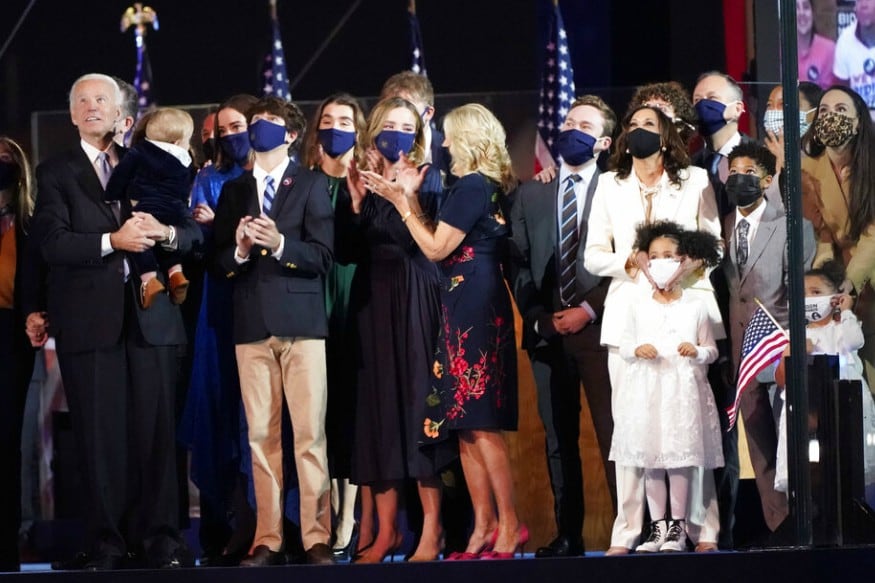
It is inauguration day, and a gentleman, a fighter, someone not ashamed to show emotion, proud of his faith, his country, his service to this country, is at the helm, and at his side is a woman of color whose intelligence is surpassed only by her fierce determination, and her devotion to country is equaled by her devotion to her family.

The former leadership showed no signs of love, none of integrity and certainly no signs of humility. The irony, of course, is had he shown even a small amount, he just might have won reelection. But it simply isn’t in him. When I saw the pictures today of Vice President Harris’ kids grabbing her arms, and them all laughing, it reminded me of the beautiful photos of the Obamas, and of President Biden’s brutal loss of his son, today his other at his side. These images—truly universal images of the elemental in all our lives, family—are absent from the past four years, and for all of the debates over policy and bullish attitudes, it just might be that love and grace, humbleness and a sense of sacrifice, is what we want in our leadership.

I’m not depressed today. It’s not medicine or the sunny, clear blue skies, or starting classes again or moving along well on a new project. No. It’s that today is an ordinary day, finally. The news is positive, words like “hope” and “grateful” have returned to the rhetoric. I’m going to have a glass of wine but this time to celebrate instead of to forget.

I live in the country, and many of my neighbors have been serious supporters of the former president. During the previous four years, the example set by the president seemed to make some feel like they had carte blanche to treat others, particularly those of us with different ideas, as intruders, as suspect, and more than a few acted like childish, unintelligent people. But this was the example set for them. Sad.

But the example set for us by President Biden and Vice President Harris is clear: it reflects the president’s very own faith in the words of Thomas Merton: “Our job is to love others without stopping to decide if they are worthy.”

That should be normal. That should be how we act on any given day. But for four years I’ve felt like my most successful days were when I made it home without having an argument, without having a stroke. Life should not be like that, but it was. It really was.

No more. Now, while we still have a transition to endure, the golden rule—quoted today during President Biden’s speech—is in favor again, and the normal acts of human behavior to treat others with respect, to act with dignity and integrity, and to have some self-respect, have returned.

The view from this wilderness today is one of hope. It’s been a long time coming.

Joe Biden, Kamala Harris & Their Families on Stage for Fireworks -  Photogallery

Rachel

Tourists In The Street At Kazan Cathedral In St Petersburg, Russia  Editorial Stock Photo - Image of road, church: 131547573

I’m thinking tonight about Rachel. Dear beautiful Rachel.

This is a tragic story.

In the early 2000’s, in May, in the hallway of the Pribaltyskaya Hotel in St. Petersburg, Russia, I ran into my good friends Jose and Rachel. It was nearly four am and we were leaving in a few hours for the airport, but no one was asleep anyway and Rachel decided while packing that she still needed a half dozen or so bottles of vodka to bring home as gifts.

“Vodka!” I said, perhaps a little too loudly. “Rachel, you’re pregnant!” A few hookers at a nearby booth turned to watch.

“It’s not for me!” she declared, also not just a little loud for the hour of the morning.

Jose explained he was bringing her to a twenty-four-hour kiosk not far away and would make sure she didn’t get hurt or ripped off, or, worse, purchase bad alcohol. This was Jose’s fourth trip to Russia with me and he knew his way around the black market during the white nights of late May. “Just be careful, Rach,” I called. “You should be dead anyway!” I added, and we all laughed.

A few days earlier our entire entourage was walking freely down Nevsky Prospect, the Fifth Avenue of the city. I was right behind Rachel on the crowded street so we were all pretty close to each other. As usual, my former student was engaged in taking pictures and writing in her notebook, jotting down “Kazan Cathedral” which was just to our right. Of all the people I’ve traveled with—numbering well over four hundred—Rachel was by far the most diligent about drinking it all in, making notes, taking countless photographs. She always smiled anyway and could make everyone around her laugh, and there on the other side of the world she was in her element. She absorbed every single moment. In the evenings she’d come into my room and show me what pictures she had taken that day and double-checked their locations. Then we’d sit and talk about her impending motherhood, what it’s like being a parent—my son had just turned ten. We’d laugh about students in the classes of mine she had taken. Like one guy that previous semester who kicked over a desk, told me to fuck off, and stormed out of the building.

“I have that effect on people,” I said.

“Only those who deserve it!” she laughed. “He was such a punk! I can’t believe you let him back in.”

“Chances,” I told her, and she laughed. We had over the course of a few semesters joked about how many second chances we get, and when we do to not screw them up. “He pulled out a passing grade. He’s in my next class this summer, so we’ll see. Which, by the way, I saw you’re not in!”

“Hello?!” she laughed, pointing to her abdomen, which was just starting to show enough that she wore loose blouses.

“Can I ask about the baby’s father?”

“We’re working it out. He keeps promising he’s going to be different now that we’re having a baby. He got a job, moved in with his parents to save money. We’ll see.”

“Second chance?”

“HA! More like fourth or fifth!”

And we’d talk about education, about travel being the most advanced degree possible, and that she wanted to make sure she went on all the trips she could. For this one Rachel had secured a scholarship to help pay for the expenses. To earn that, however, when we returned they would have to write a paper for me for Humanities credit, and she chose to write about architecture.

So the next morning while walking past Kazan Cathedral, she was absorbed in her notes and stepped right off the curb and into the cross street where a bus was ripping past us at forty miles an hour. I was close enough to Rachel to grab her hair which she had pulled back in a pony tail, and I yanked her back into my chest, and the bus was close enough to knock her bag out of her hand on into the street. Those around us screamed and Rachel turned back somewhat unaware of what had just happened. “He saw me,” she said, to which I replied, “Yeah, he did. He just didn’t care. Pedestrians don’t have the right of way here.” We picked up her belongings and in no time she was back into enjoying her tour of Russia; my heart didn’t settle down for hours.

“Second chance!” she said to me, later on the walking tour.

“More like four or five!” I joked.

The morning we were to leave, she and Jose showed up to the bus with their bags just in time for our ride to the airport. Rachel had her vodka supply and asked how she should handle customs. I ran through the myriad responses possible for whatever they asked, but as it turned out they waved her right through.

I saw Rachel several times during the following year, even after she turned in her paper (A), and a few times after she told me she had a new roommate at an apartment on 24th Street at the beach, and she broke it off for good with the ex.

The last time I saw her she brought her daughter, Shaylyn, to my office. This beautiful woman with her beautiful little girl was so excited to move on with her life; she’d be a single mother, she told me, and hoped she could set a good example. Then we remembered the bus in Petersburg, laughing at the nearly tragic outcome, and she assured me I had saved two lives that day. I laughed and told her I was just glad she hadn’t cut her long, curly hair. “Yeah that hurt, by the way,” she joked, grabbing the back of her head.

Her daughter has her eyes.

Not much later, in May of 2005, the little girl’s father went to find Rachel who was hanging out with some friends at their apartment. When she refused to let him in, he cut a hole in the screen and climbed through. Rachel ran out the back door and called 911. Her ex walked through the house and shot four people killing two of them before he found Rachel hiding outside. She had called 911 and the operator had to ask several times what was going on, but Rachel was quiet, until finally she replied, “He saw me,” and her ex put his gun to her skull and shot her in the back of the head, killing her instantly. Three years later with some plea-bargaining to avoid the death penalty, he was sentenced to life in prison with no chance of parole.

In the woods not far from the hotel, right on the beach and tucked away in a grove of trees, was my favorite gritty bar I’ve ever been in. Everyone called it “the shack.” I knew a gypsy band who played there most nights after midnight until about four, and for a few years by then I’d head out and join them, borrowing Dima’s guitar while Sasha played violin and Natasha sang, and it would last until dawn while we drank red wine and ate shashleek, a chicken dish similar to shishkabob. Sometimes there would just be a few of us, and other times a whole group, like the time we spent the night in the shack during a storm. Rachel was there that night, sitting at a table in the small make-shift shack, taking it all in, watching everyone dance, sing, and drink. She had bottled water and a lot of chicken and laughed hard with Natasha who sat with her between sets, though I know Rachel didn’t understand a word the singer said. I can picture her still, sitting there, laughing.

That’s how I will always picture her.

Her daughter today would be almost Rachel’s age then.

Christ.

We spin and we turn through the changes and falls, hoping beyond hope we get to the end of it all without something tragic happening, dreaming of second chances and laughing the best we know how, stealing time with friends, telling stories and remembering when. But there are no second chances, not really; just this one, and while not all of us will live the life we had hoped for when we started out, some will not get any chance at all.

A few weeks after the murder I was giving a tour at the Chrysler Museum in Norfolk, Virginia, to my art students at the university. Rachel always showed up for those tours—notebook in hand. She was on my email list of people who wanted to know when I brought my class since it was open to anyone. I stood in the atrium lobby drinking a glass of cabernet talking to another student who often came with her husband. It was quiet while visitors and students mulled about waiting for the tour to start, and I said to the woman, “I thought Rachel would be here. She had emailed a few weeks ago that she was going to bring her daughter.”

The woman handed her wine to her husband, touched my arm, and suggested we move to a table to talk.

Rachel Scher Obituary - Chesapeake, Virginia | Graham Funeral Home
Rachel Scher

Opinion: The Most Misunderstood Concept in Discourse

TOP 14 IGNORING FACTS QUOTES | A-Z Quotes

If you will indulge me for one post, this is a diversion from the literal nature to human nature:

Few people think they know more than the ignorant MAGA dude does in line at 711 looking for attention, for someone, for anyone to mark his credibility. These maskless morons cannot be reasoned with, nor can they comprehend large words or complex concepts. Does that sound arrogant? Does this hint of elitism? I don’t care, because at this moment I am going to do something I rarely do: Brandish my three college degrees as well as my expertise in research and verification of sources. And if any of this basic lesson in critical thinking comes across as anything other than a frustrated, highly anxious professor of thirty years who can’t handle the spike in blood pressure when small-brained pricks yell conspiracy, fine.  

So to the point, here’s how discourse in this country is supposed to work:

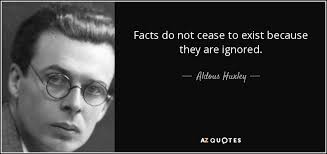
The most important question professors ask of every student who writes a paper, takes an exam, debates an issue, or raises a hand to ask a question is, “Where did you get your information?” The answer to that question determines just how prepared that student is to participate in any discourse. The very notion that “everyone is entitled to their own opinion” is simply not true. An opinion is a “judgement based upon facts.” What everyone is entitled to is their “belief.” And as long as people keep mixing up those two simple concepts, we will have division, dissent, and misleading information.

A simple metaphor: if someone’s stomach is in excruciating pain and they want to know what to do, they ask a doctor, not a plumber, not the guy next door, not the friend in line at the convenience store. No one questions this. But when it comes to issues of constitutional law, of election accuracy, of the rights of individuals to raid a government institution, too many people “believe” they are entitled to their opinion of what should be allowed and what should be questioned and mocked.

It is a simple three step process to insure people know what they’re talking about when they protest or protect, when they prosecute or defend: One, again, “Where did you get your information?” The answer to this question, if done correctly, should be sources whom have advanced degrees and experience in the field discussed—constitutional lawyers, political science researchers—and it should be noted that education and experience are not the same thing. A three-term member of congress does not make that person an expert on anything except what it’s like to be in congress for all that time. An historian, social scientist, or political scientist who has made a career out of investigating the causes and effects of House and Senate activities, studying the experts through the years, and has published extensively, is the source of what works and what does not work.

Two: Because even experts may allow personal beliefs to stand in the way, people who truly know what they’re talking about have multiple, independent sources. No self-respecting expert would dare present results of any investigation, whether into the actions of a president, the accuracy of voting machines, or the validity of an election, without first consulting at least three independent, recognized experts in the field being discussed. Then and only then can a valid judgement be made based upon the most accurate and complete set of facts.

Three: Anyone who is to be taken seriously should have a complete understanding of the opposition’s argument, evidence, and position. To know how anyone reached an opposing opinion is essential if any intelligent discourse is to take place. This allows either side to point out the fallacies of the opposition through prior understanding.

Okay, so what’s the problem? Easy: A fundamental belief that everyone who disagrees with you is lying because they want what’s best for themselves and not for you. The only way to combat such a non-objective belief is to insist those people provide the source of their information so you can better understand how they came to that conclusion. If the answer continues to be “the other side is lying” or “it is a conspiracy,” but never fastens itself to concrete study and research to accurately determine the validity of the evidence, they are participating in a debate they simply are not prepared for, rendering their belief absolutely worthless.

Facts are stubborn things; and whatever may... - Quote

The Five

In my creative writing classes I gave an assignment to exemplify the benefits of immediate experience over memory of a previous encounter, and of allowing all our senses to participate instead of just one.

I sent half the students into their respective bathrooms (without limitations upon identification, of course) with a pad and pen and I asked them to spend ten minutes in there and describe it. The other half of the students stayed in the classroom but did the same thing. The results of this second group were always predictable. Certainly, every one of them had been in the bathrooms multiple times through the semester, but still they almost universally remember the trite—running water, unpleasant odor, writing on the wall, mysterious missing locks on the stalls, paper towels on the floor around the garbage can.

When the first group returned, their notes were a bit more illuminating. Not just unpleasant smells but one of overwhelming cleansers; the low buzz of a fluorescent bulb, the mirrors always slightly too low on the wall, the faucet left on, the urinal still running, the clogged commode.

We experience with five senses, sometimes six if you include that sense of familiarity, of déjà vu, but we tend to remember and often only experience with one—sight. Studies show we rely upon how things “look” to recall them more than eighty percent of the time, yet the number one trigger for recall is smell. “Use ALL the senses,” I tell them. “Perhaps ‘taste’ is not so appropriate in this particular assignment, but sound is essential, obviously smell, and touch for its absence—how can you not include the desire to not touch anything?”

We spend a good deal of our lives living in the singular. One thing at a time; one sense is enough, one path in the woods. One thing problematic in this dip back to Psych 101 is how much we are missing. Sure, sometimes one is enough—but even when we eat, taste is only a fraction of the experience—the aroma draws us in and works with taste for complement, and presentation strikes first, of course. And how many of us are not crazy about a particular food because of its texture (for me, swordfish).

Shift:

This morning I sat on the rocks at the river, trying to mentally juggle too many happenings at once. The new semester starts soon—online for now—and I thought about how I had hoped for more classes but enrollment is way down, so then I thought about the project I’m working on to catalogue as many readings about nature from writers as I can and my attempts to summon interest, then about a new book project I started, kinda—okay, not so much started as stepped in that direction—and about my sharp, intensely sharp spike in anxiety and depression when the news is violent, when the rhetoric is redundant and aggravating and angry, and about a tree which fell and needs to be cut up, and about

and about…

and…

the coffee kicked in and I took a deep breath, exhaled very slowly into the chilly breeze, and reminded myself that I need to warm up to the day in much the same way we would warm up before a class at the health club. Take deep breathes through the nose, out slowly through the mouth, stretch, let all our senses work—and stretch those senses, make them limber, feel and see and touch and taste and hear all at once, not only like we are absorbing the world around us but the world around us is absorbing us.

This doesn’t work well in the city. It doesn’t even work well at home on a mat in a quiet room—we created the room by design and experience. No, nature is safe from subjective influence, it remains absent of judgement and human influence; there’s nothing out there we need to “get to” while looking around. It has a sense of eternal about it.

So I sat on the rocks and did that breathing thing, and the cold tightened the skin on my face the way cold wind does, and I could sense every touch of air across my reddened and tight neck and cheeks. On my tongue and lips that taste of salt I have known since my childhood, the marshy odor, the freshness of the Chesapeake, and the waves ripping against the rocks, lapping on the sand, breaking ten feet out in the river, the call of a gull behind me, the low distant rumble of a workboat diesel.

And then, dominantly, the view, the view which reaches deep into the immediate and blocks out all things social and political and makes us present. The deeply blue water today, the intrusively blue sky, the foam from the cold water on the sand and the white edges on the tips of the breaking waves. The small green strip of interruption that is Parrott Island a mile or so out, and the glint of sun off the window of a truck crossing the Norris Bridge in the west.

I am rarely present these days, distracted by what I hear on the radio, disturbed by the distance between where I am and where I need to be. It happens to us all. The changes in my life over the past two and a half years have been so drastic that sometimes—usually—it is hard to keep up with everything, so I turn to the constant, the familiar, to let my senses recalibrate themselves and make things right.

I like—need—order in my very unorderly life. And stepping into nature is perhaps the most reliable method of getting all my ducks in a row and feeling centered again. There’s something Thoreauvian about that, of course, and Jung is part of this equation, but for me on a much simpler and basic train of thought, it’s the undefinable persistence of beauty that brings me peace. And the innate need of us all to love. Lao Tzu was right when he insisted that “Love is of all passions the strongest, for it attacks simultaneously the head, the heart, and the senses.”

So many changes, so much turmoil, so many medications and sessions and updates and downplays that have distracted us all from what should be elemental in our lives—ourselves, and all of our senses working together. It is the cure for the soul, as Oscar Wilde once noted, as is the soul the cure for the senses.

In this new year I’ve noticed something which at once was subtle but has become too persistent to ignore—I’m stepping further away from that which doesn’t bring peace to my mind. And the one absolute I know is I never had that problem in nature.

It just makes sense.

Five Beautiful Moments/2020

Image may contain: ocean, sky, cloud, twilight, outdoor, nature and water
SUNRISE

I don’t need to list the events of this past disastrous year; any one of the tragic events of 2020 is too much to digest, let alone the dozens of horrific and often needless travesties. I’m not sure how we collectively decided it was the year’s fault, and leaving 2020 was going to miraculously dissolve those issues; people are still dying in record numbers, unemployment, homelessness, and hunger are the worst they’ve been since the depression and that isn’t changing at midnight, and as one friend posted this morning, “If you think 2020 was bad, wait until it turns 21 and starts drinking!”

But we like symbolism, we are energized by significance. Birthdays represent an accomplishment as well as a place to begin again, as does the New Year. The turn of the clock (despite it having been changed several times in the past two thousand years, so God knows what day it actually is) translates to a turn around the proverbial corner, a chance to see the light at the end of the tunnel, to take a new path, and whatever other clichés you can muster up this weekend.

We make resolutions. This year I started making lists and tossing them, marking how much weight to lose, how much exercise to add, how much money to save, how many letters to write to those I care about, and I tossed them all. Now, on the front edge of this new year, I have just one: To trust myself again, my instincts. I used to do that, years ago, and when I did, I may not have moved mountains, but I felt centered, at peace with who I was. It is time to feel like that again. I started practicing a few years ago and so far it’s going well, but at midnight it is official: I’m going to let Bob be Bob, to lift an ism from The West Wing.

All that aside, for many of us 2020 deserves the pummeling it is getting as we join together to slam tight the door behind us. Most of us know as least one person who suffered the virus, some of us know someone who succumbed to it. For those with conditions such as anxiety and depression, the year was especially challenging, and throw a dislikeable president into the mix and no wonder suicide rates are higher than ever. The new year gives us all a time to step back, refocus, and, as Jimmy B says, “Breathe in, breathe out, move on.”

But first, instead of rehashing the top ten crappy moments of the finally-in-hindsight 2020, I’m going out this time recalling five fine moments to take with me. If we all did this, we’d move into 2021 with fine memories.

  1. As the result of stay-at-home measures, my son Michael and I headed out into the wilderness more than ever before, discovering state parks, nature trails, marshlands, and preserves we didn’t know existed not that far from home. This isn’t solely a memory of 2020; this will stay with me forever. We hiked and talked and took in the consistency of the natural world together.
  2. Seven years almost to the week after returning from our trans-Siberian journey, I signed a book contract for the 2022 publication of The Iron Scar: A Father and Son in Siberia. On the one hand it did feel good to finally close the chapter—quite literally—on that project and move on to a new one, on the other it remains a significant accomplishment of the year since of the fifteen chapters in the book, fourteen of them have been published in twenty journals, were finalists in four contests, and have been nominated for five awards. Bragging rights allow me to add that the book will contain a section of Michael’s photographs of the journey.
  3. After several years of not working on the property all that much by virtue of too many other stresses in life from 2017 to, well, almost now, I’ve returned to one of my natural states and started reshaping the trails here at Aerie, grooming the paths and adding several more birdbaths and feeders. If I’m going to have to “stay at home,” I might as well make home a place I want to stay.
  4. While I have not really yet seen him much because of Covid, my brother lives just an hour away. This is more important to me than anyone might realize, including him I suppose. As the youngest, I was only twelve when my sister went off to college and then life, and my brother followed two years later. While we have all been close, I haven’t lived within three hundred miles of either of them since 1975, and until my sister moved about six hours away, any trip to visit siblings was a two-day drive, which I hardly ever made. Ever. Ever. So an hour away down the Colonial Parkway along the York River to have lunch, play golf, or just hang out is something I am grateful for, even if we don’t. Sometimes the peace of mind is in just knowing someone is near.
  5. Friends keep me sane, answer when I call, call to see how I am. We get together when we can and laugh, or have deep conversations about the passing of time, the beauty of the sun on the water, the sound of ice in a glass as we sit quietly and watch the moment at hand unfold. We take them for granted, these brothers of ours, don’t we? I mean when we can see each other anytime, we generally don’t, and this year has shown me how much to appreciate the ability to be with those we love.

Yes, 2020 is hindsight, and the new year is upon us. Thirty-five years ago I worked at a club where the members greatest challenge wasn’t weight loss but feeling good about themselves, and we emphasized one message in particular: be yourself. So I’d go into the studio and at the end of a difficult, challenging, but survivable workout I’d work them through the cooldown and remind them to be themselves, trust themselves, and the rest will follow.

The difficult, challenging, but survivable workout we’ve endured with 2020 is over, and I’m looking out over Aerie as the temperatures cool down a bit and know, I simply know, it is time to follow my own advice.   

Happy New Year.

Image may contain: cloud, sky, ocean, outdoor, water and nature
SUNSET

Eddie

Best trails in Heckscher State Park, New York | AllTrails
The beach trail along the Great South Bay in Heckscher State Park

NOTE:

This afternoon after learning of my childhood friend Eddie’s death, I went through my emails from him and found this one which, ironically, is about,

well…

here it is. I’ve edited for grammar and spelling (I hope), but everything else is exactly as I wrote it to him just over six years ago:

November 5, 2014

Why am I a writer?! Ha! I love these “question emails” we’ve got going here, but that’s a tough one. I think I prefer the ones along the “What kind of fruit do you never tire of?” Still, I’ll give it a shot. So, probably for the same reason you are a spot-on blues guitar player: it keeps me sane.

Because as you know I well know what a lunatic is! (in case your memory is slipping after four decades, we were working on the fort in the woods in my yard and it got dark and you said you had to go, and said, “Don’t let the lunatics get you!” and I told you I didn’t know what a lunatic was, but you just laughed and left. Then a few minutes later you jumped at me through a bush and scared the crap out of me and I called you crazy, and you said, “Yes! That’s a lunatic!” and went home)

Why am I a writer? Geez, Ed, the same reason I was when I was home sick in fifth grade and wrote that book (what, maybe ten pages?) called “Space”; because we’re going to die. I didn’t know it then (I didn’t know that’s why I wrote AND I didn’t know we were going to die) but I think I’ve finally figured out what I’m trying to say as a writer and what, in fact, every writer is trying to say: We’re all going to die. That’s it. Writers want everyone to know that in roughly one hundred years not a single person walking the earth will still be alive. We will all, the entire globe, be gone, replaced, returned to dust for the ever part of infinity, ever and ever…and ever…dust…ever.

And we want everyone to know that.  You’re welcome.

We want everyone to know that when the rain hits the roof at night it sounds like childhood, Saturday afternoons with old westerns on the television and grilled cheese sandwiches, and we want everyone to know that because childhood dies too, and even old westerns. We write because I still have some faded image in my mind of a bunch of friends in a small town on a Long Island, sitting around laughing about baseball and nature and girls, about music, and about “the trail,”—Geez, remember the trail?, that mysterious path through the woods along the Southern State that led to a creek where things happened when teenagers wandered that way. Like the time you and I swung across the creek from a vine and then followed it to the far end and came upon the arboretum gate, and hopped it and walked through the grounds pretending the estate house was ours and we could do what we wanted. And we sang “The Long and Winding Road,” and now all these broken hearts later I can’t recall most people’s faces—yours is perfectly clear but I’ll be honest, I don’t know if that is because of memory or Facebook. When I see you on there, always laughing, I see you at twelve. Sometimes it’s as if I see it like I am thinking about a movie I saw once but can’t really recall it very well. I remember the character’s names and I remember what happened, but the details are fuzzy, and my God I would love to see it again. Like that scene when you and I walked to Timber Point Elementary and met Boomer there and the three of us sent up one of those rockets with the engine packs in it. It shot up so fast we didn’t really see it go as much as we saw the smoke line, and that’s why I write, because it all goes like that, life goes like that, like a rocket we don’t see it as much as we see the residual effects. Anyway, I remember that we followed it as it drifted into the trees and Boomer finally got it down and we all went home. And on the way we talked about building a bigger one of those, really big. I had a brown CPO jacket and my mom sewed patches on it for me of NASA and the American flag. I knew everything there was to know about the space program then, including the velocity necessary to exit the atmosphere, and the speed of drift in space while orbiting. Well, writers think like that, Eddie. We are overly conscious of velocity and drift. Those two depress the fuck out of us.  

But even then I knew, I mean I just knew as well as I knew the names of all the streets in Great River, I knew we were all going to die! All of us, someday and some sooner than others, like my grandfather who died too soon; and some much later than others like my great Uncle Charlie who lived so long. And as I got older I didn’t think anyone knew but me, so I had to tell everyone; I just had to let them know we were all going to die, all of us. It isn’t a depressing thing for us (writers), it is a motivator, like barkers at a circus trying to get people in to see the show; we’re calling from our pedestal trying to get people to see the show. Remember when I said, I think we were in Heckscher, and I said I had proof everyone will die, and I said name one person who was still alive from the Civil War, which had ended about 107 years earlier. And you couldn’t. And I said, “See!” and you said, “You’re a lunatic.”

You said, “They were alive once, though.” And we stopped, somewhere toward that old abandoned beach cabana on the bay, we stopped and I said, “Exactly. They were so damned alive they bled, and they cried and they laughed and they lived. They had houses and farms and children and played games and had dogs and some of them, hell a lot of them probably, even had sex.” and then we talked about sex and forgot about dying—or living for that matter. Jesus, we were what, thirteen? Fourteen?

Anyway, that’s why I write. And I bet that’s why you play guitar, especially the blues. Because we’re not yet dead.

How’s Alice? How’s work? I’ll get up there, buddy. I will.

Until then I teach and I write; or, I should say, I teach SO I can write. And I write to remind myself that the bullshit I wade through on a daily basis is irrelevant.  The constant crap dealt with by being alive these days is tempered by the night sky and a quiet jet filled with people traveling thirty thousand feet above my head, all of them very much alive until they aren’t.

Except the old prick at the hardware store who insists on telling me a log home won’t keep me warm unless I put mud between the logs, and even after I’m paid in full he talks anyway and tells me I should have bought a double-wide. This was yesterday, and I just laughed and thought to myself, yeah, just keep talking mofo, someday you’ll be dead too.

I guess I’m here to write about what happens before that happens.

So your turn: If you could only fill the fridge with one food item, what would it be?

Miss you Eddie. I swear I’ll get up there. It might not be very soon, but I’ll get up there.

Image may contain: 1 person, hat, closeup and indoor
Edward A. Radtke 1961-2020

Special Edition

I want to take one moment to ask for help.

The Nature Writing Project, as I’ve mentioned before, has morphed into a larger and more widespread endeavor, with grants applied for, an IT guy retained to design and run the website, and already promises for video and audio clips have come in from Israel, Russia, Norway, Brazil, New Zealand, and more. Domestically, we are adding hundreds of two-to-three minute audio and video clips about nature from best-selling and award winning authors.

This will be the resource for faculty, organizations and anyone anywhere to find some of this ages greatest writers connecting with nature. Poets, non-fiction writers, and novelists all are involved to illuminate the connection between nature and humanity.

Can you help? The money donated will help curtail the costs of the technology and early promotion. Once it is up and running, the overhead will be very minute, but for now we can really use assistance.

Here is a link to more information and a way to make an anonymous donation (or public if you prefer, taking the role of “sponsor”).

Thank you very much:

https://aviewfromthiswilderness.com/donations/

300

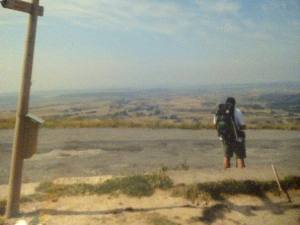
South of Pamplona, Spain (photo by Michael Kunzinger)

I started this blog five years ago just a few months after my father’s death. The first entry was January 18th, 2016, and my objective was simply to escape the changes going on—the loss of my Dad, politics, the swamp that was my job—through journal-like entries about my favorite locale, nature. I thought I’d share with anyone who might want to read these short pieces about the bay and the river and the woods here at Aerie just what it’s like to take a moment to myself on an afternoon walk, or a morning sunrise, so that I might better handle the outrageous drudgery the rest of the time; and along the way I’d probably digress into the brevity of life and the organic need each of us has to love. Sometimes it worked, more often not. It didn’t really matter; this wasn’t the writing I’d be sending out to be taken seriously. It was more or less a diary.

But every once in a while I’d be just finished with an entry and decide it was worthy of a larger outlet and I’d send it off. Like the time I sat in Panera’s in Virginia Beach the afternoon I returned from my uncle’s internment at Arlington National Cemetery. I drank iced tea and wrote a blog and posted it. I reread it right away and thought it seemed pretty good. I immediately planned to send it to the Virginian Pilot, but I couldn’t find the editor’s email, so I looked up the Washington Post just for fun and sent it. I went to the bathroom (free refills of iced tea, don’t you know), and by the time I was back at my table the Post had replied and accepted it, with plans to publish in Memorial Day Weekend on the front page of the Metro Section. My acceptance needed to accompany a checked box acknowledging it had never been published anywhere, including a blog. I checked the box and said, “of course not,” and immediately went to this blog and erased the entry. I then went to Facebook and posted a note which said, “If you thought you just read a blog here, you are mistaken; however, buy the Washington Post Memorial Day weekend.” The piece got a lot of attention.

More often I’d be halfway through and wonder what kind of pretentious, bloated ego I had to think anyone would care what happened up here. Look around: we all have faces and stories and histories and desires. Everyone can have a blog and each one would be interesting, and boring, and worthy of a larger outlet and rank enough be tossed immediately. Point: I realized straight off if this was going to work, I had to write solely for myself, like it really is a journal for my own perusal. That took the pressure off and allowed me to write without expectation, without judgement. I quickly didn’t care if a single sole followed the bloody thing.

And, predictably, the “followers” don’t number very high, but the tracker shows the current weekly unique readership is surprisingly just over 1000 people. Every single week. And after year three I rewrote several dozen entries and strung them together in what would become A Third Place: Notes in Nature, published by Madville Press in Texas last year.

So after five full years of this, and on this entry, my 300th, I thought I was going to write about something that forced me to be completely wide open, expose my soul, as it were. I was going to write about all the things writers try and write about but fall short because writers have all already written about them, like the need to love, truly love, or about the need to live, truly live the way you dreamed of living when you were young and still unafraid of failure. So many subject matters a hopeless romantic like myself could write about, such as what it’s like to be a hopeless (hopeful?) romantic. So I tried just an hour ago. Didn’t work out. At first, I wrote that I thought the hardest thing about being a hopeless romantic is that we keep dreaming long after everyone else has come back down to reality. But I reread what I had written and realized that the most beautiful thing about being a hopeless romantic is that we keep dreaming long after everyone else has come back down to reality.

There are no words for some things; some thoughts can’t be chiseled out with phrases and punctuation.

So instead, for entry 300, I decided to publish someone else’s words. It is from Joseph Zinker at the Gestalt Institute and I’ve published it on this blog before. It is still and most likely always will be my favorite passage of words on a page:

If a man in the street were to pursue his self, what kind of guiding thoughts would he come up with about changing his existence? He would perhaps discover that his brain is not yet dead, that his body is not dried up, and that no matter where he is right now, he is still the creator of his own destiny. He can change this destiny by taking his one decision to change seriously, by fighting his petty resistance against change and fear, by learning more about his mind, by trying out behavior which fills his real need, by carrying out concrete acts rather than conceptualizing about them, by practicing to see and hear and touch and feel as he has never before used these senses, by creating something with his own hands without demanding perfection, by thinking out ways in which he behaves in a self-defeating manner, by listening to the words that he utters to his wife, his kids, and his friends, by listening to himself, by listening to the words and looking into the eyes of those who speak to him, by learning to respect the process of his own creative encounters and by having faith that they will get him somewhere soon. We must remind ourselves, however, that no change takes place without working hard and without getting your hands dirty. There are no formulae and no books to memorize on becoming. I only know this: I exist, I am, I am here, I am becoming, I am my life and no one else makes it for me. I must face my own shortcomings, mistakes, transgressions. No one can suffer my non-being as I do, but tomorrow is another day, and I must decide to leave my bed and live again. And if I fail, I don’t have the comfort of blaming you or life or God.

Please go to the “follow” button on the bottom right hand corner of this site and click it. Then enter your email. Then go to your email and confirm it. You will ONLY get my blogs, nothing else, no junk (except when my blog entries are junky).

Thanks for following me these five years. I’ll be back the beginning of January to begin Volume Six of A View from this Wilderness.

Carpe diem and all that, you know.

Bob