Teacher’s Comments, III

(Part Three of Three)

Well, the truth is I probably should have paid closer attention to the teachers and less to the children around me in class. I didn’t know then that geometry would matter when I built my house and tried to cut hundreds of yards of tongue-and-grove planks of pine at bizarre angles to fit in the stairwell and along the hallway ceiling. I didn’t realize I’d need Intro to Spanish when I stayed with my friend Sean Cullen on Presidents Street in Brooklyn.

But I must have been staring out the window of East Lake Elementary or Timber Point Elementary or three different other schools when someone must have mentioned how to decide what to do with my life, when for years they said “follow your dreams” followed quickly by “get a job.” Is there a middle lecture during which I checked out, stared off into the sky thinking about the moon? Because I don’t remember it. There must have been some lesson in there about trying not to feel lost along the way. And did one of those teachers go over some checklist on what to do when friends die? What to do when your heart is broken? What to do when you feel hopeless and as if you’ve run out of options? Where are those lessons?

Which teacher talked about the value of every single different and misunderstood life, the significance of helping others, the strength it takes to ask others for help? Did one of them explain how to handle some punk making fun of you? Did one of them explain anything other than the ABC’s, the structure of a sentence, the history of us, how to figure out the value of X, the need to know why we need to know the value of X? Because those things I understood. When teachers told on me for paying too much attention to others around me, I wanted to ask, “What am I missing? Social Studies? Math? Penmanship? Got it, thanks! But which day will you explain to me how to tell the red-haired girl I liked her and would miss her and that throwing a frigging card at her wasn’t the best approach?” But it seemed rude. That I learned from my parents; don’t be rude. They don’t really teach that in class. Mrs. Guidice in Kindergarten probably did, but by then I’m sure I knew that. Apparently we learn everything we need to by the time we’re in kindergarten.

I’m not suggesting we shouldn’t listen to our teachers. I’m insisting the teachers need to do a way better job of giving us something valuable to listen to. Oh wait, Mrs. Kramer, third grade—her I heard, when she told me I’d never amount to anything (though to be fair, she told all the boys that—she hated boys and made that clear), when she said I was just another loser kid who would be lucky to graduate from school. This was May 1969—I was eight. No kidding—don’t pretend kids that age don’t hear and don’t remember. They do.

I can’t blame her, though. The whole system sucks: The United States is eighth in reading in the world among sixty-four countries. Eleventh in science and thirtieth in math. The decline started in the late sixties and while reading scores have improved (up from fifteenth in 2015), this country’s elementary school system has more violence than any other industrialized country in the world, so sometimes paying attention is challenging. The US is nearly at the bottom of the list in health education, sex education, history, and current events/social studies.

So it isn’t entirely the educators’ fault that they spend a good deal of their time wasting ours and we stare out the window or talk to each other about the Mets. Administration demands production, growth, and improvement at any cost. Parents spend way too much time watching reruns of some mind-numbing reality show instead of reading to their kids. And students, whoa! Students—don’t get me started. You need to put down the damn phones, laptops, and games, because you know what students? Tik Tok Tik Tok—life goes by fast, and it is about who shows up and who’s listening. So while everything else is more interesting and engaging and captivating and immediate, for three or four hours a day you can shut up and pay attention. And none of this would be an issue if parents started reading to their kids when they were still toddlers. Every study proves this, but still they don’t. Not nearly enough anyway.

Sigh. Okay, listen:

The truth is I simply wasn’t smart enough to know all that when I was ten, and the first reaction to confusion is fear, and the first response to fear is to look away. Maybe I was scared. Or maybe then and now I’ve simply never been smart enough for the life I’ve led. We do that, we mix up personality with ability, we confuse creativity with knowledge. The teachers were right: I paid too much attention to the others around me. Always have. And while I despise such rudeness in my students when they stare at the phone while I’m talking and apparently no one, I mean NO ONE, Dear GOD No One taught them to look at people who are talking to them, I’m guessing neither did I.

I had trouble focusing sometimes; still do. And it isn’t because of any learning challenge or medical condition; it’s just that I find people more interesting and engaging and, frankly, more important, than just about anything else. If you didn’t want me to pay attention to others, why did you put twenty-five ten-year-old’s in the same room together and then tell us to shut up and not pay attention to each other? And, really, no kidding, if my peers told me about the amendments to the constitution instead of the woman screaming at us to remember the amendments, I’d have remembered them. How is it teachers don’t see that? How is it possible a teacher can be in the same room with a student for one hundred and eighty days a year and clearly see he has trouble focusing, listening, caring, and not try and help other than to point out the obvious?

I know this: I was always told to just do my best. My father told me that, my mother, teachers, truly everyone. But I never really knew what my best was. It is such an obscure and vague goal to shoot for: “Your best.” I thought I did my best at tennis until I played someone better who challenged me to improve. I thought I’ve done my best most of the time and most of the time it turned out when I pushed my self again I did better, but sometimes I simply failed at the effort. It is not an easily definable figure, “Best.” Educators don’t know when to push harder and when to back off. Neither do parents. I do know students can do better. I told my students that once and said I could prove it. They laughed at me. So I told them to write two hundred words about being in college, and they did. Then I said if I gave an A for the semester to the top five papers, would they be better? Then all said they would. Then I said if I gave the top three five thousand dollars, would they do better work? Then all laughed and said “of course!” and I went silent. And after a minute I told them, “Then you always could do better, you just couldn’t be bothered. Not unless someone paid you.

They only thought they were doing their best. So did I. Everybody thinks they’re doing their best, that they’re paying attention. But couldn’t we all pay closer attention to the people around us, what hurts us, what brings us down, why are we so quiet, so distant, so sad? We could all do with a little less focus on the lessons and more attention to the examples of life around us, and love, and the undefinable completeness of now. But we’re all just a little too distracted these days, aren’t we?

Well, teachers of mine wherever you are, if I was talking when I should have been listening, if I was paying too much attention to others around me, I’m sorry. Sorry Mr. Kingston. Sorry Miss Terrill. Sorry Mom.

But somehow I learned. I got through. I even graduated. Got myself three college degrees and taught college for thirty years.

So fuck you Mrs. Kramer.

But through it all, what I got out of this life still comes from paying attention to the people around me, to the quiet, to the sound of geese at dusk and the gentle sound of water on sand on a calm summer morning. The sound of children in a park, laughing; tea poured into China cups, a baseball hitting a glove, the sound a can of tennis balls makes when you open it that first time, then that smell.

I’ve learned a lot. I’ve been privileged to have some of the best educators, and if I’ve been distracted through it all, I’m disappointed in myself for not showing them respect. But the education I treasure the most today was learning the value of telling others how much I appreciate them in my life; the value of a gentle touch that says I’m here if you need me. The value of standing still with someone and watching the sun settle down for the night.

The most valuable aspects of my life are the people and moments I always had, right from the very start, and it took me far too many years to understand that.

Why does it take so long to learn that?
Teacher’s Comments, II

(Part Two of Three)

I’d leave my office to walk the few hundred feet to a classroom and when I was still fifty feet away I could hear the overlapping conversations spilling out of the room, the students vying for audible space, the excitement and laughter and quiet discourse of a few less boisterous people; and all of them, twenty-three or twenty-eight or thirty-five, depending on the class, all of them talked to each other. No one had cell phones because there were no such things yet, and they introduced themselves or remembered each other from other classes, and as weeks went by they met for coffee or drinks, and some went out, and some even eventually got married. Everyone knew everyone else’s name. That was normal. It is where adult relationships started and the quick burst of life that was high school fades. It used to always be that way.

So when I sat in front of a class for the first time back then, I learned to listen to students before class started. In the first few days of the semester, most are shy, quiet, not willing to discuss anything to anyone in class. By mid-term, shutting them up takes scratching the board with fingernails or dropping a large text on the table. But those pre-class moments of seeming distraction were when I learned what I needed to focus on in class and sometimes outside of class. Students said things to each other during those minutes they might never purposefully say to a professor.

I learned about the best surf spots; which night clubs to avoid; which professors bored students, worked them too much, never showed up, never let them go early, gave pop quizzes, were cute, sexist, rude, arrogant, sympathetic, and menopausal. By listening to those students in the early days of my career, I overheard conversations about women’s cycles, men’s rejections, break-ups, breakdowns, hook-ups, the best places to get work, who drove to class and who rode the bus; who threw parties, who talked behind others’ backs. I learned who planned to stay just long enough to collect grant money, who couldn’t stand work or school, and who I offended with comments, who misunderstood me; who I misunderstood.

I learned which assignments students grasped, which they found simple and pointless, which they worked hard at and which they blew off. I discovered more than a few times which students plagiarized and which ones made up citations. I learned who hated me, who thought highly of me, who brownnosed me, who kissed my ass.

I listened to students’ conversations every week, and they were more alive earlier in the day. The eight o’clock classes talked about topics ranging from politics to rock. They talked about clothes, and through the years outfits considered decent to one group might not be considered remotely cool by the same age group ten years earlier. Hats swung from the front to the back and back again to the front, jeans are not as low on the butt as they were for a while, and tattoos are so common now they fade from view, and I learned to anticipate these trends and remain current in the vernacular of twenty-year-old coeds.

When students engaged each other and paid close attention to those around them in class, I learned whose brother died in Iraq, whose aunt never made it out of the South Tower, and the student whose baby was stillborn. I knew whose spouse was deployed, whose returned last weekend, and whose would never be back.

Sometimes I heard where people were from. Many moved south from New York, many were locals. Several came from Pennsylvania, like Karen Rounds, a student who knew my sarcasm and got the humor. She understood what I meant on the first explanation and smiled when someone asked a stupid question–and yes, there are such things as stupid questions. She just stared at them from behind, wondering perhaps what I wondered: What were you listening to just now? Once before class when she was talking to someone next to her, Karen told her she was from Pennsylvania, not far from where I had gone to graduate school. This led to their conversation in which she explained they had moved because her husband got stationed here before he had to ship out. Like many displaced military wives, Karen took classes and found a part-time job to keep busy. She planned to write her paper about living in Virginia far from family. I looked forward to it because of her sharp sense of detail and sarcasm; it certainly promised to be well written.

The day I received the paper I sat on my couch at home and read about her move. “I didn’t know people so close to my home state could talk so differently,” she wrote. She gave examples picked up while working at a local pub, the North Witchduck Inn. She didn’t need the job, she explained, but it kept her from feeling alone and bored during her husband’s deployment. “I got lucky,” she wrote. “Someone got fired and they hired me.” I remember her conversation she had before class one day with another student who was a server somewhere else when she said she was thinking of not taking the job after all since she was afraid she wouldn’t fit in.  And I laughed because I knew exactly what it was like to fall into a different culture.

But that very night, the fired waitress and her boyfriend returned to the Witchduck Inn and shot Karen and three others in the back of the head, execution style.

I listened too much, sometimes. I heard things I shouldn’t hear and became familiar with things I’d rather not know.

I knew about abortions, about pregnancies often before the father knew. I knew about little brothers and sisters with harsh diseases and grandparents with Alzheimer’s. I learned their ages, their birthdays, their income, and the cost of their birth control meds. I sat back and made notes on paper about what I might use for examples in my lecture, tried to steer it closer to their generation, their understanding. They were more human then, and the space between us didn’t seem so drastic, so distant. But that has faded as cell phones became apparent, then common, then simply an extension of their anatomy.

No one looks up, circulates, asks questions of each other, asks each other’s names. I had a student in the front row who had a cast on her arm for several weeks. Before class after about three months of this class three times a week, while everyone was looking down silently reading messages from their friends they’ve known since sixth grade, I asked one student next to the broken-arm woman if he knew how she broke her arm. He shook his head (no verbal answer, of course—verbal communication, according to one study by Pew and Duke University, shows that students actually communicate verbally seventy percent less than twenty years ago). So I asked him if he knew her name. No. I asked everyone if anyone knew anyone else’s name. No.

In these days, these tragically quiet and self-absorbed days, students don’t pay nearly enough attention to the people around them.  

new study blames cellphones for failing grades | NYMetroParents

Teacher’s Comments

(Part One of Three)

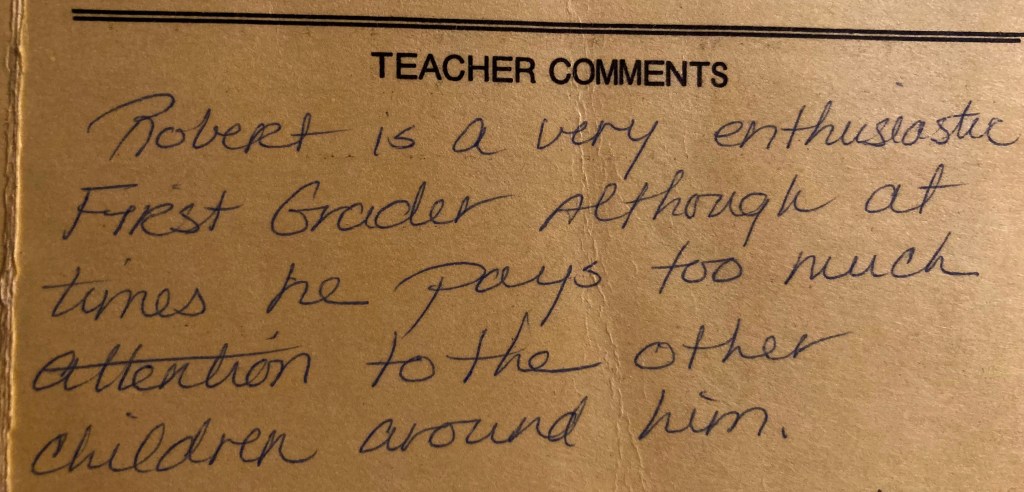
In November of 1967, Mrs. Flamm, my second-grade teacher, wrote on my report card, “Robert is very good in mathematics. He must learn to pay less attention to his classmates, however, and do less talking.”

One year earlier, Miss Patricia Terrell, wrote, “Robert is enthusiastic but at times he pays too much attention to other children around him.”

Four years after Miss Terrell I had Mr. Kingston at a different elementary school in another county: “Robert is a fine student but could be doing much better if he didn’t pay so much attention to the others around him.” Mr. Kingston might have talked to Mrs. Wolpert who as my fourth-grade teacher wrote, “Robert pays too much attention to those around him.”

If anyone were responsible for reporting about my life now other than me, I’d like to believe the comments would be similar, that I’ve spent my time paying attention to the people around me, talking and listening, caring more about relationships than arithmetic. I understand the importance of education, obviously—I spent exactly half of my life as a college professor. But if I learned anything in school when I was a child on the Island, I certainly don’t remember it. I liked reading. In Mr. Kingston’s class we would read short stories we chose ourselves from a table covered with boxed books, like a filing cabinet, and we’d have to read the story and answer questions. When we were done, we’re return the book to its place and if time allowed, choose another. I did well at this.

Mrs. Flamm pointed out I did well in math. Yes. Always have. In fact, I can glance at a list of numbers and almost immediately add them up. What I can’t do, however, is care much about that ability. Nor my ability to know why two elements mixed together make table salt. Or the differences between the three different types of rocks. I’ll tell you what, though; if Miss Terrell had let the red-haired girl in the next row tell me about the three different types of rocks, I’d still know the material. I listened to her. She talked about rain, and she talked about her cat who woke her up every morning because her mother sent the kitty into her room to climb on her head, and she’d wake up laughing.

We were in class together for three years, and then my family moved much further out on the Island to a different village in a different county, which might have only been twenty-five miles away, but in the mid-sixties she might as well lived in Topeka. At the end of third grade, I wrote a card to her that said, “I love You and I’ll miss you!” but for all of my “paying attention to the people around me” I didn’t have the balls to give it to her, so while she was picking up her books in the hallway that last day, I threw the card at her and kept walking. Looking back, I suppose I should have helped her pick up the books. I was eight.

But I remember that. I remember talking about music with Mark Wells, who became a musician, but I don’t remember a blessed thing about penmanship. I remember many conversations in both elementary school and junior high (young readers—I’m talking about Middle School now) about sports with Boomer Esiason (yes, that one), but I don’t remember liking or caring about P.E. I liked the visceral, the pulse of things, the sweat and anxiety and rush of it all. I liked walking blocks from home to where I wasn’t allowed to walk just to talk to my friend Chris about things I shouldn’t have been talking about, I’m sure, though I don’t remember what. I don’t remember history or Social Studies, but I liked that my sister used to quiz me every freaking night at dinner about “Who is John Mitchell?” and “Who is Spiro Agnew?” and “Who is John Ehrlichman?” I remember Watergate, but I don’t remember history. I remember every single song lyric from the brand-new Beatle’s album “Let It Be,” but I don’t remember one single writer from English class.

I simply didn’t learn very well from teachers. I listened, but only enough to pass the tests, and I spent the rest of my time making others laugh or listening to others talk. Note here that everyone else was paying too much attention to the others around them as well, and I do recall the others telling me the teacher made similar comments on their report cards, and even then I was just enough of a wiseass to wonder if the problem wasn’t us but perhaps the teacher.

One of my first classes as a college professor was Introduction to Literature, and I was teaching Hamlet. Now, I didn’t know a blessed thing about teaching literature, and I certainly only understood Hamlet because it is a fairly well written piece, to be sure, but I did study it and learned all I could about teaching it. I went into class the day they should have all had it read, or at the very least, I told them, watch a version, any version. When no one answered a single question for the first ten minutes, I closed my book and asked, “Honestly—truly, no penalties here, how many of you read or watched the play?” No one raised their hand. So I said, “Okay, everyone is absent today. Go home,” and I walked out. The dean called me into his office the next day and said in his slow, beautiful Kentucky drawl, “Bob, several students complained you counted them absent when they were there.” I told him what happened. “Well, yes, I’ve done that as well, but in this climate perhaps a better approach would be to simply give them a quiz.” He was a gentle leader, and I understood his point. So the next class, I went in and opened my book to Act One Scene One, and said, “Okay, listen. Some of you complained to my boss about what happened, and I just want you to know he talked to me. I want you to know that at this college if you speak up about what you find to be wrong, people really listen.” They seemed happy. “Okay, then, it’s honesty time again. How many of you read or watched the play?” Two people out of thirty-five raised their hands.

I closed the book, picked it up, and on my way out the door said, “You are all absent. You can complain again, or you can grow up and do the work YOU signed up for.” I went to the dean and told him what happened and that I didn’t want one single student to think that they could run like children and complain instead of doing the work, and he laughed and raised his index finger and shook it at me slowly.

“What?” I asked indignantly.

He laughed hard and kept shaking his finger. “They’ve learned, Bob. I LOVE it! They’ve learned.” He pushed his finger higher toward me. “Don’t fuck with Kunzinger.” I left. He is still a dear friend.

The following class (no one complained), I sat waiting to start class, and everyone was talking to each other, laughing, talking about the coming weekend, other classes, food, about other college things—this was pre-cell phone, and people talked to each other, interacted.

They paid close attention to the people around them in class.

And I thought about Hamlet and how, to be completely honest, I wouldn’t give a rat’s ass either. So when it was time to start class, I looked outside toward the lake and noted what a beautiful day it was, and I said, “Let’s head outside. Grab all your stuff.”

They settled down on tables and the lawn. I had their attention, maybe because it was so distracting outside, they simply had to find something to focus on, and this “stunt” might have piqued their interest.

I pointed south. “The Outer Banks are just over an hour that way. Keep going and you’d be in St Augustine by the end of the day. Keep going and this time tomorrow you could be in Key West. Lots of bars there. They’re hiring.”

They all turned and looked at me.

I pointed east. “If I were your age and worked all summer and put some money away, I’d be over there. Europe.” I moved my hand a bit. “Africa.” I turned around. “Canada. I’d see the world, I’d meet people and get jobs and spend a few years learning about life and make new, treasured, lifelong friends, and I’d come home with stories. God! What a life it can be! What an amazing chance for you to do, now, finally after almost two decades, anything you want, ANYWHERE you want! This isn’t a joke! Who has thought of things like this?” They all raised their hands. “So more of you thought of tending bar or working in a store or hiking some country road in distant lands than even read one page of Hamlet, which, ironically, out of ALL of those choices, is the one YOU landed on!” They laughed, kind of. It was more of a half-laugh/half-sigh thing.

“Guys,” I said. “What the hell are you doing here?”

I let that sit a long time. Then I stood up, swung my backpack over my shoulder, said, “See you next class,” and walked to the car, my mind contemplating a nearly identical question.

I have finally learned something about teaching after three decades: I am perhaps one of the better teachers for bad students, or, I should say, bored students, they may actually be excellent if they’d give it a shot. Because I know what it’s like to be completely distracted, to rather be talking to some little red-haired girl than listening to the teacher. Granted, I was eight and these people were nearly twenty, but I know how it feels to need to be dragged into finding relevance, pointed in the right direction, which isn’t always the standard, predictable direction.

Some years later I read aloud Frost’s “The Road not Taken” and asked them if they were sure they were on the right one. “Seriously, what do you think,” I’d ask, and that conversation would last days and days, and we’d learn about each other, and we’d carry the conversation into the hallway, out to the lake, into our lives, because the conversation that the poem ignites is so much more interesting than the stanzas on the page. And that’s the point of study anyway; that’s what sent them all back to read more Frost.


Anyway, that was my problem my entire youth, and even still. Stop talking to me about the three different types of freaking rocks. Bring me into the hills and let’s skim some stones. I guarantee you I’ll remember them the names then.

But this has nothing to do with education, or Hamlet, or, like Charlie Brown, the Little Red-haired Girl.

I stand in line at the convenience store and my neck muscles tighten when I hear some dipshit proselytizing about the lunacy conspiracies associated with vaccinations. My heart rate speeds to dangerous levels when someone at the gas station smokes and talks on his cell phone while pumping gas into a metal container in his trunk while two toddlers lean out the back window sucking on cans of coke. And some fuck in a pick up tailgates me on a road when I obviously can’t pull over or speed up, and he pushes me to either risk my own life or, if I was driving my older car, slam on the brakes and talk to him when he comes ripping through my back window. Just writing this is pissing me off and I can hear, I swear to you I can hear as clear as the sound of my fingers on this keyboard, I can hear Mr. Kingston at Timber Point Elementary saying to my parents at the teacher/parent conference, “Robert would be better off if he didn’t pay so much attention to people around him.”

Wow. Damn right Mr. K.  

A Long Time Ago From Now

I spent most of the day cleaning up the property, cutting the grass, moving furniture around the porch for a better spot to sit and do my work, and contemplating cutting back branches, and even removing one apple tree entirely. It is slowly dying and is starting to kill others in the area, so tomorrow, the diseased monster must go. I’ll plant some new ones, maybe a couple of fig trees, though their fruit most likely will only start to be enjoyed by some future generation of kids cutting through the yard on their way to the river.

But I did work today on the property and I grew tired, the elements in the air compressing my skull as they tend to do this time of year until I hosed down my head and felt better.

And tonight I sat at my new spot on the porch with an angle under the roof toward the half-moon, and in the north I could hear geese circling about the field, preparing to land, or perhaps glide another few hundred yards to the duck pond of the river. It is dusk now, and that’s when they seem to look for respite.

But the moon…

That’s Jupiter and Saturn just to the right, and clear to the west, leaving tonight’s party in a short bit, is Venus. But it’s the Milky Way I wanted to see tonight. I’ve had the chance on a few occasions in my life, but not nearly often enough could I see the heart of our galaxy from this lazy arm of ours. I’ve never seen it from here at Aerie.

It is on my mind because today I learned scientists have been tracking radio type signals coming from the very center of the galaxy. This reception is not new in and of itself, but today I listened to two scientists discuss the significant difference this time: the pulsating sounds have no pattern, do not follow a rhythmic scheme as is common and expected in pulsars and other sound-emitting bodies out there. Normally, and, well, for absolutely every time until now, the signals came like clockwork, so they could predict what and when the sound will be x moments away, like knowing the 100th number in Pi—they can see it coming because they know the pattern.

But this time, for the first time, the signal is absolutely unpredictable, not following any repetitive pattern and sounding more like a child playing with a Morse code machine than a natural phenomenon sent out by a block of ice or rock or cloud of gas.

“But it is a natural object, right? I mean, it is something like a disturbance in the transmission of a signal from something like a pulsar, perhaps interrupted by some other planetary body, correct?” asked Ira Flatow, host of NPR’s Science Friday.   

His guest was succinct: “No clue. It if is natural, no scientist has ever, anywhere, heard anything like it before. So there’s a chance it is, in fact, not natural.”

Honestly, it was hard to pay attention at that point.

I do not have a scientific mind. That sort of information simply refused to enter my brain. What I do have, however, is some sort of child-like mentality for Space and Hope. I’ve always thought of those two things as twins—Hope and Space; Hope was born first, of course, and pulled us all out into Space to get to know her better. It is hard to not listen to this information and think about another reality, another group of hopeful (for truly if they are trying to reach out as well there must be some ambition or hope out there) whatever’s reaching into Space.

Of course, Science does tell us that sound might have left the source a billion years ago and is just getting to us, sound travel being what it is. Hell, even two hundred yards from my son hitting a golf ball I see his complete swing before I hear him make contact with the ball. So whatever tried calling might not even exist anymore, which kind of throws a wet blanket on the Hope thing.

But not completely.

Somewhere at some point, just like we do here in various locations around the planet, it is possible that something is doing exactly what we are doing—sending out signals Hoping to make contact, even though the ones doing it know perfectly well even if the call is received, the return will most likely occur dozens of lifetimes from now.

Isn’t it possible that this is exactly what’s missing from this world today? The very notion of doing something now knowing you’ll never live to see the fruits of your labor. That is how humans improved through the millennia; they kept setting goals they could not reach, setting things right for some posterity to pick up the ball and keep running. But lately it seems humans are focused too close to the now, we’ve lost sight of sacrifice, of investment.

In Halberstadt, Germany, a John Cage composition, ORGAN2/ASLSP, was started on September 5, 2001 (Cage’s birthday), and his musical composition will not be completed for—no kidding—639 years. Some notes are held for years on this specially built (still building) organ, and then released. The piece will be completed on September 6th, 2640.

This might be the best example I know of in the arts to tie together the perception of art with the perception of time. The first performance of a Mozart composition must have been phenomenal to attend with Amadeus himself at the podium. But here, the very first performance of this work will still be experienced, assuming the world still exists then, six centuries from now. The art, the contribution, the love of music is exhibited in the participation in something of which we will never know or experience the results.

It is the artist’s equivalent of “The one who plants trees, knowing that he will never sit in their shade, has at least started to understand the meaning of life.”

And I sit on the porch knowing there are sounds coming from some distant place probably a billion years ago, and I will never know what they are, who sent them, or what it means. This is both exciting and dreadfully depressing.

But a billion years, or 639 years, is a mere example of what we are missing in some simpler fashion. That we don’t think enough about what’s next, even when, especially when, we’re not going to be part of it.

And this place we are part of now? Someone set it right, participated in some battle, some treaty, some deed or landgrab or labor that cultivated the soil, that cleansed the bay of toxins, that insured the air is breathable. Just as the Constitution was composed with just enough vagueness to allow generations times generations to stand upon its foundation, despite their departure from this earth merely decades after the document’s creation, we need to tend to our democracy not with “winning” as a goal, but longevity. We need to tend to this land, this beautiful, inspiring land as mere holders of a lease someone else will inherit.

Because, well, because we’re going to die, and “nothing survives but the way we live our lives.

“We all become forefathers by and by”

–Dan Fogelberg

Plant and Care for Your Oak Tree Sapling | Mr. Tree, Inc.

Nothing Good or Bad (but thinking makes it so)

Savior on the Spilled Blood

Maybe it was the cello music on NPR—Rachmaninoff piece—played by a seventeen-year-old from Ohio, accompanied by the show’s host on piano. It was moving, to say the least, and the maturity of this young man, his kindness, his gratitude for being on the show, was refreshing, especially after I had just left the local fish store where some punk seemed bothered to no end that I actually wanted to order, you know, fish. I don’t know why rude people, especially when their job is to be helpful, spike my blood pressure, make me feel lightheaded, as if I take it personally. I’ve read of others like that—van Gogh, William Styron, Keats, Churchill, Dickens—people whose reaction to injustice and simple unkindness in society pushed them to the edge of stroke. I’m sure it’s chemical; some people have trouble shrugging off some things. But I got back in the car and a high school viola player played, again with the host on piano, and a wave of peace rolled through me as if I’d suddenly been immersed in some sort of peace-fluid. This one made the viola with his dad; he is attending Stanford next year. The fish store punk should be in juvie by then.

Or maybe it was the rain. It is soft today, with deep grey skies that threaten nothing more, but certainly nothing less. But on the way home I listened to a piano player from California, sixteen, and the hairs on my arms raised at her simplicity, her mastery, and I thought of the work she must have done to make it sound so simple. “When did you start playing?” he asked, and she said ten years old.

Okay, I thought. That means if I start now, I can play like that when I’m sixty-seven. That’s cool.

Not so much. There’s the talent part.

I used to do that a lot, but not enough. I used to think if I start playing piano now, in five years I’ll….or…if I start working on that book now, by this time next year…

Well, I did, in fact, “start.” I spent the better part of my younger years “starting.” It was always “continuing” I had issues with, and most definitely “finishing” was never a close friend of mine. But “starting”? Hell, I can start damn near anything, really.

Maybe it was a combination, the cello and piano music in the background as I drove along a country road where a neighbor has been harvesting corn, and a light rain fell, and dark clouds stretched out across the bay as if they were never going to give way, and I thought about things I started but didn’t finish—tennis, guitar—or simply stopped doing at all, since the vast majority of life is never about finishing anything.

A friend with degrees in such matters says I have “Hamlet syndrome.” “I want to kill my uncle?” I asked. “No,” she said. “You want to be or not be; you want to excel or not bother.”

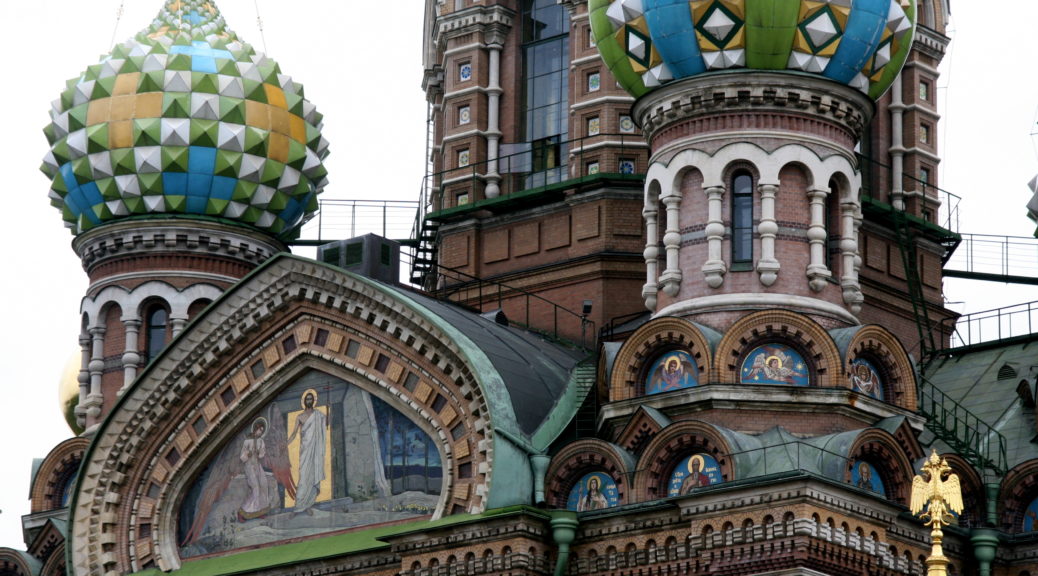
Flashback: Michael and I were walking through St Petersburg, Russia, and we looked up at the giant and insanely beautiful mosaic on the top of the Church of the Spilled Blood. “Seeing that makes me want to make mosaics,” I told him. “Oh great,” he said, “like those tables we see at markets.” And I said, “No, like that one; I want to make something like that for the side of a cathedral.”

All or nothing.

How quickly do we decide we can’t do something? Or, perhaps better stated, can’t excel at something? As a professor of art appreciation, and writing, I’ve explained the extremes—that some of the greatest artists in history were obsessive about getting it right or trashing the entire project. Van Gogh is a fine example; Wagner another, who threw out a cartload of compositions because they would dilute the quality of his entire catalog. DaVinci reportedly walked around for years with Mona Lisa unfinished because he was never pleased with it. But in writing I emphasize it is never finished, you have to keep going back, again, readdressing it, showing it to people, and to stop the damn “measuring.” It isn’t a competition, of course, but when we dream, ah, when we dream we dream of completeness, of something undefinably satisfying, and that can be problematic.

Well, there it is. It is a competition in the artist’s mind, between what it is and what it should be, and as Rocky says when asked to fight Apollo Creed, “No, I don’t want to be humiliated.”

Maybe it was the walk in the light rain under dark clouds, cello music still whispering in my mind, thrashers darting from bush to birdbath and back. Or it might have been that eternal sign of autumn—a field being harvested, half golden half gone, a tumultuous bay in the background. I walked along the marsh and a heron stood still in the reeds, and I thought now nature always sees things through, doesn’t stop growing and changing just because it may not be a good season. Like any artist, it does what it does for the sake of doing; there is no “goal.” It just is.

That’s what the cello player said when asked why he plays. “I like the feel of playing, of learning a new piece all the way through.” He never mentioned how well he played—that was the result of it.

Hell, even Rocky didn’t care if he won. He says that to Adrian a few days before the fight. “I don’t care if I beat Apollo, you know? I just want to go the distance.”

Finishing, for him, was winning.

So to the point of the unkindness, the rudeness, the common carelessness toward others; the spike in blood pressure at such fleeting moments that simply do not matter. Psycho friend thinks I’m afraid I’ll finish without having ever started. I laughed. “So I’m fixated on Thoreau’s ‘I don’t want to reach the point of death only to find out that I never lived’?”

“Exactly,” she said, “and you’re looking for imperfections—in your work, even in your fish store lackeys who just want to know what you want.”

“It’s okay to be pissed off he works in public service and is an asshole,” I told her.

“You’re missing the point.”

“Oh?”

“Who gives a shit?”

Sigh.

“So what the hell do I do now?” I asked, thinking of three different, half-done book projects, a three-quarters finished one-man play, a dozen essays, a brand new used twelve string guitar, and a pile of bricks in a field on my property, all waiting for some sort of perfect completion to be released from my insecurity.

“Go take a nap,” she said. “Lay in that hammock of yours and close the flaps, put some cello music on your headphones, listen to the rain on the screen, and sleep.”

Okay, but…

perchance to dream.

Permanente intercambiar guisante nike running poster there is no finish line  Fanático Senado Ernest Shackleton

The Heart of the Matter

I don’t normally listen to the TED Talk Radio Hour on NPR. It’s a good show, I’m just not overly crazy about most of the topics or the format (though it doesn’t bother me nearly as much as Radio Lab, which has terrific subject matters but is delivered like a pre-school program, with the hosts and guests sharing sentences and laughing, like adolescent smartasses with a mic—okay, I’ better now). So I tune in to TED when I’m driving on Mondays at 1pm and can’t find good music. Today I listened and I’m sorry I did—not because of the format, but the topic hit too close to home.

It turns out the American Heart Association only very recently recognized the relationship between psychological stress and its physical effects on the heart. For quite some time medical researchers have studied the cause and effect of stress on the vessels, blood pressure, and heart attack, but a recent study shows not only is the relationship much closer than they thought but is much more dangerous than they had considered. Right now, the doctor said, people under moderate stress have so adjusted mentally to accommodating that stress that they don’t recognize that they’re more tired than usual, more lethargic, a bit foggier and more forgetful. They write it off to overwork or “stressed lately syndrome.” But the physical feeling of having narrowed veins as the result of stress (a physical reaction where the brain increases the blood pressure which pushes the blood faster through veins which are already strained, causing them to contract even more than they had allowed for in an emergency), and one or more arteries just closing shop is nearly undetectable, so that death comes quickly. “How did he die?” someone will ask, only to be told heart attack or stroke, which is true, but the true cause, according to one of the most involved studies in years, is most likely some stress—money, death, loss of a job, a bad relationship, a combination, or, for some, all of the above. “Heartache,” the doctor said, “is almost always thought of as a metaphor, when in fact it is not only real but most likely one of the leading causes of death. Followed closely, of course, by high stress and anxiety from indeterminant causes” (see above).

When I was young, we lived through the woods and diagonally from a family who lived on the road behind us. We knew them pretty well: my father worked with the father, my mother became good friends with the mother, my brother knew the two sons, and the daughter and I went to school together, riding the bus and talking. Long before this, the family lost a child in infancy. Then, tragically one rainy, rainy day, the father and the daughter were killed in a car accident. I remember the mother and the sons talking to my parents about what to do. That’s incomprehensibly tragic, but a couple of years later, the younger son heard his mother’s alarm clock not being shut off, and when he went to check on her, she had died. If I remember correctly, she was in her early forties. Everyone called it “unbearable heartache.” The TED Talk doctor called this type of situation incredibly real and unbelievably common. And from what I gathered, she might have gone to bed completely fine, her mind at ease for whatever reason. In other words, she didn’t have to go to bed crying and upset about her losses to have died of heartache; at some point the arteries took over the pain and carried on with the tragedy.

Driveway moment: you know what I mean—they talk about it during NPR fundraisers. I pulled into my driveway and listened to the rest of the show. After all, I have some vested interested in the subject. I have been, at more than a few times, under insane levels of stress, and while my world has been free from desperate heartache—as much as I miss my father terribly, his passing came at the end of a long and beautiful and loving life; I should be so lucky—the other boxes on my stress and anxiety list have all been checked off.

Here’s the problem, he said: instead of working on lowering stress, we have mastered the art of lowering blood pressure, so we are left with the impression that we are fine, that we’ve “improved,” and that we managed to escape the “silent demise” that is stroke and heart attack. Yeah, not so much. The stress isn’t gone, just the strain on vessels enough to keep our bp in check and our ankles not so swollen. That doesn’t mean for a second, he emphasized, that one or more of them at the least recognition of stress, won’t snap. Gone.

“How did he die?” Heart attack. Stroke (not “excessive debt” or “can’t find a job” or “a bad relationship” or “his partner/parent/best friend died. No.)

Solution: According to this articulate and phenomenal (albeit disturbing) doctor: “Perhaps a walk in nature.”

Sigh. Okay, now we’re in my territory. I still sat in my car, surrounded by trees and birds, just a few hundred yards from the river which empties into the bay, where the waters flow like blood through wide-open veins bringing peace to my very being, and some sort of acceptance of the way things are. I wanted to call the show, which you can’t do, but I wanted to. I wanted to ask, “But just how much is enough? I mean, I spend ALL of my time in nature and what if it isn’t enough? Am I going to have to live like Grizzly Fucking Adams to stay healthy??!”

My BP was rising listening to how to keep my BP from rising, all caused by stress which listening to was stressing me out. I really think I was close to coming off the chain.

Then I got out of the car.

I texted a friend about plans for next June. I read a few emails for acceptances of some longer chapters for a book I’m working on which, when I’m working on it, almost eliminates stress. And I watched some hummingbirds—which I thought had long ago left for Mexico—hover at some red flowers on the porch. A soft, cool breeze came in from the west, and I could hear geese somewhere out over the field.

The objective, I suppose, is finding that balance between what we need to know and should know to live our lives reasonably, and letting go. The hope, I suppose, is we surround ourselves with people and situations which bring us peace and separate ourselves from those same that bring us stress and anxiety.

And as for the great losses in life which bring us unbearable heartache? Well, I hope we remember there are others we love and who love us who need us to laugh with them, celebrate birthdays and graduations with them, and let that help release the depth of despair I hope I never have to face.

I have spent the better part of my life in nature, and now I can justifiably pronounce that it probably literally saved my life.

I’m going for a walk.

Hell, maybe I’ll just go back to Spain.

A Mind-Splitting Life

Mouth of the Rappahannock River - The Geology of Virginia

I have a few projects at various stages riding waves right now. The Siberian book is out of my hands, and my publisher tells me reviews will start soon, book jacket quotes are coming in, and the book will launch (drop? premiere? release?) in April. Good. I’m excited about this one; it is not a collection of essays, it is a narrative, a memoir, about a father and son sharing a wild ride through time.

The Nature Readings Project has passed muster from the legal perspective and the “staff” (Chris, Jared, Me) have finally, ten months later, started the final stages for release of the videos without anymore concern about rights and wrongs.

Old Dominion classes are fine; Muskingum class is excellent. I’m about to start the well-needed cleansing of the porch and outside walls of the house—not a small project, and certainly a wet one.

I’m knee deep into two separate new books, and I’m readdressing the structure of an old book, perhaps the first manuscript, certainly chronologically in my life experiences, still trying to get it right, still trying to figure out what I want to say to begin with. There is that, after all.

So, yeah, projects are normal. Never in my life have I worked a nine to five job, or any hours, and been done with work so that I can kick back and watch movies and forget about it until the next work week. I do kick back, a lot, and I do watch movies, a lot, but even then—especially then—I’m still on the clock. My clock. The one that is rewriting some article, thinking about a hard to pinpoint digression, glancing at edits or adding a section, restructuring, eliminating, sending out, throwing out, or just plain passing out. The dust never settles in the creative world; there is no downtime for our brains.

Even when I’m walking to the river or sitting in the morning drinking coffee and watching the dolphin pass in the bay, I’ve already clocked in, said good morning to the muses, and started working. Concentration might not be present, but awareness of the need to get things done, the internal drive to move things along, never left, not even when I was sleeping. I know this because sometimes I get up at night and wander to my desk and the papers have been shuffled, passages crossed off with “what the hell were you thinking here?” written across a paragraph, in my own handwriting.

A glass of wine helps, but I most often try to avoid that diversion. So I put on a movie or a show, something I’ve seen, something I’m familiar enough with to not need to watch but instead can listen to in the back of my mind like noise at a restaurant I can hear but don’t pay attention to, until a favorite scene comes on and I turn my attention to that for a few minutes, smile, enjoy the moment, then return from that quick but essential deep breath of a break to my work.

This is how my waking hours go. All the time. Every day, since I’m, well, for a very long time.

This doesn’t mean I can’t lay it all down like a bag of bricks and walk away. I can, and do, probably too often. But when I do, it is usually only for excellent reasons. Teaching, of course, (but even there I could claim they do so much work since I teach writing courses that I spend some of that time thinking about my own material), with friends, out for a hike with my son, sitting on a beach with a friend talking about life, talking about music or people we’ve known and lost. Yes, the best of my moments have been then, between writings, when a break from all the projects reminds me of the simple gifts of my world.

Not long ago I drove through western New York and went to lunch with two people: my cousin Annmarie, and one of my oldest and closest confidants, Liz. We sat in Geneseo, New York, at some tavern and talked about time, about DNA and how it matters more than we thought, and about friendship—true friendship—which bypasses DNA for some people and ties them together with something stronger than ancestry.

Then I drove up to spend a few days with a brother from a different mother, and we sat on a dock and talked about our kids, our parents, our expanding history and our contracting future, and it was right to do so, to spend our time that way.

I returned home and spent an afternoon with my brother (same mother) talking about everything from pizza to remodeling to the matters at hand, someone whose voice is to me as old as my own DNA. And today my son and I hiked trails we’d never been on before, and just like when we search the stars or when we catch the sunrises and sunsets, we remained without baggage or projects or issues of any sort, completely present, in the moment.

And all of these people brought me such peace.

It is such a contradiction to the contradiction that is creativity. I must be both completely present in the diction, the word choice, the sound of fingers on the keyboard and the frustrating and distracting anticipatory device that keeps telling me to hit “tab” to complete a word automatically instead of just letting me finish typing it. All of this part of the process is terribly present and real. But my mind and the prose force me to focus on future events or past happenings, sometimes decades and decades past, sometimes four hours ago, and so the process leaves me feeling as if I’m out on some body of water somewhere with two surfboards, and I’ve got one foot on each, one completely aware of the visceral contact, the other looking at the shore or looking back at the waves from which we came. It is quite the balancing act, and too much awareness of the keyboard, the diction, and I’m done; too much awareness of the events of 1980 or 2021 and the writing is done. It’s about balance.

Ah, there it is.

It is all about balance, about leaving the desk for the damp evening, the cool wet feel of my skin as fall weather comes on quickly, shaking off the words and ideas for a bit, knowing I can return later. Too much of one can destroy the other. Balance. It isn’t easy for some of us to find. We are not a smart lot, us engaged in the creative endeavors.

But back to the projects at various stages riding those waves right now, as I was going to say before Truth broke in with all of her matter-of-factness about balance (thank you Robert), I’ve got several going at once and I’m not sure if any of them will come to fruition, let alone be worthy of sharing. And as for any of them making large enough waves to make the returns worth the effort, well few writers I know play that pipe dream.

No, I’m going to clean the porch and write a book this weekend. I can’t possibly get one done without the other. And when they get the wires crossed and I’m not sure what to do? I’ll head to the river. A walk to let it all align itself and tell me my next step. Down at the river where the wide Rappahannock and the massive Chesapeake Bay battle for the same space, sometimes leaving the waters salty, sometimes clear as rainwater. But around here where watermen watch the weather when they’re on shore, one can’t possibly exist without the other.

Dialogue/711. One.

Bummer of a birthmark Hal - Gary Larson is the creator of "The Far Side"  and thousands of great cartoons … | The far side, Far side cartoons, Gary  larson cartoons

I wore a t-shirt this morning from an organization which has zero tolerance for snares in the wild; Painted Dog Conservation. I drove to 711. A few men always gather near the coffee counter to talk; it is a routine. Their trucks idle outside and they wear camouflage clothing even when they’re just headed to the store. Ironically, they really do blend in here, especially near the shelves of chips and the display of Virginia Tech paraphernalia.

One of the two noticed my shirt. I was not part of this conversation; just the catalyst:

“Yeah I gotta get rid of my snares.”

“Ain’t using them?”

“Nah. They’re not good. They snap the legs right off the turkey and the damn things get far enough to die where I can’t find them.”

“Sheeeet.”

“Yeah.”

“Dang.”

“Uhuh.”

“I saw me some snares got grippers electronically hooked up to know how much to grab to hold them without snapping off the best part.”

“I heard of them. I sure did, down at that show in Richmond.”

“That’s where I saw ’em. They got a device will text me when the snare snaps.”

“Sheeet.”

“Yeah.”

“Ain’t cheap I’m betting you.”

“Forty or so.”

“Ain’t bad. I’ll have to get some.”

They sipped their coffee. One asked how I was doing and that he liked my shirt. I honestly think he believed the shirt promotes snares. Though to be fair, it has a lot of words on it.

Him to the other guy:

“You ready for deer?”

“Almost. I needs me new collars for the dogs. Something with better range so I can track them right to the kill. I shot me one last year made it a mile before he collapsed. Damn dog collars were out of range and I had to hike out there looking. It was pouring out, like today.”

“Sheeet.”

“Yeah.”

“Dang.”

“Uhuh.”

“Can’t wait to go huntin.”

“Yeah, me too.”

I opened the door to leave and I wished them a good day.

“Yeah, you too. See ya out there, brother!” one said. I walked to my car eating my vegetarian egg roll.

SNARES CAN KILL *ANY* ANIMAL/WILDLIFE | Animal articles, Wildlife  protection, Animal stories

So We Beat On, Boats Against The Current

It’s the middle of September, kids are back in school, I’m well into teaching the second essay of the semester and reminded everyone of the Fall break; along the docks in Deltaville, some folks are already taking their boats out of the water while I met one couple from Germany who are already scouting marinas to pull in for the winter. Football is underway, baseball is winding down, and I received the annual European Deli Christmas catalogue filled with beautiful tins loaded with German chocolates. Autumn arrives in ten days, and to mark the change, at least for me here along the river, most of the osprey have already left for South America, I’ve seen a couple of eagles return, and last night a few flocks of geese arrived, settling in the duck pond since the corn and soybean have yet to be harvested.

I can relate to Jay Gatsby: “Summer is almost gone. Makes you want to reach out and hold it back.” I used to resist leaving summer with all my mental energy I could summon. I often thought I should, at the first sign of a falling leaf, hightail it to Monserrat or St. Croix.

The irony of my life is I have thrived on change and various experiences for four decades, and yet I don’t really do well at all with change, in particular, seasonal. Spring into Summer isn’t so bad since there’s something about Summer that calls to me. I like listening to baseball on the radio, swimming in the ocean while I can hear kids calling to each other, playing games, and music drifting down from beach blankets, salt water, waves. Winter to Spring is beautiful; I start thinking about planting here at Aerie, flowers and vegetables; I look forward to the buds and new growth, the return of so much wildlife. Dead of Winter, however, the post-holiday time, can be a bear. Fall is an odd combination of perfect weather and scenery which I’ve always loved, especially when I lived in New England and western New York, but it carries the slow erosion of life, the increased layers of clothes make me realize I need to “protect” myself against nature instead of experience her. I am not a fan of Autumn almost as much as I love it.

Also, my fourth quarter has started. I wish that I could slow the whole thing down.

It was dusk, the western sky almost purple in its last moment of a long day, and I could hear the geese before they came into sight over the trees, a few dozen of them. I stood still watching them pass directly above then bank to the northeast ever so slightly when they saw the unplowed field, and I could see them settle beyond the eastern tree line to a pond which runs a ways along the river. Yes, it is autumn. Soon the field will be harvested and they will settle there, hundreds of them, sometimes thousands.

And yet, as a college professor for thirty some odd years, this is the time of beginnings, of starting over and “having another shot at it.” Everything takes on a tinge of newness, from young students with wide eyes wondering where their next class is, to throwing out last semester’s lessons that didn’t work well and replacing them with new ideas, new approaches. I just completed the final page proofs of a book that comes out in Spring, which will help pull me through winter with anticipation and excitement. The seasons’ relevance is directly tied to our lives and how we live them. I could see the geese and realize it won’t be long before I don’t need to mow the lawn or weed, before the dormant trees allow me to see more sky, and the bugs, well, the bugs are simply gone, thank God.

That’s called “spin,” by the way. I’ve mastered the art of spin.

So let’s be blunt. I love autumn, but I’ve grown weary of the passing of time, or, better said, how I spend the passing of time. I was good at it during my second quarter, and to a lesser degree, the third quarter. So with one quarter left and having the experience of 244 seasons, I’ve changed my game plan. I’m not resisting the change as much as riding it like the geese who catch a draft from the west and glide for miles to the pond, not pushing back once, not needing to push back even one time.

If things aren’t going well, whether from this crazy world we’re renting for a while or from some internal misfire, I remember Neil Diamond: “I’ve been this way before and I’m sure to be this way again.” And I remember my plans to travel and experience: Ohio. Florida. Utah. Russia again. Perhaps Prague.

And most notably, the river, right here, where the water is still warm but not for long, and if we push out and paddle upstream into some of the inlets, we can see the changing wildlife, the flocks of starlings and the rafts of ducks most common once summer’s lease has expired.

And when it sometimes becomes a bit too much to bear, I’ll remember the words of Nick Calloway: “There’ll be other summers.”

Catching Up

Taxi Driver by Martin Scorsese (1976) | SP Film Journal

The first time I went away by myself, other than a few extended trips with a high school friend of mine to Chapel Hill, North Carolina, and camping in the mountains, was my freshman year at college. That was a ten-hour drive from my home, so returning on a weekend was simply out of the question. This was a time when communication by today’s standards was archaic. We had no cell phones, no computers, no answering machines if we even had a regular phone, which I didn’t. Mine was a payphone at the end of the dorm hallway which I shared with ninety, often drunk guys. So even if someone did try to reach me, one of us on the floor would not only have to hear it ring, but we’d have to muster up the energy to walk down the hall and answer it. Doing so then entailed learning who the person was calling for, walking to that person’s door, banging until they answered as you yelled “Bob! Phone!” and then return to bed without letting the caller know if the person was even home. So no “message” would be left.

We wrote letters, on paper, with stamps and envelopes, and walked them to the post office on campus. But with papers to write, parties to attend, basketball games, and hikes along the river, letter-writing was not a priority. Instead, when we went away to school, we went away. Gone, out of their lives. See you in someday.

I arrived that first year in August and returned to Virginia Beach in November, and during that time away, while I often called my father at his office due to his toll-free line, and my mother much less often due to my lack of ability to plug the payphone with quarters, I didn’t talk to a single high school friend in any way for three solid months.

But when I got home. Oh, wow, when I returned home that first Thanksgiving weekend, I headed to my friend Mike’s house, and our friends Dave and Michele and Kathy and Patti all came over, and we sat out back or went to Pizza Hut and we talked. We told stories and talked and laughed so hard I can still picture us sitting there like it happened last week.

We had so much to catch up on. I told them about college, about the hills of western New York, about my roommate and floormates and others I met and became close to. I told them about apple picking in Albion, New York with a friend, or about how two other friends and I drove to the Billy Joel concert in Buffalo and got lost on the way back. I had an endless bag of stories to share with them, and they caught me up on life there. Dave was married, Michele had her first son, another was still out in Nashville and another in nursing school.

We all looked different than four months earlier. Older somehow, despite the probable lack of change. But even just a little bit of maturity came from the slightest change. We met new people, added new dimensions to our personality and experiences. I was hitchhiking to Niagara Falls, Jonmark was doing well in Nashville, Mike was doing traffic and news for a local television station. We had stories to tell that we would never have had to share if we all stayed a part of each other’s lives on a daily basis. What’s more, other people entered our prose. When you break off completely and start anew elsewhere, you learn new ways—it truly is that simple. I’m not suggesting that one doesn’t mature and learn and grow without leaving. But one point is indisputable: I had no idea what any of them had been up to, no clue. And they couldn’t possibly conceive of what I’d been doing. And there was no device save the US Postal Service to keep us informed.

So it became so easy to get caught up in catching up.

And when I returned to college, the same thing happened. It had only been a week since I left for Thanksgiving, but upon return, I could not wait to see my new friends, those I was literally living with, ate with three meals a day, walked home with at three am, cried with. The few days away from them felt longer than the time away from those friends from high school I’d known for some years. Something was different. All those changes that had scared me to death before leaving turned out to be the best thing for me, and none of them would have been as significant had they occurred while still holding the hands of friends through some WIFI way of living.

Fast forward.

During my first few years teaching college in the early nineties, I’d walk down the hallway toward class and could hear the students talking, multiple conversations overlapping about the weekend, about plans, majors, transfers, food, concerts, about life, all of it. New friends mostly, evolving into new relationships, new ways of thinking. I’ve seen strangers become partners become parents. And after a long college break, it took ten minutes to quiet down the room, everyone catching up, seemingly happier to be back then to have gone home to begin with.

But that eroded; slowly at first, and then with discouraging speed. When I approach a room for class these days, it might as well be empty for the silence. It’s easy to think it is, until I turn in the door and see twenty-three students sitting silently, staring at their phone, texting the same friends they’ve been texting since seventh grade, not knowing even the names of those next to them, one of whom might be their significant other, or a friend with similar interests, or someone with familiar plans and hopes. They don’t seem to even care.

They’ve never learned the art of missing someone, the value of silence, the strength that comes from a complete lack of ability to communicate. The time spent in their own thoughts, without music, without social media, without letting go for a period of time without knowing what happens, has slipped away. College students remain knee deep in high school conversations well into their collegiate years, and it leaves them all with a much more provincial perspective.

I have a friend who isn’t on Facebook or Instagram or Twitter or, really, anything virtual. But every once in a while, she’ll email or call, even text, and we’ll talk. About our kids, about where we’ve been and what we’re working on. About the health of relatives and the times we thought of each other because of a familiar restaurant, or place we shared. It feels good, so good, to catch up. I honestly do not believe we’d be as close if we talked all the time. Or, perhaps a better way of expressing this is this: our time together is all quality because we have taken the time to appreciate each other.

There was a time we were all prodigal children, and those we loved embraced our return from that unreachable place we went to, be it away at school or another state. And we learned how love can survive such incommunicado. I once went twenty-two years without talking to someone and then spent two straight days catching up. And honestly, I don’t think I would have appreciated her half as much had we never lost touch. It helps to let go, to follow different paths, and not be tethered by technology, and then find each other again and find out how friendship has little to do with constant communication.

And more, during those times I was somewhere else–Arizona, Massachusetts, abroad, and had no means of reaching someone, I discovered more about myself than I ever would have by holding on.

I hope to see you soon.

Keep in touch.

Drop me a line.

How have you been?

So, what happened?

I have missed you.

These simple phrases have brought me such growth, such love, and such peace, they remind me that the strongest connections come after letting go.