Get Out

When I played outside, I learned to interact with others, to share, to win and to lose. I learned when to fight and when to give in—in real time, not virtually, not because some program dictated by my algorithms decided I had an X percentage chance of reacting to Y.

When I went outside to hike through a park or play in a pickup baseball game or just hang out in someone’s garage, I learned to remember, I learned a multitude of actions and reactions through observations and mistakes. I learned about the human touch, about facial expressions of agreement, of ridicule, of doubt and of encouragement—another person’s eyes could tell me when they had my back and when they knew I could handle it. Another person’s stare told me when I screwed up and when I made them proud.

When I played outside I learned about silence, about the distant call of a cardinal after we’d all been yelling and laughing, and I learned the modulation of nature, its ups and downs, how a crowd of kids sounds then how they don’t and how the small ripple of a creek can bring peace to my entire being. When I was out there with a group of friends I learned to allow another’s interests to dictate the day and to be grateful when it was my turn to choose.

I learned to sit on the bench. I learned to get out of the way. I learned the possibility of my agility and strength and speed as well as their limitations. I found out I was really freaking good at tennis but sucked at baseball. I discovered through trial and error I was not interested in rocks but was in water, I was not interested in cars but was in music. But still I learned. I hung out with friends and someone else’s interests bled into my space, and I learned. I learned a little about engines, about various religions, ethnicities, foods. Certainly I could have read about these things or participated in some organized fashion through a community game of some sort about these things, but they eliminate the smell of life, the aroma of sweat that comes from contact, the drift of dry leaves in fall that comes when playing football in someone’s backyard. They don’t allow the feel of the air when I learned how much heat or cold I could tolerate, the outright tackle that did two things—knocked the wind out of me to remind me others are stronger and just might be smarter and just might have thoughts and opinions I could learn from, and it showed me just how much I could take and get up again and try one more time.

I learned everyone’s phone numbers and remembered them, their addresses. I learned the directions from one place to another by stopping to ask, by reading a map, by common sense. I learned about local places to eat by asking someone local, by asking someone to take my picture instead of taking a selfie, and in doing so learned about where the best places for just about everything might be that I could never find in a guide.

My parents sent me outside to play and I learned to interact, to live, to think in multiplicities instead of the scope of my room at home. And I hope I don’t need to suggest the health benefits, both physically and psychologically.

I am not better than anyone alive save serial killers and warmongers. I am certainly not smarter than most of the people I know and I’m definitively not smart enough for the life I have led.

But I have experience. I have a depth of experience I never imagined I’d have. And I can trace the spark of that experience to my parents sending me outside to play and I looked up and saw the sky was so much larger than the view from my window. The horizon too. The possibilities too.

I went outside and used something extraordinary—imagination. I wondered what it would be like to sail, to fly, to play at Wimbledon, to hike mountains. Yes, of course, I could read about them and did read about them and let my imagination fly just as easily, but outside it was all closer, in reach, outside where I could look across a field and know that just over the curve of the earth was Spain, Africa. Outside was different, it was big and taught me to be small instead of some master of my space, it taught me to look both ways, it taught me to duck and to stand up and look around.

Outside I learned the world doesn’t spin solely for me, that I could learn directly from others, that making mistakes was absolutely acceptable and expected, and that in the end, I’d be fine.

I’d be absolutely fine.

The percentage of people playing Little League has plummeted. The numbers joining the scouting programs has fallen. The numbers of young people involved in after-school groups has diminished. Racism has risen dramatically. Intolerance of anything other than what we know and what we believe is a cancer spreading throughout towns everywhere. Psychologists say in a Pew Research study that the likelihood of high school students to disagree with their teachers has risen to unprecedented numbers and in more than half of all cases where the parents pushed the school system, the board found in favor of the student. In eight percent of the cases the teacher was reassigned. Growth does not come from being right. It doesn’t even come from being told the truth. It comes from being told you are wrong, to learn from it, and to move on with more information than you had before.

Yet. YET. SAT scores are HALF that of forty years ago. Graduation rates are a third less and the dropout rate has doubled. Violent crime among teenagers has risen to numbers more than triple than they were during the 1960s.

More than triple than back then, when we played outside. When we went outside and found out that someone else might know more than us and if we ran home crying to our parents, they’d make us work it out between us.

Am I an old guy remembering when things were better? Of course. But I’m also a professor who during a thirty-year career has taught research and verification of information, and I’m not wrong. The numbers are clear. We were better off when we spent more time outside with others. I’m sure there is some serious Post Hoc Fallacy going on here—the factors for the decline being infinitely more complicated than the difference between going outside to interact with others and staying inside and being a virtual participant in life. But in some sweeping way, the old truism is still true: Everything I really needed to know I learned in kindergarten. I’m not suggesting we don’t read or get online or interact virtually with people. Of course not; I’m doing that right now. I’m suggesting that without daily interaction outside with no constant supervision, we will never grow; we will never discover; we will never know what we are capable of, and that might be the biggest tragedy of all.

Imagine never finding out what you are truly capable of.

I’m going outside now to sit quietly near the river and listen. Sometimes the Rappahannock River sounds exactly like the Great South Bay.

You’re never too old to go outside and play.

Fill in the Blank

First, the analogy:

People in the literary world criticize formula fiction as “less than” literary. With good reason. It is predicable, redundant, and can be decidedly boring. I’m speaking in general terms, of course. Some of those formula-based works are exciting; they keep your attention and on occasion surprise you with some plot twist toward the end.

The thing is the vast majority of written work follows a formula. And in cinema, plot-driven material is the bread and butter of film productions. Sometimes we might catch a glimpse of a work whose crisis is created by some setting, and more often these days, character-driven material has become more common—those works which receive the vast majority of nods from awards committees. But the public at large is comfortable with the tried and true; they like predictability, and they find some refuge in knowing what to expect.

Reality jump:

We graduate high school, maybe college, in some cases post-graduate work. We find a job and then a career. We raise a family, we retire, pursuing those hobbies we either only dabbled in or hoped to learn someday. It is the Great American Dream. We live the best we can, we work hard, we play hard, we relax, we watch our children move further than we did.

My great-grandfather was a butcher, his father as well, came here from Germany with his brothers, presumably to “make a better life of it” than they had in 1850’s Bavaria. My grandfather owned a successful glass company in Brooklyn, was heavily involved in the Knights of Columbus, raised six kids, had an apartment in Brooklyn and a house on Long Island. All of his offspring moved on still, and my own father excelled on Wall Street, providing for us a childhood we could not have dreamed of being better (except for that one liver and onion incident). And when things got tough in the world in the early 1970’s, Dad stepped to the plate and kept everything in spin, eventually retiring and pursuing his passion since 1969—golf. He spent another solid twenty years living his life, enjoying his children, his grandkids, and eventually toward the end, his great-grandchildren.

Textbook successful life. Formula narrative line at its best, to be certain. Dad was one of my heroes. If I could have chosen a life of the people I’ve known, I’d have chosen his.

But I’m not a patient man. I’m not close to as intelligent as my father was, and I am too easily distracted by big picture stuff—I have trouble with the minutia in life, the details he was so good at corralling into a successful career.

But I can be creative.

I am sixty-two now, ten years an AARP member and now eligible for Social Security—all the stuff in life I was convinced I’d die before ever participating in. I had a terrific career as a college professor, as a writer, and I literally built my own home and have a son who I could not be prouder of—in fact, he reminds me in so very many ways of my father.

So—here we go. What’s next?

Sidebar: My boss at Saint Leo’s for a few years was a retired military man who went on to teach college math and become the director of the Little Creek amphibious Base college offices of the university. I know him well, and his daughter is a friend, having been in every class I taught as well as traveling to Russia on a study abroad. Just about at retirement age, beyond actually, his lovely wife passed away, and his children—now grown—moved out. He did his time—he served his country and then some by assisting military in pursing degrees so they can start their own second careers. He is a beautiful man, and just when you know he earned the right in his early seventies to settle into the “what’s next” in life, he made a left turn.

He joined the Peace Corps and did a tour teaching math to children in Ghana. After that he did a six-month extension in Micronesia. He remains, for me anyway, one of the more inspiring humans I’ve known.

While I have left my career at one college, I’m still teaching, and plan to for a while, and as a writer I will never be able to retire—my mind simply won’t allow it. It is why every writer, artist, and musician, dies with a pile of “unfinished” work. It isn’t an option for us, retiring. It isn’t a hobby. It is how we breath in and out.

But what’s next? I don’t know, but I know without question what’s next cannot be an extension of what was. It doesn’t work for me; that is not where this narrative arc is going.

I don’t want some great-grandchild to blog about me and write, “He taught college and was a writer and retired at” whatever age it is I can no longer tolerate twenty-year old’s.

No. Instead, let it read, “He taught college and was a writer, but then, get this, at sixty-five years old he…”

I like the blanks in life. I like that we get to fill in those blanks ourselves. I have great admiration for the formula—and there is not a day that goes by that I don’t wish I had set myself up to spend my waning years simply enjoying the passing of time. But my chemistry simply doesn’t blend like that. I really wish it did. Instead, I’ll stop worrying about the plot or the setting and focus on my character. It needs work, but this script isn’t finished yet.

Chronology, One

Massapequa Park

We had a cat. Coco. Briefly.

And a dog, Randy. But he chewed furniture.

Dad made us all try liver and onions once and if we didn’t like it we didn’t have to eat it again. None of us ate it again.

Every Fourth of July the front lawn was packed with neighbors as my uncle shot off fireworks he picked up in the city. I remember still the way the air smelled of smoke and something like eggs.

The way every Christmas Dad would plug in the Christmas tree lights before we were allowed to go downstairs. Our “piles” of gifts, separated, wrapped. That afternoon the small dining room table was crowded with relatives. And how we sprayed fake snow through stencils on the mirror above the couch and on the squares of the bay window. Outside there was snow. Deep. And later I’d go out wrapped in wool and use a bucket to build a snow castle. And inside the Three Wise Men walked from the left side of the mirror to the right.

How Little League dominated my summer. I played for the Wildcats and wore a purple t-shirt and jeans and Keds. The way I couldn’t hit to save my life, so Dad promised me ice cream every day for a week if I got a home run. The way I got a home run.

And when six, I sweat under the hot lights of the television studio of Beachcomber Bills Television Show on WPIX in the city, and I sang “Zip a Dee Doo Dah.” I left with a Knock Hockey game and my brother and I would strap the plastic hockey sticks to our heads and hit the plastic puck around the basement. The “Superman” television show album they gave me. The joke I told on television for all of Metropolitan New York:

Me: “Why are there fences around graveyards?”

Beachcomber Bill: “Why?”

Me: Because people are DYING to get in.

The way I hit “Dying” because I thought no one would get the joke. The way no one ever again let me forget that joke.

The small turtles in the pan in the den downstairs on the shelf below the window.

Men lined up on bicycles for the block party parade. The drinks in their hands. Someone playing 78s. Andy Williams.  

The way our neighbor Joe, a boxer, bent his head when he talked. The way he could dive into the four-foot pool without using the ladder.

The way my friend Charlie and I would run from his house to mine. The deep snow of then. The long days of summer of then. Chalk on the sidewalk. Puddles at the curb. The cool grass on my back one winter afternoon when I looked into the sky and to this day I swear I saw my grandfather’s face come through the clouds.

The next day my grandmother on the couch crying. My mom telling her how my grandfather was such a good man.

The way I remember my dad was upstairs a long time.

Mom and I on a bus in town and at one of the stops was a circle of hippies with long hair and beads protesting the war. The way they looked so cool in tye-dyed shirts. The old ladies on the bus shaking their heads.

How I can still remember the names of every family in nearly every house on the block. The way when the occasional blackout hit in summer, people would stand outside at dusk and talk at the corner next to our house. “They have lights on Euclid.” “None on Massachusetts.” “It seems like all of East Lake and Philadelphia are out.”

The way I knew either Mom or Dad fell asleep watching television because I could hear the sound of static from the set when all the channels went off the air. And in the morning Dad took the train to work. And I would walk to the school next door. My brother with the white guard straps across his chest standing in the crosswalk. The way he made me stand on the side when I crossed the line walking home from first grade.

The way rain sounded on the awning on the side patio. The hedges. How even today the sound of rain on canvas makes me feel like I did when I was eight years old; somehow safe despite the occasional storms.

Then on weekends we started driving further out on the Island and would walk through empty houses, and I’d collect papers with the house layout on them. How in school that year, my third-grade teacher, who didn’t like boys, would yell at me for showing the house papers to my friends.

How I really liked a red-haired girl who was in my class since kindergarten, and I didn’t want to move. How the papers with the house layout smelled like the new houses, and I liked imagining which bedroom was mine. And how when holding the paper of the house we ended up buying, I knew even then at eight years old I’d never see the red-haired girl again so I made her a card and wrote “I love you” in it but I was afraid to give it to her so I threw it at her in the hallway that last day.

The way I knew I probably didn’t handle that very well.

How I couldn’t wait to watch that first moon-landing. And to watch the Mets on the television in our new home. The State Park, the arboretum, the Great South Bay. And I would make friends like you do when you’re nine. How Charlie and I wrote letters for a few months and then we drifted apart and where he is now I have no idea.

The way it was only twenty-two miles to our new home but it might as well have been a thousand miles. The way that even though we went back to East Lake Avenue to visit a few times, we never really went back like I thought we would.

The way that’s the way I learned we never go back. We just don’t.

These Days

I like to sit in my green writing chair my father gave me years ago and look past my books and paintings into the wilderness which surrounds my home. The first time I sat here at Aerie, it was winter, and the birds could not find food in the morning’s snow so a slow spread of seed across the porch rails brought nature as close as possible without opening the windows. House wrens, warblers, robins, cardinals, downy woodpeckers and others all winged in from the apple trees to the rail, grabbed some seeds or stood and ate them there. Next to the porch is a larger than me thorn bush covered in red leaves which the birds use for hiding. They popped in and out from the bush to the porch and back to grab more of the only food around. Eventually they all work their way back to the woods by dodging from tree to tree like soldiers moving forward on a night raid. The thorn bush first, of course, followed by a quick flight to the first holly. From there the apple trees, despite their dormant branches, are fine for resting because of the snowy limbs. The last leg is a short one to more holly at the edge of the woods. Once there they seem to pause, look back as if they are wondering if they had enough, or if they forgot anything, and then they disappear into the high branches of dense forest. Later they’ll return.

I have found two ways to experience nature. First by moving through her: Sunday drives, evening strolls, afternoon hikes, morning runs, and any average commute. We take in what we can, view the variety of colors in spring and the fall foliage. But I’ve driven the route to work enough times in two decades to really not see it at all anymore. Are the trees taller? I assume they must be, but a change cannot be noticed by one who watches it grow. I cross three bridges along the way and two of them have been rebuilt since I started. Still, my mind is elsewhere when nature simply rests there sixty-five miles an hour slower than me. We can’t always be aware of nature; I understand this. But I’m not fully sure I know what it is that distracts me to begin with. There are other means to move through nature: A few years ago my son and I trained across the vast empire of eastern Russia, across the Steppes and hills of Siberia, and to the pacific coast. Along the way we saw thousands of acres of birch forests and hundreds of small, curious shacks all painted royal blue. I could never drive across Siberia, so the train would have to do, but the journey left me with more questions than answers. Who works out there? Are the dilapidated gulags we passed empty or just in ruins? What kinds of wildlife did we pass, mostly at night, just beyond the trees away from the tracks? Surely a grizzly or two or a Siberian tiger stood and watched us roll along.

As if extremes exemplified my existence, the following summer we walked the medieval pilgrimage route from southern France to Santiago, Spain, on the Camino de Santiago. The Camino is five hundred miles long, and at just about three miles an hour or so means every Basque slug, meseta insect and Galacian fly could be personally experienced and known by name. We watched the colors of the sky change and stood still every few kilometers to take in the vistas, drink some coffee, and walk the rocky paths again. To drive that distance takes roughly eight hours. It took us five weeks. One sees more when moving slowly. It is simple physics. But in the end we are still moving through.

Which leads me to way number two to experience nature: Sit still.

I took pictures of birds outside my window, and then I put down the camera and watched. They tilt their heads when they eat, as if they can’t see the food unless their eyes face down. Most varieties get along well, but the chickadees are little bastards. They’ll chase away or dare anyone, squirrels included. Yellow warblers are neurotic and Cardinals look pissed off though I think they really just want to be left alone, like old writers.

It is strangely the same in winter. But I’ll never forget that first winter in this chair. I simply stared at the bare brown branches against the gray sky. Somehow the white snow on dark green holly leaves brought the yard to life. I have lived here for twenty-six years but it seems I never before sat and stared at trees, at birds’ wings just inches away, at the patches of green grass surrounded by a dusting of snow. Even walking across the yard would have chased away these observations as quickly as the birds would have scattered into their hiding spots. As if my Siberian questions needed the balance of answers, I looked about the yard and witnessed more in an hour than I had for three weeks on the rails. Usually it is in Spring that we pay attention to the trees, when bare branches give way to buds, which give way to new life. Or in the autumn when we calculate our driving times on Sunday afternoons for when the leaves will be at their “peak.”

I sat perfectly still, doused in the narration-free documentary playing out before me, and discovered something phenomenal: Trees are always at their peak.

They stand strong like church steeples. The thick brown branches reach up, shirts off, muscles taut, every bone exposed, wrestling, bent at the elbows, visible like some skeleton x-ray against a low, gray sky, or a deep dark blue sky, or a snowy dirty white sky, and these trees don’t balk, they don’t flinch. They dare every aspect of deep winter weather. The wind moves through unnoticed, and snow catches crevices and freezes further growth for months. What wonder it is to watch their stern and steady rise, proof of decades, sometimes centuries, dug in for winter, standing guard in forests and backyards, unable for a while to block the sun, bare enough for us to listen at night to the geese. Starlings settle on naked limbs, thousands of starlings like leaves land, rest awhile, then leave, the trees once again alone waiting out winter, as if to say they’ll let winter leave when they’re damn well ready.

I used to think time went by so fast. I remember my dad sitting on the porch in our backyard watching birds outside the screened-in porch. He was a relatively quiet man but loved to watch the birds. One time he and my mom watched a pair of cardinals teach their young one to fly. They watched it fail a few times until it finally took to the air, making it to the nearest branch, not far from the porch. I never had time for that when I lived there. I wonder if my parents, maybe like the cardinals themselves, were both thrilled to see me leave the nest but sad at how fast I found my wings. Now I sit in his chair watching a robin work through the seed on the rail, and I realize it isn’t time that moves too fast—it’s me.

I’ve Been This Way Before

It’s late. On my way home I stopped and stared across the water to a massive moon just hanging there. The other night we used deep-space binoculars to gaze up-close at its craters, the shadows and mountain ranges. But tonight my eyes adjusted to the breeze, the well-above-flood-stage tide moving across the road at the river, and out there in all her glory tonight’s moon, like it has been for everyone who has ever been on this planet, all of humanity has seen this moon, hanging there, pushing the water just slightly higher.

Life is quiet tonight. It’s when it is late like this that I feel all of life is a murmur, a whisper of sorts. Emotions flow and ebb, successes and failures too, love, misery, those brief lightning-strike moments of euphoria and the near-suicidal feelings of claustrophobia, when it seems there is simply no escape and no more help to be found, also, flows and ebbs.

In fact, time may be the only consistent aspect of life.

Time runs away from us, out there past the horizon where that eternal moon waits just above the bay. There is absolutely something comforting in water. Have you ever waded for a while beneath the surface? If not, I am not certain I can describe it. There is a suspension, where with the wave of your arms ever so gently, perhaps the kick of a foot every so often, you just float there, water all around, and the impressing power of ocean on your skin and in every pore, ever orifice, weightless, and you become the water, as if the body—which is, of course, about seventy percent water itself—remembers, and returns to its natural state, you just float in this amniotic ocean, and when you surface, the water pulls at your skin, the intense tug of the water trembles for you to return, but the air reminds you of gravity and linear time, and you move onto the sand knowing you barely escaped this time, just one more day perhaps.

And the highs return, the absolute conviction you have control over your decisions, and mental health has no say, and past mistakes have been forgiven, and you know everything you hoped would go right goes right. But if you’re around long enough—six decades perhaps—you know it’s all going to fade again. And again.

Anyway, the moon is pretty tonight, and the water high from some storm passing Bermuda and pushing the water this way.

Before I left the college earlier, I asked my students—all brand new freshman in a class designed to help them with all aspects of adjusting to college life— what they do when they feel trapped and scared, just can’t find their way, when they just want to quit one way or another. They shrugged, mostly. One mentioned music, another calling home or friends. But one young man kept looking away, and when I walked on that side of the room I could see he had been crying. I moved back toward the middle and said, “When I was a freshman at college in western New York, I didn’t fit in at all. I really didn’t. I got involved but I always felt like I was so much more immature than the others, and I was from a place no one else was from—before cell phones or computers, when calling anyone meant slamming quarters into a payphone with shaving cream all over the receiver. So I found a place, a small grotto in the woods on a hillside across from campus. Mind you, it wasn’t about the beautiful statues at all, it was simply about the peace there, the absolute quiet there that somehow flooded my body, every pore, every orifice and brought me such peace and reminded me I am no one but who I am and I will always be this way and I have nothing to apologize for. I’d sit in the grotto for hours, sometimes falling asleep, and head back to the dorm well after midnight only to find everyone still partying. But somehow it no longer bothered me, like I knew something they didn’t; as if I had discovered a part of myself they’d never be able to touch, and it got me through four years. It got me through four more decades.

Find a place, I said to the class but really to this one young man, and don’t bring your phone, don’t bring your laptop. Don’t bring your anxieties and insecurities and hesitations.

On the way home something else was truly on my mind, an anxiety that filled my every space and set my heart racing, so I pulled over at the bay and watched the moon—this beautiful, imposing, eternal moon, surface and rise from the bay, and I sat a long time until I found that peace I needed that holds me up through the ebbs of life, reminds me that no matter how easy it would be to let the water have its way, that the tide is turning.

For those who wait long enough, the tide always turns.

Ten Thousand Sunsets

I get up early and I go out. It took me some time to appreciate the need to let go of some sort of expectation that I “should be” tired or I am “supposed to be asleep right now.” I’m not tired, like this morning when I woke at four. I wasn’t groggy, I wasn’t overly occupied by imposing thoughts. So, I got up.

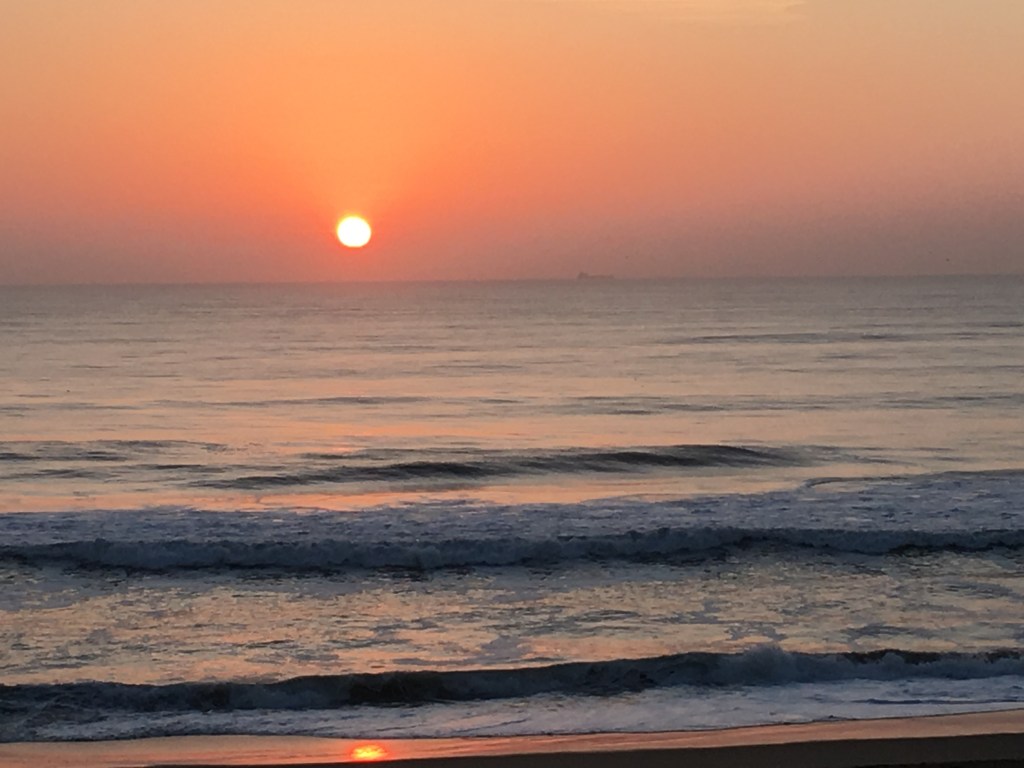
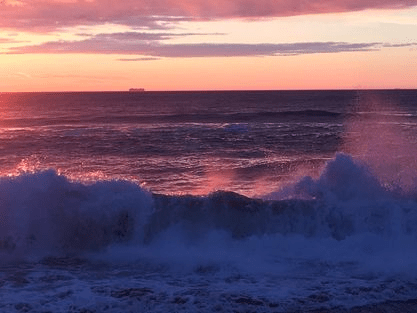
I headed south and then east and arrived at the oceanfront about a half hour before the sun, as if we agreed to meet for breakfast, me carrying my bottle of water, the sun pushing an awakening Atlantic before it. I checked the weather app and saw our appointment was for 6:37; I was early, though I can see the sun’s foreglow coming across the horizon, so I knew it would be on time. I walked the sand for a while.

This is so simple, I thought as I walked my way up the beach at the water’s edge. This clearly didn’t take planning, didn’t demand money or rearranging of responsibilities, and the only consideration I had was how long did I have before I needed to be somewhere else. This morning: about two or three hours. Experience reminds me and anticipation informs me this is likely to be the most peaceful few hours of the day; it is packed with hope and possibility, like the glimmer of light just cracking the dark blue sky, the just-waning moon fading in the west, the passing dolphins and gulls and osprey and pelicans who know nothing of being “late” to anything. I am convinced that dawn has swept in and saved me more than a few times. Today was different, however. Today I felt something like a leaning forward, like a push from behind somewhere.

These mornings remind me how often I create my own stress by not pacing myself better, by not taking a few extra moments. My son and I have risen early at home several times a month to take in the sunrise at the bay, before even the watermen have made their way out past the reach. And at night, well, at night we have seen more sunsets together in the past two and a half decades than I can possibly count. Not one of them was redundant, not one disappointing, and never did I think I should have been doing something else. Where along the way did I start to believe other aspects of my life had become redundant, disappointing?

I am pushing the edges out just a little, just a very little, to fit perspective into the fold, to allow for the purpose to reveal itself to me. This morning’s reveal: I have learned from nature to be myself, and, as someone told me not long ago, to be “unapologetically me.”

I swear sometimes at the end of the day when we’re standing on the sand at the river and the yellow, then orange, then something like deep maroon seems to sink below the western strand, I almost hear it whisper “Thank you for noticing.”

I wish we noticed each other this way. I wish we took the time to let down our guards and look at each other a few times a day with absolute honesty and noticed the beauty.

Simplicity is Gained

Aerie

Time to return to the wilderness.

I sat on the front porch tonight for a bit. Birds had been chirping for quite some time; cardinals, house wrens, and a couple of cooing doves somewhere in the woods to the southwest. When I was on the patio I sat and cupped my hands and blew through my thumbs to make a similar sound, though I doubt I fooled them. The thing is—they went quiet for awhile and then only replied when I made the noise again. I like to think I was telling them something or warning them, though they probably sat on a branch somewhere talking to each other about my opposing thumbs.

Those thoughts were fleeting—no worries. What stayed with me, however, looking out across the front yard into the woods, looking down the darkening path to the east and where it bends back toward the distant driveway, was thoughts about other paths in other places. The trails of eastern Virginia I’ve hiked with my son, the paths at Mt Irenaeus in western New York, the steeper, thin-air paths of Utah that wind straight up to the wind caves. I’ve walked paths I’ll remember forever and a few I wish I could forget, both in reality and metaphorically.

But the true path that always comes to mind, which set the standard and raised the bar, is the Camino de Santiago in Spain. It terrifies me that a pilgrimage across Spain that I can recall like I did it last month out west actually happened ten years ago next summer. It is with me still, but, unfortunately, many of the lessons I thought I learned there have slipped away. I came back convinced I had it right—I’d simplify, I’d organize and stay focused and follow through, but, as Jim Croce aptly reminds me, “So many times I thought I was changing then slipped into patterns of what happened before.”

Yeah. Damnit.

It’ll remain warm here for quite some time, but today there was a breeze off the bay that felt somehow foretelling of autumn. It wasn’t “cool” by any means, but certainly pleasant, welcome. As someone pointed out to me last week: “Summer isn’t through with you yet.” That’s fine; often come mid-September I want to “reach out and hold it back,” as Jay Gatsby desired. Almost all the time, I am like that.

Not this time. No. I’ve almost got my ducks in a row, and I’m casting aside as much as I can of old habits and tired routines. We are always looking for “kicking off” dates to start anew, to really “gather up our forces and get out of yesterday.” There are plenty to choose from: New Year’s and birthdays are probably the most common. But as a professor I have the added commencement of late August, early September, when classes start. This is the time of year everything is brand new, and my attitude is new, my hopes and ambitions, just like students I’ll face each week, just like it was for me forty-something years ago this week. It happens every year, but this time it is a bit different. I’ve worked very hard at separating myself from the umbilical cords of failed approaches and misguided directions. So this time is something closer to my return from Spain, when I knew, I mean I had the absolute conviction, that my destiny was my own. I thought that powerful knowledge would last, but it slipped through my mistakes and shortcomings.

This time, however, it won’t for one very essential reason: I’m older now, and I’ve reached the age where I know I’m running out of do-overs. And I sat on the porch thinking about Spain, about the summer of meandering, both physically and psychologically, and how I was focused on each moment, and I followed through with plans every day while there. I didn’t think in big ideas and sweeping hopes. I thought in small pleasures and that idea of simplicity.

I need to do that again, and for the first time nearly since returning from Spain, most certainly within a few years of returning, I find myself in a position to be able to do just that, and mean it this time when I say, “I’m through wasting what’s left of me.”

I’m at my desk now, an hour ago having left the circling hawk and the frightened doves to do what nature does. It is later and the sun is gone—it sets so much earlier now than just a few weeks ago. Someone across the river is shooting off fireworks. I never thought of Labor Day as a celebration to set off fireworks, but, well, maybe I shouldn’t ignore the symbolism of such New Year’s overtones.

It took ten years for the Camino to truly make sense to me. I’m a slow learner.

You know what? Maybe I’ll just go back to Spain.

Spain

To the Letter

When I was fourteen my dad had transferred to Virginia where we would eventually move, my siblings were both at college, and my mother worked in town. So when I wasn’t with my friends, I was at the local tennis courts in Timber Point Country Club hitting a ball against a backstop. Sometimes I’d bring a bag of balls and practice serving. One day I was out there practicing, and a man was doing the same at the next court—a massive bag of balls at his side, serving unseeable serves like an ace. I sat and watched when he asked if I wanted to play a bit. By then my friend Eddie had cycled up and we sat together, and if it wasn’t for Ed’s encouragement, I would have said no.

I did just fine rallying the ball back and forth. He wasn’t trying to “play,” he was just letting me return the shots. We did so for about fifteen minutes. He told me I was doing really well and that he hadn’t expected me to play so fine. I was glad he said that with a witness around. He said I need to really focus, and I need to follow through—those are the two keys to success in this game—focus and follow-through. Then he said he had to get back to a friend’s house and back to the city. It was John Newcombe. Jimmy Connors won that US Open a few weeks later, but Newcombe, second seed for the tournament, made it to the semi-finals. My passion for tennis had been ignited, and I got good, carrying that talent to Virginia where I continued to play religiously.

Until I didn’t.  I lost focus. Turns out I didn’t follow through.

That has happened to me a lot. I was going to bike to Coos Bay, Oregon. I was going to go from Tucson to LA. I was going to go from Massachusetts to Austria. Pursue music. Eat better. Exercise. Honestly, it’s a long list. Ironically, I developed a pretty good follow through on the court. Turns out I left it there.

I found yet something else I promised to do but didn’t follow through on: letter writing. About a year ago on this blog I wrote about sitting here at Aerie and writing letters to people. Here’s part of that entry:

Remember those days when we would anticipate mail? It seems like a long time ago now, but I recall the satisfaction of dropping a thick envelope into a mailbox or opening mine to see that marvelous white rectangle of someone thinking about me. My sister found letters our dad wrote to his mother when he was eighteen. When I was in college my Great Uncle Charlie, who was in his early nineties at the time, wrote me letters and often included poems he wrote. This was a man who fought in France during World War One, and when I was in my late teens, he was still writing letters and poems and dropping them in his local postal box. I don’t know what happened to those; I moved around so much. Also lost are letters from my childhood friends on the south shore of Long Island. During the first year or so after my exodus in the mid-seventies, we wrote religiously. The one I was closest to died last December and now I can’t express how much I wish I still had those epistles of what we were like then, our hopes, our plans, our fears, and our indescribable confidence which time has eroded along with our penmanship skills. I guess I just figured he’d always be around to talk to.

A few years after college, I wrote probably a few thousand letters to someone in the air force. It was our only means of communication except when she had the time to call me collect, IF I was even home. At that time I had to address the envelope with her full name, followed by her full social security number—right there on the front of the envelope. I still remember it, actually.

Okay, so…

The mother of a friend of mine in DC died a few days ago. It wasn’t unexpected, but it was still a “gut punch” as he wrote me. Yes, we are never prepared. I remembered my father’s passing seven years ago next month. He had been sliding a very long time, the final two weeks of which he was nearly always asleep, so when he entered hospice care, my siblings and our mother and I took turns sitting with Dad; we wanted someone to be there. He died just after 8pm on Wednesday, October 21st, 2015. I was teaching a creative writing class and during a break my brother had texted for me to come back. He was gone.

On the drive over I suddenly had complete clarity of every single thing I wanted to tell my dad but never did. Volumes. Sure, “I love you, Dad.” But more. About my son, about places I was going, about where he had been, about his dog—a Chesapeake Bay Retriever—my dad had when he was young, about the Mets, about golf, about whatthefuckever. I can still feel my anger at myself for not following through on that, on all the times when I knew his mind was not as sharp and not getting better that I promised myself I’d stop by and talk about those things.

I thought John Newcombe was talking about tennis.

This brings me to today. I was sitting at an event when a woman who had read my latest book told me she enjoyed it, but she was most touched by the letter in it which I wrote to my son, toward the end of the book.

“Did you really write that letter and send it?” she asked.

“Yes, I really wrote it—it’s in my journals. But no, I never intended on sending it.”

“Didn’t you want him to read it?!”

“Well…. yeah, he did, I think. I’m assuming he read the book, I’m not actually sure. But he knows about the letter now,” I said, as seriously as I could.

“Oh good,” she said. “It would be a shame if you had never sent that.”

It was slightly bizarre, but also slightly prophetic. I wondered if I would have mailed the letter had I not included it in the book, or would I have just waited for him to find my journals–assuming he’d read them at all–when I’m dead. I don’t know, actually. And I wondered if my DC friend still had something he meant to tell his mom. I can recall all I wanted to say to Eddie when we would eventually have lunch as planned but he died. Even people I love now and am still very close to, there’s so much unsaid, so much hanging in the air for a variety of reasons, some of which make sense—perfect sense, until those people are gone. Then the grief that follows has nothing on the anger when we realize what we didn’t take the time to say.

Remember those days when we would anticipate mail “from a friend or a lover? Sometimes there’s none, but we have fun thinking of all who might have written,” as Dad Fogelberg aptly wrote. It seems like a long time ago now, but I recall the satisfaction of dropping a thick envelope into a mailbox or opening mine to see that marvelous white rectangle of someone thinking about me.

I know the problems in resurrecting such an ancient art form: besides the “slowness” of letter writing, there is the “I don’t really know what to write about” aspect. Then there’s the “I don’t have time” factor. Come on; sitting down to do anything for ten minutes is not an Olympic feat. My favorite avoidance mantra is “I think faster than I write and I can’t slow down to do it.” Geez if you don’t think faster than you write then you’re probably legally brain dead. But to go with that, remember, Neil Diamond wrote, “Slow it down. Take your time and you’ll find that your time has new meaning.”

Writing letters helps me remember what is important in life, and it reminds me that I should appreciate the small stuff through the day which I might include in a letter. It slows me down, helps with my blood pressure, my stress. Mostly though, it is instigating a physical presence in another’s life in a completely non-threatening way; it is my DNA sealed and sent to another state.

I wish I had written back and forth with my father or kept in written contact with some friends from other countries, from New England, from New York. I’d love to have heard from my grandparents, or to read a collection of letters from ancestors from another land. They are treasures; they are history, humanity, emotion and time, all in the strokes of a pen. I don’t want to leave anything unwritten; I don’t want to leave anything unsaid.

I’ll be writing you soon. It might be in an email. It might be in an envelope. Anything. I just hope I follow through on this before one of us is gone and the other is left holding a handful of things we wanted to say to each other.

Still, life

Van Gogh, 1887 Netherlands

When I taught Art Appreciation at Saint Leo University on the Naval Base in Norfolk, over the course of almost thirty years the most common comment among my mostly retiring active-duty military or already retired vets, when I showed still life paintings, was, “Who Cares? Who would want that on their walls? I’d rather have a real bowl of fruit!”

Rarely did anyone catch on that it was a set-up; I knew they’d say that.

“Why do you think?” I’d retort like any good psychologist might.

At first the responses were always the same, semester after semester: the dude liked fruit (or flowers); some family member painted it and they felt obligated to hang the thing; it was on sale; it came with the castle. Then, someone would offer a constructive perspective: the artist couldn’t afford a model; it represented wealth—having paintings of fruit or flowers or livestock meant you could afford those things (as well as a painting of anything at all, actually); the colors matched the throne.

“All true, but anything else?”

Silence.

I’d put on the screen some of the more famous and celebrated still-life paintings. Caravaggio’s fruit, Cezanne’s apples and curtains, or his famous skull painting, Braque’s violin and candlestick, and perhaps most famously, my favorite, Van Gogh’s Sunflowers.

“So that’s it? They liked the colors? They liked a good Mcintosh apple? I’d ask.

“Maybe they had paintings of those things because they couldn’t see them. Back then people might not have even known what an apple or a sunflower was, or at least never had seen them,” some thoughtful student might inevitably contribute.

“Except the skull.” We’d laugh.

“Excellent, and, sorry, but why else?”

Eventually someone would see it. “That’s a damn good sunflower.”

There it is. The texture, the perspective and color. The very notion of sitting and looking intently at a flower or an apple or even a skull is met with a laugh—we walk by them, of course, and they’re pretty. But to “Whitman ourselves” into some deep study of a leaf of grass or the pedal of a tulip is met mostly by ridicule. But when it is a painting, no one questions it. We are not wigging out on nature; we are appreciating the intense talent it took to capture the life itself and make it permanent. “Here we are,” I’d say, “One hundred—no, two, three hundred years later, and we’re still looking at the same flowers that Caravaggio had on his table. He keeps showing them to us.”

“Now I want an apple,” someone usually quipped. We’d laugh and I’d move on to the abstractionists, which was an entirely different head game.

But the still-life paintings were the ones I used on quizzes. They couldn’t get the answer wrong since it was a personal response, but after they studied endless names and paintings and periods and movements, the actual questions surprised them.

  1. Part A. Look at van Gogh’s “Sunflowers” for at least three minutes—study the strokes, the perspective, the context, and any narrative you find, and write about it in 500 words.

Part B. Why don’t you do that in nature? Why is it you can appreciate a painting and look at it a long time, but you don’t stop in nature and study the flowers, the texture of a tree? Respond in 500 words.

And other questions bent in a similar fashion.

I have a passion for art and some of my closest friends, several of whom have passed on, have been visual artists. I deeply appreciate art because, in part, I can’t do it myself. I have paintings by friends like Mikel Wintermantel, James Cole Young, George Tussing, and more. I have shelves of books with work by Pissarro, Cezanne, Monet, and Van Gogh, of course. The quality of his drawings exceeds his paintings in my opinion. As a writer and therefore an artist in the more general understanding of the term, I connect completely to the notion of trying to repeat in art what we experience in nature, and while my list of writers who have succeeded in that talent is impressive, my list of visual artists is far more extensive.  

That which captures nature and holds it up for us to see in the small rooms of tall skyscrapers, or paintings of Provence hung in living rooms in Arizona, is an example of human creative potential that is so revered that the names I’ve mentioned are household names, and the artists died centuries ago—that’s their staying power.

Still, life is not two-dimensional. It cannot be hung on walls or captured with acrylics and oils. It is an experience. It is kinetic. Life is the aroma of sunflowers in a field outside Pamplona, Spain, or the honeysuckle along a sidewalk in South Philly. Life is the soft sounds of rain on a pond in a park, where Monet’s lily pads cover the green surface, and you can hear a bullfrog, and you can feel the moistness on your skin. It is the sound of dry leaves on van Gogh’s path in the Netherland woods, or the slight chill in late fall where birch trees break the horizon like an Elliot Porter photograph.

If we can go for a walk and keep still, life is the original model, the inspiration and original cause, not art. Art is there for us, and it is beautiful and eternal and, personally, brings me peace.

But it is always imitating life. It did when Plato called it a false reality of life, and it did when van Gogh said, “Still, life is what matters most and the true artist in this world does not work on canvas but with flesh, heart, and soul.”

Home, 2019 Virginia

Full Exposure

I read from my new book the past few days and it went well and I enjoyed it and the food was fine and the wine was just right and I was happy and they seemed to enjoy it.

During the last question and answer session, a twenty-something woman stood up and established herself as a non-fiction writer, a journalist, with an inquisitive mind, and she believes small details can truly reveal a person more than the longest discourse with them. I expected a question about Siberia, or about one of our cabinmates on the journey, or the food, or my son, or anything anyone might ask, only smaller and with more detail. But no:

“How did you get that scar on your cheek?”

I sipped my water, and several attendees seemed suddenly uncomfortable. It felt like a 19th century question, like she should have been standing too close in some flowing corset gown and I would sip cognac in some dapper suit, and she’d say, “Tell me Robert,” putting her finger just a little too close to my face, “how did you acquire this scar? Do tell.”

But she was a j-student working on her masters, took copious notes during the reading, and sat with her pierced, tattooed boyfriend.

I touched my face. “I forget, to be honest.”

She nodded, and I knew she was thinking about it, wanted to push me, since she must have noticed it too big to “forget,” but she held enough decorum to let it go. But my host? No such luck. “You wrote about it, though, Bob, didn’t you?” he called from the back of the room. “Unless that is different.”

“I did write about a scar, but, ironically enough, this time I wrote about a different scar; The Iron Scar.” Everyone laughed. “Shall I tell you how I arrived at that title for a book about the Siberian railway? They encouraged me to do so. And I did, and she took more notes, and her boyfriend listened intently, and my host kept the pace and let it go.

But he was right. And here is the piece which appeared first in Southern Humanities Review and later the collection Borderline Crazy. But I should say that since the reading my mind has tumbled into a place I’d not thought about for quite a long time. We wonder what it is that will trigger a memory. Usually it is an aroma–smell is the strongest catalyst for recall. Often a photograph. But without really thinking about it, when she asked, I touched my cheek, almost as if to see if the scar was still there, if that part of my life really did happen, and my mind just kept spinning away.

Full Exposure

I have a scar on my cheek from a jagged section of chain link fence. But that is not what I told my son when he was two and ran his finger across it. One hand rested behind my neck the other outlined the scar, or pushed it, or pulled at it. “How did this happen, Daddy?”

I would smile, and with a story-telling voice, say something different each time, like: “I was escaping from a lioness when I accidently stepped on her cub, and just as I dove off the edge of the waterfall, her right paw clawed at my face.”

“Wow!” he responded, amazed for a moment, and then, “No, really. How did you hurt your face?” I’d laugh that laugh we use to dismiss what we said as recognizable nonsense, as if what we are about to say is the real story, and I would tell him “I fell off a train in Mexico and when I rolled safely into the Sonoran Desert, a scorpion stung me. Since I had no antidote for such stings, I had to dig out the poison myself with a dull pocketknife.” I would set Michael back down on the floor and he’d run off satisfied, not with the truth but with adventure, mystery, and more to think about. His vocabulary and imagination gathered these non-sequiturs—scorpion, lion, desert, waterfalls—and they would dance in his mind as he made up his own tales of near-death encounters and narrow escape.

At night I read Curious George to him and when the stories were finished, he would lean against me and ask what’s new or how my day was. And then after a few minutes of silence he might say, “Daddy. It wasn’t a scorpion.”

“What do you think it was?”

“I think you were born that way.”

“Well I wasn’t. I can show you pictures.”

“Well, then it must have happened at work. I think a student did that to you.”

“I’m sure many have wanted to, but none have tried…yet…so that isn’t it.”

“Then what?”

I would think a minute and say, “Son, honestly, it was a rabid vulture,” and he would sneer at me, laugh, and jump off the couch exclaiming, “I guess it’s time for bed.” After he ran off, I would sit and think awhile; kids do that to you. They say something, or ask, or sometimes just laugh a certain way that rakes up what had been settled matters, and you can’t help but think awhile before heading up and tucking them in and letting them know everything is fine and that you’ll be fine and when they wake up, you’ll be there, safe and whole, albeit with a few imperfections.

Scars are not unusual. For some, they are the unfortunate leftovers of disease, for others battle scars not treated or tended to, or untreatable. And for some they are souvenirs, notches on the skin akin to those carved on walking sticks or gun barrels. George Washington had scars left over from Smallpox, as did Soviet leader Josef Stalin, whom as a result was called “Pocky.” When Andrew Jackson was a boy, a British officer demanded Jackson shine the officer’s shoes. When the boy refused, the soldier cut his forehead with a saber—a mark which the future President of the United States did not hide.

George Custer’s younger brother, Thomas Ward Custer, a two-time Medal of Honor recipient, was shot in the face by a confederate color bearer when Custer reached for the man’s flag. The younger Custer killed the confederate and carried off his flag only to be shot and killed eleven years later beside his brother at Little Big Horn. Ironically, Crazy Horse had also survived a shot to the face, his by a war chief whose wife he stole. Go figure.

Me, well, I can still taste the dust, smell the rotten fruit of the nearby marketplace. I can still feel the fence, not on the way in but on the way back out.

When Harriet Tubman was young, an overseer threw a weight at her head which not only caused seizures most of her life but left a “horrific scar” which she said never let her forget “the horrors suffered during slavery.” A glance in the mirror may remind some of a tragic event, but that same memory might serve as inspiration, the signature of survival, the markings of the moments they overcame unthinkable odds. The picture of the slave’s back whipped to shreds and left to heal like a topographical map is also a document of inhumanity recorded for posterity. Branded numbers on holocaust survivors’ forearms forever keep alive the knowledge that evil walked these lands. Scars are history; they infect our psyche with sometimes unconscionable reality to make our history present. They are proof we survived our past despite odds, sometimes despite logic.

Some marks are merely fictional scars which, because of literature and film, are closer to legend than falsities teased by a father to his son. Harrison Ford’s marked chin comes from a car accident at twenty, but has since become an asset, a distinctive feature and part of his personality, even incorporated into the storyline of movies like Indiana Jones and the Last Crusade. Robert Shaw and Richard Dreyfuss exchange stories in Jaws of which sharks left their teeth marks on their legs. The scars render pride in their ability to survive. These souvenirs and conversation starters carve their credibility into bone, and they read like brail to tell us that these people have been there.

But who we are is more than the aesthetic; we are all branded in one way or another. The injury, disease, or self-inflicted wound caused the mark, but our character traits, from malicious villain to a hero with integrity are what we see. In both fiction and reality, the imperfection is just that because of its diversion from “normal.” Most people do not have scars, not visible ones. So when someone does expose such diversion from the expected aesthetic, judgment often follows. “If not for the wound,” they say; “He should have done something about it,” they say; “He should get it taken care of and move on,” some say. Of course, I didn’t seek out the wound like some scarification ritual; it isn’t an African osilumi—a mark of sorrow made after the passing of a loved one. It isn’t for fashion, similar to the tattoo-like Mehndi in India. It isn’t even political or ethnic as most African traditional markings. Some scars prove the woman can meet the demands of childbirth; some symbolize lost children either during childbirth or to slavery. And slaves themselves were branded or scarred to make less attractive or more noticeable. In other locations scars were burned or cut and then left to heal on their own to mark temples or foreheads or forearms for the pride or disgrace of a group. And paleontologists trace scarification to 50,000 BC.

When Michael was three, he slipped on monkey bars at a park and hit his head on the crossbeam. He wrapped himself around me and cried, but it was only when I checked to see if he had a bump that I noticed a hole in his forehead where a bolt on the beam had punctured his skull above his eye. Ultimately, he was fine, and his tears quickly resulted not from pain but because we left the park to go to the hospital where they sewed him up and we went home. More than two decades later there really isn’t any scar, but for a few years when he was little it was obvious. For others the scar briefly took attention away from his head of thick curls.  For me it was a crevice through which I traveled back to that moment, my shirt covered in blood, his piercing screams, the hole in his head. The scar is no longer visible. The markings of that moment of impact cannot keep pace with the persistence of my memory.

Years may pass before someone once again asks what happened. And by then, what happened often gets watered down and what seemed to happen takes over. Then, the story is either exaggerated or forgotten altogether.

Until you touch the cheek.

A border patrol guard asked for my papers but actually wanted another payoff.  I can still smell rotten fruit; taste the red dust. That was more than three decades ago; that was just now. You see a scar; I smell sweat, I hear the low buzz of a generator not far away, the diesel sound of a truck. I smell rotten fruit and feel the tug of children begging for money. You barely see the unevenness of my face; I feel and taste the sweetness of my blood dripping into the corner of my mouth, I taste the significance of a terrifying moment. Sometimes the worst of our scars marks the best of who we were at that point in our lives. 

After the monkey bar incident, Michael and I returned home from the hospital, his head bandaged and a new book in his hands. We moved on. The physical wounds of war or personal battles are transient. Even when they seem permanent, they fade to some accessory-like marking, barely noticeable for seeing it all the time. No, the wounds which usually keep opening are the stinging reality of memory which wakes us at three am. For someone it is the love which melted into hatred and bitterness; for someone else it is the belittling by siblings, spouses, parents; it is the cuts on the wrist; the two-thirds of a man; the inability to vote—look at their scars, just under the skin, healed, forgotten, and then like magma rise out to flow through months and years, to grab us and say, “Yeah, now you remember.” It’s the vet. It’s the abused wife. It’s the battered child, the neglected, the forgotten, the Jew, the Serf, the back of the bus, the separate water fountain, the depression; the depressed. You can touch my scars, run your finger along the ragged edge where skin never really met skin again, and find some tale there, but it might be closer to myth. It can never be simply facts and dermatology. Really, it could totally have been a hot curling iron; no, a kitchen knife. Cancer. Ask me again, and I swear I will tell you the truth this time. The thing is: the truth never completely heals.

Maybe I was born this way. Perhaps my DNA bends toward crossing borders. It is possible I simply was not cut out to keep intact, and these scars have always been just below the surface waiting for the right place and time. Check points and jagged fences might have been inside somewhere while I was still gathering adventurous words and fantastic ideas.

That night after the hospital, on the couch after listening to me read him another story from one of his books, Michael touched his forehead, freshly stitched and bandaged, and then touched my face. “Will I have a scar like yours?” he asked, paying more attention to his bandage.

“No, of course not,” I said.

“How come?” he asked, and I truly wasn’t sure if he was curious or actually disappointed.

“Well, the doctor fixed yours right away and it won’t be long before it isn’t there anymore. But I couldn’t get medical help for a while.”

“How come?” 

I pulled his hand away from his bandage. “Well,” I said. “Once I pushed the mother dingo away from my head and pulled her paw far enough away to come out of my cheek, I had to rush her cubs to a vet to get them care.”

He was quiet, opened his book and fingered his forehead, then said. “Daddy, you can do better than that.”