AI AIN’T

A student actually asked me if it was okay to allow artificial intelligence (I see no reason to capitalize that) to write his paper. He didn’t try and plagiarize and pass it off as his; he didn’t unintentionally use someone or something else’s material and mistakenly claimed it to be original. No. He sat at his computer, opened his browser, addressed an email to me, and wrote, “Is it okay if we allow ai to write our papers? Will I lose points for this?”

Once again, we have slid right past the founding problem and into the next level, where we have already accepted the premise but now we must fight small issues. It happened with cell phones when we moved from not allowing them in class at all to penalizing students if they use them at the wrong times or for the wrong reasons. What happened to “No cell phones. Pay attention to me”?

We have so much technology in our lives and in our classes that time must be spent powering up and down, downloading, transferring, waiting, and on and on that the actual time a student is truly “present” and looking at who is talking, making notes, discussing, has diminished by nearly eighty percent according to Pew Research and a study at the University of Pennsylvania. The productivity and scores at every level of education in this country suck and we cannot figure out why. Here’s why: No one is paying attention.

Problems:

*As soon as cell phones or laptops entered the classroom, teachers had competition for already questionable attention.

*Students who consumer energy drinks have an attention span nearly twenty minutes shorter than just one generation (pre-cell phone and energy drinks) ago.

*It was proven many decades ago that writing things down, even just once, increases the ability to remember information tenfold. It is called “writing to learn.” But today students do not write down a single note choosing instead to take a picture of the information.

Education is easy: Listen intently (that means with intent to learn) to the person who knows what they’re talking about, ask questions of those areas you are not sure you clearly understand, write it down somewhere to see if you will remember it all. This is how it was done by slaves like Frederick Douglass who battled opposition from overseers who would whip him for reading, plantation owners who would kill him for learning, national laws forbidding him to read and write. This is how it was done by the Irish who were forbidden to learn in their own land so they had to hide behind the hedges in small groups to learn reading and writing from their “hedge master.” This is how it was done by immigrants who needed English to get a job and wanted to make a better life for themselves. This is how it is done. All the technology available will not replace internal motivation necessary to achieve your purpose. Nor will it explain to you what that purpose is.

But students today read texts from friends, use a program to write their papers, believe they can only get through the next five minutes with another Five Hour Energy drink.

There is no more quiet, no more earbudless, phoneless people walking peacefully from one place to another, listening to nature, listening to each other, listening to themselves, thinking about the day or about the moment. There is no more sense of now. They don’t yet realize that you have to put down the past and the future if you want to learn to unwrap the present.

There is no more sense that people are paying attention. Not on the highway where distracted driving is the number once cause of accidents; not in the classroom where distracted students are missing nearly eighty percent of the material. Not in our souls, where we need to pay attention to our own compass, our own course.

Artificial intelligence can certainly write a pretty decent paper, but it will read like the blind date pretending to get along with you so that the night isn’t a complete waste of time. Yes, it will fulfill the requirements and might even be acceptable, but I won’t feel it in my soul. When I read someone’s writing, I need to believe they stood in that spot, felt the sand, tasted the old wine. Ai cannot make me believe your heart raced when you got closer to some destination. Ai cannot convince me you actually lived.

Ai is not alive. Cell phones are not alive. The energy gained by ingredients in even the most natural of power drinks is not the fire you need to be truly alive, present.

We are dying. Slowly for certain; but dying equally for certain. And the only way to make that worthwhile is to be absolutely present on the way. To do the work, to grow tired from trying so hard.

Our pace is all wrong. Somewhere we believed that advances were always a good idea. We convinced ourselves that convenience was the best approach. The number of people fighting depression is at unprecedented levels; the suicide rate is increasing nearly daily; the dropout rate is growing exponentially; and our success in English, Math, and Science is nearly out of competition with all other industrialized nations. Our priorities are wrong.

Artificial intelligence assumes some level of intelligence to begin with. But it is not intelligence that is the problem to begin with that we need to use artificial versions like we do with sweeteners and flavors and levels of energy. It is purpose.

On the first day of class I ask my students to put everything away—laptops, cellphones, notepads, energy drinks, earbuds, bluetooths, all of it. We sit and I ask them where they’re from. Then I ask them this: Why are you here? What are you doing here? You can be anywhere–tending bar in the Caribbean, backpacking around Europe, working and making money at some resort hotel, absolutely anywhere you want. But you’re here. Why? And we spend the rest of class exploring purpose.

Does it work? I have no idea. But on my long drive home I ask myself that same question trying hard to answer it before my mind melts and I put on the radio instead, relying upon some noise to fill that dangerous space of silence.

Life is paper thin, Toni Wynn wrote. How are we spending it?

What did I really do with my time?     

133 Years Ago

The Potato Eaters, 1885

Imagine these circumstances:

A thirty-seven-year-old man has not held a steady job since he was twenty-seven, and he was fired from the six jobs he held until then in his adult life. He has fallen out with his father, lived with a pregnant prostitute and her daughter, and his younger brother gives him every dime he needs for food, housing, and supplies so he can paint. He claims (after saying he wanted to be a preacher, an art dealer, a tutor, and a bookstore clerk) he wants to be an artist, but every artist save one believes he simply isn’t at all good at it. The critics dismiss him as an amateur with no control over his craft, and everyone believes him to be a bum, a vagrant, a freeloader. He has a handful of maladies such as syphilis, bi-polar, manic depression, and “fits of dismay” we can today label as seizures, but in his day was simply considered signs of insanity. Four months after turning thirty-seven, he still has no job, sold no paintings, received no sign of hope from critics or artists, and has been rejected by women from his cousin to his landlord’s daughter.

Then on July 27, 1890, he shoots himself in the side (yes, he did it, not some teenager in town, not some unknown soul, he did it), and two days later on the 29th he dies. There seems every reason to consider this poor man has thrown away his life and took advantage of those he loved for some foolish “obsession” only he seems to believe in.

Yet, within a few dozen years he becomes one of the most influential, inspiring, and successful artists in the history of western culture. His letters found later reveal his passion to show others the humanity so overlooked in the poor and destitute of the world. In his day, this greatest of artists was considered the least of our brothers.

How many of us would pay attention to such a character, listen to what he has to say, get close enough to understand what bothers him, motivates him? How many of us would simply walk past this man?

I am not suggesting we are surrounded by genius disguised as misunderstood, downtrodden individuals. But it seems believing in others even when no one else does, especially when no one else does, can change a person’s life, and who knows what kind of ripple effect that might have.

I feel that there is nothing more truly artistic than to love people.

–VVG

Friends of A View: Watch this. Trust me. You’ll cry:

Curious Men

The piece I wrote which was the fastest to go from concept to completion, in ready to be published form, was in 2016 about Arlington National Cemetery. From the time I sat down to write to the moment I sent the version that would eventually be published in the Washington Post spanned just twenty minutes. We call that a lightning strike.

The slowest has been “in progress” for more than forty years, but as of a few days ago it headed to the fast lane and dragged my procrastinating ass with it. Here’s what happened:

When I was a freshmen and sophomore in college, I was deeply involved in the planning and training for a great adventure of a friend of mine who had graduated from the college about four years earlier. While it was not my adventure we planned but his, in just a couple of years it unsuspectingly became mine, and I have tried to write about it ever since. A few pieces have been published by journals such as Matador Review and Palooka, and the entire 275-page manuscript became my MFA thesis, Fly. It was more than a little weak, however, and I subsequently attacked it with a pen, markers, highlighters, and anything else to move hard-copy paragraphs from chapter to chapter and front to back. I trimmed it down to a not-so-well written 50 pages. That version, Curious Men, received some decent reviews, but the primary response involved readers wanting to know more. That can be both good and bad, and in this case, way bad. I was never satisfied with the work; I could not capture the excitement—exhilaration really—and anticipation at just twenty-years old, followed by confusion and disappointment. For me it became the quintessential “you had to be there” narrative. The true story goes to emotional extremes, pulling this nineteen-year-old boy out of some catatonic state and into some woke existence of adventure and exploration. The written version, well, didn’t.

Long story short: the long version was way too long, and the short version left people longing for more, indicating I came up short. I can’t get it right.

Honestly, I have been thinking about, writing about, messing with, focused on, and ignoring this story for forty years. I long ago decided that I would never get it right, figuring it would be wrong to put it out there. I have letters, maps, notes, journals, emails, and a half dozen different versions of the same manuscript all saying the same thing, and not very well.

Until last month. On a drive to Florida I listened to the audio version of Beryl Markham’s West with the Night. I enjoyed this version of the book I had read several times decades ago, but somewhere while driving past the dilapidated and very incorrect theme park, “South of the Border,” in South Carolina, my mind drifted back to my manuscripts. And on I-95 South I figured out exactly how to start, what to focus on, and I finally understood the problem I’ve had all along with the narrative: It isn’t about anyone else’s journey, it’s about mine. The book is not about the character I had been writing about for forty years; it is about me; I’m the protagonist.

When I got home, I pulled out the long, bound version that was my MFA thesis, as well as the short version in a binder on the shelves behind me. I pulled up the published versions which focused on one segment of the story, and I reread the longer version, Curious Men, and sat back knowing two essential things: First, they all suck. Second, I know now exactly what I need to do to unsuck them. My energy has returned, some internal motivation has been reignited.

It was a four-hour session that first morning I did little more than read through pages and chapters with a fine-tooth comb much like the NY Times editor must have when he first received the Pentagon Papers. What I believed was a story no one would care about and which I was not telling well at all, I finally knew exactly how to tell so others would be interested.

It was both exhilarating and terrorizing. I am ready to get back to this and get it done right this time, yet doing so means not only facing the possibility of not getting it right yet again but also dealing with some realities I’d almost rather let lie dormant.  

But if my trip to Florida followed by an inspiring trip to western New York ignited some spark, it would be just a few hours later that some bomb exploded in a manner that sent those proverbial chills up my spine.

Long story not so short:

I received a message that very afternoon; I mean I closed the manuscript, got in the car to get a Slurpee, was sitting in the parking lot thinking about the protagonist of the work, me, and I received a message from the sister of the subject of my book. Be clear: I had never heard from her before in my life; I did not know she existed. Yet, she messaged me the very afternoon I had started work in earnest on a book about her brother.

She said in part, “My name is Kim and I just read online one of the stories you wrote about my older brother. I never knew him, he left with you that last time when I was five, and I am now almost fifty. I saw online you are a writer now and I am wondering if you plan to write a book about him.”

Again, that message came just hours after I decided in earnest to get back to it, my desk covered with pages and maps and journals and emails. Insert Twilight Zone music.

Kim wrote that she remembers the leather coat in a picture of him with me and a friend, Annemarie. We’re in a hallway at the college, laughing. She remembers him dropping her off at kindergarten the last week she saw him, and her teacher asked if the man in the car was someone else he happened to look like. She still has an old, worn sweatshirt of his he left behind. I asked what made her write me that day and she said their oldest brother George had recently died and it got her thinking about her other brother who was long gone, and so she found me online and messaged me.

I told her about my day up until then, and she agreed it was more than a little freaky that she chose to write me that day. Strange, but when I read her message, I didn’t picture a fifty-year-old, but instead a little girl.

The most difficult part of writing is getting started. In this case, I started more than a few times, and each complete version begins differently. Chronologically, the story starts in Virginia Beach in the mid-seventies. For narrative sake, it starts in February 1980 in my small dorm room. If I want to put a “hook” at the front, it starts a few years later seven thousand miles southeast of here in a then-peaceful, not-so-small-anymore village in what is now one of the most volatile and dangerous places on the planet. In a few versions it starts with a nightmare I had three or four times—same one—that woke me up. In one version it starts at the end and works its way backward.

None of them worked.

But when I think of that time, that experience; when I recall the “me” of back then and the life that I had, the energy and motivation and confidence I had then; when I think of the times I’ve told this story to others, my thoughts always go directly and immediately to one place: Antonio’s Italian Restaurant on Route 417 in Allegany, New York.

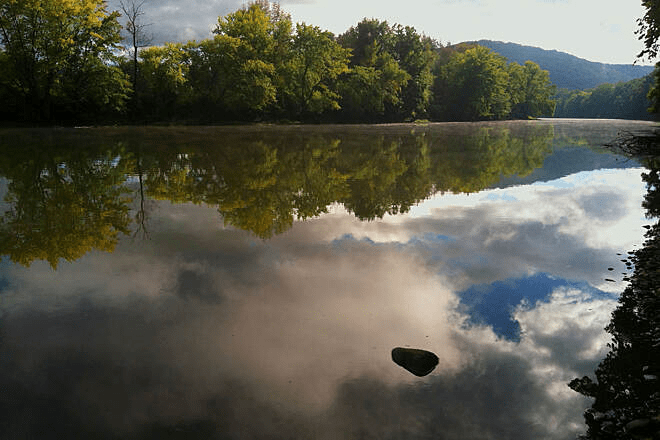
Last week I was in western New York, and I walked along the Allegheny River, followed a path through the woods, and remembered my life in that very spot almost forty-five years ago. I felt younger and vibrant yet somehow tired and disillusioned. The perfect combination for a work of creative non-fiction.

So that is where it starts. Time to wake this narrative back up so I can put it to bed and send Kim her own copy of a book about her brother that in the end isn’t about her brother at all. It truly should not take forty years to finish writing a book. On the other hand, some books, perhaps, should not be written at all, and that may well be the case here.

I have learned that sometimes it is best to not search too long and too deep for a resolution to the narrative, and that in real life sequels are rare. But I’m a naturally curious person, and it seems to me now that Joseph Conrad was absolutely correct: “Curious men go prying into all sorts of places where they have no business.”

Allegheny River, New York

In My Life

My birthday is just a few days from now. I’ve had several careers, experienced life at the extremes, and while I would do a slew of things differently, I am where I am, and the scales tip decidedly toward an incredible journey.

For my entire life, my birthday was marked by picnics and fireworks since we always celebrated a day early. When I was young, relatives and neighbors all gathered at or around our house to watch fireworks my uncle picked up in the city. I was twelve before I understood the festivities were not for me.

Through the years here at Aerie, my son and I have gone down the hill to the river where we can see clearly all the way out into the Chesapeake as well as up the Rappahannock. Some neighbors just down river set off beautiful ones from their widow’s walk, and across on the Northern Neck fireworks light up the sky from Tides Inn in Irvington, the pier at Willoughby Restaurant in White Stone, and all the way down to Windmill Point. On the south shore of the river we can see them rise from Deltaville clear on up to Grey’s Point Campground. It usually starts on the first or second, this year in particular since the Fourth is a Tuesday, though even then it will be spectacular.

But this time the show has been stolen; quite literally something else has taken the light–the moon, which is full on the third this month, sat massive and round and slightly orange from the dust of the Canadian Fires. No matter what fireworks exploded, I couldn’t stop looking at the moon, I couldn’t help but know that everyone was looking at the moon, everywhere they could see it. Our monthly display.

I’m about to turn older. I can remember sitting cross-legged on the grass, almost sixty years ago. I’m still here. Despite some years of bad decisions, wrong turns, and helpless abandon, I just watched an orange moon rise out of the east tonight and felt like a little boy, sitting cross-legged, looking at my life illuminated before me.

First and foremost, birthdays remind us in fine mathematical style that we are alive and are still part of the population which constantly expands like bottle rockets in the deep blue sky. It bends my small mind to think of this reality that I’m certain everyone knows but few contemplate: I shared this planet with every other human who ever breathed the air.

Just in my lifetime: Mother Theresa. Malcolm X. Neil Armstrong. Jimi Hendrix. Pope Paul the Sixth. Lech Walesa. St. John Paul the Second. Thomas Merton. President General Eisenhower. Elvis. Pablo Picasso. Albert Schweitzer.

Rwandan Tutsis. The Lost Boys of Sudan. Steven Biko. Pol Pot.

I shared time with these people; these saints and sinners brushed my sleeve simply by sharing the earth during my stay. We have a loose connection to miracles and massacres.

This world has some serious issues; always has. It is at best, though, a hotel, and every once in a while I take a look at the register to remind myself who else stayed here. Alexander the Great, Charlemagne, Mohammed, Ivan the Terrible, Ghengas Khan, all guests just over the slope of the horizon, just beyond some small slice of linear time. On the same human trajectory as mine but before is Geronimo, Moses, Jesus, think about the gentle bend of time, the careen of place that separates me from the disciples, the Visigoths, the founding fathers. All here but just before.

Closer to now, when I look inside the lines of my coming and going, between those two rays shooting off from my birth, I can see the souls who at one time or another shared with me this spinning blue wad. Not short of miraculous, we claim the same particles of stardust, and that’s what keeps me looking around when I walk down some city street; I want to know who else is on earth with me.

I was born a month ago. I waded through foreign rivers last month. My son was born last Tuesday. Fleeting. Swift. Impatient. And my thin life falls on the same graph as Richard Wright and Ernest Hemingway. And Grandma Moses, who painted her last work about the time I learned to swim, was born during the Civil War. I was alive when someone was alive who was alive during the Civil War.

Carl Jung lectured during my youth, and Ty Cobb watched the same Mets players as me. When I was still cutting new teeth and outgrowing my Keds, I could have headed downtown with my Dad and possibly been on the same train as William Faulkner, ee cummings or Marilyn Monroe. I might have passed them on the street, maybe stood in line at some drug store counter with my mom and behind us because of the blending of circumstance might have been Sylvia Plath or Sam Cooke; Nat King Cole; Otis Redding. We have overlapping lives. On a Venn graph, we share the shaded space.

Judy Garland and I watched the New York Jets in Super Bowl Three. When I was born World War One vets weren’t yet senior citizens and World War Two Vets were in their thirties. Vietnam isn’t history to me; it is my childhood, my early teens. The fall of Saigon was announced over the loud speakers at my high school.

There are empty fields save monuments and markers where soldiers died defending this land against the British, against ourselves, and they stood where I stand and watched the hazy sun rise. Same sun; same beach, same blessed Commonwealth. Don’t mistake history for “back then.” Those people just happened to check out before us. It could have been us. It is us now, watching the orange moon like we do, noticing the calm river, sharing time with loved ones, thinking about others.

And it won’t be long before our lives overlap with the crying call of a newborn Einstein. Did you see that boy running at the park? That girl climbing the tree at her home? Did I just pass by some senator, some Cicero or Socrates, some St Augustine?

Like a couple today buying the same house that young lovers lived in centuries ago, like sour-dough starter. Like a relay race.

My adult son is trying to get a shot of fireworks in front of the moon, but the angle is wrong. When he was just five months old I held him with my hand over his ear, the other ear against my chest, as we watched fireworks out over the Atlantic in Virginia Beach. That was last Friday or so.

What a life. How many times do we reinvent ourselves? How often to we stop in our tracks, get out of the rush and inertia of humanity pushing from behind, and let it all go by, catch the moon over the Chesapeake? Why do we so rarely rest easy in the love of those near and of those still far away when our stay in this world in our time is brief at best. God I love getting older, knowing more people, turning the pages. I love anticipation.

I like knowing the people I know now, these brothers and sisters, whose overlapping lives linger just within my time frame; we share the same air, watch the same news and celebrate the same wins, note the same celestial bodies reminding us of our worth. In some divine book somewhere, these people and I are on the same page. My parents, my siblings, my children, my God what grace to have shared this passage from cradle to grave.

Too Early for the Sun

Sometimes you have to stay up until dawn to understand what’s hiding behind the night. It’s been a tough two days, and I need a significant diversion. For me, anyway, I find hope in the same time of day that can push me over the edge; late night, early morning, just after the tigers come out but too early for the sun.

Like a rest stop at three am with two truckers and a couple of local high school kids screwing around, or the sound of wildlife in the desert brush, or tall pines scraping together in winter in the woods with no light but the moon. It’s walking up an Arctic Path at four am in a snow-deep March with Northern Lights bouncing past like a bull whip; or lying on my back on a cot in a compound in Africa beneath more stars than could possibly exist, the distant sound of someone chanting the Koran. It’s walking out of a shack in the Russian woods after a storm passes and you see the sun just lifting over the raised bridges, ears still buzzing from loud live music. That’s when you know it’ll be okay.

In Portomarin, Spain, one night, my son and I stayed up as long as we could because the rooms were all filled. We hung out in a small café until one am and then walked around the misty, cooling waterfront. Then we settled on the town square with covered walkways running next to a medieval church. Against some storefront we pulled together folding chairs and wrapped ourselves in whatever we could and tried to sleep in rapidly dropping temperatures. A kid on a bike did tricks on the steps of the church until three am which anyway kept me amused. But for a brief time after that, it seemed like dawn would never arrive, like I totally screwed up, and I couldn’t believe I would put myself and, worse, my nineteen-year-old son in danger. But at 4:30 we got out our flashlights and headed west. You can see a million stars in Spain at 4:30 in the morning, and the darkness makes the silence nearly sacred.

If I can make it past the tigers, I’m usually just fine. Better than fine.

That shack in the Russian woods was just off the Gulf of Finland—a dive really—a place to drink and sing and meet people you’d never want mad at you. It was small, with broken-down shed-like walls and windows which barely kept out the storm blowing off the Baltic one May night in the nineties. I use past tense since sometime just after 911 it burned to the ground. But back then, it was well after midnight, closer to dawn than dusk, and we ordered a bottle of Georgian Merlot and several plates of shashleek, a Russian shish kabob dish. A gypsy band showed up, including a guitar and violin player I’d met before, along with a friend of theirs, a woman singer. I played with them for thirty minutes or so, and hours passed as we sang and drank. I long ago forgot what night-terror sent me walking into the Russian night, let alone up the beach into the woods and this shack, but I did, and we sang and drank while what must have been that hurricane from The Perfect Storm slammed to shore. This duck blind of a building sat amongst birch trees, but that simply made me more aware of the weather, wondering when one might topple through the roof. It was exhilarating, an adrenaline rush that had nothing to do with the wine. It was being alive, right then at three am, with total strangers, live gypsy music, Georgian wine, and shashleek, that kept me awake and okay.

But those are extremes, aren’t they? Right before that, you wake up in a sweat and your heart is racing and your mouth is bone dry, and you know everything is going to fail. The hot water heater blows out and you can’t afford the five grand for a new one, the car needs work, the dentist is waiting for the call back, things are tight, and your chest gets tighter. You are at that line, the one some use as an excuse to check out, the one that can terrorize others into submissive acceptance, but the one some simply cross. I keep thinking of that line from Dar Williams: “And when I chose to live, there was no joy it’s just a line I crossed.”

.It doesn’t have to be a broken down bar or some desert hike. It could be a porch, and you sit there with tea and note the coming of the first birds, and you have an hour on the sun. And whatever it was that shoved a hot blade into your chest just thirty minutes earlier has been doused by the deluge of the new day, the sky, dark blue, then pale yellow.

There is no miracle. It is something on the other side of hopelessness; the place too many people I know could not hold out long enough to find.

One night in Virginia Beach some years ago when someone dropped a brick wall right in my line of trajectory, I could not sleep so I went to the oceanfront, walked on the pier I have walked out on since I’m a teenager, and sat listening to the surf in the still-dark night. A fisherman walked up the pier on his way to try his luck and he stopped to adjust his bucket and gear. I asked if the water seemed flat enough for good fishing, and he said he didn’t think so, but he added, “I ain’t got no other reason to get up, so I’m here. I guess I’ll find out.”

We laughed, but not really.

When a hot water heater breaks it sounds like the surf; it wakes you up, sends you ankle deep on hardwood floors for mops and valves and towels. And you know you can’t do a damn thing about it, and you know it’s going to be a long time before you can, so you go back to bed telling the tigers to go ahead, have at it.

But the whippoorwill is doing her thing, and a few house wrens have come out of the nest. If it’s early enough you grab a bottle of cab, head to the café table on the front porch and fill a small glass, and you look east, out over the bay, and wait for that sliver of light. It’s not so bad you tell yourself. You don’t need help you tell yourself. And you remember some story that was told to you to hold on to for just this moment. Like this one: When I lived in the Sonoran Desert, I would spend a lot of time at the San Javier Mission down Route 19 toward Nogales. There I learned that the Navajo used to run toward the sunrise every morning to visit and welcome the spirits who watch from the sky over their people below.

When the priest at the mission told us that story, a friend of mine said she thought it was beautiful how they ran toward the sunrise, but I couldn’t help but wonder what they were running from. What tiger’s grasp did they narrowly escape, barely pushing across that line?

If you ever see a picture I have taken of dawn, the sun slipping out of the water on the horizon, you’ll know I ran there, narrowly escaping some grasp, to welcome the new day.

The Truth About Everything

“It’s time to make mistakes again, it’s time to change the show

It’s time and time and time again to find another way

It’s time to gather forces and get out of yesterday”

John Denver

Catalogue: One

When I was not yet seven, maybe earlier, I lay on my back in the grass on our front lawn and saw a face in the sky between the clouds. I have no idea who it was. He smiled. It was not a dream, though it might have been a concussion.

I fought with Lee Pierce because I had a crush on Essie, his girlfriend. We became friends. Lee and me, I mean. Essie never knew I existed. This was fifth grade.

I didn’t want to move off of the Island.

I should have taken tennis more seriously.

I spent that first southern summer riding my bike everywhere around Virginia Beach—sometimes up to one hundred miles in a day—and I learned the city, especially the beach area and the state park, so well. It was then I decided to ride from Williamsburg, Virginia, to Coos Bay, Oregon. I should have.

The first girl I had a crush on was a neighbor, Karen. I mean the first one that knew I actually existed. I’m not counting the little red haired girl in third grade I threw the card at. I suppose her if you count third grade.  

I’m glad we moved off of the Island.

I really wanted to go to Chapel Hill for film school.

Truth: I believe I overcompensated for my insecurity as a professor by being arrogant and impatient.

I should have listened to more music.

I should have taken music more seriously.

I should have taken college more seriously.

I have always been accused of not taking anything seriously enough. I take some things very seriously. Hence, anxiety. I love connections.

I should have headed to NYC instead of Tucson when I left college.

I should have headed to LA instead of back east when I left Tucson.

I should have joined the Peace Corps right out of college.

No kidding. I should have ridden to Coos Bay.

I should have stayed in NYC instead of moving to New England.

I quit working for Richard too soon.

________

I believe everyone has a half dozen or so events they know they should have missed and as many they should have made. I believe regrets are not a waste of time if they help us correct our behavior.

Truth: I more often felt bad for what I didn’t do or say then for what I did do and say.

Truth: I just assumed everything I wanted in life was somewhere else so I kept moving. When I stopped moving I learned the truth. I walk a lot now.

I should have taken the job at Peter Trimbacher’s castle in Austria.

I never should have moved to Pennsylvania. I’m glad I did.

Truth: I remember the first year of Pennsylvania like it happened yesterday and have completely forgotten the next two.

I never should have gone to Penn State. I should have accepted the film school thing at USC.

I should have accepted the management position at that small inn on the Outer Banks.

I should have sailed away in my boat before it sank. Fixed it first, I mean.  

That Peace Corp thing is bothering me.

I never should have believed it could work, that trip. I never should have helped. We were so young. We were so arrogant.

I was qualified on paper to teach college but for the first fifteen years I had no idea what I was doing in a classroom. As a result, I was not a teacher; I was an entertainer.

I should have taken the Division Chair position.

Truth: I have made more bad decisions in the last five years than I did the previous thirty.  

I never should have left New England.

Truth: umm. No. This one is too real and too true and will remain mine. Besides anyone who needs to know this one I’ve already told.

I should have gone back to Mexico.  

I never should have jumped on that hand grenade. On the outside all seems fine, but it blew me apart inside.

I should have gone back to Spain.

Truth: I will.

Truth: I never should have asked anyone for help. Irony: I need more help now than I ever have. Lesson learned: We all do.

We should have come home from Siberia through Canada. I never wanted that trip to end.

I should have asked more questions and followed, as my colleague Michelle Heart notes, “The road more traveled.”  

Truth: People with depression don’t pretend to be sad, they pretend to be happy.  

I should have kept playing. Tennis. Guitar. Whatever. The play is the thing.

Truth: Most of the time I’m hanging on by a thread, and that’s with meds.

I should have answered the phone that morning, about seven.

I should have gone to the dentist more years ago. That’s what happens when your first dentist was a Nazi. No kidding.

I should have left Pennsylvania right after that phone call. Right then I should have sailed to Antigua or Monserrat or St. Somewhere. Sometimes something seems devastating at the time but years later it turns out to be motivating. Truth: all my life’s a circle

I should have canoed the Chesapeake. For Fun

I should have learned more about finances.

I should have stained the house a lighter color. And put in a basement. And bought the land next door.

I should have gone back to Spain.

Truth: I told Dad it was all fine but it wasn’t. This wasn’t about him. I just didn’t want to let him down.

I miss Bobbie and Dave. I miss Cole. I miss Joe. I miss Trish. I miss Eddie a lot.

Truth: I wish I were as thoughtful as my brother and caring as my sister. I wish I was as adaptable as my mother and as instinctively kind as my son. I wish I had my Dad’s gentleness.

I know small villages in foreign lands better than I do Brooklyn or New York City.

Truth: Sometimes I’m only kind of paying attention. The rest of the time hardly at all.  

When people ask where I live I say Deltaville. When they ask where I’m from I have absolutely no idea what to tell them.

I never studied in college. Or high school.

I am a lousy teacher; I am an excellent motivator. There is a significant difference.

The best job I ever had was working for Richard Simmons. The worst job I ever had was digging cement blocks out of deep holes in 95 degree heat for two thirty an hour. That lasted one day. Maybe four hours.

I am deeply uncomfortable around people unless I’m talking to either just one or two, or two to three hundred.

Truth: More often than not I am deeply uninterested in anything so I walk and write in my head until something interests me, then I come back to my desk, write it down until it sucks on paper, and I go for another walk. That’s being a writer.

I can’t help thinking much of the time, “What difference does it make? The sun is going to explode in a few billion years anyway.”

I need a dog.

Truth: I was not wrong to fight back. I was wrong in not immediately fighting my way forward again.

I’m still frozen. It’s like PTSD. It’s like a breakdown. It’s like a suddenly-exposed truth. It’s like playing monopoly and suddenly I forgot all the rules and I’m getting creamed.

I need to listen to more Jason Isbell:

Maybe it’s time to let the old ways die.

Maybe it’s time to let the old ways die.

It takes a lot to change a man; hell, it takes a lot to try.

But maybe it’s time to let the old ways die.

Poetic Justice

I’ve written only a few poems in my life. I’m decidedly not a poet. As a writer who spends a significant amount of time surrounded by other writers, most of them poets, I can say their craft is infinitely more meticulous than I can manage. We both work in imagery, of course; we both shoot for a sense of place and emotion, but while they’re trying to figure out where to break a line, I’m three paragraphs on with no idea where I’m going next.

But I wrote a few. Like this one, which I still remember: 

Christmas is coming 

It’s coming soon 

But not that soon 

It’s only June. 

It’s about a baby 

And some food and some toys 

But it’s still only June 

So I’ll have to wait.

Okay, so I was ten. I used a white Olivetti typewriter on a snack table in front of a black leather couch in our den in Great River. I used that typewriter to write letters to friends in an old neighborhood, to write a fiction story called “Flight” about two boys in a capsule zooming through the Milky Way (which they used for food, of course, saving space on cargo; if they got hungry, they just reached out and grabbed part of a Milky Way—again, ten years old). I long ago lost the story, but I remembered the poem. Interesting that I remember hating the last line because it didn’t rhyme with “toys” (I tried “noise” and “boys” but never returned to it), but now that last line is the one I believe actually works. 

The second and only other poem I wrote appeared in several journals and was excerpted in a column in the New York Times. I wrote it in response to the murder of Eric Garner and it found new energy after the death of George Floyd. It has gone under two names, “In Visible” and “White Out.”

Here it is:

“White Out” 

I drive speeds to make color disappear and cops
never pull me over. Buy me drinks
and turn me loose at three am;
they never notice. Never catch me. Blow hard
into some tube—I’ve seen it,
haven’t been asked, ever. I loiter
in malls, linger too long outside
some convenience store; play music loud
along the strip, midnight, trying to hook up
with some woman both of us hold up traffic. Officers
never suggest we move along, never notice
my brake lights are out– all they see is white
and polished chrome. Old women walk ahead
home from the grocery relaxed, worry-free. Clerks at night don’t eyeball me up aisles

I can pump then pay
I can try it on
I can move through the mob, wander unsupervised. Understand how unimaginable to question me when I ask for change without buying

a blessed thing.
I am armed with my ancestry; I am a card-carrying Caucasian. I am
unnoticeable on 95 North; this marks me as Everyman.

If someone asks me for the time, she asks “that man,” Not

“that white man.” I have never been “othered.”   

White is a given. I am never modified; I am

hardly ever described at all.

I have always been allowed to make eye contact.

I could always curse and complain.

If I say “I can’t breathe,” I am given oxygen. Just because

I am white.

I am disturbed by and proud of that poem. It is absolutely true, all of it. Sometimes privilege comes from simply by being left alone, out of eyeshot of suspicion, off everyone’s radar. I am a sixty-something white guy in America; it’s like being a Roman Citizen when they could walk the earth without fear of attack. There’s something wrong with this.

I have stood in the local convenience store talking to neighbors, drinking coffee, and random men with Civil War style beards come up and tell me when “the next meeting is” or start talking about what needs to be done to the man (“the N”) who just left who doesn’t look anything like us, whether they are Black Americans or Hispanic or Asian. These people, the talkers in front of the piles of bagged wood next to the Propane Tank Exchange Cage, are sick, and I let them know. One man in his forties held up a headline for me to see not long after the Floyd incident, and he told me what should have happened. I’m not sure where I lost my inhibitions and fears, but at some point in the last five years they evaporated. So I said, “You are one sick mofo, you know that? Get away from me.” He never approached me again. This isn’t just here. This is everywhere I’ve traveled, and it isn’t simply that we are left alone by authorities because of our whiteness; there are a growing number of people who assume we agree with them also because of our whiteness.

Many people in this nation don’t mind expressing their hatred and racism. On the one hand perhaps the blatant exposure is better—we know who they are. On the other, the violence and ignorance, fueled by leaders all the way to the top, is a powder keg and it seems more people are standing around playing with matches. They are small-minded, yes. They are insecure, definitely. They are terrified of “different,” obviously. And I have no problem telling them their heads are up their collective asses. But the worst aspect is the most difficult to change—they are suspicious of education. No one, not anyone, nobody, not one soul they know is teaching acceptance, teaching the gains of multiculturalism, teaching the facets of being human and those that are, in their minds, mean them harm. The education system needs to be overhauled starting with pre-school, yes, but that doesn’t address the ones at home teaching Junior who to hate and who to trust.

They trust me. They don’t even freaking know me, but they trust me. “He’s the quiet one at the convenience store. White guy.”

I’m a small voice, despite a weekly readership here of close to two thousand. But this subject, this inhuman behavior, is best addressed by the poets.

In that vein, I’m starting a new poem. What do you think? 

Changes are coming 

They’re coming soon 

But not too soon 

Because the small-minded, ignorant

fucks are everywhere. 

Okay, so I’m still working on it. I’m not a poet, you know.

“In the end we will remember not the words of our enemies but the silence of our friends” Martin Luther King, Jr.

Unexpected Flowers

I watched an osprey teach her young to fly today. The nest is in a tree next to the post office parking lot in the village, and normally I wouldn’t notice for the car engines and the people coming and going from the hardware store across the road, but the mother’s call was quick and loud from high above the pine. The offspring moved out over a higher branch, then she fluttered out into the deep end of the sky for a moment until she Woodstocked her way back to the nest. I could have watched for hours.

A deer came out of the marsh woods on my walk. It stopped, frozen, and looked at me like she wondered if I could see her just ten yards away. I stood still until she nibbled on some grass. When I took one step she galloped back into the brush, leaving me alone and suddenly at peace.

I moved past the tall reeds at the edge of the marsh where it meets the river, and a heron stood ankle deep and did not move as I walked by.

An elderly woman at the convenience store called from her car window as I walked toward the store and asked if I’d mind bringing her a bag of ice for her cooler in the back seat. She had a disabled vehicle tag and clearly could not walk from her car onto the curb, let alone carry ice, so I did so, and I noted her northern accent. Worcester. I mentioned my life there, both in and just north of town, and we talked for thirty minutes. She remembered the health club I managed. She knew of the mountain. Time slipped out of joint again.

An old friend texted and suggested we get together. He lives near DC and I said perhaps later this month. “It’s been too long,” he said. It takes very little to change the tone of a person’s day. He did that today.

Another very dear friend sent a picture of him holding his new grandson. When we were young, forty-two years ago, he had told me about the previous summer he spent riding his bike through Ireland. His eyes were alive and full of life, like it was something everyone should do; something he might even do summer after summer. In this picture he sent holding his daughter’s son, his eyes were alive like that.

Today I noticed unexpected flowers pushing through the soil.

Yesterday it rained and I watched it on the river for quite some time. It felt good to be so present.

I sat this afternoon on the patio drinking tea while listening to The Piano Guys and writing a piece for a newspaper about how we are focusing on the wrong things—all of us, the whole planet, focusing on the absolute wrong ideas. The writing was pretentious and arrogant; I need to humiliate it a bit, so tonight I put on Jackson Browne and it is starting to make sense. That moment, this, now, when something I want on the page has trouble leaping from my mind, but then the right song (Sky Blue and Black) pushes it out and what I meant spills across the screen. That’s when it feels good to push through the hard parts.

My father’s picture on the wall downstairs. He’s holding an oar in the air; he is twenty-seven, he is in a canoe and my mother, his newlywed in the photo, took the picture. He is laughing hard.

In the picture he is thirty-six years younger than I am now. I said, “It is hard to believe he was ever that young,” but I quickly realized it is hard to believe that I was ever that young.

That’s when I went for a walk and saw the deer, and the heron. That’s when I noticed the flowers I didn’t even know were growing there.

One

I would like a quiet day. One. A quiet day without the residue of yesterday or headwinds of tomorrow. Just the day. A quiet one during which I could just let the river run past and feel the cool and heat of the sand and the sounds of gulls or osprey and, of course, waves; when I define quiet I include birds and waves.

I would like one of those days where I’m not waiting for a response from anyone, or when I’m not anticipating appointments or deadlines. A day where the phone doesn’t ring and no one knocks except family, ready with a joke or an old story to get us all laughing and remembering and planning. Usually quiet days include laughter and stories.

A day to myself like I used to do in my twenties when I drove into Manhattan and walked from Herald Square all the way up and through part of the park, talking to the vendors or checking out the music along the way coming from the cafes and radios. When I explain “quiet day,” I must include the sounds of the city as natural and organic as the osprey and waves since they are expected. Plus, they aren’t talking to me as much as near me so no response is expected or necessary, just my presence.

My life is not unlike Thoreau’s in that my retreat is near the water in the woods where I am able to regroup, not to ignore civilization as much as be better prepared to face it. So I would like one day. One. One quiet day where I could live deliberately and be in absolute touch with the passing of time solely for the sake of the passing of time, not to watch the seconds or to count the minutes. I could lean against a tree and hear the combine on the neighbor’s farm or the rigging on the boats on the river. There is a thin, very thin line between quiet and the sound of rigging in the early morning hours.

I was thinking the other day about the quiet days in college when a bunch of us would walk into town just to get something to drink and everyone would be talking at once, and laughing at once at different things, and we were always like that and we were always going to be like that. If my mind wandered at all it was to exaggerate, to magnify, the sweet and passive activity of such permanent transience. If I am going to define “quiet days” I can’t leave off my friends. Or a drink or two.

I have had many days which I would “formally” call quiet by the Oxford definition. In Spain, at home on the river when it is early, or late. When I was young and hiked through Heckscher State Park or later in Mexico. Sometimes when I am alone at home I fiddle around the house, working out on the property or on the porch, and I can go from sunrise to sunset without a sound except the breeze, the water, and the birds, and it can be deafening. But those are literal, and I have come to understand that true peace is not the absence of noise but rather the presence of something like love.

I remember a beautiful, perfect, quiet evening a long time ago when a friend of mine and I went to an Italian restaurant in a run-down strip mall, and they were almost closed but they let us order some bread and a bottle of wine and we talked for hours, joking with the woman who worked there but mostly just laughing together about now and about then. We finished each other’s sentences and the wine. Or another time when my son and I stood between train cars far from home barreling across a landscape so barren that to cross it by foot is not possible, and the silence was beautiful and permanent and we brought it home with us.

Like the quiet of night and the moon, or Vega, sitting out there like God. Like that three a.m. peace when I wander to the front lawn and watch a lone cloud drift across a full moon and there’s nothing to think about except philosophy.

That kind of quiet.

Wait/Loss

Wait

I might take down the clock if I’m here a few more days; and the laminated sheet which notes television stations he will never watch. I would at least ask someone to fill in the information on the empty whiteboard I’ve stared at for a week; the one that says “Nurse:” “Contact:” with smiley faces next to frowny faces to indicate his pain tolerance. That one I’d cross off; he can’t feel anything. If he had more time, I might have filled it in myself since I know the names and shifts of everyone on this ward.

Most certainly I might move the two boxes of latex gloves from the wall inside the door to the wall outside the door. Nothing says “If I touch you, I might die” like latex gloves. I might turn around the health monitor above his head to face the opposite wall since I memorized his steady vitals days ago. At the very least I would turn off the incessant beeping noise.

Three times I moved his food trays into the bathroom. I explained the meals are merely trice-daily reminders that he hasn’t regained consciousness—the dank brown tray and plate cover, the aroma of onion soup he doesn’t know exists.

I’m okay with the medical jargon I’ve picked up. I’m okay with sitting here. Because I know as sure as I know his blood pressure, blood oxygen level, and pulse, I will miss waiting, miss the slim possibility, miss the sliver of “just maybe.”

Loss

The text from my brother read, “He’s gone. Come back over.”

I dismissed class just after 8:30 at night and left for the hospice center only a few miles from the college. I forgot to tell the students it would be a few weeks before I returned. I knew this was coming but I knew as well that it would still startle me, snap me out of the subconscious illusion that Dad was at his condo watching a movie. I drove to see my suddenly-late father.

My mother, siblings, and I took turns saying goodbye once more, this time after the fact. I went last. He looked gone—as if he’d been dismissed, like he transferred to a different body, a stronger vessel. I held his bare arm below the sleeve of the green golf shirt they provided. I wondered if all the patients had the same shirt. The entire building had a sense of oneness, of warm togetherness, like all the nurses should have the same name, and all the patients looked like my dad.

I held his bare arm and kissed his withdrawn face. I thought he might feel cold, and perhaps his arm would feel cold to a stranger, but not to me. No, to me Dad’s arm felt warm from the sun from all those days at the field coaching my brother in Little League, and from sitting all day in the bleachers at Shea Stadium, buying me hotdogs, letting me keep score as he showed me how to fill in the small boxes. Then his arm felt almost wet, like from the pool water at the house on the Island, or from the resort pool when we went swimming at one of his conferences when I was fifteen.

I touched his face and it, too, was not cold, but warm from the August heat when we canoed on the Lynnhaven those first two summers at the Beach. I smiled, wanted to remind him of our trip to the big theater to see the premier of Jaws, how he jumped when the man’s head appeared that night in the hole of the hull of the boat.

When I took his folded hand in mine, it felt stiff, but not from some medical transition; no, from his muscular grip when he took my infant son in his arms and laughed, his eyes wider than Space, his laugh deeper than love, just moving Michael up and down as his grandson laughed and laughed, reaching for his nose, for his glasses.

He looked barren in the green golf shirt. I wondered where his glasses were. Home, I suppose. Yes, I am sure everything of his at that point was at home.

We all drove home separately. It had been a week. No. Not a week. Six days. Almost a week since that morning I had stopped at the hospital about seven-thirty to check on him, expecting another day of quietness after a week of him never regaining consciousness.

But I walked in to see his eyes wide open, staring at the ceiling, then at me.

“Well hello,” he said in his baritone voice I can still hear.

“Hey Dad, how are you?”

“I’ve been here since 4:30 this morning.”

“You’ve been here for four days.”

“Four days! What hotel am I at? Ha! Hotel! I wish I was at a hotel! What hospital?”

He could have been thirty years younger. After a long, slow erosion from dementia, I had not heard Dad so lucid in a year. More.

“You’re near home, Dad. You’re at the hospital right near home.”

“It is serious, then?  Tell me.”

“You have pneumonia, Dad.”

“So I probably don’t have much longer, do I?”

And that nurse came in. I didn’t want to answer Dad anyway, but I didn’t want to stop talking. I wanted the nurse to leave, to turn around and walk out fast, so I could tell him we hadn’t thought he had much longer but now he sounds great. And we would have talked about the Notre Dame/USC game he had watched with my brother, and then I would tell him how my students were thrilled I had to leave class, and we would both laugh, and he would say when we got home we need to have just a little Scotch, and he’d hold his index finger and thumb up to show me how much.

But the nurse came in and Dad checked out. That night I rode in the transport ambulance to take him to hospice.

We had Scotch on Tuesdays. I’d arrive at his place about nine-thirty at night and before I could take off my jacket, he would say, “Okay I’ll have just a little,” or “Gee, my hand feels pretty empty,” and we would laugh, and I’d go get two glasses of Scotch, though mine was mostly water. I never liked Scotch, but he never knew that.