An Appeal to Artists in America

download


“If you ask me what I came to do in this world, I, an artist, will answer you: I am here to live out loud.”       –Emile Zola


I moved through several stages of grief in the past twelve hours. Denial hung on a while, anger held court the longest, at about three am I woke up bargaining that it all be a dream, at five I woke up depressed, and at six I got up but instead of moving to acceptance, I back-peddled to anger again.

First, a quick note to my friends and family who happened to support our president-elect: This isn’t about policy—it can’t be since I have no idea what his policies are. It is about lack of character, lack of experience, an absence of respect and compassion. I am scared for my LGBTQ friends. I am worried for the economy. I am horrified for my grand-nephew Sitota whom his beautiful parents brought here from Ethiopia for a better life. I am thankful I do not have a daughter.

In fact, this is an appeal to my colleagues in the art community. There has rarely been a more important time for us to be writers and musicians. Our discouragement at watching this country move backwards into what many in the past few days have called that horrific term “Melting Pot” instead of forward into a multi-cultural society must be met by our abilities to give voice to our frustration.

It has always been the task of the artist to expose inequity, injustice, and fascist tendencies. It was Thomas Paine whose small seditious book Common Sense instilled in the citizens of the colonies the ability to move forward; it was David Walker who called upon his Black brethren to resist; it was Thoreau’s Civil Disobedience; it was Ida Tarbell and Carl Sandburg. It was the writings of John Stuart Mill, and Richard Wright. It was the writings of Woody Guthrie and Bob Dylan.  

It was, it is, the poets.

President John F Kennedy said, “When power leads man toward arrogance, poetry reminds him of his limitations. When power narrows the area of man’s concern, poetry reminds him of the richness and diversity of existence. When power corrupts, poetry cleanses.”

Some have suggested that one voice doesn’t weigh much anymore in a world of a million sound bites. However, there has never been such a thing as a spontaneous chorus. The artist, despite his isolation, has it in his or her power to put voice to what others wish to say but cannot, but once they hear it said, sing along with the harmony of their generation. Ginsberg wrote, “Poetry is the outlet for people to say in public what is known in private.” And our own Robert Frost said, “A poem begins as a lump in the throat, a sense of wrong.”

This is an appeal, then, to the poets and to the musicians and actors and painters to combine our talents with our grief, to blend our anxiety with our refrain, to risk exposing truth.

And what do we say, exactly?

In whatever way we can, with whatever genre we can, that we can do better than this. Simply, that we are better than this.


“We must always take sides. neutrality helps the oppressor, never the victim. Silence encourages the tormentor, never the tormented.” –Elie Wiesel


tortured-artist

Hey, Tomorrow

46815208-gone-to-vote-sign-on-old-green-doors

Tomorrow is November 8th, and we all know the significance of the day: it is, of course, the anniversary of the invention of the insect exterminator by William Frost in 1910. Understanding the serendipity of tomorrow’s date being the anniversary of extermination of insects, I found it equally terrifying that tomorrow is also the anniversary of Hitler’s first attempt to seize power during his failed coup in 1923 Munich at the event which became known as the “Beer Hall Putsch.”

Tomorrow and tomorrow and tomorrow.

The Louvre Museum in Paris opened on November 8th in 1793 just a dozen years before Lewis and Clark reached the Pacific Ocean.

Appropriately enough, Ford rolled the Edsel off the line for the first time on November 8th, nine years before “Days of Our Lives” premiered.

Reagan became governor in 1966.

Let’s go back: in 392 Roman Emperor Theodosius declared Christianity the official religion, but we’ve screwed with the calendar since then so to be honest I have no clue what day that would be. I do know that Ben Franklin opened the first library in Philadelphia in 1731, and in 1789, much to the pleasure of my old friend Mike Russell, Bourbon Whiskey was first distilled from corn by Elijah Craig in Bourbon, Kentucky.

The number one type “event” whose history lands as a start date on November 8th is a battle of some sort. Go figure.

But tomorrow is irrelevant to me. There isn’t a blessed thing I can do about tomorrow more than I’ve already done by voting. The importance comes the day after. This is the significance of history; it is the measure of integrity and character; it is proof of sustainability—what happens next. The tragedy of September 11th was followed by armies of volunteers on September 12th ready to do what was necessary. December 7th was followed by a surge in enlistment and patriotism. The death of Mother Teresa was followed by canonization. It is progression. We have an uncanny ability to survey whatever happens and move forward.

It is never the situation; it is how we handle the situation.

Tomorrow I have classes all day. Some will show up, some will not. They know that if they vote instead of going to class I won’t count them absent. But there are so many things they do not know. They don’t know their individual vote counts. They don’t yet realize that one voice whether in a crowd or alone on a beach somewhere can still make waves. They have no idea that they are as much a part of the decision process as me, as the candidates’ spouses, as the candidates themselves. Tomorrow is historic no matter what happens. It is one of those days that will end up on the timelines I read to compile the above list of events.

And no matter what happens, it is important to note that on the next day, November 9th, Einstein received the Nobel Prize in 1921, that the first US pharmacy college held classes in Philadelphia, that the Atlantic Monthly was first published in 1857, the NY Symphony Orchestra played for the first time in 1858.

They played Pachelbel’s “Canon in D.”  According to one review, “I was left with hope, with a sense that no matter what else, everything is going to be okay. The audience was left in tears, and I wish to believe it from the sheer possibility.”

Ipso Facto

castillo_de_san_marcos_fort_panorama_1

Every November I pack my bags, pack the car, and leave my home near Virginia’s Historic Triangle and drive ten hours to St. Augustine, Florida, to find the no-name food shacks and art shops down side roads. I travel under the guise of a writer’s conference where I’ll be running a workshop and then reading Friday evening. But I’m here for the places where local people linger long after vacationers are in bed. I know they’re the best locales to find fine food. I’ve spent most of my life in the heart of tourist country between Williamsburg and Virginia Beach, Virginia, living on the cusp of the very first settlement in America—Jamestown.

Founded by John Smith in 1607, Jamestown has grown into a world class tourist spot, including Williamsburg and Yorktown. In fact the first landing was right up the beach from my high school and people come from all over to see the replica cross marking Smith’s arrival thirteen years before the pilgrims at Plymouth. Smith’s spot sits near First Landing State Park, the beautiful beach and wilderness area commemorating the arrival of Europeans to the mainland.

On my drive south yesterday I skirted by the Lost Colony of Roanoke Island, North Carolina, pitched to people as the origin of old-world settlements, where players act out the arrival and the subsequent mysterious disappearance of the entire population of the Island. Andy Griffith tried to learn acting here, not far from where the first child was born in America to European parents—Virginia Dare. When you grow up in the Historic Triangle and the surrounding areas, by God you know some American history.

So heading to St Augustine for me was about avoiding the tourist crap and finding the cool dives in which I thrive; the places not on Google Maps, Wikipedia, or even the Chamber of Commerce’s must-visit list.

The first time I arrived many years ago, however, I read the brochure in my hotel room.

“Saint Augustine was founded in September of 1565.”

It is America’s first European settlement, claimed forty-two years before John Smith sailed up the James, and roughly four hundred and ten years before I was taught that Jamestown was the first settlement. Somebody has been lying to me.

Certainly, in recent years, the books added “British” to the notation for Jamestown, but not when I was young. Back then, we were taught Virginia was where it started. Florida wasn’t on Johnny’s map. In fact, in my youth Disney hadn’t been there yet; Cuba had only been communist a few years, and “buying swampland” and “Florida” were synonymous thoughts. A fort? You think when I was a kid I would forget something like a freaking fort in Florida? Come on. No one told me about this. And as for Little Miss Virginia Dare, well I’m just guessing two of those sixteenth century people must have been attracted to each other and ducked out behind the walls of San Marcos decades before her dad and mom even met.

So I had to see this place, explore the tourist spots, eat in the predictable traps. Florida was no longer a conference location; I was on a journey to rewrite my education. Ten hours after leaving the Farce on the James, I rolled past the school Ray Charles attended, tacky tourist trains, the fountain of youth and other Ponce de Leon locations, and the shrine where Pedro Menendez first landed and proclaimed the territory for Spain, where a chapel was built and the first service celebrated one hundred and nine years before Bruton Parish was built near William and Mary College.

And then I turned the corner on A1A and saw San Marcos. Stark and bold like blocks of brown ice, shaved cliffs, the weight of half a millenium. It was night, and the few lights illuminating the 16th century fort rendered an ominous, subtly imposing presence. It’s the burly friend, quiet, steady, always been there and always will be. You might get around me, it says, but you’re not going through, and I’m not moving. I walked about the walls, along the bay, behind the former moats, and imagined the Old World. This whole town is a tribute to Spanish Europe, filled with people who for the most part have never seen Spain. I walked the streets and learned about the settlers, the missionaries, and the pirates.

When Menendez found this coast, he and other Spanish explorers found gold, making King Phillip the II and Spain the wealthiest nation in all of Europe. Then, with their sister Portugal, they mastered the art of slavery, thus driving their economies skyward while swallowing the people of other continents. In China the Ming Dynasty had just started its decline, Europe was engulfed in religious turmoil with schism after schism during the reformation. All while San Marcos was being built near the eventual Golf Hall of Fame.

Fifteen years before John Smith was born.

I sat on the wall overlooking the harbor that first time. I feel kind of guilty when I see this fort, though, like I want to find some Seminoles and apologize. What a history we have. Jamestown, St. Augustine, Plymouth. All of them “claiming” something for someone. I like to think that out on Roanoke Island, the inhabitants of the Lost Colony looked around one day and said, “You know, this is just wrong. Let’s get out of here.” I like to believe they surveyed their profits, the abundance that is this new world, and realized it cost them their souls.

This fort called San Marcos demonstrates one truth quite clearly: we as individuals are not here for long. If I live a life as long as my father’s, who also loved this town, I’d still not see one fifth of what these walls have seen. But I’ll still recall the words of the fort’s namesake: “For what shall it profit a man, if he should gain the whole world, and lose his soul?”

first-landing

Eton

eton

Eight years ago this month a friend of mine died. Coincidentally, while cleaning out an old box in my office last week, I found a play I wrote, “Blessed Twilight,” which he directed. He was an artist in every sense of the word. In the same box was a copy of the following piece of writing I did just after his death. I am in the middle of a writers festival this week, and next week I’m headed to Florida to do the same. I am intensely lucky to be surrounded by artists, and when I found this I realized that has been the case since I was a teenager and became friends with such talented folks as musician Jonmark Stone and landscape artist Cole Young, the latter who died in his fifties.

Too young. So many artists die too young:

I saw “Witness” before I attended Penn State for graduate school. In one of the last scenes, Harrison Ford comes out of the barn and is going to be shot, but he’s surrounded by Amish. It has a happy ending–the dude gives up the gun, Harrison Ford walks away, and the Amish go home. One of those actors was Eton Churchill. To Ford’s left in the blue shirt and white suspenders, which he borrowed from Ford.

When I arrived at Penn State I was accepted for the Masters of Arts in Humanities, but since I wanted a double major to include one in Art History, I requested an active project in addition to my required thesis. The director asked what I wanted to do beyond my humanities proposal, which was the adaptation of prose into film and theater. I told him I wanted to write and act in a one man play about Vincent van Gogh. He sent me to Eton.

Eton Churchill published short stories, documentary films, and had plays produced around the country as well as having published a novel, “Mind How the Sun Goes.” Eton shared the power of storytelling, his compassion for humanity and his deep devotion to nature — in particular the islands of Penobscot Bay where he frequently sailed. In addition to his written works, Eton’s creative production included building wooden boats and playing the acoustic guitar. We became immediate friends, talked about sailing, about New England, played guitars together. We’d go for pitchers of beer and talk about writing and plays. He said he could get my project done, though something like that had not been done at PSU before.

He took my source, “The Complete Letters of Vincent van Gogh,” which is 2000 pages long, and helped me narrow it down to the less than 40 pages for the one-man show. Previously, when it was thinned out to 160 pages, he published it as a book. When I memorized the 40 page version, he drilled me on stage until I knew when to look toward the lights, when to fall on my knees, and when to keep going when I made mistakes. He was not concerned about our ability to pull this project off, but about people watching a play about a dead artist who kills himself at the end. “It’s real, but it’s real depressing,” he told me.

When rehearsals began, he told me in his less-than subtle way, “Don’t quit when you suck at something.” The writing was right on the money, he said. But my acting wasn’t working. “Just keep pushing it until you get through it.” I did, and 18 months later we premiered “Blessed Twilight” at the Olmstead Theater in Pennsylvania. The play did well, but it was his friendship which endured. He helped me get my job teaching in Virginia Beach.

He died at just 64. What I remember most about Eton is his passion about not simply talking about life, but living it, then writing about it. Talking about it has no destination. His plays have won awards, his directing has won more, including a nomination for the Pennsylvania Humanities Award for “Blessed Twilight.” When the first performance ended, the audience asked questions, and one person inquired who was my acting coach. “The writing is excellent,” this person said. “But your acting is, well, not beautiful.” After everyone stopped laughing, she asked, “Who taught you?” I pointed to Eton. Later that night while drinking beer at some Pennsylvania dive, he said, “You know, it wasn’t bad acting, it was the character. Van Gogh was psychotic–all over the place when it comes to emotion. They just didn’t get it, Bob. Nobody likes to see anything about a dead artist.”

No, I sucked. He knew that. But we didn’t talk about it. We pushed through it. When he read online a piece I wrote about artist Cole Young who had died, he called to say he was sorry and that he remembered me talking about him. “Another dead artist, huh?” he said, and we laughed. I heard from Eton after “Out of Nowhere” was released. He said, “Finally, you’re writing about yourself instead of dead artists.” He supported my writing more than any professor I recall. He knew it came from life, not from imagination, as his came from life. He wrote about humanity, about relationships, about sailing and music and the brief run on the reach when the trade winds come on. He wrote descriptive essays and plays with more imagery than most poetry.

Me, I’m still writing about dead artists.

eton-movie

Shadows

everest

This afternoon a colleague told me she had to spend more time with the students not doing well in class. “I need to spend time with all of them!” she added. “But I’m going to pay closer attention to the ones who need some prodding to get things done.”

In an effort to be professional, I bit my tongue. But you know the analogy: When there are several people who are having problems on the mountain climb, help the ones most likely to survive, not the weakest. If you spend too much time with the weakest, everyone might die.

A bit extreme, I know. But go with it for a moment.

I have students who are doing almost really well but for that extra information, that little bit of one-on-one. They try hard, they do the work early and thoroughly, but they could use just a bit more assistance to see them to the end. I also have students who need a lot of help; who barely made it out of some developmental class; who forgot all the information taught in high school or in other English and writing classes; who are smarter than the first group but couldn’t care less about the material. If spending extra time with these students means not spending enough time with the very first group, then everyone suffers. There might not be much I can do to help these students get far, and I might neglect the ones with a real shot at moving on successfully.

In other words, the students who aren’t trying or aren’t up to the task are draining time away from those who are. Either the first group shouldn’t be here and should rather be at UVA or Tech or any other four year institution with an enormous endowment and well-placed grads, or the second group should be out working for a few years longer to find out how badly they really do need this information, and then they can come back later. I’ve said this before. Either way, someone shouldn’t be here.

Well, just a short time ago in the copy room two faculty members were planning a “brown bag” lunch discussion to review pedagogy for improving ill-placed students into faculty tutoring sessions so they (the ill-placed students) might better address their shortcomings in college. They made a list of assignments for various committee members to review before the meeting along with plans to seek out documentation on such programs at various other colleges to support their beliefs.

Then it was all so perfectly clear: I don’t belong here.

These hallways are packed with indifference, lined with skepticism, and overflowing with doubt. Everyone walks in shadows, wanting to commit but not knowing what to commit to, not knowing who to listen to since contrary voices abound, and finding it all so irrelevant. We are running out of absolutes. “It depends” is the backbone of every argument, rule and objective.

———

Last night Michael and I brought the telescope to the river at low tide and at the water’s edge stood and looked across the mirror-like Rappahannock and Chesapeake at such an abundance of stars we could not see them all in ten times ten lifetimes. We focused briefly on Saturn, then some stars whose names I forgot or never knew. It is a state of absolute presence. Billions of years old and still spilling down on us at night, the peace found by looking up can’t be written down, let alone taught. You have to see for yourself. I took astronomy in college, read some books, try and keep up with Michael’s magazines about the Sky during the various months. But either it doesn’t stick or it can’t compare to being there, under the stars, the stark reality just out of reach. There is absolutely no pretense, no digression from the facts. And yet it is not so much science to me as it is poetry. The night sky was abundant with perfect meter and appropriate rhyme schemes.

Nature simply “is.” There is no argument, no digressions at all, no false attempt to chase illusions. No, it is all so clear. I’ve lost interest in the shadows. I’m going to quietly follow Whitman out of here:

When I heard the learn’d astronomer,

When the proofs, the figures, were ranged in columns before me,

When I was shown the charts and diagrams, to add, divide, and measure them,

When I sitting heard the astronomer where he lectured with much applause in the lecture-room,

How soon unaccountable I became tired and sick,

Till rising and gliding out I wander’d off by myself,

In the mystical moist night-air, and from time to time,

Look’d up in perfect silence at the stars.

stars

a leaf falls

rip-rap

This time of year when leaves start to fall I recall a line I wrote which to this day bothers me.

“Life is the distance between a falling leaf and the ground.”

I loved that line. I was walking around home some years ago and it popped in my head. At the time I had been working on a piece called “Walled In” and the end of the essay digresses into a litany of “life is” comments. I added this as the last line of the piece, which tied back to the narrative about stepping away from society a la Thoreau. The Southern Humanities Review picked up the piece and when I received the final edits before press I wrote Dan Latimer, the editor at the time, and asked him to strike the last line. He did.

I am pretty sure it isn’t original. I googled it; I turned it in to turnitin.com, I tried everything. I don’t read that much so I looked through the few possible books I might find it, but nothing. I looked through poetry books, I called writers I know who actually do read books and asked them. I even, thinking it might have been in a passage read by a writer as a guest on NPR’s “Fresh Air,” wrote the show asking if anyone there, namely host Terry Gross, remembered the line. They were nice enough to write back politely suggesting I might be having a mental breakdown. “But it is a great line!” I wanted to write back. I didn’t.

I remember an interview where Paul McCartney to this day is not convinced he is the author of the music for “Yesterday.” Unlike McCartney, I chose to strike the line. The piece went on to other outlets and has done very well through the years, san line. I was concerned someone would recognize it and know it wasn’t original, even though I’m pretty sure it is. My journalism training, however, requires me to be one hundred percent sure. “If you can’t back up your sources,” Dr. Jandoli repeated, “you don’t have a story.”

That might be in part why I slid away from journalism and into something more personal. I hate fact-checking. Instead, I found stories in life. Though to be honest I don’t know any writer who walks around looking for stories. We don’t stand in the middle of family circumstances or think about work issues or attend baseball games taking mental notes about some possible narrative arc.   

But those situations are always possible material. We never stop working. Either some digressive thought about an ongoing work, or a new work, or a very old work, crawls into our consciousness while we are watching television, or some quick phrase catches our attention and we know it is the beginning of or end of or transition to something. It is not on purpose; there is no attempt to blend writing and “life.” I swear. It just happens. We are always working.

An artist’s brain functions differently. A photographer goes for a walk and finds himself framing nature, a painter sees color schemes, a musician notices sounds, and writers, well, complete mental breakdowns from information overload is not out of the question. It is why we despise the comment: “You know what you should write about?” Go away. Did you really think we were sitting around thinking “I have no idea what to write about, I hope someone makes a suggestion”?

And we don’t actually “find” something to write about; it seeps into our existence like humidity or allergies. For me, I walk in the woods, or along the water, and the nature of nature is non-judgmental, absent of debate. I can walk for hours and my thoughts move through unattached to some human-inspired “suggestion” from a billboard or odd structure. It is organic, like leaves falling: thoughts let go and gather around.

Near my home at the river is a small strip of beach which changes with the weather and storms. Sometimes there is room enough to walk quite a ways along the water, and other times the river moves right to the edge of the swamp or rip rap and to continue means wading through the tide. In either case, I am always discouraged at my inability to communicate the perpetual reality of that tide, the infinite days the water will ebb and flow, and the significance of nature compared to the miniscule roll I play in this short span of decades. So I don’t even try. I “stand back and let it all be” as the Boss suggests. And the passing of time is enough some times.

That’s writing. A writer spends a great deal of time not writing. Not because we have nothing to write about, but because we have an absolute conviction we can never, ever do it justice.

falling-leaf


Painted Dog Conservation

img-20161008-00900


I wore a t-shirt this morning from an organization which has zero tolerance for snares in the wild; Painted Dog Conservation. I drove to 711. 

Reminder: I live I very rural Virginia where wildlife and Trump signs are common.

A few men always gather near the coffee counter to talk; it is a routine. Their trucks idle outside and they wear camouflage clothing even when they’re just headed to the store. Ironically, they really do blend in here, especially near the shelves of chips and display of Redskins paraphernalia.

One of the two noticed my shirt. I was not part of this conversation; just the catalyst:

“Yeah I gotta get rid of my snares.”

“Ain’t using them?”

“Nah. They’re not good. They snap the legs right off the turkey and the damn things get far enough to die where I can’t find them.”

“Sheeeet.”

“Yeah.”

“Dang.”

“Uhuh.”

“I saw me some snares got grippers electronically hooked up to know how much to grab to hold them without snapping off the best part.”

“I heard of them. I sure did, down at that show in Richmond.”

“That’s where I saw ’em. They got a device will text me when the snare snaps.”

“Sheeet.”

“Yeah.”

“Ain’t cheap I’m betting you.”

“Forty or so.”

“Ain’t bad. I’ll have to get some.”

They sipped their coffee. One asked how I was doing and that he liked my shirt. I honestly think he believed the shirt promotes snares. Though to be fair, it has a lot of words on it so can be confusing.

To the other guy:

“You ready for deer?”

“Almost. I needs me new collars for the dogs. Something with better range so I can track them right to the kill. I shot me one last year made it a mile before he collapsed. Damn dog collars were out of range and I had to hike out there looking. It was pouring out, like today.”

“Sheeet.”

“Can’t wait to go huntin.”

“Yeah, me too.”

I opened the door to leave and I wished them a good day.

“Yeah, you too. See ya out there, brother!” one said. I walked to my car eating my vegetarian egg roll and drinking some apple juice.

bummerofabirthmark


Mon soon Come

weather

“The Weather is Here, I wish you were Beautiful” –j buffett

Maybe (maybe) the most universal effective aspect of life is weather. It concerns every person who wakes and must go outside, and even those who remain cloistered. It determines what we wear, how we travel, what grows and can be harvested, what we eat, our health, our heating bills, flight schedules, road conditions, skin cancer, landscaping, pizza delivery, getting to work, to school, to the stores to buy food, to our friends and family in need. To be clear—it is everywhere, this weather.

No metaphors here. No convoluted comparisons. Just weather.

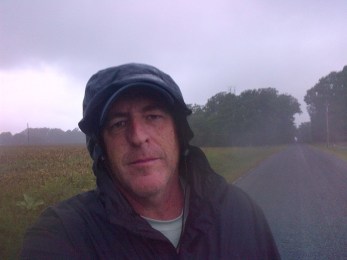
I spend the vast majority of my time outside. I absolutely love to walk in the rain. Part of that is I know when I’m done I can dry off, change my clothes and make some tea. It is the same with snow. The cold tightness of my skin on a blustery winter day feels oddly healthy, as does the blistering sun on my neck in August. I love wearing my flip flops, shorts, a t-shirt and sweating profusely as the hours pass well into the afternoon while walking in the sun, listening to nature react. Equally, I’m completely engaged when I have to put on three shirts, a hoodie, sweat pants and two pairs of socks just to be able to go for a walk during which I might see deer, cardinals, and various other life scooting around for something to eat while I am engulfed in the deafening silence of the snow. I’ll cover the porch rail with seed and stay dressed and sit on the porch. Those birds don’t care that I’m a foot away; they stay, they brave my presence. Only in winter.

Then I go back inside and change into warm sweatpants and have tea. See, it works for me; it doesn’t work if you have no home. A little perspective there. Every time I walk in extreme weather I think about someone who might be in the streets of some cold place, or blistering hot place, and I remind myself it is more than bearable for a little while until I make the choice some can’t—to get out of the weather.

“Come in from the cold,” people say. “No I can’t it is pouring out,” people say. “Wow, it is just too damn hot,” people say. They’re not speaking for me. I like to spend as much time as possible immersed in the unbearably brilliant sensual joy of life. That includes rainy days.  

Hurricane Matthew is approaching the Florida coast and predictions show it will go ashore in just a few hours. I worry about my friends there, and I think about one of my homes away from home, St Augustine. It seems at this moment the worst of this storm will not make it as far north as my house, not like Isabel did, and others. But maybe (maybe) it is too soon to tell. There are times the weather seems not so much part of nature as it is simply nature having a bad spell. Blizzards, tornadoes, drought; these to me are nature’s way of hemorrhaging.

Van Gogh wrote, “There is peace even in the storm.” I understand that. When it rains hard, or the wind is fierce and I can hear branches snap, as long as I am safe it all simply reminds me I am alive to experience this weather, this turn of currents, this atmospheric screwball, and I feel somehow calmer and more alive. Of course I love the perfect weather, the still day with low humidity and pleasant sunshine. But equally, to experience the rain on my face, getting drenched, reaching out and being a part of the earth and nature instead of it simply being something “around” me or something “outside,” floods my senses and elevates my awareness to keep everything else in perspective.

Who among us during the calm days doesn’t hope for some metaphoric lottery win, some breakthrough in life to make us feel like there is something more to grab on to? And then severe weather arrives and we shift our thoughts and pray no one gets hurt and our property is spared, and above all else that we come out of it alive. When some system swirls off the African coast creeps its way up the Saffir-Simpson Scale, it throws our lives into a whirlwind of measuring value and understanding perspective to discover what is essential. Hell, just a little rain should do the same thing. Putting on warm clothes and having tea is absolutely more enjoyable when doing so is preceded by a good drenching.

The weather is constantly changing, and so are we. Rachel Carson believed that a rainy day was the perfect time to walk in the woods. Of course. And “the best thing to do when it is raining,” Longfellow tells us, “is to let it rain.”

rainy-bob

Just for a Moment I was Back at School

with-ed

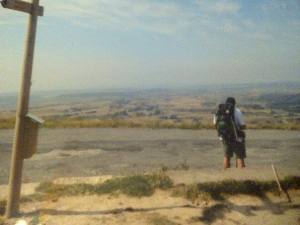
I talked about Spain at the Regina A. Quick Center for the Arts at St Bonaventure University Wednesday night. Normally, I do readings of my work. But last night I talked about the pilgrimage I walked with my twenty-one-year old son, and the places we saw, the chapels and mountains, the people we met. I’ve done this before in various venues, but never at my alma mater.

There was the exciting and predictable chance to be back home, and I didn’t miss the opportunity to point out how my own pilgrimage began in 1979 in Devereux Hall, just a few dozen feet from the auditorium. Some old friends showed up whom I haven’t seen since graduation, and some whom I’ve seen quite consistently since. But last night we realized just how many years have passed. We all are well along our journeys. 

There was some consistency. I saw Rula who traveled to Russia with me and other friends a few years ago. I saw the good friars at Mt. Irenaeus, including Fr Dan who has been an anchor for three dozen years. Renee and I ate at the Beef and Barrel, of course, as we did thirty five years ago before heading to Arizona. I saw Fr. Kevin, and went to dinner with Sean, a kindred spirit who understands how to listen and how to laugh. I saw Liz. Mikel. Bobby. And Rick—good friend and publisher, as well as excellent writer, who made the pilgrimage from West Virginia since he wasn’t far, comparatively speaking.

I can’t talk too much about what has changed. That students walk around with phones, so spontaneity seems rare; that there are endless fast food joints; that “sponsorship” signs are abundant; that there is a Starbucks on campus. I did notice, however, the view to “Merton’s Heart” is the same. At some point while having coffee with Sean, we noticed how empty campus was, even between classes, and I wondered if the students don’t hang out so much anymore, sitting under trees or throwing a football as was common years ago. It was, after all, an absolutely beautiful fall day. 

My journey since I was a student is nearly impossible to communicate. In fact I’ve written volumes about my life in books and articles yet haven’t scratched the surface of  what happened during the years since I lived here. When I think of my life back then, I remember innocence and hope, much like Michael’s and my innocence and hope while standing in Saint Jean at the start of the Camino. As the pilgrimage continued, new experiences contributed to the narrative, and the innocence slowly slipped away, but never the hope. The small village of Saint Jean became little more than a gorgeous village to begin from and which I look forward to seeing again, but it holds nothing on the deep satisfaction gained on the journey itself.

Yesterday I stood near the Center for the Arts about to talk to the audience surrounded by my son’s brilliant artwork, and I looked up at Devereux Hall where I lived when I was nineteen-years-old, and for a moment I glanced at a young man looking back at me. I swear I almost called out to him across the quad, across the ages, the innocence on his face so precious and frightening, to tell him I promise it is going to be okay. I immediately knew, however, he wouldn’t listen. And it’s just as well. We have to find our own way. And we will, so long as we keep hope. I still wanted to quickly warn him about the girl on the second floor of Francis Hall, but all lessons must be learned on our own. 

I walked around for a long time on roads and pathways so familiar in my youth. In that aspect nothing changed and I made my way across the bridge into the village of Allegany then back and well into Olean and was overwhelmed by the thought that  I’ve already done this; I’ve already walked this way. I wanted to find new roads but there weren’t any around here–not for me anyway; maybe for some newbie nineteen year old. I guess a few things the Camino taught me well is to keep going forward and only bring along what is necessary–like those people who made all of these journeys so worthwhile. My heart does not remain in the Enchanted Mountains; it is with people like Liz and Sean, Rula and Renee, and those who “see where you are, but they know where you’ve been.”

Harry Chapin had it right when I was doing coffeehouses thirty-five years ago, and it is still relevant today: All my life’s a circle. No straight lines make up my life–all my roads have bends. With no clear cut beginnings, but so far no dead ends.

Buen Camino.


1981

It’s Like Rain

rain

It’s been raining for a few days now; almost four inches last night alone. Roads throughout the area are flooded and creeks and rivers have swelled well beyond their banks. Today schools throughout the area are closed because of impassable roads, and classes at the college are only half-filled.

I went to the oceanfront and walked as usual, though no one else was around. The waves were choppy but the tide wasn’t that high, and the wind was strong, though not as fierce as I’ve found before.

There is something so cleansing about walking in the rain. It keeps my mind almost entirely in the moment, and though by the end of a half dozen miles I’m soaked as if I dove in the Atlantic, it doesn’t bother me so much since I know I can change my clothes, or at the very least find a place to dry off.

Still, I prefer the sun and warmth, but I don’t mind the rain. There’s something about wet weather which makes me feel alive. It is the visceral, it is the texture of life we normally don’t brush against. Usually weather is something “above us” or “out there” or even if we are out on a fine autumn day, it is something somehow balanced so that we barely notice. Rain, though, a heavy rain with a slight tropical wind swirling back down from the northeast, makes its presence known. I love it.

When I was very young we lived in a house with a side patio surrounded by hedges and covered by a green canvas awning. I loved sitting at the picnic table on the patio when it rained and listening to the sounds. It is the same camping. After high school my friend Mike and I went camping in the mountains of Virginia and one day the rain was torrential. I’ll never forget it. We found things to do like visit the most obscure caverns in the east, but mostly we sat inside the canvas tent, listening to the rain and writing a letter to Jimmy Carter. It passed the time.

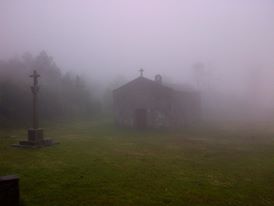
I am sure my most memorable rainy day was one spent with my son in Spain. We walked east on our way back to Santiago from Fisterra on the Atlantic, and there was a long, steady, heavy rain the entire hike. The mist was heavy and while there were supposed to be scenic cliffs and vistas to our right as we walked, we couldn’t see past the trees. At one muddy incline we followed a path to the left which led to an old chapel and stood in a bandstand-type structure in the back. It was the most beautiful sight, looking out at the chapel in the mist as if it was a thousand years ago or a thousand from now. We were soaked to the skin, but it felt fine; we didn’t mind. We were there, understanding the absolute sense of “now.” Rain can do that.

In 1983 I was in Tucson for the floods. Renee and I and Tom and a few others headed to the San Rillito River which had been used for kids baseball games just a few days earlier and watched an A-frame house drop off the cliff as the mud was torn away from raging waters. The house flipped and floated downstream toward Mexico. Even Route 19 South to Nogales was wiped out in one direction from the floods, which came from the heavy rains. It never ceases to amaze me how individual droplets of rain are harmless, but gathered together they are the number one cause of weather-related deaths. It is amazing and terrifying what the singular can do when bonded to others with a common goal—in this case just, you know, falling and saturating the ground.

The least rainy place on earth is Antarctica. Lloro, Colorado is the rainiest with 534 inches a year. Raindrops look more like chocolate chips than teardrops. Rain falls at about 18 to 22 miles per hour, no matter how “torrential” you think it is—it isn’t falling faster or harder, just denser. (See, sometimes you learn something from a blog)

In college I once borrowed a Franciscan friar’s robe for a Halloween party and went as a priest. With the hood up on the rainy walk home to my off-campus apartment about a mile away, no less than a dozen cars stopped to offer me a ride. I simply blessed them and kept walking.

It doesn’t seem to rain as much as it used to growing up. I used to love rainy Saturday afternoons when I was young, and we’d hang out in the den and watch old westerns or old movies. I thought those days would never end. Like that rain, the rain today reminds me that it had been sunny and isn’t now. It is a slight push toward melancholy, it hints at appreciation of things past. I welcome the rain so that I will not take for granted the sun. It is like fasting, a rainy day. It forces me to spend an entire day not in the sun, somehow allowing my senses to breathe.

“Some people walk in the rain. Others just get wet.” –Roger Miller

chapel-rain