O’er Moor and Mountain

cole

I am selling my art.

I love art and have been surrounded by it most of my adult life. But I like to make left turns, and sometimes doing so means adjusting various aspects of life. And for me, now, it means selling art, making room for other things, and pursuing a much larger ambition for which, now that I analyze it, the art work was an investment to begin with. Time to climb out of this lane and onto the next level.

I teach a course at Saint Leo University called “Journey’s of the Narrative.” It is about the odysseys we find ourselves on in life, with historical as well as literary references. I loved bringing in my copy of Homer’s Odyssey, translated by Pope, to show them something other than electronic (that piece of art is not for sale). We talked about pilgrimage, about journey, about pursuits. And we also discussed trials and tribulations met along the way.

Last night we discussed “character flaw.” The conversation moved from Odysseus to Don Quixote to Santiago of Old Man and the Sea and Alie Fox of the Mosquito Coast.  Pride seems to dominate, some vanity, a little bit of delusion. I asked which character they most related to. The guys chose Santiago, mostly because of his persistence and stubbornness, plus they are mostly NAVY retirees. The women chose Louise of Thelma and Louise (no one chose Thelma, who I think was the stronger character). One woman chose Alie Fox, saying she could totally see herself chucking the “dying American way of life” and carving out a new existence in some jungle until she happily lost her mind.

I always choose Cervantes’ most famous character. I don’t mind tilting at windmills. I have no problem with self-deception. I know someday someone’s going to hold up a mirror so I can see my character flaws, but until then the quixotic ways of life have worked for me. I think my most recent dynamic moment came when I realized sometimes we establish one way of existence for the purpose of moving to another. It’s time for what’s next.

So I’m selling my art. On the one hand it is symbolic–the art work represents a professorial collection of beauty and accomplishment. On the other it is practical–I need the money to fund what’s next.

And what’s next?

I can’t say, really. No, really. I have no idea. I just know I need to climb on the donkey and work my way up whatever new hillside I come across. I saw a lot of windmills in Spain; maybe I’ll go to Spain. That seems appropriate. 

You know it can be just as stressful knowing what’s going to happen down the road as it is not knowing at all. If I back up, four years ago I had no idea the Camino de Santiago existed; since then I’ve walked it with my son, am going to again, and written several articles about the journey. It has, in fact, realigned my life in a way. Two years before that the idea of riding the Trans-Siberian Railroad was a punch line to an outdated joke, but not only did we ride the long version, my next book is about the journey (well, not really..it’s about fathers and sons kinda, or more about the journey theme again, but that’s not right either). 

Our lives are riddled with examples of left turns and roundabouts we never anticipated but later can’t fathom life without them.Richard Jones was working with tension springs when one of them fell to the ground–the slinky. George Crum was a chef in Saratoga Springs who got pissed off when a customer kept sending back her potatoes because they weren’t done enough, so he cut them really thin and fried them to a crisp. She loved them, he made them a menu item, and potato chips were born. My favorite is the Kellogg brothers who left a pot of grain boiling on the stove for way too long and the dried up mess became corn flakes. 

George Halas played outfield for the Yankees but hurt his hip. He was replaced by two new players–Sammy Vick and Babe Ruth. Halas’ injury made it possible for Ruth to get game time every day, but it also enabled Halas to start the Chicago Bears and become one of the greatest football coaches of all time.

You never know. Maybe I’ll coach football. Maybe I’ll buy a slinky. I think I left something boiling on the stove. Who knows what might happen. My car broke down in the parking lot and I got a job teaching  college. I sold some of my art collection and….

How far down the road can you see? No. This instead: Just how far down the road do you really want to see?

quixote


On a More Serious Note

14th-street-pier-ash-wednesday

If nothing else, I can count on nature. I have always thought that way, that if everything else were to fall apart, I can walk and watch the water ebb and flow, the changing leaves, the wildlife. It brings me peace both being there and knowing it is there, a foundation of sorts, the original “space” before the deluge of humanity. I’m okay when I am there. It is honest.

I was telling this to someone who asked what I do when I get depressed or feel hopeless.

I head outside, I said. And I really never feel hopeless because I chose a long time ago not to put my “hopes” in other people’s hands. Sure other people will determine how successful some of my life is, whether job opportunities or writing or even relationships, but “hope” I insisted, is best sought internally and not motivated by external approvals.

I’m not qualified to talk about this, I said. We were walking to the counselor’s office. It was windy but sunny and warm.

Back up:  

Langston Hughes wrote a short poem which reads:

                                                   The calm,

                                                   Cool face of the river

                                                   Asked me for a kiss.

I write that on the board for my creative writing students and inquire what they think the title is. I let them read it a few times and think about it. Titles are amazing; they can not only reveal content for the reader before the piece even begins, they can also completely change the tone and direction. In this case, the normal responses include “Swimming,” “Intimacy,” and even “Ego.”  Only a few ever come close to the poet’s intended tone.

Hughes’ title is “Suicide’s Note.” Go ahead, read it again.

It makes sense really. People contemplating suicide most likely don’t see it as violent or offensive or even hurtful, but simply a sense of peace which awaits. If death provides their only conceived escape, then no matter how violent that death is, it pales in comparison to the hurt hurled at them on a daily basis, even if that hurt is misconceived; it is real to them. It is not a matter of a “bad moment” in their minds. It will not pass, in their minds. It will only get worse, in their minds.

Gwendolyn Brooks, in her poem “To the Young Who Want to Die,” wrote:

                                                Sit down. Inhale. Exhale.

                                                The gun will wait. The lake will wait.
                                                The tall gall in the small seductive vial
                                                will wait will wait:
                                                will wait a week: will wait through April.
                                                You do not have to die this certain day.

Someone contemplating suicide might argue this.

I became interested in Vincent van Gogh when my friend Cole Young gave me his complete letters. In them, two particular contradictions caught my attention. One, van Gogh was despised by so many who knew him; critics and artists alike thought his work to be trash; he was a complete failure—but he went on to become one of the most influential and celebrated artists in history. And two, he wrote extensively to his brother about the beauty and grace and gift of being alive, yet goes on to kill himself. On the one hand he had many afflictions, including chemical imbalance, which might have led to such an ending, and further it has been suggested he didn’t kill himself at all but local teens shot him. In either case, he told his brother who was at his side in those last hours that he wanted to die; that “death is not the worst event in a painter’s life.” I was curious so I read much about depression and suicide, including William Styron’s beautiful, personal work, Darkness Visible.

I don’t know about depression as a disease, nor am I prone to it. But friends of mine certainly are, and many members of the military whom I’ve taught on the local bases certainly are.

And in some scary way some of my literary heroes have been: Hemingway most famously; Bohumil Hrabal of Prague “fell” out of a fifth story window; Tim O’Brien has written often of his depression; David Foster Wallace most recently.

This girl on campus is suicidal.

Twenty five years ago (Dear God twenty five years ago) a friend of mine killed himself. There have been others since then I’ve known who took their own lives. An adjunct friend of mine who took the wrong medicine, a former student upon returning from Iraq, some guy I knew in Pennsylvania who killed himself at a press conference. But my friend twenty-five years ago was the first.

Simply put, he wrote a note for his boss telling him he quit. Left another on his front door saying he was in the garage. He took the dog, closed the door, started the car, and died.  Since then his daughter grew up, moved on, married, and is a mother. His friends have jobs, houses, families, down time. We laugh, sit around sometimes and drink beer, listen to music, talk about old times, talk about what’s next. To us, our current “old times” came after he checked out—that much time has gone by. Now he’s the guy we used to know who buried his future in a cloud of carbon. It will always be 1992 for him. We don’t talk about him that much. In just a few years he’ll be gone longer than he was ever alive anyway. But so will us all. That’s the part he couldn’t wrap his mind around; that this life isn’t very long at all anyway.

This morning the sun seemed to come out of the ocean with such persistence and boldness I think it would have chased away the most severe of storms. I get energy from the morning; it is like a caffeine boost that rips through me until the next one. Things go wrong, things fall apart, tragedy can loom sometimes, but we keep waking up, even if sometimes we have to change the game plan. But not everyone can pull themselves up by the bootstraps; not everyone can talk themselves out of that long, dark tunnel. Whether it be situational or chemical, not everyone sees things with hope.

The girl on campus is a straight A student.

So many people are depressed these days. The country might not be going the way we want it to; jobs may not be available, bills are hard to pay, friends are hard to find, and sometimes sleeping in seems like the best solution. I don’t know if the girl on campus has a medical condition or was taught somewhere that failure was not an option (in most college suicide cases, grades are high). I do know that the suicide rate for college students is much higher than the same age group of those not in college. I think that’s because in the real world we seek out challenges we know we can meet, but in college, students are faced with so many unknown requirements and unanticipated difficulties. No one taught her one of the most essential lessons in life—that failure and success are not opposites. If her problem is situational and not chemical, I wish someone would have taught her not to define herself by external events like school and peer pressure and others’ expectations.

I’m not qualified to write about this either.

That’s why the poets. I stood once in the hospital room of one of my college mentors, Dr. Russell Jandoli. He had heart problems and at that time would recover, but while visiting we talked much about writing, of course, but also life itself. He was a man of few words. He said, “Mr. Kunzinger, leave death for the poets.”

And so I shall:

                                   You need not die today.
                                   Stay here—through pout or pain or peskyness.
                                   Stay here. See what the news is going to be tomorrow.

                                   Graves grow no green that you can use.
                                   Remember, green’s your color. You are Spring.

                                                                                       –Gwendolyn Brooks

640px-vincent_van_gogh_1853-1890_-_wheat_field_with_crows_1890

Face Value

18793590-Khokhloma-Seamless-Pattern-Background-Stock-Vector

I’ve made a few dozen trips to Russia and on each trip bought a few dozen pieces of Khoklama. This is traditional, Russian hand painted wood, usually bowls, spoons, vases, and even swans and tables. Mostly I bought bowls, but hundreds of these beautiful red and black and gold gifts are stowed about the house in Rubbermaid storage containers. These things ended up in boxes, behind shelves and in drawers. I like them. I use some for coins, some for pens, some for flowers or a candle, or candy. One holds exactly a one pound bag of M and M’s. Really, I could open a gift shop and make some serious rubles.

One of the first times I traveled to Russia in the early nineties shop-keepers still weren’t trained in selling these things and when I asked how much for the beautiful hand-painted bowl with the lid the woman said after much discussion with her colleague, “How about one dollar?” I’m still somewhat certain had I negotiated I could have walked out with two or three for a buck. But as it was, a dollar seemed fair for what would eventually cost in the same shop seventy five to one hundred dollars. I bought twenty that first time. I gave them as gifts, I used them, and I stowed them away. Once one broke and while part of me was disappointed since it came from one of my early trips, it wouldn’t be missed.

When my son was younger he liked to dig. He was convinced somewhere on our property, which sits near the Rappahannock River near where the troupes marched during the Civil War, is spent ammunition. He may be right. There are mounds along the perimeter that resemble casements, and a few seem too much like burial hills. So he dug. And it was Michael who came up with the notion that if we buried a few dozen broken Khokloma bowls, a few spent bottles of vodka, and perhaps a torn up book written in Cyrillic with some beets in an old campfire, a thousand years from now archaeologists will rope off the area and attempt to figure out the trade route that brought Russians from Western Europe to central Virginia. Future Phds might note these ancient people most likely couldn’t survive due to a fondness of bad alcohol.

Recently a horde of Bronze Age weapons was unearthed in England. From this very cool discovery of what resembles small shovels, pick-axes, and what can best be described as head-cracking-open thingys, researchers and other people who know determined the Bronze Age inhabitants of that part of England were violent nomads who couldn’t organize enough to conquer each other. Okay, on the surface I can see where it appears that way, but perhaps they just liked each other. Maybe those small Bronze Age bronze tools and so-called weapons were their version of our cold war stockpiles of nuclear threats so we won’t attack each other. They may, in fact, have meant to defend themselves against aliens but when they arrived they all got along simply divinely and they buried their hatchets in celebration of inter-galactic accords and from that time we gained the expression, “Let’s bury the hatchet.” Who the hell knows? Maybe they were the Bronze Age equivalent of ashtrays from seventh grade shop. The shovel and head-cracking-open thingys were all they could figure out how to make. “It was supposed to be a lamp, Ma!” little Zorr might have whined. “Oh honey it looks lovely,” his mom answered in a pre-British accent as she tossed it in the neighborhood pile of trash.

They didn’t recycle. Time passes.

So we’ve decided to make an archaeological compost pile. This one, Russian, perhaps in a few years after several more trips to Prague, another pile on the other side of the property made from Czech glass and pottery. We might even toss in some torn and tattered nonsensical language and send the diggers searching for a new Rosetta Stone to break the code of these Slavic people speaking odd English in America.

Yes, we are scientists of a different era, ready to guarantee future funding of necessary research projects insuring jobs to graduate students a thousand years from now. We are doing our part. Open the vodka, have some M and M’s, let’s get started.

But first I need to unearth something closer to my own surface, some relics from my recent past. I’ve gathered information and ambitions through time and place and often it is difficult to see how they match up. Did the farm house in Pennsylvania where I spent some intensely happy days in ’86 have anything to do with the Mexican blankets? And those stories an old friend of mine told me while driving to Niagara Falls on random weekends; are they related to my trip across Siberia or Spain? On the surface these events seem so disjointed, but when I dig deeper and understand the language of time a bit more, it all starts to make sense. While Browning believed, “The past is in its grave,” Jackson Browne said of the past, “I’m looking back carefully. There’s still something there for me.”

I like to walk carefully through the woods near home. If I am not paying attention I might think I’m walking through Heckscher State Park on Long Island’s South Shore where I spent many happy years; or it could be the Berkshires, or the Enchanted Mountains of Western New York. I believe if I were to look at my life many years from now to trace my journey on this earth, what on the surface seemed decisions as random as the ricochet of a pinball, underneath it all I would fine everything connected by passion and desire and some quixotic need to keep digging.

heckscher-state-park

Now She’s Gone

swans-017-2

Six swans have made their home here at the river. I saw them for the first time last night and then again this morning. The water today is absolutely still, like glass, like ice, and looks more an inverted sky than brackish river-water.

My son says the swans have been there for a week or more. I hope they’re here to stay, at least a while, but more likely they have been fooled by the warm temperatures—in the seventies—and are headed north. Soon they’ll reach the Southern Tier of New York where the weather is not so kind right now, and turn around, questioning their internal clocks.

And osprey, too, glided from the duck pond across the river to Windmill Point—a mile and a half across the river where the Rappahannock meets the Chesapeake. Osprey are abundant here on the Bay, but not now; not yet. Usually we are still graced with bald eagles, which don’t get along with ospreys and so they somehow split the seasons between them. Apparently our osprey friends who return late every spring from Central and South America cut their getaway short.

In Tennessee a friend of mine woke one day this week to flowers blooming in his backyard and questioned the month; in Utah and Colorado the ski season has yielded to floods from melt and rain, and in Texas my retired brother just keeps playing golf in short sleeve shirts. The seasons are out of whack and it is difficult to determine when something is dying and something is coming to life.

This isn’t about global warming. I stood a long time last night watching the swans, listening to one of them hiss, the water quietly lapping at the rocks and sand. I want to appreciate them as long as I can. I was relieved they were still there this morning. I’m sure before long they’ll be gone, and who knows which one of us will not be here next year. I’m plagued with persistent thoughts of “enjoy this while you can, you never know.” I think that comes from my maternal grandmother whom every time I would say “Talk to you soon, Grandma” to on the phone would answer, “God willing.” I laughed back then.

This is why art history; this is why journals and writing. This is why long walks along the river and Bay. I spent Thursday night at the fine Chrysler Museum in Norfolk, Virginia, with my art students, and I am always grateful for the likes of Fra Angelica, Monet, Sisley, Rodin, and more. They used their talents to isolate time and pass it on to us, centuries and millennia later. We can stare at the work of the good Dominican painter and see the beauty of his subject matter, of course, but also see the 15th century, the European sentiment, the philosophical bend, the life of then.

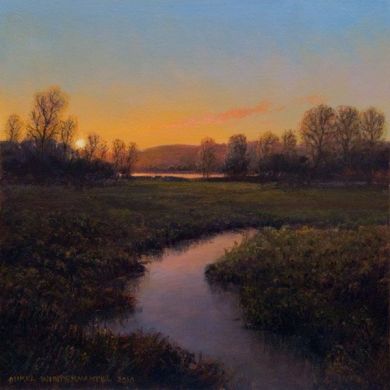
This morning I watched the swans and recognized the extremes in my world. There is the art of it, for example, made permanent by artists such as my friend Mikel Wintermantel, whose landscape paintings hang in my house, or my son’s own abstract water photos which fill my soul with such calmness. They bring instant peace of mind as well as transport me to pastoral locales I love to wander; but there is also the temporal reality of it, as moments pass, as loved ones pass, as we realize the greatest treasures can’t be recreated or often even remembered—only experienced, now. Right now.

The swan spends her life hissing. It is a gentle sound, and I don’t know better but it is almost as if she is trying to harmonize with the water or the soft breezes through the reeds along the shoreline. But right before she dies she lets out a long, serene call, just before the end, as if to offer us one last beautiful moment before she leaves us for good.

It is, literally, her swan song.

Sometimes when my mind is clear and I’m not distracted by the give and take of going and coming back, I can sense every aspect of nature in the constant call of her swan song. It is then that I am inspired to do the same, to stop hissing and make every call as beautiful as I can, even if I do wake up ready to try it again the next day. It is how I wish I could be all the time, to bring as much beauty as I can, to see as much beauty as I can, as often as I can. And then tomorrow—God willing—do it again.

7a74760187c14da86df85cf589c9da4a
Mikel Wintermantel

1301 K Street

imrs

I spent a good deal of time in Washington DC when I was younger. Not enough to know it well, but certainly enough to develop an extended, deep appreciation of not just the architecture, but the foundations upon which those structures and monuments were built. No one needs me to linger through a litany of historic and political references and landmarks, footnoted by great Americans with sometimes fate-bending accomplishments or sometimes questionable motives. From the portrait gallery to the Lincoln Memorial, to King, Vietnam, Jefferson, and World War Two memorials to the outrageously symmetrical Capital and the tonnage of objects at the Smithsonian, just walking by these places is a humbling experience; more of an event, really.

And right in the middle of it all, gently set back from the center of the mall, is the White House, the President’s Mansion. To think that a handful of people over the course of the past two centuries changed the course of human events just inside the fence across from Lafayette Park, moves almost everyone who walks by, pauses, takes a picture and then a deep breath, and moves on.

I drove into town last week and rolled slowly by the White House, and I got depressed. No, I’m not going to criticize, analyze, lambaste, ridicule or even remotely pass judgement on who is inside and what is going on, except to say I was depressed. I normally sensed the occupant of the White House moved about inside with purpose, of course, but did so always rooted in respect for the position and the place and the people who came before. I just assumed the president would always carry the weight of this country in his or her arms with the strength of our history in his or her spine. I often disagreed with policy and perspective, but I never doubted motive or morals. Still, last week I was sad by what seems to be a mockery of over two hundred years of checks and balances, of respect, of dignity, of morality, of history and the human condition.

I went to a writer’s conference, hung out with some friends, ate, drank, laughed, and forgot about where I was until I went to the Ford’s Theatre. I couldn’t watch the play without also glancing up at the box where Lincoln was shot, and I thought about how even now, more than one hundred and fifty years later, the respect citizens have for this sacred location is unwavering. Later, I walked north and wondered just how this country is going to survive. I didn’t turn toward any problems over trades and economic sanctions and immigration and fences and treaties and ecology, but instead I worried for the rapid erosion of our sense of self. We always lived in this country with the historic and absolute truth that the people who worked in these places would at the very least act with a firm conviction for the future of humanity. And I just don’t believe that is the case any longer. This is not a partisan problem, it is quite concretely a matter of trust that we can face our problems with honesty, integrity, and for the better good of us all. And I was depressed for the first time in all my travels to Washington, D.C. because of the seeming absence of honor and respect for institutional memory. Gone. Depression turned to worry. Worry turned to Pinot Grigio.

Then I got to 14th and K Streets. There against the evening sky is the most bold, imposing building on this side of the Capitol. Most of the office lights were lit though it was after eleven p.m. and I had the immediate sense that something subversive and determined and important was going on. This, of course, as noted in majestic letters at the top near the two towering points illuminated by red lights, is the headquarters for The Washington Post.

I stood and stared and remembered my youth at college, listening to lectures by real journalists explain how the American Experiment is still strong because of the Checks and Balances not just of three branches of government but because of the Fourth Estate. Now, in a world my late advisers could never fathom, where true, honest reporting is as rare as it has ever been since the days of Rome’s first newspaper, the “Acta Diurna,” it seemed to me while I stood on the street looking at the monstrosity of a building that it was now, somehow, rebel headquarters. I have a strong sense of security knowing that if we are ever under attack from within, we have at our disposal some of the world’s and history’s most dangerous weapons—trained journalists who know how—often better than administration insiders—to find the truth and disseminate it to the world.

These guys are good. 47 Pulitzer Prizes, 18 Nieman fellowships, 368—friggin’ 368—White House News Photographers Association Awards, and still counting. The work of writers Bob Woodward and Carl Bernstein, along with Editor Ben Bradlee, brought down the Nixon White House because of persistence and an unwavering commitment to accuracy and the truth.

Journalism history is riddled with examples of one honest voice deafening the screams of a thousand liars. Ida Tarbell unearthed the secrets of Standard Oil and the Rockefeller’ empire, redirecting the rivers of investigative journalism, Upton Sinclair’s famous work concerning the meat packing industry forced the development of the Pure Food and Drug Act and new standards in the packing industry. Murrey Marder of the Post exposed Senator Joseph McCarthy’s hearings and brought an end to them and the senator. David Halberstam of the New York Times wrote extensively about Vietnam and Seymour Hersh, also of the NY Times, changed events in this country by writing about what became known as the My Lai Massacre. These people and others championed investigations, often life-threatening, to get at and expose the truth. This has not changed by one syllable. It might seem as if the pure waters of honest journalism have been diluted by the brackish facts of a million streaming tributaries, but there are some organizations whose commitment to truth is so grounded in history and tradition that they can still be counted on to call out the criminals and charlatans.

At the top of that list for internal investigations of governmental affairs are the two men who inspired my choice of major in college—Woodward and Bernstein.  

I’ve been to DC many times through the years but for one reason or another either I never walked up that way or simply never noticed, but there I was standing on K Street, at first feeling depressed and even frightened for the future of the country, then suddenly at ease.

Because it occurred to me at nearly midnight on a clear, cold evening in our Capital, that the building on K Street might just be the most important piece of real estate in Washington DC right now.

2017press-corps3-960


Their Future is Not Their Own

golden-tiger

I sat in the Golden Tiger in Prague drinking a Pilsner when I figured out the problem with my students’ view of their future. First, a quick story:

I spent a great deal of time in both St. Petersburg, Russia, and Prague, the Czech Republic. I met some people in both cities whom became dear friends: artists and writers and business people. A colleague and I received a few grants to discuss American culture to Russian faculty who would be teaching American authors. This was the early nineties when communism had only recently “ended,” and Boris Yeltsin was president.

We discussed Miller’s “Death of a Salesman” and Douglass’ Narrative of Frederick Douglass, among others.  One example of the problems we faced is trying to help faculty teach “Death of a Salesman” and needing to explain commission sales, insurance premiums, and the American Dream. The faculty and citizens we met throughout the city all wanted to know everything about the United States, about democracy, about capitalism and the entertainment industry. They wanted to be us. But no one really understood how to do it. We told them to have patience; it took the United States a few centuries to get it right and we were still stumbling. But their primary problem was something different: no one in Russia had ever lived under any form of government that was not oppressive. And their history showed no difference; the Czarist system had its unique form of oppression but not any better than the Soviet system. Democratic principles were never, ever part of the country’s vocabulary.

Prague was slightly different.

When I taught a seminar at Charles University I was lucky enough to work with and become friends with best-selling Czech author Arnost Lustig. He grew up in Prague, survived the Terezine Ghetto, survived Auschwitz and the Nazis, and spent half of his time in Prague and, after the Soviet crackdown in 1968, the other half in Washington, DC. 

We sat one afternoon at the Golden Tiger and talked about the differences between Russia and Prague. It was an enlightening discussion. He pointed out that Prague was quite democratic for many years, and remained so even after the Soviets took over after World War Two, and by the late 1960’s, Rock and Roll, left-wing politics, and the hippie culture took the area known as Bohemia to heart and culminated in what was known as the Prague Spring—the first “Spring” of its kind. Then the Soviets sent in tanks and crushed the movements for another twenty years before the Velvet Revolution. But he said the reason Communism never worked well in Prague is because of “institutional memory” of so many of the citizens. “The Russians never knew freedom so well, so in the ‘90’s they really didn’t know how to handle it, but we knew freedom, we knew how to live with Democratic principles, so we really never took well to Communism to begin with. Like oppression of the Russian people is inevitable again because it is what the people are comfortable with and understand, Democracy in the Czech Republic was equally inevitable.”

When there are people to remember what it was like before, there are people to help us understand what is wrong with how it is now.

My freshmen students were, for the most part, two-years-old on September 11th, 2001. Even my older students were not nearly old enough to be out of grade school. All these people have ever known is a country looking over its shoulder, a Department of Homeland Security, the threat of terrorism in an era of wars, a life of sharing information online, of surveillance, of alternative facts. They’ve only ever known the need “to be protected,” “to report suspicious behavior,” to be weary of the monster on the other side of the Island.

They missed the whole America where we had the absolute conviction our future was our own, where the inalienable rights were not based upon criteria, and where respect of our government and the democratic principles proven for two centuries was universal, even if some of those countries didn’t like us very much.

My students for the most part came after the whole “hope” thing. They didn’t have any “moonshot” ambitions. They never had a chance to demand walls be taken down and gates be unlocked. This, right now, is their reality. It is one of apprehension and suspicion.

We can teach them the history and the social sciences behind the pre-911 way-of-life in the United States, and the world for that matter. But it is unlikely they will comprehend something we show no signs of ever heading towards again. So what are we left with to balance the increasingly questionable future these students have apparently decided to try and improve simply by their act of being in college to begin with?

I turn again as I have before on these pages to one of the most important letters written in the 20th century. It was composed by a contemporary of my late friend Arnost, as they both managed to survive a Nazi death camp, and the letter was published by Haim Ginott:

“I am a survivor of a concentration camp. My eyes saw what no person should witness. Gas chambers built by learned engineers. Children poisoned by educated physicians. Infants killed by trained nurses. Women and babies shot and killed by high school and college graduates. So I’m suspicious of education. My request is: help your students to be human. Your efforts must never produce learned monsters, skilled psychopaths, or educated Eichmanns. Reading and Writing and spelling and history and arithmetic are only important if they serve to make our students more human.”

berlin-flag

At Any Cost, Art

Saint-Cecilia-picture

I applied for a $25K NEA grant to finish a book about fathers and sons. It takes place in Siberia, in Spain, and in Brooklyn. It’s been an ongoing project for a few years, and recently I’ve had an excellent string of acceptances of excerpts, placing eight since January first alone. I am grateful beyond words for the placement of the work, and I know it is primarily because I’ve touched on something personal—relationships between fathers and sons, across time and miles and often across prayer or memory, has a universal appeal.

I planned on using the NEA grant, if it had been accepted, to finish the work both in Spain this summer and in Brooklyn in the fall to wrap it all up.

Then….DJT. Maybe since he is axing support of the National Endowment of the Arts he will give me the money. He had a father who set him up well; has three sons who also are set up well. Maybe he would read what I have so far and it will touch him a little, especially now that Baron Trump is in New York while DJ is in DC. Maybe he would read some of my work and, after sending me a check for $25k to finish it, he would wonder how his own son was doing at the other end of the shuttle to New York. Maybe he will read a few of my pieces and wish he could sit at Baron’s bed while his son sleeps and whisper confessions to him. He might suddenly see his son as a sleeping confidant, while somewhere in Virginia this minor writer is trying to record a few thoughts about his own father, his own son, and the space between them.

Damn, I should be writing fantasy fiction.

As for realistic means like the soon-to-be drained-dry NEA, it appears as if all bets are on hold, and myself along with other hopefuls striving to get some good work done in a world without patrons any longer, will miss the cut by one president. When I heard the NEA was in his crosshairs, I kept hoping he thinks it means Newly Elected Assholes, and simple wants to extinguish the reference. Apparently the NEA, along with so many other arts and humanities groups that support artists, is taking money away from other endeavors of the newly elected Populist Movement.

Oh to have been born in the last century where wealthy patrons paid for the expenses of artists for no other reason than they understood the contribution artists make to the world. When I realized I had run into this wall, that there was yet another set back to finally getting this done, I went for a walk. And when I came home I didn’t throw my work away; I didn’t put it in boxes in the back of the closet, and sigh, saying, “Maybe some other time.” I didn’t open a new blank file and start on a new project about butterflies or an essay about feeding birds and drinking iced tea. I kept working; a little on Siberia, some on Spain, both about fathers and sons.

The journalists recently told to shut up in DC and NY did not rush out and apply for bartending jobs. Leftwing news shows didn’t start running reruns of “The Apprentice.” No, we kept doing what we do. This is where the arts differ from business: we don’t declare bankruptcy even when there is no money, we don’t shut the doors and try something else.

The history of the arts is the history of civilization; from the cave art in France to the sharp-witted drawings by Goya in Spain, to the underground French newspapers, we record what is going on in civilization so everyone knows. It is how we pass along truth whether about our democracy or our dads. Thomas Paine couldn’t get anyone to publish “Common Sense” which told this New World we had it in our power to start anew. When someone in Philadelphia took a chance, lives changed. Paine did not quit. The dissidents who were exiled to Siberia did not silence artists from Dostoevsky to the Decembrists. Solzhenitsyn is more remembered and influential than the men who sent him away. Trying to stop an artist from expression is like trying to stop a river from going downstream: the thought will be created and disseminated. It isn’t an option. We can’t be fired, sidelined, and certainly not silenced.

Something a businessman could never understand is that artists are not in it for the money. Money does come in handy to more efficiently get work done and published; I could use the $25K. But it isn’t a goal; the art is the goal. A businessman may build the most beautiful hotel in Washington DC, but it is a waste of money if no one stays there. But for artists the work must be produced whether or not anyone ever hears it because we know if it is worth its salt, eventually someone will experience it, sometimes not for quite some time. Orwell’s 1984 is more relevant now that when it was written in 1948, as is Common Sense. Artists live by that old Japanese saying, “Just because the message is not received, doesn’t mean it isn’t worth sending.”

I’ve been to Siberia, been to Spain, and, well, Brooklyn is in my blood. It will take me longer this way, but it isn’t like I have a choice. I’m  still going to Spain this summer and Brooklyn next fall. I’m actually more motivated now. It might even be possible that if the NEA and NEH and other organizations which support artists are shut down, we will see an increase of some of the most inspired and subversive art to rip through society in a generation. And when this administration is past and the Republic has survived, it will be the artists that record these times; it will be the writers and filmmakers and musicians who will pass along to posterity what happened here. DJT can spin this however he wants, but I suggest anyone in the street can more easily name ten artists before they can name five businessmen.

I’ll get it done.

“There was a father who had a son. He longed to tell him all the reasons for the things he’d done. He came a long way just to explain. He kissed his boy while he lay sleeping then turned around and headed home again.”

                                                                                                     –paul simon

NEA_logo

Leave Death for the Poets

d042df7d654d5b91ac5ad2ac35bba9f0-800x600x1

At a creative writing workshop someone asked the standard “Where do you get your ideas from?” question. I used to say, “Trenton. I use a mail-order catalogue,” but I realized that was somewhat snarky. Now I quote my good friend Tim Seibles:

Some things take root in the brain and just don’t let go

I love when someone says exactly what I’m thinking. Saves me time.

As for ideas, yes, that’s how it works. I might be out for a walk along the water, or perhaps driving somewhere, and one thought leads to another, and then just the right song comes on, or a smell—yes, sometimes it might be an aroma that makes me think of a place, and then the receptors in my head are off and running; I’m just along for the ride, somehow simply a spokesperson who never really gets the translation right. That’s the problem with writing; it is never right. If someone looks at a piece they’re working on and very comfortably suggests there is nothing more that can be done, I am weary of reading it.

But of all the writers I know it has always been the poets who can get me to sit back and say, “Yes! Exactly.” I can carry on conversations all day long about a subject and then toss it around in my head for a few days, write it out, readdress it, and pour some decent energy into it, only to turn to a few lines some poet wrote and I find the need to burn my work. I’ll do it too; I’ll sit here with a match and hold the pages while they flare up. It has a very cleansing effect.

Here’s an example: Tim and I went to lunch at this same divey joint in Norfolk we always go to, and we talked. We talked about our fathers, or about something in the news. We talked about a variety of things that good friends talk about; no, we rarely talk about writing. Well, somewhere over the course of the last year I have several times talked about my dad, about how I miss him; I know Tim gets it so I don’t’ have to say much, but still, talking is always helpful. Unfortunately, my words are trite, predictable, and lazy descriptions of how missing a person feels. Of course, I’m not trying to compose a play; I’m just talking about my dad. Still, I want to get it right.

Then not too long ago I flipped through one of Tim’s books and came across this:

Missing someone is like hearing a

name sung quietly from somewhere

behind you. Even after you know no

one is there,  you keep looking back.

I could write a thousand lines about how I miss my dad, but that covers it. That’s poetry.

Anyone who listens to a lot of music knows what I mean. Some lines just say it all.

I have tried to write essays about nature, already handicapped by the vast selection of the genre from people such as Thoreau, Muir, and E.O. Wilson. In my files are dozens of starts in an attempt to finish a piece about the fall of the year and the coming of winter. Those brain receptors often click into the passing of time, the end of things, the changes beyond our control. I wrote one “epic” diatribe that might be the most bloated piece of crap I’ve ever attempted. The only way to make it more pretentious would have been to have it translated into Latin. Then Frost does this:

So dawn goes down to day,

Nothing gold can stay

Asshole.

I prefer conversations, of course. I like to sit and have a beer and talk about our dads; I like running into a friend and grabbing a bite and laughing about simple things like sports and movies. But I also like reminders of our glide across this thin layer of life.

Over the course of the past several years I found a way to handle my frustrations when I can’t find the right words to express our need to celebrate being alive. I call a friend and meet him for lunch. I head to a favorite café and have a beer and talk to strangers. Every single one of my closest friends was, at one time, a complete stranger. I walk along the water and watch the dolphins breech and disappear. I feel the coolness of morning give way to the warmth of the sun on my face.

I am surrounded by poetry.

I sat in an Irish pub in Prague once during a soccer match between Dublin and Manchester United. The excitement and roar of the crowd, the explosion of being in the moment, alive, then, ever-so-briefly, was poetry.

There was the time my friend Tom and I sat on a rock in the mountains west of Tucson and watched the sun work its way across the desert. Or that same year when Renee and I walked through a Mexican village and found a restaurant inside a cave where, incredibly, someone who had babysat her sat at another table. Or when Michael and I walked past the small sign that said “Santiago de Compostella” five hundred miles and five weeks after we left France. Or when we watched the seals at Lake Baikal.

Poetry.

Or Tuesday nights after I finished teaching and Dad and I would have some Scotch.

The sound of the golf ball dropping into the cup.

The sound of cardinals on the porch, looking for food.

Waves.

A very long hug from an old, old friend when we knew there was no reason on earth we should have lost touch.

My dad’s laugh.

His deep “Hello.”

A name sung quietly from somewhere behind you

11139373_10205989968335763_1044172444966323755_n


Walk On if You’re Walking

inthestreets-300x224

On Saturday, January 21, 2017, I sat on the foggy banks of the Chesapeake Bay in Virginia, far from the crowds of New York and DC and LA and cities across the country and around the world, where women—and men, of course—marched. In those crowds was a significant number of family members—Cathy, Jeannie, Janessa, Erin, Barbara, Fran, Tricia, Shannon, Morgan, Rachel, Suzanna, and many more—and those are just some of the women (it’s a big family).

Also on that day my Facebook feed was filled with comments from Republican friends urging everyone to get along. “It is time to gather behind our president and see what he can do.” You get the idea; comments common from both parties at the start of a new administration. They are normal, supportive words urging unity. I have never had a problem with the sentiment, until now.

Many of us who do not bend to the right did, in fact, give a chance to presidents in the past, like Reagan, George H. W. Bush, and even his son, though to a lesser degree the first time because of the nature of the decision in 2000. But again in 2004, despite disappointment, Democrats pulled it together and did their best to move forward. The same can be said of most Republicans after both Clinton wins and both Obama wins. Respect for the winner has always been a mainstay of the American public, albeit coupled with dissent.

But this time is different. The new president has proven through action and words that he disrespects women. He thinks he can “grab them by the pussy” because he is famous; he made fun of a former beauty contestant because she gained weight; he wondered who would vote for a particular female opponent “with a face like that”; and he made dangerous, unprofessional, and immature statements, such as, “We will bomb the shit out of them,” and “Tell them to get the fuck out.” His behavior is not acceptable in a classroom, an office meeting, or at a dinner table. Despite the political differences of both parties during the administrations of previous presidents, it wasn’t difficult to respect them as men. President Donald J. Trump is not, in the eyes of a majority of Americans as well as leaders of many nations throughout the world, including leaders of the Republican party, a person one can respect or trust.

Many people questioned the march. They do not understand that this was not an Anti-Trump march; it was an effort to expose unity among the women of the world to be recognized as equal. But how telling it is that people immediately associated the Women’s March as anti-Trump; when women did the same thing in March of 2015 during the Obama administration, no one claimed it was an anti-Obama demonstration. Perhaps because Mr. Trump has from his youth established himself as anti-women, disrespecting and degrading them at every turn. So, yes, in part this particular march exposed the lack of support for Mr. Trump. A real leader would have supported the efforts of everyone who marched.

I urge my right wing friends to understand that our lack of ability to quickly gather our crumbled hopes and stand behind the president has much less to do with policy than it does character—he has none. And if anyone suggests character is not necessary or even secondary for such a powerful position, he or she should study the art of nuance, of subtly, and quickly take a crash course in international relations. I cannot stand behind a man or support someone who is little more than a street punk. Quick observation: if Barack Obama made any of the comments about women and minorities that Mr. Trump has, he would have been eliminated very early on; laughed off the stage. And I would have been at the front of the mob—that behavior is unacceptable, and everyone—everyone—knows it. Mr. Trump is a bad human being and the people who marched and the tens of millions more who support them simply do not respect the man. If this were simply a matter of policy differences, anger and fear would be replaced by profound disappointment with a “try again in four years” mentality. But policy has little to do with this: he is unpredictable, crass, and too antagonistic to converse with world leaders who are frankly far more intelligent.

I understand the reaction to such rhetoric is for me to “leave the country if you don’t like it.” On the contrary, I’ve traveled extensively throughout the globe and I know first hand this has the potential to be the best country in the world, and I certainly love my homeland. So I will do what real leaders from the early days of this republic guaranteed I can do through their foresight: Protest.

Some people march, like my sister and others did this past Saturday. Some will write their congressional leaders, some will even run for office. We do what we do best for our individual contributions to this Great American Experiment. As for me, I can open a dialogue at the university to insure that at least some small groups learn how to become well informed. And while I am no Thomas Paine, I do have some common sense when it comes to writing, and I will do so. I will not attempt to challenge Mr. Trump’s policies—I do not have enough political savvy, almost as little as him. I will not attempt to suggest particular actions. And I will most certainly respect the Office of the President, while I do not respect the current occupant of that office. No, I aim to remind as many people as I can that how he acts, how he treats women, how he disrespects people of color, how he lacks decorum, grace, and character, is unacceptable, and he does not represent what Americans are like.

When he ran his own company he rightfully could act however he wished. This is the first time in this man’s life he has ever applied for a job and works for someone else—us. Yes, my Republican friends, we will, of course, honor the Electoral College and recognize Mr. Trump as president. But we will do so the same way I should hope our counterparts do so during Democratic administrations—by exposing every possible violation of ethics, character, and morality. And if anyone suggests I should not throw stones but instead I should look in a mirror and hold myself to the same standard, I have two responses. One, I try to everyday, and while I am desperately far from canonization, surpassing Mr. Trump in those areas is not difficult—the man shows no sign of humility or self-restraint and that combination is both dangerous and insulting to the forty-four who came before him.

And two, I did not choose to run for office, he did.

We are going to watch what he does every single day, Democrats and Republicans alike. We have to; it’s in all of our best interests. But he has already proven he is not up to the task of common decency. And if anyone believes his repulsive remarks and disgusting attacks on women and minorities is acceptable or excusable, then you’ve completely misunderstood the role of the president on the world stage.

I agree, my Republican BFF’s: we should all get along; we should have unity and we should see what he can do. But ask yourself this: Would you accept his behavior in anyone close to you? At the office? At home? This might be the first time in electoral history the President of the United States was held to a lower standard than just about any decent-acting human being in the most menial of jobs.

Yes, we are giving him a chance, of course. But we will march on; some on the streets of New York and DC and Houston and Seattle.

And some on the back of the First Amendment.

untitled

One Brief Political Blog

untitled

Bear with me here.

A significant number of Americans, not a majority but a vocal minority, did not like the president, thought him to be illegitimate, thought they needed a change, saw the country going in the wrong direction, did not like the people surrounding him in office, did not believe anything he said, and therefore stepped to the plate and voted him out. Some other day someone else can argue the electoral college. For now, this is reality.

I majored in journalism and studied under some of the finest old-school journalists in the business. Russell Jandoli, Pete Barracchia, and others, whose bio’s include places like Stars and Stripes, The New York Times, and more, were my advisors. I went to school and have known some of the best in the business. It is why I left journalism; I could not play at that level, nor did I remotely desire to try. But because of that background and professors like George Evans, who demanded the most accurate and verifiable sources during our research studies class, I learned how to pay attention and have the patience to check all the sources. I am proud of that background. It can also be intensely frustrating.

But it is time for that now. We have entered a dangerous age with an unpredictable leader, and historically the strongest method of keeping him in line, of insuring our Republic is not compromised, is by turning again to those well-trained and experienced journalists who provide the most accurate reporting possible. This is the worst time for sensationalism, for ratings concerns, for caring about corporate sponsorship. It is a time to trust the best among the Fourth Estate to provide us with verified information.

I hope what they tell us is we were all wrong. I hope beyond reality that four years from now I am humiliated for thinking this repulsive man would make a bad president. But if I am not wrong, it is only through true journalism that I will know.

And if things don’t go well and we think we need a change; if we see the country going in the wrong direction; if we don’t like the people surrounding him in office; if we don’t believe anything he says; we need to step to the plate and vote him out of office.

Every journalist of worth is going to sit over this man like a hawk. It is what they do best. Trust me.

images