People are Starving (and you aren’t)

IMG_2855
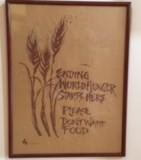
a bit blury…it says, “Ending World Hunger Starts Here: Please Don’t Waste Food”

The poster above hangs in the dining room at the Franciscan Mountain Retreat of Mt Irenaeus in western New York. It is about thirty-eight-years old. Fr Lou at the retreat was interested to know how I remembered its exact age. “I made it,” I said.

When in college I started the World Hunger Committee, which had a short-lived purpose to provide information about the plight of hungry at home and abroad. Maybe the greatest accomplishment of the group was obtaining permission to have just one day where all students who were on the dining plan would turn in their dining cards for that day and the money would go to World Hunger organizations. I do not know if that tradition continued, but we managed my senior year.

But before that, when I was a sophomore, I had twenty-five of these posters made and put them up around campus. A few went in the dining hall, a few in the campus café, and one in the campus ministry, where Fr Dan Riley, founder of Mt Irenaeus, was then working. I still have one at home.

It’s a bit surreal to sit at the dining room table at the mountain and see the poster. I can picture a young man, a boy really, standing next to Mikel Wintermantel in Studio 4 East discussing the phrase to put on the poster. Mikel—or one of his brothers, I’m not sure—came up with the idea of the wheat stalks up the side. It is like a different life, a movie I once saw and only kind of remember the plot. But that scene I recall just fine. And here is the evidence that those times existed—like going from dorm to dorm for floor meetings where we collected money to help the hungry. We were inspired by the late Harry Chapin, who championed efforts to end world hunger, and who had recently been killed. We held a coffeehouse during which we handed out information about the numbers of hungry in the state and the country. And we helped sign up volunteers to assist at the Warming House in the next town. It was a time—both the era and our age—when we believed in things like solving world hunger, like achieving world peace. We were so idealistic.

But like all twenty-year olds I aged, lost some idealism, got busy with life, and the energy of that time faded.

Yesterday when everyone had left the mountain but me I sat at the table and stared at the poster. It was like it suddenly became animated and was calling to me across the room, across decades, and it said, “Where the hell did you go?”

I got sidetracked I guess. But seeing the poster had one immediate effect: I was aware of the food I ate, and the food I didn’t eat.

It is coming on forty years later and today forty percent of food is wasted every year in the United States. Forty percent. Here, in numbers: 40 percent.

60 million tons worth of produce alone is wasted every year just in this country.

According to a study published in The Atlantic, food occupies the single largest amount of room of all landfills. One reason is American’s maniacal obsession with perfection. Most of the waste is the result of blemishes on produce, or other such aesthetic “faults” which cause chefs both professional and not to toss food away. Another reason is how cheap food can be, so throwing it away doesn’t have much impact on the budget. In addition the portions are insanely large, and to make it worse parents stand over their children trying to push in another fork from the way-too-big pile of corn and tell them to “eat every bite” because there are children starving. Result? Some American kids get fatter while some American kids get nothing, and the balance gets tossed in the trash. The only punishment for the stuffed kid is “no dessert” for not gouging his mouth with more and the punishment for one in five American children is to go to bed hungry.

We think of “wasting” food as a “trash” problem. That is just part of it. Wasting food is also a consumption issue. Portions, again, are too large, snacks are too common, people eat between meals, multiple dinners, and while the recommended daily caloric intake is about 2000, the average American caloric intake every day is 2900, while 1 in 5—that’s ONE in FIVE—children’s average caloric intake is 700 a day. That’s just a little less than one blueberry muffin from Starbucks.

I could go on; there seems to be some rekindled idealism in this dormant conscience. But the point is clear: we don’t need to feed the world to help the less privileged—the first step to ending world hunger is much closer to home: Please don’t waste food.

00003583209833

Five Things a Day

61uBePJm6YL._SX355_

Things I find beautiful:

Two older women at a coffee shop meeting for lunch and talking about the people in their lives, talking about their kids and grandkids. One of them showed pictures.

The toddler coloring while her mom eats. She also has stickers and just offered one of a flower to her mom, who put down her cinnamon roll to put the sticker on her blouse.

A very old man walking very slowly, noting that it is an extraordinary thing to have an ordinary day. He has a cane. He wears a hat.

Caffeine.

Today on Facebook I read the post of a friend of mine who I hardly knew at all from a time in my life so long ago I can hardly remember, is visiting other friends in Arizona, and in the picture they’re laughing. I liked the picture and commented how much fun it looks, and one of her friends said, “Yes, and it is only eight in the morning!” I thought about how time is out of joint. In that one exchange I bulleted to 1973 to today and back again. We are all connected; Facebook is just the physical reminder and convenient apparatus. But we’ve all been connected the whole time, even if we lose touch.

How I noticed when I stopped at an ice rink to say hi to two skaters home from a world tour that these partners are on vacation and spending it skating together, in love with each other, in love with what they do for a living, and everything’s going to be alright. They pursued life the way they wanted it to be and found it. They skate really well too.

Driving across the river I noticed the sun on the water, and the colors, and the shapes of the colors ever so briefly before becoming other shapes, and how my son’s photography makes me notice the beauty in something I’ve been looking at my entire life.

So look, I have a new plan: I’m going to find five things a day and note how beautiful they are. This doesn’t mean I won’t still get pissed at the idiot walking diagonally across a parking lot and holding up a line of cars; or at the woman at the checkout who needs to account for everything in her purse before picking up her packages and getting the hell out of the way, or the punk in front of me at the light who was reading his phone when the light turned green and my quick honk to let him know he can go now startled him into flipping me the bird. No, I’ll still find no pleasure there.

But, honestly, it took me less time to note how the very old woman and her husband at the table next to me were thrilled to share a free chocolate chip cookie than it did to calm down from the finger flipping.

I take a lot of pictures of sunsets, sunrises, and I know they’re trite, I know the worst picture of a sunset or sunrise is still a beautiful thing, but they remind me that whatever falls between the beauty of the start and the beauty of the finish is still as miraculous.

Like the school bus filled with kids counting down their final days before summer.

Or the way waking up at three in the morning doesn’t mean I have to get frustrated at not sleeping when there is an indescribable blanket of stars to see just outside.

Or how endings, as Neil Simon once pointed out, can be just beginnings backwards, depending upon perspective.

Pachabel’s Canon in D.

Wysteria.

Sitting with a friend, having a drink, laughing. Crying. Whatever.

Remembering. Wondering why.

download

It’s Like Rain

10455744_10203881536066274_933251597045339631_n

I like the rain. Always have. I like the way I am completely aware of the here and now when I’m outside, blinking away the dripping wet from my face. One time, just east of Fisterra, Spain, Michael and I walked all morning and afternoon in a steady downpour. We were drenched and walked along muddy trails for miles and miles. Some paths ran through trees and it wasn’t all that bad, and sometimes we found refuge, like under the overhang of a medieval church, another time a pub where we played foosball and had a drink. We had no plans, weren’t going anywhere except farther east on our way back from the end of the earth. And anyway, we knew already that eventually that evening when we changed, our clothes would dry. What’s the big deal.

I like working in the garden in the rain, or swimming in the ocean or in a pool. I especially enjoy swimming when there is obviously no chance of lightning. The steady rain on the water is soothing and eternal, something from Eden, something from sometime before that.

When I was a kid and went for bike rides on Saturday afternoons when it rained, a streak of puddle-wet would whip up my back. And while it was slightly irritating when a pebble took flight with the water, it was also visceral, absolute; the rain drowned out any sense of shadows from earlier or later, allowed only the present to persist. Sometimes my face was so wet my skin softened.

It’s raining now, and I’m doing work in a sandwich shop drinking tea listening to acoustic guitar music. That one sentence is loaded with personal imagery: the rain and my youth and walking once to a clearing in the hills behind the college in the torrents with a friend of mine, the music and how it keeps resurfacing, sometimes pushing me along sometimes pulling me back, and the tea and all the times a cup of tea was all I needed.

It is raining now, and I am aware of how much I can feel it on my skin when I think about how my father no longer can; my father and so many friends we’ve lost by now, some not far from here. Or how my friends so far away might be inside working, looking outside glad they are not out in the rain. I picture the times when I have had to find my way through a small village and it is raining, and I don’t mind at all. It is reassuring when I remember those times. It makes me realize no matter what I will always be fine, always be okay. If I can be completely at peace while walking in the rain, why would I ever let anything else bother me?

Another time in Spain Michael and I walked up a long road in the rain and an elderly man was standing in his doorway and asked us to come inside. He made us coffee and gave us some bread and we sat inside awhile, grateful for the break, more grateful for talking to someone new. The rain often brings people together, sometimes in doorways, sometimes in sandwich shops, and sometimes on grassy paths in some other place.

Once, I remember I was about eight and the rain had just passed and my mother let me go outside our home in Massapequa Park on the Island. The sun was out but everything was wet and puddles had formed everywhere, and steam rose from the pavement, and I can still picture it as if I was standing right there on the avenue, and the grass was soggy under my small feet. At home the pool water was cooler from the rain, but eight-year-old’s don’t care about that.

It seems more and more we are less aware of the here and now, but weather keeps me in the moment. Nature is in control; the wilderness will win eventually. I love standing back to watch it all. I love the way I can still feel the rain on my face, or the sun pressing on my neck on a July afternoon. Or the snow and a cool wind coming down from the north in November, and being outside takes some presence of mind.

                  Let the rain kiss you
                  Let the rain beat upon your head with silver liquid drops
                  Let the rain sing you a lullaby
                  The rain makes still pools on the sidewalk
                  The rain makes running pools in the gutter
                  The rain plays a little sleep song on our roof at night
                  And I love the rain.
                                                                                      April Rain Song
                                                                                                –Langston Hughes

11218484_10206402475368181_6845117422389598884_n

Saturation

blog-find-cell-phone-tower

At Walmart yesterday a man walked from the back to the front of the store cursing loudly. This wasn’t a disease-caused situation; this wasn’t a self-directed tirade. He was clearly pissed at someone in the store, either in customer service, or, for all I know, his boss, since I couldn’t tell if he was an employee or not. But he walked by, yelling, “This is F.ing ridiculous!!” and on and on, stopping when he was near someone who did work there to direct his anger to that unfortunate soul.

From where I stood it sounded like it took him about five minutes to exit. One woman near me raised her eyebrows and commented that she wants to leave in case he comes back with a bomb or a gun or friends. I understand the fear.

I stood also wondering just how far away I was from being that guy.

Everyone is getting angry way to easily these days. Drivers and workers and customers, everyone. You. Me. And not just at Walmart where a little temper-tantrum from time to time is understood. Everywhere. Everyone. From leadership, opposition parties, faculty, students, police, everyone. It is as if we’ve all had way too much caffeine, or are constantly being poked, or aren’t getting enough sleep. I honestly don’t remember another time in my life when so many were so angry so much of the time.

I stopped at a light and noticed a group of people on their cellphones at a few tables at a corner pub. In cars, on the sidewalk, in the restaurant, the stores, the hallways, the offices, the entire population is on their phones. If those phones were all landlines, I thought, we would never be able to navigate the millions of miles of wires set out to trip us up. Every single human would have long telephone wires running from them to poles everywhere they went, and of course since we don’t live in a symmetrical world, the thick intrusion of wires would be like liquid, like air, like soup so thick we couldn’t walk or see or even breathe.

The light turned and I drove on, and eventually I made it to near my home, out in the country, nothing but the bay and the river and some farmland for dozens of miles in three of four directions. I could breathe, I could look out uninterrupted, I could think clearly. I could relax.

Contemplate this: Every single cell phone is searching for frequencies set out from towers, usually trying to find three towers to hook up to. And this is constant from every single active cell phone looking to hook up or already connected to the towers which transmit the information—calls, data, etc—to the destination, all the time. All the time.

Isn’t it possible our immersion in this saturated atmosphere is fucking with our mood, playing games with our attention span and anxiety level? Our blood pressure? It’s as if while sitting at a stoplight I am drowning under an invisible sea of signals and frequencies, and while it keeps me connected it makes it difficult to function. It isn’t that we are being “converted” into technology, or that technology is ruling us. No. I think it is just the mechanisms to make this all function have saturated the air, cutting off our oxygen, making us stupid.

I want to get out of my car at a stoplight and climb on the roof, or, better, climb a telephone pole to the top. But since towers are usually really tall my own refuge is to escape, to drive to where the “pavement turns to sand,” and break free from the tsunami of data.

Perhaps from some mountainside or the vista from a cliff on the bay, if we could somehow bend light to illuminate that which we can’t presently see, down in the city or other busy areas, a haze of black, or deep purple, or dust-like energy would pulsate before our eyes.

The region from central New York State to the Ohio Valley has been determined to have some of the highest levels of oxygen in the air anywhere. It is easier to breathe there, and more than a few times the regions have been rated to have some of the happiest people with the lowest rates of crime and violence.

And the cellphone reception sucks. Go take a good view in the wildness and see how calm you feel.

Coincidence? I doubt it.

download

Implosion

dark-clouds-white-house

During the election of 2016 the vast majority of anti-Trump citizens were primarily concerned that he’d have access to the “button,” the ability to start a nuclear war with somewhere in the world. It was pretty well agreed upon by rationally-thinking people that the combination of this narcissistic personality with candid illusions of grandeur and the power to annihilate civilizations should not be introduced. Still, that’s what happened.

What irony; what a tragic twist to this pathetic narrative: not only did djt not cause atomic arsenals to rain down upon various “questionable” nations around the world, those same nations somehow managed to gain the support of our allies even as the United States moves dangerously closer to isolation. North and South Korea moved closer to landmark discussions until djt kept pushing with his sensational rhetoric about his being the catalyst behind such talks; he pulled out of the Iran deal which, as a result, will hurt American companies and send Iranian businesses into dealings with our allies, who, despite their hesitation, are more than willing to cover the gap and work with the leaders there.

We live in a world where negotiation trumps threats, and only one person in government doesn’t seem to understand this. It is like the rest of the world moved out of their parents’ home: there is some residual desire to appease and please the folks, but there is an increasing awareness that they’re on their own and it is now in their best interests to do what they want. The United States doesn’t have the political or economic influence it once did, and only djt hasn’t gotten that memo.

The President of the United States did, in fact, drop the bomb, but on his own people. Our country is deteriorating in reputation, influence, and power, and djt is the one pushing all the buttons.

The man keeps pulling out of trade partnerships and other negotiations claiming he can make a better deal, but he still has not got a clue, not a clue, not a freaking clue, that the negotiations and partnerships have less to do with money than they do relationships. Simply put, Free Trade Stops Wars. Trade deals and partnerships are the price we pay for being a powerful country to keep nations from partnering only with each other and ganging up on us. If we think of us as the King and other nations across the Pacific or in the Middle East as fiefdoms, we will all benefit if we build those nations castles in the country and palaces in town instead of sending out our army to destroy them. Nothing is more dangerous than an organized group of people who have nothing to lose by resisting and everything to gain. Add to that the reality that they can become more powerful if they join economic forces, and we’re simply screwed.

All because one man has decided to stir things up. For what? For one, to simply undo anything former President Barack Obama did out of spite and racism and bitterness; for another, to benefit his multiple holdings which somehow seem to make millions every single time he pulls out of a deal, watches the stock market tumble, and then changes his mind, watching his newly purchased stocks skyrocket.

But I know nothing of it. I am not a political expert, I’m not schooled in economics or trade; even my journalistic skills waned decades ago. But I’ve studied human nature for most of my adult life, as a professor and a traveler, and it is painfully obvious that djt has no values or morals which benefit the better good of everyone. We only succeed as individuals and, therefore, as a nation, if everyone benefits.

Anything else is called tyranny.

Risk-653x393

Passages

thumbnail

I walked on the beach last night, then back under the pier and along the water. A heavy fog settled in early and the ships sounded their horns out in the dark. All the pubs along the boardwalk are coming back to life as the season settles back on this tourist town, but it is quiet along the ocean at that hour, nearly a different world, even on the busiest of nights at the hotels.

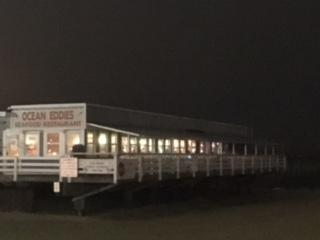
I stopped at Ocean Eddies for a drink and then kept walking. The air was wet from the weather, but the water is calm, and the further north I walked into the residential area at North Beach, the less I could hear anything at all except the ripples of the water at my feet.

This morning I walked again, this time noting the proverbial line in the sand of my life which divides what has been for three decades and everything that comes next. I’m in that period we all face with a major change: some sort of blending occurs where those whom I’m leaving ask about the future, talk about what’s next, and the inevitable remnants of a thirty-year career in the form of paperwork and some possible unfinished business. But I suspect these two worlds will separate for good sooner rather than later. It reminds me of a song by a New England folk singer, in which she writes, “Getting used to saying ‘let’s keep in touch’ though I know we probably never will; probably never will.”

And the sun came up today; I guess I shouldn’t be surprised. People out on the highway heading to work, rubbing their eyes. People on the sand set up umbrellas, called to kids, and music spilled out from radios, the smell of sunscreen, the taste of salt in the misty rise from the breakers. I find refuge in this routine. I am encouraged by its predictability. City workers planted new flowers along the bike path, and a yoga class positioned themselves right at the water’s edge as they do most mornings.

Eventually I made it to what is known locally as “First Landing”; the spot where John Smith came ashore before settling in Jamestown, ignoring the presumptuousness of being the first when in fact the Spanish trumped the Brit by a century. My mind slipped to the Middle Passage which started nearly a century before Smith’s arrival, but which he helped usher to the mainland. I’ve seen both sides of the Atlantic: obviously from these shores for most of my life, but once, briefly, just over thirty years ago I stood on Goree Island near Dakar, off the coast of Senegal. It was used to hold African men and women before they were chained aboard slave ships for transport through the process until they were enslaved on plantations, some of which still stand not far from my home. There’s Church Hill Plantation standing in all its dark history just across the road from where my son went to elementary school. And River View Plantation dating back to the early 1800s, which grew tobacco slaves harvested and loaded aboard ships in Urbanna just up the Rappahannock River from my house. I am surrounded by history; sometimes on quiet mornings when skulling the Rap I can almost hear history screaming from the fields and foundations.

At lunch yesterday, my friend Tim and I talked about Zora Neal Hurston’s book, Barracoon, in which she interviewed the last surviving slave who came to America on the Middle Passage. History ebbs and flows in our lives, spilling into and sometimes flooding us with emotion, and other times history recedes so far it is hard to remember what it is that connects us to begin with. Until I stand on the sand, not far from the cross which marks that landing four hundred years ago, and look toward the rising sun. It is important to look back carefully.

Our past is always present, swirling around our ankles, pulling us into the wet sand, always the shifting wet sand beneath our feet. And it does this again and again as long as we stand still.

No. It is important to keep moving. Sometimes the only value we can find in looking back is the lesson in not following that path again. It is a difficult balance, knowing which parts of history to remember and which parts to bury as deeply as we can. But the older I get the more I believe we should never ignore history, pretend it didn’t happen, or relegate it to the dusty corners of losing touch. With the right balance of emotion and intellect, history can serve our Institutional Memory so we don’t get caught again falling into the same undertow of time. 

I’m metaphored out. i’m going to go find the beauty of a rose which has not yet bloomed. There is nothing left for that rose to do but to bloom.

30716404_10214570627206872_3667433958003441664_n

Just Another Day

550410_4810385945013_921848682_n

I just left my last class at Tidewater Community College. I started here twenty-nine years ago as an adjunct instructor and moved to full-time professor just a couple years later. I taught, traveled, raised a family, built a home, had lunch, and now I just left my last class. It was advanced creative writing and they all read some of their favorite work they produced this semester. I read as well and so did my former office mate Tom Williams. It was fun.

We had pizza and wings and chips and drinks, and we talked about what’s next, now that they’re transferring to four-year schools. Some are going to Virginia Tech, some to Old Dominion, some to William and Mary, and a few aren’t really going anywhere—working full-time and raising children. One is an elementary school teacher here for recertification, and she has her seven-year-olds writing poetry, which she plans to send to them in a few years. We all talked about our favorite pizza toppings.

Afterwards, my son and I sat and had drinks at a boardwalk café. The moon was red just above the horizon, not full, and the light it reflected cast across some vessels on their way north, or south, or waiting to enter the port of Hampton Roads sometime in the next day or two. Venus was setting to the west and Jupiter was just about to appear, not quite visible for its proximity to the moon. I had a rum drink because it felt like the thing to do after all this time. Besides, Michael bought it for me.

It’s hard to imagine the horrors taking place in Syria, Afghanistan, and other places when the water is calm like this and the boardwalk lights illuminate lovers walking quietly, the occasional call of a gull just beyond the shadows on the reach. I tend to look out and think more about the peace that awaits in northern Spain than the hunger that haunts the people in South Sudan, but only because I’ve been so lucky. I mean, sometimes when the Atlantic and I are just hanging out peacefully like this, I can’t help but understand I wasn’t raised in Mosul; I wasn’t born in Beirut.

Humanity is a crazy race, building irrigation systems to help grow food to feed millions while building methods to annihilate those poor souls in seconds. Maybe the greatest irony of education is the stretches of intelligence, research, and application it takes for the human mind to conceive, create, and execute weapons which can evaporate entire cities. The mechanics to build the means by which to destroy someone else wouldn’t cross the mind of an uneducated person. Only educated people can accomplish such a holocaust.

It feels tragically like no one wants to save the world anymore.

There needs to be a new requisite in schools everywhere: Humanity 101. The course could cover the benefits of helping other people, the rewards of sharing not just gains but losses as well. There could be a lesson on compassion and one on being a good Samaritan. A sociologist might talk in one session about how what happens in one section of the globe really does have an impact on the rest, and a psychologist can show the class how to balance the beauty of nature with the evil things people say and do.

A theologian could explain why there are, or at least needs to be, some absolute morals. That person might explain why the belief in postmortem consequences is what can keep evil in check, keep the horrible potential of humanity at bay. Without preaching about salvation in heaven, he or she can certainly drop in a few lectures about earthly responsibility to each other, and if the fear of God is necessary to get it done, so be it; not unlike threatening toddlers who act up with the possibility of Santa skipping their house as a result. The potential of a little supernatural backlash is just what this world could use right now.

Honestly, it seems like no one wants to save the world anymore. I fear for the absence in education of something other than the notion of “career.”

More connections with other people can be made by sharing a meal than college administrators give credit for. Looking back now, I should have taught all my classes over dinner, sitting around a huge table passing the potatoes while talking about social-responsibility and expert sources.  

We might solve more problems by knowing what our neighbors like on their pizza than understanding the treaties that keep us apart.

In any case, it’s time for another round.

image


13.1

images

Here is a contradiction:

I am twenty-five pounds over what I want to be. The reasons aren’t relevant; here I am. I can make excuses as is customary in situations like this. I have had one of the most stressful years of my life; circumstances with obligations kept me from my routine, I was pretty sick for a while, and my son constantly makes delicious bread. Whatever—here I am.

At the same time, I was a highly trained and practicing expert in exercise and weight loss. I ran a club for one of the most celebrated and accomplished exercise gurus in America, and I went through months of training, eight hours a day, five days a week, to learn about how to properly work every muscle in the body, how to eat, how to lose weight and keep it off. I helped work out everyone from college football teams to excessively obese women. Granted, that was more than thirty years ago, but I still remember the process.

I know, for instance, age has little to do with it. DNA plays a part, of course, but in most situations, adjustments can be made as we grow older. The metabolism slows making it more difficult to shed pounds as you age, most of the gain or lack of loss is environmental, and there are compensations readily available to make up for that. Schedules are another oft-referenced excuse, but the exercise aspect doesn’t take long and the eating, well, if you’re doing it right, takes less time than you think.

No, we simply don’t bother doing what is necessary because of lack of will power, bad habits, pressure from loved ones, bad associations, and a slew of other contestable dissents.

I am not trying to go back to being twenty-five-years old, though how cool would that be? No, I’m going to apply the knowledge of then-me to the increasingly discouraged now-me. This has nothing to do with how I look; it is about how I feel. I used to tell all people who came to the club that it is not about the scale, it is not about how it weighs on your mind. It is about how you feel about yourself. Friends say I don’t look like I need to lose that much; but it isn’t about what they think. 

Since every other aspect of my existence is rebooting, I figured this was a good time for a complete renaissance. So here are a few guidelines I plan to follow to help me lose twenty-five pounds by Labor Day. I used these at the club, and they helped some members lose upwards of one hundred and fifty pounds:

1. It’s an old axiom but it is true: breakfast like a king, lunch like a prince, dinner like a pauper.
2. Cut back the carbs, cut out the sugar, cut out the salt.
3. Plan the day’s food the night before and stick to the plan.
4. Drink a lot of water; often we aren’t hungry we’re dehydrated.
5. Cardio ten to fifteen minutes a day through swift walking or climbing stairs.
6. Get on the floor and do simple sit-ups, leg lifts, and a few others you can learn by Googling “lower body exercises” to work the waists and thighs fifteen minutes a day. And move slowly; speed during exercise is counterproductive.
7. Abdominal work 8 minutes every other day.
8. Arm isometrics for five minutes every day.

And the small things:

1. Park far away from anywhere I’m going (not too far).
2. Wear comfortable shoes.
3. Carry water.
4. Stop thinking about food, talking about food, and watching shows with food.

And the quirky things:

1. Brush your teeth when you start to feel hungry. No one ever enjoys following teeth-brushing with chocolate or sugars. That’s disgusting.
2. Eat food with natural sugars like oranges and apples, which are healthy and curb the desire for junk.
3. Leave your money at home. Empty the wallet except for what you need for gas. Carry no change and convince yourself that charging fast food is just pathetic.
4. Keep the list with you of what you’re going  to eat for the day.
5. Avoid dairy; it screws with the digestive system.
6. Until you reach your goal don’t agree to go to the normal places with family or friends where you always end up getting something to eat.
7. Wear tight clothes. Everyone feels thin in sweatpants.
8. Choose one day (and it must be the same day—Sunday works for me) that you’ll allow yourself to not worry about what you eat (still worry about how much you eat, keeping the calories below 2000). This gives you something to look forward to instead of constant denial, which inevitably results in binge eating.
9. Set up a plan to cut back on bad habits. To cut out completely is always a mistake, just like with alcohol or heroin, there will be some serious withdrawal problems resulting in falling off the wagon. So if you’re doing ten snickers bars a day like someone I knew at the club was doing, go down to eight, then six, then four, in subsequent weeks until you’re only having one on one day a week.
10. Don’t check the scale. Stop worrying about how much you are losing; you’re going to go up and down for quite some time until the body adjusts and then will finally find the slope back down to what you are working toward. If you must must must must check the scale, do it once a week and laugh at the lack of results when they happen. If you have a deadline for losing weight, count on no more than two pounds a week, ever. If you do more, that’s great, but losing just two pounds a week insures you are seventy percent more likely to keep it off
11. Stop going to grocery stores; send someone else. Tell your son to stop making bread.
12. Stop STOP STOP!! Eating out!! The sodium alone in processed foods will keep the weight on and cause unwanted heart problems.

Do. Not. Quit. After three weeks if you stick to this, you’ll more naturally start to accept this way of doing things, and it will work. I’m using the second person here but really that is mostly so when I read this again I will talk to myself (which is more normal for me than you might think). I’m not trying to lose twenty-five pounds; I’m trying to lose five pounds in two or three weeks. At that point I’ll think about what’s next. Eventually it will be the twenty-five. Think about it: We are adamant about what type gas we put in our car but not what food we put in our body. That’s insane.

One more trick, and I am not trying to be mean. Find two pictures of yourself: one when you thought you were at your best, and one when you were at your worst, and keep them somewhere visible. If you don’t have any, find a picture of some poor slob eating a box of Krispy Kremes, and find another of some buff person. In both sets of examples, ask yourself which direction you’d prefer to go and are you doing anything to get there. Two picture; two ideas; two dreams of the once-would-be-now you waiting to emerge, and shelf any notion that starting over is more difficult. I won’t list examples from the club or from the world at large of people who made up their minds to see it through. In the end, though, it only worked when they did it for themselves. Just for themselves. 

The first time I ever heard my boss at the club offer advice I was sitting right next to him and I not only never forgot it, I used it many times both at the club and in classes at the college:

Too often we do things because we are bored or depressed or because we aren’t getting along with someone we love or something isn’t going right at work, and we do something self-defeating because it is something we can control, such as eating. We can eat what we want and no one can stop us and it makes us feel good and empowered. The immediate satisfaction is worth the price of any long term problems. Sometimes when we eat it is the only time we feel alive. But you always have two choices. Always. You can do what brings you toward your goal or do what takes you further from your goal.

For me? Well, let’s just say I once again feel entitled to pursue my goals. 

there-is-no-finish-line-8

Adaptation

IMG_2326

I stood in the gates of the small fortress next to the Terezin Ghetto north of Prague. I traveled there with my colleague Arnost Lustig, who had been interned there with his family from when he was about fourteen to seventeen, shortly before being sent to Auschwitz, and a few years before he wrote himself into literary history with more than a dozen bestsellers, some made into movies. I’ve written about the burly author before for Ilanot Journal in the work, “I Knew Two Men.”

This isn’t about him; it’s about a friend of his.

On that particular day in 2000 Arnost needed to talk to his good friend Milos Forman, who wanted to make a movie based upon Arnost’s book The Unloved. Milos, who just passed away last week, made beautiful movies like One Flew Over the Cockoo’s Nest, Man on the Moon, Heartburn, and others including my favorite, Amadeus.
At some point on that cool afternoon between conversations about the horrific ghetto museum of Terezin and the prison for anti-Nazi protesters, the Small Fortress, I ended up having a conversation with Milos about adaptation. He discovered that subject matter to be the focus of my lectures at the university.

“So we agree then,” he said to me. He was much younger than Arnost with the same controlling conversational style.
“Yes,” I said, “Of course. It is always frustrating when people say how much more they like the book, or do any form of comparison at all. They are completely separate art forms.”
“Exactly!” he said, gesturing with his fist. “I can’t film all of a book!”
We talked further about our common concern on the subject of movies based upon a novel or play, and we reiterated the inability of people to see movies and books they are based upon as separate. Yet we also agreed on the difficult task of expecting anything else of the average person at a movie on a Saturday afternoon.

Eventually, of course, the talk turned to his work.

“Yes,” I said. “I’ve taught both “Cockoo’s Nest” as well as Amadeus, and I did read Kesey’s book as well as Shaffer’s play, which I first saw when I was in college.”
“Well?”
“Both times you nailed it. From Kesey’s novel you kept the major themes which worked and consolidated what needed to be. In Amadeus you made music the central theme of the movie instead of the ridiculous “mystery” between Mozart and Salieri. I still enjoy watching both films and teaching them. Oh, and Amadeus has the BEST cut in movies, when Mozart is in bed and Salieri finally hands him the completed “Requiem,” and Mozart says, “Okay, from the beginning,” and we hear an entire orchestra for the first time as his wife’s horse and carriage come into view. Love that scene.”
Milos indicated it was hard to miss with such material and brilliant film editors, but I appealed. He was a great director.

Then he mentioned Ragtime.

When I was young my father bought me E.L Doctorow’s book. I loved it and read if several times. I loved how it swept across decades and included some major historical figures such as Houdini. But I never could picture it as a movie; even if one could save the major themes, it simply is too complicated to pull off as a traditional narrative with the proper conflicts clarified.

Then I saw the movie and I didn’t like it all that much. I even watched it again after I learned a few things about adaptation at Penn State, and it still, for me, didn’t work. I even left behind my memory of the book and focused solely on the new art form, trying the best I could to not include the literature in my analysis.
“What about Ragtime,” Milos said.
I thought about saying, That was really some casting they did for “Cockoo’s Nest,” wasn’t it? But I could tell he was enjoying our conversation. I looked at his Czech copy of The Unloved in his hands. It was bookmarked and folded and noted in dozens of places. He clearly learned the book as if it were his own, like his films each became his own, not Kesey’s or Shaffer’s and definitely not Doctorow’s. 

“It seemed too complicated to capture,” I said. 
“Yes,” he agreed, reflectively. “It never did convey the themes well. Or at least the way I wanted to.”
“It seemed more of a vehicle for Cagney seeing as it was his last film.” I was feeling ballsy now in the conversation.
“You’re probably right. He got more attention than the film. Will you discuss these films tomorrow in your class?”
“No. I’m moving on to Hrabal’s Closely Watched Trains. He smiled. Milos was a fan and friend of Hrabal’s. The Prague art community is not very big.

I told him I was going to talk about how adaptation of one art form into another involves both deciding what essential elements must make the transition and which ones very specifically needed to be left behind.

Arnost returned, always sharp, always ready for what’s next. I stared at this man’s eyes and thought about how much he went through. The Nazi’s disrupted his life, caged him for three years as a workhorse, forced him to build a railroad from Terezin to the mainline on the way to Auschwitz, killed his family, and still he escaped. And still he went on to not only live his life, but live it fully as a writer. He knew what to take with him after the war and he knew what he need not address ever again.

It is not easy, adapting, saving the best of what exists, our strengths, and leaving behind the weaknesses, the parts we wish we could do over given the chance.

And this week I found my copies of Arnost’s work when I packed up my office and brought everything home. I sat in the small room at the college scouring stacks of books I’d collected in nearly three decades. I decided which ones to leave on a table somewhere for students to take, which ones to give to certain people, and which ones to bring home to pull out from time to time as I make my transition into a new way of life. Arnost’s work is a keeper; he is as strong a writer as he is a person. I also found my notes and thesis from Penn State. I flipped through my work about adaptation; meanwhile, on the radio the news anchor announced Milos’ death.

And I left the college. I didn’t throw a water fountain through some bars and escape across a field, and I didn’t end up in an asylum as the Patron Saint of Mediocrity. No, I simply packed my belongings and brought them home, and hopefully I’ve kept the basic theme of my life alive. Now I must try to set it to new music.

RIP Milos. Ragtime was fine. But I liked the book better.

IMG_2325

A Piece of Fertile Ground

13133182_10208384568959282_830887679397207826_n


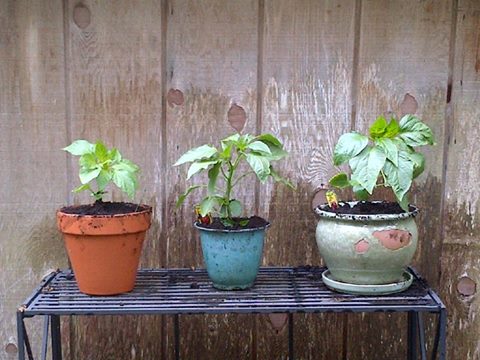
I planted four varieties of tomatoes and four kinds of peppers, including hot and spicy. Cucumbers run along a small green fence and several blueberry plants hold tight to the lattice behind the shed. Along the path to the new garden area are peas and beans in pots and just at the entrance to the new sitting area inside the garden are several pots of container-size lettuce, which looks a lot like romaine.

I’m craving salad right now. I might put a small refrigerator out there stocked with various Newman’s Own Salad Dressings.

In the new area are the ground/vine varieties, such as watermelon, cantaloupe, and squash, as well as more cucumbers and a few large pots for cherry tomatoes. I’m also about to hang several containers of various sweet pepper plants on shepherd’s hooks along the way.

I have always had some vegetables running alongside the shed, behind it under the window, and on various tables and garden stands. But this year I decided to finally cut through a fallen tree in the woods and open up the clearing inside what used to be a fort, a young boys play area. There were planks of wood and two by fours, a hand-made box buried in the ground for storage, long vines and sticks intertwined like lattice for fences, and although most had fallen over, they still held together just fine. Michael read about how to make them in WW1 books and survival books by Bear Grylls. He was only eight or nine at the time (Michael, not Bear).

I took two chairs from another sitting area and moved them to the new clearing, and I rested thinking about what to grow. It is the hardest part, knowing what will take and what won’t, what will need a lot of nuturing and what can make it on its own. I have rain barrels scattered about so watering will be easier during dry periods, but I finally learned that for the best pollination there should be several plants of the same kind near each other. Even plants need companionship. I got tired of year after year having amazing beautiful yellow flowers on the squash vines but no squash growing. Now it should be fine.

When Michael was very young the garden was on the other side of the house and I worked in it until he would find me, ask if I wanted to see what he did in his fort, and then I’d stand right about where the cucumbers are now and he’d explain the changes, why he made them based upon the best fortification on the No-Mans-Land side of the fort (the woods to the south), and what his plans were when he had a chance to “pick up more materials.” Then he’d asked if I wanted to explore with him, and we would, walking through the woods for hours checking out osprey and eagles nests above us, fox dens at the end of long-fallen oaks, and animal tracks including raccoon, deer, opossum, and more.

Like it was yesterday I recall standing on a fallen tree as I noticed how fast he was growing. I always stood on the same spot when he showed me his progress, so I was able to measure him against a thin dogwood to the rear of the fort. One day I noticed for the first time how high up the trunk he had grown despite the fact the tree had also sprouted. He spent the vast majority of his youth and young adult years outside, much of it in the fort, and I believe he is healthier both physically as well as mentally as a result. He has never had trouble finding peace of mind. He grew well here.

Where there is now a slate patio with wrought iron furniture, was once a stack of tree trunks—dozens and dozens of them. When I had the area for the house and driveway cleared, they placed the trunks in a pile in that area so that I could use the wood later for the fireplace or other projects. I cut up several dozen cords before I made the slightest dent, so over the course of several years it became overgrown with weeds—and lizards. All sorts of lizards, fence swifts, salamanders, and more. Michael would grab his net and stand there, carefully climbing, looking for more reptiles to add to his aquarium on the table behind the fort where I now do my replanting. On a nice summer day he might have hunted lizards for hours, catch them, feed them, and then a few days later let them go. He left berries for them, of course, just in case they had already “acclimated to domesticity” as he once conveyed to me.

I sat at the slate patio where those logs used to be and thought about how long ago those years were; almost two decades. I looked at the house we built and remembered how when this was all woods I came out and taped off the area to be cleared. Then my dad and I came up here and he helped me stake out where I wanted the footings to go for the foundation. We measured it out together and talked about how centrally located the place is—not too far from DC, from Richmond, from Virginia Beach. We talked about the soil and I said how I had hoped things would grow well there; I was worried that being so close to the river and the bay made the ground a bit sandy and the nutrients might be questionable.

But as it turns out, things grow just fine here; they always have.

14088538_10209272109667245_6325731574787723766_n