A friend and I were texting today about age, about our inability sometimes to remember how old we are; especially when we both have been fortunate enough to have parents live into their nineties. It is difficult to feel like a senior citizen when you’re out to lunch with your mom laughing and eating pizza.
But we certainly have aged, and it’s not going to get easier. Toward the end of our exchange I related how I know I’ve made countless mistakes through the years, particularly the last several, but I’m still here and as long as I can rise tomorrow, I can make amends for those mistakes, or, more likely, make even bigger mistakes.
It’s called being alive.
Here’s one:
When I first went to Russia in the early nineties, an orthodox nun asked me to kneel next to her and she prayed for me for ten minutes at the Shrine of St Xenia, one of the patron saints of St. Petersburg. Then she gave me a piece of bread from the top of the sarcophagus and asked if I liked it. I wanted to say yes, I enjoyed her blessed bread, but my weak language skills kicked in and I told her, “I love you and I lust for your black God.”
It feels odd to make mistakes in a foreign language. Oh, there’s more:
I wanted to ask a cab driver where I could find a bathroom but ended up saying I like to drink dark beer from a toilet.
I told someone I thought was a waitress who turned out to be a prostitute what I thought was yes I could use a few minutes to think but turned out to be yes I’d absolutely love oral sex. I turned to a friend with me at the bar and said wow, the service here is phenomenal.
I wanted to tell a room full of students to listen, but instead I told them to get their suitcases.
I pulled out a chair for a lady and told her to heel.
I asked for five Danishes and walked out with fifty.
A priest friend of mine stationed in the city wanted to tell a waitress he would like some mayonnaise but ended up saying I love to masturbate.
Some friends went to buy coffee and asked me how to ask for sugar. I told them. It turns out the word for sugar is “Suga” but the word for bitch is “Suka.” They returned exclaiming Don’t ask for sugar in your coffee in Russia, Dude; they’re assholes about it.
I could go on but more or less by screwing up I learned to fit in, pick up the nuances of accent and syllables, which brought down prices at the flea market, brought out their best Georgian wine, and opened gates to closed graveyards and monasteries.
My mistakes are some of my best memories. Even the ones which broke my heart, left me penniless, crushed my ambition. Sometimes we don’t know they are mistakes at the time—our lives are filled with those incidents. Acutely optimistic people will tell me those aren’t mistakes, they’re lessons. No, they’re mistakes. I can honestly look back at certain moments in my life—no matter how sure I was of my decision at the time—and say, definitively, I screwed up.
But we move on and hope we are forgiven; we keep going and learn to forgive ourselves.
At the back of one church, in the rubble of what was and would eventually again be St Catherine’s Catholic Church, a woman stood looking for a priest I knew. She seemed confused and we talked a bit—slowly of course. Her mother had been the secretary of the church before the revolution seventy-five years earlier. She needed to see the father. In my weak Russian I determined the woman told me she had a huge cross to bear because of the horrors of communism for all those decades and wanted the priest to take the sins away from her, but when Fr. Frank appeared with sharper language skills than mine, his translation was somewhat more significant. Sitting outside was the original cross for the church dating back hundreds of years, which she had brought with her, and which her mother had taken when the Bolsheviks took control after World War One and had buried in the yard at their dacha where it remained for seventy-five years. She thought it was time to return it.
My bad.
Back at home and much more recently I showed my students how to present a paper using the guidelines from the Modern Language Association. I gave them copies, I presented another example on the outline, I asked them to open their books to the appropriate example in the text, and still forty percent of them did it completely wrong. Is that a mistake? Is that boredom? Distraction? Idiocy? I like to think they are overwhelmed and go home kicking themselves for doing something wrong that was so easy to get right, but I’m probably mistaken. A few years ago I would have returned to a class like that and lectured them about how their priorities are screwed up; I would have told them that if they can’t get the easy stuff done, they’ll never handle the challenges as they attempt to move up the collegiate ladder. I would have used the appropriate sarcasm with a touch of professorial belittling attitude.
But last January I was driving through the Pennsylvania countryside on my way to western New York on a Sunday morning when I heard a guest on a talk show quote St. Bernard of Clairvaux who said we need to learn to make excuses for other people.
We need to learn to make excuses for other people.
If we can see other people’s reasons for their failures, their errors, their need over and over again for help despite being helped so many times before; if we can consider the myriad possibilities that they might need help other than the knee-jerk reasons we label them with, the world changes. For us, for them. It gets lighter, somewhat more manageable.
Sometimes students come in later and we see laziness, disrespect, disregard.
We need to learn to make excuses for other people.
I once had a student who came in late because her husband is stationed in Iraq and she got to talk to him that afternoon. Another one told me after the fact that she left early because her father had died that afternoon. The one who couldn’t get the presentation correct no matter how hard he tried has never been the same since returning from war. No one would know that to watch him stumble through a relatively easy assignment; but a little background information illuminates so much.
The one who stared at me the entire class without blinking an eye, then left, only to later email me to apologize for not concentrating; she had just learned her cousin was shown on television in Baghdad, dead, and left swinging from a bridge. I taught in a different environment in the military rich resort city of Virginia Beach. I wish I had learned to make excuses for other people earlier in my career.
St. Francis de Sales said, “Never confuse your mistakes with your value.”
I’m trying. Mostly, I hope beyond hope that others, particularly those I’m closest to, make excuses for me.
I suppose, though, in all honestly, that sometimes we really can be lazy assed howl-at-the-moon stupid people. I do it all the time. Make no mistake about that.
It’s raining at Aerie today, a heavy wet rain which if it wasn’t sixty-five degrees outside would be snow, the kind that weighs down pine branches and snaps the limbs of the smaller trees.
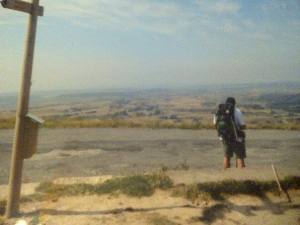
The sound of the rain is relaxing on the skylight above my head, and out the window the woods are foggy with a mist which looks cold but isn’t. It’s a good day to walk. When I was getting ready to do the Camino ten years ago this Spring, I walked in all kinds of weather from the rare snowstorms to the common downpours. Only lightning keeps me at bay; I don’t do lightning. Even inside I prefer to not sit under this skylight during a lightning storm.
But today is okay, with the rain and the warmth and my work for the colleges all caught up. I’m arranging some material for Ireland, figuring out a trip to West Virginia and Ohio, dreaming about Spain. I often dream about Spain.Remembering Ireland.
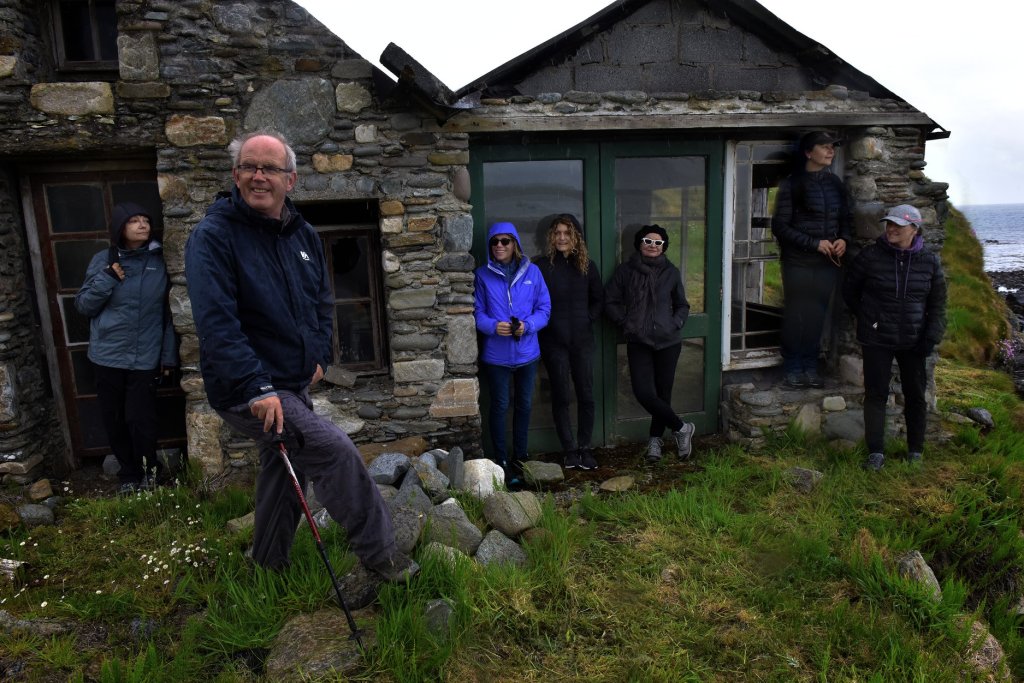
The last time I was in Connemara it rained one day, one out of about eleven days. That was in June that year, and the rest of the days were sunny and pleasant. It just so happened, however, that the one day it rained was a scheduled hike throughout the Renvyle Peninsula with famed archeologist, Michael Gibbons. Of course, being in Ireland, and him being one of the fine personalities of Ireland who jumps into bogs to show how dangerous they are and has a sense of humor which directly lines up with mine, none of us minded the rain. We walked through the crumbling graveyard of the Seven Daughters, took a break from the weather in an abandoned house overlooking the ocean, wandered for miles in the wide “wild west” of Connemara, along roads stretching past ladder farms and peat fields, and stood and listened to Michael talk about Standing Stones standing right in front of us, and dilapidated famine homes, and the Twelve Bens—mountain peaks stretching to the north, and curious customs he told us about with endless hysterical anecdotes. In all of my travels, that day, with Michael and my companions, was one of the most memorable.
With Michael Gibbons (foreground) et al, taking a break from the rain.
But I was going to say before the walk about Connemara came to mind and all the matter-of-factness about the rain, as Frost might have said, that today is fine here along the Rappahannock, and the rain won’t keep me from meandering to the water, listening to the foghorns on the fishing boats coming back from the Bay.
I was talking to someone earlier this week about Ireland, about the Renvyle Peninsula where we go, and he asked if I was from there, my ancestry that is. I was proud to answer yes, that in fact a large swatch of my DNA hails from County Galway, in Connacht, and while everyone who travels there automatically feels right at home, I felt some connection we all sense when returning to a place our forefathers come from. I felt it in Brooklyn, too, the first time I returned as an adult and walked the streets where my father and my grandfather grew up, and my great-grandfather too. It was like that in Ireland, in Connemara. I didn’t know my great-grandfather of Brooklyn any more than my ancestors of Connemara; I am as connected to them all.
Looking toward the start of the Twelve Bens
One evening we all went to dinner at Paddy Coynes in Tullycross, about two miles away. It dates back to 1811—new for Ireland—and is one of the popular pubs in western Ireland. We swapped stories, had oysters and lamb, whiskey and beer, Irish coffee, and readied to leave when I told everyone I had decided to walk back. A few protested, particularly Jacki who knows the roads better than anyone and whose roots run deep in the area. The roads are curvy and lined to the edge with high hedges, and traffic flows on the opposite side than what we are used to. Plus, it would be getting dark soon. Will, whose family is from the neighboring county, seemed more pleased than worried.
“It’s only two miles, and besides if it gets dark it is easier as I can see headlights and simply saunter from one side of the road to the other.”
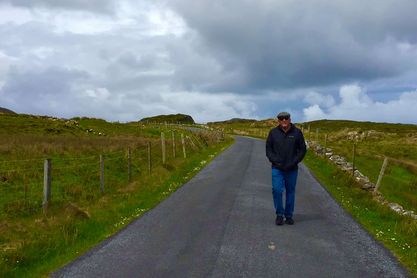
They stood around talking about the meal we had just completed, and I left. The first mile is fine, with a wide road and wide shoulders, knee high walls and fields stretching clear to the east. On the west side of the street, houses sat back from the road behind Irish gates and Irish lawns—green of course.
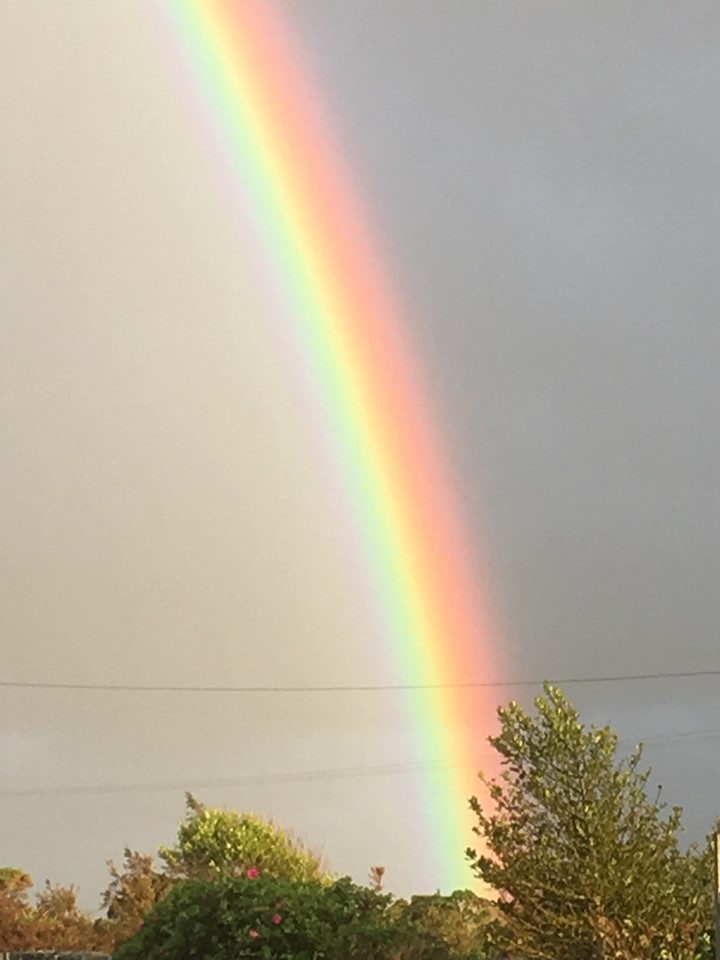
The rainbow over Tullycross
At the one mile mark I came to a crossroads with some houses and a pull-off area. I turned to look for the van, which had yet to pass in the time it took me to walk the mile, when out across the reach was one of the most beautiful rainbows I had ever seen, bold, and welcoming me to the Republic in fine Irish tradition. A car pulled over and the driver got out and took pictures, and then he and I talked a bit about rainbows and Paddy Coynes and Renvyle and America and writing and, finally, Guinness, and we sat on his nearby porch and continued our conversation for an hour, drinking beer and swapping stories. When it was time to leave, I decided to walk the last mile along the beach, this awesome Wild Atlantic Way, which I imagined my ancestors might have walked as well, dreaming perhaps of America.
Here’s what I did not know:
The stretch of beach does not go straight down the coast to Renvyle House, but instead jetties out into the Ocean and then winds back, making the one mile walk about three and a half.
There are cliffs—not high, about twenty feet, along the water, with a rocky beach; rocky like baseball and softball size rocks everywhere.
The tide was coming in.
I was about forty-five minutes into my walk when I realized I could no longer see lights anywhere. I enjoyed the walk though, albeit on wet rocks while I was wearing slick-soled Vans more appropriate for standing on the deck of a boat. A few times the waves crashed close enough to wash up my legs to my thighs, and it was only when I turned a bend and the closest lights I could see down the coast, hoping it was Renvyle, were still well more than a mile away.
I slipped once and landed on my butt in the sand, my pants wet but my phone safe. I checked and had received a text from a friend back at the house: “Where are you? We’re all in the lobby! We didn’t pass you coming back.” I quickly replied. “Walking home now, slowly. I met a local man who invited me for beers on his porch.” Okay, I knew that sounded way more planned and carefree than my impending very possible dragging out to sea by a rogue wave on the rocks of Connemara.
Eventually, I could no longer walk along what was no longer a beach—excuse me, rocky path—and I looked up at the cliff and realized it was easier to climb than I had thought. A sheep looked down at me, almost as if to say, “You know we’ve been watching you this whole time. You’re a moron.” I moved up the sandy and grassy side of the cliff with relative ease as there was plenty to hold onto, and I made it to solid ground, a grassy field spotted with cattle and sheep, and in the dark distance a house, presumably the hand who owns these herds. I walked freely, sheep moving out of the way, me moving around cows, and climbed over several small fences and kept walking another thirty minutes, climbing fences and dodging livestock until I could see the lights of Renvyle just a few hundred yards away.
I made it to the beach near our place, and I walked to the front door and walked in to find most of my friends hanging out, drinks in their hands, listening to music, warm by the peat fire in the large fireplace. Will looked up from his camera to ask how it was. I told him about the beers, and he said it was the perfect Irish experience to have, and he was happy for me. Then I quietly told him I walked down the beach instead of the road, and he said, “Yeah, I figured.”
“I think a sheep called me a moron.”
“I know that sheep,” he said, and we laughed.
the peat fire at Renvyle House
A friend of mine says since I was born in a water sign, it makes sense that I’d be more comfortable along the Atlantic coasts on both sides of the pond than anywhere inland. Sure, part of me buys that, but just as much of me understands I’ve been coasting along sandy beaches since I’m nine years old and feel more comfortable doing so than in any hallway I’ve frequented.
But another part of me, the DNA part, likes to believe I followed some ancient path my great-great forefathers followed when they dreamed of America, wondered if they’d ever get there, wondered if they could simply ride the tide out past the Twelve Bens, past Achill and Inishturk, across the North Atlantic.
The following is the longest blog post to date at A View. It is the result of news today that going to Russia is dangerous even for Russians with dual-American citizenship.I miss the place, the people, the endless laughter and outrageous stories from decades of travel. The country has come full circle in that time. For anyone wondering what the hell happened, here’s what happened:
The Russian Arc
In 1994, the streets of St Petersburg were dank, a monotone of browns absent of advertising, neon, or anything other than some Soviet style atmosphere. The only placards placed in random spots on Nevsky Prospect—the city’s Fifth Avenue—were Marlboro signs, the only western clothing of note worn by the suddenly displaced masses was Adidas warm-up suits. It appeared a parody of itself as presented in 1970’s and ‘80’s anti-Soviet movies. For seventy-five years the country, and Leningrad, moved in darkness under the Soviet leadership, and for centuries before that under the long reach of the Czars.
But in 1994 when I first arrived to teach American culture to faculty at Baltic State University, the first of what would end up being more than twenty-five trips in thirty years, democracy had found the streets of Leningrad, which had just changed its name back to the Imperial “St. Petersburg,” and Russians struggled to figure it out. The first week there, I stood in line for two hours at a bakery, and when I pointed this out at the college, my colleagues shrugged and said, “Da. Canushna.” Yes, of course. I explained that in the States, a new bakery would open across the street and be faster, charge less, offer discounts. Then I had to explain discounts and why, explain that the cashier who stood outside smoking while twenty people were in line would be fired. This led to a conversation about capitalism, and everyone was suddenly enthralled to hear about businesses and learn how to make money, the advantages of choices, the value of options. The men of the previous generation on through to the college students present when I first taught in the city, simply understood service to their country as paramount; it involved time away from family, but also provided pensions and a chance to protect their living conditions.
But after the coup, and certainly in the few years which followed leading up to 1994, it was a brand-new way of existence, and the long, cold winter of communism had finally ended. Things changed—and this is where it got tricky. At first everything was different overnight, like their currency, living conditions, international relationships, and availability of goods. But then the changes slowed to an immeasurable pace. People couldn’t find jobs or food, or they had to work for some organized crime group. Old folks lined the metro begging for money or selling items—shoes, loose cigarettes, empty bottles. But within a few years they figured it out. One afternoon that first year I went to the market behind a cathedral in the arts district. It was a park area with tables covered in tourist items: matryoshka dolls, the famous Russian wooden bowls known as khokloma, pins, small wooden toys bears. Scarfs, shawls, icons, amber jewelry. The following year the market built small booths in long rows instead of random tables. A year or two later, the booths had roofs over them, then lighting was put in for night shopping, and by the 300th anniversary of the city in 2003, the entire market was covered, gates out front, a veritable mall filled with all the previous items, but also fine art, expensive purses, technology, and food were added to the shelves. The Russians were figuring it all out, and many made more money in a month than they had in a year under the Soviet regime. Organized crime groups took over and took a cut, and the city streets once filled with just Russian-made Ladas were now lined with black SUVs.
A friend of mine in the marketplace, photographer and artist Valentine, remained my source of all things business, and the changes almost became too much for him to handle. In 1995, I went in the Catholic Church nearby to find piles of rubble where an altar used to stand eighty years earlier, and the walls had been painted black, on the floor lay statues without heads. The priest, Fr. Frank Sutman, explained it had been used as a storage facility for motorcycles since the Great Patriotic War, World War Two, but the church took it over for the first time since 1917. By the turn of the millennium, the grandeur of the marble floors and beautiful walls had been restored. Across the street was a small shop. In the early years, I had to point to the item I wanted on the shelf behind a counter or in a glass case, and if I liked it, I took a handwritten receipt to the cashier who figured out the total on an abacus (no kidding), gave me a new receipt which I took back to the first worker to retrieve the items. This is how it was in the few grocers, the pharmacies, the bakeries. Only in the tourist market did one deal directly with one person.
Years pass.
A supermarket opened with cashiers at the end of conveyor belts who rang up your items, bagged them, and you walked out like you just left Walmart. The discovered calculators, paper bags, and the shelves were stocked with European goods. And on the streets, neon signs dominated the avenue: KFC, McDonalds, Pizza Hut, clothing brands, cigarettes, alcohol, appliances, cars. Except for the language I could have been in my native New York. The once empty streets were filled with people, all on their new phones, all taking pictures, all donning expensive jackets and shoes.
These were the years of tourism, of an entire generation and the next growing up without memory of Gorbachev, even of Yeltsin. We went on canal rides and took videos, wandered through neighborhoods and graveyards. I went to Victory Day a dozen times, talked to Vets of the Great Patriotic War, who loved to share their experiences, and I talked to the women—St Petersburg became known as a city of old women since the men mostly died in the war and children starved to death—about the changes, often as they swept the streets with brooms made from birch branches.
We went to the Kirov Ballet, the opera, folk shows, and soccer games. We dined in restaurants from Germany, Italy, China, and played music, danced and drink at The Liverpool, a Beatles bar.
Peter the Great’s dream of a city of culture, his “Window to the West” as he called it, had come to fruition.
By 2014, after twenty-years of going to Russia, anyone thirty or thirty-five years old and younger only new this new way of life. The very notion that the government would dictate what they could and could not do was as foreign to them as it is to us in the west. Students graduated from college and set up businesses, tech companies, they traveled freely and often to Portugal, the United States, Hong Kong, Sicily, everywhere. After almost a century of needing to walk everywhere and live with two other families in small communal apartments, they now owned cars and nice apartments. The once common practice of tourists bringing Levis or other western brands to trade for Russian trinkets was not only over, but laughable, with malls opening up with shoe stores, clothing stores, phone, sporting goods, and music stores, all filled with western brands.
The “old country” of Russia had so modified over the course of just two decades, one had to be in their forties to remember the Soviet system. What the average Russian citizen could not know, of course, was that the modifications made in palaces throughout the country, but in particular St Petersburg, was paid for by organized crime to increase tourism and international trade. The city where I could in those early years buy items for a few dollars, quickly figured it out and charged twenty or thirty dollars for the same items. Restaurants appeared everywhere with prices for those driving the SUVs, not for the Lada crowd.
My friends from Russia adjusted. A tour operator learned business well and built a company that dealt with tourists from all over the world. My artist and writer friends found new freedom in being able to take pictures of anything and anyone they wanted without recourse. They criticized the Yeltsin administration without worry of harm. For seventy-five years, the notion of dissidence, which not only included those who wrote against the government, but those who simply didn’t always write positive things about the government; particularly Stalin, had in just a few shaky years, slipped into history. Going to St Petersburg became simple. There was even talk for a while of dropping all the VISA requirements. I wouldn’t call it democracy, as such, but communism was dead. Gone. Lenin’s statues which had been everywhere in the early ‘90s were much more difficult to find. It became simple for a Russian to leave home and travel to the United States. And the did, gladly, relishing in being a part of the world, finally. This wasn’t simply détente; this was the start of a beautiful relationship.
In 2013, my son and I rode the trans-Siberian railway from St. Petersburg to Vladivostok, across more than six-thousand miles, and seemingly across decades as we retreated into the previous century the further east we traveled. In Yekaterinburg the western influence was still obvious, but in Irkutsk, another few days east, Soviet style practices still appeared common. The one fortunate thread remained the people, all deeply rooted in new democratic, even capitalistic practices. They drove Kias and Toyotas, they wore Levis and Ray-Ban sunglasses, and they spoke of their vacations in Australia, the Canary Islands, Florida. If I had not been already in my fifties, there would be no basis of comparison to the old, Soviet ways I grew up learning about, fearing, hating. Nothing I had learned about these people was true, even in the early nineties. The propaganda machine, practiced just as efficiently in the west, had turned out to be shallow, and that was with a generation of Russians whose experience had only ever been Soviet or Czarist. This new generation, those already well into their careers, families, homeownership, and substantial investments, just two decades old, was the dominant population across the country, and they knew less about living under a fascist regime than I did.
Until Putin.
He came in early and soft, almost friendly, certainly acceptable. He was a man with a vision for this new country who followed the floundering Boris Yeltsin, and as Putin’s power and wealth increased, he rebuilt his native St. Petersburg. He saved the former Soviet Union from ruin and the economic disaster of the Yeltsin years, which left a rampant homeless and starving population to fend for themselves. Right after the coup to end communism, the nationalization of all businesses and housing ended, but so did the pensions. Housing privatized and if the residents couldn’t afford the new rent they were kicked out. Hospitals quite literally rolled patients out the door and left them near churches to fend for themselves. Putin moved from the city’s Vice Mayor up the ladder to President on the promise he would “clean up” the homeless problem, “employ” people willing to work for anyone, and made business deals that brought unprecedented wealth to the nation. Russians welcomed him; so did western leaders. And the population which benefited the most were under forty, tech-savvy millennials who worked their way up, drove expensive cars, and lived in large sweeping apartments on Nevsky Prospect with beautiful dachas in the countryside or Ekaterinburg. Tourists who visited St Petersburg discovered open palaces with gourmet dining rooms, clean hotels with five-star service, shops with icons, malachite and amber jewels, and all-things-fashion. Russians, too, became tourists able to see more than the dachas they shared with other families. They traveled to Italy, to Portugal, France, and the United States. Satellite television common in the nineties became fast internet service enabling partnerships and communication with anyone anywhere.
Then Ukraine happened.
Those same students just out of communism and thrust into capitalism are now in their late forties, at least, and their children, raised in nothing but a mostly free-capital society with all the advantages and freedoms we understand here in the States, are being drafted into an army to attack a country they spent their entire lives visiting on vacation. When the news speaks of “Russian military,” this is who they’re talking about; men and women whose only reference and background was freedom of choice, of employment, of wandering, of economic wealth. Their only requirement was the possibility of two years mandatory service before they turned twenty-seven. Piece of cake; their billets ranged from one end of the earth to the other. So while their parents may not have been surprised to have been called to service in Afghanistan in the seventies for the Soviet government, these men and women dreading duty in neighboring Ukraine had anticipated their best-laid plans to pursue personal ambitions, and went to schools which had been teaching them international relations and economics, until the hope they had for life was disturbingly aborted for reasons beyond their comprehension or desire.
Then western sanctions hit and the country shut down, banks stopped all business outside the borders, foreign companies which lined Nevsky Prospect with signs and tables and parties were suddenly gone. The streets once again seemed grey, empty of life. Employment disappeared and no pension waited by to save them, so the army promised to pay their bills, which they did for a short while, and when word spread that the truth is they could barely feed their soldiers, let alone pay them wagers a fraction of what they had been used to, many fled.
Back in the mid-nineties, a friend of mine would write complaining about Yeltsin, about the lack of support from the United States, about the homelessness and difficulties dealing with “Old Russians,” who knew Soviet Ways, and how the “New Russians,” assume they have a right to whatever they can get. The anecdote which circulated then was how a New Russian in a Mercedes SUV waited at a stoplight when an Old Russian in a Lada with no brakes hit him from behind. The Old Russian got out of his car terrified, but the New Russian simply said, “Aren’t you glad I’m here to stop you? Otherwise you would have run out of control and killed yourself.” That was the propaganda which took hold and brought this nation to life; this nation now isolated and quite possibly on life support.
In the last few months, after a year of no word from friends who still live behind this new Putin Curtain, I heard from the friend who twenty years ago spoke openly of the problems in the city, back when the place was starting to shine. This time he speaks only of pleasantries, of how beautiful the weather is, and how he loves his city. No word of Putin; my friend remains uncharacteristically quiet about all things governmental. Another friend in Europe tells me his own family in St. Petersburg reports the lines are back for the purchase of many goods, like before the coup thirty-five years ago, and families are once again forced to move in together to save money, and he cried knowing his family whom he could visit whenever he wanted and who came to see him often, no longer has the ability to travel anywhere, nor the means even if they could leave. And he spoke as if this was the early fifties and Stalin was still in charge, that “to speak negatively about President Putin is to be thrown in jail.” And today come reports that anyone with dual citizenship with the US and Russia who had been contemplating going back to Russia should not do so lest they be detained indefinitely in Russian “holding” areas.
Maintaining control over the population of the Russian Empire after the Civil War following World War One was not difficult; the people had never truly known freedom as we understand it; Czarist Russia ruled for nearly a millennium. Russians appreciated the promises made by the Bolsheviks, and despite many of those promises never coming to fruition, most people abided by the Soviet system, even out of fear. And following the fall of communism in the late eighties and early nineties, Russians welcomed the opportunity to break free of the limitations of their previous government, but when almost a decade passed and things got worse, not better, it was not difficult for someone like Putin to convince them a little more government control, “like it used to be,” was a good thing. For a while, he maintained a perfect balance of top-heavy government—albeit one on the take to the tune of billions of dollars—and the personal freedom to come and go, grow and expand, as one pleased. This lasted until February 24th, 2022, when Russia invaded Ukraine.
But something is different this time. One hundred years ago the people had only known an oppressive government, as was the case thirty-five years ago, so leading them down the path the new leaders desired was not difficult. But now, two generations into a country used to most of the freedoms we have in the west, the population, despite the Russian propaganda to the contrary, is displeased with their government’s bombing of an innocent nation, ending the freedoms of the people of both countries. When the war began, Russia had 360,000 active troops. In the past two years, 315,000 of them have been killed or badly wounded, only to be replaced by new “recruits.” According to the UN, that amounts to 87% of their numbers at the start of the war. In the Ukraine since the world changed two years ago, more than 30,000 soldiers and civilians have been killed or wounded.
The Russia I knew is dead. I miss my friends, Valentine, Igor, Sasha, and Dima the violin player. I miss the atmosphere, the storied example of perseverance that was the St Petersburg I knew, filled with veterans who miraculously survived the siege of their city for nine hundred days in World War Two; a siege and destruction of people which one of the city’s own, Vladimir Putin, once exclaimed must never be allowed to happen again, until he did just that. The promise and beauty of the Russian artists, the teachers, and the children, are simply gone. And in Ukraine with a history deeper, older, and more beautiful than even Russia’s, a civilization has been annihilated. Historians will not point to a myriad of reasons for this incomprehensible tragedy; studies will not have to be undertaken to better comprehend the causes of the invasion. The brunt of this brutality falls squarely on the shoulders of Vladimir Putin.
Sometimes you can sense some sort of lethargy this time of year revealing itself in subtle ways, like not wanting to go to work, not filling out some forms or editing some article, not bothering to return important calls completely out of a sense of avoidance, as if you might be able to wait long enough and all of this will pass—this stuff that brings you down, and to be honest, you’re not really sure what that stuff is. The idleness of society maybe, the constant sense of impending doom reported in all forms of media about democracy, about pandemics, about weather, climate, Ukraine, Gaza, shootings, political attacks, corruption, the economy, about depression and isolation. You have no reason to take any of it personally, but some people can’t let it go, it is so overwhelming and it weighs heavy, and you wonder how can you hold out hope for anything, let alone just one good day, when humanity is humiliating itself; so you settle for avoidance, which adds to the isolation, which fans the grief.
And you wonder what happened to everyone; what did you say or do to create some distance with family or friends, which may not be true at all, but with Seasonal Affective Disorder, it’s exactly true, and it’s your fault, clearly, and you know you’ve made mistakes but you know also what no one else does, that some contact can cure, even for a short while, some malaise.
You can sense yourself not trying as hard or caring as much, like eating whatever is around instead of thinking it through, not going for a walk because you don’t want to be bothered putting on a coat or dealing with any sensory change. You’re sitting; you’re comfortable, and you’re numb. It works.Numb is good.
Going for a walk helps. Filing out the forms, returning calls, all help by providing a sense of accomplishment and forward motion, like checking things off the to-do list, it leaves you with the hint that if you keep going there’s something worthwhile on the other side. You convince yourself it is the medicine side effects.You tell yourself the mistakes you made are in the past; you know it doesn’t matter.
There’s the rub. It seems you keep reaching the other side and there’s still nothing there to lift the spirits, not this season anyway—more hostility in the east, more pessimism in our government, more variants on deck ready to step to the plate after some new mass shooting smacks a triple into right field. So you try a little less at one task, and it spirals from there. You realize it’s not depression; it’s, well, yeah, it’s depression, but not in the deeply caving sense; more like in the “whatever” sense. You tell yourself you’re not even close to suicidal; then you read telling yourself that is a bad sign.
More spiraling.
The problem with this type of malaise is it can be debilitating to you without being scary to others if you are not suicidal. The truth is, the vast majority of people who deal with depression are not contemplating suicide and will never kill themselves, which is what most friends fear most, and when those friends learn that is not part of the equation, they feel better. But that can often make it worse since the objective is for you to feel better, not them. But that’s fair since you know what they don’t: that a different suicide exists, a slow erosion of sorts, which anonymously eats away at ambition and accomplishment, takes the edge off of energy and momentum. It’s the guy sitting at a bar nursing a beer, nowhere to go despite having a million things to do. It’s the one on the park bench watching people walk by but not noticing a single one of them; it’s the inability to concentrate, the disinterest in listening, the short responses to questions, the inability to make it through the most basic of activities. It’s writing endless emails about nothing to others in some attempt to reach out; but that just backfires. Rational thought has nothing to do with it. “Knowing” what to do is not relevant. Your mind is suspended, your thought process withdraws into some elementary state.
On the one hand it’s situational—financial problems, relationship problems, blizzards. But it can also be chemical if you don’t have medical help. It’s addiction without restraint. It’s a combination of these, and it is unpredictable because the same thing that leaves you in bed staring at the ceiling feeling hopeless can drive you to your feet to tackle whatever it is that left you prostrate to begin with. It is a conundrum that plays handball in your brain.
The guy at the bar with the beer, the woman in the park, the man at the river watching the tide roll out, all know exactly what the problem is. But their brains are aflush with fog, their anxiety has disabled their decision-making capabilities, and their strongest assets and most celebrated talents that normally keep them going the rest of the year, are no longer applicable since they carry a sense that those traits are probably what brought them to this place to begin with. They sit and wonder what if. They sit.
“Maybe if I had just…”
“Perhaps I should have…”
“Fuck it.”
At some point it seems you stop fighting altogether and are either not afraid to hit bottom, or you hope to use that bottom to bounce back, not afraid to fail since it can’t be worse than this. It is extreme but that is part of the diagnosis—extremes, polar reactions—sometimes both in one day. Sometimes within one hour.
More often than not, the guy on the corner holding the cardboard sign didn’t “decide” to quit, didn’t give up, but “felt” a pressure that he no longer could handle or define, caught in some stream of disconnect and hopeless confusion. Sometimes the one who does, in fact, tragically go that last fatal step didn’t “decide” to do anything at all, and that is the point. Suicide is not a decision. It is one step beyond decision making. The vast majority of people who deal with depression have that in check, less so in the dead of winter, of course.
But that’s not you. Truly. And that is the problem; you really aren’t suicidal at all. And when suicide is not part of the equation, others feel that you must be “okay,” or “going through something right now.”
Yeah, winter, you’re going through a snow bank that’s three months thick. This is the worst time of year for many people with depressive issues. Seasonal Affective Disorder is real and feels like all of the above. Nothing helps but time, but time to some people sounds like the slow drip of icicle melt.Others say you’ll get over it, it will pass, hang in there, talk to someone. Yes, all of the above, but right now–right this minute–you need help and you don’t know it.
Other people try to help so they talk about the weather or sports or anything at all with enthusiasm and a sense of caring, but it often makes it worse, only emphasizes that others get excited about the minutia while you can no longer find value in a sunrise.
And the disguises are nothing short of cunning. I’ve known people fighting depression who on the outside resonate as the very poster image of Carpe Diem. I’ve been friends with people who contemplated overdosing on Monday while making plans for Tuesday, who loved others more than the average soul but only wanted their puppy nearby at checkout time, and people who fought depressive ways by pushing adventure to the limit, and beyond. “What a lust for life!” people exclaimed. They had no idea.
It isn’t exactly depression, by the way, though it is easier to simply call it that because it certainly wears the same eyeshadow as depression. It is indifference; it is a vague inability to muster the energy to lift your spirits enough to give a damn about anything. It’s not like you woke up depressed so you decided to stay on the couch all day; you simply don’t care that you’re on the couch to begin with. Complete apathy. You’re not down about anything; you answer “fine” because you really are fine; fine’s a fine word; vague and indifferent. It has the definitive weight of a horse shoe and the value of fog. “I’m fine, really,” should never be left alone with a person who fights depression.
Ironically, for most of these afflicted people, life is amazing, every half-beat is a moment of “miracles and wonder” which is why you cannot comprehend the misuse of time. The abuse of time in so short a life, you think, is as suicidal as the abuse of substances, and that can be depressing as well.
It is the time of year when you wake at three am knowing nothing is going to work, and you’re going to lose your house and your sense of security and no answer makes sense, no way forward seems rational. Equally, the dawn can come with new ideas and hope, and if you push those moments far enough into the morning, you just might be able to make a day of it. But January has 285 days. And February is several months long. March? Well you well know that March is merely a tease. April comes and breathing is easier. May, and nothing stands in your way. But in January it is safe to say yet difficult for others to understand that May hasn’t even been invented yet. It doesn’t exist and neither will you by then.
On the outside you seem to be fine. On the inside you’re grasping the thin rope of enthusiasm with clenched fists, pretending all will be well, but your insides—much against your will—are shredding at the thought of what to do next.
You “hang in there.” You “get through it.” You suffer the trite suggestions of others who simply can’t understand what the big deal is. That’s okay though, you think. Really. You absolutely know, logically, it is chemical; while at the same time you absolutely know, logically, the world has moved on without you. There are no solutions, per se. Just more questions. And “hang in there” is at the very least an acknowledgement you really aren’t trying to dismiss your very existence; it just happens sometimes. Depressed people do not feign depression; they feign contentment.
This afternoon I went to the river where a bitter breeze is pushing down from the west. There’ll be ice tonight somewhere, and snow, but I sat reminding myself I have been there, touched that ring of undefinable despair, and I’ve moved through it, sometimes with difficulty, often with ease, always with the knowledge that I’ve had one freaking incredible life so far, and time enough left, I hope, to continue my pilgrimage well into the next mood swing. But there are moments, collisions with frustration at the gap between the way things are and the way things should be, that catch some people off guard.“You’ve been like this before,” a dear friend told me not long ago when things were less than fine. “And you’ll be like this again.” And all you can think is, “Yes I will, like right now.” But what she meant was this is you, this is part of your DNA, this is as much you as your skin. What she meant was there is no “fighting” the tigers that come at night. Better to sit and dine with them, pour some Bailey’s on the rocks, and wait. Just wait.
AndEventually you remember that the seasons, like everything else, change. And love, despite its bad reputation, is holding the other end of that thin line you’re grasping.
Because nothing else matters but love. Nothing.
I’ve been released And I’ve been regained And I’ve been this way before And I’m sure to be this way again One more time again
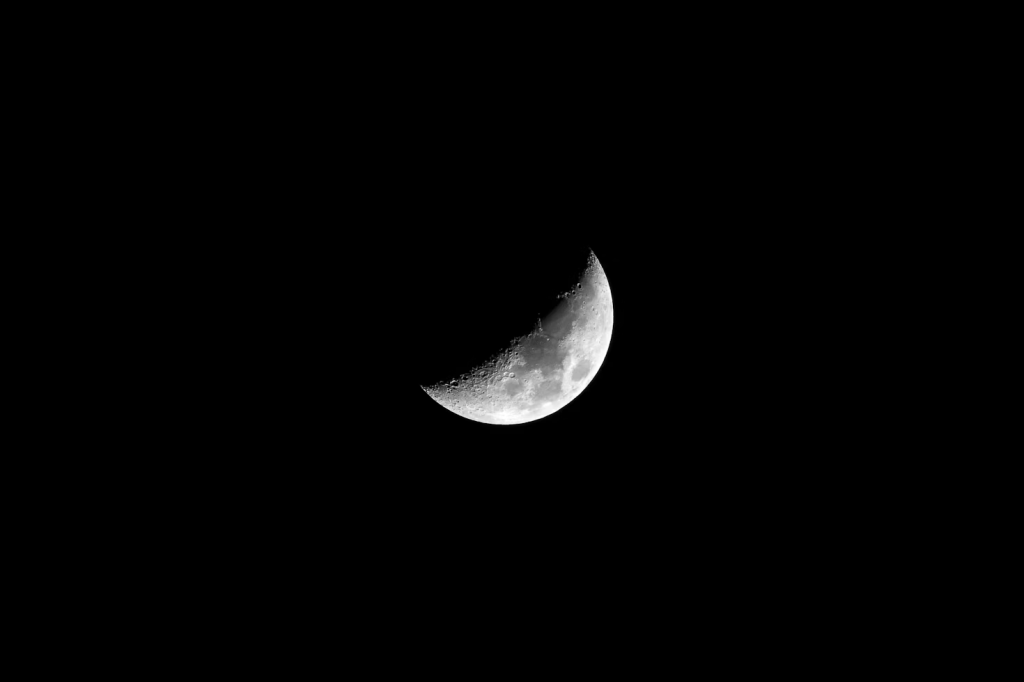
The moon last week through the telescope looked like a golf ball, the dimple-craters and the bright white side imbedded in the mud of the dark side. We looked at it a long time with the perspective Apollo 8 must have had when it orbited the place, moving around it like Tiger Woods circling his next putt.
It’s cold, but still, and the air off the bay bites a bit, and some rustling in the leaves makes me think the fox is around tonight, or a cat from a house through the woods, but it is how it should be–we seem to look at the stars most in winter because it gets dark so much sooner, the air is cleaner, the humidity low.
But last week despite the bright half-moon, the sky was dark and the telescope picked up an amazing nebula all ablaze not far from Orion, shining out from billions of years ago. It is the middle star on the belt and the brightest nebulae up there. I’ve needed perspective lately. When “the world is too much with me” and “life is like a pathless wood,” it is good to look at the same stars as did Copernicus and Galileo and ancient astronomers who saw bulls and crabs and horseheads where I can only see a random sampling of bright dots, like dots on a map.
And the top half of a golf ball stuck in the mud of space.
“Why, I ask myself, shouldn’t the shining dots of the sky be as accessible as the black dots on the map of France?” wrote Van Gogh to his brother, Theo. “Perhaps we take death to reach a star. We cannot get to a star while we are alive any more than we can take the train when we are dead. So to me it seems possible that cholera, tuberculosis and cancer are the celestial means of locomotion. Just as steamboats, buses and railways are the terrestrial means. To die quietly of old age would be to go there on foot.”
I like that, the illusion that death is another mode of transportation, and those we love and lose here are simply on some galactic pilgrimage. I have several books about the stars given to me by my brother, by my son, and I’ve read them, returned to them for reference, for maps, and I have such trouble remembering the names of space stuff. I mostly use my cellphone app, point, and then say with absolute authority, “I’m nearly positive that’s Avior. I think it’s a star in Corina if I’m not mistaken.” But I swear ten minutes later if anyone asked me to repeat it, I couldn’t.
So I’ve started making up my own star names, like the International Star Registry, only specific to Bob. Deep in the Pleiades I can see “Cole,” leaning into the other stars, preaching, pushing them into agreement about the colors he should use to paint Jupiter with all her moons. And what used to be Lesath in the Scorpio constellation according to my Backyard Guide to the Night Sky is now “Eddie.” I can almost hear some Janis wailing from his band of Red Dwarfs. “Dad” is clearly Polaris, my North Star, up there to guide me if I wish, follow him when I’m lost. I wish I had turned to him more when I couldn’t find my way.
Now, I know from these books from my brother and son that the brightest star in the night sky should be Sirius. Orion’s belt points right at it, yet more than a few times I’ve mistaken it for her sisters, like Vega and Canopus. So I’m saving her, putting a sticky note on Sirius. I have a special name for her I’m keeping to myself and will send to the Star Registry—though I doubt they’ll change the name of such an important celestial body; but I will, if only in my mind. And I’m going to memorize her location so I can go outside on a clear night and talk, reminisce, find a bit of permanence in an all too temporal existence.
For the past several years at the college, I’ve had more than a few athletes in my classes. This isn’t unusual when one teaches general education courses, required by the college for every discipline. One of those courses on my schedule every semester is an argumentative course of critical thinking and writing. And one of the hottest topics for quite some time that inevitably comes up during our weekly discussions is, “Should college athlete’s get paid?”
The conversation is partly predictable. This semester a starter for the women’s basketball team is in class, several lacrosse players, a few swimmers, and a rower. Last semester three or four football players. Their contribution to this particular subject is generally predictable; they’re in favor of paying athletes. Go figure. The basketball player, in respect to the rower, said it depended, and that she would not want to get paid if it came at the cost of cutting smaller squads, like the scull team.
The focus we land upon, however, since any argument is irrelevant if you don’t find a particular point to address to avoid butting heads all day, is what is known as a NIL contract. This is when college athletes are paid for the use of their name, image, or likeness in promotions, on jerseys, in gaming. Most agree this seems fair, though most agree it probably doesn’t add up to much unless you’re up for the Heisman Trophy and play for Alabama or Notre Dame. Still, it’s something (above the full ride and other benefits—I’m not arguing this here). In a gross oversimplification, the NIL contract is through a third party such as Nike or Cheerios, not the college, and cannot be tied to performance or choice of schools.
Okay, it’s something. For some not enough, for others more than they imagined. Not everyone is going to be Bronny James of USC Trojans basketball, who makes $5.9 million from his NIL deals with companies like Nike, Beats by Dre, and PSD Underwear. The average NIL deal is roughly between $1000 and $10,000, which is no small chunk of change, but the numbers can be distorted when coaches are pulling down seven figures and some colleges’ television deals seem like enough wealth to share the good fortune with the players who generate the revenue to begin with. But there are more than half a million athletes in the NCAA in this country, and only about 2% of them will ever play professional sports. So on the one hand any NIL contract provided by a company is not going to last long; that is, it is unlikely in 98 percent of college athletes to transfer to a professional deal, but on the other hand for that 98 percent, it is as close as they will come to compensation beyond their tuition, room and board.
But this isn’t about them. I really don’t care either way.
This is about me.
I left class last week with these numbers swirling in my head, walking with basketball player who said she really enjoys my class. “No kidding, Professor Bob, I tell everyone about the class; I look forward to this every single week.” That feels good. We never ever hear it. Like ever. 😊
Player went her way, and I headed toward the parking garage considering something that had never crossed my mind: I want a NIL contract. Why not?
I once wrote a piece comparing my salary over a thirty-year career, total, to Alex Rodriguez’s, who at the time was the highest paid player in baseball. It turns out in my entire career, including cost of living increases, bonuses, overloads, and raises, I will earn, total, what A-Rod made in seven games, eight innings. Something is out of whack. I understand that no one is running to the bookstore to buy jerseys with my name on the back, and that whether I show up on the collegiate classroom playing field or not, students will still come, still take the course, and still graduate. Still, surely the transitory impact of watching a sporting event cannot be measured against the lifelong impact of a college degree. But in comparison to A-Rod you might say I made nil.
I know the college won’t pay me more, but someone can supplement my income, like LL Bean, Vans, 3M paper products. For a small sum I’ll wear a polo shirt with Nike on it and throw a swoosh at the bottom of my course outline. It can’t affect my teaching; and hell, the news stories alone at the beginning will make it worth it for the company. There can be billboards with my name and image, stating, “Prof B uses 3M sticky notes,” or one of me walking into the classroom with my vintage tan Vans, stating, “Walking from his office to classes and back is easier in Vans.” Come on, there’s a gold mine to be made.
It is laughable, of course; a parody of such ridiculous proportions that all I’ve done is made people more aware of the financial situation in collegiate sports.
But think about this: forty-five years after I started college, I can only remember the names of one or two athletes, and at the time, St. Bonaventure’s basketball team was decent under the coaching of renowned Jim O’Brien, going 20-10 and 18-13 back-to-back seasons. I knew a few of the starters and still can’t remember their names.
But I don’t know a single person my age who can’t tell you the names of every professor they had in college. Every one of them; the impact they had, the life-steering energy some of them provided. Every semester, professors have anywhere from sixty or seventy students to one hundred and fifty, depending upon the school. Every season students watch forty or forty-five football players, a dozen or more basketball players.
Yet every semester each student has just four or five professors, two or three times a week, for fifteen weeks. It wouldn‘t kill a company to toss some action our way and gain a reputation for supporting education in America at the same time.
And why can’t the bookstore rack some jerseys with “Kunzinger” on the back. Hell, I’d buy one.
It’s foggy across the river and bay this morning, and out on the bridge a heavy mist blanketed the area so that even seeing the sky-blue girders above us was difficult. A foghorn sounded from the mouth of the river, presumably menhaden boats out on the Chesapeake, perhaps an oyster workboat. It’s chilly, but not too bad. That could be a description of my head, but it’s not. It’s outside my head I’m pretty certain.
The view from this desk is only slightly better. The woods are misty, but the fog lifted. I can see pretty deep into the trees, and the skylight above my head is wet.
Sitting before me is a to-do list. I need to record a few art lectures for a university in Ohio, send edits of a piece to a journal, read proposals from capstone writing students in West Virginia, make a topic list for my writing students down in Norfolk, rewrite twenty pages of the monster—twenty pages about a time in my life when absolutely nothing happened, but something should have happened and that is the point of nothing happening, so that the reader will feel like something should have happened all the while nothing happens at all. Wow. That sounds like a metaphor for life. But it’s not. It was life, once.
And I need to send emails to a bunch of people who I was supposed to send emails to a few weeks ago but then college happened. And deadlines. And basic malaise. Luckly, the Kahlua bottle behind me is still full.
Alternate plan: Sail down to the Gulf of Mexico, teach online from the aft cabin, grab the guitar, play someFogelberg and Cat and Van around a beach bonfire with friends and Malibu rum. Forget finally that social mediahad ever been invented. Go back to wondering how everyone is instead of knowing constantly. I miss wondering, I miss “catchingup,” telling stories about things that others don’t know about yet. But we don’t. We value our homes and the lives we built; we asses and measure in terms of security and balance instead of whim and ideals. Of course. It’s called being mature, something I have rarely been, I suppose. I don’t know why; a design flaw, perhaps? Too much daydreaming when I was young? Not enough classical music?
So naturally I’ll need to stick with Plan A for a while. I wonder why, of course. Not enough nerve? Gummies? Too many responsibilities?
First, though, I need to complete a self-evaluation for the college. It’s a once-a-year thing, not difficult, which includes understanding what I did right, what I might change, how I respond to criticism of others, particularly students, what I’m going to include or exclude in the future, and some sort of game plan. It sounds more involved than it is, and it won’t take long. And after thirty five years of these things, I can clearly see how they have helped fine-tune my work.
Yet recently I realized I should have been doing one of these self-evaluations about my life all along. Five pages about the year, perhaps. Five written pages about what worked, what didn’t, what I need to do differently and proposals of how I might get there. This time five pages might not do it; I messed up in some big ways simply by not doing things, which should be part of any evaluation: what didn’t I do that I should or could have?
Do you do this? Maybe schedule a drink with a significant other or close friend next to a fire, talk a bit, then do self-evals with each other. It’s what I like about the assignment: At least a few other people are going to read it, so I need to be clear, concise, constructive. And so the “life-evals” should be too, whether oral or written. In both cases, honesty is essential. In both cases, brevity is dangerous. The college assignment is two or three pages of actual written self-analysis. That’s just short enough to bullshit with the best of them, which is why I believe it should be five pages; then I’d have to come up with some serious details and examples to maintain info about the man in the mirror for that long. Plus my writing is foggy and misty for the first two pages, even in rewrites, but by the time I’m moving into page four, everything is clearer, and you can see even my metaphorical trees far into the woods.
She’s a 41’ Morgan Out Island, spacy aft cabin with a queen size bed, long and wide main cabin with a navigator’s table which converted makes an excellent writing desk, another two cabins up front and two heads, one forward and one aft. The stove is a good size, and the refrigerator holds more than a few bottles of Kahlua.
What would you do?How do you write this into your self-evaluation? Truthfully.
I guess we’re not always so honest with ourselves after all, are we? I need to finish preparing the week’s lectures, send in the rewrites to the journal, and clean up the monster, clarify I wasn’t doing anything when I was hoping to be doing something.
I heard an interesting comment on NPR last week. When talking about someone who died by suicide, the victim’s brother said he didn’t think his sibling didn’t like life anymore as their mother had suggested, but just didn’t like one particular part of life, and somewhere over the course of time—maybe weeks, maybe months or longer—the poor man hyper focused on that one aspect until it became a monster, blocking his view of any other aspect of existence remotely salvageable; even the finest reasons to continue were saturated with the pain of one part, perhaps even a small part, of life.
On the one had it made their mother feel a bit stronger—that her late son did not despise life, and in particular perhaps not the life she and her husband had built for them, but one thing happened, who knows what, and that overtook him despite the beauty around him. He couldn’t see past that monster any longer, and in his then-compromised view, nothing else existed any longer. Life became about the pain-inflicting monster, so killing oneself seemed the only clear way to end the pain.
On the other hand, for those who still know someone with some form of depression, particularly situational depression and not chronic or manic depression, being able to unearth and understand that aspect of life which has the potential to take over a person’s mind can help isolate it and, over time maybe, destroy it. At the very least the knowledge of the issue might help others keep it in perspective, perhaps even eliminate it.
The surviving brother then, almost off-handedly, said, “I wish we had gone hiking more.”No one picked up on it; at least not on air. But I did. It slid right in my thought process and simmered all day. His brother must have been considering how things might be different if he had helped replace the monster with something more powerful, more soul-owning. For them, apparently, hiking. Had they gone enough times, or consistently enough anyway, for the deceased to have discovered that hiking was his life and he now could own that choice, his routine and whatever negative issues came up—a problem with a partner, finances, even simple malaise that chronically depressed people will never be able to explain—would be minimized by the power found in something positive.
It doesn’t have to be hiking. Could be music, sports, food. But something active, something visceral and kinetic.
I asked my students the other day how much time each day do they spend watching other people live their lives or pretend to live life. That is, how much time are they stagnant viewing other people’s happenings on tv, movies, TikTok, etc. I’m not talking about going to events like sports or lectures or the like. No, those are very participatory. I mean the dead-brained observation we do that when we’re done—or better stated, when we take a break–we are exhausted, and we never did a damn thing.
The suicide rate among college-aged students is about 2 percent, about 1100 per year, and about 25% know of someone who killed themselves, and just over that percentage thought about it themselves, all of them offering as their primary motivators pressure, helplessness, relationships, loneliness, and money.
It takes just one issue to debilitate a person, make them feel hopeless, and all the time in the world trying to balance it with positive acts cannot extract that monster from the mind, and eventually ration slides away so that suicide is not a conscious decision but in itself a rational act to eliminate the pain, which by that point is all there is.
And later people say they wish they knew, they say they would have helped. The man on the radio said, “He asked for help; we told him we had helped him all we could and he had to do this alone.” He was riddled with guilt, but then realized that the way he could have helped may not have been clear to either his brother or him at the time. One just assumes the help one asks for when in a bad place is the only way to help them out of that place, but that’s not always accurate; in fact, it is often hardly ever accurate.“I just should have been there more, called and asked how he was doing more, had lunch,” the brother added. Exactly.
Yes. He should have, but not because of his tragic loss, but because we are humans, responsible for each other, and I am so guilty of not being there for others it is disturbing. I can change that, but there are some things I cannot change.We can at least change the things we can. I’ll leave the wisdom part for someone else.
I guy I knew a long time ago told me a story about a friend who couldn’t see past a bad relationship, a mentally abusive relationship, and saw no way out of it, particularly since they just had a baby girl. In all other aspects of his life he was okay, very giving, impossibly kind to others, but he felt he had nowhere to turn. His mother ignored him, his father tried to help but without emotion, making it difficult. And he thought his friends had moved on. One morning the troubled one called a friend, but the friend didn’t answer the phone. The friend was pretty sure he knew who was calling and that he was probably depressed, but he didn’t want to deal with it at that moment. Three hours later the guy I knew called to tell him that the troubled one killed himself. He told the friend that the widow told him his last outgoing call was to the friend. He thought it would make him feel good to know the dead guy was thinking of him, probably missed him. He had no way of knowing that the man had ignored that very call. I knew these people; and it is easy to say there was nothing anyone could have done, but that simply isn’t true. We just tell ourselves that. Certainly we may not be able to save someone’s life, but we can save some time for them. It’s a tough call but an easy decision; make the call, stop by, go for a walk. Grab some tea.
Give them a reason.
We are here for each other. It’s all we have. We are only here for each other. We can’t save others if they don’t want to be saved, but by trying to help others we just might end up saving ourselves.
I went into class Monday and asked who had read the only assignment for the day, Kate Chopin’s “The Story of an Hour.” One person out of thirty. I want to be clear about this: the story is barely two pages long. I moved my chair to the center in front, sat, and said, “Okay, let me get the straight:” I had Morgan Freeman’s voice in my head. “You graduated high school, applied to colleges, decided to come here, went through whatever financial mess you had to go through from parents to grants to loans, found out what classes you need, packed your life and moved here, came to class, found out what you needed to do, which, again, was to read a couple of pages, and just didn’t bother. Isn’t that a little like hitting a home run but after you round third, you think ‘Ah, screw it,” and you walk into the dugout without touching home plate?”
“You just got here, and you already gave up.”
I’m not making any of this up. One person out of thirty read a story that is about half the length of this blog post. What do you do with that? They’re nineteen years old, on their own for probably the first time in their lives, living with strangers, trying to figure out from everyone else what their lives will be about, and I asked them to read a story written more than a hundred years ago about a woman who’s glad her husband is dead. But they don’t know that because they haven’t read it. I talked about the symbolism, the setting, and the internal monologue. I sighed.
It already hadn’t been a good day. Or week. Or, well, weeks anyway. I’ve been deep in the rewrites of a manuscript which has been bleeding out of my right ear for more than forty years; I started the damn thing during the first Reagan administration. I’ve abandoned it, tackled it, trashed it, and started over, published portions and rewrote all of it a dozen or more times.
A month ago, just as the winter season had kicked in strong here along the bay and I could see the long, moody haul to next spring, which, for some comes with another set of issues, I knew that I wanted this manuscript, this “monster in a box” as Spading Grey once called a work of his, released into the wild. Hell, there are only two characters, so you’d think it wouldn’t be all the difficult.
I tell my writing students that if you have trouble writing something, write something else. I don’t believe in writer’s block; I think that is the result of trying to drain something of value from something that should be passed on altogether, or at the very least addressed some other time. Sometimes there is a piece missing and you simply don’t know it, so instead you blame “block” or distractions or the story itself for being lame. You have no way of knowing that what it needs has not been born to you yet and in time it will materialize. That has happened with this monster several times. No longer.
About three weeks ago when I had been lifting portions of an introduction from writing by Beryl Markam to use in this work, I realized that the narrative is not about either of the two characters: it’s about being nineteen years old. The one hundred pages turned into one fifty. Then two hundred. It is now roughly two hundred and twenty pages long. It’s not War and Peace, grant you. But it’s at least Peace.
And I just received an endorsement for the manuscript from a very well-respected writer in Oklahoma.
And that’s where it’s at as I continue to tweak, manipulating the middle a bit after hearing back from my long-time writing muse in Ohio. She nailed what is missing in the exact spot something is missing but I couldn’t figure out what. Geez I love when that happens. Writing is decidedly not a solo sport.
So I went into the week feeling pretty good. I made a fun video about art of the renaissance for my art history course, and another about the art of the Islamic world. I had some good conversations with my senior creative writing students about their final projects before graduating, and I felt pretty damned good. Yep.
Then Kate Chopin happened. Mrs. Mallard shows up with her not-dead-after all husband and the joy that kills, only to be abandoned as if the story had never been written to begin with.
They’re nineteen, I reminded myself. You just spent a lot of time writing about how hard it is to be nineteen. Give them a break.
“Okay,” I asked, “You knew the assignment, yet you didn’t do it, so why?”
I got the usual responses.
“Okay,” I said. “How’s this”: I mock-typed on a dead keyboard on the front desk, and said to everyone, “Dear Potential Employer, Graduate Director, Grant Reviewer: He can’t even read a two page story he had a week to complete. Nuff Said.”
Everyone laughed.
“My guess is if I had assigned a novel of some length, you’d have at least started it; but this was too easy to wrap your minds around as a collegiate assignment.”
One guy spoke. “I didn’t even look to know it was only two pages. I would have read it. I just assumed that it would be really freaking long.”
Fair point, I thought.
So I cut them some slack. I talked about the story. Symbolism, setting. We talked about Chopin. We just talked. I explained why I chose the story, and I tried to explain how it is relevant to us for knowing what to look for when we analyze something. I looked at the course outline and saw that they needed to read Baldwin’s “Sonny’s Blues” in two days. Baldwin is one of my favorites.
“What do you guys read? I mean beyond TikTok.”
Crickets. I could hear my officemate on the next floor eating her lunch. They all checked out, mentally gone.
“When I was nineteen one of the books I had to read was All the President’s Men by Bob Woodward and Carl Bernstein about the fall of Nixon and how two reporters from the Washington Post brought him down, exposed what we now know as Watergate. I was a journalism major, so I found it interesting, and it was easy reading, but something else was different when I was your age. What do you think it was?”
Same guy spoke up. “Your story wasn’t about a lady glad her husband is dead?” I suddenly liked this guy.
“It wasn’t, no. But I didn’t know that until I READ THE THING!” We laughed.
I told them:
No computers. No games. No phones, texting, TikTok, Instagram, Starbucks, Redbull, fast food joints everywhere, no fantasy sports, no Fortnight. No Cable TV.”
“Booorrrring.”
I laughed but this time to myself. I didn’t say anything because I didn’t want to continue to sound like an old geezer.
“Yeah, in parts. The whole thing was boring for some people. I think we had less anxiety than you do. Less pressure from all sides to keep up with the latest…”
I tried to think what we might have done when I was that age that we would need “the latest” version of. All I could come up with was music. And that really doesn’t bore many people.
“Okay, Professor,” a student asked. She plays for the basketball team and seems focused, listening to whatever I say. “So then when you were nineteen, what did you spend your time doing?”
I checked out.
I thought of my monster. I remembered being that age and how I had infinitely more energy than could fit in chair long enough to read a two-page story about a wasn’t-on-the-train-after-all husband and the now-dead wife he oppressed.
“Get a reading group together.”
They stared at me.
“Get a group together to meet once or twice a week to read the story. Once the conflict kicks in on the longer ones, you’ll want to finish it. But then you have others to keep your attention instead of your mind wandering wondering what others are doing. And you can take turns reading the story out loud, be expressive.”
“Sound stupid,” said the one I liked briefly but no longer did.
“Yeah, it does, but just meet for an hour. That’s not long.” I replied, thinking of all the times I embarrassed the crap out of myself when I was young. “I’m just some old guy to you,” I said to the same one, laughing so he knew it was okay.
He laughed and said, “Yeah a bit,” and we all laughed.
“You know what?” I stood up, gathered my things, and I thought of the monster and of that time, back then, and what happened and how I carry it still, picture it still like it all happened last Tuesday instead of 1981, and I said, “I did nineteen really well. I was really good at being nineteen. Now I’m doing this age. You’ll get here if you’re lucky.” I looked at the kid. “How are you doing nineteen? Hmmm? You nailing it? or are you trying to slide through without having to do too much?”
After about sixty minutes of this, I left and walked to my car more convinced than ever that it is definitely time to let the monster go.
According to the stats page of WordPress, the platform I use for A View from this Wilderness, more than four percent of the weekly readers view it from Israel. None from Gaza. I have been in support of and have promoted the work of Israeli writers for four decades now, including both the journal Ilanot, based in Tel Aviv,which has posted more than a few of my works, and my late friend, best-selling Czech author Arnost Lustig. On the other hand, I have no personal ties at all to Gaza or anyone living there. This is not pro-anyone. This is not anti-anyone. Honestly.
But…
I am not a fan of needless, widespread, pointless killing. Call me quirky like that. So if anything about the following numbers, acquired from the Jerusalem Post, the UN and the WHO, bothers you, you either have difficulty facing the truth or you’ve not done your homework. I have; these are the undisputed numbers.
Killed in attack on Israel October 7th: 1139 people.
Israelis killed since then, 700, nearly all soldiers. Roughly 6000 wounded.
Palestinians killed in Gaza since then: more than 25,000
Including 10,000 childrenkilledin Gaza.
Another 1,000 children in Gaza had at least one limb amputated.
62,000 people in Gaza wounded in life-altering ways.
96% of water in Gaza is unfit for human consumption.
90% of people in Gaza in life-threatening situation from lack of food.(“If your enemy be hungry, give him bread to eat, and if he be thirsty, water to drink! ” ~~ Proverbs (Mishle) 25:21)
16 hospitals still remain out of the 36 pre-October 7th. Of those 16, none have power from more than a generator, and all are “critically close to zero” of medical supplies.
85% of the people of Gaza have been displaced beyond any ability to return home.(“Who is a hero? The man that turns an enemy into a friend.” ~~ Avot Derabbi Nathan)
Honestly, the moment anyone starts defending Israel’s right to kill 10,000 children their argument falls apart.
No one I am aware of has ever spoken against Israel’s right to retaliate after the senseless and horrible attack by Hamas on October 7th, 2023. But their mission has slid definitively over the line from retaliation to annihilation. Simply put, with numbers like those above, the military’s mission is to obliterate not only the citizens of Gaza in their attempts to destroy Hamas, but also to eradicate future generations of Palestinians. Why else on earth would anyone have any reason to kill children—10,000 of them.(Please be clear; this is a reference to the leaders of the government and army in Israel, not the Israeli population at large or Jewish people anywhere).(“They shall beat their swords into plowshares and their spears into pruninghooks; nation shall not lift up sword against nation, neither shall they learn war any more.” ~~ Isaiah (Yesha’yahu) 2:4)
That’s it. If anyone disagrees that the only recourse for Israel was to kill more than 25,000 people including 10,000 kids,I have no interest in a conversation with you.Get your own blog. (“Even on the threshold of war, we [Jews] are bidden to begin in no other way than with peace, for it is written: “When you draw near a city to fight, first offer it peace.”” ~~ Midrash Leviticus R. 9)












 a view from this wilderness