The Rain that Day

There’s a scene in one of the Hunger Games films where Jennifer Lawrence and Josh Hutcherson are sitting in the doorway to their house. The shot is from deep inside the room and we can see them almost silhouetted on the floor leaning against the door frame looking outside where a heavy, steady rain is falling. It’s summer or fall. The door is open yet and they seem comfortable, and it is raining. 

That image stayed with me. I want to call the director and say, “Well done,” you nailed one of the most comforting images I can recall–inside warm and dry away from the storm but close enough to appreciate it. 

I loved sitting on the patio when I was a child, under the canvas awning when it rained, and I just assumed it was raining everywhere, which at eight years old was probably a three block radius. What did I know of everywhere? But that closeness of rain never left me. In Spain on more than one occasion we donned our raingear and walked out onto the Camino to keep going, a heavy fog sometimes filled the air, and on one day near the village of Cee on the way back from Fisterra to Santiago, we couldn’t even see ten feet forward. But here I am eleven years off the Way and I remember that day as if I just walked in the door from the path and set my walking stick against the fireplace stones. 

What is it about the rain? 

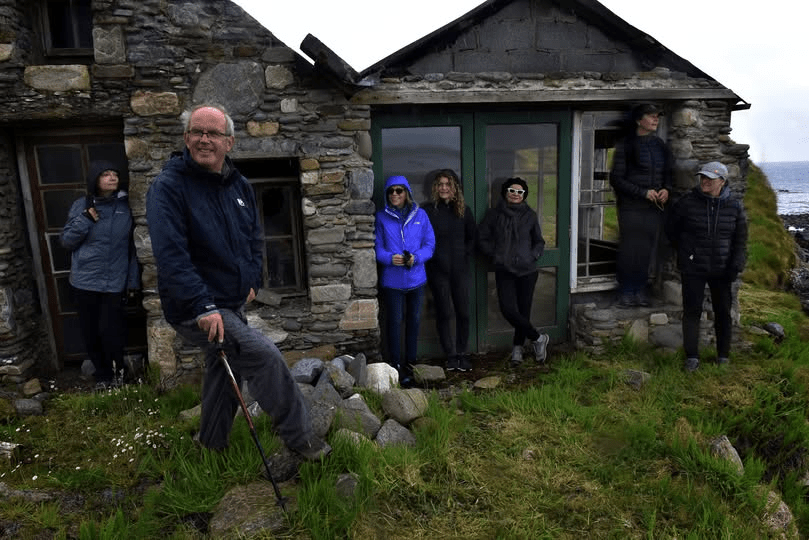
On a trip to Ireland, the only day out of ten it rained was the very day archeologist Michael Gibbons planned to give us a walking tour of the Renvyle Peninsula in Connemara just along the Wild Atlantic Way. We went anyway, along roads and across bogs for a half dozen miles, and sometimes it was only cloudy, but more often a steady Irish rain fell as more of a pleasing accompaniment than any nuisance of weather. In fact, when we walked near an abandoned home we stood under the eaves to wait out a downpour and during the short break we laughed and joked with each other about nonsensical things, but it is the time from the walk we remember most, the moment we all took pictures and realized how stunning the Irish Pete could smell in a rain, and how we didn’t mind, not in the least.

I took a moment just now to look up the history of rain, already knowing the first evidence dates back 4 billion years, and the first mention of it in literature dates back to both Gilgamesh and The Iliad. What I didn’t know until just now is that raindrops are not shaped like teardrops but more like hamburger buns, that one inch of rain over one acre of land weights over 110 tons, that Mawsynram, India, is the wettest place on Earth with more than 450 inches of rain annually, and that rain really does have its own odor, called petrichor, caused by the wetness releasing the oils from plants and soil which then fill the air. 

“The beauty of the rain is how it falls”

–Dar Williams

I love the smell of rain, the feel of it on my back and neck, but my reason has little to do with any enjoyment of being wet, soggy, drenched; it is because I can, because I am here in nature still, well after so many I love have closed the door behind them, all of whom if they could would love to be drenched in the rain with me, and we would laugh at being here, alive, and I’d say how moist I am and we’d laugh even harder. 

I love feeling alive and rain does that, even if I’m just on the patio at an old picnic table sixty years ago and the sound on the canvas above me and the steam off of the sidewalk nearby all kept me present, absorbing the moment before the next one came. How often in life can we be so acutely aware of a moment so that we can hear the nudge of the one that follows? Time is too swift for rain; life is too short for the subtle rise of mist from the pavement. 

“Let the rain kiss you, Let the rain beat upon your head with silver liquid drops, Let the rain sing you a lullaby.” –Langston Hughes

It’s the same with the sun, the feeling-alive thing. The heat and scorch on my neck and back energizes me like nothing else can, and everything around me is hyper-present, like I can feel the molecules, the very atoms of the light, and too of the rain, like the coursing of blood. 

It’s raining now, and I’m going to pour a cup of tea, put on a sweatshirt and go sit on the porch and listen to the rain in the woods and on the porch roof here at Aerie. I’ll let my mind wander and try and remember the last time I heard my father laugh and remember the last time my mother and I talked about nothing at all. I’ll think about Eddie and that time we walked all day in the rain through Heckscher State Park on the Great South Bay, just two fourteen-year-olds who suddenly owned the planet, and we spent all day out there and sang “The Long and Winding Road,” and now when I hear that song I think of rain, and Eddie, and how it always takes me a moment and a shake of my head to understand that day was fifty years ago, forty-five years before he closed the door behind him, and how that rain that day was like a third friend laughing along with us, singing along with us. When it rains now I can have that day again, and I like that. So I walked up here to my desk and settled into this chair and I’ll listen to the rain on the skylight before I turn out the lights. 

“Some people feel the rain. Others just get wet”

–Bob Marley

An Apology to the World

Let’s get a few things straight:

First, the president of the United States is not the “deal maker” here, we are. We hired him to carry out what we decide needs to be done. Sometimes that power is abused; sometimes we need to reevaluate our own choices; and sometimes it simply goes awry and we hire an immoral, indecent, and perverted asshole, but we’ll decide what needs to be done, not him, and if errors continue we’ll find someone else to take the job who will listen to what we say. When that isn’t done efficiently and with our confidence, most of us regret it. Not everyone, of course, but that’s another problem; some buy into the propaganda hook, line and sound-bite. Not because these sheep believe it so much as the methods employed to communicate such crap is so convincing. Huxley wrote in ’58: “The effectiveness of political and religious propaganda depends upon the methods employed, not upon the doctrines taught. Under favorable conditions, practically everybody can be converted to practically anything.”

Or anyone.

Second, the president often makes executive decisions we don’t like. Our support of US troops, for instance, should not be mistaken for a belief that most American’s think those same troops should be sent to North Korea, Somalia, Venezuela, or anywhere else. Additionally, many Americans understand true Islam is not what the president is mouthing off about, and most Americans know that the environment must be our primary concern. I’m sorry if the president and some people around him leave the impression that Americans stand behind destroying the world either by imminent destruction because of childish and irresponsible hyperbole or by some slow erosion through pollution and overuse of natural resources. We were doing fine until about a year ago. Forgive us. We are embarrassed by the president’s inability to recognize his mistakes and refusal to reverse bad decisions out of some false sense of pride.

But that is not what we need to apologize for, though we’re really sorry for that, too. No, what sits atop this mass of mess we’ve helped make is the greatest of ills for which perhaps no apology will suffice: we’re sorry we are not what we used to be. At one time Americans created a constitution that rewrote how government should be run. The world turned toward us with respect for our progress. We didn’t suddenly succeed at nearly everything we did—military, invention, science, medicine, and engineering—because of our population: we’re not that big. We didn’t surpass the expectations of critics from Czars to Monarchs because all Americans got along—we disagree with each other perhaps more than most citizens in most countries; that happens in an experiment like ours which is why dissent is written into the Constitution. In fact, the constitution encourages it, particularly free speech. With that model, we made good on our word for two centuries, and when we had problems of our own—the Civil War, Slavery, Civil Rights, Women’s Rights, political scandals like Watergate, LGBTQ+ rights—we dealt with it, sometimes aggressively, sometimes diplomatically, and sometimes poorly, but we dealt with it and moved on. No longer. No, now, I’m sorry to say we attempt to bury our faults beneath distraction and fear. We simply are not what we used to be, and that isn’t fair to our future or the future of countries which turn to us as an example.

The truth is, the United States as we knew it is ill. Its heart is filled with fear and unsubstantiated speculation, and when executive decisions are coupled with personal attacks, degrading and racist statements, and absolute ineptitude, a change has to happen. This country does not have the moral strength it did in its youth, and any artificial means of sustaining life will eventually collapse to the reality of this false resuscitation in some pathetic tagline like “Make American Great Again.”  Honestly, most of us are too smart for this. Patriotism has always been the backbone of this country; but it had always been a patriotism built on pride—the pride that came from making the right decisions, following the right paths, no matter how hard; it was a patriotism built on the backs of dissidents and soldiers who knew how to fight for our freedoms without compromising them. It was not false; it avoided the trite sound-bite built by committees and marketed to the mob who drive about the country with flags flying from car antennas.

But many here have bought into this new, veneer patriotism. It has a different grain, this national pride which permeates every aspect of American life. It’s a patriotism balanced on fear and propped up by stimulus-response. It has not the historic sense about it the world so respected and tried to emulate in decades past.

It is Lord of the Flies here right now; it is the reactionary leader creating a monster he is set on protecting us against, silencing the dissent of investigations like most dictatorships do, convincing us the one who leads with reason and diplomacy will place everyone in danger; it is Moby Dick, with Ahab determined to commit suicide against an unassuming nemesis solely for revenge and not to advance some greater good. It is the tragedy of the ages, the fall of an empire. It is our own fault, and we’re sorry. No one here is happy about this.

No one here is happy when the president declares he is a deal maker not a diplomat; when he pushes aside world leaders to get in the spotlight; when he ridicules mentally or physically challenged people; when he badmouths journalists—the very soul of a democracy—when he treats women like objects and brags about it; when he lies about his accomplishments; when he makes fun of anyone who disagrees with him, when he destroys national treasures and institutions without permission, when he associates with pedophiles and criminals and lies about it, when he fights the judicial system tooth and nail to keep food aid out of the hands of starving Americans.

This man is an embarrassment no matter how far to the left or the right he might stand. This is about human behavior. We were supposed to be a better example than this. We were supposed to provide proof that humanity had it in its collective power to accept the ways of many people and, based upon a common constitution, work together. Our proclamations promised in writing the rights of liberty and happiness—amazingly, for the first time in recorded history. And it worked for a while. Oh, the democratic principles of our founding fathers remain the cornerstone of any government that hopes to rule without revolution; that aspires to last longer than its military forces allow. We were really good at it, too. But who isn’t embarrassed by the fall of a good example? It is, perhaps, worse than watching some wretched foe attempt to lead you into the abyss; for after proving oneself worthy, after placing oneself in the position of respect and admiration, after followers line up blindly trusting this once-great prototype of human justice, to bend toward being an aggressor, to bring the balance of criticism against the once seemingly-faultless government, is nothing short of deplorable. We preached to the world that our way of life should be emulated and respected; and certainly for some time it was. But we’ve become the spoiled athlete with talent and power who bends rules to benefit himself. Watch closely then because we are truly falling. And it is undoubtedly because of a small group of demented leaders manipulated by the current fascist president.

Talk about inappropriate behavior in the workplace.  

We are not on this slippery slope because of some foreign power who takes issue with our self-worth; no, we’ve made it here on our own. We spend more time studying the drinking habits of bad actresses than the decisions made in congress. We propose new governments to foreign lands while our own executive branch is under investigation; cabinet members disagree; both major political parties prefer there were only one party; what the president says is cause for war both domestic and international; race relations are once again in turmoil; the president wants to literally build a wall between us and our neighbors; we spend more on fast food and gourmet coffee than we do on education; we don’t handle natural disasters very well; violent crime is higher here than in most countries on the planet; our jails are saturated, and our waterways are polluted. And all the while we spend a great deal of energy telling other countries how they should act and what is wrong with their leaders and policies. Are we right? Perhaps, but we’ve lost credibility, and many of us would rather our leaders simply keep their mouths shut for awhile and let the world, as Mark Twain said, believe we are stupid than open our mouths and remove all doubt. Please, just for a short time while we straighten this out, could everyone look away?

We are so sorry. We may have earned the position of respect and reverence in the past, but it is not automatically renewable. We should not follow up these successes of domestic and foreign programs fifty years ago with a new foreign policy based upon “gut feelings.” The primary fault and eventual downfall of any great nation is hypocrisy.

We weren’t always this way. When we recognized our own hypocrisy—slavery, for instance—the collective power of this country’s citizens demanded we set it right. Now we call for executive privilege as if we’re ordering a pizza. We refuse to testify like we’re turning down dessert. We’re scattering troops about the world like it’s a Risk board and the only place left to put a few cannons and horses is Kamchatka. We refuse to accept the ideas of other nations no matter how many are unified against us, and we withdraw from treaties set up to protect the globe solely to protect our wallets.

We’re sorry our leadership often acts and speaks less than presidential. Listen, lots of people here make fun of our president. They make fun of his tweets, his verbal sweeping generalizations, his inability to act like a mature adult. Yes, it’s embarrassing– the world has made that clear, but you don’t need to tell us.

Believe me.

Newspapers in countries that once turned to the United States for leadership and guidance mock our president on a regular basis, emphasizing his flaws, using his fallacies as some proof that America is not what it used to be.

And it’s not. And we’re sorry, but the rest of the world needs to understand how this works. When we collectively decide he needs to be fired, we will do so. For now, disagree as we might, our system is set up so that other branches of our government hopefully pull up the slack. This type freedom comes at a price, and we don’t always make the right decisions. But they’re our decisions, and while we deeply apologize for not maintaining our past strength and dignity, that respect was not earned by any one president or any single policy, but by the collective efforts of the American people and supported by the finest constitution in human history which guarantees rights that have made this country work. Rights such as the one that states anyone born here can become president. Anyone.

Even this asshole.

constitution-page1

The Years Just Roll By

Like a broken down dam…