Just, before Dawn

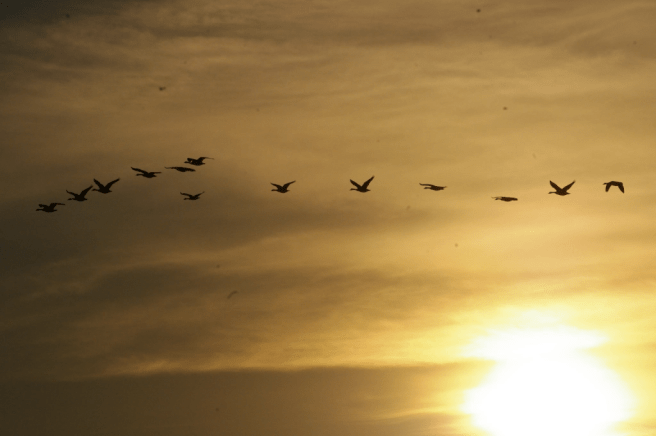
I rose early this morning since I needed to be in Norfolk by 8. That’s okay, though. I am drawn toward the early morning hours of dawn when I feel ahead of the world, and I can sense some small hint of hope. The geese flew by headed to the river, and to hear life around the water in those moments motivates me. Before the sun rises, often just after the first sliver of light reaches up across the bay, I can hear osprey and other sea birds who at that hour never seem to mind my presence.

But earlier, when that glimmer on the eastern horizon is still merely a possibility, I have taken to walks by moonlight, sometimes not even that. In the woods where I live and down along the water, something is going on. There is life out there wide awake and moving through the dark hours like spirits who need to finish their errands before the sun gives them up.

Fox come about the edges of the woods looking for scraps of food or the peels and rinds of bananas and melons. I can stand patiently off the side of the drive and one fox will wander across the yard from the woods behind me to those on the south and stop before disappearing again beyond the laurel, and he will stare at me, relaxed, nosing around the base of a tree where I occasionally put food. Then he’s off—not swiftly or in fear, but nonchalantly, demonstrating that he lives here as well and has decided to stretch his legs. That’s all.

Owls, too—some barred but mostly screech owls, perch in the oaks and elms, sometimes swooping down and moving through branches with precision. But my favorite are the geese which cover the night sky in flocks sometimes so enormous the swoosh of their wings alone creates a breeze, and their call to “Go! Go! Go!” is startling.

Closer to home, out front near the edge of the trees, deer nearly always feed on the dew-soaked grass and often the hostas, and if they sense me sitting on the porch or standing in the clearing, they will look up, briefly, ears turned forward—just for a moment—and then return to their grass, not minding me, aware just the same.

And it is then, when I am well acclimated with the night and my eyes have adjusted, and my soul too has adjusted, that I think of my way in the world, the motivation behind the turns and hesitations, my purpose of this passing in time. Oh, do I ever have an internal monologue underway with long-gone friend now gathered in my nocturnal imagination. There’s Cole nodding his head and insisting I follow my own path. I can hear him clearly when I’m out there, see his small sardonic smile as he says, “Come on Kunzinger. You know how to do this, stop waiting for approval or it’s never going to happen.” And there, too, is another friend whose smile is as wide as dawn pressing his sense of adventure into my spirit with an “all or nothing” carelessness about him which brings me up short yet livens my ambition. In one brief moment I am eased by no longer thinking of them in the past tense, but just as quickly, we all move on; usually just as the sun surfaces.

The sky in the distance across the reach lightens ever so slightly, from dark, almost Navy blue to something slightly more pale, like powder, and I’m alone again—the fox rushing off into the woods, the geese at rest in the harvested field or at the river’s edge, and the murmurs of chickadees and wrens and cardinals chase away what’s left of the stillness, and even my friends bow off, and I have trouble separating memory from imagination. So I get in the car and head south to the city where I simply don’t belong.

It’s as if time offers a small reward for some of us who stay up late or get up early to gather as much out of our moments as we can. Then, just briefly, it eases me back into this new reality I never anticipated. It remains for me the most honest time of day, the most just, when all thoughts have a chance of pushing through the darkness, and the truth about what we are here for is ironically illuminated.

I’ve started to live for the deep hours of the night at the twilight of dawn.

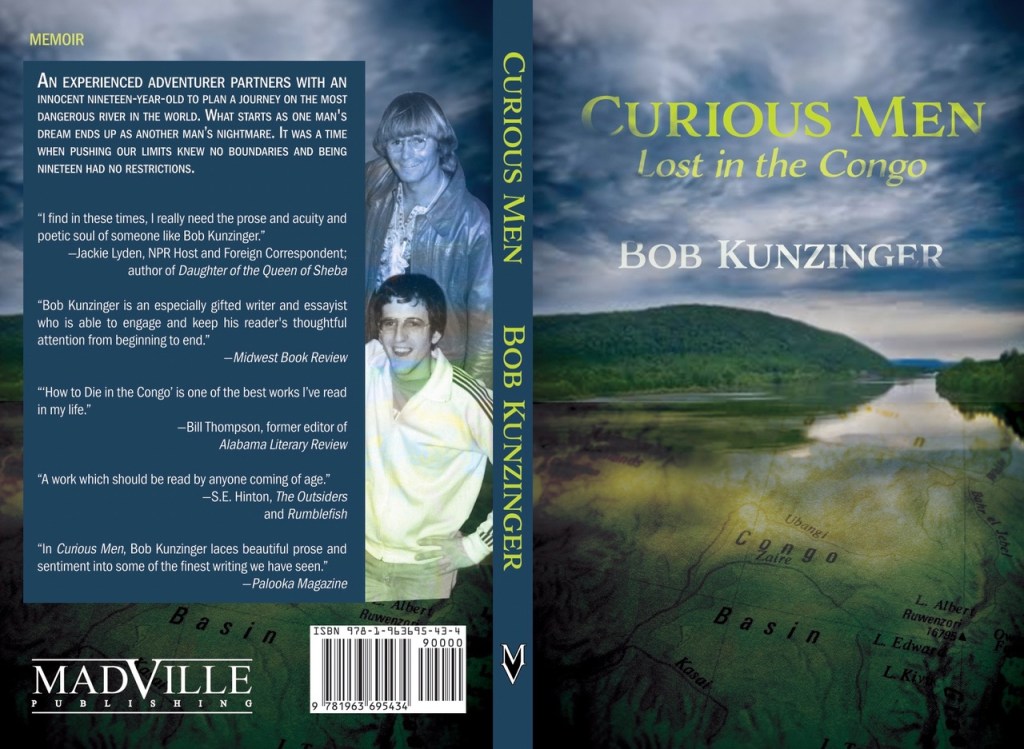
Curious Men: Lost in the Congo

The Allegheny River, Allegany, New York

Memory is as fluid as anything in our lives. What happened and what “seemed to happen,” as writer Tim O’Brien points out, can often be confused. When looking back we might have a habit to recall what seemed to happen, reality having been washed and hung out to dry over the course of decades. Sometimes though we can recall nearly ever nuance of a time in our lives for its significance, its uniqueness, or its romance. I have a pretty sharp memory when it comes to many events. A friend of mine and I were talking not long ago about how we can both remember nearly every detail, everything, about a period in our lives so long ago you’d think it was from another life. Many of us have times like those which, for whatever psychological reason, we can summon up to the point of remembering the clothes we wore on a particular day.

My basic memory for most things is pretty solid. I remember all my phone numbers and license plates, and, worse, the phone numbers and license plates of friends of mine. The old joke about song lyrics holds true with me, but so do the times spent with extended family. One of my only memories of my paternal grandfather was him weeding a lot he owned next door to his house on Long Island. He died when I was five, so I was no older than that, probably still four. But I picture that day, those moments, perfectly.

Some years ago when Meanwhile in Leningrad came out, someone asked how I can remember the conversations I had with survivors of the Siege of Leningrad, who at the time I knew them were in their eighties, and I wrote the book several years after our conversations. I said, well, first of all, they’re never going to find or read the book, so there’s that. But more accurately, when a woman sitting on a bench holding my hand tells me about dragging her dead husband and son across the city to leave in a mass grave, and she sat with me clinging to their photograph sixty years later, I will not forget any of it. Much of the writing in that book falls in that category. Did the conversation happen verbatim? Doubtful, but the gist of it is pretty damn accurate. There’s an old journalism method that when you write the piece and include quotes from someone, call them up and read what you wrote to them and ask, “That’s pretty much what happened, right?” Nearly all the time they’ll say yes. Can you remember the words, exactly the words, you spoke an hour ago? Exactly. If that’s not possible as in this case, I rely on memory and notes.

Memory is reliable or not depending upon just how present we are during the event. That time so long ago when we said we could remember everything: We were both very much present at the time, we lived the example of what would later be called “mindfulness.” Of course we remember. Likewise there are times I so shut out of my memory it’s like they never happened at all.

Still, some events are so close to my soul I would need the team from Matrix to come extract them.

Like what happened in 1980 and 81, when I was a freshman and sophomore in college, the subject of my forthcoming book, Curious Men, from Madville Press. Of that time then, I remember everything. I watched, studied, and listened so intently that this memoir could be considered a documentary for how clear the details remain to me four and a half decades later.

I like that “memoir” includes the Spanish word “oir,” to hear, because much of memory stems from what we hear, and as a nonfiction writer I am bound by listening to the world around me, sometimes to the one sitting in front of me, and those sounds of vowels and consonants and the musicality of language I know will never escape my recollection.

My friend, colleague, and former officemate, Tom Williams, once introduced me at a reading as a non-fiction writer by saying, “Here’s some shit that happened to Bob and the best he can remember of it.” That’s pretty spot on. Despite a degree in journalism, I never had what it took to do the job in the traditional sense like so many I graduated with, some of whom have won prestigious awards for their work. I was definitively not up to that task. But I could handle the feature work, the “Let me tell you what just happened to me” work, just fine. In college, my friend Deb used to help me with news stories and I’d help her with features. We knew our strengths. I had a column in the college paper for which I ventured out into the community and did something, and then I wrote about it. I went horseback riding in Machias, New York, flew planes in Wellsville, kayaked the lake in Allegheny State Park, and sat on the ground behind campus at Merton’s Heart. Those events I could remember. I knew how to be present. Most of those activities were out of my wheelhouse at the time, so recalling what happened was easier. I was paying closer attention, sometimes just so I wouldn’t die.

Memoir is like that. If we can’t remember it we’re certainly not going to write about it.

But not this time, not this book. Summation: As a college freshman uninterested in the normal activities of my floormates–that is, drinking and drinking–I felt lost and disconnected from everyone. Then a family friend returned from the Peace Corps and asked me to help him plan a trip, solo, on the Congo River. So I did.

Long story short, it didn’t work out and his trip became mine. The first half of the book takes place in western New York. The second half in the Congo.

Still, that’s not what the books about.

Most of it takes place now, in every classroom across America where nineteen-year-olds sit and try and find something worth doing, something that reaches deep inside them and wakes them up. I’ve been staring at nineteen-year-olds for thirty-six years and one thing hasn’t changed: they’re scared out of their minds. They’re alone in a new place far from home living in a room this size of their car with a total stranger, and every adult within earshot constantly wants to know their plans for their major, their careers, their lives. It is often unbearable.

I was exactly like that back then. Until a friend walked into my life and said, “I have an idea. I need your help.”

We were so young.

So that’s what this memoir is about: About that time back then. What we did and how and why we did it, yes, but mostly about being nineteen and far from home looking for a reason to exist at all.

This is how I remember it.

Coming this winter:

The Rest of Me

I ask my students the same question the first class every semester. I pull a chair into the middle of the front of the room, ask them their names and where they’re from, and we talk about the area, hobbies, majors, quirks, travel favorites, and more. Half the class—I find it a priceless investment in time as they warm up, get to know me and each other, find themselves more able to talk throughout the semester, ask questions, share ideas.

Then I sit quietly for a second and ask them the same question every time:

What are you capable of?

What do you think you are capable of? I don’t mean “What do you hope you can do?” but what tangible proof from previous experiences has convinced you it is worth reaching out a little further than your grasp this time because you know you can do it?

It’s not an easy question to answer because it is difficult to know if we can achieve that which we have not yet attempted, so at best we need to guess. And even the most educated guess is still hypothetical. Yeah, I lose a few at this point, but I usually can reel them back in by jumping that chasm to the goal. “Okay then,” I continue. “What do you wish you were capable of?”

I remind them that unfortunately, every semester the evidence gets worse that freshmen in college are capable of anything other than having technology complete their assignments for them. I insist, then, that one of the finest results of college beyond the degree and the friends and the job prospects is the sense, the absolute pure sense, of accomplishment. To achieve something, to find out we are capable of so much more than we thought, becomes part of one’s bloodstream.

I asked myself that recently, the Capable Question. It was my birthday, sixty-five years to the day after I showed up at the now defunct Shore Road hospital in Brooklyn; one year to the day after Letty “closed the door behind her.” I looked back at what I have done with my life, who is in it and who no longer is, and who is again, and the good news is I’ve been around the block a few times and that’s one thing I always wanted to do. The bad news is as it turns out the block isn’t in my neighborhood.

Sometimes I don’t know where the hell I am. For a person who has traveled as much as I have, I still need direction an awful lot of the time.

So I asked myself, “What are you capable of?” I figure I still have a couple of decades, surprisingly. Maybe more on a good day, maybe just a few weeks when my mind downshifts. But let’s call it twenty years.

I just agreed to a location to perform a one man play in New York. My book Curious Men comes out in just a few months. My book Office Hours comes out in about eighteen months. My fig trees need watering. I’m thinking of getting a new cat or two. Maybe a dog. A goat for sure.

A few months before she died, Letty and I sat in Starbucks at the beach and after a lot of laughing, she said, “I always thought I’d be here past sixty-five, Bawb. I just never thought it would all be over; my life would be completely done at sixty-five.” I nodded. I tended to avoid trying to come up with a response. She didn’t want one. She wanted me to listen, to hear her existence, to be there while she was being alive. After a while she leaned forward and said, “Since I’m not using the rest of me, you can have those years. I trust you to use them well. What will you do with them?”

I thought about it like she had some power to give me twenty more years. “I am going to walk the Camino de Santiago again. I’m going to drive through the northwest for a few weeks. I’m going to take a river cruise in Europe with a friend of mine. I’m going to camp in Havasu Falls.”

“…and?”

The perfect response. “And?”

This is all to bring up a point:

After something I wrote went online about a month ago, several people, some I don’t know, wrote to tell me how good it is that someone my age still thinks I can do something new. They wanted me to know how much they are behind me no matter how outrageous it is that I’d try something besides enjoying retirement.

Two things here: One, I have no idea what they’re talking about. And two, Seriously? I mean, I’m sorry you took a nose dive as soon as you were eligible for Social Security, but I can’t wrap my mind around that mentality. Maybe it’s because retirement is somewhat irrelevant if you never really worked to begin with, but also in the world of arts, in the realm of love, there is no “retirement.” You can’t turn it off, you just can’t. And I want to spend my time with people I care about, seeing things together. I felt the same way when I was in my twenties. Did you guys grow tired of those you know?

“Someone my age” my ass.

I’m not going to republish the litany of accomplishments by people in their seventies and eighties. If you understand then you’re not sitting around lamenting anyway; and if you don’t, you’ll just shake your head.

I have done okay until now, and parts of my life turned out to be riddled with circles, as if Einstein was right—there is no actual “time,” humans have just made it linear so we can comprehend our passage here. Well, I’ve never been good at staying inside the lines anyway.

Honestly, I don’t know what’s going to work and what won’t work from day to day. I just hope for the best for the rest of me.

But, at the risk of being in over my head, here’s my plan: To speak my mind, about love, about hopes, about what is working and what is not. To keep writing as long as I have something to say. To fulfil some plans that I can’t shake.

I’ll retire when I’m dead, and then I’ll close the door behind me. If something should happen to abort those plans, feel free to take the rest of me and see what you’re capable of.

My Left Turn

When I was sixteen, I spent part of the summer living in Granville Towers on the campus of UNC Chapel Hill with fifty one other high school students from around the country, including my best friend and tennis partner, Mike Russell. We were there for the National Radio, Television, and Motion Picture Workshop. We learned much about all of these mediums, and we made several films. I knew already I wanted to be a writer and a filmmaker, and some years later was actually accepted by USC Film School during my junior year of college, but I opted out of Southern Cal and headed to Mexico instead. The first of a series of moves to avoid committing to anything.

I’ve always believed eventually we live out our lives as they were meant to be, but not always the way we thought it would happen.

To that end, here’s what happened:

In the fall of 2026 I’ll be performing in a one man play at a theatre in the Catskills. After the three days of performances, a full film crew will arrive and we will spend the week shooting the play in the theatre with all the perks–lights, sound, make-up, sound engineers, and then post-production to turn it into a full fledged, albeit experimental and theater-like movie, which will be sent to Indie Lit Festivals and Streaming services everywhere.

“Front Row Seat” is about a professor on the last day of his career while he packs up his office, and what he files away triggers stories and memories, and philosophy, through his career, including too many tragedies and a lot of laughter. His observation of the behavior of nineteen-year-olds over the course of nearly four decades is a reflection on the changes in society, education, and family life, with always a sliver of hope.

Important note: The most impact this production will have is no-cost distribution to high schools and colleges throughout the country so students understand going in what they need to do and what not to do. These aren’t simply “stories” from an old guy leaving his job. They are carefully composed movements which together expose the deep-rooted aspects of college life that keep students from succeeding. Please help. This is truly an investment in education–as well as an enjoyable play/movie. 

I started writing “Front Row Seat” many years ago and I kept adding stories; stories that included anecdotes, like the student who plagiarized me, and one who plagiarized my cousin, the one who threw a desk at me, and the Russian student who freaked out when I spoke Russian to him and he ran full speed out of the building and was never seen again. The brilliant student who became a friend who almost got killed on a study abroad trip only to come home and lose her life to her ex, and the poignant and often horrific stories from military students who came home from war with a different kind of education. There was that paper that belonged to a student who was shot and killed while at work the same time I was grading her paper, and how it took me years to throw it out, and the confrontation with a gang member in the bathroom late one night when I stayed to do my own work. Yeah, I had enough material for a play and a book

Hence, my forthcoming book (2027) Office Hours. But the “performance” part remained, and after several more years of ironing it out and trying out pieces of it to various classes and seminars, I knew it was ready. I’ve consulted with friends in the entertainment industry who, behind the scenes, steer me in the correct direction, and instead of “trying this play thing,” I decided to, how shall I say it, go all in on this. This isn’t me “taking a shot,” at anything; this isn’t getting my feet wet. This is me jumping off a freaking cliff with plans to land right in the middle of the Catskills with a full-fledged, professional film crew, editorial consultants, a PR person, supportive friends. Confidants, really, and a killer script.

So, we’ve started an Indigogo campaign for supporters, including the prized “Executive Producer” roles (the money people), tutors for acting, with still another year to fine tune the material. This is not hotel management or health club management. This isn’t teaching college, though it is about that. This project is a whole new way of life, and it is important. High School seniors and college freshman throughout the country will want to watch this movie. There’s no preaching, just reflection and regret, anecdotes and apologies.

Imagine that; a one-man play on stage in the most artsy community in the country, and a film capturing it all for distribution. That’s my life now. I’m still teaching college, of course. I mean, I could always use more material. But look, I found the people who are the best in their field and can remain a step ahead of me when I explain what I have in mind, and people who all you have to do is make a spark and they’ll burn bright for days on end.

I found the people who know what they are dong.

Something had to change. I decided it would be me.

Click Away:

https://igg.me/at/bobkunzinger/x/35964663#/