Looking for Space

I don’t fit in. That’s okay.

When I was young I certainly had friends, but I was never completely comfortable around anyone—it probably explains my ease in front of a crowd instead of in a crowd. When I was growing up, Eddie and I would wander the state park and sing, and even with him, my best friend, conversation came with a melody and lyrics. Things don’t change. Honestly, I’m much better and more myself in front of two-hundred-fifty people or more than I am with three or less. The art of small talk has always eluded me; in fact, I wrote a relatively successful piece entitled just that, “Small Talk.” It’s not my thing.

I could never involve myself in the minutia of life. I was always better at big picture jobs—a hotel, a health club—where the objectives were clear and the conversation was kept to a minimum. So you can see the irony coming, right? Yes, thirty plus years teaching and discussing and reworking writing by college students, very often one-on-one. I always fell back on my health club training. That is, I became not so much a professor of grammatical skills or syntax as much as I was a motivator.

Big picture themes. That’s my wheelhouse.

So I never fit in at departmental meetings or brown bag discussions. In those places my mind shut down when endless conversation ensued about how to word one sentence of a document or the need or not the need for the Oxford comma, and on and on and blah blah blah and whomp whomp whomp…They didn’t want me there anyway. They didn’t mind me there, but they knew–I knew–I had no idea what they were talking about, not because I wasn’t smart enough; I just didn’t care so much and it showed. I didn’t take it personally. They argued about policy and pedagogy and pedestrian approaches to the diaspora of whatthefuckever. I watched a hawk outside. It seemed more important.

I went to a high school reunion a few years ago. I knew just four people there. Kathy, her sister Patti, our friend Michele, and…okay three people. In retrospect that makes sense—I didn’t really do much in high school. My friend Mike and I did announcements, and that left the appearance I was involved, but I wasn’t. There was a mic, a room, and hallways between me and everyone else. Perfect.

In college it was the same. I was very involved, but scrutiny of that involvement is illuminating for me. Radio station (alone in a studio talking to the campus); coffeehouses (alone on stage in front of a crowd of people I couldn’t see anyway because of the lights); weekends with keg parties and drunken floormates found me borrowing a car and heading for Niagara Falls alone or with one friend. I was more comfortable around the resident directors and priests who were often alone in their apartments, or driving to Canada, then my floormates.

Throughout my life, even when I did participate, what I participated in is defined by the singular concept of “one.”

Tennis is an isolated sport.

Guitar can be played without accompaniment.  

Writing. Oh hell, I’m not even there when I’m writing.

Walking. Hiking. In college it was the Allegheny River, in Tucson I’d drive down and wander the empty streets of a Mexican village, and in New England I’d hike to the top of Mt. Wachusett where kettles of hawks kept my attention for hours.

Nature.

I find myself more comfortable in nature because it doesn’t mind failure, it pays no attention to shortcomings and disappointments. It simply allows us to exist as we are without judgement or ridicule. It doesn’t care who is in charge. And in the end, Nature is in charge anyway.

This afternoon after the storm I sat on some stones at the river and watched the choppy waters, the heron gliding across the duck pond toward the marsh, a kingfisher perched on a wire, and the distant, dark clouds building again, bringing more rain again.

It was a few moments of absolute peace of mind.

A thought about this: The peace of mind thing is not easy to obtain. It is not an absence of sounds and conversations, it is an internal escape from one’s own internal disturbances; the constant interior monologue about everything from the practical (money, transportation, deadlines) to the emotional (sick friends, relatives), to the fleeting irrelevance in life that get their claws in your thoughts and won’t release. So finding peace of mind is not easy to do just because my surroundings are quiet and natural; it just makes it easier. I have found peace of mind in the midst of a thousand people and felt trapped inside a panic attack when alone on a beach. This is definitely a mental thing.

So I sat on the rocks in a rare moment of internal quiet, the still waters of my mind undisturbed by some psychological pebble, and I looked calmly across the river and realized something profound: nature doesn’t necessarily want me there either. It was not created for humans, it is not set up for people. It’s why the heron flew off because of me but not because of the egret or the eagle or the osprey. It is why the tide will ebb and flow based upon the natural phenomena of the moon and the sun, gravity and storms—not because of anything or anyone anywhere.

Nature has a whole other level of confidence. Still, it’s as close as I have come in life to being myself, being out there. Hiking in the mountains, canoeing, simply walking down the coast toward some other where.

Some people never find their reason for being here; they let the world saturate their thoughts like a swollen river and swallow them, giving up, giving in, letting that minutia like money and disappointing others get the better of them. It’s easy to do; it happens. I suppose most people don’t ever feel completely comfortable around others, a bit of self-consciousness slips through. But for me it isn’t that, exactly. I don’t feel uncomfortable around others; I’m okay in my own skin. It’s more of a feeling of always thinking I should probably be somewhere else.

Counselors have said since counselors have been saying things that it is essential to find your place in the world. I agree. I’m not sure I ever will, but I certainly agree, and at least I know where to look.

I’ll be outside. Don’t come.

Bulldozer Leadership (and herons)

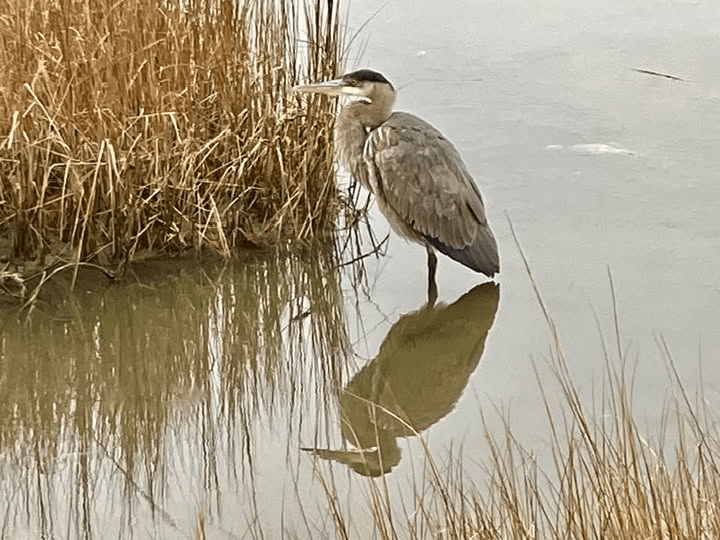
This morning a heron—the same one that seems to be there every day all day long—caught a fish in the icy pond at the bottom of the hill. My presence didn’t disturb her as she fished out small crabs and one six inch or so fish. She seriously did not appear to be stressed at all; not even when my phone rang. I left quietly so she could eat in peace.

It’s the morning of January 20, 2025, and here at Aerie along the Rappahannock River and Chesapeake Bay, it’s cold; temperatures won’t rise above 35 degrees Fahrenheit. It’s sunny, which somehow saves the day.

There’s a transfer of power taking place today, fyi.

Strength has two determinants: The ability to overpower if one so desires to do so, and the ability to refrain from such actions simply because one can. The first is the result of many factors including money, relationships, status, and position. The second is the result of character. It is a symptom of intelligence and humility. The vast majority of leaders in history shared the first, but only the truly “great” leaders embodied the latter.

True strength is the ability to overlook, to forgive, to accept without judgement, and to understand without pretense. Any other action is usually a characteristic of those who fear, those with low self-esteem. The need to overpower the weak and degrade the defenseless is the result of an absolute conviction no one but them can possibly lead, so they simply use what can best be described as “bulldozer leadership” by using the mechanisms at their disposal for their own sense of security, albeit a false one.

Strength is the ability to accept criticism and learn, the ability to recognize the truth despite its contradiction to one’s own belief system and accept that truth. A true leader delegates and discerns instead of dictating and determining.

The Reverend Dr. Martin Luther King, Jr. seemed to embody those characteristics. He recognized that the true power was when the people stood up—or in some literal cases, sat down—for what they knew was right, to destroy what was unjust and degrading. He knew such an ideology could mean his death from those without the strength or character to accept that truth. But he also knew that true leadership perhaps above all else means sacrifice for the greater good.

I am spending today at the river, watching the heron feed and the geese fly. The ice on the tide has gathered for more than thirty feet out and that hasn’t happened here in several years. At the Bay the current is strong enough to keep from freezing, but Buffleheads dive and rise continuously, oblivious to the goings-on just 100 miles to the northwest.

I wish things were the way they used to be, when leaders acknowledged, even if only publicly, another’s victories and strengths, when there was hope for inclusion and safety in truth. I really do.

Dr. King said, “A genuine leader is not a searcher of consensus but a molder of consensus.” Where is that leader?

I’m headed back to the heron to watch her eat fish. It’s going to be cold for a while, but I have hope things will change. King also said, “We must accept finite disappointment, but never lose infinite hope.”

SAD

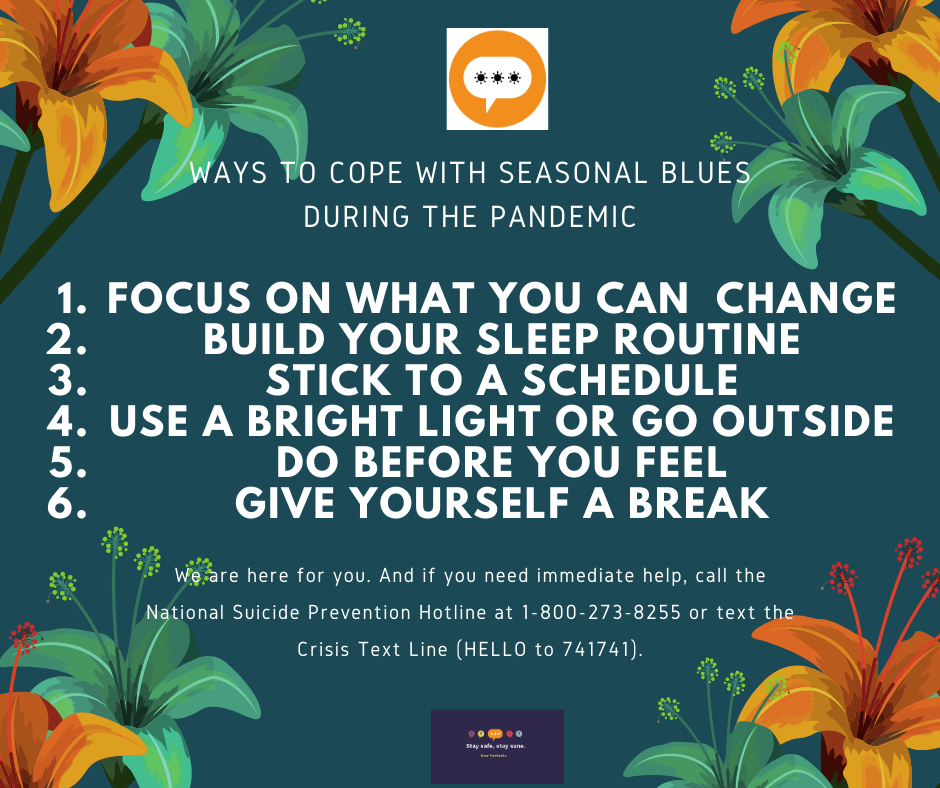
Sometimes you can sense some sort of lethargy this time of year revealing itself in blatant ways, like not wanting to go to work, not filling out some forms or editing some article, not bothering to return important calls completely out of a sense of avoidance, as if you might be able to wait long enough and all of this will pass—this stuff that brings you down, and to be honest, you’re not really sure what that stuff is. The idleness of society maybe, the constant sense of impending doom reported in all forms of media about democracy, about pandemics, about weather, about climate, about the economy, about depression and isolation. You have no reason to take any of it personally, but some people can’t let it go, and it weighs heavy, so you aim for avoidance, which unfortunately ends up a heavier burden.  

Sometimes the withdrawal is subtle. You can sense yourself not trying as hard or caring as much, like eating whatever is around instead of thinking it through, not going for a walk because you don’t want to be bothered putting on a coat or dealing with any sensory change. You’re sitting; you’re comfortable, and you’re numb. It works. 

Numb is good.

In both situations you are absolutely aware of it. Going for a walk helps. Filing out the forms, returning calls, all help by providing a sense of accomplishment and forward motion, like checking things off the to-do list, it leaves you with the hint that if you keep going there’s something worthwhile on the other side.

There’s the rub. It seems you keep reaching the other side and there’s still nothing there to lift the spirits, not this season anyway—more hostility in the east, more pessimism in our government, more variants on deck ready to step to the plate after Omicron smacks a triple into right field, and fires in LA so out of control it’s hard to watch or imagine. So you try a little less at one task, and it spirals from there. You realize your handwashing time has dropped to about 12 seconds. It’s not depression; it’s, well, yeah, it’s depression, but not in the deeply caving sense; in the “whatever” sense.

The problem with this type of malaise is it can be debilitating to you without being scary to others if you are not suicidal. The truth is, the vast majority of people who deal with depression are not contemplating suicide and will never kill themselves, which is what most friends fear most, and when those friends learn that is not part of the equation, they feel better. But that can often make it worse since the objective is for you to feel better, not them. But that’s fair since you know what they don’t: that a different suicide exists, a slow erosion of sorts, which anonymously eats away at ambition and accomplishment, takes the edge off of energy and momentum. It’s the guy sitting at a bar nursing a beer, nowhere to go despite having a million things to do. It’s the one on the park bench watching people walk by but not noticing a single one of them; it’s the inability to concentrate, the disinterest in listening, the short responses to questions, the inability to make it through the most basic of activities. It’s writing endless emails about nothing to others in some attempt to reach out; but that just backfires. Rational thought has nothing to do with it. “Knowing” what to do is not relevant. Your mind is suspended, your thought process withdraws into some elementary state.  

On the one hand it’s situational—financial problems, relationship problems, blizzards. But it can also be chemical if you don’t have medical help. It’s addiction without restraint. It’s a combination of these, and it is unpredictable because the same thing that leaves you in bed staring at the ceiling feeling hopeless can drive you to your feet to tackle whatever it is that left you prostrate to begin with. It is a conundrum that plays handball in your brain.

The guy at the bar with the beer, the woman in the park, the man at the river watching the tide roll out, all know exactly what the problem is. But their brains are aflush with fog, their anxiety has disabled their decision-making capabilities, and their strongest assets and most celebrated talents that normally keep them going the rest of the year, are no longer applicable since they carry a sense that those traits are probably what brought them to this place to begin with. They sit and wonder what if. They sit.

“Maybe if I had just…”

“Perhaps I should have…”

“Fuck it.”

At some point it seems you stop fighting altogether and are either not afraid to hit bottom, or you hope to use that bottom to bounce back, not afraid to fail since it can’t be worse than this. It is extreme but that is part of the diagnosis—extremes, polar reactions—sometimes both in one day. Sometimes within one hour.

More often than not, the guy on the corner holding the cardboard sign didn’t “decide” to quit, didn’t give up, but “felt” a pressure that he no longer could handle or define, caught in some stream of disconnect and hopeless confusion. Sometimes the one who does, in fact, tragically go that last fatal step didn’t “decide” to do anything at all, and that is the point. Suicide is not a decision. It is one step beyond decision making. The vast majority of people who deal with depression have that in check, less so in the dead of winter, of course.

But that’s not you. Truly. And that is the problem; you really aren’t suicidal at all. And when suicide is not part of the equation, others feel that you must be “okay,” or “going through something right now.”

Yeah, winter, you’re going through a snow bank. This is the worst time of year for many people with depressive issues. Seasonal Affective Disorder is real and feels like all of the above. Nothing helps but time, but time to some people sounds like the slow drip of icicle melt. Others say you’ll get over it, it will pass, hang in there, talk to someone. Yes, all of the above, but right now–right this minute–you need help and you don’t know it.

Other people try to help so they talk about the weather or sports or anything at all with enthusiasm and a sense of caring, but it often makes it worse, only emphasizes that others get excited about the minutia while you can no longer find value in a sunrise.

And the disguises are nothing short of cunning. I’ve known people fighting depression who on the outside resonate as the very poster image of Carpe Diem. I’ve been friends with people who contemplated overdosing on Monday while making plans for Tuesday, who loved others more than the average soul but only wanted their puppy nearby at checkout time, and people who fought depressive ways by pushing adventure to the limit, and beyond. “What a lust for life!” people exclaimed. They had no idea.

It isn’t exactly depression, by the way, though it is easier to simply call it that because it certainly wears the same eyeshadow as depression. It is indifference; it is a vague inability to muster the energy to lift your spirits enough to give a damn about anything. It’s not like you woke up depressed so you decided to stay on the couch all day; you simply don’t care that you’re on the couch to begin with. Complete apathy. You’re not down about anything; you answer “fine” because you really are fine; fine’s a fine word; vague and indifferent. It has the definitive weight of a horse shoe and the value of fog. “I’m fine, really,” should never be left alone with a person who fights depression.

Ironically, for most of these afflicted people, life is amazing, every half-beat is a moment of “miracles and wonder” which is why you cannot comprehend the misuse of time. The abuse of time in so short a life, you think, is as suicidal as the abuse of substances, and that can be depressing as well.

It is the time of year when you wake at three am knowing nothing is going to work, and you’re going to lose your house and your sense of security and no answer makes sense, no way forward seems rational. Equally, the dawn can come with new ideas and hope, and if you push those moments far enough into the morning, you just might be able to make a day of it. But January has 285 days. And February is several months long. March? Well you well know that March is merely a tease. April comes and breathing is easier. May, and nothing stands in your way. But in January it is safe to say yet difficult for others to understand that May hasn’t even been invented yet. It doesn’t exist and neither will you by then.

On the outside you seem to be fine. On the inside you’re grasping the thin rope of enthusiasm with clenched fists, pretending all will be well, but your insides—much against your will—are shredding at the thought of what to do next.

You “hang in there.” You “get through it.” You suffer the trite suggestions of others who simply can’t understand what the big deal is. That’s okay though, you think. Really. There are no solutions, per se. Just more questions. And “hang in there” is at the very least an acknowledgement you really aren’t trying to dismiss your very existence; it just happens sometimes. Depressed people do not feign depression; they feign contentment.

This afternoon I went to the river where a bitter breeze is pushing down from the west. There’ll be ice tonight somewhere, and snow, but I sat reminding myself I have been there, touched that ring of undefinable despair, and I’ve moved through it, sometimes with difficulty, often with ease, always with the knowledge that I’ve had one freaking incredible life so far, and time enough left, I hope, to continue my pilgrimage well into the next mood swing. But there are moments, collisions with frustration at the gap between the way things are and the way things should be, that catch some people off guard. “You’ve been like this before,” a dear friend told me not long ago when things were less than fine. “And you’ll be like this again.” And all you can think is, “Yes I will, like right now.” But what she meant was this is you, this is part of your DNA, this is as much you as your skin. What she meant was there is no “fighting” the tigers that come at night. Better to sit and dine with them, and wait. Just wait.

And Eventually you remember that the seasons, like everything else, change. And love is holding the other end of that thin line you’re grasping.

I’ve been released
And I’ve been regained
And I’ve been this way before
And I’m sure to be this way again
Once more time again

–N. Diamond

First the COVID-19 pandemic, now winter….is seasonal depression coming my  way? — Dear Pandemic

Life in the Margins (Part two of two)

When I was in my late teens my father and I played golf one afternoon at his club in Virginia Beach. About the third hole a man caught up to us and played along. He was good; a driver, short chip, one putt player. I was not. I had the same clubs but more often than not sliced it to the right or bounced it into a water hazard. I didn’t have a temper, but it wasn’t unusual for me to put my club back in my bag with some force, as if to say, “Don’t even think about coming back out until you know how to hit the ball straight!”

I did this after I butchered an easy fifty-yard chip shot by clipping it straight to the right into a lake. I cursed, of course. The golfer was standing nearby waiting to hit his second shot to my fourth.

“Can I give you some advice?” he asked. I sighed. First of all, no, no you cannot, because I’m nineteen and I don’t take advice, and because I don’t even know you. But noting my dad just a few yards away I opted for sportsmanship.

“Sure,” I sighed.

He paused. “You’re not good enough to get mad.”

I stared at him.

He continued: “Really, how often do you play? Do you take lessons? Do you have the best clubs? If you played all the time and took lessons, well then you could be upset at not improving. Otherwise you’re just wasting good energy.”

Ever since then, I have not only relaxed and enjoyed the game, I play better. After a while I applied this to most aspects of life, not in a way to find an excuse to not try, but to relieve the stress that comes from going through life doing things everyone else seems to simply be better at than me. It also motivated me to get into the game a bit in those areas I do have some game.

Awkward Transition Section:

I gave an assignment not long after September 11th, 2001, when my students would have been in their teens during the attack. I wanted them to reflect on what will remain one of the most significant days in our lives. How, I wondered, do they remember that day? I thought it was a good assignment—a specific event but a vague enough request for them to wander where they wished.

One student wrote of her aunt who never made it out of the South Tower. Another wrote about her sense of horror and disbelief, which, she wrote, she could never correctly capture on paper. Several actually commented they didn’t think it affected their lives at all while others spit out what they kind of paid attention to with one ear from local television reports—about heightened security, conspiracy factors, the indescribable loss of life that spontaneously erupted on TV that morning. But one student’s piece caught my attention. He wrote, in part:

In a way, September 11 demonstrated, more than any one phrase can contain, the strength of our Constitution. The day became the beginning of a new era of the democratic process, and the definition of how we will defend our liberty, maintain our principles and remember our purpose—to stand as an example of humanity’s potential. It was Memorial Day. It was Victory Day.

I read this with amazement. I asked for the rough draft and received exactly what I knew I would: A similar, hand written version with some words written differently and others crossed out. Excellent.

“You plagiarized this,” I said, which, understand, is rare for teachers to say. We receive copied material all the time, but nearly never have enough proof to say, directly, “You didn’t write this.” In a world of AI generated essays, it gets even tougher, but I ask them to ask themselves if they’re good enough to plagiarize correctly. I remind them in order to pull off an AI paper or plagiarized work they need to have a deep understanding of my requirements for the essay, the style I’m looking for, the specific language, the relevant references, and to be frank, I let them know, most of them aren’t good enough writers to plagiarize that well.

But this kid nailed it. “I didn’t plagiarize that!”

I smiled. “Yeah, you did.” My small laugh, I think, pissed him off. He continued to challenge me. Normally, plagiarized papers frustrate faculty members when they know an assignment was plagiarized—either from another student or from one of the many web sites offering papers for sale, or more recently for various AI sites— but can’t prove it. So when proof does come along, while it’s disappointing to have such lazy ass students,  it’s not just slightly satisfying to stop them in their tracks.

“Yes, you did. Tell me why you shouldn’t fail.”

“Because I didn’t plagiarize it.”

“Okay, I’ll tell you what. I want you to bring me a copy of the original. If you do, I’ll let you redo the assignment without penalty.” I figured the embarrassment would be sufficient.

Once a student turned in a paragraph she plagiarized from our own text. Another time a student turned in a paper right out of the psychology textbook assuming I wouldn’t recognize that his in-class writing had the ability of a seventh grader and the essay he turned in was written by Freud.

I don’t think they’re simply overworked. They’re bored. What they’re doing is staring at me and thinking of everything else. In the front row is the guy with his fingers in his mouth, gnawing on his fingernails, pulling them out wet every once in a while to observe his work and then shift his focus to a different cuticle. In the back row some dude’s pretending to write notes while he’s reading his text messages on his cell phone.

Certainly, some things really are boring, and sometimes it’s difficult to find the relevance. I know; I was a student.

Too many aren’t listening. And I totally understand. There’s too much noise. Streaming services, reels, TikTok, internet scrolls, deadlines, term papers, credit card bills, car repairs, moving in, moving out, daycare, spouse abuse, deployment, speeding tickets. The pace of life is at Mach 7, and we’re teaching from a stage coach—no wonder they’re bored. They haven’t yet realized that life is infinitely more interesting from the stage coach; that life exists in the margins as well as the headlines, and we should not simply focus on the large, obvious lessons we underline but the small details where we learn what we are and are not good enough at to get upset to begin with.

We’re too busy for that. Before they’re out the classroom door, students are calling each other, talking and walking from building to cars, elbows bent, phone tucked tight to their ears. We’re completely plugged in. There’s no time to think. Don’t stop, don’t listen, and don’t figure it out. Just keep yourself plugged in to create the illusion that something’s getting done.

And we keep missing the good stuff because we don’t have time. A college where I used to teach had a reading by one of America’s leading poets, Reetika Vazirani. Maybe a dozen people showed up. There was enough room for her cute two-year-old to run around the auditorium, climb across chairs and make everyone laugh. Reetika’s poetry was magic. Students who did show up sat looking at their laps while Reetika read:  

Little by little, I’ll figure it out

I’ll say to them, Relax, we’ll live to be a hundred

I’ll sort things out.

And her child danced down steps toward the small crowd. They missed that for the noise. Noise, that unlike the rest of our lives, won’t ever fade but instead will grow in intensity until it blends to the point of saturation, and becomes inaudible, an undercurrent of indiscernible distraction.

I can’t help but sympathize with students. They see the careers of their parents or friends, and they know at best the future holds the slow erosion of enthusiasm.

Early before class one day, I waited for my student with the plagiarized 9/11 paper to show up. Some papers are so moronic I pray they were plagiarized just so I don’t have to believe one of my students wrote that crap. I read a paper once which began, “Shakespeare wrote Hamlet almost a decade ago.”  Another paper I received once had the same page printed three times. When I pointed out the mistake, he said he couldn’t think of anything else to write but knew the paper had to be 800 words, so he just copied it a few times.

When the student with the plagiarized paper returned, I was ready. “Ah, did you find it?” I asked when he came in and tried to sit down without looking at me.

“No,” he said, as I knew he would. Pride sucks.

“It’s okay. I brought a copy. Shall I read it to you?”

“No.”

“Great! Here goes:”

I believe our best education has nothing at all to do with the classroom or the assignments or the degree. It’s between the lines and off to the side of the narrative where we discover the best of what we need. This isn’t original; in fact, it’s a thought and practice older than formal education.  I don’t remember much from grammar school, which they called it then because they still taught grammar there. But I do remember my teacher taking us all out one April afternoon to lie in the grass on our backs and stare at the sky while she told us about the tragedy aboard Apollo 13 going on right then in space above us. All the discussions about what went wrong and how they might not make it back were irrelevant until we rested in the grass and stared at the sky.

The thing is, we’re all the same. Conditioning has them believing that life is supposed to be some Reality Television show. There’s no plot, no writers, no purpose.  Suicide is the second leading cause of death among college students behind accidents. In fact the rate is higher among college students than it is for the same age group who aren’t enrolled in college—you know why? Because life is infinitely more interesting than most of the crap we’re fed in school. No one cares about most of the material we spend so much time preparing.  In the real world, however, we tend to seek out challenges we know we are up to, where in college students face new levels of expectations, and when they’re not up to the task they complain instead of asking themselves if they’re good enough to be there to begin with, if they’re willing to get better. They’re trying to make sense of it all—or want someone to help them, and when they can’t they rely upon what others have done and plagiarize that.  No wonder they’re bored. Hell, I’m bored.

Sometimes I try and picture my students as toddlers and help them not in a childish way but in a way which I hoped faculty had helped my son, as if he were their own. Was he paying attention when teachers taught?

Was I?

Recently I remembered Reetika’s son, who ran through the vacant auditorium while his mother read poetry. Shortly after that reading, just before taking her own life, Reetika—riddled with psychological challenges—killed her son. I’m tuning that one out. There’s no lesson there. Sometimes I picture my son at twenty, wondering which of my students he would have been like and how would I have answered his questions, approached his plagiarized paper.

I stared at the young man that plagiarized the 9/11 story and asked if he were ready. He turned his head to one side, trying not to make eye contact. “Hey, it’s from the local paper! Well, let’s see:

“There are still no words for September 11’ by…”  I stared at him: “Oh my god, Dude, should I go on?” He laughed a little at my sarcasm because he knew what came next and because, really, it’s so laughable.

“There are still no words for September 11’ by…” I stopped and looked at him. “You’ve got to be kidding,” I said.

He spoke quietly: “I didn’t know you wrote it.”

“Where’d you get this?” I asked. A friend of his gave it to him from his developmental English class but had taken my name off his copy.

“I was set up,” he said.

“You think? Do it over. Here. Now. You’ve got the whole class.”

I opened the door and the class came in. I talked about something, I forget what since I wasn’t really listening, and after class everyone left and he gave me his paper. He wrote:

September 11th scared the hell out of me. I was only fifteen and our country was being attacked. I remember rumors that a bomb had been planted at the State Department and I really thought it was just starting, that we were at war right here in America. My brother was nineteen at the time and in the Army in North Carolina, and I couldn’t sleep. Our teacher talked to us about it during the following period at school, but I wasn’t listening. I was thinking of my brother and about war. I was thinking about how a few hours earlier my friends and I were talking about how some guy bought us beer that weekend and we hung out in Croatan, and suddenly none of us was talking at all, and no one wanted to. We just stood around and said, “Damn,” and we were scared.

He found his voice. “I’m disappointed,” I said. “This is way better writing than the one I wrote that you tried to plagiarize.”

“See you Thursday.”

Most students don’t find their own voice or would even hear it over all the noise. When things finally do settle down and it gets quiet and the cell phones are turned off, most of us wouldn’t know our own voice. Maybe we’re scared. I know I am. Maybe we don’t want to know what we sound like, preferring instead to fall into some mainstream composite of expectation and predictability. I tried to tell my son to figure things out for himself. Don’t rely upon being taught, but instead, learn. They’re not the same thing. I hope he listened.

And I’m certain he hoped I listened as well. I tried to pay attention, but it was hard back then with the constant noise of students and papers and classes and all the other voices in my head. So sometimes, too often I suppose, it was difficult to always pay attention and listen to everything. And that scares me.

Turns out it is the small stuff that mattered. It’s the details I should have paid attention to. In class I wonder if I have any right to get angry when they’re cheating with AI; I mean, maybe if I were a better professor they wouldn’t do it. But it’s more than that: In the hallways, in conversations, in all lessons I want to drill into them that the larger objective is not difficult to digest; it is the details that we need to spend more time focusing on. It’s the same for college students as it was for toddlers. You see, I had this fear when my son was little that I would get mad at him one day and he would turn to me and say, “Dad, you’re not a good enough father to get mad. Maybe if you’d practiced a little more.”
The $5,000 Question (part one of two)

The following piece originally appeared in the Chronicle of Higher Education, June 2009, and has since found its way into other journals and texts.

PART ONE:

Wherein our protagonist discovers the first of two important life lessons

Almost every day I hear my fellow professors complain about their students’ poor writing on papers and tests. The papers lack depth, my colleagues say, and reflect a lack of commitment to good writing. Having read countless examples of such sloppy college writing over the past three and a half decades myself, I’ve identified the main cause. Weak writing has little to do with students’ innate writing ability, even less with how much time they spend working on their papers, and less yet with how ill-prepared they are to do college-level work.

The real problem is this: Students know that professors must read their papers, no matter how poorly they might be written, how irrelevant their cited examples, or how “un-collegiate” their content. Poor writing persists because students know that professors are obligated to suffer through endless garbage in hopes of finding something salvageable. They are well aware that many professors will highlight their papers’ weaknesses and then allow rewrites, and that some professors will accept nonwritten extra-credit projects to improve their final grades. In short, students know there are usually ways to avoid putting forth a gallant effort.

I realized this great truth some years ago at the beginning of a semester in a composition class after I finished reading a paper by one of my students. During our next class, I asked everyone, “If I were to skim only the introductions of all twenty of your papers, but read in their entirety only the five papers with the best introductory paragraphs —the ones that entice me to continue reading —and automatically give the rest failing grades, would your introductions improve?”

They all said yes and admitted that they would put more of an effort into capturing my attention and solidifying their theses. I’ve continued to ask each new class of students the same question, and I invariably get the same response.

So a few semesters later, I added to my proposition a more tangible, albeit hypothetical, reward. I asked, “What if I had a check on my desk for $5,000? And what if I rewarded the writer whose introduction most caught my attention, who most effectively made me want to continue because of a solid and clear thesis, with a check for five grand? Would your introductions improve even more?”

Cries of “Absolutely!” filled the room. I stood and stared at them for a solid, uncomfortable minute, nodded, and said, “There it is.” They looked confused, so I added, “You always could do it. You just couldn’t be bothered. You just admitted that to me.”

Silence followed.

I still do this, pointing out to class after class, “You know you write better than these half-baked attempts you typed up late at night. There just wasn’t anything tangible in it for you.” The students will agree. Some will even acknowledge that conditioning throughout high school left them believing that a “good” attempt is good enough.

Now, I’m confident that my students aren’t sitting at home saying, “I’m going to make this as pathetic as possible.” There is no malice on their part. But there’s little “real world” risk involved, either. “What’s an A on a college paper worth in the grand scheme anyway?” they reason.

While the answers are obvious to those of us who do the grading, to the average student with 12 credit hours, a full-time job, a family, and essays to write, excellent work is often simply getting it done at all. Professors are in competition for attention not only with family, friends, classes, and jobs, but also with ever-increasing news-media onslaughts that rarely require students to focus for more than 20 seconds at a time. Our competition is TikTok and Reels on social media.

We must reshape students’ thinking so they understand that “good enough” isn’t, and that doing better is simply a matter of seeking the rewards of excellent writing in the same way one might seek a bigger paycheck for working overtime. We aren’t offering them real training in earning rewards if we allow them to pass their courses despite weak effort and poor results. In the real world, people often get only one opportunity, one job opening, one chance to move ahead. Most of us know that the amount of time that a person commits to a project usually leads to better outcomes, but many students work under the delusion that almost any result is acceptable.

But what if we teach students to write their essays as though professors simply won’t read them if they are of unacceptable quality? What if we all asked ourselves if we would be doing better if the reward for our actions was more enticing? Shouldn’t we be operating at that level anyway?

By driving students to improve their efforts, we can teach them how to maximize their ability and overcome their lack of motivation. We must repeatedly remind them that doing poorly in college through halfhearted effort and mediocre work could lead to doing poorly in the real world, too, damaging their reputations and chances to advance in their careers. We want our students to view us as gatekeepers to what comes next in life instead of as mere grade distributors. Combined, those strategies are often sufficient wake-up calls for students to improve their efforts.

We need to show students that we expect the same effort to get an A that they put forth to get a job, establish a career, or win a trophy. They can do it; they just need to be reminded of the difference between short- and long-term rewards, between internal and external motivation.

And so do I. Sitting in classes now I think about all the times I did “good enough” work—to this day—when had there been more of a tangible reward I’d have made more of an effort, until I trained myself to understand that the effort is the reward.

Anything less than a fully-committed effort should mean an F —failure in college, fired in the real world.

Next time: Our protagonist learns the lesson of his life on a golf course