Eostre: The Goddess of Dawn

aerie one

Eōstre is the Old English way of saying Easter. The reference is to a new birth, a sense of rising quite appropriate for the holiday. Few realize, I’m sure, that Eostre was the name of the pre-Christian Goddess of Dawn.

Life is always being reborn, whether the result of the changing seasons or divine intervention, rising from the past to try again.

I’m home now, and it is Easter Sunday, and I’m thinking about the need to start over. In that frame of mind with the buzz of a dozen candy coated chocolate malted eggs, I found again a metaphor in nature.

Back to this wilderness.

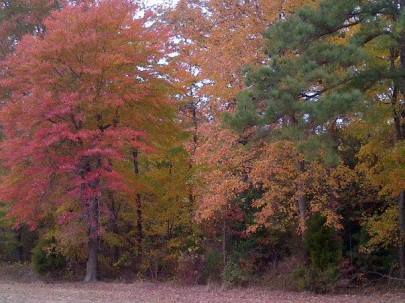
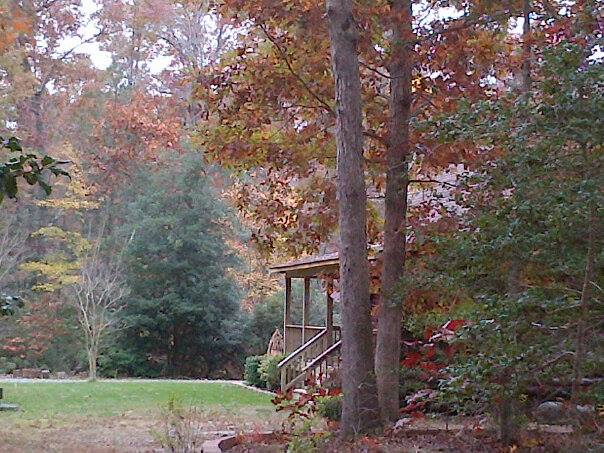
It occurred to me one day on my porch while staring at the surrounding woods, that at some point less than one hundred years ago none of those trees were there. The land has beautiful eighty foot oaks, some maples, tall thin pines and various other hardwoods including black walnut trees, which I am told can provide the ingredient necessary in the liqueur, Wild Spiced Nocino.

The branches protect birds as diverse as red-tailed hawks, downy woodpeckers, and countless chickadees, and they are habitat to other wildlife including one flying squirrel we spotted a few years ago when his tree fell. The squirrel was fine and found a new home in a white oak.

But a hundred years ago this was just land, sandy land, edged by the running Rappahannock River and backed by equally treeless farmland. A century before that these nearby plantations provided food for the region at the expense of slavery, and some slave descendants remain, selling vegetables at food carts out on the main road, or working the bay as watermen, telling stories about how the Chesapeake is just about farmed clean every season by crabbers at the mouth or the headwaters leaving nothing left for those working the midland shoals.

This area hasn’t changed much in one hundred years.

It is like this everywhere, the coming and going of things. In Manhattan a few hundred years before the wild construction on bedrock, coyote and deer were common. It was hilly (Manhattan means land of hills), and where the United Nations stands once stood grand oaks. The Lower West side was a sandy beach, and ecologists say if left to do what it wanted, most of the upper west side would be covered in trees and vines, shrubbery and wildflowers inside twenty years.

I can’t imagine what my house would look like if left untouched. When I don’t mow the lawn for a few weeks it looks like a refuge for timber wolves.

But these trees weren’t here a century ago and I sat on my porch and wondered if there had been other trees or if this land was barren, or was it used by the Powhatans, or was it home to some former slave family, or just a dumping ground. Evidence is scarce, buried beneath the roots of this small forest. Local historians settled long ago that this lower part of the peninsula was primarily hunting ground for the Powhatans, including Chief Powhatan and his daughter Pocahontas.

It’s changed since then. Four hundred years of rebirth in these woods finds me on the porch contemplating the ghosts of Aerie

This happens to me everywhere I lived; I like to imagine what was on that spot one hundred, two hundred, a millennium earlier. The house I rented in Pennsylvania was used as a hospital during the civil war. Before that it was a farm. Now it is a Real Estate office. The maples which lined the road and shaded the living room are gone. Someone planted new ones but it will be decades before they mature. My house in Massachusetts was a fish market a century earlier. Purpose moves on with time. Maybe that’s why I’m so mesmerized by the Prague hotel I always stay at. It was the same building seven hundred years ago that it is now. But here on my porch I realize this house is the only place in my life I’ve lived for twenty years, and I was curious if five times that score of years ago I could sit on this spot and see right out on the water, or were there trees then as well, different ones which died or were timbered to make room for crops.

The house is made from western pine forested on land which I assume is either now empty of trees or filled with young pines waiting to become log homes. What will be left a hundred years from now? Will someone sit on this same porch and look right out toward the bay once these oaks have long fallen? I know this house, this land, is a “hotel at best” as Jackson Browne despondently points out. “We’re here as a guest.”

Wow. Wrote myself into some sad corner there. Thanks Jackson.

I know nothing is as permanent as nature, despite the constant changes. It simply isn’t going anywhere. We are. So I like to remember that a century ago farmers sat here and talked about the bounty in the soil, or talked to 19th century watermen about the changing tides. And I like to realize that a hundred years before that the nearby swampland, now home to so many osprey and egrets, was a major route for runaway slaves. They’d have been safe in these woods, if there were woods then.

I like to do that because it reminds me a hundred years from now perhaps I will have left some sort of evidence of my passing through; even if just in the cultivation of language, the farming of words.

So I sit on the porch and listen to the wind through the leaves. It is now; it is right here, now. Sometimes at night we stand in the driveway with the telescope and study Saturn, or contemplate the craters on the moon—both here long before us and in some comforting way, long after we’re gone.

In spring and fall the bay breezes bring music even Vivaldi would envy, and I’ll listen to his Four Seasons, written nearly four hundred years ago, and listen to the wind through the leaves of these majestic, young trees reaching eighty feet high, and be completely, perfectly in the moment.

Despite the warming trends, the extreme tendencies of weather, the fragile ecosystem which sustains life, nature is still the only place I have found that really doesn’t change. It never has. Ice ages and dust bowls will alter it, but eventually some seed will take root.

aerie two

Cathy Kunzinger Urwin, Ph.D.

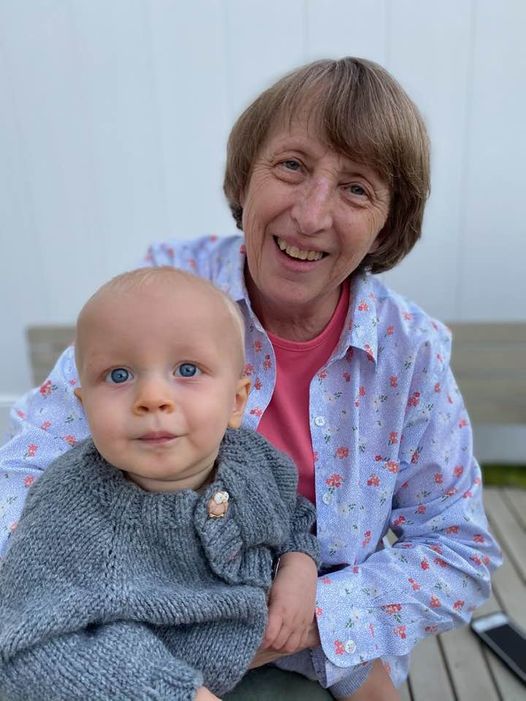
Today my sister turns seventy-years-old.

Let’s start with this: My sister should be dead. Some years ago Cathy was diagnosed with aggressive stage four ovarian cancer. She had to undergo treatments in Philadelphia, knowing the odds of surviving even for just a couple of years were slim. She continued to work daily in Princeton, New Jersey, forty-five minutes from home, and she battled the monster. To the point: If you know anything about my sister, you know that ovarian cancer, even stage four, didn’t stand a chance. That was more than ten years ago, and not only did she defeat the cancer, not long ago she was told she is completely cancer-free and doesn’t need to return.

First picture ever of the three of us with Mom, Point Lookout, NY, 1960

Of course. That’s Cathy. One of my heroes.

I thought about telling “Cathy stories” here, like how she got my copy of the then-brand-new Let it Be album by trading me a Bobby Sherman album. Or how she let me use her guitar all I wanted. Or how she sent me care packages, made me ceramics like a seagull mug and another of a seagull standing on one wing, a beautiful rug she made of a seascape, and a pillow she made of Fozzie the Bear. How she introduced me to the music of John Denver which carried me through some difficult nights as I went out on my own, and how she sent me a plaque she made with the lyrics to John Denver’s “The Eagle and the Hawk.”

Cathy and Fred holding up their chubby brother

She doesn’t recall but I do how during the Watergate fiasco, my history-major sister quizzed me relentlessly in who the primary players were at the hearings. I was thirteen and she was in college, so I didn’t really see her too much after I turned twelve. But I ended up at the same college some years later to discover she had left a mark at our alma mater, graduating seven years before I did, but her former professors knew who I was because of her. I let them know quickly I was not my sister; an always straight A student who excelled in her studies, particularly in history, eventually earning her doctorate at Notre Dame where she met her loving and devoted husband, Greg.

Cathy and Greg

I’m not going to provide details of the myriad times she ended up being the butt of my jokes and those of our brother Fred. I will say she is such a fine cook and baker that her food should be in restaurants, she is an excellent writer of both history and other subjects, authoring the fine and definitive book Agenda for Reform, about Winthrop Rockefeller. I’ll not embarrass my sister with stories of her dancing to the “Hokie Pokey” at a resort in Downingtown, Pennsylvania, or bring up the complete drenching she received on the Roman River Rapids ride at Busch Gardens in Virginia, where she apparently didn’t know she’d get wet, to which her son replied, “Ma! It’s Roman River Rapids! What did you think was going to happen!”

Cathy with Lyra

I’m going to save the story of calling her one August day in 1988 just seconds after she received beautiful news that would change her life; how she became a committed and loving mother; a passionate grandmother, which only deepened her love for her husband and the rest of our family.

Cathy with Henry

There are too many details necessary to explain the time I finished a reading at a major conference and afterwards a woman approached me and asked if I was related to Cathy Kunzinger Urwin. When I told her, she said, “I’m with the Winthrop Rockefeller Center in Arkansas and we’ve been trying to reach her! Her book Agenda for Reform is the best work written about Rockefeller and the work he did, and we want to invite her to a symposium.” I was never so proud of my big sister, and I really don’t remember much about the rest of that three day conference, but I remember that.

The three of us at the World’s Fair, Flushing, NY

And I’m going to keep to myself the history we’ve shared not solely as brother and sister but as friends. And readers do not need to be reminded of what it means to have an older sister; how she is counselor, surrogate mother, teacher, patient audience, how she teaches scared younger brothers how to care about others, how to show compassion, how to think of others first. Few people with an older sister don’t already know she is a security net for the most challenging of emotional events, how she listens, how she is tolerant.

“Life is paper thin,” my friend Toni Wynn once wrote. Sometimes we all take each other for granted, forget to check in, see how life has been treating us. On the one hand we might talk often enough to know our sisters are there if we feel like calling. On the other, we don’t let them know nearly enough, not nearly enough, how much they mean to us.

Happy Birthday Cathy.

Cathy and me, 1988

But I can’t avoid this one, just for old-time’s sake:

For Cathy:

Can You Say “Non-fictionalist”?

Last night I had dinner with seven other writers at an Italian restaurant (manicotti, meatball, salad with blue cheese dressing, chianti). I never before met the two women on either side of me, or a few of the others for that matter. We talked about weather, of course, and about the food. Where we’re from, what genre we write in (most of these people are poets). The talk turned to “what we’re working on,” and that’s when I ordered the wine. I’m not comfortable talking about what I’m working on unless I, a. know you very well, and even then, b. will change the subject. I’m not alone in this. One of my closest friends for twenty years is a poet and in all of our lunches or dinners through the years we only ever talked about writing when we read together at some event, and even then we don’t. Rick, another very dear friend, was there last night and we sideswipe the writing conversation nearly all the time. We’ll send each other drafts for comments, but don’t really talk about it

I never saw the point. I’m interested in what they’re working on, sure, kinda, but I’d rather really just read the final copy. If they do mention it, I’m really looking for little more than, “A collection about warts” or the like, no details. Peek my interest and step back. And who am I kidding; I’m not going to ask what anyone is working on, particularly people I don’t know. I don’t think it’s rude; I’m more comfortable with my work if it goes from brain to screen without getting blown around in the air between other people. I don’t mind the question; I get it all the time. But my answer will be little more than “some work about teaching,” or “several things going right now,” which doesn’t answer the question at all, which works best.

I find it revealing that the writers I know well also simply don’t really talk about it. We’ll talk about the process, or the stages of publication, or past work (ugh), but what’s on the front burner now is simmering and it’s best not to get too close.

It might be different for poets, or even novelists. But then those monikers right there in the previous sentence explains a lot–they are, in fact, “poets” and “novelists.” I’m neither, and what I do do does not translate to such a label. “Hi, I’m Bob, I’m a non-fictionalist.” Memoirist comes closest, I suppose, but most of my writing is not (my last book and my next book excepted, since both are full-length manuscripts about a certain time and place in my past). I write essays, or observations. A book slated for 2025 is a Sedarisest-style book about teaching; it’s not a memoir, so in that case I could be called an essayist, but that’s not accurate either since, it’s very memoiry, but, well, never mind.

The point is the manicotti. Growing up my mother always pronounced in manigaut (I’m not even sure how to spell this, but assume it is said as might an Italian who doesn’t speak English–without offense to my Italian cousins, and you know who you are). I was old enough to order my own food when I pronounced it that way and some server somewhere looked at me for a minute and replied in all her Virginian perfection, “OH! ManiCATTi!” Okay. Last night I heard a lot of menu items pronounced by the staff in a very non-West Virginian way of saying it, so when I knew I was going to order this dish (avoidance there, thank you), and when our excellent server, Jaimie, asked what I would like, I replied, as might my mother fifty years ago, “Manigaut.” She looked over my shoulder for a few seconds at the menu and replied, “Oh, the manicAtti, excellent.” Sigh.

Do you say what is the proper way to say things or do you say what they simply need to hear, are used to hearing? “I’m working on a piece about being nineteen years old.” “I’m working on a group of short essays, really nearly flash non-fiction, about stages of life, the patience we need when our children are very young and the patience we need when our parents are very old.”

That usually gets an accepting “Sigh. That sounds so good.” But it sucks, so I can’t agree, it might be good later, maybe tomorrow maybe in a dozen years by someone else. And that’s why I don’t talk about it.

Another writer I’m very close to is working on quite an involved work of fiction and is already nearly 100,000 words into it, and does not mind talking about it. But it helps, I believe, that writer clarify all the various aspect of this work, so talking about it somehow sharpens the mind about it. And I truly loved hearing about it.

But that’s not me. I don’t do small talk to begin with, and certainly have more trouble with it when even I don’t know what I’m talking about yet. So I’m more of the grunting type. “What are you working on, Bob?” “A book.” “Nonfictional stuff.” “Being nineteen.”

I was honest and as thorough as I could be. Jaimie returned and asked if I wanted anything else. I was about to order another chianti but hesitated. In America, shouldn’t that be che ante, hitting the ch, instead of the keeantay, pronouncing it as it should be in Italian? And if not, then why are we calling it ManAcotti? It’s Managaut.

A real non-fictionalist would know that.

Proof:

Making This Permanent

A View from this Wilderness began in January of 2015, a few months after my father passed away, as a way of reminding me of the permanence in life found in nature. That was nearly nine years ago. Six hundred blog posts ago.

Once every 150 blogs (about two years) it’s time to send out one of these for donations. This is kind of like NPR–the show will go on, but some unofficial “membership” keeps the wheels turning and defrays the cost of the blog, the website, upgrades, and this time, a permanent place online. That is, should anything happen to prevent me from renewing every Spring as I’m supposed to, the site will have “lifetime” status and nothing will expire for 99 years. This means this will very likely be the last time to call for donations.

With a weekly readership of close to 2000, it has been inspiring to watch the site grow as more people read these musings.

This is truly a situation where every little bit adds up. Think of it this way: Each year the blog posts total roughly 500 book pages.

Thank you for being part of A View, and shortly I’ll be back to our regularly scheduled post. And if you haven’t yet followed the blog, go to the bottom right corner and hit “follow,” enter your email, then go to your email and confirm. The only thing you’ll ever receive are blogs, about once a week.

Thank you for reading my weekly writings.

To Donate:

Venmo: @aviewfromthiswilderness

Mail: PO Box 70 Deltaville, VA 23043

Review:

“Nature,” Bob Kunzinger, writes, “keeps me in the moment.” Standing on the shores of the Atlantic Ocean and Rappahannock River, Kunzinger describes sights that lift the spirits and make hours and hearts glow. Like Robert Louis Stevenson who wandered the globe “for travel’s sake,” Kunzinger explains that “we all go looking for one thing and often find something else.” What readers discover are descriptions that delight and thoughts that surprise and awaken appreciation. His essays urge, almost impel, readers to kick the dust off their boots and minds. He makes them ache to be up and about and embracing our bruised but glorious world, to treasure it and its inhabitants anew.

—Sam Pickering author of The World Was My Garden, Too

Disappearing Act

Excuse me while I step aside. It won’t bother anybody if I simply duck away for awhile. I can no longer handle the endless stream of garbage reported in media. Don’t pay any mind to me if I move out of the way while the convoy of criticism and manipulation passes . I’ll just sit and watch the water and wildlife do their thing, the perpetual movement of the tide. In fact, my health, my energy, and my stress level are all improved by the absence of the nightly news, which I once revered. And I’m better off without the one on one conversations with way too many negative people. I am more likely to live longer, less likely to have a negative disposition, and infinitely more likely to relax by turning away from those contested discussions. No contest.

When I’m at the river and the sun is just changing tones behind clouds in the west, it doesn’t make a bit of difference who the president is, what the commentators had to say, which alerts came from which attention-deficit minds, and what happens next. My phone ping from the NY Times Breaking News doesn’t really catch my attention anymore, and I am far less interested in who said what than I am in keeping my blood pressure in double digits and my heart rate closer to my age than my golf score.

When the eagle glides from the tree tops, and the osprey teach their young to fly, and the clouds at dusk separate colors in prism-like perfection, it is hard to remember what the complaining was all about anyway. We carry our baggage way longer than we ever need to, if we ever really needed to at all. And the answers we seek in day to day life won’t be unearthed during some pointless pursuit of fair and balanced. Even if I listened more intently to all the facts and expert opinions and came to the correct conclusions agreed upon by Nobel laureates and Pulitzer Prize winning journalists, what then? So I might know the truth about A and the lies told by B and the injustice we see served to those in need. Again, what then?

The truth is I’m far better served by a phone call from a friend just to say hi; someone who knows the difference between quiet and depressed, between solitude and alone. But this lack of connection can cause one to completely disconnect for a bit while the endless stream of attempts at ways to improve ourselves leave us helpless.

When I returned from Spain I was on a mission to “simplify” my life. It didn’t take long on the Camino to discover how little I needed; how superfluous most concerns really turned out to be. When all I hear is the call of an osprey or the way the waves lap at the edge of the land, I could be in so many other places and so many other times. It is innocent, even ignorant some might say. We need to be aware of what’s going on around us, I’m told.

Okay, but I’m sitting it out for a while.

We live in the age of information, the age of blame, the age of instantaneous and simultaneous where the comment you posted ten minutes ago is now ancient news five screens in the past. It’s a time of grudges and unforgiveness; it is the time of exclusion. It is the age of convenience and the age of emotion and the age of attention-getting-self-indulgent-everyone’s opinion matters and is valid and is equal and should be heard. And that’s just not true, it is wrong, it is defeatist, and it is destructive.

So I’m done jumping through hoops and trying to walk across coals or glass. I’ve finally “come ‘round right” and am simplifying my life. My theory is this: I will be healthier, happier, more efficient, more useful and focused, and infinitely more at peace.

I love the way the water feels cool on the soles of my feet on a hot afternoon, or how the salt water gets on my lips and seems to stay there all day, even after I shower. It is as if the movement of the waves exactly coincides with the movement of my blood, and that rhythm somehow settles my soul. It’s about sitting on a beach somewhere remembering and hoping; it’s about a late night dinner at some strip mall restaurant drinking wine and being quiet. It’s about how thin life is; how so few more times we might ever see those we love anyway. It’s about not knowing and about not acting like we do.

I’ve tried this before and it never worked. But mostly because I always said I would but could never decide when the right time was to pull over and let the rest wait.

It turned out to be this simple: I just decided to.

Sliced Bread

Note: I wrote this piece nearly exactly as it reads below not long after the invasion of Iraq. Originally, I sent it to Dan Latimer, who at the time was editor of The Southern Humanities Review. He rejected it. About a year later at a reading in Atlanta, I read this, and Dan came up after and said, “I love that piece! Is it published? I want to use it in the SHR.” It was a few years later after he published several other works of mine I told him of his initial rejection of “Sliced Bread.” A year after the initial publication, Dan wrote to congratulate me; “Sliced Bread” was noted in Best American Essays, edited that year by Adam Gopnik. Since then it has been anthologized several times and even taught at a university in Taiwan. It remains one of my favorite pieces. I watched Oppenheimer again the other night and thought of this. Thank you for reading/sharing.

Sliced Bread

Tennessee Williams ate cornbread, as does Bill Clinton. Hemingway ate anything toasted. Vladimir Putin likes pumpernickel, named, according to spurious account, by Napoleon during war with Russia when he demanded a loaf of bread for his horse, Nicole, and shouted, “Pain pour Nicole.” Jacques Chirac chooses French from the Mediterranean region while Vincente Fox finds southern Mexico’s flatbread best with paella and beans.

Reagan liked sourdough. Nixon, a connoisseur of fine food, enjoyed sliced wheat bread and lightly buttered popovers, as does Margaret Thatcher. Thom Jefferson like Sally Lunn, of course. Mao didn’t eat bread. Stalin soaked black bread in beer and Lenin liked rolls. Alexander the Great relied upon some form of flatbread, while Ivan the Terrible ate black bread. Seafarers fared fine on hard biscuits inedible without sopping up soup or grog, and the staff of life literally saved the lives of millions during the nine-hundred-day siege of Leningrad during World War II, when bakers mixed breadcrumbs with sawdust to trick the stomach into feeling full. While mothers waited for food, while children starved to death, the Nazis pounded the city from the south with endless bombings. Hitler ate rye.

Which made me wonder about George W. Bush, so I Googled “Bush + Bread” and came up with “Damper Bread—a favorite in the Australian Bush.” Campers eat this horrific outback specialty in the wild. They bake damper in the hot ashes of the campfires in the outback dirt. It tastes disgusting but the sustenance is often necessary. Still, this tells me nothing, and I don’t think Bush bakes bread in the ashes of his Crawford ranch.

But just below that entry is “damper bomb.” This small exploding device can be manufactured at home for just dollars and will smoke out or kill anyone in the house. The damper bomb how-to page notes, “This is not a smart idea.” I should think not.

This same search, however, exposes “Smart Bombs” as a brilliant result of precision technology. They’re designed with a sensor system that uses a battery and onboard controls. Instead of just being dropped from an airplane as dumb bombs are, smart bombs are dropped then guided to their computed targets. They essentially become heavy gliders. Dumb bombs, however, fall helplessly.

So I searched “dumb bombs” further and found “Dum Bread.” This is a round loaf that indentured servants brought to the Caribbean from India after slavery. The dough was sweetened with coconut and placed in a covered skillet and fried on coals. More coals were placed on the lid. Later, wheat flour was added to the dough and the result was called Smart Bread. It can sit heavy in the stomach, however.

Equally difficult to digest is Daisy Bread. It is the most popular treat at the Lighthouse Bakery in England. It is dense, but pulls apart into pieces that resemble daisies. For an extra few pounds hungry daisy-eaters can add soup. The cook admits the weighty combination. “It’ll warm you up, though,” he says.

So will the infamous Daisy Cutter Bomb.  This cutter is essentially a dumb bomb weighing in at fifteen thousand pounds with more than six tons of explosives. Someone thought this was a smart idea. These bombs were common in Afghanistan but became most popular in Vietnam, where soldiers were hungry for landing-zone clearings. One of these twenty-seven-thousand-dollar-apiece bombs could clear an area three-quarters of a mile wide, including all buildings and rock formations. One of the problems with the Daisy is that the pilot must fly low, right over the target, so the wind won’t carry the bomb off course. They cost a lot of dough for such dangerous operations.

The fact that I searched for Bush and Bread and came up with bombs at first seems ironic. Not so much. Since I’ve already stumbled upon heavy bread and bombs, I look for the two in one shot and come up with MOAB, the Mother of All Bombs. This weighs in at twenty-one thousand pounds with nine tons of explosives. It’s the largest non-nuclear bomb in the world and is considered a Smart Bomb because of its gliding ability through GPS. It sprays a highly flammable liquid mist and then explodes about six feet above the ground for maximum impact. This monster is the size of a Jeep Cherokee. In 2002, Donald Rumsfeld said as far as weapons were concerned, the MOAB was the greatest invention since…well, how trite.

Truckers often stop at the Moab Bakery and Brewery in Moab, Utah. There they serve a popular bread bowl filled with whatever soup customers desire, along with some fine microbrew, for a few dollars. Moab is appropriately named; it means “beautiful land,” and Utah sure is beautiful. Of course, Moab also rests above one of the world’s largest uranium deposits.

The name has a biblical reference as well; it means “of the father.” Turns out that after Lot escaped from Sodom, his two daughters got him drunk and had sex with him. They both gave birth to sons and named the oldest Moab, whose primary diet consisted of salted bread. The territory in which they settled became known as Moab and one of the leading Moabites was Ruth, the great-grandmother of Kind David, whose lineage cuts directly to Christ. The first breadline, perhaps.

To go back:

Ancient Mesopotamians nearly nine thousand years ago chewed wheat grain. Eventually, the pulverized from, heated, tasted better, especially when they accidentally added yeast. It didn’t take them long to figure out that pulling off some of the old dough to use as starter for new dough would speed the process, and sourdough was born. In about 1000 BC, they grew a new strain of wheat which allowed them to make white bread. They ate thirty different varieties and washed it down with their most popular brew—beer. This all spread to Greece, which carried it to Italy, where grain and bread became the primary sustenance and monetary unit. Soldiers didn’t mind so much if they missed out on the meat, but don’t dare short them the bread. And the Roman welfare state was based on the distribution of grain to the citizens. Eventually, the government even baked the bread for them.

In 186 BC, the bakers formed a guild, making baking a separate profession. They enjoyed special privileges and theirs was the only trade carried out by freemen, not slaves. The members of the guild were not allowed to mix with regular people and were prohibited from attending events at the coliseum for fear they would be “tainted,” contaminated with the vices of ordinary folk. Romans loved rich breads with eggs and butter, but their favorite was white bread, made with special wheat grain, and to eat white bread indicated one was special. However, bakers considered it somewhat stupid, recognizing what the rest of the world would discover later—dark bread simply tastes better. Bakers believed it was bad taste to eat white bread.

Still, throughout most of history, white bread was an elite product since the grain was more expensive, and darker breads were distributed to the poor. Eventually, that switched and darker breads became renowned for their taste, making them more expensive. Through the dark ages, bread helped humanity rise above the plagues. Bread prevented suicide; bread filled young stomachs when nothing else worked; it was used for trade, as a status symbol, as an aphrodisiac. During the French Revolution, the Bread Riots nearly collapsed the government, giving rise to the myth of Marie Antoinette’s insensitivity: her supposed declaration that the poor, for whom bread was too good, should eat cake instead. Beer and bread were the two staples of life throughout the Middle East for centuries. Mothers used to send their children to school with both.

But even the Egyptians, who greatly improved bread-making recognized that the origin of the process and the best-tasting bread came from Mesopotamia, where the Euphrates and the Tigris rivers form the Fertile Plain.

Modern-day Baghdad.

The irony is so thick you can slice it.

The wheel was invented here, and the great mathematicians of ancient Greece recognized the Fertile Plain area as the source of their inspiration. Ancient Mesopotamia gave the world the first metal-working, architecture, city-building, urban planning, legal system, medical writings, cobblestone streets, and even beer. All of these six millennia and billions of loaves of bread ago.

The first bread with a name was called Lotus Bread. Flatbread with little or no yeast, it was used mostly to sop up oil and gravy in the meal so as not to allow anything to go to waste. Pita is a modern form of this. Roti in India; hleb in Russia; pan in Spain; brot in Germany; ogi in Basque; pao in Portugal; ekmek in Turkey; non e barbari in Iran; and in Iraq, khubz—the correct name for pita, taken from the Hebrew and Arabic. It’s the most widely eaten bread in the world. The Body of Christ is a middle-Eastern recipe. Michelangelo ate pita, as did the first popes. It is available at the Lotus Bakery in England, which also makes bread and rolls from the finest spelt flour, grown in the Middle East for nine thousand years. Today, farmers grow nearly a thousand varieties of wheat grain but still only one strain of spelt. And according to the Lotus Bakery it is easier to digest and tastes better than wheat.

The Lotus Bombing Principle is more difficult to swallow.

This declares that an independent government has a right to defend itself with whatever method is not prohibited. Here’s the problem: the World Court, in determining that states have the right to use nuclear weapons to defend themselves, ironically determined that states have the right to choose a course of action that could conceivably lead to the extinction of humanity. But not allowing the state that right would not allow them to carry out an action that is not prohibited under the law of the World Court; the “lotus” principle. Confused?

Simple: The world governments with money and know-how set out to find and extinguish nuclear weapons of mass destruction from the arsenals of governments considered “high risk,” Bush’s “Axis of Evil” members. And how do they find them?

Yeast.

As it turns out, yeast functions like a scout, or a canary in a coal mine. If yeast cells are exposed to dangerous chemicals they change color and die. Scientists genetically modified yeast so that when something happens to its cells they change color. These yeast cells are placed on the backs of cockroaches—a species which can apparently survive a nuclear war. The roaches are then sent into places where someone might hide dangerous chemicals or weapons. These yeast cells can stay alive for several days, and that is long enough to keep an eye on the little indestructible suckers to see where they’ve been and if, when they come out, the yeast cells have turned color.

So war and bread apparently need each other. However, I still need to know the president’s favorite bread. In need of aspirin as well, I wander to the drug store, where the clerk watches Oprah, and who’s her guest but the Commander-in-Chief himself. I watch the way one watches a NASCAR race: waiting for, just expecting, an accident, but she keeps the questions relatively simple. One of them is his favorite food—I can’t believe it.

“Oh,” the president says, “I love peanut butter and jelly on white bread.” I pegged the president as a white bread loafer from the start, with maybe an occasional drift toward tortillas. But any WWII Navy personnel could predict he’d go for the PBJ because the PBJ-1 was the US Navy’s designation for the famous B-25 Mitchell Twin-engine bomber. It had a mounted upper turret and retractable radar unit  along with the ability to carry a single torpedo fitted outside the bomb bay. One of the Mitchell’s finest hours was the Doolittle Raid in which Jimmy Doolittle led a group of PBJs off the carrier Hornet in a bombing raid of Tokyo. Many years later, President Reagan and Vice President George H.W. Bush awarded Doolittle the Presidential Medal of Freedom for “dropping the bombs that led to the end of the war.” During Doolittle’s tours overseas, he was allotted four ounces of bread per day.

According to Saint Don Bosco, a nineteenth-century Silesian priest, our only salvation from the bombs that will rain down is the “bread of life.” Saint Don would have eaten mostly flatbreads from Northern Italy. The year Bosco died, Van Gogh wrote that he ate only “bread and whatever beer I can borrow from the innkeeper from the night café to keep myself from suicide.” Van Gogh liked sourdough. Snoopy eats wheat toast. My son likes hard-crusted Italian. My father likes white bread; he voted for Bush.

In America last year we spent about seven billion dollars on bread. The workers who built the pyramids were paid in bread. The great fire of London started in a bakery. Of the more than six billion people on the planet, nearly five and a half billion of them rely upon bread as their primary nourishment. Meanwhile, that same number has at one time or another in the last five years been in some sort of volatile conflict.

Julia Child once wondered, “How can a nation be great if its bread tastes like Kleenex?”  Henry Miller said you might travel fifty thousand miles in American without once tasting good bread. Gandhi said there are “people in the world so hungry that God cannot appear to them except in the form of bread.” Francis Bacon said acorns must have been good enough to eat until bread was found. And he wasn’t far off; the first bread probably tasted nutty.

Bread is a slang word for money. Bread is the staple of life, both nutritionally and spiritually. Thomas Merton wrote, “Stale bread is much closer to crumbs and I am humbled by that.” Plato believed an ideal state “where men would go to their grave old was one where people ate locally grown whole grain wheat.” Socrates, on the other hand, believed whole grain bread to be pig food. Christ probably ate Parthian bread, and the loaves that fed thousands were a similar variety. “Companion,” literally translated, means one with whom we “break bread.” Bread is the staple of civilization; it keeps the seams from unraveling.

When a movie fails in the United States, it is considered a “bomb.” When it succeeds in London it is considered a “bomb.” In both cases the word comes from the Latin, bombus, which means “a booming sound.” Bread, on the other hand, is derived from the Hebrew, which is known in some lexicon circles as the “mother of all tongues.” To brew, the root of the word “bread,” is to concoct. No wonder warm beer and bread have been linked since biblical times. Certainly those downing loaves of Parthian must have been getting bombed along the way. Dwight Eisenhower said, “Every gun that is made, every warship launched, every rocket fired, signifies in the final sense a theft from those who hunger and are not fed.” Eisenhower liked Irish soda bread.

Robert Oppenheimer, director of the Manhattan Project, upon watching the first atomic explosion in 1945 quoted a Sanskrit verse from the Bhagavad-Gita. He whispered, “I am death, destroyer of worlds.”

Oppenheimer loved white bread, lightly toasted, with butter.
Time. Out.

So here’s the thing: According to scientists who constantly work on and adjust the Asteroid-Satellite Collision Probability, when a meteor or other such space object hits a satellite, the rock “vaporizes into hot, electrically charged gas that can short out circuits and damage electronics, causing the satellite to spin out of control.” Don’t worry about being hit–it’ll burn up on reentry into the planet’s atmosphere. No, that’s not the problem.

See the problem? Yes, no more satellite. And if a large such space rock plays pinball with Space X’s system of communication, we here are earth are, as they might say on “Eureka,” simply fracked.

Since the beginning of the Industrial Age, humanity has forged ahead into the more convenient, even at the expense of the more improved. Further, we have built these castles at the expense of their foundations. The percolator becomes Mr. Coffee becomes a Keurig. Hell, I’ll just swing by Starbucks, and I’m not getting out of the car; I’ll go through the drive thru. Fine, but now give someone a percolator and ask them to make coffee. It’s not going to happen. How many people know their friends’ phone numbers? Their own? Ever been in a store in the middle of checking out when the “connection” fails on their register, and the clerk who can’t write in cursive or add without a calculator stands there completely perplexed?

The world became transfixed by convenience so that ambitious endeavors are no longer defined by “better than it was,” but “more convenient.”  As a result, we are completely, arguably, most definitively reliant upon the 2500 operational satellites orbiting the earth (about 6000 actually are orbiting, but more than half simply don’t work). The argument is the more time we save the more time we can spend with those we love.

Nice. But we’re not. People don’t drive by and visit. Hell, they don’t even call anymore. We’re not going for more walks in the park or along the beach. Where is that extra time? Where are all the people?

You know what? Let’s do it this way instead: Every single day, 100 tons of meteorite dust coats the entire planet. This is true. You, me, the cars, buildings, everywhere, everything. It is so miniscule, of course, that we don’t even know it is happening, preferring instead to wait for the Leonid shower, or the Perseid, the Geminid, or even the Urid, to run outside and watch the shooting stars every twenty or thirty seconds on a clear moonless night. Who isn’t transfixed by that?  Yet equally, who isn’t freaked out by the thought of meteor dust in their hair? On their ice cream cone?

But wait, there’s more:

The temperature at the core of the earth is the same, about 10K Fahrenheit, as the surface of the sun. I love symmetry but part of me wonders if The Great Universal Thermometer simply stops tracking at 10K. Based on that and some formula they figured out with a slide rule (look it up), scientists–the ones who know what they’re talking about because of generations of research and who have less ability to create a fiction than I do–say the planet is about 4.5 billion years old, but humans of any sort have only been here for about 450,000 years (Note: If you are even slightly considering posting a response about how the earth was created in April about 6000 years ago, go away). Now, if you do the math and divide the history of the universe into a day, humans have been searching for convenience stores for about ten seconds.

Our time here is short. So it comes back to meteors. Stardust. The naked-to-the-eye coating which exploded countless zeros away from here several billion years ago, arriving, now on our chocolate swirl cone.

Keep that dust in mind as we add this to the equation: The greatest scientists in the world have trouble wrapping their mind around the concept that our own planet is an anomaly. Even if you are like those of us who believe somewhere in the deep recesses of unthinkable distance are planets with lifeforms playing Scrabble and drinking Pinot Noir, astrophysicists like Stephen Hawking, Neil Tyson, Carl Sagan, and Brian May can’t tell you where, and they’ve looked with equipment so advanced some of it has left the solar system, some landed on moving asteroids, and some is scooping up dirt on the moon like it’s dog poop and bringing it back. And these experts with combined IQ’s in the thousands do not know.

But they can tell us around 100 tons of meteorite dust coats the earth, and us, daily.

I sat at the river this morning completely unplugged and, to be honest, uninterested in much. I get that way a lot. I felt like going for a long walk in the mountains or sitting on the sand and look for manatee. But both those locales seem as distant as the stars. Instead, I looked out at the Norris Bridge two miles upriver, and the cars and trucks crossing the mile and a half span headed North, up toward DC, up toward New York, up, just further and further up and my mind wandered up as well, across the Niagara Frontier, across Ontario. Up.

I couldn’t hear them, the cars, but I could catch the glint of sun on their windows. Closer, on the river, some bufflehead ducks surfaced then dove again. A workboat headed out from Locklies; I guess to check some traps. And now it is raining, torrents. When it rains like this, when the sky seems to be falling, I don’t want to retreat inside as much as I want to go all in–dive into the river and feel the water around me like amniotic fluid. But it is late. Today, it is about noon, but as far as the history of “time in a day” is concerned, for me it is four in the afternoon. The sun is no longer at its full strength, dinner will be ready soon. The streetlights will soon be on.  

I can’t focus on the minutia in life; never could. Some student asks me about subject verb agreement and I’m wondering why we can only see about 2000-3000 stars, not “millions” as we feel when standing at the bay on a clear, moonless night. I’m more focused on the reality that I have so much I want to see, so many glasses of wine to drink with friends in European pubs and small quaint villages and sandy southern beaches, but very possibly won’t, brings me to the brink of psychosis when someone actually screws up simple comma rules. Part of me wants to say, “Come on! This isn’t rocket science! It’s a fracking comma!” and another part of me wants to whisper, “You’re doing fine. It’s just commas–I knew what you meant. Now go bathe in the miracle of meteorite dust. Buy a chocolate cone and wait for it!!”

In some inhumane attempt to find the easier, find the quicker, the more efficient, humanity has drifted too far astray in 450,000 years; so far from the essential; so far afield from what matters.

We’ve got to get ourselves back to the garden.

There Ought to be Clowns

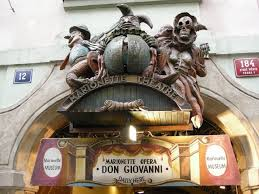
I was in Prague when a Czech girl about twenty held a heavy sign outside a ticket booth.  “Stop by the National Marionette Theatre for a Show,” it said. An arrow pointed up some stairs. She wore a clown suit. Ten AM, no later, she started—I saw her there four hours later, five hours, six, she stood supporting her sign and handing out leaflets to lead me to the “National Marionette Theatre’s Production of Don Giovanni.” I thought of the Statue of Liberty people hawking tax filing; and of giant chickens handing out coupons in the mall. This one is a national marionette theatre. This Czech girl pushed puppet shows on people.

Perhaps passing out flyers pays well. Or her parents preside over the theater, and this is punishment for tangling the marionette strings when she was five. Naturally, I couldn’t support such delayed abuse.  I might have taken a look if this person in my path performed with a puppet or two. But no; she just stood there. Maybe she holds the heavy sign in exchange for free admission to any performance she prefers. Tonight, Mozart: The Marriage of Figaro. They’re puppets, though. I’m not easily fooled.

To be fair, exposure to these arts is rare and the ransom of holding a heavy sign eight hours a day in a clown suit is worth it. Still, when she handed me the leaflet, I declined. Taking it, I thought, would provide false hope of my attendance. Perhaps she’s paid per person, and upon entering we must say, “The twenty-year-old girl in the clown suit sent me,” and she’d expect her cut of my admission. That money, added to the rest from other guilt-ridden tourists, might be enough to buy the Bohemian bracelet at the boutique near Charles Bridge. She might, while on break, charge the jewelry having counted on money from her promised patrons. She would eventually pay for it knowing she had income from my gracious acceptance of her leaflet. But I pulled my hand away. You see, when the theatre is mostly empty, and puppets bounce to Swan Lake, she might notice my absence, my lie, my blatant mockery of the marionette art form. I could not walk along Karlova Avenue again, not past that theatre, that clown suit holding that sign, in angst over her noticing me. I know no flier to this theater is handed out without strings attached. Especially if dangling from her wrists, beneath the puffy sleeves, I might hear the clanging of the bracelet still not paid for. I could not bare it.

So, of course, I didn’t take the leaflet.

Fliers about music, however, I accept. The string quartet playing Pachabel and Vivaldi at St George’s still stirs in my mind, or the symphony at St Martin in the Wall. One student once stood between me and the Literature Café after I had been teaching and was thirsty. He pushed Bach on me, motioning toward some small space in the next building. Outside a cello player performed for free, teasing us, baiting us without charge so we’d get hooked and go for the harder, move complicated compositions inside. Good marketing, I thought—the whole Literature Café crowd could conceivably fill a concert hall for Bach. Still, I declined and tried to glide around him.

Unfortunately, leaflet pushers in Prague promote their papers to blind eyes, throwing themselves in harm’s way to deliver the news, the message, the memo that something is about to happen that simply can’t be missed. I see smoke rising on cold evenings from the myriad chimneys across the rooftops and imagine these Czech people, instead of going to the show, walk the streets and collect leaflets to burn for warmth at night, the ashes of theatre and museum bills billowing into the cold Czech evening air.

Hawkers hand out leaflets for museums, tours to other cities, walking tours of the castle, Kafka’s Castle, Havel’s castle; walking tours of the Golden Way where Kafka wrote in a small blue house, walking tours of the Jewish Quarter with its cemetery of headstones strewn about like fliers in a parking lot on a windy day. Leaflets of art museums in Old Town near the atomic clock, tours to the Golden Tiger where Hrabal drank beer and wrote novels; sheets of paper promote discounts at restaurants, coupons for strudel, Monrovian wine tasting, and more music. No guidebook is needed for Prague; no online sources recommending what to do on a Tuesday night in March. Just walk up Karlova Street, or Nerudova, and flier clowns keep information flowing like hot wine in the Bohemian cafés.

One guy one night one year handed me a leaflet for a pub he said was near, right around the corner, an Irish pub, and the next night was St Patrick’s Day, and if I walked that way with him he’d tell me what to order, what foods are best, and if I took the flier with me, I’d get a discount and he’d get paid, and I knew then I was right in not taking that clown’s flier, that she, too, depended upon commission. So this guy walked with me that March 16th, late, through tunnels, up steep streets, and half-way up one narrow medieval way was an Irish pub, and I relaxed, no longer worried about being led into some torture room out of some Tarantino film. I walked in grasping my flier, had Guinness and potato cakes when a large Irish man invited me to his place for a St Patrick’s Day party the next night. “His place” turned out to be the Irish Consulate, and there turned out to be a few hundred people. We drank beer and listened to the Chieftains and to rare Van Morrison, and to the Wolfetones. We ate and laughed about Dublin versus Manchester United, which I had seen in a pub after someone handed me a leaflet for happy hour to watch the football match. The ambassador talked about his love of Prague and one of the guests talked about the cathedrals, when everyone began to talk about the music, and that flier brought it all home for me; the spontaneity that fliers provide. Guidebooks usually are married to planning or at least engaged to thinking ahead, but the almighty flier with its primitive shoving into our faces while heading somewhere else is the ultimate in tangents, the epitome of carpe diem. This is, after all, Bohemia.

“Here’s a flier—do it now—don’t think” is what those hawkers truly hail.  

One guy gave me a flier for a free strudel. I don’t turn down free anything, particularly food, particularly strudel. It was warm, with ice cream, and a pot of Irish Crème Tea, and I know the purpose was so I might purchase the pot of tea. Okay.

It is the unanticipated beauty of the immediate. It is the hard left turn. It is the unexpected now when moments of “what’s next” so often occupy our present ones. Sometimes life should be more akin to a pinball game: Instead of pulling our hands in, away from the tugs and tears at our sleeves from friends offering a last-minute road-trip, or family who knock unexpectedly, we should reach out and grab the opportunity. In Prague passing out leaflets prior to the Velvet Revolution indeed meant possible prison and accepting a flyer likely the same sentence. Indication of how important those fliers can often be. The power of the 8 1/2 by 11 sheet of paper can be immeasurable.

But more than that, they remind us that at any given moment, if we take our hands out of our pockets, we can discover a whole new train of thought, turn a whole new unanticipated direction. Little in our lives is designed for spontaneity; no, instead grand design proves itself with calendars, schedules, voice mail reminders, alarms and wake up calls. The places promoted on fliers are most often in back alleys or misunderstood. They’re the commoners’ billboard.

Once out near the Strahov Monastery, a dirty young woman with a dirty young child lay in the dust and filth of some alley not far from a nice restaurant where I used to drink fine wine, and she handed me a flier written in Czech. Her todler sucked on the crusty edge of his shirt. A passing stranger told me the flier read “Give me some money please. It won’t change your life but it might change mine.”

I did. It did.        

Leaflets have been around probably since Gutenberg. But as a means of persuasion, they most likely hit the mainstream during World War I when the British air-dropped leaflets throughout France to communicate with the German army. The Nazi’s dropped anti-Jewish leaflets during the 1930’s and the early part of the 1940’s, Lee Harvey Oswald handed out pro-Cuban leaflets, and just before the bombs were dropped on Hiroshima and Nagasaki, the United States showered Japan with more than five million leaflets warning the citizens of the imminent attack. It began, “Read this carefully it may save your life or the life of a friend or relative. In the next few days some or all of the cities named on the reverse side will be destroyed by American bombs.”

The Velvet Revolution in Prague in 1989 gained momentum behind the guidance of then play-write and eventual president, Vaclav Havel. The movement gained so much support, however, they couldn’t meet in the streets anymore and designated the Magic Lantern Theatre as their headquarters to organize. The dancers—out of work for the strike—would run leaflets around the city.  It was from there propaganda flowed. They passed out bread, they collected money, and they made and distributed leaflets to gain support from students and workers alike under the guise of the theatre.

So naturally while contemplating the clown at the National Marionette Theatre, I rethought the whole puppet thing; maybe I was wrong to walk by so fast. If she did get a cut, and I did attend, then she’d be happy, her bracelet paid for, and I’d attend what might turn out to be an amazing performance of Don Giovanni, albeit by sophisticated Pinocchios. So the next morning I vowed to go. Perhaps my attendance also supported some revolutionary agenda, even if her own. Clearly, it’s happened before.

The next day at the foot of the castle steps a man gave me a flier for the Torture Museum. “Just tell people to walk up and down these stairs,” I joked, but he didn’t understand.  I walked across Charles Bridge, up Karlova, and looked for the clown. The twenty-year-old was still there, and I walked close enough for her to hand me the paper.

Don Giovanni, or Don Juan, was written by Mozart and he first performed it here in Prague; Casanova himself collaborated on some of the scenes. In fact, in imagining Don Giovanni, Casanova said, “My life’s been filled with adventures, and truths often become larger than life when they’re retold. I never correct the tales that are especially hard to believe. It would be unkind to those who want to believe in them.”

Sometimes you just need something to believe in.

I sat in the back and enjoyed the marionette show. It was only later I realized I never saw a single string, not one wire.