Fall(ing)

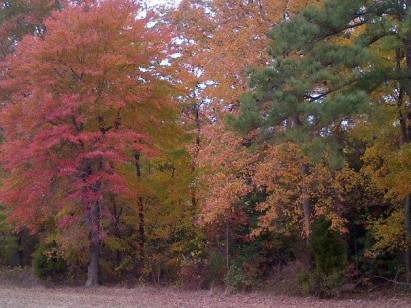
This time of year when leaves start to fall I recall a line I wrote which to this day bothers me.

“Life is the distance between a falling leaf and the ground.”

I loved that line. I was walking around home some years ago and it popped in my head. At the time I had been working on a piece called “Walled In” and the end of the essay digresses into a litany of “life is” comments. I added this as the last line of the piece, which tied back to the narrative about stepping away from society a la Thoreau. The Southern Humanities Review picked up the piece and when I received the final edits before press I wrote Dan Latimer, the editor at the time, and asked him to strike the last line. He did.

I am pretty sure it isn’t original. I googled it; I turned it in to turnitin.com, I tried everything. I don’t read that much so I looked through the few possible books I might find it, but nothing. I looked through poetry books, I called writers I know who actually do read books and asked them. I even, thinking it might have been in a passage read by a writer as a guest on NPR’s “Fresh Air,” wrote the show asking if anyone there, namely host Terry Gross, remembered the line. They were nice enough to write back politely suggesting I might be having a mental breakdown. “But it is a great line!” I wanted to write back. I didn’t.

I remember an interview where Paul McCartney to this day is not convinced he is the author of the music for “Yesterday.” Unlike McCartney, I chose to strike the line. The piece went on to other outlets and has done very well through the years, including several anthologies, but san line. I was concerned someone would recognize it and know it wasn’t original, even though I’m pretty sure it is. My journalism training, however, requires me to be one hundred percent sure. “If you can’t back up your sources,” Dr. Jandoli repeated, “you don’t have a story.”

That might be in part why I slid away from journalism and into something more personal. I hate fact-checking. Instead, I found stories in life. Though to be honest I don’t know any writer who walks around looking for stories. We don’t stand in the middle of family circumstances or think about work issues or attend baseball games taking mental notes about some possible narrative arc.   

But those situations are always possible material. We never stop working. Either some digressive thought about an ongoing work, or a new work, or a very old work, crawls into our consciousness while we are watching television, or some quick phrase catches our attention and we know it is the beginning of or end of or transition to something. It is not on purpose; there is no attempt to blend writing and “life.” I swear. It just happens. We are always working.

An artist’s brain functions differently. A photographer goes for a walk and finds himself framing nature, a painter sees color schemes, a musician notices sounds, and writers, well, complete mental breakdowns from information overload is not out of the question. It is why we despise the comment: “You know what you should write about?” Go away. Did you really think we were sitting around thinking “I have no idea what to write about, I hope someone makes a suggestion”?

And we don’t actually “find” something to write about; it seeps into our existence like humidity or allergies. For me, I walk in the woods, or along the water, and the nature of nature is non-judgmental, absent of debate. I can walk for hours and my thoughts move through unattached to some human-inspired “suggestion” from a billboard or odd structure. It is organic, like leaves falling: thoughts let go and gather around.

Near my home at the river is a small strip of beach which changes with the weather and storms. Sometimes there is room enough to walk quite a ways along the water, and other times the river moves right to the edge of the swamp or rip rap and to continue means wading through the tide. In either case, I am always discouraged at my inability to communicate the perpetual reality of that tide, the infinite days the water will ebb and flow, and the significance of nature compared to the miniscule roll I play in this short span of decades. So I don’t even try. I “stand back and let it all be” as the Boss suggests. And the passing of time is enough some times.

That’s writing. A writer spends a great deal of time not writing. Not because we have nothing to write about, but because we have an absolute conviction we can never, ever do it justice.
Additive Inverse

My doctor asked if there was anything that bothered me on a daily basis. Habits, she suggested, or small annoyances.

This was an easy one. “People talking with food in their mouth. Or chewing with their mouth open.”

“How do you feel?”

And this is true. “Like my chest hurts and if they don’t stop–and sometimes even after they do–I’m going to throw up or collapse with a seizure.”

I suggested I overreact and I know that. She said no. “You have misophonia.” I “feel anger, disgust and a desire to flee” when I hear certain sounds.

Last week she suggested that for several years beginning about 2017 I had suffered from a form of cognitive dissonance. I asked her to explain it and she tried, she really did, but then I remembered Google. It turns out everyone experiences it; we call it “stress.” But some people—a minuscule percentage, which apparently includes sixty-three-year-old white writers from New York who live in Virginia, have trouble listening to the news, dealing with hostile people, understanding conflict to the point that the stress (dissonance) can be intolerable. It’s not simply that the way things are contradict how they should or can be; it’s that some minds can’t tolerate that often serious digression from what should be normal. Think of turning on the radio and the music is all off key, and everyone else ignores it or tunes it out, but you feel it in your bones so that your skull starts to crack. That. It’s when the solution to a problem that anyone else would either figure out quickly or abandon and move on leaves you so confused that a complete mental breakdown is entirely likely.

It’s when your actions do not coincide with your beliefs or strong desires because of some lack of information, pressure from others, whatever, and instead of being mindful, instead of having enough self-awareness to reconcile those differences by not rationalizing your way out of your beliefs or desires, you live with absolute anxiety and disarray, psychologically, of course, but also physically as it can manifest as high blood pressure, lightheadedness, or rapid heart rate, and often it is set off by some event or occurrence slamming you off track like a landslide taking out a passing train. The causes are simple: severe and sudden change of direction in life either through leaving a job, losing everything, or some form of physical or mental attack that seems to never end.

So while it is not uncommon to not want war (everyone wishes for peace and can’t tolerate war), it is an entirely different level if your mind cannot comprehend the very existence of war, the very notion of hurting others for some gain, and even for self-preservation, makes your mind freeze and your heart race; and the news reports are the adult equivalent of some childhood bully yelling in your face in some foreign language. You cannot for the life of you understand how it is that war leaked into the pool of peace and watching or hearing about it causes a racing heart, drastically increased blood pressure, and irritability. So if the conflict is personal, confusion is even more common, and you might very likely abandon critical thinking skills entirely making a difficult situation–whether it be in relationships, finances, or even employment–tragically worse. And if one must deal with all three, jumping off a cliff is not off the table.

So when two seemingly opposing forces attempt to exist in the same space, or even attempt to conquer each other, it can be damn near suicidal to tolerate for someone suffering from cognitive dissonance.

I think I explained that better than the doctor. Just saying.

There is a way out of it besides suddenly or even gradually becoming completely mindful and self-aware, as if you can buy a gallon of that with a yoga mat and stretch pants.

So I asked the doctor just that, and her reply was this: “Do you spend any time in nature?”

I smiled. “Yes.”

“Not enough.”

“I live in a jungle near water. It’s pretty enough.”

Not anymore, she said.

Here’s why nature: Nature, it seems, does not contradict our expectations of its actions since it always has and always will be in and of itself its own source and recipient. We are not in charge and when we try to be we eventually lose.

Check out the blade of grass coming up through the sidewalk.

This isn’t OCD. And it isn’t in a person’s control without first having some sense of absolute awareness that it exists at all. In other words, you have to know you have some form of cognitive dissonance before you can avoid (not cure) it to begin with. Not an easy task. Otherwise, one can continue to come across to others as mentally disheveled, dependent, bothersome, irrational. Some of you who know someone like this know well exactly what I mean.

Here’s the bizarre thing: My favorite class to teach is critical thinking wherein we must examine all the sources of a particular argument, vet them for expertise and accuracy, examine as many sides of the argument as seem legitimate, and come to some conclusion based upon rational thought and an absence of fallacies. No wonder I enjoy it; it’s a course with a primary objective of eliminating dissonance from an argument. Boom.

So today after my nature walk, I made a list of opposites. Please don’t comment that some of these are not, in the Webster sense of things, actually opposite. I know that. But they play out as opposing forces in some way. You can make your own list as you’ll see in a minute:  

War/Peace

Israel/Gaza

Russia/Ukraine

Republicans/Democrats

Vanilla/Chocolate

Trump/Biden

Cain/Abel

Frazier/Ali

Fires/Floods

Smalls/Shakur

York/Lancaster

Grudge/Forgiveness

Torrents/Drought

Yankees/Mets

Hamilton/Burr

Addiction/Pain

Manic/Depression

China/Thailand

Android/Apple

Elizabeth/Mary Queen of Scots

War/Peace

Batman/Superman

Brexit/EU

Jobs/Gates

Brady/Montana

Army/Navy

Public/Private

Imperial/Metric

Crawford/Davis

North/South

Permission/Forgiveness

Harding/Kerrigan

Winter/Summer

Byron/Keats

Hot/Cold

War/Peace

Heaven/Hell

Give/Take

Hatfields/McCoys

Here/There

Stay/Go

Live/Die

Attract/Repel

Edison/Tesla

Opposite/Same

Jefferson/Adams

War/Peace

Now/Forever

Okay, you get the point. But next we must do what is infinitely more difficult: Make the personal list, the opposites “within” which battle or have battled so deep in our psyche they rattle our very notion of our purpose in life. This list of “opposites” might not appear to be so contradictory but merely choices. But our lives are set up to label the path not taken as “opposite” of where we went, not because of coordinates but the “one or the other” significance of choice.

New York/Virginia

St. Bonaventure/Chapel Hill

Tucson/NYC

Austria/Pennsylvania

Log/Brick

Oysters/Clams

And then in recent years the list gets more specific for its sheer continuing presence. For instance:

No.

No, this list is mine. I am mindful enough to keep this to myself.

There are advantages of practicing mindfulness beyond not allowing the off-key aspects of life to make our blood curdle, not the least of which is a new sense of self-awareness. To look back now, for me anyway, over a few years when my cognitiveness was anything but harmonious, is to be flush with embarrassment at the choices I made, at the favors and requests I asked of others when needing help instead of figuring it out on my own. They were not conscious decisions; they were somehow self-embodied survivalisms that, if I had any presence of mind outside of the stress of dissonance, I never would have pursued. Ever.

So that list is mine to burn.

Or freeze.

Bury/Cremate

Rent/Own

Lease/Purchase

Chicken/Egg

Fiction/Non-fiction

Comedy/Drama

War/Peace

Peace.

Peace.

Departure Signs

Some stories are difficult to write about for a variety of reasons. This falls into that category, but not for the reasons one may conceive, such as “too sad,” or “too morbid,” both of which I write without much trouble.

No, this is about diction and sound. It relies heavily on the reader “hearing” particular words phonetically so one can understand the misunderstanding.

Here’s what happened:

Many years ago I drove my parents to Norfolk International Airport for a flight to Islip, Long Island. It was early, just after six, and nothing was open at the airport food court yet except an “A&W Root Beer” joint serving breakfast biscuits and coffee. Dad was still tired, so he and I sat at a table while Mom went to get two coffees and two breakfast sandwiches for them. I opted out.

I could hear my mother repeating the order several times to the Filipino woman working alone behind the counter, and frustration grew between both of them. After fifteen minutes of Dad wondering where Mom disappeared to, she returned with a brown tray with their order.

“Somethings not right,” she said.

“Why?”

“It came to $27.50.”

“Airport food is very expensive,” my father chimed in, reaching for his bacon, egg, and cheese biscuit.

“That sounds wrong, Mom.”

“I couldn’t understand a word she said.” And at that, Mom grabbed the sandwich out of Dad’s hand, put it back on the tray, and walked to the counter.

“They’re speaking Spanish. No wonder.”

“No Dad, it’s Tagalog.”

“Why don’t you help your mother. You speak Spanish.”

I walked to the counter. The woman looked at me. I simply repeated what my mother had said from the start, that the sandwiches and coffee should have come to just over $8. I swept my hand across the plate and showed her the receipt for $27.50, and she put four more sandwiches on the tray. I took them off and asked if she was the only one there. She walked into the kitchen.

Exasperated, I put my hands on the counter with my head down and said, mostly to myself, but my mother could hear, “We’re not going to get anywhere unless we speak Tagalog.”

My mother stood up as if she had new life breathed into her. “Well! Then let’s speak to Galag. Is he the manager?

The woman returned with an older, Filipino gentlemen, and my mother, very politely, told him, “I’m sorry but we paid almost thirty dollars for sandwiches that only cost about eight, so we’d like to speak to Galag.”

“Mom…” (it was hard for me to speak as I was laughing)

“I think my son here knows him, but we’d like to speak to Galag immediately.”

“I don’t understand!” the man said.

“Is Galag here? We’d like to speak to Galag please.”

“I speak English,” he said to her, and then, just as I was finally calm, added, “I’m sorry but it takes quite a while to speak Tagalog.” I lost it when Mom looked at me and asked when the flight leaves and if we had time to wait for him.

The man, figuring out the problem quickly, refunded all of Mom’s money and gave her new sandwiches for free. On the way back to the table, she turned to me and said, “How do you know Galag?”

Dad had wandered across the hall to Starbucks which had opened by then.

I was at Mom’s this week. We talked about Long Island, and about Dad, who passed away eight years ago on October 21st. I think of him when I’m in airports, or when I see a payphone. He had an 800 number at his desk back when the only way to call home was “long distance,” and it cost a fortune. So throughout my techless twenties, I was able to talk to Dad several times a week. I’d call from the Arizona/Mexico border, from New England, New Orleans, and everywhere in between. He was a quiet man with a deep sense of humor. One of my biggest regrets in life is I am not more like him.

In their later years I brought them to the airport or Amtrak more than a few times. Once, we were on the train and I disembarked just before they left. But it turns out my officemate Tom, who knew them, was on the same ride north and kept them company the entire way. Another time I brought Dad to some flight somewhere, I forget where, but we had a drink at Phillips Seafood Restaurant in the airport and talked about travel and books and plans. When we talked like that I felt close, of course, but also more connected; as if we shared something larger than ourselves. I could always tell when he was thinking about travel, though he rarely went very far. He didn’t miss a chance to talk to his kids about it, though. The signs were there to show me where his mind was; the way he liked to ask where I was going next. The way he listened so closely, responded always with such encouragement.

The first time I flew in my life I was fifteen. Dad had a convention in California, and Mom refused to fly. So Dad and I dropped her off at the Amtrak Station in Norfolk, played golf, and went home. Spent the next day around the house and then we went out to dinner together. The following day we flew to Los Angeles business class—my first ever flight—with dinner menus and a large screen on the wall so all the passengers could watch a movie together. It was Rooster Cogburn with John Wayne. We arrived in LA, rented a car, and drove to the train station and waited for Mom to arrive. We laughed about that for years.

One time we remembered that story when he brought me to the airport to fly back to Buffalo for college. He said he couldn’t stay, so he shook my hand and left. I got something to eat, wandered around, found my gate, waited, boarded, and the plane taxied out to the runway.

It had been about ninety minutes, but when I looked out the window, I saw Dad at the observation parking lot standing near his car, waving.

“My life has been a poor attempt to imitate the man.”

–d fogelberg

Me with Dad at Mahi Mah’s Restaurant in Virginia Beach (photo by Michael Kunzinger)

The Great Escape

aerie one

Fall has arrived and the breezes this weekend cleared away most of what was left of summer. Last week at home I walked along the river like I always do this time of year when the water laps at my feet, it is warmer than the air, inviting, deceiving, teasing me into thinking summer will push back on autumn and maybe even win out. I don’t mind the change so much; I’m not bothered by the passing of time as much as how I spend the passing of time.

The truth is, some things need to change. Even with resistance, sometimes it is the only way to make room for new growth.

For me even the seasonal change from summer to fall is often troublesome. Again, I don’t mind fall—my days in western New York and Massachusetts are most memorable for this time of year. And obviously I know it is going to happen. I watch the weather, I mark the calendar, I see the leaves letting go. But still it always takes me by surprise. I wake up one day and I need to wear more clothes, or I no longer feel the sun so strong on my shoulders, and I am saddened.

So when a change is even more unexpected, like anyone else I wonder how I am going to handle it. And the surest way—for me anyway—to gauge my reaction to life being different or accepting some sort of radical, unexpected shift in existence is to look back to when these things have happened before.

I’ve never lived a conventional life.

Like that time we moved away from what had been “home” when I was eight or so. In kindergarten I liked a little red-haired girl, Kathleen. Just like Charlie Brown I was afraid to approach her. We were in the same class until third grade when at the end of the school year my family moved much further out on the Island. Instead of saying goodbye to her I made a card that said, “I love you” and threw it at her in the hallway. I think she got it. Now I wish I had just handed it to her politely and said I was sorry I was moving. I never saw her again. I probably didn’t handle that relationship well.

But I liked moving. I liked heading to somewhere new, and even at eight I sensed the need to see it as an adventure instead of a radical shift in life. Man, was I innocent. Again, I was eight. But the times were simpler, not because of how old I was but how more focused we were, as if we still were growing, getting stronger. I don’t feel that way about society anymore. It’s like we peaked quite some time ago, and now we keep trying to invent new ways of regaining that hope we had. A line from a favorite song of mine says, “Can you picture a time when a man had to find his own way through an unbroken land?” Imagine that for a second. No satellite photos, no GPS, no maps and indicators, no sextant, nothing but perhaps some paths beaten by cattle or floods. Wild, but filled with hope.

In some ways that’s all of us in our youth. Personally, I often ignored advice of my older siblings, examples set down on television or in school. I simply preferred to assess a situation and have at it on my own terms, even if it meant complete and utter disaster. Once I walked three blocks from home just to play with a friend’s plastic bowling pin set. I was eight. Another time I decided to hike into the San Jacinto Mountains outside Palm Springs without telling my parents, or anyone for that matter. I missed the small sign that said “Danger: Rattle Snake Area. Keep Out.” What a beautiful hike that was until I fell into a Saguaro cactus and spent an extra hour on a rock pulling thorns out of my leg. What a great day. I think there are too many signs telling us what not to do, too many limitations, and maybe that’s from the technology; I really don’t know. But I know this: we went outside and escaped the very notion of limitation. Our imaginations were limitless, and we “searched” the wilds of our world. Okay, I suppose it was more dangerous. But as Lily Meola wrote of daydreams and imagination: “It’s not big enough if it doesn’t scare the hell out of you.

So maybe I should be dead. Or abducted. Or in juvi for harrassing an eight year old girl. Instead, I gained that small bit of confidence we used to earn out on our own, trying and failing, fantasizing and acting and pretending. You simply never know when those youthful lessons will return to come in handy, see us through an unexpected left-turn, help us through the changes.

I thought about those years, my early youth in Massapequa Park on Long Island, and how innocent it all was; how we flipped baseball cards and played stickball. We had block parties where the block would be closed to traffic and we all put picnic tables and grills out and walked up and down the street talking to everyone else and sharing food, and riding bikes, and the adults had drinks and the kids had fun. Television went off the air at night, just a fuzzy white noise until the early morning when a black and white flag waved across the screen and some dude said, “We now begin our broadcast day” after the National Anthem.

This was the age of my youth. It was innocent and tech-free and filled with hippies and protests and flag-burning and marches and sit-ins and rumbles. The laughable Mets became the champs and we walked on the moon. On the moon, for God’s sake. How can you possibly not understand why at the core of my generation is some semblance of hope, still simmering. We were not a generation of followers staring at our hands; not by any stretch of the imagination. So when the times were a ‘changing, we changed—or we were the ones causing the change to begin with. And as we grew older, those organic traits became part of our DNA.

Note: No, I’m not reminiscing or longing for the days of my youth. Not at all, Just the sense of hope we had that seems to be missing now. If there was anything I look back there for, it is that. Part of who we are is absolutely dependent upon how we were when we were young. And when I was young I was restless, always ready for something new. I didn’t mind our move away from the Little Red-Haired girl. I didn’t mind the move to Virginia. But I’m saddened by the slow erosion of hope, the dilution of imagination.

Everything needs to change, and it scares the hell out of me, so I could use a bit of that eight-year-old gumption right about now.

“If you do not change direction, you may end up where you are going.”

–Lao Tzu

quixote

Passing through Nature to Eternity

there’s a house in there, swallowed by the growth

It’s raining, and the air is cooler than it has been, which brings with it, for me anyway, a soft undercurrent of sadness. You see, I love summer. I love the heat and the stillness of it, the hot sun on my face and shoulders, the sand under my feet, the water—oh the water. So when I wear long sleeves or shoes with socks, or when the water can no longer be waded into for no reason at all other than slant of earth and distance to the sun, I get melancholic (as if listening to Jackson Browne right now might not already be responsible). And today was like that, but more so because of the rain.

This week’s work involves adding random details from my younger years to a one-hundred-and-eighty-page manuscript to set a sharper tone to a time that was above description, beyond anything that could be limited by diction. This editing stage sends me back to a place I would, both at once, relive again in a heartbeat and never want to think about in my lifetime. But it was so long ago I have trouble remembering some details and I get lost in the weeds of long ago. So to clear my head, I went for a walk to keep myself present, keep my mind on the here and now. Rain can certainly do that. This can be a Herculean task at times—keeping things clear. More so for me when the air is cooler, and the sun is not so hot anymore. It made me realize how much simply fades from our lives if we stop paying attention to it.

Writers have various ways of dealing with ghosts. Some watch Pirates games, some watch movies. Some drink and some play with their dogs in open fields. I walk.  

Down the road is a track of wooded land with an old colonial house. At one time, even since I built here twenty-seven years ago, the house was completely visible and well admired. It sits recessed on the front edge of beautiful, forested land with hardwoods, which this time of year are starting to show their colors. The house is white with a wrap around porch, hedges, and a front lawn more akin to a rolling, green field where deer gathered every day at dawn and dusk to sip the dew. I loved walking by and think about sitting on the porch, drinking tea on a day like this, watching deer and listening to something gentle, like piano music, while rain kept meter on the porch roof.

You can no longer see the house. The front lawn has grown deep in weeds and small trees after just a half dozen years of no one caring for it. Nature has reclaimed the entire property, and the house, if you walk up the no-longer-navigable driveway far enough, is covered in vines and mildew. Several porch slats are caved in, and while the windows remain in tack, portions of the siding are simply gone. I don’t know who owns the place, but the man who rented it and lived there with his dog has gone back to Richmond an hour from here and, presumably, has no connection to or obligation for the place. For all I know the owner is dead. That happened elsewhere nearby. One house not far from here has been so reclaimed by nature it is absolutely impossible to tell there is a structure there except for a slight glimpse on a sunny day of a car bumper and an old boat appropriately named “Prozac.”

It happens sometimes when there is a lack of heirs in a community where restrictions are limited and property size is usually somewhat sweeping. The once lived-in and celebrated home is a house being swallowed by the earth, as all eventually will be. It makes me wonder if Mars at one time had a suburbia which a billion years of burning sun and negative-Kelvin ice storms vaporized into nothingness. That’s what crosses my mind when someone doesn’t mow their lawn very often.

There was a time, though, when someone oversaw the construction of the beautiful place, measured twice and cut once, new owners backing up a moving van and carefully designing the rooms, children running up the steps to their bedrooms, leaning against the window on days like this to watch the deer out front. The place might have filled with the aroma of turkey in the fall, soft sounds of football from the television in the den in the back, with the double doors that looked out over the marsh to the east. Geese frequent the area, and from the porch the kids would have sat in the chairs when relatives visited and watched the birds land in the fields across the road.

The kids grow up and leave, for Richmond, for DC, for another place. The parents can’t take care of it as well as themselves, so they move to a smaller place in the village, or in with one of their kids, and the paid-for-house sits alone and silent. Taxes only run a few hundred a year, so they’re easily paid and then forgotten. Then they rent it to a man with a dog, but he leaves too, and the owners die, and the kids let it go, hoping to take care of it someday.

Or maybe they had no kids, like the Prozac house. It just sits there until nature, which always wins in the end, wins.

I wonder if I’d run through that entire scenario if it wasn’t raining. Autumn is proof, I suppose, like old, uninhabited homes, of the passing of time.

Back at Aerie, I sit on the porch, drink tea, listen to a football game, and can smell turkey drifting out from the kitchen. I have some planting to do for the fall—bulbs mostly, but the back trails have gone untended for far too long. I’ll do that, this week probably. The area behind the shed needs to be cleaned up as well, and I need to get an estimate on stripping and restaining the house; I’m way overdue on that. I don’t have the energy I did when I built the place twenty-seven years ago. Then, all winter long I came and helped stack the logs, met sub-contractors while my then three-year-old son sat watching his home rise out of the dirt. While the roofers worked or the electrician figured out how to install wires in a log home, he’d ride on my shoulders as we walked down the hill to the river and we’d talk about what we’d do here–a pool, of course, and a basketball net. We’d play football in the yard, and we’d throw the baseball, of course. Come that early Spring I built the inside; all the interior walls, the cabinets, the stairs, the rest. The rest of life was still a distant curve after a still-to-come lengthy journey, and this place was forever. Come spring, we moved in, and the wood smelled so fresh, plus outside honeysuckle and lilacs.

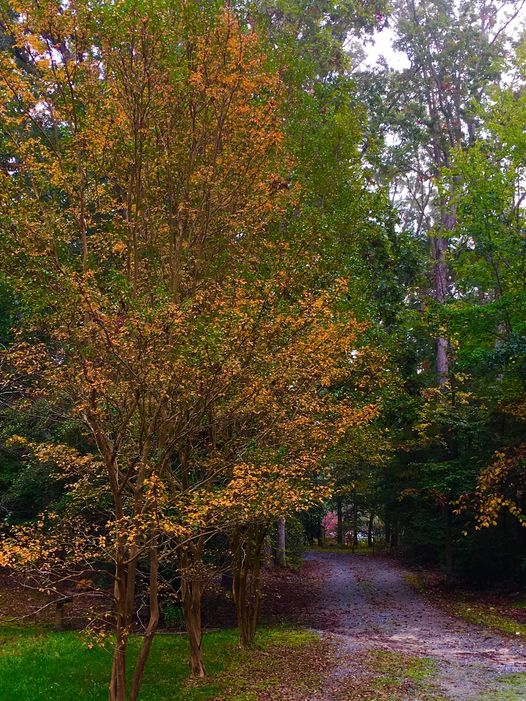
The leaves are changing colors early this year, and I can feel the fall in the chill of the wind. The bay breeze helps keep it seasonal for now, but the winds will shift soon to the north, shutting down summer completely.

I don’t mind fall; it is beautiful. My time in western New York and especially in central New England spoiled me for how intensely beautiful autumn can be. But summer for me has more hope, still holds just enough promise for everything to work out fine in the end. It is the time when we keep building our lives instead of stepping aside and letting nature run its course.

Does everything eventually bend the way of the once-white colonial? Is even Aerie headed someday to the condition of the Prozac house? We like to think not.

And anyway, for now, I am here, sitting and drinking tea. Tonight the fox will come by the side of the house for apple pieces, and the birds flitter between the crepe myrtles and the porch-rail feeders. Life is everywhere right now, even while summer fades. I can hear the geese headed toward the field.

The rain has eased, and I think I’ll walk again, down past the farm, past the unseen, recaptured house, and to the river, which will hold its own for eras beyond everything else, as waters have done since the start. But then I’ll need to cut the grass. If I have the energy, I’ll also trim the hedges.

“And while the changing colors are a lovely thing to see,

if it were mine to make a change I think I’d let it be.

But I don’t remember hearing anybody asking me.”

–John Denver

Aerie