Breakdown Dead Ahead

This morning I woke up about four from a dream so real I looked around the room expecting to see people from a place I used to work; people who just a few deep minutes earlier were sitting next to me in intense discussion. I sat in bed aflush with images of standing in hallways, sitting in my office, standing before classes, walking from building to building; or the early days out in portable buildings, walking to the market with my officemate for lunch.

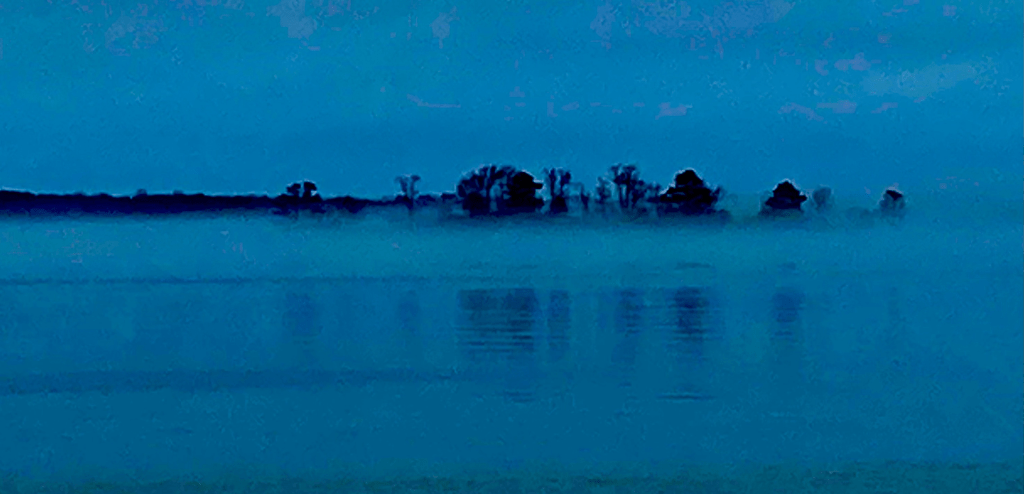
My heart raced and my breathing became labored and shallow. My BP spiked and my mouth went completely dry. I got up and headed out to the river where the water found my resting pulse. Some seabirds dove for breakfast, and I watched an osprey carry a fish to a nest. Dolphins swam by. The dolphins don’t know about my dream. The osprey might.

With a nod to Jason Isbell: Maybe it’s time to let the old ways die.

I rode that train for almost thirty years, one-way, full speed. When I disembarked, it took me some time to get my bearings; I still can’t always find my balance. Usually I can forget that period of my life, but when I remember incidents, or, like last night, when I wake up awash in the past, I shake.

It is difficult to explain.

There’s nothing from that time I need any longer, and nothing to gain from remembering. It has taken me five years to figure this out, always assuming that since I spent so much time—literally half my life—wading through those murky waters, it must be essential to carry at least some of it forward. But no—and this is where one can get their money’s worth out of therapy: Simply, no. Nothing. Oh, of course at the time the paycheck and benefits, the ability to travel the world on someone else’s dime, all worked for me. But that inner-core sensation that I’m “contributing” my “verse” to the bigger “play,” well, that never materialized for me, so thirty years of pouring oneself into the same bucket with a hole in the bottom is quite discouraging. Don’t misunderstand me; it had serious advantages over nearly every other profession. This isn’t about that. In fact, I still do it somewhere else, and I love it. It was there. It was then. Some people who try and remind me I did some good, had a positive effect on some people, and should be proud of that period, are missing the point. I know what happened; I was mostly there at the time. It is irrelevant. Like watching your favorite baseball team score six runs in a game but lose ten to six. Yes, remind them of how great they did scoring the six runs; then step back.

This is about the self-preservation necessary by living a life which outpaces the past. Sometimes—granted, not always; in fact recently I wrote fondly of my time at a health club in New England where I know I had a positive effect as well, and about where I wish I would have a vivid dream, of course—but sometimes there are no glory days and there is no sense of melancholy. Sometimes those tethers simply tug at the scars, open old wounds. You have to let it go. It’s not always an amicable separation; sometimes it’s a reminder of wasted time, and the best psychological recourse is akin to a bad divorce. Or, better, like you never met the person to begin with. Yes, that would be better—some dreams can kill.

The idea of “moving forward” is so simple and common that the axioms to do so are abundant, and they all are a variation of the need to “face forward” and “take small steps.”

Let’s go deeper:

A nervous breakdown in movies is nearly always represented as a person freaking out, flailing their arms, and screaming or crying or otherwise needing to be slapped upside their head. This makes sense since some visuals are needed. But the reality is a nervous breakdown can be as subtle as the rain. Certainly there can be “emotional outbursts and uncontrollable anger,” but more often it is what cannot be shown appropriately on a screen that dominates the symptoms: withdrawal, a sense of being overwhelmed, not wanting to interact with others, feeling burnt out, moody, low. Your self-esteem evaporates, you feel worthless and unqualified for anything, you make illogical requests, you assume nothing is going to work. You stop showing up. You make horrible, self-destructive decisions to the point that those who had faith in you lose their desire to help.

At first, after a major change, after that significant about face, what you do not yet realize is a nervous breakdown can come disguised as a welcome surprise. It is, in fact, similar to mania in that the person might feel overly optimistic.

Here’s how the experts break it down:

  • The honeymoon phase – The first stage of a nervous breakdown is referred to as the “honeymoon” stage and is particularly noticeable when undertaking new work responsibilities or initiatives. There are no warning signs of a nervous breakdown at this time. You are, on the contrary, enthusiastic and committed to your work. You are also highly productive and eager to demonstrate your potential in any way possible. If you do not avoid overworking or implementing effective strategies to deal with stressful situations and get enough rest, you will gradually progress to the next stage.
  • The onset phase – This stage is reached when you recognize that certain days are more stressful than others. You have insufficient time for personal needs, family, and friends. As you struggle to keep up with your stressful schedule and workload, your productivity levels begin to diminish. And you may begin to experience some mental and physical symptoms of stress, such as headaches, anxiety, changes in appetite, high blood pressure, and an inability to concentrate or focus. 
  • The chronic stress phase – Chronic stress sets in when you do nothing to manage the mounting stress of work or other commitments. As a result, your productivity levels decline, and you may start to feel overwhelmed. You begin to withdraw from social situations and exhibit symptoms of mood disorder. In extreme circumstances, some individuals may start to self-medicate with alcohol or drugs to escape their overwhelming negative emotions. 
  • The burnout phase – Burnout occurs when an individual has reached their limit and can no longer function normally. During this stage, you will neglect your personal needs and self-care and continue to isolate yourself socially. Along with other physical symptoms, headaches and fatigue may intensify. 
  • The habitual burnout phase – Those unable to recover from burnout and whose symptoms have become a part of their daily lives attain this level. This phase can have a detrimental effect on your career, relationships, and health and cause burnout syndrome or other long-term complications. Therefore, getting assistance as soon as possible is imperative if you are experiencing this phase of a nervous breakdown.

Usually comfort is found in extreme retrospect; that is, you look to times before the place of the fall, when that proverbial garden was still green and the metaphoric apple was still on the tree. You reach back for help from those you knew before all of that time, those without association.

And sometimes you get it, though usually not because there is an overwhelming urge in society to tell people it is a “phase” and they’ll “move past it.”

Ask them to do that to a soldier just back from war; tell them their issues are just a phase and they should move past it. How about this instead: listen. Tell them you’re there if they need you. Call them more than once to see how they’re doing, to talk about something completely present and benign.

Semantically, the words “nervous” and “breakdown” are deceiving because it isn’t the same “nervous” one feels when the roller coaster is clicking to the apex of the ride; it is an internal, simmering, indefinable nervousness more akin to complete and absolute helplessness so that even talking seems irrelevant. And it isn’t a “breakdown” in the category of the car no longer running because the starter is broken. It is more like a stall; all the parts are working, but you have a complete sense of an inability to move. You’re a deer in the headlights.

And often, quite dangerously, there is the overwhelming need to just end the thought process that fuels all of this.

Ask that soldier just back from war what their instincts are when they’re feeling this way. It isn’t to “talk about it” or be told anything at all. And the mere fact one might have to take drugs to get them through is a daily reminder swallowed with water that something is not right and any sense of hope is clearly synthetic.

So what is to be done?

Ironically, you accept that it was a phase you went through, and it is time to move on. You just do not, do not, absolutely do not want to be told that.

Because the dreams will come and you’ll see faces of people you used to eat lunch with, used to share an office with, and your depression with force you to wonder why you wasted so much time with people who couldn’t give a rat’s ass you ever existed at all. And that just fuels your sense of worthlessness. And the cycle begins.

Every single person has to decide for themselves how to deal with this. And no one can tell them how; even a therapist, though any therapist worth their weight already knows this and simply helps someone discover these things on their own.

It is as individual as your dreams.

If it were me? I mean, just speaking hypothetically here, but if it were me what would I do to somehow shed those deeply rooted and tightly clasped feelings of worthlessness?

My instinct of course would be to leave like I did throughout my twenties. Maybe I’d go back to Spain, or perhaps sail south on a forty-one foot Morgan Out Island named Pura Vida. Maybe I’d move to some mountains somewhere and go hiking. Yes, that would be nice too. That therapist worth their weight would somehow suggest that having plans like these, escape plans, is essential even though you know you’ll never follow through on any of it. That isn’t the point; the point is about possibility, about choice, about regaining that often taken for granted ability to make our own decisions, something that seems completely gone to a person with this level of depression and hopelessness. They need to feel possible.

It’s kind of like hope but not really. Hope implies some form of stagnancy, of waiting. It needs to be more kinetic than that, like saying, “Hey, let’s get an Airbnb in the Netherlands,” or “You know I think I’ll walk the same route this time instead of doing the Portuguese Route.”

Imagine a brain whose sense of “possibilities” has been extracted. Just for a moment, imagine a person who has not even a remote sense that anything good can possibly ever happen again.

That’s what we’re talking about.

And if you walk into any store today, anywhere, one out of every twelve people are feeling helpless. One out of every twenty completely abandoned.

+++

On the wall of an office I was in a few weeks ago is a poster of an open sky across some western vista. The quote from Richard Bach is one I remember from when I was young.

“Here’s a test to see if your mission on this earth is complete: If you’re alive, it isn’t.”

Too simple? Too elementary? Too, excuse me, pedestrian?”

Maybe.

But I saw the poster and thought of Spain, so there’s that.   

Course Outline Rough Draft

Classes start again, so I’m updating my course outlines. I’ve been thinking lately about the problems in class, including tardiness and distraction. Those issues in and of themselves are short-lived and don’t bother me so much. What is disturbing is the rampant disregard for others that is infesting schools from pre-K to post-graduate.

Humanity and our interactions with each other–thinking of others for starters–is slipping out of our hands, and it is compromising all aspects of life.

I’m nobody when it comes to having a significant effect on the big picture, but in my profession there are a few things I can slip into the mix which might help. With that in mind, I have started to revamp my entire course outlines.

Understand, these are rough drafts.

Attendance Policy:

What is so difficult about getting to class on time? Let’s simply assume traffic is heavy, the weather is bad, accidents are everywhere, and the parking spots are taken. Get your ass in the chair by the time class starts or go home and come back when you grow up into a responsible human instead of an entitled little shit who thinks you can show up when you damn well feel like it. If you are late to work or don’t show up, you get fired, if you are late to class or don’t show up, you fail. Either way, F. It’s a great fucking letter. And as for your oh-my-god-this-is-the-best-ever excuse, we’ve heard it already. And no, you AREN’T paying me. You can’t come close to affording me. If you’re not ready to attend class, go in the hall, call your parole officer and say college just didn’t work out after all.

Policy Update Concerning the Use of Cell Phones During Class

Put away the damn phone you miserable no good fleckless, rude dirtbag! What makes you think you’re so important that whoever calls or texts you needs an answer immediately because your thought is so essential to civilization that it can’t wait ninety minutes? If it’s that big of an emergency they should call 911. If it’s not you can wait until I’m done talking, and by the way while I am talking look at me and not at your phone because that is how vertical homo sapiens are supposed to act. Essential? Bullshit. Shove your ego aside and accept the fact you’re talking to your girlfriend or on Tik Tock or checking updates or seeing the score. Here’s the score: Shut the fuck up or put the phone somewhere so far removed you’ll need your urologist to answer it!

This is just a rough draft.

Too much? What’s interesting is how, in retrospect–retroing more than four decades that is–I missed a lot of classes. I was playing music, buzzing up to Niagara Falls, sculling Chautauqua Lake, so I’m either not in a position to preach or am the perfect person for the job. Likewise, I can’t deny that if anything other than a wall-mounted payphone existed when I was in college, I would have androided my way through Earth Science.

I’ll keep working on it. Maybe I’ll add a caveat: yes, yes, I’m bored out of my head as well, but please, be politely bored, be humanistically distracted.

Okay, I’m ready.

Blog Post 500

What’s funny is how many writers don’t like blogs; or at least they don’t like the idea of “wasting” time writing a blog when we could be focusing on best-selling books, Pulitzer Prize winning novels, Nobel fodder. Because that’s what I’d be doing, obviously, if I weren’t doing this, this A View from this Wilderness, for the past eight years, the past four hundred and ninety-nine posts.

I suppose some of the disdain is justified when some writers put everything out there; the result of impatience or insecurity, of misjudging the quality of their own work or overestimating the literary instincts of journal editors.

But that’s the trick. No writer who is thinking clearly is going to put publishable (“otherwise” publishable) material in a blog. That’s dumb. The trick, of course, is knowing what someone else will publish and what we are better off just slapping down on our own page and letting it drift. We guess wrong in both directions, to be sure.

One writer I admire both professionally and personally told me I’m throwing all of my energy (for her it is about energy: “How do you find the energy to write the ‘real’ essays and books if you’re spending it on blogging?!” That last word said with attitude) into some online trash bin. She has a point; but it’s all about balance. It is very easy to get carried away with a blog post, treating it more as a serious essay for Atlantic or New Yorker, when it is going into the same format used by brain dumps about dating from fifteen-year-olds.

I actually know someone who just had a piece published in Atlantic Monthly. He also writes a regular blog, and he also just launched (not dropped, come-on, save “dropped” for music where it belongs—besides no one wants to “drop” a book, they want it to take off) a new book which is getting some national press. I’m more than a little confident the material he is putting out there in his blog is not the same quality he published in either other format. Maybe—maybe—some of it was intended for another outlet, but for whatever reason, it didn’t make it. He didn’t think, “Well, Atlantic Monthly with hundreds of thousands of readers wants this, and it is good enough, but hey, I’m blogging this baby.”

For me, I have several levels of writing. The work that is most involved, which comes closest to what I wanted it to be when I conceived it, whose style and artform are working for me, head toward editors of various flavors. The work that is raunchy, work not only I would never publish in a magazine, but I’d also never publish on my blog, I save to read at pubs with Tim Seibles. The rest—the good thoughts I rarely rewrite more than once, if that, the more personal stuff that most readers wouldn’t necessarily care about, are blogs.

As for energy, well, this is the point. Come on; we push new writers to write everyday—write—keep writing. “Sir? How do I become a better writer?” “Write! Everyday!” So I do. I put my blog where my mouth is. Blogging every week, sometimes more, has kept my brain functioning, kept me on the writer’s driving range where I can keep my swing loose, adjust my grip on verbs, and make writing my daily routine instead of only when “projects’ haunt my screen.

And more than a few published pieces were the result of blogging; some quite successful ones.

But that’s not how this was born. I did not have literary ambitions in my mind, creative prompts, or really even a need to be heard and read.

It was January of 2016 and my dad had just died three months earlier. I was here at Aerie thinking about how much peace I find in nature, escape, like I did as a kid on Long Island where I escaped with my friend Eddie into the wilds of Heckscher State Park. Or I did with my son on the Camino in Spain. I have always found it easier to assess what’s bothering me, what is getting me down, if my view is from the wilderness.

It was going to be about nature and philosophy. All of it, about being out here on the bay and how the old axiom is correct: We cannot step into the same river twice. The blog was going to be about trying to do just that. But it was 2016 and the world was hijacked by the presidential election. My editorial muscle memory from my collegiate editorial-writing days under the guidance of Russell Jandoli and Pete Barrecchia suddenly flexed, was reignited, and what emerged in my posts was pissed-off Bob. But then stress took over, and bad things happened, and breakdowns ensued, and I needed an escape—this damn blog, conceived to help me and perhaps others escape, had funneled me into the murky waters of “who really gives a shit anyway.”

So I reread them to find the good ones, the ones with peace and some soul-settling thoughts and observations, and the book A Third Place: Notes in Nature was born. More recently, another, Wait/Loss, has coming to fruition, both from blogging. Certainly none of the Siberian essays which I knew would end up in a book started here, but other material—about my son, about traveling, and of course about my father whose passing pushed me onto these pages to begin with to better “deal” with it all.

But none of that is what I wanted to write about. Hang in there:

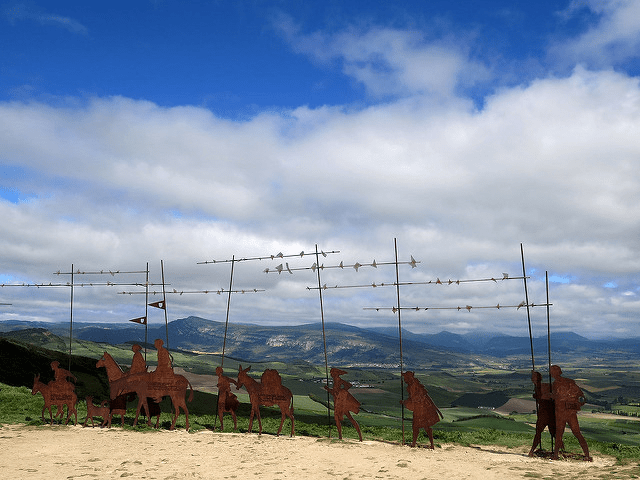
It’s about that picture up top. The “label” of A View. That’s me in the photo taken by my son, and we are just southwest of Pamplona, Spain, on the Camino de Santiago. Behind me, just next to Michael, are the famous bronze statues at the Alto del Perdon, the Mount of Forgiveness. At that point we had walked roughly two-hundred miles. We had adjusted to climbs, our muscles and lungs had been tested while climbing the Pyrenees, we had weathered some rain as well as blistering heat, and we kept going. At some point we arrived at these statues, but for most of that day I had been thinking about the paths I had taken in my life and how almost always they were accidental; I had been a veritable pinball. Very little if anything had been conceived and planned in advance, thought out, problems anticipated, goals in mind. No, not at all. Not me. If there was a path with less friction than the path of least resistance, I would have found it. As I climbed the long steady trails to this point, my anger at myself for how I had lived was climbing as well, and my disappointment in myself, and my frustration and depression and self-doubt, to the point that I knew I had to completely abandon those old ways and reinvent myself somehow, remember somehow the drive I had had in earlier years. And I knew instinctively that I could only do that if I first forgave myself all of those shortcomings, those lazy-ass, howl-at-the-moon stupid decisions I didn’t so much make as I simply rolled through. Then we reached this cool hilltop, these metal pilgrims, at Alto del Perdon, and the name of the plateau on the sign took me up short. I mean, I had just been thinking about forgiveness.

And Michael snapped this shot, and to me it symbolized the world, the life in front of me, wide open, a million choices, endless possibilities.

And one thing more. Life sometimes feels like a pathless wood, as Frost once wrote, and much too often we have simply too much to deal with. And I can think of a thousand problems, the weight of which just gets too damn much to handle on my best of days. Then I think of this picture, and I notice that in it I am carrying a small backpack; that’s it, with Planet Earth just down the path, and I had everything I could possibly need with me. Everything.

The picture is static of course, but not really. Clearly, I am about to step off into what’s next.

______________________________________

Thank you so very much for reading A View over the course of these past eight years and five hundred ramblings. If you want to follow, in the bottom right corner there is a small box that says “follow.” Click it, enter your email, you’ll get an email asking to confirm, and that’s it. You’ll get A View each time a new one is published.

Peace, my friends. Much peace.

I Just Decided To

Yesterday I sat with someone who asked questions about my past. Vague questions, searching, I assume, for some root cause or instigator of both good and bad changes.

“You’ve worked a lot of jobs,” she said, recalling an earlier conversation some months ago. “What was your favorite?”

Easy.

When I was twenty-four years old, I managed a health club in central Massachusetts. It was a great job, and I started before the building was even built, signing up members in a trailer next to the site. When it opened, it smelled new. The grey carpet, the red and grey paint on the walls, and the wallpaper glue in the nursery.

We had two studios, the one up front being larger, both soundproof—kind of—and beyond the studios down the hallway were about ten Lifecycles, the nursery and two locker rooms, though only the women’s locker room could be considered such, the men’s might as well have been a closet with a shower since out of about four thousand members, the overwhelming majority of them—I’d be safe to call it one hundred and ninety nine out of two hundred—were women.

The workout lasted an hour, and we worked every muscle in the body from the neck down. We did aerobics as part of the program, of course, but also lengthy isometrics, abdominal work, thigh and butt work, everything. We also did motivational talks during the warm-up and cool-down. We were trained for this for eight weeks, eight hours a day, five days a week. We were trained in muscle work, exercise, breathing, health concerns, CPR, nutrition, and, of course, motivation.

The music would seep out of the studio windows and drift down the short hallway to my office. Music like Wham’s “Wake me Up before you GO Go,” which, while I despise that stupid song, ignites something in me that makes me feel strong enough to run uphill all out for hours whenever I hear it. “We are the World” had just happened, so there was that, and Springsteen’s “Born in the USA.” Madonna, Mariah, Michael, Seegar (Bob not Pete), and more. What a life it was then. I went to work managing this place, making a ton of money wearing a sweatsuit, listening to music surrounded by a sea of women, and I lived in a cool house on a reservoir.

Oh, we had no problem signing up members. In Central Massachusetts in the winter there are only two things to do: ski at Mt. Wachusett just up the road from my one-hundred-year-old yellow house, or nothing at all. So they built the club and people flocked in. They came to this particular club for a very good reason. You see, a good number of the members needed to lose weight, many of them more than a hundred pounds, and while I taught advanced classes that included the Holy Cross and Boston College football teams, I also taught women who on a daily basis did not move; they were an entire other human being overweight, and many could and did eat a box of ice cream by lunch. We needed to show these souls that they did not directly have a weight problem, they had a depression problem—bad marriage, bad finances, no education—whatever, and the depression emerged from their psyche as hunger. They were not going to lose weight unless they lost the depression, so we had to work on both. Some took much longer than others to understand this; myself in particular.

This was before Yoga hit the mainstream, so we had our share of twenty-something thin beautiful women who wanted to workout right in front of the mirror. Still, we had four thousand members and only two studios, each which held 40 to 70 people. We used to joke that one day everyone was going to show up at the same time. But studies showed ninety percent of members will never return after signing up. Well, that was still four hundred people, so we stayed busy. But the main reason people came to our club was not the weather or inability to ski—it was the name that went up on the marquee six weeks before opening: “Richard Simmons Anatomy Asylum.”

Richard himself owned it, came to the club, called on a regular basis, and checked in both on the phone or in person. This was during the height of his popularity, and no one ever, ever could change the life of a depressed, overweight woman like Richard. A master.

Of the piddling of men at the club, one came to my advanced class then spent an hour on the lifecycle: John. John was sixty-three. I remember because I thought how disturbingly old he was, four years older than my own dad at the time, and he bounced in and outpaced the BC running backs. This guy was good. Tall, thin, grey curly hair, a club sweatshirt with the sleeves cut off. Way too cool for Central Massachusetts I thought.

When you’re twenty-four years old, someone sixty-three is almost dead.

I’d wander about the club talking to members, making sure they were doing okay. I’d observe classes, sit on the floor in the back taking notes, listening to my favorite music, laughing with everyone as the instructor joked. In my office I filled out forms for everyone. One of the questions we always asked was “What are you goals?” Some were straight forward: Get in shape; lose one-hundred-fifty pounds; get out of the house; daycare; an hour of him not yelling at me; an hour of peace and quiet—and really loud music.

John said to me after staring at me with a Sam Elliot smile, “I’m not going to tell you. They’re my goals. I hope that’s alright.”

There was something about his increased time in the studio, on the bike, his quicker step, his friendlier attitude toward other members, that somewhere inside he was satisfied he had been reaching his goals, whatever they were.

Damn, it was a great job. I’d sign up people or work with members who requested nutritional counseling. I’d take lunch at Papa Ginos a few buildings away or Christo’s Italian Restaurant across the road. I’d joke with Andrea, the other manager, with Melissa, the clerk, and the fourteen instructors ranging from overweight to transparent. I was the only guy. In fact, except for two guys in LA and Dan the regional manager, I was the only guy working for Richard in the entire Asylum network.

I couldn’t wait to go to work. At home I was walking all the time, quick hikes to the summit of Mt. Wachusett, runs around the reservoir. My typewriter was on my kitchen table, and I would write while I cooked, after I ran, before I hiked. Energy is right, but something else; something even chemical maybe. Everything clicked.

Then I left. Different story. Life happened until about five years ago when I left a job I held for thirty years. Not long later I was prescribed medicine with a primary side effect of weight gain and depression—and by the way, I nailed both of them. Went through some traumatic experiences, slept more or not at all, fumbled through some editing, started and quit a dozen projects, until last night when I had shrimp for dinner. That brings me to today.

Except for one thing.

About three weeks ago I was sitting down near the river. It was hot, and I had been at the store so instead of driving up to the house, I parked at the river and sat on the rocks watching the river run by.

There are moments you remember all your life. If we were even conscious enough to know what was happening, we’d anticipate them, but we’re not; we tend to careen into them. I sat on the rocks and realized everything has to change. All of it. It was like a valve opened up in my brain, or a switch I had accidently tapped off clicked back on.

And for some bizarre reason I thought of John. I suppose I had been thinking about the past and when I was in the best shape of my life, which made me think of John; John, the sixty-three-year-old dude from the club, He popped into my mind for the first time in thirty-nine years.

Thirty-nine years.

Yes, I did the math right there on the rocks: that would make him one-hundred-two years old if he were alive, which, I suppose, is possible for the shape he was in. That time then, those days at Richard’s, don’t seem so long ago to me, they really don’t. I can recall events like they happened Tuesday, and please don’t even look at me if Wham comes on the radio. Seriously, I know life goes by fast, but those days were right there, just over the edge of time, like those days are just up the beach a bit.  

The thing is, I’m the same age now as John was then. The distance from my days then to now is the same time frame as now to when I’m one-hundred-two years old.

It truly stopped me in my tracks at the river. Even the heron looked at me like, “You okay?”

Everything. Diet, movement, prescriptions, work ethic, the time I spend on myself, the time I spend volunteering to help others; the time I spend. How I spend the time.

That moment at the river was fifteen pounds and six-miles-a-day ago. But it’s not enough. I know this because I know inside what my goals are, and I’m headed that way for the same reason people came into the club to change their lives to begin with: they just decided to.

Yeah, I have goals. But I’m not going to tell you what they are. They’re my goals. I hope that’s alright.

Zodiacal Light

I am drawn toward the early morning hours before dawn, when I feel ahead of the world, and I can sense some small whisper of…what….hope, I suppose, or wonder maybe. To hear life around the river in those moments motivates me, awakens in me possibilities which otherwise lie dormant. Before the sun rises, often just after the first sliver of light reaches up across the bay, I can hear osprey and other sea birds who at that hour never seem to mind my presence.

But earlier, when that glimmer on the eastern horizon is still merely a possibility, I have taken to walks by moonlight, sometimes not even that. In the woods where I live and down along the water, something is going on. There is life out there wide awake and moving through the dark hours like spirits who need to finish their errands before the sun gives them up. Like sneaking up on some grand behind-the-scenes operation, or suddenly discovering the dark web and meddling around a bit, those hours when the rest of our lives are at rest, motionless, recharging, the world around us is in full swing on the midnight shift.

Fox come about the edges of the woods looking for scraps of food or the peels and rinds of bananas and melons. I can stand patiently off the side of the drive and one fox will wander across the yard from the woods behind me to those on the south and stop before disappearing again beyond the laurel, and she will stare at me, relaxed, nosing around the base of a tree I occasionally put food. Then she’s off—not swiftly or in fear, but nonchalantly, demonstrating that she lives here as well and has decided to stretch her legs. That’s all.

Owls, too—some barn but mostly screech owls, perch in the oaks and elms, sometimes swooping down and moving through branches with precision. But my favorite are the geese which cover the night sky in flocks sometimes so enormous the swoosh of their wings alone creates a breeze, and their call to “Go! Go! Go!” is startling.

Closer to home, out front near the edge of the trees, deer nearly always feed on the dew-soaked grass and often the hostas, and if they sense me sitting on the porch or standing in the clearing, they will look up, briefly, ears turned forward—just for a moment—and then return to their grass, not minding me, aware just the same.

And it is then, when I am well acclimated with the night and my eyes have adjusted, and my soul too has adjusted, that I think of my way in the world, the motivation behind the turns and hesitations, my purpose of this passing in time. It’s then my own spirits circulate, pulling aside the thorny branches and leading me through the pathless wood. There’s one friend nodding his head and insisting I follow my own path. I can hear him clearly when I’m out there, see his small sardonic smile as he says, “Come on Kunzinger. You know how to do this, stop waiting for approval or it’s never going to happen.” And there, too, is another friend whose smile is as wide as dawn pressing his sense of adventure into my spirit with an “all or nothing” carelessness about him which brings me up short yet livens my ambition. In one brief moment I am eased by no longer thinking of them in the past tense, but just as quickly, we all move on.

And sometimes sitting there on one of the benches is another friend, subconsciously rubbing her neck, tearing off the edges of her notebook pages, and looking at me with wide brown eyes saying, “Someday I will,” and then laughing and repeating, “Honest, someday I will,” and it makes me sad, deeply sad like dark water, but that moment too passes.

And then the distance across the reach lightens ever so slightly, from dark, almost Navy blue to something slightly more pale, like powder, and I’m alone again—the fox rushing off into the woods, the geese at rest in the harvested field or at the river’s edge, and the murmurs of chickadees and wrens and cardinals chase away what’s left of the stillness, and even my friends bow off, and I have trouble separating memory from imagination. So I go inside and wake my son so we can head to the bay to catch the sunrise.

It’s as if when I wander out in the pre-dawn hours, linear time cuts me some slack. It seems to offer a small reward to some of us who stay up late or get up early to gather as much out of our moments that we can, and I can bend her ever so slightly and talk again with what can best be defined as “unfinished friendships.” Then, just briefly, it eases the almost vague pulse somewhere deep which some have defined as depressive tendencies, as if labels somehow are half the solution.

But predictably and somehow simultaneously surprisingly, dawn returns with that hope I need and says, “Wait, watch. Just watch.”

Just watch.

Higher Education v. Work

BT Washington and WEB Du Bois

Indulge me this brief history jolt before I get to my point:

In 1930, W.E.B. Du Bois gave the commencement address at what was then Howard College. The title of that speech was “Education versus Work.” In it, he addressed what had been, from the late 1800’s to about 1915, a public disagreement between him and the ideas of Booker T. Washington. In a nutshell, Washington gave a speech in 1895 at the Atlanta Exposition in which he called for “Separate but Equal.” He proposed that the African-American community, particularly in the south, should not concern themselves with the folly of higher education, of learning Greek and Latin, when they could barely read and had no job, no money. “He insisted that the former slaves and children of former slaves should “cast down their bucket where they stand.” They should use what they know–agriculture–to build their lives up and make some money to buy some land. Learn a trade, he insisted. He was right; in fact, the school he principled, Tuskegee, is now one of the leading universities in the world, particularly in aeronautical engineering.

But at the time there was only one source of financial support for this so-called industrial education: Industrialists like J.P. Morgan, Andrew Carnegie, and others. This in itself wasn’t so bad, but there are some who, though at first supported Washington, started to recognize that he was popular–world famous in fact–with the White leaders of the country because not only was he not threatening, he was downright compromising (in fact, that speech he gave in Atlanta later became known as the “Great Compromise Speech”).

One of those dissenters was the first Black PH.D from Harvard, a man who wrote the treatise on the poor of Philadelphia: Du Bois. He wrote a book called The Souls of Black Folk, and in chapter three, called “Of Mr. Booker T. Washington,” he calls out his friend and colleague for undermining their pursuit of equality in this country. He said that at least ten percent of every race are leaders, the ones who insure the progress of the other ninety percent. He called it the “Talented Tenth.” These were the people who would pull the train. Because no matter how much money they earned, what kind of land they might buy, if they didn’t have CEO’s in the boardroom, representation in Congress, lawyers and judges to defend them and insure justice, they would just be taken advantage of by systemic racism and hatred. He was right. He stated when speaking of Washington’s speech in retrospect, that, “In one five minute speech Mr. Washington set back our hopes of Civil Rights in this country by decades.” He was right again. He was not against industrial education; in fact, he wrote and spoke often of the brilliance of the ideas of Washington. He just insisted those progresses came at a cost, and since the only source of money was going to industrial pursuits, the cost was much too high. “We must,” he insisted, “put all of our efforts into insisting on our rights to higher education, if not for any other reason than to protect our welfare.”

Okay. Now this:

This meme has been circulating with what looks like a very cool version of The Village People with the tag, “Promote trade schools with the same passion we promote college.”

No, I don’t believe I will. I support them, of course. I absolutely support trade schools; the vast majority of the people I know are in the trades: electricians, HVAC, construction, mechanics with auto and marine specialties for which they went to trade schools. For thirty years I taught retiring military who first learned a trade and led constructive, successful lives, making a greater contribution to their community and this country than most I’ve ever known. Then they went to college. Of course I support trade schools. On any given day for the past three decades I have recommended students abandon their course of action in higher education and pursue a trade since that is where their passions truly lie.

But my passion is not. My passion is the exchange of ideas, philosophies, and civil discourse. My skills and my support go fully behind learning the thoughts and ideas of the Renaissance, the Classical age, the Greco-Roman period, from when we learn to consider how to argue, how to understand validity and the difference between facts and opinions, where we learn fallacies and how to recognize the intricacies of human behavior and understanding from philosophy to psychology and, of course, the humanities. It is in higher education where we learn the significance of history and its relevance to what happens next; it is where we understand constitutionality and precedents.

Trade schools are essential and those whose ambitions are to pursue excellence in the trades should have the support of everyone. Of course. But do I support the trades with as much passion as I do higher education? Again, absolutely not. When it comes to discourse from experts to dissect what is accurate and what is fable, experts who can check the authorities and keep them in line, balanced, experts who pull the train, I put all my energies behind higher education. Without these experts to study the trends and changes in society, in particular in a global market where trades are no longer simply “local,” the working class, which is made up mostly of tradespeople, would not have a fighting chance in congress, in unions, in contracts, in employment security, benefits, and fair workplace conditions.

There is a place for them both, and we should all support them both; but I’m not going to pretend I don’t first believe in the necessity and power of higher education. I am not proposing, hopefully obviously, everyone should pursue a higher education. People in my life I am closest too and love the most never did. One’s a musician, one a photographer, one a technician, several are watermen, one an electrician, one a contractor. Come on, we need them all.

But we need the study of classical music, of jazz, of literature, of impressionistic art; we need knowledge of the philosophers and the understanding of social sciences; people should know who Albert Schweitzer was, who Emmanuel Kant was, why Bach as so important and how Hemingway not only changed how we write but what we read.

Why? I’m sorry but I’m going to have to quote John Keating again, the character based upon my colleague in writing Sam Pickering: “These are noble pursuits and necessary to sustain life. But poetry, beauty, romance, love, these are what we stay alive for.”

The Reach

One of a huge fleet of boats hauling up nets of menhaden for Omega Protein of Reedville

Four men in their seventies are at another table at the café. For a while they talk about a trip one of them took to the mountains, and he describes the farms out there, the slopes and crops, the height of the corn and the how dry the air is and the effect of the lack of humidity on the growth. He saw some pheasants and deer, and he saw some cottonwoods which if you cut it up for firewood will quickly rot if it gets wet. It was a bus trip, and he must admit he spent a good deal of time sleeping on the bus. 

Then they talk about dead friends, two of whom passed last week. Both had cancer and one is believed to have caught it in Vietnam. The dead vet’s wife is in hospice and doesn’t know he died. “Doesn’t know he was sick,” says another. “Doesn’t know she was married!” laughs a third and they all laugh until one shakes his head and says, “Shame really. Such a loving couple.” They are quiet a bit and sip their coffee. It’s raining today, and it isn’t hot. It’s cold in the cafe and I wear a sweatshirt. 

Then they talk about boats. 

People in Deltaville for the most part are farmers or watermen, often both. Corn, butter beans, soybeans, tomatoes, wheat, flounder, bass, oysters. Crabs. Inevitably, the talk turns toward the commercial fishing conglomerate in Reedville up the bay that’s been fishing the mouth of the Rap for menhaden for well more than a hundred years and were out there in their fleet of ships again this morning. Omega Protein cooks and grinds the fish for nutritional supplements as well as feed for livestock. No one eats menhaden except the larger fish, in particular bluefish and bass, but they’re a cash cow for fish oil. Still, the watermen will tell you the truth, that the fish of the bay are being starved off because of the over farming of menhaden. One guy’s grandson is working out there on the boats holding the tubes that suck up the millions of small fish out of the nets and pumps them through a filter system and then into the hold. The fleet pulls out five hundred metric tons of the little suckers every year.

“Down at the mouth of the bay, and up bay in Maryland, those fishermen doing okay. We’re dying here in mid-Chesapeake,” one says. He eats a breakfast wrap the sole worker walks back. She hands him a small bag of chips and says she didn’t forget, and they all laugh.  

Then one of the men sees the college sticker on the back of my laptop. 

“Bob, you work at that college? I heard you’re a professor.”

“I am.”

He nodded. 

“My wife read one of your books. Got it at the library.”

“Well. Thank her.”

He nodded.

“Wayne would read it,” says another, “but he only knows so many words.” They all laugh. Oh, these men read. The details and depth of their knowledge of weather, sea conditions, fishing practices, equipment updates, agricultural spill, fertilizer, engines, oyster conditions, and more is extensive, and I’ll turn toward them for what the weather will be like in the next week quicker than any other source. 

“So you been to Siberia?” Wayne asks. Before I can answer, another points out the obviousness of the question, but Wayne says he’s just making conversation.

“I have.”

“I ain’t been nowhere. The mountains on a bus trip. Fredericksburg once.”

“And Richmond, Wayne. You went to Richmond that time.”

I’ve been thinking a lot lately about this contrast. I’ve been around the block, and a significant number of my neighbors have not been very far at all. Growing up it perplexed me. The world is massive, with so much variety in people, vistas, foods, customs, and more that to spend your life not exploring seemed a waste of a life, like vacationing in London but only going to see Big Ben every day. 

But we’re just curious about different things, is all. I can navigate easily through more than a few foreign countries. So can these men; foreign to me, anyway. From Reedville to Havre de Grace, Tangier to Cape Charles, and Windmill Point to Point Comfort and on, dead reckoning if they must, navigating the depths and dangers beneath them, the changes in the tide, the wind, the mood.

Oh these men read. They read the clouds and can communicate the narrative arc of storms, they read the waves and the tides and can tell what the antagonist will be today, when the skies will clear, when the flounder will return, when to head home early and when to push it.

They are masters at their lives, and while they are often prisoners to the weather (and international conglomerates), they are, most of them, still their own bosses with boats much more costly than my home.

These guys killing time at the café are part of the backbone of this country, and we’re sitting a few hundred yards from the famed Stingray Point where, according to spurious accounts, John Smith was stung by a stingray. They walk into the café or the convenience store or IGA in work boots, sometimes raincoats.

One complains again about Omega. “I saw them out off Windmill again, five am.”

“Come on Jimmy. You know as well as me if you had the money to get one of them boats they got you’d be sucking up the menhaden too. Sheeet.”

“You go out today?”

“Yeah, Out and back.”

“Anything?”

“Tomorrow.”

“I suppose.”

They sit quietly and Wayne shows a picture on his phone of the bus he rode with his wife and a group to the mountains.

“You working on some new bestseller Bob?”

“Not today,” I say.

“Tomorrow then,” he says, and nods.

The Space Between

Earlier today my brother and I walked around Colonial Williamsburg and through the old part of the College of William and Mary. Of course, most of CW is recreated, rebuilt, and replicad to death, but I’ve been going there since I’m fourteen-years-old, and I never tire of the landscape, the costumed near-historians acting their parts, the oxen in the field, and the horses and sheep.

This is, after all, the same ground, the very same foundations, as our Colonial counterparts. In fact. Bruton Parish, in particular, is original and you can walk the same stairs and sit in the same pews as this country’s forefathers. Original, too, is the Wren Building on campus, where Thomas Jefferson among others studied. As a professor, I can’t help but imagine the late 18th century classroom filled with such minds in a building already one hundred years old at the time. As a writer I want to communicate how real it all is, how those figures are not characters in an historical graphic novel or songs on a Broadway stage; they were real, and it happened immediately here, beneath our feet today, only earlier.

Once back home, I filled the birdbaths thinking about the rest of eastern Virginia during those times. To get home we pass several former plantation houses still surrounded by fields where enslaved women and men were whipped, raped, denied rights to family, education, life itself. Such a contrast to the “wisdom” wielded in those hallowed halls forty miles southwest. And here at Aerie, this land was the Powhatan hunting ground, and the “Great Shellfish Bay” provided Chief Powhatan and his daughter Pocahontas with sustenance in their village on the other side of this narrow peninsula. It sat, actually, just across the York River (called the Pamunkee River then) from what would become Williamsburg. This river here at Aerie, the Rappahannock (“River of Quick, Rising Water”—makes me feel safe—one of only four rivers in Virginia to still use the name given it by the Native Americans who lived here), was farmed by the Powhatan and Europeans alike for oysters for centuries.

It’s hard to walk about here and in Williamsburg and not think about what was, what people back then saw when they crested the hill out on the road and headed down the hill to the river. And at the river, which was narrower then, with Parrot Island—a mere marshland today just offshore—large enough then to maintain an agricultural community, they would have looked east past the cliffs along what is now Deltaville, past Stingray Point where John Smith was stung while swimming—and who knew Chief Powhatan—then out across the Chesapeake.

As I did this very night with my son and some dude fishing. We knew what was about to happen. We all stood and looked northeast, just across Windmill Point on the other side of the river, and across the Bay to where Wallops Island sits just offshore on the edge of the Atlantic, and we watched the explosive fires from the engines of the Antares rocket carrying a payload of supplies to the International Space Station.

Powhatan missed this one.

Time is slippery. Ten hours ago I wondered about men in wigs a few hundred years ago wandering about the college, walking to the courthouse just past the parish, perhaps on to the Colonial Capital building. This evening I thought about astronauts onboard a spinning building two hundred and fifty-four miles in space waiting to catch a tube of supplies sent from a small island fifty-six miles from me. Add to this the fact that earlier in this very day, NASA regained communication with the Voyager Two spacecraft which left our solar system six years ago and is tumbling through interstellar space. Tonight seven people who pass by every ninety minutes inside paper-thin casing separating them from temperatures outside bouncing from 250 degrees below zero to 250 degrees above are waiting for that tube of stuff.

Humans have done so much since Aerie was a hunting ground and the roads of Williamsburg were filled with people during the Jacobean Era.

Yet still this world is dying, and the people of this planet seem dead set on ending humanity’s reign, despite all of the gained wisdom, harnessed possibilities, and collective ambitions of the most brilliant people on earth; people who figured out how to send a tube into space to dock with a station run by humans spinning about the planet.

How cool is that?

How very sad is that?