Too Early for the Sun

Sometimes you have to stay up until dawn to understand what’s hiding behind the night. It’s been a tough two days, and I need a significant diversion. For me, anyway, I find hope in the same time of day that can push me over the edge; late night, early morning, just after the tigers come out but too early for the sun.

Like a rest stop at three am with two truckers and a couple of local high school kids screwing around, or the sound of wildlife in the desert brush, or tall pines scraping together in winter in the woods with no light but the moon. It’s walking up an Arctic Path at four am in a snow-deep March with Northern Lights bouncing past like a bull whip; or lying on my back on a cot in a compound in Africa beneath more stars than could possibly exist, the distant sound of someone chanting the Koran. It’s walking out of a shack in the Russian woods after a storm passes and you see the sun just lifting over the raised bridges, ears still buzzing from loud live music. That’s when you know it’ll be okay.

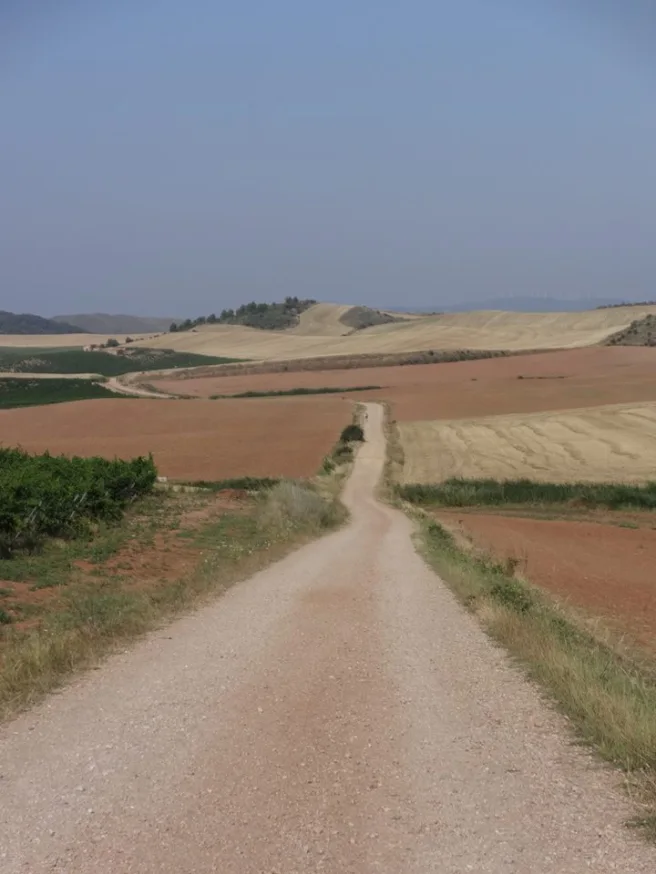
In Portomarin, Spain, one night, my son and I stayed up as long as we could because the rooms were all filled. We hung out in a small café until one am and then walked around the misty, cooling waterfront. Then we settled on the town square with covered walkways running next to a medieval church. Against some storefront we pulled together folding chairs and wrapped ourselves in whatever we could and tried to sleep in rapidly dropping temperatures. A kid on a bike did tricks on the steps of the church until three am which anyway kept me amused. But for a brief time after that, it seemed like dawn would never arrive, like I totally screwed up, and I couldn’t believe I would put myself and, worse, my nineteen-year-old son in danger. But at 4:30 we got out our flashlights and headed west. You can see a million stars in Spain at 4:30 in the morning, and the darkness makes the silence nearly sacred.

If I can make it past the tigers, I’m usually just fine. Better than fine.

That shack in the Russian woods was just off the Gulf of Finland—a dive really—a place to drink and sing and meet people you’d never want mad at you. It was small, with broken-down shed-like walls and windows which barely kept out the storm blowing off the Baltic one May night in the nineties. I use past tense since sometime just after 911 it burned to the ground. But back then, it was well after midnight, closer to dawn than dusk, and we ordered a bottle of Georgian Merlot and several plates of shashleek, a Russian shish kabob dish. A gypsy band showed up, including a guitar and violin player I’d met before, along with a friend of theirs, a woman singer. I played with them for thirty minutes or so, and hours passed as we sang and drank. I long ago forgot what night-terror sent me walking into the Russian night, let alone up the beach into the woods and this shack, but I did, and we sang and drank while what must have been that hurricane from The Perfect Storm slammed to shore. This duck blind of a building sat amongst birch trees, but that simply made me more aware of the weather, wondering when one might topple through the roof. It was exhilarating, an adrenaline rush that had nothing to do with the wine. It was being alive, right then at three am, with total strangers, live gypsy music, Georgian wine, and shashleek, that kept me awake and okay.

But those are extremes, aren’t they? Right before that, you wake up in a sweat and your heart is racing and your mouth is bone dry, and you know everything is going to fail. The hot water heater blows out and you can’t afford the five grand for a new one, the car needs work, the dentist is waiting for the call back, things are tight, and your chest gets tighter. You are at that line, the one some use as an excuse to check out, the one that can terrorize others into submissive acceptance, but the one some simply cross. I keep thinking of that line from Dar Williams: “And when I chose to live, there was no joy it’s just a line I crossed.”

.It doesn’t have to be a broken down bar or some desert hike. It could be a porch, and you sit there with tea and note the coming of the first birds, and you have an hour on the sun. And whatever it was that shoved a hot blade into your chest just thirty minutes earlier has been doused by the deluge of the new day, the sky, dark blue, then pale yellow.

There is no miracle. It is something on the other side of hopelessness; the place too many people I know could not hold out long enough to find.

One night in Virginia Beach some years ago when someone dropped a brick wall right in my line of trajectory, I could not sleep so I went to the oceanfront, walked on the pier I have walked out on since I’m a teenager, and sat listening to the surf in the still-dark night. A fisherman walked up the pier on his way to try his luck and he stopped to adjust his bucket and gear. I asked if the water seemed flat enough for good fishing, and he said he didn’t think so, but he added, “I ain’t got no other reason to get up, so I’m here. I guess I’ll find out.”

We laughed, but not really.

When a hot water heater breaks it sounds like the surf; it wakes you up, sends you ankle deep on hardwood floors for mops and valves and towels. And you know you can’t do a damn thing about it, and you know it’s going to be a long time before you can, so you go back to bed telling the tigers to go ahead, have at it.

But the whippoorwill is doing her thing, and a few house wrens have come out of the nest. If it’s early enough you grab a bottle of cab, head to the café table on the front porch and fill a small glass, and you look east, out over the bay, and wait for that sliver of light. It’s not so bad you tell yourself. You don’t need help you tell yourself. And you remember some story that was told to you to hold on to for just this moment. Like this one: When I lived in the Sonoran Desert, I would spend a lot of time at the San Javier Mission down Route 19 toward Nogales. There I learned that the Navajo used to run toward the sunrise every morning to visit and welcome the spirits who watch from the sky over their people below.

When the priest at the mission told us that story, a friend of mine said she thought it was beautiful how they ran toward the sunrise, but I couldn’t help but wonder what they were running from. What tiger’s grasp did they narrowly escape, barely pushing across that line?

If you ever see a picture I have taken of dawn, the sun slipping out of the water on the horizon, you’ll know I ran there, narrowly escaping some grasp, to welcome the new day.

The Truth About Everything

“It’s time to make mistakes again, it’s time to change the show

It’s time and time and time again to find another way

It’s time to gather forces and get out of yesterday”

John Denver

Catalogue: One

When I was not yet seven, maybe earlier, I lay on my back in the grass on our front lawn and saw a face in the sky between the clouds. I have no idea who it was. He smiled. It was not a dream, though it might have been a concussion.

I fought with Lee Pierce because I had a crush on Essie, his girlfriend. We became friends. Lee and me, I mean. Essie never knew I existed. This was fifth grade.

I didn’t want to move off of the Island.

I should have taken tennis more seriously.

I spent that first southern summer riding my bike everywhere around Virginia Beach—sometimes up to one hundred miles in a day—and I learned the city, especially the beach area and the state park, so well. It was then I decided to ride from Williamsburg, Virginia, to Coos Bay, Oregon. I should have.

The first girl I had a crush on was a neighbor, Karen. I mean the first one that knew I actually existed. I’m not counting the little red haired girl in third grade I threw the card at. I suppose her if you count third grade.  

I’m glad we moved off of the Island.

I really wanted to go to Chapel Hill for film school.

Truth: I believe I overcompensated for my insecurity as a professor by being arrogant and impatient.

I should have listened to more music.

I should have taken music more seriously.

I should have taken college more seriously.

I have always been accused of not taking anything seriously enough. I take some things very seriously. Hence, anxiety. I love connections.

I should have headed to NYC instead of Tucson when I left college.

I should have headed to LA instead of back east when I left Tucson.

I should have joined the Peace Corps right out of college.

No kidding. I should have ridden to Coos Bay.

I should have stayed in NYC instead of moving to New England.

I quit working for Richard too soon.

________

I believe everyone has a half dozen or so events they know they should have missed and as many they should have made. I believe regrets are not a waste of time if they help us correct our behavior.

Truth: I more often felt bad for what I didn’t do or say then for what I did do and say.

Truth: I just assumed everything I wanted in life was somewhere else so I kept moving. When I stopped moving I learned the truth. I walk a lot now.

I should have taken the job at Peter Trimbacher’s castle in Austria.

I never should have moved to Pennsylvania. I’m glad I did.

Truth: I remember the first year of Pennsylvania like it happened yesterday and have completely forgotten the next two.

I never should have gone to Penn State. I should have accepted the film school thing at USC.

I should have accepted the management position at that small inn on the Outer Banks.

I should have sailed away in my boat before it sank. Fixed it first, I mean.  

That Peace Corp thing is bothering me.

I never should have believed it could work, that trip. I never should have helped. We were so young. We were so arrogant.

I was qualified on paper to teach college but for the first fifteen years I had no idea what I was doing in a classroom. As a result, I was not a teacher; I was an entertainer.

I should have taken the Division Chair position.

Truth: I have made more bad decisions in the last five years than I did the previous thirty.  

I never should have left New England.

Truth: umm. No. This one is too real and too true and will remain mine. Besides anyone who needs to know this one I’ve already told.

I should have gone back to Mexico.  

I never should have jumped on that hand grenade. On the outside all seems fine, but it blew me apart inside.

I should have gone back to Spain.

Truth: I will.

Truth: I never should have asked anyone for help. Irony: I need more help now than I ever have. Lesson learned: We all do.

We should have come home from Siberia through Canada. I never wanted that trip to end.

I should have asked more questions and followed, as my colleague Michelle Heart notes, “The road more traveled.”  

Truth: People with depression don’t pretend to be sad, they pretend to be happy.  

I should have kept playing. Tennis. Guitar. Whatever. The play is the thing.

Truth: Most of the time I’m hanging on by a thread, and that’s with meds.

I should have answered the phone that morning, about seven.

I should have gone to the dentist more years ago. That’s what happens when your first dentist was a Nazi. No kidding.

I should have left Pennsylvania right after that phone call. Right then I should have sailed to Antigua or Monserrat or St. Somewhere. Sometimes something seems devastating at the time but years later it turns out to be motivating. Truth: all my life’s a circle

I should have canoed the Chesapeake. For Fun

I should have learned more about finances.

I should have stained the house a lighter color. And put in a basement. And bought the land next door.

I should have gone back to Spain.

Truth: I told Dad it was all fine but it wasn’t. This wasn’t about him. I just didn’t want to let him down.

I miss Bobbie and Dave. I miss Cole. I miss Joe. I miss Trish. I miss Eddie a lot.

Truth: I wish I were as thoughtful as my brother and caring as my sister. I wish I was as adaptable as my mother and as instinctively kind as my son. I wish I had my Dad’s gentleness.

I know small villages in foreign lands better than I do Brooklyn or New York City.

Truth: Sometimes I’m only kind of paying attention. The rest of the time hardly at all.  

When people ask where I live I say Deltaville. When they ask where I’m from I have absolutely no idea what to tell them.

I never studied in college. Or high school.

I am a lousy teacher; I am an excellent motivator. There is a significant difference.

The best job I ever had was working for Richard Simmons. The worst job I ever had was digging cement blocks out of deep holes in 95 degree heat for two thirty an hour. That lasted one day. Maybe four hours.

I am deeply uncomfortable around people unless I’m talking to either just one or two, or two to three hundred.

Truth: More often than not I am deeply uninterested in anything so I walk and write in my head until something interests me, then I come back to my desk, write it down until it sucks on paper, and I go for another walk. That’s being a writer.

I can’t help thinking much of the time, “What difference does it make? The sun is going to explode in a few billion years anyway.”

I need a dog.

Truth: I was not wrong to fight back. I was wrong in not immediately fighting my way forward again.

I’m still frozen. It’s like PTSD. It’s like a breakdown. It’s like a suddenly-exposed truth. It’s like playing monopoly and suddenly I forgot all the rules and I’m getting creamed.

I need to listen to more Jason Isbell:

Maybe it’s time to let the old ways die.

Maybe it’s time to let the old ways die.

It takes a lot to change a man; hell, it takes a lot to try.

But maybe it’s time to let the old ways die.

Poetic Justice

I’ve written only a few poems in my life. I’m decidedly not a poet. As a writer who spends a significant amount of time surrounded by other writers, most of them poets, I can say their craft is infinitely more meticulous than I can manage. We both work in imagery, of course; we both shoot for a sense of place and emotion, but while they’re trying to figure out where to break a line, I’m three paragraphs on with no idea where I’m going next.

But I wrote a few. Like this one, which I still remember: 

Christmas is coming 

It’s coming soon 

But not that soon 

It’s only June. 

It’s about a baby 

And some food and some toys 

But it’s still only June 

So I’ll have to wait.

Okay, so I was ten. I used a white Olivetti typewriter on a snack table in front of a black leather couch in our den in Great River. I used that typewriter to write letters to friends in an old neighborhood, to write a fiction story called “Flight” about two boys in a capsule zooming through the Milky Way (which they used for food, of course, saving space on cargo; if they got hungry, they just reached out and grabbed part of a Milky Way—again, ten years old). I long ago lost the story, but I remembered the poem. Interesting that I remember hating the last line because it didn’t rhyme with “toys” (I tried “noise” and “boys” but never returned to it), but now that last line is the one I believe actually works. 

The second and only other poem I wrote appeared in several journals and was excerpted in a column in the New York Times. I wrote it in response to the murder of Eric Garner and it found new energy after the death of George Floyd. It has gone under two names, “In Visible” and “White Out.”

Here it is:

“White Out” 

I drive speeds to make color disappear and cops
never pull me over. Buy me drinks
and turn me loose at three am;
they never notice. Never catch me. Blow hard
into some tube—I’ve seen it,
haven’t been asked, ever. I loiter
in malls, linger too long outside
some convenience store; play music loud
along the strip, midnight, trying to hook up
with some woman both of us hold up traffic. Officers
never suggest we move along, never notice
my brake lights are out– all they see is white
and polished chrome. Old women walk ahead
home from the grocery relaxed, worry-free. Clerks at night don’t eyeball me up aisles

I can pump then pay
I can try it on
I can move through the mob, wander unsupervised. Understand how unimaginable to question me when I ask for change without buying

a blessed thing.
I am armed with my ancestry; I am a card-carrying Caucasian. I am
unnoticeable on 95 North; this marks me as Everyman.

If someone asks me for the time, she asks “that man,” Not

“that white man.” I have never been “othered.”   

White is a given. I am never modified; I am

hardly ever described at all.

I have always been allowed to make eye contact.

I could always curse and complain.

If I say “I can’t breathe,” I am given oxygen. Just because

I am white.

I am disturbed by and proud of that poem. It is absolutely true, all of it. Sometimes privilege comes from simply by being left alone, out of eyeshot of suspicion, off everyone’s radar. I am a sixty-something white guy in America; it’s like being a Roman Citizen when they could walk the earth without fear of attack. There’s something wrong with this.

I have stood in the local convenience store talking to neighbors, drinking coffee, and random men with Civil War style beards come up and tell me when “the next meeting is” or start talking about what needs to be done to the man (“the N”) who just left who doesn’t look anything like us, whether they are Black Americans or Hispanic or Asian. These people, the talkers in front of the piles of bagged wood next to the Propane Tank Exchange Cage, are sick, and I let them know. One man in his forties held up a headline for me to see not long after the Floyd incident, and he told me what should have happened. I’m not sure where I lost my inhibitions and fears, but at some point in the last five years they evaporated. So I said, “You are one sick mofo, you know that? Get away from me.” He never approached me again. This isn’t just here. This is everywhere I’ve traveled, and it isn’t simply that we are left alone by authorities because of our whiteness; there are a growing number of people who assume we agree with them also because of our whiteness.

Many people in this nation don’t mind expressing their hatred and racism. On the one hand perhaps the blatant exposure is better—we know who they are. On the other, the violence and ignorance, fueled by leaders all the way to the top, is a powder keg and it seems more people are standing around playing with matches. They are small-minded, yes. They are insecure, definitely. They are terrified of “different,” obviously. And I have no problem telling them their heads are up their collective asses. But the worst aspect is the most difficult to change—they are suspicious of education. No one, not anyone, nobody, not one soul they know is teaching acceptance, teaching the gains of multiculturalism, teaching the facets of being human and those that are, in their minds, mean them harm. The education system needs to be overhauled starting with pre-school, yes, but that doesn’t address the ones at home teaching Junior who to hate and who to trust.

They trust me. They don’t even freaking know me, but they trust me. “He’s the quiet one at the convenience store. White guy.”

I’m a small voice, despite a weekly readership here of close to two thousand. But this subject, this inhuman behavior, is best addressed by the poets.

In that vein, I’m starting a new poem. What do you think? 

Changes are coming 

They’re coming soon 

But not too soon 

Because the small-minded, ignorant

fucks are everywhere. 

Okay, so I’m still working on it. I’m not a poet, you know.

“In the end we will remember not the words of our enemies but the silence of our friends” Martin Luther King, Jr.

Unexpected Flowers

I watched an osprey teach her young to fly today. The nest is in a tree next to the post office parking lot in the village, and normally I wouldn’t notice for the car engines and the people coming and going from the hardware store across the road, but the mother’s call was quick and loud from high above the pine. The offspring moved out over a higher branch, then she fluttered out into the deep end of the sky for a moment until she Woodstocked her way back to the nest. I could have watched for hours.

A deer came out of the marsh woods on my walk. It stopped, frozen, and looked at me like she wondered if I could see her just ten yards away. I stood still until she nibbled on some grass. When I took one step she galloped back into the brush, leaving me alone and suddenly at peace.

I moved past the tall reeds at the edge of the marsh where it meets the river, and a heron stood ankle deep and did not move as I walked by.

An elderly woman at the convenience store called from her car window as I walked toward the store and asked if I’d mind bringing her a bag of ice for her cooler in the back seat. She had a disabled vehicle tag and clearly could not walk from her car onto the curb, let alone carry ice, so I did so, and I noted her northern accent. Worcester. I mentioned my life there, both in and just north of town, and we talked for thirty minutes. She remembered the health club I managed. She knew of the mountain. Time slipped out of joint again.

An old friend texted and suggested we get together. He lives near DC and I said perhaps later this month. “It’s been too long,” he said. It takes very little to change the tone of a person’s day. He did that today.

Another very dear friend sent a picture of him holding his new grandson. When we were young, forty-two years ago, he had told me about the previous summer he spent riding his bike through Ireland. His eyes were alive and full of life, like it was something everyone should do; something he might even do summer after summer. In this picture he sent holding his daughter’s son, his eyes were alive like that.

Today I noticed unexpected flowers pushing through the soil.

Yesterday it rained and I watched it on the river for quite some time. It felt good to be so present.

I sat this afternoon on the patio drinking tea while listening to The Piano Guys and writing a piece for a newspaper about how we are focusing on the wrong things—all of us, the whole planet, focusing on the absolute wrong ideas. The writing was pretentious and arrogant; I need to humiliate it a bit, so tonight I put on Jackson Browne and it is starting to make sense. That moment, this, now, when something I want on the page has trouble leaping from my mind, but then the right song (Sky Blue and Black) pushes it out and what I meant spills across the screen. That’s when it feels good to push through the hard parts.

My father’s picture on the wall downstairs. He’s holding an oar in the air; he is twenty-seven, he is in a canoe and my mother, his newlywed in the photo, took the picture. He is laughing hard.

In the picture he is thirty-six years younger than I am now. I said, “It is hard to believe he was ever that young,” but I quickly realized it is hard to believe that I was ever that young.

That’s when I went for a walk and saw the deer, and the heron. That’s when I noticed the flowers I didn’t even know were growing there.