Everyman

Nearly every evening this time of year just before dusk bends to night, in those moments after twilight when I have to let my eyes adjust to the lack of light, a few hundred geese land in the pond, some on the river, and a few in the field nearby.

I can hear them for quite some time before they actually fly into sight from beyond the trees to the west. The air is so clear now that I can hear them honking in groups, joining in like a chorus which starts with just a few voices and adds another rafter until they reach some crescendo. At first it might be only a flight of a dozen or so based upon the muted sound from the distance. But over the course of five minutes or ten I hear another group, then another, and more. They fly in a “V” to be able to see each other clearly for protection and create just a little draft, but the closer they come to landing, the faster the formation falls apart.

Eventually the first group is already in the pond when the last group crests the bare branches of the oaks and hundreds settle into the field or onto the river. One time some years ago a bit earlier in the evening thousands of geese, no kidding—thousands—landed on the plowed cornfield just down river. Their honking continued for an hour that night, and just as the sounds of these geese slowly softens and, finally, quiets, so did theirs so that from my porch I could tell they had all landed safely.

But every single time a while after the large group arrives, two or three geese come in late, alone, as if they stopped at another farm over near the bay and had to regroup and find their flock.

I don’t want to disturb them, but I always want to watch. So when I walk along the river at that hour and the skin on my face is tight from the cold, and my nose runs a little, and the muscles in my back are also tight from the cold, I keep my hands thrust into the pockets of my coat and walk along the soft shoulder of the tiny dead-end street so that my feet make no noise. I can usually get to the narrow strip of sand at the river from where I can see both it and the pond, but not the field so well. Their call increases in a burst of warnings to the rest that I’m around. It quiets quickly though as I remain absolutely still and sit on the cold rip rap running along the river and blend into the rocks and am no longer a threat.

On winter nights the water is almost always calm, a slow methodic lap at the rocks and sand. The sky is all stars with no unnatural lights for more than twenty miles in any direction except from the scattered farmhouses or buoys; the sky is a carpet of constellations.

It isn’t by chance my Canada friends find respite here. They need grass for food, they need water, and they need to be able to see great distances to anticipate danger. That’s why they’re here on the edge of the bay with open fields and ponds. It also explains why they love airports and golf courses. The abundance of geese isn’t an accident either; they travel in gangs, often the younger geese are forced into the gang, so that traveling is safer and they can better dominate areas like this.

But their coolest trait is their honk. They keep that up as a form of encouragement so the lead geese will maintain their speed and not give out so easily. Basically, the ones in the back are telling the ones up front to “Go! Go! Go! Go!” and move their asses. And when the lead gets tired, she moves to the back and gets to badger the others for a while. And they do this their whole lives—about twenty-seven years.

And just after twilight when dusk is making its brief appearance, and the water is like a mirror, the call of the geese from well across the treetops is musical, somehow eternal. When this land was unbroken, Canada geese called to each other, rushing for the open fields and waterways, settling down here. Powhatan heard geese here as did Pocahontas, and John Smith, and Washington just to the north at his birthplace on the Potomac, and Jefferson not far from there. Through the centuries the flyway from the St. Lawrence down across the Adirondacks and Catskills to the Susquehanna south into Virginia to the mouths of these five fair rivers spilling into the Chesapeake has been their home.

And they love dusk, just before dark, as it is the best time of day for them to recalibrate their internal magnetic compass to cross continents; to come here year after year.

But this isn’t about geese.

The peace in such sounds late on a winter’s evening definitely touches my soul, settles me somehow beyond my ability to explain. I sit and blend into the rocks and watch the geese in the water, and I contemplate their distance from the central regions of Ontario and Quebec, across Hudson Bay. My entire life I’ve been drawn to migration, to some sense of movement from one place to another, particularly the seeming randomness of such order. They know where they are going every time, and yet they move south without boundaries, schedules, or maps.

I am drawn to that lack of boundaries, an absence of schedules. And I’ve never been much for maps. In my days at home and my days traveling as far north as these geese and as far south as the osprey who will be returning from the tropics soon, I take great issue with some sedentary lifestyle. I am older now, of course, and a bit more tired. I think more about gardens than marketplaces, more about my porch than some hotel balcony. But I’m not settled yet. No. In fact, I just might be less settled than I’ve been in decades. I like the consistency of this migration; the predictable return, surrounded by friends, a quiet night.

I still have some dreams simmering which require wings. Was it Austria? Monterrey? Wasn’t it the Netherlands or Ireland again? Maybe it was just a drive to see my beautiful siblings or my flock of cousins, to spend time laughing, sharing stories, saying we need to do this again before moving on.

I suppose all dreams are migratory, both in hopeful destinations and their transience with the changes in our responsibilities and circumstances. I’ve lived many of my dreams, but we always have some out there in the field, picking up a sliver of light at the end of the day. At times I even take flight, abandon my flock and push off for a while. But I look forward to coming home to settle into some sense of domesticity, which I can accommodate briefly at best, because eventually I think about the dreams of my youth as I fly toward my twilight years. Those dormant–not dying–dreams call to me to “Go Go Go Go” as my life moves further along, pushing at the edges of dusk.

And now as night falls completely I walk back to the house and always a few more geese find their way to the flock long after dark. Only once did I experience the return to the sky of so many all at once. I was walking from the river to the house past the field where hundreds that evening had settled, and either something or me or the ground disturbed them, or it was simply time to move on, but in great waves they took off, honking. I heard them calling, waves of them into the sky, honking, great waves of honking geese calling ahead to the ones already in flight, as those behind fell in line and they swept from horizon to horizon blocking out the moon and headed out over the trees running down the bay, and I stood and watched them until the last.

It is one of my most beautiful memories.

Then everything was silent and I found myself, much like I do now, oddly alone, like a young man left on the sand while his friends all pushed off to sea to head for distant lands.

“But don’t think too badly of one who’s left holding sand.

It’s just another dreamer dreaming about everyman,”

-jbrowne

To Finish: (13 century) from Latin finire; “to limit”

“To set bounds,” the definition continues.

I watched a hawk sweep down and pulverize a dove. The hawk perched on an oak branch and the dove, distracted by the wind and some seed on the lawn, stopped paying attention. It happens. The hawk isn’t fast as much as he is silent, just a simple cliff dive, stepping off the branch, and, wings out, sweeps in with perfect form with his claws out front to grab the dove at the neck. A sudden puff of feathers busts into the air, and the raptor is gone. So is the dove.

This time the dove simply stood on the grass. She had been facing the direction of the hawk and when she turned around the hawk dropped into action. The dove seemed to hunch down like she knew what was about to happen. Gone.

Sometimes the natural instinct to survive is not as strong as simple resignation.

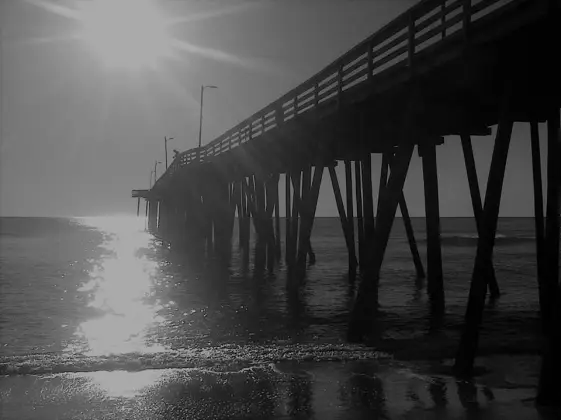
When I was in high school some friends and I went to the beach on the bay. At some point one friend and I decided to swim out to the end of a very long pier. We made it past the end, but we were exhausted and ended up helping each other back, each of us taking a turn at holding the other until we were at the breakers and could ride in. She and I just collapsed on the beach, spent. It isn’t like we weren’t in shape. We had stamina; we just swam too far out. I stood on the beach and wondered how much more we would have had to swim before we had to give up? If we had been another hundred feet would it have been too far? Or would we have found the strength and determination to push it.

I mean, did we collapse on the beach because we couldn’t go another yard or because we didn’t have to?

I wonder how often I’ve given up because I thought I found the shore when the truth was I could have probably held out for more, pushed it a bit, opted to swim a bit further.

It’s cold today, but sunny, and the hawk is around—I can hear him, though the doves are feeding on the porch rail where it is safe and out of sight. Earlier out on the river, an osprey just back from warmer waters found food for their new offspring, and the cormorants have returned. Sometimes some river dolphins swim under the Rappahannock Bridge, but not yet this season. I like it here. I find peace here. I think mostly though I like the area because of the water and the sand. Ironically, the first time I was in this area was exactly ten years before I bought the land to build the house. Just across the river is The Tides Inn, a quiet resort right on the Rappahannock. For my parents’ thirty-fifth wedding anniversary, my father invited us all to stay at the Inn. It was an excellent time, and we went for a river cruise on the Miss Anne, a riverboat which went under the bridge along the south shore and returned to the Inn along the north shore, turning around at the mouth of the river into the Chesapeake. I had no clue then we passed close enough to my eventual home to be able to cast a line to shore and pull us in.

Thirty-six years later and I’m watching osprey out across the same bridge feeding their young, while hawks stand watch in oak trees waiting for doves to stand still.

I was born a moving target; I’m not sure I ever learned when the right time is to collapse on the beach. The hawks have, for the most part, missed me up until now. Even when I do settle down it is usually to look at a map. Ironically, since I moved into this house I have traveled more than I ever dreamed I would—Russia, Prague, Amsterdam, Spain, France, Norway, and plenty of states. And at night in the darkness we use the telescope to travel through the heavens out across the waters and find planets and meteors.

When I was in college a friend had a poster on his wall promoting Nike. It was a long shot of a winding road through open country with one solitary runner, and the tag line said, “There is no finish line.” I like that. If we didn’t know when to stop I wonder how often we would keep moving. I’m not an advocate of indecision, but I’m a staunch opponent of settling for something when there’s still more options for the ones willing to wander a bit more. It is, to be sure, a delicate balance.

Certainly I get tired as I move forward, especially on the days when I’m not sure where I’m going or how long it will take to get there. But when I think about that swim to the end of the pier and back, I don’t often recall the collapse on the sand; I remember how quiet and peaceful it was taking turns helping each other back to shore. It was hard to tell if we were helping each other or saving ourselves. I do recall quite clearly, however, that it wasn’t long after we had rested that we headed back out, a little bit further that time.

The journey doesn’t necessarily end because we found a safe place to rest.

Rambling Man

It’s windy on the bay, and the current could carry a sloop eighty miles south to the mouth in less than half the time then when under normal sail. It’s choppy, with three feet waves and whitecaps, and even here at the shore waves pound the riprap in regular intervals and the spray is salty and piercing.

A bank of clouds hangs seemingly on top of the Eastern Shore twenty miles east; dark clouds, stretching from the horizon up and high enough to block the sun even now at nearly ten a.m.

It’s not normal out there.

At the convenience store a waterman said he wasn’t going out and another said he just got back. The first asked what made him chance such conditions when the oysters and rockfish will be there tomorrow and the second said, “I’m a waterman. And I know what I’m doing.” He wasn’t taking a shot at the first; he quickly commented on it would have been more prudent to wait.

But he didn’t wait.

It’s a tough call, sometimes, isn’t it? When do you wait? When do you step up and watch a bit, see how the tide rolls? Half of it is confidence, half of it is experience, half instinct, half willingness to fail and embarrass yourself. But maybe sometimes success only comes when you’re willing to put in four halves instead of the standard two.

This is true in all things. Anyone can go the distance; just keep your head down and don’t die. Or, as John Denver noted, “Growing isn’t hard to do; just stand against the wall.” So what is the next part that drives watermen into rough seas when even the oysters are quite literally bedded down?

Van Gogh said, “Those of us who live; why don’t we live more?” Took me a long time and a lot of leaning on others to understand this. Partly because when I was young—twenties mostly—I was the second waterman. I headed to places somewhere beyond reason, driven by something other than rational thought. But after a while you get tired, as if you saved up all the failures and missteps to use all at once at sixty-years old.

Or maybe I just slipped into some more comfortable clothes a la waterman number one, which, really, is only a half-step from going back to bed, though he certainly is the more practical one. We find out just how ordinary we are when ration takes over, we recognize our lack of good judgement, our extreme ways when you either have to hit it right or you end up begging for mercy for needing help yet again. There is no middle ground for the second waterman. Yeah, it may be safer tomorrow, he might think; but I might die tonight.

How do you know when the odds are against you?

Something shifted in me this past month. Something significant.

For five years I’ve been Waterman One. This after a lifetime of not only not leaning on others or contemplating consequences but moving forward with innate confidence. But we all learn at different times. We all grow up eventually and recognize our mortality, our faith or lack thereof, our true passions, our fears; when the completed file is piled higher than the “to do” stack.

It is the question which haunts all artists, all of us, who work in a field where hesitancy and self-questioning mean obscurity. How do I know I’m not just wasting my time?

Van Gogh didn’t hold a paying job for the last ten years of his life. He ate paint. He drank turpentine. He had syphilis, was bi-polar, manic depressant, had epilepsy before there was medicine for it, cut off the lower half of his left ear in a fit of rage and nearly died, was hated by painters and dealers, lived with a prostitute and frequented others, drank steadily, and even his own brother– a leading dealer of the time–couldn’t sell his work and suggested he do something else. Today his works sell for between 80-100 Million dollars each and he is considered one of the most influential artists in history.

“One must work and dare if one really wants to live.”

I have no idea how much time is left for me. Almost no one does.

Almost.

Life certainly does not have to be in the extremes, but it should also not be a constant state of hesitancy simply because nothing has gone right.

It’s the “get back on the horse” thing.

It’s the “like riding a bike” thing.

Yesterday a friend of mine said she has some very specific regrets in her life. Then she quickly noted what we all say when we say that; how, no, no regrets; “it is what it is” and “I made the right choices at the time” and “everything happens how it does for a reason.”

I waited just long enough for her to believe I agreed, then said, “No. That’s bullshit.”

Laughter followed by a quiet, almost a whisper, “I know.”

Because regrets help us recognize where we didn’t trust ourselves and maybe should have; they help us see some semblance of truth in our life instead of some veneer to justify our actions. I have no problems with regrets; they teach us not to live out the definition of insanity. They help us to step up to the plate because last time we didn’t bother and now we’re sorry. It is, plainly, how we learn from mistakes.

Did Waterman Two regret going out? Did Waterman One regret staying ashore? Maybe both, maybe neither. But I bet most of us wish we were Waterman Two.

Thoreau wrote that, “To regret deeply is to live afresh.”

I don’t have enough space even on this infinite space of pages to list my regrets just in the past five years, let alone my life. I should have gone to Austria; I should have gone to Monterrey, I should have stayed in New England, I should have driven right by, I should have stopped.

Whatever. But knowing some of those truths has made it easier to stand up next time for what I should have done last time. Of course. Or to keep silent longer. Or to say something.

You know what? It’s always windy out there, and calm days these days are few and far between. Hoist the mainsail and ride it out.

And what if you knew

A full moon is hanging through the winter branches of the oak trees on the far east side of the property, and clear across the sky, Mars is lingering behind Jupiter with Venus shadowing the big planet. It’s as if they should hold their breath before sinking below the earth’s surface.  

It’s a clear night, cool but not cold, and Orion is ablaze with its blue headlights on in the upper right corner. It looks like a comet ripping open the Hunter’s bow. I stare that way a while half expecting to see the belt suddenly spin in a circle like the old Orion Pictures logo. It doesn’t.

The sky saved me again tonight.

Earlier a friend of mine asked, “So what would you do?” It’s a real question, a serious one few of us decidedly consider more than during a passing whim of light conversation.

What would you do if you knew you had less than a year to live?

Read that again and take it seriously.

I’m sure the romantic in us would like to burn out a la Tim McGraw’s “Live Like You Were Dying.” Skydiving, Rocky Mountain Climbing. But it’s not likely.

The bills are debilitating, and the energy is fried. People we love live all over the country these days, and you probably don’t want everyone coming to you as if every single day is last rites. Plus they have to work, tend to their own days and nights.

The answer is probably not too varied from the answer we already have while hoping and expecting to have several dozen years left: See those you love as much as possible, work if you can to pay bills and not leave a mess behind for others to deal with, maybe travel if you can.

What will you do in those months before you “close the door behind you”?

First, I’m certain I’ll be keenly aware of all the projects I started writing or planned to write but didn’t get to. I’ll remember that I wanted to become more serious about playing guitar. I’ll remember that I was going to make next year’s garden the best one ever, and plant fig trees, and get a dog. I was going to go back to the Camino with Michael and train across Canada. A friend of mine and I were going to go to the Netherlands. We were going to do a European River cruise.

I was going to restain the house.

But those long-range plans will all be suddenly moot. I suppose that the best we can hope for is we get to the end of our dreams before the end of our days.

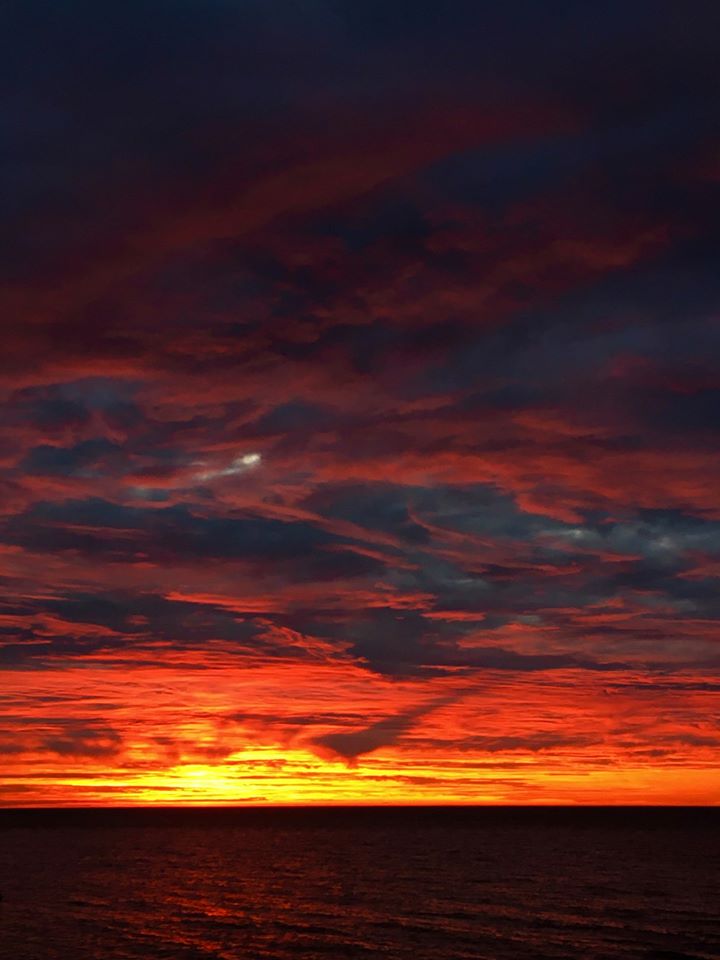
Still, I’m pretty sure what I would want to do. I’d get up early and sit at the bay and watch the sunrises whether it was sunny or not. Something I do on a regular basis anyway, but I’d do it more. And more still.

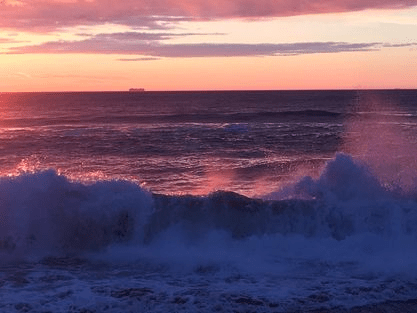
And I’d go to the river with my son and watch the sunset, skip stones, feed the gulls. We’d talk about art and music, about movies and travel. And we’d note all the colors in the sky as the sun disappeared up the Rappahannock.

I’d invite friends over, sit on the porch on a warm summer evening, have a few drinks, some music in the background, and talk about the baseball game, talk about what people we know are doing, about Molly’s new book or Rick’s new essays. We’d laugh about that time we….and we’d get quiet when someone mentions next Christmas. We’d change the subject to how beautiful it is out.

“And when the morning light comes streaming in

We’ll get up and do it again.

Amen.”

I won’t look at photo albums from the Island, or watch videos from when my son was small; God no, no videos. I won’t talk about any more seasons, no. Just this one.

I will talk about my dad, About Cole. I’ll tell funny stories about Dave and Bobbie, about Rachel and Trish.

I’ll speak of how I never could get the African story right, knowing that the truth of that time would be coming with me. And then I’ll finally tell everyone about something else, something beautiful, something still nearly completely mine.

What would you do if you knew?

I’d call everyone I love, but not to say goodbye or even to tell them. I’d just say I felt like saying hi, catching up. And we would, and we’d laugh, and we’d say we have got to get together, that it’s been too long, and not to let another five years go by. Then I’d call the next person, then the next.

I’d remind myself that the truth is I’ve already lived completely out loud and nearly always on my terms, and it has been enough for a half-dozen lives. No kidding. I’d keep telling myself that. Because it’s true. What a journey it’s been so far.

Okay, the superstitious Irish side of me is thinking even posting this blog is a bad idea. But the ballsy New Yorker in me is thinking to lay it all out there right now, because you never know, like Eddie who at 11:45 pm one December 15th was talking to a coworker, and at 11:52 pm he was dead on the street, a car hit him. He never saw it coming.

He had no idea. We have no idea.  

And there’s the thing: Knowing allows you to rewrite the ending how you want your character to finish this story. But not knowing allows you to exit completely unaware of what didn’t get done without having to face the fact that most things didn’t get done simply because you simply didn’t bother to do them. No mysteries to unravel, no excuses and fallacies to face—just reality—you just didn’t bother to do them.

Life happens that way. So does death. Knowing roughly when you’re going to die forces you to face knowing how much you didn’t live at all to begin with.

Maybe tomorrow morning that can be different. Another sunrise, or the first; another phone call to an old friend to thank him or apologize or to just say hi. Another glass of cider on the porch listening to the Mets, talking about that time we….talking about that time we didn’t…and maybe a sunset, most certainly a sunset.

Maybe tomorrow the lines won’t bother me, the rude clerk at the convenience store won’t bother me. Perhaps by lunch time I’ll realize that sitting on the deck at the café working on that editorial for the paper is refreshing and satisfying. Or that talking to students about potential, about the hope of what comes later, about the swiftness of now and the thinness of life, is more projection than it is lecture. And I’ll feel good about it. And they’ll look forward to another class. So will I.

And I’ll come home, and again, at least one more time again, get out the telescope and watch how Venus is tucked away, shy. And we’ll stare toward that blue blaze on the upper right corner of Orion, and understand that life is expanding, faster and faster, running out into the distance, and only those who are told they’ve got a limited amount of time left on this planet seem to understand what that means.

And the stars won’t seem so far away anymore.

Bob I Am

Instant Replay

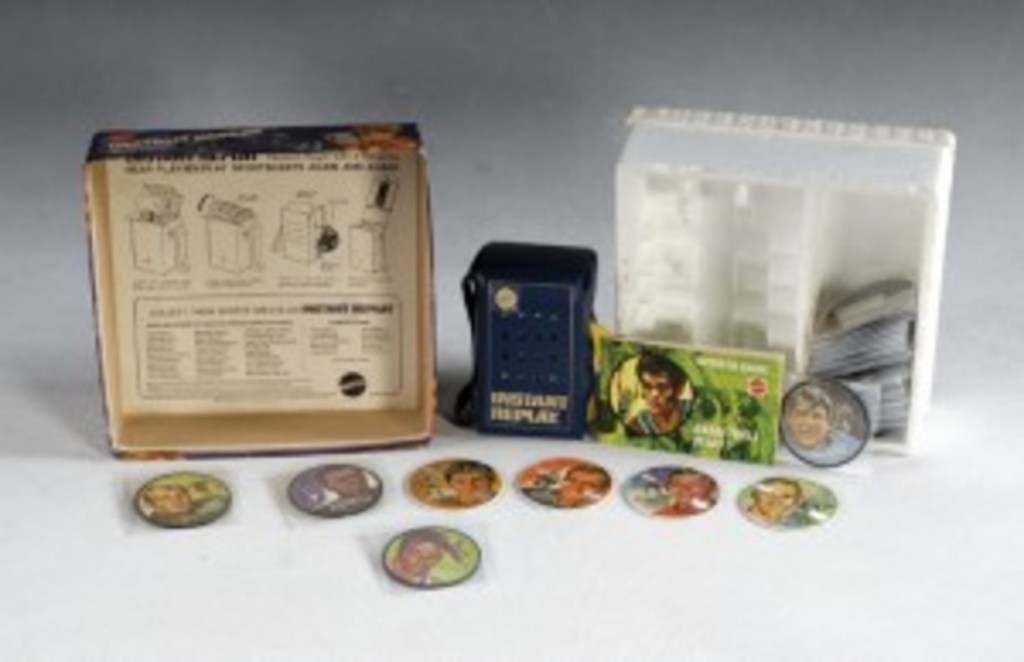
I remember Lou Alcindor. When I was young, I had a hand-held radio style device by Mattel, called Instant Replay. You put a disc in its side and highlights played from different athletes’ lives. It came with a handful of discs from all the major sports. I loved that thing, and I remember hearing highlights from Lou Alcindor’s early days, his pre-Karem Abdul-Jabbar days.

It played a disc featuring Cassius Clay.

This was the same year LeRoi Jones changed his name. About fifteen years after Malcom Little changed his the first time, and three years after he switched it a second to el-Hajj Malik el-Shabazz.  

And, of course, I remember listening to

Personally, I remember Robert, but that was a long time ago. Some family still call me that, and that is fine because it would be weird if they didn’t. So when someone calls me that I assume they are family. Or someone from the neighborhood on the Island. But sometimes someone I don’t know will call me Robert for some fracked up reason since they’re not family and I introduce myself as Bob. I don’t get that. If someone told me their name was Bill, I can’t imagine saying. Well, William, it is nice to meet you. That’s rude. He said his name was Bill.

I’m Bob.

Not Lou. Not Cassius. Not LeRoi. Not even Prince. Just Bob.

Names change. Sometimes for religious reasons, sometimes for marriage or divorce or some identity crisis. Sometimes someone wants to disappear into the masses. I wonder if Martin Sheen’s sister calls him Ramon. Certainly he is Martin now. But his daughter and two elder sons use Estevez while his third son uses Sheen. I read that John Denver’s adopted kids use Denver while his biological daughter Jessie Belle uses Deutschendorf, her father’s real last name. No offense meant to Jessie, but I’d have gone with Denver.

Crazy, but President Gerald Ford’s real name was Leslie King, while Bill Clinton’s real last name is Blythe. The Fourth.

The first name recorded on a document is Kushim.

In elementary school, we learned to write by printing our names on those loose leaf sheets of paper that had lines to keep your penmanship straight, and dotted lines to know where the top of the lower-case letters should reach. My friend Chris Smith on Euclid Avenue didn’t have a problem. But I had to print it all out, and living where I did didn’t make it easier:

R O B E R T  S T E P H E N  K U N Z I N G E R

200 E A S T  L A K E  A V E N U E

M A S S A P E Q U A  P A R K, N E W  Y O R K

For God’s sake, I was seven.

I think I ran next door from the school to our house to plead with my mom to let me change my last name to a letter. “I can be K! I can be Z! Whatever!”

Last names didn’t really begin in the west until the later part of the Middle Ages, about the late 11th century, though the first known European last name is from my ancestral home, County Galway, Ireland, in 916. I do not believe O’Cleirigh is a relative, but since the subsequent variations include O’Cleary and O’Leary, they might be ancestors of my friend Will O’Leary. I shall ask Himself when I get the chance. Surnames, however, not surprisingly, are thousands of years older than that in China, used, logically, to separate people with the same first names. The last names typically were some variation of “son of” or “from the land of.”

I wish we still did that. I could be Bob of Deltaville. Or Bob of the Great River. Or Robert of Brooklyn. Not as melodic as Leonardo de Vinci or Francis of Assisi.

What I like about my name is if you google me, the first seven hundred entries are actually about me.  I Googled my friend Tom Williams once and I found a reference to him six hours later.

I spoke to a woman recently who told me I say my last name different every time I say it. Do you have any idea how self-conscious that made me? Now my tongue hurts from repeating the damn nine letters for an hour to see what she meant. Kunzinger KUNzinger KunZINGer. KunzingER. I had a Social Studies teacher in high school who when calling roll would say KUNNNNNNNZinger. I had a prof at college who would insert an “r” for no good reason at all and called me Kurnzinger. Other variations followed me through life, some not worth repeating. But I have come to like my last name. The people I know with the same name are people I’m insanely proud of, whom I enjoy being associated with.

I hope I never do anything to bring shame to the name. It is our identity, my link to Lohr en Mein, Germany, to Bay Ridge, to glassmakers and butchers, organ builders and accountants. Snow White

A stockbroker.

A photographer.

A student recently asked how I pronounce my name. I told her, “The same way it sounds.” “OH! She said, thank you Professor K.”

Robert lives on Long Island. Bob lives on a river and writes books. Bobby is hiking the trails on a retreat in western New York. We are a multiplicity of identities, a collage of personas. Sometimes Bob would like to take a train up to see Robert, tell him to take it easy, to not be in a rush to do anything. Sometimes I miss Bobby—his innocence and hope, his lack of inhibitions and his willingness to embarrass himself.

I spent the past five years finding my footing, making drastic changes—some by choice and others by circumstance, and the truth is you can change your name a thousand times and never change at all. Change must be deeper than the alphabet; integrity and self-worth are tied to actions, not labels.